Jump to ratings and reviews
Rate this book
Rate this book
From Book 1:

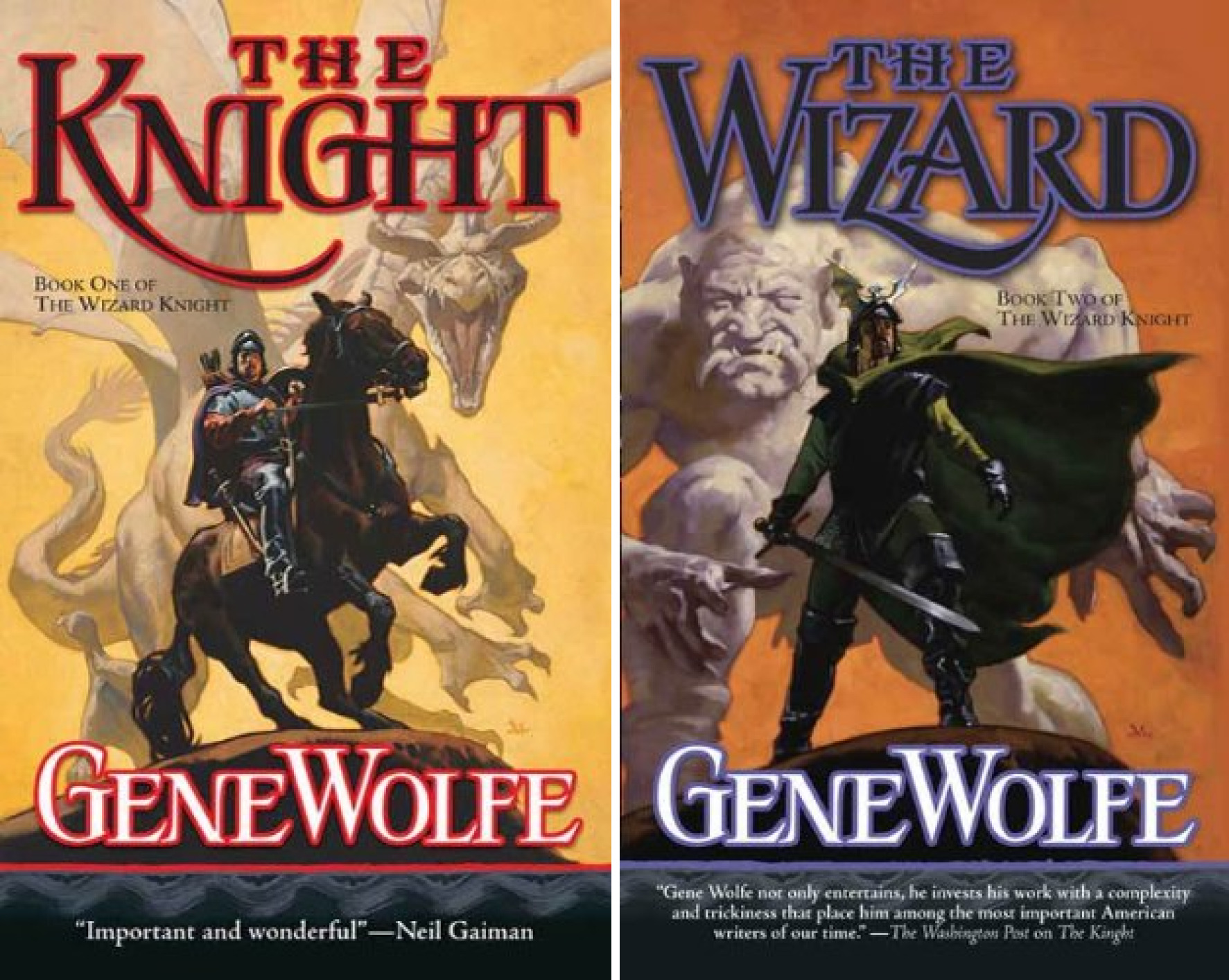
A young man in his teens is transported from our world to a magical realm that contains seven levels of reality. Very quickly transformed by magic into a grown man of heroic proportions, he takes the name Able and sets out on a quest to find the sword that has been promised to him, a sword he will get from a dragon, the one very special blade that will help him fulfill his life ambition to become a knight and a true hero.
Inside, however, Able remains a boy, and he must grow in every sense to survive the dangers and delights that lie ahead in encounters with giants, elves, wizards, and dragons. His adventure will conclude next year in the second volume of The Wizard Knight, The Wizard.
Gene Wolfe is one of the most widely praised masters of SF and fantasy. He is the winner of the World Fantasy Award for Life Achievement, the Nebula Award, twice, the World Fantasy Award, twice, the John W. Campbell Memorial Award, the British Fantasy Award, and France's Prix Apollo. His popular successes include the four-volume classic The Book of the New Sun.
With this new series, Wolfe not only surpasses all the most popular genre writers of the last three decades, he takes on the legends of the past century, in a work that will be favorably compared with the best of J. R. R. Tolkien, E. R. Eddison, Mervyn Peake, and
T. H. White. This is a book---and a series---for the ages, from perhaps the greatest living writer in (or outside) the fantasy genre.


At the Publisher's request, this title is being sold without Digital Rights Management Software (DRM) applied.

Kindle Edition

282 people are currently reading
2003 people want to read

About the author

Gene Wolfe

506 books3,560 followers
Gene Wolfe was an American science fiction and fantasy writer. He was noted for his dense, allusive prose as well as the strong influence of his Catholic faith, to which he converted after marrying a Catholic. He was a prolific short story writer and a novelist, and has won many awards in the field.

The Damon Knight Memorial Grand Master Award is given by SFWA for ‘lifetime achievement in science fiction and/or fantasy.’ Wolfe joins the Grand Master ranks alongside such legends as Connie Willis, Michael Moorcock, Anne McCaffrey, Robert Silverberg, Ursula K. Le Guin, Isaac Asimov, Ray Bradbury and Joe Haldeman. The award will be presented at the 48th Annual Nebula Awards Weekend in San Jose, CA, May 16-19, 2013.

While attending Texas A&M University Wolfe published his first speculative fiction in The Commentator, a student literary journal. Wolfe dropped out during his junior year, and was drafted to fight in the Korean War. After returning to the United States he earned a degree from the University of Houston and became an industrial engineer. He edited the journal Plant Engineering for many years before retiring to write full-time, but his most famous professional engineering achievement is a contribution to the machine used to make Pringles potato crisps. He lived in Barrington, Illinois, a suburb of Chicago.

A frequent Hugo nominee without a win, Wolfe has nevertheless picked up several Nebula and Locus Awards, among others, including the World Fantasy Award for Life Achievement and the 2012 Damon Knight Memorial Grand Master Award. He is also a member of the Science Fiction Hall of Fame.

http://us.macmillan.com/author/genewolfe

Ratings & Reviews

What do you think?
Rate this book

Friends & Following

Create a free account to discover what your friends think of this book!

Community Reviews

5 stars
405 (45%)
4 stars
294 (33%)
3 stars
134 (15%)
2 stars
34 (3%)
1 star
19 (2%)
Displaying 1 - 30 of 77 reviews
Profile Image for Kyle Muntz.
Author 7 books121 followers
November 22, 2013
Starting a reread. Some thoughts before I go back:

I remember loving this the first time through--Wolfe mentioned somewhere that he wanted to write a book for younger readers, though I'm not sure he succeeded because this one felt as rich as anything else he'd done to me, and it actually starts out like a much more difficult text. What he did do, though, was turn all the conventions of YA novels on their head (it begins after most of those novels would have ended; and, from what I can tell, something like halfway through the story in general), and do it in a deftly researched and fantastically strange world that's one of the most interesting I've seen. Also, from what I remember the tone is a fantastic blend of the richer prose of his earlier work with the more straightforward, accessible narration he's doing now.

Things I'm going to be looking out for this time: I remember thinking the book had, not bad, but extremely strange pacing, and I'm wondering how that will seem to me this time. Also, I'm curious whether all the bravado will seem like excess, and how I'll feel about Wolfe's treatment of gender in this explicitly chivalrous context. (Which I think has always been his weakness.)

This is the last of Wolfe's major series I've been wanting to reread. Each of them has been richer and more interesting the second time I've gone back, and I have a feeling this one is going to be no exception.

//////

(200 pages in)

Worth noting--people don't discuss Wolfe in relation to surrealism often enough. With Wolfe the surrealism is always concrete: impossible things happen in impossible ways. What seems like dream logic, at least for the most part, is just a logic hidden within the text (and Wolfe's notorious tendency for secrecy), but it does things to the narrative progression that couldn't happen with any other writer.

///////

(Okay, finally done.)

I don't have a lot to add, except to say the ending blew me away--the second time. The Wizard Knight is strange, incongruous, and complex even for Wolfe; a sort of broken myth, that takes more risks with storytelling than anything I can remember and somehow gets away with all of them. It's not my favorite of Wolfe's series, but it's probably one of the most unique. Quite a few sections (and particular the last 200 pages) I think are some of the best and most interesting in all of fiction. The book is complex to the point of being impossible to pin down, I think, not just in the narrative, but ideologically, politically, etc--while still being perfectly clear.

There's a lot that could be said, but this is one that just has to be experienced to be understood. I read it much slower than a would have liked, but it's been with me again for a few months and I'm sad to be done. Gene Wolfe really is just the best at what he does.
Profile Image for Terry .
449 reviews2,196 followers
May 24, 2024
2024 Re-read:

Yeah I still love this one.


2021 review:

I was somewhat dubious coming to this, my third reading of Wolfe’s fantasy story of chivalry and devotion. I had previously rated it five stars and declared it my favourite of Wolfe’s books, but subsequently when I attempted re-reading it, I found myself put off and wasn’t sure that it would hold up. I finally took the plunge and I’m glad I did. I’m not sure if it’s Wolfe’s best, and it’s certainly not his trickiest (though it has a few persistent mysteries), but I have to say, once again, that I think maybe it still is my favourite of his works.

Previously published in two volumes, I read the new omnibus version produced by Tor this time and I think I prefer it in one volume even though the story demarcation of the two-volume set makes sense both thematically and from a page count perspective. Book one, The Knight, covers the main character, Able (a boy from our world thrust into a fantasy world of knights, monsters, and gods) finding his feet in a world not his own with the single goal of becoming a knight against all odds. He is a stranger in a strange land who acts mostly by instinct, but luckily for him his instincts appear to be the surest path towards his goal.

Book two, the Wizard, covers Able returning to the land of Mythgarthr having achieved the crown of glory, yet with work left undone in this lower world. In the former he is constrained by his ignorance and the doubts of others, in the latter by his oath to not use his powers when he must instead let others come into their own power. He can lead by example, but he can’t solve their problems for them. Even though still ostensibly told by Able, many of the events of the second book centre on the actions of other characters and his ostensible role as at least a partial ‘watcher’ of events distances us somewhat from Able. I would have initially thought this an advantage, but now I’m not so sure. This is primarily due to my recollection that Able seemed like much more of a bully to me on my initial readings. This time Able seemed to be a much less reprehensible character than I remembered. Perhaps I am more inclined to allow that he is trapped in a world where all appearances point to the fact that ‘might makes right’ and he makes the best of it that he can while still trying to hold to some level of morality.

I don’t really have much to add substantially to my original review, but I will note that the theme of ‘proper worship’ came through loud and clear. This isn’t particularly surprising given Wolfe’s reputation as a ‘Catholic writer’ until one notes the fairly pagan flavour of the worship in the seven worlds. There is indeed a “Most High God” in the highest heaven of Elysion in Wolfe’s cosmology that one could imagine is analogous to the Christian God, but the lower worlds are explicitly meant to worship the beings in the world next up from theirs in a manner that comes across as distinctly pagan. Of course, this ties in nicely with the themes of chivalry and feudal obligation that are also central to the text and perhaps it is Wolfe’s attempt to show what kind of world(s) would have the chivalric code as the foundations of not only the political, but the moral and spiritual spheres as well.

I’ve never felt Wolfe to be a particularly poetic writer (with a few exceptions here and there) despite his penchant for arcane words, but I have to admit that there are definitely times in the Wizard Knight where his prose has that poetic ring of Elfland that LeGuin so admired in true fantasy. I think a book, perhaps especially a fantasy book, can be said to have succeeded in its task when it leaves you with impressions that can be re-awakened unawares in later circumstances in everyday life. There are still times when I look at a mountain of clouds tinted orange and pink by the setting sun and I think of Able mounting the steep airy pathways to Skai, or perhaps riding down them on some errand of the Lady’s. It’s not the kind of rumination I’d expected to result from the reading of a book by Wolfe, but there it is. Perhaps he’s not just a puzzle-maker after all.
Profile Image for Hans Otterson.
259 reviews5 followers
Read
December 28, 2020
Just about every spread of my copy of this book's 900+ pages has underlines and margin notes, and I've read through the whole thing twice now, nearly back-to-back. I can't make a better answer than that to any review-reader's question of the book's worth.

But what else to say about it? I feel that I have in some sense lived in this book for the past two months. I like to write half-reviews that touch on principle flaws and accolades and sometimes go on little detours. That doesn't feel proper for this book, so I'll just say that this is surely one of the finest examples of literary fantasy you will find. Anywhere. The pressing-forward pace of the best Conan stories, Arthuriana and Norse Myth filtered through a mind faceted and sharp as a diamond, and deep deep Jungian subtext and symbol. About that latter I'll say, too: the sussing out of symbol is one of those things that layreaders like to excoriate academics for, uncharitably imagining them as dilletantish prigs angling only for some angle to hang a paper on. Well, okay, sometimes they're right about that.

But sometimes symbols live and breathe deep of the air of the earth in the exact way that Able, in this book, can't. The symbols in this book are so alive I've sometimes been frightened by them in the halls of my house at night.

When I start reading a book, I thoroughly shuffle up and draw a tarot card as the bookmark, not because I believe in fortune telling, but because I like the pictures and their rich symbolic nature, and I like to see if there is some connection between the book I read and the traditional interpretation of the card. When I read The Knight for the first time I was kind of hoping I'd draw the Knight, in the surprising way I drew Death when I read Death's Master earlier this year. What I drew instead was a more subtle nod to this story of a boy leaving America and entering an unknown world: the Six of Swords, a card depicting a young man rowing a woman and a child across a body of water, representing a state of transition (from one world to the next?) leaving behind the past and looking toward the future. For reasons that don't matter, I didn't draw a card for The Wizard, but when I came back to read both books again a couple weeks later, I drew a card this time. And again it was the Six of Swords. Rationality says sure, any card was just as likely to be drawn as any other. But if you read deep into The Wizard Knight, you'll know that not only does the book concern itself with the surface-story of a transition from boyhood to manhood, from churl to knight, from one world to the next, but also a deeply embedded, deeply sacrificial story about a child, a mother, and the youth who sheperds them across dangerous waters.

I am astonished, not only at this peerless work, but also how some still-mysterious Jungian Synchronicity is at work through it in me. Sometimes symbols live.

6S
Profile Image for Mark Zumpano.
80 reviews1 follower
July 17, 2023
I discovered this book at a bookstore not knowing a thing about it or its author. The medieval period art on the cover and “Wizard Knight” written across the front cover caught my attention. I decided to take a stab at this totally random find without any expectation whatsoever.

I soon found that Gene Wolfe is one of sci-fi/fantasy’s most beloved authors, though he is also among the most enigmatic and underrated. I was eager to get to reading.

The prose, humor, dialogue, all read like butter to me. The story and world building were so original yet classic at the same time, and the fantasy elements made this feel totally mystical and enchanting throughout.

What I think I love most is that Wolfe doesn’t explain probably more than half of what’s going on. He just says things in the story that are happening and makes humongous connections between worlds and characters and history and just says it and moves on and leaves you shattered and mind blown without any actual explanation, leaving you to pick up the pieces and put them together for yourself. And I loved it. I was all for it. I had so much fun reading this story.

There was so much room for interpretation, it was so cool. It’s the kind of book you’ll need to reread and like do a bunch of research to figure out what the heck is going on. Sorta like a Christopher Nolan movie or something. It made it feel like a mystery and that there were so many secrets to discover which I love when I find that in fantasy. .

I’ve heard that many people don’t/can’t like Wolfe for this reason, that his style makes it hard to follow along with what’s actually going on, but I found it fun and inspiring. I also saw his Catholic faith come through at times, there are a lot of philosophical, psychological, and religious themes throughout that I appreciated.

Some tout him as one of the greatest of all time, which to me is a relative term, however after reading this I think I might already consider him one of my favorite authors. I immediately want to read more of his work.

I love this story and care about knowing more details. I’m very interested to read his most celebrated work, The Book of the New Sun series.
Profile Image for Alan.
82 reviews35 followers
June 4, 2010
This was my first Gene Wolfe book. Before Wolfe I hadn't the slightest experience with unreliable narrators and let me tell you that this was my first window into an entirely new world of literary experiences.

Perhaps its due to nostalgia more than anything else that I'm giving this book a five-star review. Last year I had the honor of meeting the man himself and he autographed this edition for me, bringing this tome yet closer to my heart.

And so I jump to the text itself, perhaps a little biased, but very satisfied. Okay. Here it goes:

If you are a Gene Wolfe 'newbie' then I recommend this book, especially for the younger readers. I discovered this book during a time of great personal growth (teen years). I read it first before I had done much maturing and even then it was a very fun, not TOO difficult book to read. This being filled with familiar genre tropes helped me make the transition from run-of-the-mill to more highbrow fiction. As my own naiveté shrunk I decided to give this book another read and to my shock something had changed. Something in the story had literally changed, but not via a difference in text, but a difference in myself. In a hilariously ironic realization I saw that my own unworldliness had prevented me from seeing the massive immaturity of the main character (and narrator!!!). Through a careful reread I saw that the reality of this person wasn't so heroic as he tries to make out. He makes childish choices and mind-boggling misconceptions, and the story itself is told through the medium of Able's letter to his brother, in which his callow reactions to the world around him must be found the same way one would see through the self-idolatry of any child telling you a story. The revelation of a narrator being as fault-ridden as oneself gives the work a certain grounding in reality. This is an exercise of the mind while also pleasing.

The pace varies. The first book is well-paced and interesting, but the first half of the second book gets a little slower as Gene Wolfe switched from an episodic form to start building up to the climax of the second half of book two which speeds up and the sh^t really hits the fan.

For the most part the characters have well-crafted personalities. One must pay attention to them because pieces of personality might get filtered away thanks to the ignorance of the narrator. Anyways, the characters vary in their sympathetic-ness but they never fall to being cardboard (like real people).

There is a mystery with epic consequences. There is magic and murder. Lust and love. Chivalry and churlishness. Top it off with a wonderful layer of world-building that borrows from Norse, Arthurian, and Christian mythologies that remain firmly relevant to the real world.

The real world. If you pay very, VERY close attention you'll find it leaking through into the fake one and you'll find that there's a whole story, the truth in fact, behind the narrator's actual fate, in the real world, not the fantasy land we see him in.

So while I don't think this is 'quite' his best work, it is damned good, especially as a starting point for new Wolfies.
Profile Image for Z.
49 reviews
March 14, 2025
Celtic and Norse mythology through the lens of Christian cosmology, with plenty of chivalric themes and Arthurian flavor. One of my favorite works from one of my favorite authors.

Most modern fantasy feels kind of mundane, but the fantasy you'll find here is fantastic. It's not weird for weirdness sake or anything. In a lot of ways it's actually kind of basic standard fantasy with a lot of familiar fantasy tropes, but it is also alien and occult in the way fantasy should be (and too often these days isn't). It resists attempts to be completely demystified and fully mined.

This is probably one of his more accessible works, but don't take it lightly. Wolfe truly was a peerless master, and the world is a little duller without him.
Profile Image for Martin.
144 reviews3 followers
July 23, 2024
I've never been so glad to be free of a book in my life. I read three other books since starting this one, and not pamphlets, either.
The Wizard Knight is incredibly long, and has an unusual style...there seemed to be action on every page, yet nothing ever happened. It was frequently puerile yet occasionally brilliant. Very occasionally, per the page count.
I don't expect Gene Wolfe to hand me anything, but I like to feel as if there's a point to the book and as I was warned, there wasn't. The dog was cool though.
Profile Image for Patrick.
19 reviews
October 9, 2024
The premise and setting were great in this duology. Personally, I enjoy when authors use too much detail in stories which Wolfe did not do. It felt like some of the most interesting scenes or parts of the world were glossed over. Additionally, the choice to describe major actions sequences with a mere sentence or paragraph never sits right with me. This was the case with this book. At times, the dialog seemed overly clunky which strained my focus. Overall, I feel like this is a good book for what it is.
Profile Image for Bryn Hammond.
Author 21 books413 followers
Read
March 13, 2023
I've finished the first volume, The Knight. That'll be enough for now (possibly forever). Things to like, things to annoy.
Profile Image for Doctor Doom.
85 reviews2 followers
April 17, 2023
I finished Wizard Knight last night and I can't work or concentrate on anything anymore
My mind is spinning trying to comprehend what I just experienced.

Transcendence
“The best” of each realm can transcend to the next highest. But the transcendence is imperfect. Transcended Aelf and Dragons are semi-translucent in sunlight.

Hierarchy
All is hierarchy, both between realms, but also within realms

Yet there’s a careful and bold distinction between rightful authority (The King of the dungeons) and tyranny (The False King on the throne)

Mystery: Able, real name Arthur, is the rightful King, yet never rebels against the False King Arnthor, despite clearly knowing his treachery, sorcery, disastrous leadership, and neglect of those lower.

Frustratingly, Able continues to serve this King at all times, even enduring wrongful imprisonment. This is the same as Christ, who never uses his God Powers, yet allows himself to be sacrificed by sin. Odin also hangs himself on the Tree of Life, pierced with his spear, to learn the runes.

Therefore, the message is that - not through power and force can a legitimate King win his authority (or transcend), but through leadership, caring for those beneath him, and enduring suffering.

This is in stark contrast to the progression in “The Knight” where his ‘transcendence’ from churl to Knight is earned through heroic acts of strength and defended brutally with force?

The story is filled with examples of Satanism: Rebellion against rightful rule and Inversion of order - and the catastrophe it creates.

Svon refuses to serve Able

The Aelf refuse to worship humans and kill their Creator, Kullili

The Dragons want to be worshipped by Aelf

Humans worshipping Aelf

Half-Breeds
Mystery: What is the meaning of Abominations - half breeds?

Must think of the Nephilim in Genesis. Angels breeding with humans created a “Fallen” race of giants. This angered God and led to the Flood. What is the symbolism here??????

Gaynor is a virgin and legitimate Royal who refuses to sleep with the False King tyrant Arnthor, despite being publicly falsely shamed as a slut. This is because of Arnthor’s “true form” which is monstrous and half-dragon.

Drinking Blood, Transcendence, and Perfect Union
Able Transcends to Skai, but FALLS back to Mythgartr because of his desire for Disiri, which in the end is exposed to be infatuation with something unworthy of him.

Mystery: Able drinks Aelf blood and is healed/empowered. Why?

Dsiri drinks Able’s blood and is converted to a True Human (this is Transcendence). Remember, the “best” of each realm CAN transcend, but the transcendence is imperfect. Yet, through the intervention and sacrifice of a God - AND THE REDEMPTIVE BLOOD - one can transcend truly and perfectly to reach Union with the Divine.

Dsiri is unable to join Able in Skai, yet the Divine (in this relationship), Able, can condescend to stay with the Lower.

This, of course, is what God does for Man through Jesus Christ, who condescends from heaven, leaving behind perfection to reside with the imperfect Man, because he so loves us that he would choose to consort with us despite our sinful natures, rather than be without us in perfection - as long as we drink his blood, FORSAKE OUR LOWER NATURES, and transcend our natures. We will never be as perfect as God, yet we can be MORE than we are, through Him.

But why does the story end there? Able shouldn’t be satisfied staying in the realms below, when he has glimpsed Skai…Yet he seems totally content. I suppose we have to accept that although the pattern of Divine Redemption is modeled in the relationship between Able and Dsiri, Able is not the Highest God, and is an imperfect being?
This entire review has been hidden because of spoilers.
Profile Image for Aspiring Gold Soul.
21 reviews
February 3, 2023
This is a frame narrative, where our main character is writing a letter to his brother. Our main character is somehow transported from America to a much more magical place, and from there, the book takes off in typical Gene Wolfe fashion. At times the story feels straightforward, while other times feel complex and confusing.

I think at the heart of this story there are two questions. What makes someone a knight? And What is magic? The answers that Wolfe provide are much deeper than one might expect. Sir Able of the Hight Heart feels like a mashup of Don Quixote and Alice in Wonderland. He fights Giants and Dragons, visits faeries and gods, and challenges the reader to examine his own heart.

I thoroughly enjoyed this story, and I cannot recommend it enough. Fans of Wolfe's other works will find this just as rich and thoughtful as what they can expect a Wolfe story to be.
Profile Image for David Warriner.
21 reviews
March 30, 2025
The coming of age story where everyone except the protagonist comes of age. The coming of age story that finds plain details sufficient enough, yet the beauty and love of all of the characters are plain to see
283 reviews66 followers
October 8, 2024
Just didn't do anything for me. A lot of work went into this book but I did not enjoy it.
Profile Image for Aaron Schmid.
118 reviews1 follower
June 4, 2025
I wish I liked it more. It was just too much and too little for me.

In typical Wolfe fashion, this narrative has an astounding number of layers. And while I'm sure that a re-read would make things clearer, I just don't have the stomach to start it all over for the sole purpose of untangling the cryptic meta-narrative and Jungian/Catholic symbolism.

That said, if you like character-driven high-fantasy, there's plenty to like about The Wizard Knight, and it's pretty approachable on its surface.

The character list is expansive, with over 300 named individuals. But while that might be a lot for a duology, it hardly ever felt overwhelming. The greatest challenge probably comes right at the end, when readers are required to recall the most who's-whose and their various arcs (pun-intended). Overall though, it's a surprisingly manageable cast and a fairly easy story to read, even if The Wizard gets a bit more difficult.

Wolfe starts each book with a reference list of characters and settings, as well as brief descriptions of each. I appreciate that readers are told they can skip over these lists at first and just come back as needed, and I would suggest people do exactly that. There are probably some mild spoilers in the lists, regarding names readers have yet to encounter, but Wolfe keeps the descriptions simple and leaves out key details that the story reveals.

The world was great; fantastically creative, robust, and fun to explore. The main character's ever-growing list of colorful companions (each with their own idiosyncrasies), the "soft magic system" of the world, and the various artifacts, were everything I could ask for. If you're familiar with Greek and Norse mythology, Arthurian legend, and epic poetry, you're in for a treat. Gene Wolfe commanded a seemingly bottomless knowledge of myths, legends, and epics. The layers are exciting and the lore is very well crafted. There are a few "info dumps" sprinkled throughout, but compared to the cryptic meta-narrative, I welcomed a bit of exposition about the world-building. It might be a bit too "conservative" or "traditional" for some modern readers, but outside of one infamously shocking section, I thought the story really lived up to it's "noble-bright" reputation.

That one section though... wow! I could've done without that paragraph... if you know, you know. It honestly holds me back from recommending this book to a lot of people - it's very adult. Now that I think of it, there are a few other tiny parts that really manage to sully the book's nobility. All of that aside, I just think 900+ pages of character-driven fantasy is probably more than I have a taste for.

I've come to realize that I might be more of a "tone reader". I love lyrical prose and flowery language. The Wizard has a bit more of that, but in my opinion Wolfe's prose is rarely rhythmic, let alone poetic. In fact, it seems like he wrote The Knight with deliberately simple prose. His "voice" does seem to evolve a bit, but the narrator is framed as an adolescent boy, so even when the simple language made sense, I still found myself longing for a bit more flair. A few segments did really shine, but overall the tone failed to satisfy me and I began to look for fulfillment elsewhere - namely, in the palimpsestic meta-narrative.

In that regard, as much as I revere Wolfe and respect his arcane ability to create insanely layered narratives, when I'd finished this book, I found myself longing for more concrete answers.

Here's where it gets really spoilery:


As usual with Wolfe, the layers of meaning and mystery in this book beg for a re-read, but due to the length and structure of this duology, I'm honestly a bit let down and ultimately happy to be done with it. It's a real bummer. I was hoping I'd like this a lot more, especially considering everything I've heard about it, particularly among Wolfe's fans, one of which I will remain.

This experience certainly hasn't decreased my appreciation for Gene Wolfe. It's a good book. I liked a great many things about it. The part where was really impactful, even if I did have some of it spoiled for me... don't watch Marc Aramini's explanation of Chapter 1 of The Knight until you've finished both books in The Wizard Knight... ugh.

Anyway, I've gone on long enough. It was a 3-star read - I liked it. It's right there between, "it's okay" and "I really liked it". Some parts were great, others were okay. But in general I think this was just not the book for me - obviously.

I'm not sure who I'd recommend it to. I might've recommend it to Catholics, if they don't mind some shocking sexual imagery... but probably not. I think it would be most appropriate to only recommend this to secular readers who enjoy character-driven fantasy. In fact, one of the most interesting things about the story, which I can't believe I never mentioned above, is that Wolfe essentially wrote a tale of chivalry without Christendom - at least without it being explicit. I think if you like mythology, legends, epics, and Jungian dream-symbols you'll probably have a ball. There's so much more there that I could talk about, but I'm honestly eager to move on. I'd recommend people read (and re-read) the Book of the New Sun before and over this.
Profile Image for HowardtheDuck95.
161 reviews2 followers
September 23, 2024
What a story. Wow. Took me forever to read. Lots of stops and starts, but I did it. And what a beautiful book Gene Wolfe wrote. I’d heard he was “your favorite author’s favorite author” and…I now know why. He melded a medley of influences together in a beautiful tome. Norse myth, Celtic folklore, Arthurian legend, all undergirded by Wolfe’s own faith…he makes it all work. And it’s beautiful. I’m using that word a lot, because it is.

He crafted a wonderful world full of fleshed out, unforgettable characters and places. From his own creations like Pouk, Toug, and Bold Bertold, to mythological figures like Loki and Odin, and King Arthur’s court, Wolfe puts a unique spin on it. With the myths and religion, he constructs a beautiful cosmology that uses the Norse myth’s principle of the Nine Realms to create a multilayered fantasy world and somehow meld it to his own Christian faith’s cosmology in a form that somehow…works. With King Arthur’s court, it twists what you know about it to work with the story he’s telling, and it feels fresh but familiar.

Sir Able of the High Heart’s journey from child to knight to more is epic, and he brings out the best in everyone he meets. Some parts of the journey can get a bit slow, but Wolfe’s prose makes it interesting. It’s written in an epistolary manner. It reminds you every now and then that it’s a portal fantasy, but it doesn’t overwhelm you with it. There’s no odd pop culture references or anything, just the occasional flourish that lets you know Able remembers a few things about his former life. Sometimes it’ll skip away from stuff other writers wouldn’t, and plays with that omission. Sometimes it’ll give you answers that just lead to new questions. Sometimes you might need to give it another go through. The prose is dense, and chewy, but that’s because Wolfe packs so much in.

Both parts of the story, the Knight and the Wizard, come to appropriately epic crescendos. You even get moments that evoke some of the best Tolkien has to offer. I was quite honestly at the verge of tears reading those final pages, seeing it all come together so…beautifully.

To tell the truth, part of why it took me so long to read was that I didn’t want to leave. This world, these characters…maybe someday, after a while, I’ll come back to visit again. And I hope anyone reading this decides to take the trip too.
8 reviews
July 17, 2023
The Wizard Knight is a two part story that follows Sir Able of the High Heart. An American boy who was transported away to a fantasy world. The boy decides to become a knight and this book chronicles his journey. It's an epistolary novel, although it doesn't feel that way often times. The narrator is Able after the events of the book, writing a long letter to his brother Ben who was left on Earth.

This is an excellent book. It was so good, in fact, I was surprised at the halfway point it hadn't won a Hugo or Nebula the year it released. But, by the end, it's clear why. Despite it being an excellent book, it's a difficult book. The prose is fantastic, and at points becomes poetry. For example, early on in the book the Aelf are described as having yellow eyes. A character says "their eyes held moonlight and made it burn." It colored how I viewed them the rest of the book, and it was beautifully done.

By the same token, there's several dream sequences. Or at least, what we're to believe are dreams. They come in quick sequence and force the reader to shift between seemingly unrelated memories. If you read poetry, and are used to letting your mind wander over the words, it feels natural. If you are not, it's jarring. So when I say it's a difficult book, I mean a difficult book to read because it's complicated.

It's clear the author spent a lot of time with the lore and adding in small easter eggs to enthusiasts of Norse Mythology. There's also clear references to the Green Knight, and the Knights of King Arthur smattered throughout. Disiri, the main love interest, has clear origins in Morgan le Fay. There's a tower hidden away from the world with magic (Merlin). There's a hall for feasting after one dies that you're taken to by valkyrie (Odin).

So who should read this book? People who enjoy the prose and mythos of Tolkien. Or maybe you want a good fairy tale about what it means to be a knight. I wouldn't recommend this book to a new reader, or someone being introduced to fantasy. But, if you are a long time fantasy read, this book is special and you should read it.
Profile Image for John Price.
35 reviews
July 6, 2022
Very torn about this one. The Knight on its own was very good, but while The Wizard had its moments, overall it was kind of a slog.
Profile Image for Hugh.
33 reviews
October 30, 2022
I’ve come to believe that the great Myths of humanity’s past are in fact living things - things which seek out and inhabit storytellers across time. Like a sort of possession, or a kind of viral infection of the best sort. Gene Wolfe is here inhabited by the great tradition of Northern European mythology, and it speaks through him an incredibly vivid yet somehow simultaneously disorienting yarn of the highest order of adventure and delight and deep, deep truth.

It’s pointless to go into the precise aspects of what I love about this story.

Rather, I’ll say this in the hopes it might inspire folks to read it: it is by far the greatest tale within that tradition of imaginative fiction made popular over the last century by the likes of T.H. White, Tolkien, Lewis, LeGuin - where new stories are spun from the fabric of ancient Myth. Yes, I’ve read all of those and loved all of those - but The Wizard Knight by Mr. Gene Wolfe is the greatest of them all as far as I’m concerned.

7 reviews1 follower
October 31, 2019
Another smash out of the park from the award winning Gene Wolfe, my favourite author of all time.a great starting point for lovers of fantasy who haven’t yet read the books of the master. A young teenager, magically transported to the magical realm of seven fantastic world, starting with Mythgathr, based on Viking mythology. He takes the name the Abel and becomes a hero. By the second part of the book he is transformed into a wizard of unusual powers. Many of the major reviewers view this as a powerhouse of a fantasy novels, full of fantastical beings and an incredibly likeable hero. One of my top ten of all time. Read this if you like fantasy and even if you do t. The writing style is masterly yet accessible. The only downer is that this book is not available through audible in Australia, which is a crime!
1 review
January 12, 2025
I have seen that this book is intended for the younger among us, though I'm about 15 years out from Sir Able when he first entered into Mythgarthr, I will attempt to speak of it to inform that audience of my thoughts.

I... did not like or love this book. At times I enjoyed it, or found particular scenes, vistas, character expressions, and so on, to be moving, I had a number of gripes. Wolfe's prose is delightful, his willingness to use the Seven Realms to emphasize who/what is more or less *real*, I enjoyed greatly. I thought he used the world he built tastefully, and though I'm certain I missed many facets and details, I appreciate his willingness to allow us to miss things. This is a book that rewards some careful consideration in between chapters, if put down often enough. ((Which I did, although because the book frustrated me, until I had no option but to read this or stare at a wall, at which point I finished readily.))

My ultimate issue is with Wolfe's chosen protagonist, Sir Able of the High Heart. He is just... utterly uninteresting. Anything he is not immediately good at, he approaches with perfect humility until he is good at it. Brief tangent, I think the decision to report the book as a letter to his brother did the story a number of disservices. Perhaps Wolfe thought that it might emphasize that Sir Able's experiences were mythical and hard to put upon the page, but it frequently robbed the story of tension and emotion. His forgetfulness of any events does not color him as a protagonist later in the story.

He faces no emotional struggle from his life in America overlapping with his life in the given setting. He is not afraid, he does not make mistakes that cause him any real difficulty. If he does, the mistake was actually a good thing and he is rewarded or gets yet another servant or slave. He is simply fated to become a knight, accepts this as fact, and does it. He's a boring ol' Chosen One. He rarely, if ever, acts rashly. He rarely, if ever, acts like a teenager. He never for a moment doubts that what is happening in front of him is real. I think this lack of emotional weight might explain other reviewers' feeling that things just kind of happen haphazardly in this story. That is, there isn't much a sense of buildup and release, at least not consistently in a way one might expect. What Sir Able chooses to emphasize or de-emphasize in his telling is often jarring, such as participating in a tournament to win an audience with King Arnthor is told in like, two pages. Anything he does not understand is usually explained by his unfamiliarity with Mythgarthr, not his youth, despite his constant refrains that he's but a boy.

When I think of the kind of knight I would like to be, I would have little in common with Sir Able.

It is interesting that Sir Able is willing to use certain unconventional methods to assure victory, such as "befriending" aelfs and ogres and such, but again, this isn't something that chafes with his expectations of knighthood or others' perspective of him. A certain character in Sir Able's employ is frequently a trouble maker, but it doesn't matter, even when that character eats people. If Wolfe wanted an unreliable narrator whose perspective colored the tale more thoroughly, I would point to Till We Have Faces by C. S. Lewis as something I read recently. That, too, is a fantastical story written as though in a journal, but implements it far more effectively, in my opinion. It doesn't do so in a way that compromises tension or the incredible insanity of that protagonist, or the weight it imposes. The flaws in her storytelling become clear and later collapse around her, whereas, even when Sir Able claims he is not able to fully report something, or saves something for later, it never retroactively 'destroys' anything. This claim may be false, but I doubt I'll be re-reading this anytime soon to go and check.

Sir Able is not particularly kind, or particularly clever, or particularly skilled. His greatest strength, it would seem, is that he adapts quickly, rolls with the punches, and risks himself for advantages, which he does frequently and never with any lasting consequences. He'll often deck someone because they doubted his knighthood ((at least in The Knight, not so much in The Wizard)), offer them his services as payment for decking them, and then get what he wanted with no trouble at all.

He is frequently tempted by various supernaturally hot women, and occasionally indulges in a kiss or two, but never cracks, never relents, for his is already forsworn to the Queen who knighted him in the opening pages.

You know, as a teenager, I wanted to believe I could slay dragons. I have slain one or two in my time, but it never, ever, was so easy as Sir Able made it look. That is, perhaps, the caution I wish to give to anyone in their teens, or younger, reading this. This is just... not a thoughtful representation of what could be going through the minds of the young. Maybe I just haven't been a teenager for too long, but I think even at that time I might have found something off. There are many ways in which Wolfe respects his reader greatly, for which I *do* think such a book might be delightful.

If you like a tale of someone winning, making cool friends (although they're more frequently better described as 'assets'), and generally earning for themselves status as a legend of the realm, you'll enjoy this. But, if you want emotionally complicated characters, you will not find that here. Sir Able, the unwavering heart of this story, can do no lasting wrong, and it's as if everyone in this story knows it. Everyone loves him after five minutes, and it's just so fucking boring.
115 reviews
September 27, 2020
After the baroque, brilliant prose of The Book of the New Sun, the simple, clear style of this novel is as wonderfully shocking as a jump into ice cold water. They cannot have been written by the same person. Of course, they were.

The story - of a child raised to adulthood and then knighthood, in a seven-layered world, is (for Wolfe) relatively straightforward. But what is the string the old woman give him? And why was there an ambulance? Clear water can be deep, too.
Profile Image for Godly Gadfly.
605 reviews9 followers
April 2, 2024
I really wanted to like this more than I did (3 stars)

I’m a relative newcomer to Wolfe, having already enjoyed many of his novellas and short stories immensely. Given that The Wizard Knight was widely lauded as one of the more accessible Wolfe novels, and that it featured a story-line in which a young man becomes a knight in a fantastic world, I came in with high expectations, and I read both The Knight and its sequel The Wizard twice in immediate succession, to give it every chance.

Certainly there’s a lot of good things to say about this two-volume work. Gene Wolfe accomplishes something that reminds me of Frank Herbert’s Dune: a very believable and imaginative world that is populated with interesting characters, because this novel is concerned more with setting, characters, and thematic motifs than with the plot.

When asked in an interview where he hoped The Wizard Knight would take a teenager reading it a hundred years from now, Wolfe answered: “To a country where honor, courage, and fidelity actually mean something. The whole knightly ideal came into being because the fighting was so close ... Communities were small; everybody knew how everybody else behaved. I want her to see what those qualities can mean to the person who has them and to those around him.” It is this concern with honour that is the heart of this book, as the man-boy protagonist Sir Able of the High Heart must face many challenges around him, as well as his own flaws and fears.

I appreciated the humanization of a hero, who has to be candid about his foibles and failings, and yet wants to pursue the noble ideal of being honorable in a fallen world around him which is mostly dishonorable. Like most of Wolfe’s work, the Wizard Knight also feels like a puzzle, and will be best enjoyed upon a second reading.

So with all this promise, what left me disappointed? Reading this book is hard work. Even the narration of the protagonist can’t be relied upon as being truthful, and the truth is often hidden, elusive, and difficult to discern. As such this requires a considerable investment of time and effort to work through, although I don’t mind that if there’s enough pay-off in the end, and requiring this level of effort from the reader is a typical hallmark of Wolfe’s work. From the outset Wolfe assumes that you’re familiar with the characters and setting, and he makes frequent references to events and individuals that you can’t possibly grasp unless you’ve read the book before. I don’t mind that if it makes sense in the end, but in the case of the Wizard Knight it felt more like an exercise in frustration, and not worth all the effort I put in, despite wading through this work carefully twice.

The epistolary form is also problematic and even internally inconsistent at times; while the Wizard Knight is often praised because of the naivety of the narrator, it seems to me that if Able is writing a retrospective as a mature knight, he would be more critical of his initial immaturity, or at least expose it or comment on it, which he doesn’t. Even worse, in his quest for honor, he ends up violating a sacred oath; there are also some explicit sexual references that make this unsuitable for younger readers, and in my view were unnecessary distractions. The dialogue can also be absolutely maddening at times, not to mention obscure, as other reviews also point out. Even with the benefit of a second reading, and after consulting some literary analysis of fellow reviewers, there was still too much that felt flat, confusing, and unpolished, inexcusably so even granting an immature narrator like Able.

As such I find myself sympathizing with both the 5 star reviews as well as the 1 star reviews. The Wizard Knight seems both frightfully clever, but also maddeningly frustrating and almost a mess at times. There’s a lot of brilliance evident, particularly in the setting and characterization, and even some of the well-articulated prose, all of which is often absent in most popular pulp fantasy work today. But there’s also too many things that are let-downs.

It’s worth noting that this criticism doesn’t just emerge from outside the camp of devoted Wolfe fans, but that even of those who do normally appreciate the enigmatic style of Gene Wolfe, many felt that the Wizard Knight fell short. I’d especially recommend reading Stephen Frug’s throughtful analysis and review (google it), which provides a balanced assessment that I find myself agreeing with in many respects; the criticism of Erik at The At Sea Journal is also well-worth considering.

I was left disappointed with the Wizard Knight, even though I can see that there is a lot of cleverness and creativity going on. I really wanted to like this more than I did in the end, and throughout my second read I felt myself hoping for the reward that never seemed to come. The Wolfe faithful will of course read this book anyway, and should indeed do so, to appreciate the brilliance that can be mined from its pages. But I can’t recommend this as the place for newcomers to his work, since it’s just too inaccessible and unpolished. I would instead point people to his short stories, novellas, and of course his epic and outstanding New Sun series.
147 reviews1 follower
September 13, 2021
In this two-part fantasy, Gene Wolfe fused together fairytales, Arthurian legends, and Norse myths. A boy touches a strange tree and enters a fantasy world. He is given a new name and a destiny (Able), transformed into a man by a beautiful wood elf, and pursues knighthood and glory. He attracts a motley retinue that includes multiple servants and squires, a talking dog and cat, a ghost, an ogre, two mischievous fire elves, and a unicorn pegasus. His travels are marked by uneven circles of separation and reunion with each of these players.

The 900-page affair is written in his trademark style: in this case, his narrator is unreliable but not necessarily duplicitous--just ignorant, forgetful, and selective in the telling. Wolfe's books have a tendency to leave large elements of the plot buried (or submerged?) for the dogged reader to excavate. That tendency, combined with his often-antiquated vocabulary, can create a gauzy, uncertain reading experience that returns actual strangeness to the fantastical. In some parts, particularly in the straightforward action sequences, Wolfe's magic worked for me again.

However, there are also some serious flaws with the style this time around. Wolfe relies on those circles of separation to generate plot momentum, so when they idle (around pages 450-800 in this edition), the book really drags. This section is also primarily concerned with giant politics and intrigue. Enough is hidden from the readers to create a mystery, but it's ultimately not a very important mystery. In general, that goes for many of the other hidden plot elements this time around. I'm sure I'm missing some big reveals, but the ones I caught simply weren't enlightening enough to reward the close reading practiced with Wolfe's more well-known books.

The thematic elements are also underwhelming. If I had to guess, I would say that Wolfe wanted to ironically comment on the sizable gap between fantasy values and grounded reality. Sir Able often seems to learn the wrong lessons as he becomes a man and a knight, or at least give his lessons the wrong weight. For example, in conversation he is concerned above all to point out the difference between "can" and "may". Arthur's stand-in, King Arnthor, is an unlikeable, stubborn brute. The interspecies liaisons described in the novel are often pretty gross. But I think or hope most adults already have a skeptical view of a fantasy value system based on medieval Europe, and Wolfe doesn't really want to put his finger on the scale to offer something different; whatever Able and Arnthor's faults, he finds them preferable to the barbaric, inhuman Easterners (modeled after a Khanate) that they fight. The Wizard Knight was often interesting but rarely enthralling.
Profile Image for Igenlode Wordsmith.
Author 1 book11 followers
August 15, 2022
I found the beginning absolutely brilliant; classic heroic fantasy, with just the right amount of unexplained allusion to things that we learn about or which become evident later on. You couldn't get much further from the laboured 'world-building' of modern Young Adult novels if you tried; the protagonist falls magically in love within the first few chapters, and remains loyal to his distant elf-queen throughout everything that follows, rather than being instructed that he ought to learn better and have a 'healthy' relationship with one of his quest companions, which came as a refreshing change after rather too many selfconsciously revisionist fantasy novels. This is High Fantasy as a cross between Lord Dunsany, Conan the Barbarian and Arthurian and Norse legend, with flowing poetic writing intercut with the occasional (deliberate) teenage Americanism: "A nice lady fixed a swell supper for me last night".
In the second half I felt what Wolfe was doing was less successful; the deliberate skimming over of episodes becomes less a case of a confused or traumatised narrator, and more of an annoyance, and the protagonist becomes a semi-mythic and almost background character. It's less of a levelling up/coming of age story and more about scheming among an assortment of fairly unlikeable political leaders, and the mysteries start to become confusing rather than being enchanting glimpses into the untold wonders of the world. I don't think I ever did work out who killed the Giant King, and it doesn't appear to have any long-term significance in plot terms, but a great deal of talk gets spent on the issue. On the other hand the 'ultimate boss' fights with Kulili and Setr feel extremely sketchy, and I didn't feel that the whole prior friendship with Garsecg was ever really sorted out: the fight surely should have had more impact than it did. By the time it got to the dragon turning up at the River Battle, I either had very little idea of what was supposed to be implied was going on, or else had lost too much concentration to be able to follow the clues that were given.

But it is certainly an epic exercise in high fantasy, and one with impressive scope, e.g. the River Battle in the final pages turns out to have been referenced in the narration right back at the start.
Profile Image for Gian Marco.
78 reviews
September 18, 2025
I really didn't think I was going to give this book five stars, at the beginning.

Let's start by saying that I had "only" read the full Book of the New Sun, by Wolfe, as well as The Land Across, and the Fifth head of Cerberus, and that by the first one, he was already one of my all time favourite authors.

What might ever top The Book of the New Sun, I often asked myself?

I am not saying the Wizard Knight did... but it stood its ground, and could fight it on equal terms.

This is a delightfully cryptic epic, whose narrator has a strong, recognisable voice that is wholly unlike Severian's. If Severian was an old soul in a young body, Sir Able is the opposite, and proves so throughout.

It's very difficult to make a good character out of a very young personality - yet, Wolfe proved it can be done.

It's remarkable that instead of discussing the oh so rich in-world lore, I should be talking about the way the plot is recounted, but it is indeed the most striking feature of the book - Sir Able is a writer in his own right, and as it happens, we readers suffer and rejoice with him all along the way.

This is a book for everyone and no one, but I still feel I should try to inform prospective readers who are here in order to discern whether they'd like it: this is a coming of age story in which love is both a protagonist and an extra; it's a marvelously intricate depiction of a far, fantastical place whose inhabitants one comes to love; it's an informal treatise on how we learn and perceive moral values; it's a shocking tale of heroism where what heroism means and entails is constantly discussed.

I have to discuss this last point more in detail.
Throughout most of The Knight, I believed the theme of, well, knights, to be a convenient cliché, a pleasant narrative device. I was so wrong, and I realise it only now. It is everything but.

Sir Able's quest to become a knight, as well as those of other characters, is a wonderful allegory of what it means not just to become an adult - but to become an adult we can be proud of.
Profile Image for Billy Kid.
266 reviews4 followers
October 15, 2024
Gene Wolfe's take on an Alice in Wonderland "rabbit hole" story which follows an American teen who finds himself in a layered fantasy world based on Arthurian legend, British folklore, Greek mythology, Norse mythology, and more... All at the same time...

This is something only Gene Wolfe could/would write.

There's a lot to like here and as is common in Wolfe's work, every chapter is filled with more interesting ideas than most novels have. Making for a perfect book club / buddy read book.

Our POV character is Sir Able of the High Heart, an American teen who's physically transformed into a strong adult man's body, but retains his naive and relatively simple mind.

The process of his transformation is particularly fraught and definitely worth thinking about, and I'm interested to see how that all plays out (cw: ).

Able really wants to become a knight, and he's got both the body and the determination for it. With the help of his dog Gylf, his sailor / manservant Pouk, his two fire elf slaves Uri and Baki, his Ogre follower Org and a really big cat (TBD), he's got everything he needs to achieve his goal except wisdom, experience, and brains.

He's got BIG main character energy and he seems fated for success but his path to it isn't as smooth as it could be due to his unique set of weaknesses.

Perhaps, this is one of Wolfe's funniest books due to this discrepancy between your expectations about the story and the curveballs Wolfe's is constantly throwing at the reader.
Displaying 1 - 30 of 77 reviews

Can't find what you're looking for?

Get help and learn more about the design.