Jump to ratings and reviews
Rate this book

Winter

Rate this book
"[This] beautifully restrained novel, a meditation on aging, marriage and loss, fictionalizes a well-known period in Thomas Hardy's life" (The New York Times).

A November morning in the 1920s finds an elderly man walking the grounds of his Dorchester home, pondering his past and future with deep despondence. That man is the revered novelist and poet Thomas Hardy, and this is a fictionalized account of his final years from the celebrated author of The Elephant Keeper.

The novel focuses on true events surrounding the London theater dramatization of Hardy's acclaimed novel Tess of the D'Urbervilles, including Hardy's hand-picked casting of the young, alluring Gertrude Bugler to play Tess. As plans for the play solidify, Hardy's interest in Gertie becomes a voyeuristic infatuation, causing him to write some of the best poems of his career. However, when Hardy's reclusive, neglected wife, Florence, catches wind of Hardy's desire for Gertie to take the London stage, a tangled web of jealousy and missed opportunity ensnares all three characters--with devastating results.

Told from the perspectives of Hardy, Gertie, and Florence, Winter is "a meditation on love, regret, and an elusive yearning for happiness" (Kirkus Reviews, starred review).

"A book for grown-ups, one that finds the acme of human happiness in a young mother looking out at a starry winter's night, while she holds her baby in her arms." --The Washington Post

"Winter is quietly intelligent and compassionate, but what stands out most is that it is gorgeously, gorgeously written in prose so elegantly crafted that it becomes, paradoxically, almost invisible. It never shouts, never startles, just moves lithely along with an almost miraculous sense of rightness." --Minneapolis Star-Tribune

272 pages, Kindle Edition

First published January 14, 2014

35 people are currently reading
695 people want to read

About the author

Christopher Nicholson

4 books26 followers
Christopher Nicholson was born in London in 1956. He read English at Gonville and Caius College, Cambridge, and lives in south-west England.

His first novel, THE FATTEST MAN IN AMERICA, was published in 2005. THE ELEPHANT KEEPER, which followed in 2009, was shortlisted for the Costa Best Novel award and for the Encore Award. His third novel, WINTER, about the life of the elderly Thomas Hardy, was published in January 2014.

His first non-fiction book, AMONG THE SUMMER SNOWS, a meditation on the great, enigmatic snow-beds that survive each summer in the Scottish mountains, was published in June 2017.

He was married to the artist Catharine Nicholson, who died in 2011, and has two children, a son and a daughter.

Ratings & Reviews

What do you think?
Rate this book

Friends & Following

Create a free account to discover what your friends think of this book!

Community Reviews

5 stars
97 (19%)
4 stars
183 (37%)
3 stars
154 (31%)
2 stars
38 (7%)
1 star
15 (3%)
Displaying 1 - 30 of 111 reviews
Profile Image for Diane S ☔.
4,901 reviews14.6k followers
February 2, 2016
3.5 This is not an action packed novel, no car chases, murders or huge emotional scenes. This is a quiet, soulful look at the last years of the writer and poet Thomas Hardy and his second wife.

Forty years previously while walking through the country he saw a beautiful dark haired milkmaid who he never met but she often haunted his thoughts. He would base the character of Tess on this young girl.

Now 84, he is stuck in his routines, no longer writing novels but writing poetry, he lives with his wife and dog Essex. He encounters another young girl who fascinated him, Gertrude Bugler, who in an ironic turn of fate turns out to be the daughter of his milkmaid of old. He agrees form the first time to have Tess performed by an amateur theater with Gertrude in the role of Tess.

We hear from Thomas, his very unhappy wife, almost half his age and Gertrude in alternate chapters. The prose it outstanding, loved the descriptions of the countryside and the antics of the little dog Essex. An elderly man's infatuation, a wife's jealousy and a young woman with stage ambitions set the stage. This will appeal best to those with an interest in Thomas Hardy and his writings. It is very slowly paced and is an introspective look at a man, an infatuation and a marriage in crisis.
Profile Image for Laysee.
630 reviews342 followers
March 2, 2020
I recently read ‘Jude the Obscure’ and was quite unsettled by the unforgiving bleakness that enveloped the destiny of its key characters. It made me curious about the life of Thomas Hardy and the experiences that shaped the fatalistic worldview in his novels. Hence, I was motivated to read Winter by Christopher Nicholson, a fictionalized account of the last few years of Hardy’s life.

It was the winter of 1924. Hardy (age 84) was living at his Dorset home of Max Gate with his second wife (Florence, age 45) and their beloved dog, Wessex. Nicholson set the scene very well: an elderly man in the winter of his life braving the extreme cold in the West of England in an old house with no electricity, and the growing chill in his relationship with his second wife.

In the introductory pages that described Hardy’s house, we were told that ‘The drive was flanked by trees, and the depth of the shadow beneath their boughs was such that the old man seemed to emerge by degrees out of a dim obscurity.’ The word ‘obscurity’ caught my eye and true to its intent, this story did allow me to see the author more clearly for who he was.

At the heart of this well known period in Hardy’s life was his wife’s growing suspicion of his infatuation with Mrs. Gertrude (Gertie) Bugler, a 27-year-old actress who played lead roles in the dramatization of Hardy’s novels. Hardy was evidently smitten by Gertrude’s beauty and adamant that she be cast as Tess in the much awaited London debut production of ‘Tess of the d’Ubervilles.’ Interestingly enough, we were told that Hardy was once similarly charmed by Gertrude’s mother when she was a young dairymaid. Did Florence have grounds to be jealous or was she being unreasonably alarmed?

Structurally, the novel alternated between the perspectives of Hardy and Florence, and on two occasions, included the perspective of Gertrude as well. What struck me was that whereas Hardy’s story was presented in the third person, Florence and Gertrude’s stories were told in the first person. The natural outcome of this was the reader’s tendency to feel greater sympathy toward the two women than Hardy. I felt keenly Florence’s sense of feeling unloved and fear of losing her husband to a younger woman, and understood why she sabotaged Gertrude’s chance of performing in London. I also empathized with Gertrude’s growing apprehension of Florence’s hostility, her desire to actualize her dream of acting on a London stage and becoming an actress, and the flattery she must have felt from being the apple of Hardy’s eye. Hardy struck me as a man inconstant in love with a weakness for young, beautiful women. Is it any wonder that his novels frequently depicted love lost rather than love endured?

Like the characters in his novels, Hardy may have had a serious character flaw. He seemed perpetually to be pursuing the ideal woman, ’the well-beloved, the Shelleyan avatar of whom he had so long dreamed and who had haunted every novel he had ever written.’ In talking about Hardy's poems, Nicholson said, ‘When he wrote a poem in which he wrote of eloping with Gertie, it was nothing but a flower of desire. Once again, he found himself thinking of Shelley’s theory of the ideal woman who has the ability to appear in numerous guises. It perfectly seemed to fit his own dealings with the opposite sex, in and out of fiction. Who, after all, was the she in the poems to whom he had here given the name of Gertie? Who the shes of the novels and short stories? Behind each stood one even more mysterious, more alluring: a woman’s shape veiled by shadow or mist, on the edges of vision, out of reach. If he tried to move towards her, she seemed to drift away. His entire life had been spent seeking her, catching occasional glimpses of the same shape...’ At age 84, he refused to give up the possibility of a romantic engagement with a married woman in her 20s. Admittedly, there was something rather sad and even moving in Hardy’s neediness and endless pursuit of the ideal woman. If it did not hurt the women in his life so much, I would have been amused.

I also gleaned that the struggles of Hardy’s early years became the inspiration for Jude in Jude the Obscure. ‘A country education had not given him the advantages that many men had enjoyed; denied the chance of university, he had to tutor himself in Latin and Greek.’ Like Jude, Hardy was a member of the working class. He was the son of a stonemason but had aspired for a university education to take up holy orders. Hardy, however, was more fortunate than Jude. He became the wealthiest English writer of his time and was much respected.

Published in 2014, Winter is a well-researched and melancholic account of the last years of Hardy’s life. Thank you, Mr. Nicholson, for lifting Hardy out of obscurity for me.
Profile Image for Susan.
3,018 reviews570 followers
January 28, 2019
This is the story of an odd, ill-assorted, triangle of people; one of whom is the, now elderly, author, Thomas Hardy. Hardy is eighty four, when we meet him in this novel. His second wife, Florence, is in her mid-forties, and feeling oppressed by her life and the fact she sees little to look forward to. The third person is Gertrude Bugler, a young woman, daughter of a milkmaid, amateur actress, wife and mother.

Told from the perspective of all three of those involved, we gradually learn about them. Hardy dislikes change and, although he goes to his study every day to write, he is aware that his best is behind him. Still, he enjoys writing poetry, he muses on life, death, and on Gertie, who is playing Tess in a local play. Hardy wishes her to take the part of Tess to London and Gertie is thrilled at the idea. Her husband is supportive and she comes across as a sweet, innocent, young woman.

Florence is less than happy with Hardy’s championing of Gertie. I know little about Hardy, but the portrait painted of Florence is very unsympathetic. She comes across as whiny, a hypochondriac, jealous and demanding. However, the author does try to present some reasons behind Florence’s behaviour. She feels she has lost her identity; a former writer of children’s books, and a teacher, she has become Hardy’s secretary, and biographer, but feels he does not care for her. His first wife, Emma, is a presence in the house, and her marriage, and now he is becoming consumed by Gertie.

This is beautifully written, as we veer between Gertie’s straightforward telling of events, through Hardy’s uncomprehending view of Florence’s opinions and Florence herself – hysterical, demanding, distressed. It is the parts narrated by Florence which are the hardest to read. Her longing for the child she will never have, her resentment and jealousy of Gertie, her anger at Hardy’s unwillingness for change – he resists a telephone, electric light, a car and, to her great distress, cutting back the trees, which, quite literally, darken her days. An evocative portrait of human jealousy, desire and obsession.

Profile Image for Carol Rodríguez.
Author 4 books34 followers
March 20, 2019
3,5

Es un libro que tenía muchas ganas de leer desde hacía tiempo y me ha gustado, pero lo esperaba diferente. Es corto, fácil y agradable de leer, pero muy reflexivo y psicológico, lo que no es malo. A ver cómo lo explico, es complicado porque hay una serie de sentimientos encontrados ahora mismo dentro de mí hacia esta novela.

Casi al final de su vida, Thomas Hardy se prendó de forma platónica de Gertrude Bugler, una actriz aficionada que interpretó a Tess en una adaptación teatral del libro homónimo. Entonces, tomando este hecho, Christopher Nicholson hace una reflexión libre sobre cómo pudieron haber pasado por la situación el propio Hardy, Gertrude y Florence, la segunda esposa de Hardy. El autor otorga voz a los tres personajes, hace capítulos desde su punto de vista y me ha parecido un poco un arma de doble filo, porque a la vez que resulta muy interesante ver lo que opinan tres personas diferentes de un mismo hecho, esta posición narrativa puede caer también en la redundancia. Bueno, rectifico, los capítulos de las dos mujeres (los que más me gustaron) sí son en primera persona, pero los de Hardy en tercera, donde Nicholson busca el estilo pausado, descriptivo y en consonancia con la naturaleza de Hardy.

Tiene su punto la novela, es pura especulación e interpretación del autor, pero más allá de este embrollo de relación, me quedo con cómo muestra la vida en el campo en los años 20, en plena campiña inglesa. Y también me quedo con la diferencia de perspectivas: las reflexiones de un Hardy de 84 años que piensa en el final de su vida y hace cierto balance de su existencia, arraigado a antiguas tradiciones; Florence, de 45 años, ante la idea de perder a Hardy, haciendo también balance, sufriendo celos por Gertrude; Gertrude, veinteañera y madre de familia que sueña con ser una gran actriz, un poco ajena a los sentimientos de Hardy. Como decía, interesante, porque las tres voces se diferencian muy bien, pero al mismo tiempo hacen que se estanque un poco el ritmo.
Profile Image for Connie  G.
2,143 reviews710 followers
April 27, 2021
Thomas Hardy, novelist and poet, was living his last years in rural southwestern England with his second wife, Florence. Thomas, 84, and Florence, 45, are childless but dote on their terrier, Wessex. It is 1924, but Thomas does not want to own any new inventions such as a car or electricity although he can easily afford it. Florence spends her day managing the household, answering correspondence for her husband, and writing his biography while Thomas spends time daily writing poetry. The chilliness of their house during the winter seems to match the temperature of their marriage.

A local acting company is staging a play based on the novelist's book "Tess of the D'Urbervilles." Thomas is infatuated with its star, the beautiful young Gertrude Bugler, who is also the inspiration for his romantic poetry. Through this love triangle the book shows us the strengths and weaknesses of Thomas, Florence, and Gertrude. Thomas' musings about nature, and imagining his own funeral were especially moving.

Christopher Nicholson writes beautiful literary fiction. This is a quiet, character-driven story which is told from three points of view. I've had Hardy's "Tess of the D'Urbervilles" on my list of books to read, and hope to get to it this year after reading Nicholson's lovely "Winter."
Profile Image for Rebecca.
4,185 reviews3,449 followers
October 9, 2016
A perfect novel about a few months of Thomas Hardy’s later life. On the surface it’s the story of a rather odd love triangle: the octogenarian Hardy was infatuated with Gertrude Bugler, a local Dorset actress (and daughter of a dark-haired milkmaid who had bewitched him decades earlier) who had agreed to play Tess on the London stage; his neurotic second wife, Florence, got wind of his feelings and jealously decided to sabotage Gertie. Underneath, I found this to be a deeply moving book about fear – of death, but also of not having lived the way you wanted and meant to.

The perspective moves between Florence and Gertie in the first person and an omniscient third-person narrator. Chapters 1, 6 and 8, in particular, are a pitch-perfect pastiche of Hardy’s style, referring to the author simply as “the old man.” I especially liked the line “The long years ahead, the years in which he would play no part save as a memory, stretched before him like a procession of lamps leading into a dark nebulousness.”

A bleak country winter is the perfect setting for a story of personal decay and a marriage grown cold. Unlike the much weaker Max Gate, this brought back vivid memories of my visit to Hardy’s house in 2004 (by chance, I was there at the same time as novelist Vikram Seth and got to accompany him for a quick look into Hardy’s study, not part of the usual tour) and coincided with my own vision of who Hardy was.
Profile Image for Bettie.
9,977 reviews5 followers
December 10, 2015


http://www.bbc.co.uk/programmes/b06qmtzr
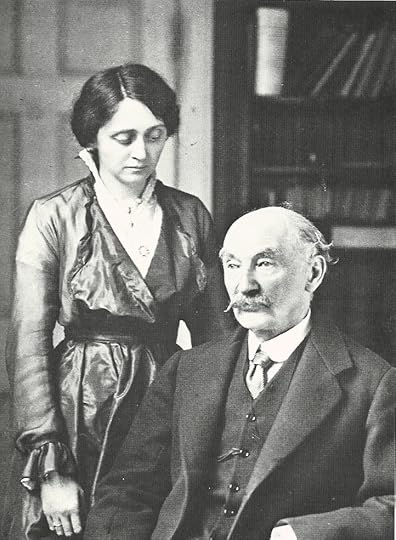
Description: Inspired by the novel 'Winter' by Christopher Nicholson and dramatised by Sara Davies.

The most famous writer of his day is living in chilly seclusion in Dorset with his second wife and former secretary, Florence. Between these two frozen hearts comes the talented amateur actress Gertrude Bugler, playing Tess in the first production of Hardy's play, provoking local and national fascination.

Florence determines to put a stop to what she sees as Hardy's ludicrous infatuation with the young woman. Gertie is caught in the middle, longing to play Tess on the London stage.

Florence Hardy often found herself dealing with the many journalists and admirers who wanted access to her celebrated husband. Caught off-guard, Thomas has agreed to be the subject of a fly-on-the- wall documentary, but he hands the interviewer on to his wife, who reveals more than she intends about her husband's fascination with Gertrude.

Vibrant performances and a sensitive, unusual treatment bring new light to a story that continues to fascinate.


Florence Dugdale


Gertrude Bugler


Florence Hardy Pippa Haywood
Gertude Bugler Katy Sobey
Thomas Hardy Nicholas Farrell
Elsie Alex Tregear
Wessex Bella
Profile Image for Bill.
308 reviews300 followers
January 23, 2016
This is an historical novel about Thomas Hardy, the famous author. In this book, Hardy is 84 years old and living in his house in the country, where he has lived for 40 years. He is living with his second wife, Florence, who is 40 years younger than him.

Hardy becomes besotted with Gertrude Bulger, a 25 year old girl, who plays Tess in a local adaptation of his novel into a play. He even writes her love poems, which of course, does not make Florence very happy.

At times the writing is very beautiful, especially when describing the English countryside or the many species of birds that inhabit it. However, there is really little or no discernible plot and the writing at times is very repetitious. Florence's desire to have the trees surrounding the house either cut back or cut down altogether must be mentioned at least a dozen times. And at one point the word beautiful is used 7 times in one short paragraph. Presumably the author did this deliberately for some reason, but I just found it very annoying.

In short. this is a passable novel, but would probably be of more interest to real fans of Thomas Hardy. I have to admit that I have never read any of Hardy's novels, a situation I must rectify at some point, as I would hope that they would be better than this book.


Profile Image for Elizabeth (Alaska).
1,570 reviews554 followers
January 17, 2021


He gave me a particular look, a look that I have come to know well, intended to convey the message that he was impervious to all argument, however reasonable.
This is not a humorous book, but I couldn't help myself in highlighting this sentence. For years, comedians have referred to wives giving husbands "the look". I simply want to make note of the fact that wives have been on the receiving end of the look, too. Thank you Christopher Nicholson for acknowledging that fact.

The Goodreads description accurately tells us that the novel is told from three points of view: Thomas Hardy, his second wife, Florence, and the young woman Gertrude Bugler who plays Tess in the amateur theater group The Hardy Players. The novel takes place in the Winter of the year Thomas Hardy is eighty-four, about 1924 or 1925. The characters look back from that vantage point, and sometimes nto the future.

The several sections/chapters told by Florence and the two chapters told by Gertie are in the first person. I think Nicholson does a good job of writing from the viewpoint of a woman and making clear which woman is telling the story. Florence is simply a shrew of a woman. I don't mean that she is domineering at all. Instead she is an A Number One whiner without a shred of self esteem or self-confidence. In these chapters I found Hardy to be long suffering. Florence, of course, thought her self long suffering and through this apparently self same attitude the novel is brought to a climax. Gertie is a young woman who simply wants to be an actress. She has played the lead in several of the Hardy plays to date.

The chapters with the point of view of Thomas Hardy - about half of the novel - are told in the third person. Nicholson did a fair imitation of Hardy's writing style in these. Though in the third person, we see how Hardy looks at the world. We are privileged to view the fields, the birds, the sky, just as Hardy writes. We also come to know about some of those who have peopled his life and how he views his writing. This quote is very early in the book and I could have highlighted many more such paragraphs.
Her hair was a conspicuous feature; thick and very black, with tresses that shone in the light of the fire, it was the kind of hair that in a former age might have adorned the head of a Cleopatra or a Helen of Troy, and a man with an imaginative cast of mind might have wished himself transmuted into a comb, merely for the pleasure of being drawn through its length.
I woke up last night and couldn't get back to sleep. I was glad to have 40 or 50 pages left to read. It is not a flashy novel and I was very glad for the quietness of the Hardy sections in particular. This novel reminded me that I have more Hardy to read. I hope I get to them without letting too much time pass. 5-stars, although it's probably in the lower 1/4 of that group.

Profile Image for CanadianReader.
1,304 reviews183 followers
January 8, 2017
In WINTER, Christopher Nicholson explores a brief period in author Thomas Hardy's 85th year, when he was infatuated with the young Dorset woman, Gertrude Bugler, who had played Tess in the local Hardy players' dramatic version of the famous writer's favourite novel. As Nicholson's book opens, Hardy is offering Gertrude the role of Tess in the London Haymarket Theatre production of the play. Nicholson also gives us scenes of Hardy reflecting--on his life, his approaching death, his first marriage, and the natural world. WINTER, however, is less an exploration of Hardy himself than it is a study of his claustrophobic and unhappy second marriage. There are as many chapters devoted to Florence--Hardy's second wife, who at age 45 is 40 years Hardy's junior--as there are to Hardy.

Florence is apparently unwell, having recently had surgery on her neck to remove what she (fancifully) believes is cancer caused by spores from the oppressive trees that crowd Max Gate (their house in Dorchester). Hardy refers to Florence's "neuritis" but we would probably call it "neurosis." Not being familiar with the actual details of Hardy's second marriage nor with his second wife's health complaints, it sounded to me as though Florence was plagued by hypothyroidism, which, untreated, makes one feel depressed, cold, and tired. This is not to say that Florence's sense of being unloved, unappreciated, intensely insecure and jealous of her husband's preoccupation with a young woman sixty years his junior were not very real and even justified. Even so, reading page after page of a rejected wife's complaints and dissatisfaction become tiresome after a while.

WINTER is otherwise a beautifully written, melancholy work of biographical fiction. It will most appeal to readers who have some familiarity with Hardy's novels and poetry. Not having read Hardy in many years, the book made me want to revisit his novels. However, Nicholson's novel also made me realize that though Florence is not a character that the reader particularly warms to (her chapters are a litany of complaints and cries of being unloved, unfulfilled, and having missed out) it cannot have been easy living with the great writer.

Rating 3.5 out of five. I have rounded down to 3 stars,
Profile Image for Ali.
1,241 reviews392 followers
December 22, 2014
Drawing heavily on what is known about Thomas Hardy’s later years and the first production of the play ‘Tess’ –Christopher Nicholson has written a novel that explores many of themes which might have interested Hardy himself. I am a little nervous perhaps, of novels written about real people – and I don’t mean historical figures from so far away a time as to make them almost fictional like anyway (is that just me?) but those people who lived in times not so very long ago – who we still feel we can almost reach out to, and about whom we think we know so much already. I was slightly cured of that fear when I read and absolutely loved Helen Dunmore’s Zennor in Darkness – which features D H Lawrence and his wife. This novel however is about Thomas Hardy and his second wife Florence – set in the last few years of his life, when he and Florence had been married ten years. I was a little concerned I suppose at the Thomas Hardy I would encounter in this book, fiction though it is, it isn’t as though I believe he and I would have been great mates should we ever have met – I think that unlikely – but I wanted still to like him. Incredibly I do – I say incredibly, because Christopher Nicholson hasn’t made either Hardy or Florence especially sympathetic, Hardy emerges as an obstinate, slightly delusional old man, set in his ways and Florence is rather hysterical and a little shrewish at times. Yet still I love Thomas Hardy – it seems I cannot be cured.

In the 1920’s Thomas Hardy adapted his favourite novel Tess of the d’Urbervilles for the Hardy Players – a Dorset amateur dramatic group which still exists today, at least they seem to have been reformed a few years ago. Gertrude Bugler was cast to play Tess; she was a Dorset girl, who had been locally acclaimed as an actress of real ability. Gertie was the daughter of Augustus Way who years earlier as an eighteen year old milkmaid had been Hardy’s inspiration for Tess. This of course is a tantalising glimpse into the possible thinking of the great man. Augustus/Gertie/Tess are inextricably linked and tangled up with each other. So in a way this novel is a wonderful companion read to The Well Beloved – the next read in my ongoing Hardy reading challenge – a novel I have read twice before though not for a long time. Hardy desperately wanted Gertie to take the play to London, and perform it at the famous Haymarket theatre. This was a dream come true for Gertie, although it would mean leaving her husband and young baby for a month. However this was destined never to happen, Florence Hardy had become so jealous of Gertie that she put a stop to Gertrude Bugler’s playing Tess in London. It seems that all this is true, and has provided Christopher Nicholson with a wonderful story on which to build his novel.

Winter – named for the time of year the story is set and more importantly the stage of Hardy’s life it concerns, is a beautifully constructed, subtly complex little novel. Exploring themes of marriage, desire, ageing and mortality, it is a wonderfully psychological examination of one of England’s best and most loved writers (oh I know there are Hardy haters out there I like to ignore the fact). At Max Gate – Hardy’s country home he and Florence lead a largely reclusive life with their adored little dog Wessex. Thomas Hardy is eighty four, his wife only forty six – but in poor health she seems older. As the novel opens the couple await a visit to their home by Gertrude Bugler. Gertie threatens the equilibrium of their quiet life; she is beautiful, ambitious and in Hardy’s mind embodies the spirit of Tess – his favourite heroine. As plans for transferring the play to London start to take shape, Hardy is often preoccupied with thoughts of his own mortality – going as far as picturing his own funeral in minute detail, though even here his thoughts return to the Tess/Gertie/Augustus ideal.

“Yet the one who caught his attention as the crowd thinned was a woman somewhat like Gertie but entirely she, a woman whom he had never seen before, but whom he seemed to know with an intimacy which ran to the bone; the ideal woman, the well-beloved, the Shelleyan avatar of whom he had so long dreamed and who had haunted every novel he had ever written. Beneath a wide black hat she gazed into the grave before slowly raising her head as if to bid him a final farewell. Her precise features remained elusive, for her face was veiled, yet he had no doubt that she had full knowledge of his presence, and he would have liked to step forward, or to make at least, some corresponding gesture, but found himself unable. Then she and all other members of the human race faded from view, and he was left alone by the yew tree, in the winter wind.”

Florence meanwhile already obsessed with the idea that the thick trees which surround Max gate are affecting her health, frustrated at her husband’s refusal to have them cut back, now becomes convinced that he is planning on betraying her with Gertie Bugler. Florence’s moods become increasingly erratic, making whispered telephone calls, and finally paying a secret visit to Gertie Bugler at her home to beg her to turn down the London role. This is a superb novel, beautifully written, profound and deeply affecting. This is Christopher Nicholson’s third novel, although the first of his I have read, and I probably wouldn’t have read him at all if her hadn’t gone out and written a novel about my favourite novelist, I am so glad I have encountered him.
Profile Image for Issicratea.
229 reviews475 followers
March 5, 2016
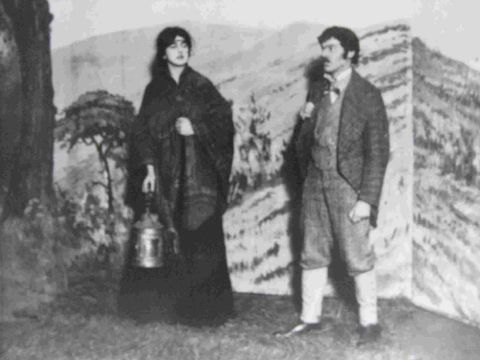
This quiet, well-crafted novel focuses tightly on an episode in the winter of Thomas Hardy’s life, three years before his death in 1928 at the age of eighty-seven. Although he had given up writing fiction by this point, Hardy was involved in the staging of dramatized versions of some of his novels by a local acting troupe in Dorchester, the Hardy Players. The novel explores Hardy’s relationship with the troupe’s leading lady, the beautiful and charismatic (though uneuphoniously named) Gertrude Bugler: a relationship sufficiently warm to arouse the jealousy of his unhappy second wife, Florence Dugdale Hardy.

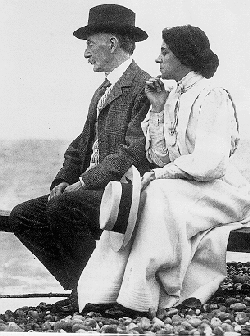
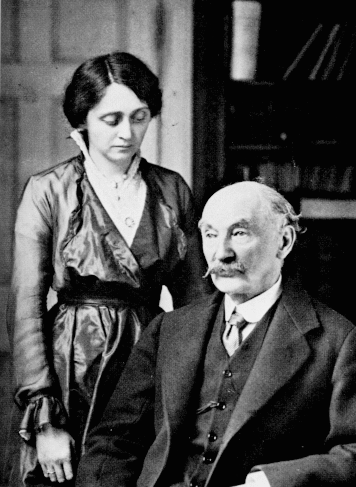
Here are Hardy and Florence in the year of their marriage, 1914:


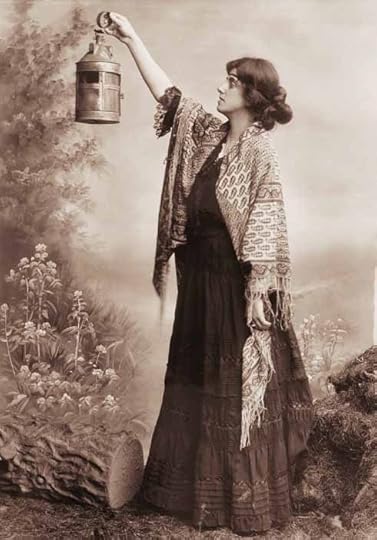
And here is Gertrude:

description

That’s just about it where the plot is concerned; and the threesome just named are pretty much the only characters, despite bit-part appearances by cultural luminaries like Sydney Cockerell, J. M.Barrie and Lawrence of Arabia (weirdly), and more substantial roles for Hardy’s fox-terrier, Wessex, and his brooding Dorset house, Max Gate.

Winter is written multi-perspectivally, so we get the view from all three sides of the peculiar love-triangle made up by Hardy, Florence, and Gertrude. Nicholson makes the rather odd choice of narrating the Hardy passages in the third person, speaking of Hardy as “the old man,” while Florence is given a present-tense narration (in the sense that her voice is contemporaneous with the events narrated), and Gertrude is given a retrospective narration, looking back on her young self from an undefined late-ish middle age.

Of these three narrative strands, that voiced by Florence was certainly the standout for me, and far the most interesting aspect of the novel. As portrayed by Nicholson (who respects the historical evidence pretty closely), Florence is anxious, jealous, cranky, hypochondriac, hypersensitive, and generally a bit of a nightmare to live with; yet, to Nicholson’s credit, we can understand all too well how she has become the way she is. Nicholson portrays her as an intelligent woman, in quiet desperation at her blighted life, but without the strength of will to do anything about it. He also invests her voice with a spiky, sarcastic energy that cuts against its dreariness. She is especially incisive on Hardy’s postmortem idealization of his first wife, Emma, who became a powerful poetic muse and myth for him once she had had the decency to remove herself physically from his life.

I felt that writing as Florence rather freed Nicholson up; he seems considerably less sure in the other strands of the novel. The third-person Hardy narration is written in a curious, semi-archaic diction presumably intended to evoke Hardy’s own voice. It may be that the emotionally distancing effect of this style is supposed to mimic the pyschological remoteness of which Florence complained in her husband, but it can be rather deadening on the page, especially when Nicholson hits a flat patch (“One feature of his personality was that he had always found himself to be most enamoured of churches when they were empty.” )

I had read Hardy’s early novel Desperate Remedies with pleasure shortly before embarking on this, so I had Hardy’s own novelistic voice in my head as I was reading. This rather spoiled for me Nicholson’s attempts at Hardyesque passages of lyric natural description, even though some of them are nice in themselves (frost “stealing through the starry night … crisping the fallen leaves in wood and copse;” old gravestones in a country churchyard, with their “now blank faces covered in pincushions of moss, dew-soaked spiders’ webs and the irregular, frilly growths of rusty pink lichens.”)

I don’t think this was quite the novel for me, but there was still quite a lot that I enjoyed about it. I would certainly read Nicholson again.
Profile Image for TBV (on hiatus).
307 reviews70 followers
November 7, 2019
"A door of the house opened, and out stepped an old man, who stood motionless on the gravel drive. From a distance, he seemed less a living human being than a spectre who had temporarily chosen to haunt the spot where he had once lived. The textures of the fog drained the substance from him so thoroughly that it might not have been surprising had he faded entirely from view. With him, and equally ghostly, was a dog, a white terrier."


The old man, and thus is he referred to throughout this novel, is the eighty four year old Thomas Hardy. Set in his ways, he follows a strict routine and spends much of his day writing. Sharing his life are Florence his wife and Wessex (or Wessie) the dog.

But beneath this apparent simplicity there is a triangle of tensions:
Hardy favours Gertrude (Gertie) Bugler for his stage adaptation of Tess of the d'Urbervilles. Gertie reminds him of the beautiful milkmaid he had seen many years before and who had in fact inspired his vision of Tess.
"Presently the luminous shapes of the dairymaids, five in number, each one carrying a stool and a bucket, came into view as they made their way from the barton towards the river. To his gaze, they seemed to him as much spiritual as physical beings; humble country lasses, but also angels, he thought to himself. Among them was one whose beauty stood out from the rest, and who fastened on his mind with the power of a dream: a girl with long dark hair and pale features."

It just so happens that Gertie is the milkmaid Augusta's daughter.

Gertie is young, married and has a baby. She is delighted to be chosen for the role of Tess and to be regarded a friend of the famous author. She is romantically inclined and compares her life with those of Hardy's heroines and imagines herself as Eustacia or Bathsheba.

Florence is Hardy's second wife and about half his age. "She must have been half his age, while he was old enough to be her father. But what people don’t realise is that he had a quite youthful manner, whereas the reverse was true of her. She seemed much older than she was. Even so, the gap in age did make you wonder." Florence has a heap of problems. She feels used and unloved. She wishes they had a child and she lavishes her affections on the dog. She is a hypochondriac. She is peevish and resentful. She is jealous, very jealous. She says to herself: "O Florence, these are bitter thoughts and you are not a bitter person; you must not give yourself up to bitterness." But bitter is exactly what she is. And, oh, how she hates the trees around the house.

Hardy, well he loves those trees. And he is determined that Gertie should be his Tess, Tess who represents an elusive but ideal woman. "It was better for Augusta to remain as he had seen her that dawn in the mist, a quintessence of unattainable, unapproachable beauty, never to be forgotten." To Florence Gertie is all too real and she perceives her as a threat. There is affection between Hardy and Florence, but there is also misunderstanding. "However, if he had once thought of Florence as his Beatrice, he no longer did so. Either she had changed, or he had changed, or both of them had changed." Marriage is an issue which crops up time and time again in the novel.

The thoughts and feelings of Hardy, Florence and Gertie are narrated in alternating chapters, but it is Florence's character which is most strongly portrayed. Perhaps deliberately so, as Hardy is somewhat phlegmatic and cannot understand what all the fuss is about, and Gertie is simply absorbed with her acting, her family and her friendship with Hardy.
Profile Image for Roger Brunyate.
946 reviews741 followers
August 24, 2016
Hardy at Midnight

Or if the secret ministry of frost
Shall hang them up in silent icicles,
Quietly shining to the quiet Moon.


Towards the end of this elegiac novel by Christopher Nicholson, the aged Thomas Hardy reads one of his favorite poems, Coleridge's "Frost at Midnight," whose closing lines I quote above. It is an appropriate image. The author, now 84, has his novels and most of his poetry behind him, although he will publish one more collection, the aptly named "Winter Words." He spends the winter of his life mainly thinking back on the past, on the changes that have come to his beloved Wessex, and the people whom he might have loved passing by on the other side of life's road. He lives in a kind of freeze himself, sitting alone in the study in his big gloomy house, unable to give his much younger second wife Florence the love she needs. Coleridge's "silent icicles" are apt indeed. Yet for all this, Nicholson's book is full of beauty, those icicles "quietly shining to the quiet moon." And much of the beauty comes from the author's masterly handling of prose, very much imbued with the regretful spirit of Hardy's late verse.

It is, nonetheless, a simple style. A review from The Guardian praises it for its inconspicuousness, its "refusal to astonish." By picking out a section to quote, I know I am doing Nicholson a disservice, highlighting a passage that the author wanted simply to take its place in the texture. But I do so since it says a lot about the aging Hardy also—Hardy not yet at midnight but at dusk: "The maids had not yet lit the lamps. He might have rung the bell and summoned them to do so, or he might have lit them himself, but for the moment he preferred to remain in the twilight. This was his favorite time of day, when the interaction between the physical and spiritual seemed strongest, when the barriers that were supposed to part the living and the dead dissolved into nothing…."

The story is all true. Hardy has written a stage adaptation of his Tess of the D'Urbervilles, and is much taken with the amateur actress who plays the title character in its local premiere, Gertie Bugler. A beautiful young woman in her early twenties, it turns out that she is the daughter of the milkmaid who, seen only from a distance, was Hardy's inspiration for the original novel. Now the author wants Gertie to have the role when the play opens professionally in London. But the neurotic Florence envies her health and happiness, and is not prepared to see this butcher's wife receive the attention and acclaim she had longed for in vain from her own husband.

Florence and Thomas Hardy may love one another, but they cannot communicate anything of importance. Yet Nicholson communicates for them, alternating overlapping chapters from each of their points of view (in the first person for her and third person for him), with two interspersed chapters by Gertie, written in the 1960s, that somehow manage to put it all in perspective. It is a tragedy of a sort, of jealousy, thwarted aspirations, and misplaced love. Yet, in Nicholson's telling, Hardy at midnight is not Hardy in the dark. That quiet moon still shines.
Profile Image for Mary-Ellen Lynn.
72 reviews14 followers
September 5, 2014
Thomas Hardy had a very particular view of marriage; he was married twice and in neither case very happily. It is a common joke among Hardy enthusiasts that Hardy’s idea of a good wife was a dead wife. He had a troubled relationship with his first wife, Emma Gifford, but her death inspired him to write a volume of beautiful love poetry, much to the annoyance of his second wife. Thirty-nine years his junior, Florence was a volatile and jealous woman when it came to Hardy’s interest in other women, dead and alive.
Winter offers the reader a window into a moment of crisis in their relationship, set amid the drama of an amateur stage production of Hardy’s novel, Tess of the D’Urbervilles. The part of Tess is to be played by a young farmer’s wife from Beaminster, Gertrude Bugler. Bugler’s mother Augusta happens to have been Hardy’s original source of inspiration for the character of Tess. Florence is intensely jealous of the beautiful young actress and her husband’s interest in her.
Martin Seymour-Smith’s biography of the author went quite a way in painting Florence as a devious hysterical woman but Christopher Nicholson gives her a new voice. He tells the events of the story through three points of view: Hardy, who is stubbornly detached from his wife’s vociferous unhappiness; Gertrude, who is elated to be playing Tess on the stage but is torn between her career and her devotion to her family; and Florence, who acts out of spite, feeling herself to be an invisible wife living in the shadow of her husband’s passion for his first wife and a young milk maid, brought back to death (so to speak) in the form of Gertrude.
Nicholson voices Florence’s despair at her 84 year old husband’s inclination to live in the past. Hardy will not listen to reason: “Obstinacy is ingrained into his very nature. It blinds him to common sense. It makes him deaf to all persuasion.” He has also crushed Florence's dream of being a writer herself, all the while unaware of the hurt he is causing his wife.
There is winter at this heart of this story, but the tone is so beautifully elegiac and the prose so effortlessly understated and unpretentious that you cannot help but be moved by it. This novel is worthy of Hardy but you don’t need to be a fan of his novels to appreciate this story about love and loss.
Profile Image for Melissa.
289 reviews132 followers
February 6, 2016
I received an ARC of this title from the publisher.


I always thought it was sad that the Roman Stoic philosopher Cicero, in his moral treatise De Senectute (On Old Age), argues that not only do old men not engage in the pleasures of a lover any longer, but they are actually relieved to be free from such sensations. Seneca, in one of his Stoic epistles, agrees with Cicero's sentiment by telling Lucilius that it is a relief to have tired out one's appetites and be done with such things.

Christopher Nicholson, in his fictional autobiography about the last few years of Thomas Hardy's life, greatly disagrees with Cicero and Seneca's views on old age. Nicholson gives us an example, through the life of this famous author, of an old man enjoying love and fantasizing about pleasure even though such enjoyments are not necessarily attainable. The focus of the book is the winter of Hardy's eighty-fourth year when he decides to become involved in an amateur production of Tess. He has resisted turning what is his most famous novel into a staged production, but when he meets Gertrude Bulger, a local townswoman, he believes she is the only one that can do his heroine justice.

Hardy lives a very quiet life in the small town of Wessex where he was born. He doesn't go out and socialize very much, so it is truly remarkable when he agrees to become involved with the local theater company to stage this production of Tess. He develops a heart-warming relationship with the lead actress, whom he affectionately refers to as "Gertie." He enjoys having her over for tea and talking to her about books, philosophy and life in general. He realizes that, even though he is in the winter of his life, he still has strong feelings of love and desire for this twenty-eight year-old woman. She inspires him to write love poems again and he produces over twenty such poems in the course of a few months.

The imagery and backdrop of winter is appropriate for Hardy's reflections on what he feels could be the last few months, weeks or days of his life. The cold and ice and bleak landscape reflect what he feels is going on in the natural progression of his life. He, however, is not sad or bitter about this . And when he has the opportunity to interact with Gertie he embraces the opportunity and does not deny himself feelings of love, pleasure and desire just become of his advanced age. One of the sweetest moments of the book is when he finds one a piece of her hair and tucks it into one of the books in his library as a keepsake.

The other forceful character in the book is Hardy's wife who is about forty years his junior. Although Florence is much younger than her husband she acts like she is the octogenarian in the relationship. She is obsessed with her health, paranoid, whiny and jealous. When she sees that Thomas has developed feelings for Gertie she is relentless in her nagging at him and does everything she can to make sure that they do not see each other again. I understand that Hardy could be a quiet, brooding, stubborn man and was not the easiest person to live with. But Florence's constant obsession about her health and the perceived wrongdoings against her made it difficult to have any sympathy for her.

The reader should be warned that the ending is not necessary a happy one. There is, however, a larger message in the book to be found which is that Cicero and Seneca did not quite have the correct perceptions on old age. Human beings have the capacity to experience love, desire and pleasure right up until our final days. Cicero and Seneca most definitely would have judged Hardy to be a bad Stoic.

Profile Image for LindyLouMac.
1,010 reviews79 followers
January 8, 2017
Since studying Thomas Hardy's literature at school I have been a firm fan of all his novels. Tess of the D'Urbevilles has always been a favourite, so I was intrigued when presented with this title for a recent book club selection. In the 1920’s Thomas Hardy did actually adapt his apparently favourite novel Tess of the d’Urbervilles for a Dorset amateur dramatic group, so this novel is based on real events.
Winter is not something I would have normally wanted to read as I do not like it when it seems like an author is taking the fame of another, real and or fictional for their own novel. It almost feels like cheating to me. Despite these doubts I did enjoy Winter, although I was not particularly keen on Nicholson's portrayal of either Thomas Hardy or his second wife Florence. He is portrayed as a somewhat reclusive and obstinate old man that is not at all pleasant to his much younger wife, though one feels she deserves it with her tendency to hysteria and nagging at times.
In conclusion this complex story about the winter of Hardy's life and the emotional problems arising in his marriage due to old age, his desires, fear of mortality and his wife's jealousies does provide a provoking read.
Regardless of the way the author has characterised Hardy, I still love his writing and would therefore recommend this novel to any fans of his work.

https://lindyloumacbookreviews.blogsp...
Profile Image for Andrew.
630 reviews4 followers
March 15, 2016
Winter is a novel which tells the story of the complicated relationship between the author, Thomas Hardy, his second wife, Florence and a budding young actress called Gertrude Bugler. The story takes place in the 1920s and explores a possible version of events which have a root in the real world. It explores the shine which the elderly Thomas takes to Gertrude, who plays the lead character in an amateur theatre group's production of 'Tess'. The situation becomes difficult, because of the stress, imagined or real, which this infatuation has on Florence and her relationship with her husband. As a fan of the writings of Thomas Hardy and a visitor to his homes in Dorset, I was drawn in to this book by the descriptions of Max Gate, his home and the locality in which it sits.

Once the scene is set, the early chapters are written in the voice of Florence. She explores the history of her marriage to Thomas, following the death of his first wife, Emma. This gives an insight into what day to day life at Max Gate was like. Florence gives the reader an understanding of the sense of frustration which she has living in the shadow of the famous author, as his biographer. "I think it is as if my husband was a great tree and I am stunted from living in his shadow". I enjoyed the switches between the voice of Florence to the situation as Thomas saw it. This helped to develop the story and kept me wanting to know what happened next.

The story is taken up by Gertrude, and the outlook from the viewpoint of her and her husband, who supports her theatrical ambitions. Here I must stop to avoid spoiling the ending. For me, Christopher Nicholson has created a believable, readable novel which encapsulates a sense of time in the way he explores the attitudes of men towards women. I found the writing opened up a real feeling of time and space, a window into Hardy's Wessex, as he draws towards the end of his life.
Profile Image for Kim.
2,722 reviews14 followers
August 17, 2020
Setting: 1924; Dorset, UK. In this fictionalised account, 84 year old author Thomas Hardy is living at his country house, Max Gate, with his second wife, 45 year old Florence - his wife is feeling very insecure following an operation to remove a growth from her neck and is concerned about the lack of affection shown to her by Thomas. Meanwhile, Hardy is becoming increasingly infatuated with Gertrude, a 24 year old local woman who is taking the role of Tess in a local production of Tess of the D'Urbervilles - the first time the play has been performed. Hardy's infatuation is such that he arranges for Gertrude to be asked to play the part of Tess in a future production of Tess to be staged at The Haymarket Theatre in London, even though she is not a professional actress, and starts writing poetry dedicated to her. When Florence discovers this, she is understandably annoyed and takes action...
Narrated from the points of view of the three participants in this 'love triangle', I was not totally sure what to make of this one - parts of this were quite good and other parts not so. In particular, some of Hardy's reminiscences and future predictions were a trifle long-winded and boring, hence only 3 stars for me, even though I really enjoy Hardy's writing and read a biography of him some time ago - 7/10.
Profile Image for Laura.
7,132 reviews606 followers
December 4, 2015
From BBC Radio 4 - Drama:
Inspired by the novel 'Winter' by Christopher Nicholson and dramatised by Sara Davies.

The most famous writer of his day is living in chilly seclusion in Dorset with his second wife and former secretary, Florence. Between these two frozen hearts comes the talented amateur actress Gertrude Bugler, playing Tess in the first production of Hardy's play, provoking local and national fascination.

Florence determines to put a stop to what she sees as Hardy's ludicrous infatuation with the young woman. Gertie is caught in the middle, longing to play Tess on the London stage.

Florence Hardy often found herself dealing with the many journalists and admirers who wanted access to her celebrated husband. Caught off-guard, Thomas has agreed to be the subject of a fly-on-the- wall documentary, but he hands the interviewer on to his wife, who reveals more than she intends about her husband's fascination with Gertrude.

Vibrant performances and a sensitive, unusual treatment bring new light to a story that continues to fascinate.

Dramatist...Sara Davies

Music...Jon Nicholls
Production Manager...Sarah Goodman
Director...Mary Ward-Lowery.


http://www.bbc.co.uk/programmes/b06qmtzr
Profile Image for Booknblues.
1,532 reviews8 followers
December 12, 2023
Christopher Nicholson tells the story of an aging Thomas Hardy and his relationship with two women, his wife Florence and the local woman, Gertrude, who is playing Tess in an amateur production.

The story shifts between Hardy, Florence and Gertrude. It is a character study, a study of the times and aging.

It is one of those books which seems much longer than it actually is and I was heartily glad when I reached the last page.
Profile Image for Ocean.
772 reviews46 followers
November 29, 2017
An awfully bleak story with incredibly annoying main characters for whom I developed no sympathy through the 247 pages.
The only thing that could save this book in my eyes is how well written it is. The author has great technical writing skills but the story lacks emotions if not action. It needs some sparks to make it truly memorable.
Profile Image for Nicole.
169 reviews
August 16, 2018
Such a beautifully written ode to the writer Thomas Hardy in his later years. I savored every word of it!
Profile Image for Laura.
190 reviews54 followers
March 19, 2014
I am sure David Lodge has read this novel: after all, it follows the same pattern as his fictionalizations of Henry James and HG Wells. I am fond of literary novels about writers and Winter was likely to be special for me, given that I am a Hardy buff. Quite a lot of the content is bound to be familiar due to his novels and biographies (Tomalin's, and The Well-Beloved are particularly relevant works), but I found Nicholson's efforts well-attuned to my own mental image of the writer and his environment.
There is something irresistible about a man who in his eighties is still capable of developing a fancy for a young woman, and dwells and acts on it as he does. He becomes infatuated with a local actress who takes the part of Tess in an amateurish theatrical production, Gertrude, and this still has consequences on his marital life, as if he were a much younger man and he stood any chances, as he would have put it... Half the fun of being in love for Hardy must have been "thinking" about being love, and here he brings up again his theories about this, particularly how love migrates from one partner to the other, as in The Well Beloved, where the same man falls in love with different generations of women from the same family. On this occasion, Hardy goes for the mum, a milkmaid he observes while on a country walk, and then for the daughter, both of whom he then relates to Tess, his fictional creation...
Nicholson's is a strong recreation of Hardy's environment and I particularly enjoyed this: the gloomy damp house, his study, his dog, the looming trees that his second wife, Florence, feels threatened by... I always sided with the first wife, so I felt irritated by Florence, her grievances and her hypocrisy, but of course living with Hardy must have been difficult: he comes across as a man who liked being in control of his affairs, such as money and even other mundane domestic matters. In contrast, Gertrude feels sweet, even if completely unaware of the impact she has had on the old man.
Was the Hardy in Winter like the Hardy you pictured in your mind while reading the novels?
This entire review has been hidden because of spoilers.
Profile Image for Elena Sala.
496 reviews93 followers
January 25, 2020
WINTER (2014) is set in the winter of 1924, when Thomas Hardy, aged 84, is living with his 45-year-old wife, Florence, and their beloved dog, Wessex, in Dorchester. Their house has no electricity, they own no car but Hardy is happy to be isolated, in fact he prefers it. Florence, though, loathes the isolation, the dark, cold, damp house and even the trees which surround their estate. However, she dutifully answers all his mail, declines all interviews and invitations, while he retires to his chilly study and writes poetry.

When he adapts his great novel, TESS OF THE D'URBERVILLES for an amateur dramatics group, he is captivated by the attractive Gertie Bugler, the young woman who plays Tess, and insists that she perform the part when the play transfers to the London stage. When Florence sees poems apparently celebrating this new love, she falls apart. Florence’s jealousy and despair propel the plot in this novel told from the alternating perspectives of Hardy, Florence and Gertrude.

The plot is drawn from a real episode of Hardy's life. All three characters are portrayed unsentimentally, though with empathy. Florence, who has not been viewed sympathetically by Hardy's biographers, is depicted here as deceitful, hysterical and tiresome. However Nicholson also illuminates the anguish of a wife who feels invisible to her self absorbed husband.

WINTER is a compassionate fictionalized account of the aging poet's last years and his infatuation for a young woman. The prose is elegant and lyrical and the story is excellently crafted. Readers who love Hardy's novels will enjoy this book, especially those who are devoted to TESS.
Profile Image for Brooke,.
375 reviews26 followers
February 25, 2014
Started really well with some beautiful prose and then I just couldn't find any sympathy for any of the characters. Barely managed to finish.
Profile Image for Deborah .
413 reviews13 followers
November 19, 2019
How disappointing! I was looking forward to this book about the later years of one of my favorite authors, Thomas Hardy, but the main characters were so unlikable and the narratives slow and repetitive that I almost gave up on this one (and probably should have). Hardy is 84 focusing on poetry. He lives in a country home with his second wife, Florence, who is roughly half his age. She is one of the most annoying, unpleasant characters I have ever encountered. And Hardy is not much better. The story is told by three narrators, the Hardys and Gertie, a young wife and mother who has played Tess in a local production and has dreams is introducing the role on the London stage.

Florence is a hypochondriac, and I would also consider her a hysterical. She had a small growth on her neck that she felt sure was cancerous and went to three doctors until she found one who agreed that it might be a concern and removed it. Now she is obsessed with her scar, continuously wearing a wrap with a Fox head and fussing to make sure her scar is covered. She has convinced herself that her health issues are caused by the large pines on the property and begs her husband relentlessly about cutting them down or cutting them back. When she isn't whining about the trees, she's whining, "You don't love me. You don't love me as much as you loved your first wife. Did you ever really love me?" Despite of all this whining, by the end of the book, she is calculating how much money she will have when Thomas dies and fantasizing about who she might choose for her next husband. Oh, and about removing the trees, of course.

Lest you feel sorry for Thomas, never fear, he is equally annoying. He has become obsessed with Gertie and spends his time writing love poems to her that are never sent, gazing at one of her hairs that he has preserved in a book, and fantasizing about eloping with her. Remember that Gertie is a married woman in her 20s, a new mother whose only interest in Hardy is that his influence might get her the role of Tess on the London stage. I guess we're supposed to see him as a man nearing death longing for one last stab at youth, but I found him foolish and annoying. He does either ignore Florence or treat her condescending, but I really can't blame him for that.

Gertie is the only somewhat likeable character. She loves her baby and is committed to her husband, but she does dream of acting in London and is thrilled when Hardy arranges a limited run of Tess in London. She and her husband have agreed that they will work things out so that she can leave for a month. But Florence suspects that Thomas has designs on Gertie and then finds the love letters. She feels threatened by the fact that the two will be in London without her. Her first plan of attack is to nag Thomas to withdraw the role, claiming that Gertie should be with her baby, that the separation could ruin her marriage, and that the girl could be destroyed by negative reviews. When that doesn't work, she goes to Gertie's house and claims that "Mr. Hardy and I" think it best that she write to the producer and decline the role, citing the reasons above. When Gertie remains unconvinced, Florence become hysterical and confesses that Thomas is infatuated with her, and she agrees to withdraw from the play.

This review is more detailed than I usually like, but I want to give readers sufficient reason to avoid this plodding, annoying novel. Read Hardy's novels instead.
Displaying 1 - 30 of 111 reviews

Can't find what you're looking for?

Get help and learn more about the design.