

What do you think?

Penguin Specials: The Hong Kong Series
City of Protest: A Recent History of Dissent in Hong Kong: Penguin Specials
From the turbulent 1960s until today, Hong Kong has been a city shaped by civil disobedience. The latest wave of protests in Hong Kong's long history of public dissent culminated in the Occupy Central movement of 2014. What emerges from these grassroots movements is a unique Hong Kong identity, one shaped neither by Britain nor China. An insightful exploration of the historical and social stimuli and implications of civil disobedience, City of Protest offers a compelling look at the often-fraught relationship between politics and belonging, and a city's struggle to assert itself.
119 pages, Kindle Edition
First published July 1, 2017
About the author
Antony Dapiran
3 books31 followersAntony Dapiran is a Hong Kong-based writer and lawyer, and the author of two books on Hong Kong including his latest, "City on Fire: The Fight for Hong Kong”, published by Scribe. Antony has written and presented extensively on Hong Kong and Chinese politics, culture and business, with his writing appearing in The Atlantic, New Statesman, Foreign Policy, Quartz, Art Asia Pacific, Mekong Review and The Guardian, among many others. A fluent Mandarin speaker, Antony has resided between Hong Kong and Beijing for over twenty years.
Ratings & Reviews
Friends & Following
Create a free account to discover what your friends think of this book!
Community Reviews
Displaying 1 - 22 of 22 reviews

Want to Read
June 14, 2019Pre-reivew:
Yeah, Hong Kong, my home city and its people are protesting again, to defend our basic rights and freedom.
Hong Kong’s huge protests, explained:
https://www.youtube.com/watch?v=6_Rdn...
Blood had already been spilled, 6 young people had committed suicide in protest against the government, one young woman lost her left eye after getting headshot by police, the battle continues.
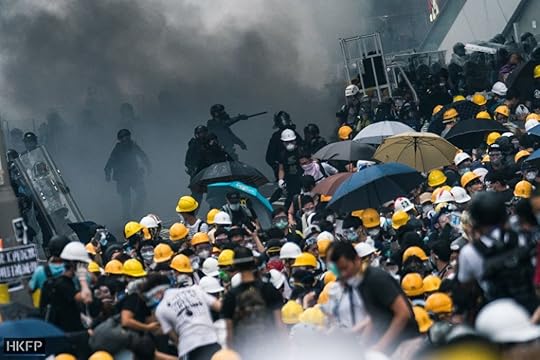
A bit of update on the situation: https://www.hongkongfp.com/2019/06/14...
Video: https://www.youtube.com/watch?v=34oZj...
Another news article: https://www.hongkongfp.com/2019/06/20...
Now I have a piece of dark humor to share: My friend had just joked about if he were to call for the million Chinese football fans to unify and campaign for Arsène Wenger to step down, he will still get jailed by the Chinese authority. The logic being: "If today you can campaign for Wenger to step down, then tomorrow you can campaign for Xi Jinping to step down as well."
An excellent review from Thomas,/a..
News flash:
After nearly two months of protest and police watched and allowed mobsters beating citizens up in a train station, civil servants said: enough is enough: https://www.scmp.com/news/hong-kong/p...
and here is the hottest Hong Kong protest themed artwork on dA:

(Link: https://www.deviantart.com/yuumei/art...)
Bonus:
Here is the million dollars question every protester from around the world needs to know: Water on the Smoke: The brilliantly simple Hong Kong method for fighting tear gas.
https://slate.com/news-and-politics/2...
Yeah, Hong Kong, my home city and its people are protesting again, to defend our basic rights and freedom.
Hong Kong’s huge protests, explained:
https://www.youtube.com/watch?v=6_Rdn...
Blood had already been spilled, 6 young people had committed suicide in protest against the government, one young woman lost her left eye after getting headshot by police, the battle continues.
“All human wisdom is contained in these two words - Wait and Hope”
― Alexandre Dumas, The Count of Monte Cristo
A bit of update on the situation: https://www.hongkongfp.com/2019/06/14...
Video: https://www.youtube.com/watch?v=34oZj...
Another news article: https://www.hongkongfp.com/2019/06/20...
Now I have a piece of dark humor to share: My friend had just joked about if he were to call for the million Chinese football fans to unify and campaign for Arsène Wenger to step down, he will still get jailed by the Chinese authority. The logic being: "If today you can campaign for Wenger to step down, then tomorrow you can campaign for Xi Jinping to step down as well."
An excellent review from Thomas,/a..
News flash:
After nearly two months of protest and police watched and allowed mobsters beating citizens up in a train station, civil servants said: enough is enough: https://www.scmp.com/news/hong-kong/p...
and here is the hottest Hong Kong protest themed artwork on dA:
(Link: https://www.deviantart.com/yuumei/art...)
Bonus:
Here is the million dollars question every protester from around the world needs to know: Water on the Smoke: The brilliantly simple Hong Kong method for fighting tear gas.
https://slate.com/news-and-politics/2...

August 9, 2017
An excellent short history of contemporary Hong Kong as seen through the lens of protest. Antony Dapiran sets demonstrations and protests in Hong Kong, from the Cultural Revolution through to the present day, in the context of Hong Kong's history and political system, in which people power has long been the only power the citizens really have. His descriptions are vivid, his anecdotes well chosen and he draws out the bigger meanings of ephemeral events. He writes very well, too - it's possible to read this in a sitting or two.

October 7, 2019
The form of government in HK right now is a defective compromise best described by Chris Patten, the last British governor, as "liberty without democracy." Hong Kongers have made ample use of this liberty to promote the growth of democracy, because to have liberty without democracy is paradoxical. Liberty erodes without democracy, and Hong Kongers have fought this erosion repeatedly since 1997.
The "Basic Law" which frames the government in HK has authoritarianism baked in. All power flows through the Chief executive, and that office is more or less chosen by Beijing. The legislature has a limited check on the CE, but it too was designed to favor Beijing and the commercial class. The judicial branch is subordinate to executive decisions, and hence to the wishes of the PRC. The people of Hong Kong have a voice in government, but it was designed to be a valve for free expression, not a vehicle for autonomy. I guess it was thought that Hong Kongers would be satisfied with protest without change.
Antony Dapiran shows, however, that protest in Hong Kong has in many cases effected real change: the resignation of Chief Executives, the reversal of objectionable legislation (sucha s the anti-subversion laws) and the defeat of the "Moral and National Education Curriculum" in 2012. Most recently, it forced Carrie Lam to withdraw an extradition agreement with the mainland which would have subject Hong Kong people to whims of Chinese prosecutors. Protest works in Hong Kong, so those who say that HK patriots are wasting their time fighting Goliath are demonstrably wrong, at least if history is any judge. It remains to be seen if protest alone can win the universal suffrage promised by the Basic Law, but there is no other avenue for the people. Young Americans learn how the colonists dumped tea into the Boston harbor as a protest against "taxation without representation." Friends of liberty and democracy should see current events in Hong Kong in a similar, but more serious light. The 2019 protests are more than symbolic.
The "Basic Law" which frames the government in HK has authoritarianism baked in. All power flows through the Chief executive, and that office is more or less chosen by Beijing. The legislature has a limited check on the CE, but it too was designed to favor Beijing and the commercial class. The judicial branch is subordinate to executive decisions, and hence to the wishes of the PRC. The people of Hong Kong have a voice in government, but it was designed to be a valve for free expression, not a vehicle for autonomy. I guess it was thought that Hong Kongers would be satisfied with protest without change.
Antony Dapiran shows, however, that protest in Hong Kong has in many cases effected real change: the resignation of Chief Executives, the reversal of objectionable legislation (sucha s the anti-subversion laws) and the defeat of the "Moral and National Education Curriculum" in 2012. Most recently, it forced Carrie Lam to withdraw an extradition agreement with the mainland which would have subject Hong Kong people to whims of Chinese prosecutors. Protest works in Hong Kong, so those who say that HK patriots are wasting their time fighting Goliath are demonstrably wrong, at least if history is any judge. It remains to be seen if protest alone can win the universal suffrage promised by the Basic Law, but there is no other avenue for the people. Young Americans learn how the colonists dumped tea into the Boston harbor as a protest against "taxation without representation." Friends of liberty and democracy should see current events in Hong Kong in a similar, but more serious light. The 2019 protests are more than symbolic.

May 12, 2026
Decent little Penguin Special of the sort we should have more of, but necessarily dated.

June 18, 2019
Reading this to get a proper context on the sociopolitical factors and governance structures that lead to today's Hong Kong protest against the Extradition Bill, allowing fugitives to be extradited to China. The protest, attended by hundreds of thousands of the city's citizens, is almost a redux of the 2014 Umbrella Movement.
At the heart of it all is the Hong Kong Core Values, formulated in the Sino-British Joint Declaration, which states what Hong Kong is:
But it also states what Hong Kong is not, which is, definitely they are not their Mainland Cousins, even and especially after the handover of the city's sovereignty from the British to Chinese in 1997. In a way, any attempt of their freedom and rights to be encroached by the Chinese officials is very largely frowned upon.
What especially caught my attention in the current protest is the fact that this protest is deliberately leaderless, yet very well-organised as if they're trained for years. Anyone who needed a helmet, mask, or umbrella would yell to the sky. Those around them would stop, passing the message instantly through the crowds with unified chants and matching hand motions: patting their heads for a helmet, cupping their eyes for goggles, rolling their arms for cling wrap, which they were using to protect exposed skin from tear gas and pepper spray. The protesters even developed their own hand gestures to communicate among themselves to ask for helmets, eye goggles, face mask, and others on the front lines. In one instance where protesters get hurt and need an ambulance, the crowd parted like the red sea giving the ambulance a clear path to get to the other side to treat the patients. Everyone knows their roles, what to do and where to go — which is in a way was also attributed to the effectiveness of the public sphere and architecture of their city (which is another question to think of).
They have definitely been trained for it, through the 2014 Umbrella Movement and this is how they learned their lessons.
The protest, in my opinion, is an embodiment of the power of the collective, one disregarding the notion of charismatic leadership, and one that, through the words of civil rights activist Ella Baker, “emerge(s) with collective analysis, serious strategising, organising, mobilising, and consensus building.” It is not often that we come across such protests with a great deal of organisation, strategy, and capacity — and this 2019 Hong Kong protest is definitely something I am keeping an eye on, and to learn greatly from.
At the heart of it all is the Hong Kong Core Values, formulated in the Sino-British Joint Declaration, which states what Hong Kong is:
...one of the world’s freest economies, a lively and unfettered media, the right to participate (to varying degrees) in the electoral and governing process, freedom to criticise the government, unrestricted travel, rule of law and due process, an independent judiciary, accountability and clean government and, of course, the right to protest.
But it also states what Hong Kong is not, which is, definitely they are not their Mainland Cousins, even and especially after the handover of the city's sovereignty from the British to Chinese in 1997. In a way, any attempt of their freedom and rights to be encroached by the Chinese officials is very largely frowned upon.
What especially caught my attention in the current protest is the fact that this protest is deliberately leaderless, yet very well-organised as if they're trained for years. Anyone who needed a helmet, mask, or umbrella would yell to the sky. Those around them would stop, passing the message instantly through the crowds with unified chants and matching hand motions: patting their heads for a helmet, cupping their eyes for goggles, rolling their arms for cling wrap, which they were using to protect exposed skin from tear gas and pepper spray. The protesters even developed their own hand gestures to communicate among themselves to ask for helmets, eye goggles, face mask, and others on the front lines. In one instance where protesters get hurt and need an ambulance, the crowd parted like the red sea giving the ambulance a clear path to get to the other side to treat the patients. Everyone knows their roles, what to do and where to go — which is in a way was also attributed to the effectiveness of the public sphere and architecture of their city (which is another question to think of).
They have definitely been trained for it, through the 2014 Umbrella Movement and this is how they learned their lessons.
The scale of the initial occupation exceeded protest leaders' expectations to such an extent that they had no strategy to cope with it, and never developed one. They never planned on being allowed to stay for so long, as days of government inaction turned into weeks then months.
The protest, in my opinion, is an embodiment of the power of the collective, one disregarding the notion of charismatic leadership, and one that, through the words of civil rights activist Ella Baker, “emerge(s) with collective analysis, serious strategising, organising, mobilising, and consensus building.” It is not often that we come across such protests with a great deal of organisation, strategy, and capacity — and this 2019 Hong Kong protest is definitely something I am keeping an eye on, and to learn greatly from.

June 24, 2019
Protests and demonstrations are raging in Hong Kong again. It feels like it is never-ending. They are protesting an Extradition Bill allowing possible criminals to be taken from Hong Kong to Mainland China. That is the purpose of the protests, but there are more reasons such as the difficulty living in an ever increasingly expensive city and the fear of a disappearing culture of Hong Kong under the threat of Mainland China.
These protests are not new, and after reading City of Protest by Antony Dapiran, it will not be the last time. The book is short and concise, giving an overview of the many protests before 1997 and up until the post-Occupy Central/Umbrella Movement of 2015. It provides an excellent background in understanding what is going today in the streets.
Mr. Dapiran is an excellent writer describing in detail how the protests and demonstrations are not necessarily about what they are protesting about but a way for the population to express their frustrations about how this society is constructed. In a democratic society they ‘vote the bums out’ but here they can’t and can only do it through protests.
If you are coming or living in Hong Kong, the book is an excellent overview of the history of protest in this proud city.
These protests are not new, and after reading City of Protest by Antony Dapiran, it will not be the last time. The book is short and concise, giving an overview of the many protests before 1997 and up until the post-Occupy Central/Umbrella Movement of 2015. It provides an excellent background in understanding what is going today in the streets.
Mr. Dapiran is an excellent writer describing in detail how the protests and demonstrations are not necessarily about what they are protesting about but a way for the population to express their frustrations about how this society is constructed. In a democratic society they ‘vote the bums out’ but here they can’t and can only do it through protests.
If you are coming or living in Hong Kong, the book is an excellent overview of the history of protest in this proud city.
July 15, 2026
I will fit right in with my awesome launch able umbrella

January 3, 2020
This is a clearly-explained and well-written account of the Umbrella Movement of Hong Kong (2014), contextualised as the latest example in the use of protest as a tool to effect change in government policy. Along the way, this also provides a useful introduction to key social and political events in Hong Kong in the last 50-odd years.
Reading this with the benefit of hindsight has been, at times, a painful experience. The current protests (ongoing for more than 6 months now) have evolved from that original Umbrella Movement, but bigger, more violent and more unpredictable (especially when both sides seem to be playing dirty), with no end in sight. Many of the issues, organisations and individuals mentioned in this book are, once again, in the spotlight. Highly recommended as a primer to the current situation in HK, and I look forward to seeing the next instalment, specifically about the current protests, when it arrives later this year.
Reading this with the benefit of hindsight has been, at times, a painful experience. The current protests (ongoing for more than 6 months now) have evolved from that original Umbrella Movement, but bigger, more violent and more unpredictable (especially when both sides seem to be playing dirty), with no end in sight. Many of the issues, organisations and individuals mentioned in this book are, once again, in the spotlight. Highly recommended as a primer to the current situation in HK, and I look forward to seeing the next instalment, specifically about the current protests, when it arrives later this year.

January 18, 2021
A good little overview of the history of organised protest in Hong Kong, and a decent companion to Dapiran's full length book on the subject of the 2019 protests, City on Fire: The Fight for Hong Kong. What an interesting coincidence that this Penguin series on Hong Kong came out in 2017!
Very quick to read, and as with most things Hong Kong-related, very interesting. A proper review will probably be bundled into my review of CITY ON FIRE.
"Through their protests, Hong Kong citizens seem to be asking again and again: What is Hong Kong's place in this post-colonial world?
Perhaps the protests will continue until Hong Kongers can answer this question for themselves."
Very quick to read, and as with most things Hong Kong-related, very interesting. A proper review will probably be bundled into my review of CITY ON FIRE.
"Through their protests, Hong Kong citizens seem to be asking again and again: What is Hong Kong's place in this post-colonial world?
Perhaps the protests will continue until Hong Kongers can answer this question for themselves."

February 11, 2020
Dapiran's novel talks about Hong Kong being a city of protest - something which has been entrenched in their history for decades both in the 20th and 21st century. It sheds light upon the Umbrella Movement in 2014 and the protests that occurred in 1967 and in 2003. It gives you a sense of clarity as to why protests in Hong Kong are an effective method to Hong Kongers to their approach in seeking demands for change in both their demands for universal suffrage and the freedoms they were promised following the handover in July 1997. I felt that reading this book gave me more of a greater understanding towards the sentiment of the Hong Kong people and the history of many pieces of legal documents that were signed that led up to this point in time. A great read!
January 7, 2022
The book City of Protest by Antony Dapiran is a very concise summary of the history of unrest in Hong Kong spanning from the post-WW2 era to the 2014 umbrella movement. Written in 2017, it does not include the 2019-2020 Hong Kong Protests. It goes through things like Article 23, which Hong Kongers opposed to, and the election process for chief executive. A large portion of the book informs the reader on the Umbrella Movement, which was particularly interesting to me because I was too young back then to really understand what was going on. Overall, it was a great book that was short and an easy read.

January 26, 2018
A nice wee introduction to the fraught social situation in Hong Kong, nicknamed the City of Protest. It's interesting for me, as someone who has lived here for a few years and followed the recent protest movements, to get more insight into what went before. The key takeaway is that Hong Kongers protest because in the past, it has worked. That's why we see the sheer volume of people taking to the streets that do so regularly. It's an admirable part of the culture here, and something I hope is maintained despite the disheartening encroachments of the Chinese government.

December 10, 2019
This book gave me a better understanding of the history of protest in Hong Kong. The city is unique in having a system described by the last governor as 'liberty without democracy'. The book argues this is one of the main reasons for political grievances regularly spilling onto the streets of the city.
January 9, 2020
Superb book to understand HK current protests ‘ deep origin.
“As long as the disequilibrium between rights & freedoms and representative democracy prevails in HK, the competing pressures to right that imbalance will also persist. And without more representative democracy, protest will continue to be a foundational form of political expression in HK.”
“As long as the disequilibrium between rights & freedoms and representative democracy prevails in HK, the competing pressures to right that imbalance will also persist. And without more representative democracy, protest will continue to be a foundational form of political expression in HK.”
February 5, 2018
A concise summary of Hong Kong’s history of protests. Will be a good read to Hong Kongers (who want to have a quick recap of the city’s political history) and foreigners (who want to know a bit more about the city’s politics).

June 17, 2019
This is a perfect background story of what is going on in Hong Kong now. It’s a short book, but includes all the pertinent backstory of why 2 million people march in Hong Kong over legislation when that rarely happens in other places.

March 10, 2021
This is a historical summary of Hong Kong protests, citing their origins in the 1960s, making for a very cohesive little timeline and the explanations behind each event. I like that it is not dense, and is easily comprehensible for a reader who knows little about Hong Kong’s political history.
May 5, 2022
Very informative and a fantastic book
It teaches you a lot about Hong Kong post colonialism history and how protest was one the key ways they got their message out to the government in here and in China
It teaches you a lot about Hong Kong post colonialism history and how protest was one the key ways they got their message out to the government in here and in China
March 31, 2019
A good introduction to the cultural foundations of protest and political activism in Hong Kong. A quick read intended to just open the door for the interested.
August 24, 2019
Great concise read about the history of protest in Hong Kong over the past half century.
May 4, 2020
For what it is — a very quick, obviously surface level primer — very readable and informative
July 5, 2020
Short and concise, very easy to read.
Displaying 1 - 22 of 22 reviews