

What do you think?

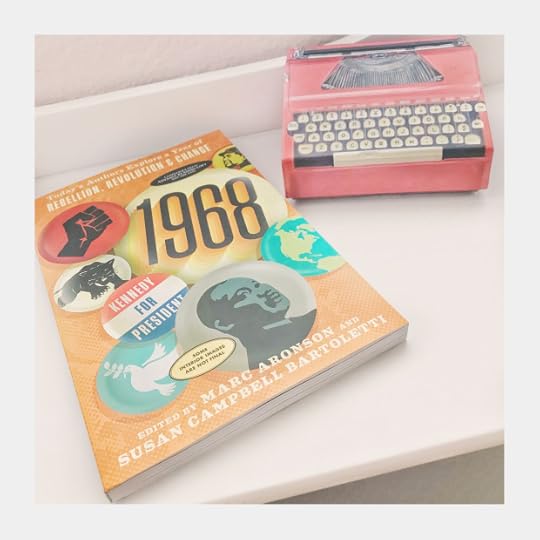
1968: Today's Authors Explore a Year of Rebellion, Revolution, and Change
Welcome to 1968 — a revolution in a book. Essays, memoirs, and more by fourteen award-winning authors offer unique perspectives on one of the world’s most tumultuous years.
Nineteen sixty-eight was a pivotal year that grew more intense with each day. As thousands of Vietnamese and Americans were killed in war, students across four continents took over colleges and city streets. Assassins murdered Dr. King and Robert F. Kennedy. Demonstrators turned out in Prague and Chicago, and in Mexico City, young people and Olympic athletes protested. In those intense months, generations battled and the world wobbled on the edge of some vast change that was exhilarating one day and terrifying the next. To capture that extraordinary year, editors Marc Aronson and Susan Campbell Bartoletti created an anthology that showcases many genres of nonfiction. Some contributors use a broad canvas, others take a close look at a moment, and matched essays examine the same experience from different points of view. As we face our own moments of crisis and division, 1968 reminds us that we’ve clashed before and found a way forward — and that looking back can help map a way ahead.
With contributions by:
Jennifer Anthony
Marc Aronson
Susan Campbell Bartoletti
Loree Griffin Burns
Paul Fleischman
Omar Figueras
Laban Carrick Hill
Mark Kurlansky
Lenore Look
David Lubar
Kate MacMillan
Kekla Magoon
Jim Murphy
Elizabeth Partridge
Nineteen sixty-eight was a pivotal year that grew more intense with each day. As thousands of Vietnamese and Americans were killed in war, students across four continents took over colleges and city streets. Assassins murdered Dr. King and Robert F. Kennedy. Demonstrators turned out in Prague and Chicago, and in Mexico City, young people and Olympic athletes protested. In those intense months, generations battled and the world wobbled on the edge of some vast change that was exhilarating one day and terrifying the next. To capture that extraordinary year, editors Marc Aronson and Susan Campbell Bartoletti created an anthology that showcases many genres of nonfiction. Some contributors use a broad canvas, others take a close look at a moment, and matched essays examine the same experience from different points of view. As we face our own moments of crisis and division, 1968 reminds us that we’ve clashed before and found a way forward — and that looking back can help map a way ahead.
With contributions by:
Jennifer Anthony
Marc Aronson
Susan Campbell Bartoletti
Loree Griffin Burns
Paul Fleischman
Omar Figueras
Laban Carrick Hill
Mark Kurlansky
Lenore Look
David Lubar
Kate MacMillan
Kekla Magoon
Jim Murphy
Elizabeth Partridge
208 pages, Hardcover
First published September 11, 2018
About the author
Marc Aronson
56 books84 followersAronson has won many awards for his books for young readers and has a doctorate in American history. His lectures cover educational topics such as mysteries and controversies in American history, teenagers and their reading, the literary passions of boys, and always leave audiences asking for more.
http://us.macmillan.com/author/marcar...
http://us.macmillan.com/author/marcar...
Ratings & Reviews
Friends & Following
Create a free account to discover what your friends think of this book!
Community Reviews
Displaying 1 - 30 of 30 reviews

June 15, 2018
I received this book for free through LibraryThing’s Early Reviewers.
1968 was a fascinating year. This book was not.
I was really looking forward to reading this book because I wanted to learn more about this pivotal year in history. So many important events happened in that year and I was hoping to find some interesting insight into them. Unfortunately, the book left much to be desired.
The book consists of essays from different authors. None of the essays resonated with me. I kept waiting for one to really hit me, but it never happened. Even the ones about the topics I was especially interested in (ex. Kennedy assassination and Mexico City Olympics), didn’t leave much of an impression on me.
There were a few things I liked. One was that the last essay did provide a conclusion to the book. Sometimes with nonfiction books, there’s no wrap up at the end when I feel like there should be one. Luckily, this book did provide some closure.
I also liked the Nightly News segment at the beginning of each section. Those were one of the more interesting pieces to read.
Lastly, the parallels the book made comparing 1968 to 2018 were very interesting and thought provoking.
Overall, the book provides a good baseline to the events of 1968, but ultimately did not manage to do it in an engaging way.
1968 was a fascinating year. This book was not.
I was really looking forward to reading this book because I wanted to learn more about this pivotal year in history. So many important events happened in that year and I was hoping to find some interesting insight into them. Unfortunately, the book left much to be desired.
The book consists of essays from different authors. None of the essays resonated with me. I kept waiting for one to really hit me, but it never happened. Even the ones about the topics I was especially interested in (ex. Kennedy assassination and Mexico City Olympics), didn’t leave much of an impression on me.
There were a few things I liked. One was that the last essay did provide a conclusion to the book. Sometimes with nonfiction books, there’s no wrap up at the end when I feel like there should be one. Luckily, this book did provide some closure.
I also liked the Nightly News segment at the beginning of each section. Those were one of the more interesting pieces to read.
Lastly, the parallels the book made comparing 1968 to 2018 were very interesting and thought provoking.
Overall, the book provides a good baseline to the events of 1968, but ultimately did not manage to do it in an engaging way.

March 16, 2019
This is an anthology of various writers' takes on the year 1968. Some tied it explicitly to the year Some told aspects of the year by extending their own personal histories. Others actually did research to find out what interested them and then wrote it down, hoping we would agree. For the record, I found all the chapters interesting. I also found it directly linked to today, specifically. Today youth all around the world marched for the Climate which was arranged via computers, Facebook, and smart phones. It made me wonder how much impact the youth of 1968 or the how various activists would have extended their impact if they had been able to use smart phones and the internet to reach out to others. Certainly the massacre in Mexico wouldn't have been such a secret (see the chapter 'Student Sacrifices' by Omar Figureras).
I cannot quite trace what brought this book to my attention. I thought it would have been the ALA youth media awards but apparently not. Nonetheless, I am glad I read it and recommend it to others.
I cannot quite trace what brought this book to my attention. I thought it would have been the ALA youth media awards but apparently not. Nonetheless, I am glad I read it and recommend it to others.

June 20, 2023
Wow! Great historical insights what was happening in 1968 in the United States, and around the world. This book put a lot of names and occurrences (ok, yes, riots) in historical context for me. Each chapter, written by a variety of well-known children’s and YA authors, explores a different event and the connection it may’ve had to that particular author’s life: from the assassination of Martin Luther King, Jr, to the cultural revolution in China—the significance of the Smothers Brother’s Comedy Hour (which I watched), to the escalation of the war in Vietnam. The book addresses not only the historical context, but also how that history has shaped events and attitudes in our world today. Have we learned or are we just repeating history with slight variation? A compelling question. I loved this fascinating non-fiction glimpse into a pivotal year.

January 15, 2019
Thank you Candlewick Press and Netgalley for an ARC of this book.
I really enjoyed reading this book and learning so much about an important to me year ! I learned lots about this period of time and found the book highly informative.
Highly recommended reading.
I really enjoyed reading this book and learning so much about an important to me year ! I learned lots about this period of time and found the book highly informative.
Highly recommended reading.
October 1, 2020
I was eleven year old in 1968. Indeed a pivotal year, very similar to issues we are facing today. We even had a pandemic called The Hong Kong Flu that affected children. It's very uncanny how history repeats itself. One of my favorite quotes in the book says ...we can not walk away and ignore the past and the present.... we are too interconnected... we cannot repair the past but must repair the present as well....
July 22, 2025
Definitely very informative and it was cooling seeing many stories from many perspectives

November 2, 2018
Excellent writing and fascinating and different points of view on events all around the world in 1968. I learned a lot and found hope for today in its pages.

gave_up
October 22, 2018Not yet at any library system in the area (DC, Mont, HC). After today's Cap Choices meeting (12/14), I now have the ARC at home.
I read a few of these, and found the writing to be very uneven. We didn't pick it for our Cap Choices list, and I'm not sure whether I'll finish it.
I read a few of these, and found the writing to be very uneven. We didn't pick it for our Cap Choices list, and I'm not sure whether I'll finish it.
October 20, 2019
The year 1968 is MY year, so I'm always interested in books that delve into the complicated events and people of that year. This book is really fascinating, because it collects so many diverse authors together to share their experiences of or connections to events and social movements of 1968. There are essays on the assassinations of Robert F. Kennedy and Martin Luther King, Jr, of course, but also international events such as the Prague Spring uprising, the Mexico City police massacre of protestors, the Cultural Revolution in China (Red Guard teens destroying property and turning in 'elitists'), and Paris student protests. Other highlights for me included the very personal essay by author Paul Fleischman about his first 200-mile bike ride with a friend, as he was a teen and just beginning to assert his independence. David Lubar examines the comedy of the times, whether stand-up or TV variety shows or political humor (The Smothers Brothers). One essay is very science-detailed, all about the 1968 Nobel Prize for coding of DNA proteins. And editor Marc Aronson ties the whole thing together at the end with his essay on Douglas Englebart (I'd never heard of him) and his tech 1968 conference presentation on groundbreaking computer concepts that were way before their time: the mouse, split screen, linked files (hello HTML), messaging, and the internet! I had no idea so much of that was thought up that early. Unfortunately he never was able to capitalize on his inventions; the people who worked for him went on to great heights, but he got involved in a cult and didn't do so well. The author's notes at the back of the book are mini-bios of each author and tell what led each author to choose and research their particular topic, whether it was from personal experience or a family connection or whatever. The chapters all have source notes and there is a bibliography. I don't know how much "teen appeal" it will have, but for any teen needing a good resource for a research paper on the sixties, this will definitely be a good place to start.

Read
August 27, 2018I was very excited to read this having been an excitable, peacenik 15 year old for most of 1968. Found it a mixed bag.
I especially appreciated Paul Fleischman on a bike trip, Kekla Magoon on Kennedy and King, Lenore Look on the Cultural Revolution (possibly my favorite of all), Laban Carrick Hill's on family racism, Bartoletti's on Abbie Hoffmann and the Yippies (especially Chicago), and Omar Figueras on student protests in Mexico.
While the subtitle indicates the contributors are all authors they are not --- a librarian writes her memories of being in Paris during the student uprisings of 1968. Most puzzling to me is the essay on the Columbia University strike --- the author's bio gives no sense of what her connection is or who she is for that matter. I happen to be especially familiar with that topic as my father joined the Columbia faculty the fall before the strike --- poli sci no less --- and so I had a very front row seat to what was going on --- I was 15 at the time. I went to college there a couple of years later so the radical culture was still alive and well then.
Perspective is overly white --- I would have appreciated reading about some of these important events from a black point of view, say the Black Panthers, Mexico City Olympics, etc. Missing the Poor People's Campaign, protests at Howard, Kerner Commission report and more.
I especially appreciated Paul Fleischman on a bike trip, Kekla Magoon on Kennedy and King, Lenore Look on the Cultural Revolution (possibly my favorite of all), Laban Carrick Hill's on family racism, Bartoletti's on Abbie Hoffmann and the Yippies (especially Chicago), and Omar Figueras on student protests in Mexico.
While the subtitle indicates the contributors are all authors they are not --- a librarian writes her memories of being in Paris during the student uprisings of 1968. Most puzzling to me is the essay on the Columbia University strike --- the author's bio gives no sense of what her connection is or who she is for that matter. I happen to be especially familiar with that topic as my father joined the Columbia faculty the fall before the strike --- poli sci no less --- and so I had a very front row seat to what was going on --- I was 15 at the time. I went to college there a couple of years later so the radical culture was still alive and well then.
Perspective is overly white --- I would have appreciated reading about some of these important events from a black point of view, say the Black Panthers, Mexico City Olympics, etc. Missing the Poor People's Campaign, protests at Howard, Kerner Commission report and more.

January 5, 2021
Buy this book. So good.
Page 160&161:
The crises that mean everything in the present may not be the best predictors of what will come to be the most significant in the future. ... how do you weigh technological progress again social progress? Since 1968 untold billions of dollars have been poured into making faster chips, better displays, more robust computers. We can see the effects of that investment in endless generations of new devices. But the influence of the ideals for which Martin Luther King Junior and Robert F Kennedy gave their lives, the impact of the dreams of the protesters in Mexico City, Paris, New York, Chicago, and Prague: these are harder to trace. Perhaps this just shows how mesmerized we are by technology. What if we had put the same national and international effort as was poured into computers into dealing with our social divisions? What if we all still use clunky mainframe computers; and lived in a more just society? That is the question of proprieties that you will have to consider over the next 50 years.
1968, edited by Aronson and bartoletti
Page 160&161:
The crises that mean everything in the present may not be the best predictors of what will come to be the most significant in the future. ... how do you weigh technological progress again social progress? Since 1968 untold billions of dollars have been poured into making faster chips, better displays, more robust computers. We can see the effects of that investment in endless generations of new devices. But the influence of the ideals for which Martin Luther King Junior and Robert F Kennedy gave their lives, the impact of the dreams of the protesters in Mexico City, Paris, New York, Chicago, and Prague: these are harder to trace. Perhaps this just shows how mesmerized we are by technology. What if we had put the same national and international effort as was poured into computers into dealing with our social divisions? What if we all still use clunky mainframe computers; and lived in a more just society? That is the question of proprieties that you will have to consider over the next 50 years.
1968, edited by Aronson and bartoletti

January 4, 2019
Collection of short stories about things that happened in the year 1968. Includes perspectives from around the world, including China, VietNam. Broken into quarters of the year and interspersed with "news reports" from VietNam. This was the year before I was born and there was a lot happening: civil rights, VietNam War, cultural revolution in China. It was interesting to read about those things from people who lived it, especially since many of them intertwined and told them from opposing viewpoints. Some more engaging than others. Not sure how engaging they will be for students 12-18. I had ARC, so pics and captions not finalized. I think my favorite story was the one about the Olympic athletes who raised their fists as it is so relevant to the football players who are kneeling for the anthem currently.
October 19, 2018
I remember so much many events from this year- Dr Martin Luther King and Robert Kennedy beiung shot and killed, My Lai massacre, Viet Nam War protests... so much was going on that year, so much I was a bit too young to understand. Curiosity about that year led me to requesting to read this book and I'm not sorry I did. It was very enlightening. What a pivotal year it was. I think it would be a good read for us younger baby boomers to read about what we were on the cusp of and also how the world changed because of that year. All those who came after us would benefit from reading it too just to see what the older baby boomers witnessed, reacted to and changed. Amazing collection of non-fiction works be contemporary authors.

December 11, 2018
1968 was a momentous year in history. The Vietnam War was at its height and protests were also at a height. The Reverend Martin Luther King, Jr. and Robert Kennedy, Jr. were both assassinated, there were protests in Chicago at the Democratic Convention, Mexico City just ahead of the 1968 Mexico Olympics, at the Olympics, in Prague, and in Paris. China was undergoing a “Cultural Revolution.” This book of essays covers historic events that took place 50 years ago and many of these issues are still relevant today. The editors offer this book in hopes readers will reflect on issues and protests from 1968 and how they have shaped our world today. Some pieces are memoirs, others are extensively-researched. The book includes author notes, source notes, bibliography, and index.

May 20, 2019
This book is a MUST read for history lovers and readers who never lived through 1968 or were too young to fully grasp the social complexities of both this nation and nations around the world. The format of this book--a collection of essays--was appealing, as it brought multiple perspectives to the turmoil that so many were experiencing socially and politically. I learned so much about the way RFK and MLK's assassinations impacted American politics, the Vietnam War, the Olympics, and the geopolitical climate in 1968. This book was an excellent collection of diverse voices that highlighted a world that looked very different from the one I studied in history!

February 19, 2026
This book is a collection of pieces written by different authors. Several of them lived through the events about which they write. Others are working from research. The collection gives a world-wide view of this year and issues that made headlines. Some are more interesting than others, but all are well-written.
As someone who was a teen-ager at the time, these events recalled moments from that year.
I found reading this to be a bit nostalgic. Also, based on the often disappointing awareness of how little some of these things changed the world, especially for the better, I also had a real sense of sadness.
As someone who was a teen-ager at the time, these events recalled moments from that year.
I found reading this to be a bit nostalgic. Also, based on the often disappointing awareness of how little some of these things changed the world, especially for the better, I also had a real sense of sadness.

November 4, 2018
Did I become politically aware in 1968 because I was eight years old? Did I become politically aware in 1968 because so much happened politically?
We didn't have a television until 1970 so the television I did see comes with landmarks. I remember walking into my great-grandparents' day room while visiting them in Berkeley and seeing footage following Bobby Kennedy's assassination. I remember visiting my grandparents' and seeing footage of the Vietnam War.
I enjoyed reading the essays of some favorite authors.
I'd recommend this book to readers who enjoy history.
We didn't have a television until 1970 so the television I did see comes with landmarks. I remember walking into my great-grandparents' day room while visiting them in Berkeley and seeing footage following Bobby Kennedy's assassination. I remember visiting my grandparents' and seeing footage of the Vietnam War.
I enjoyed reading the essays of some favorite authors.
I'd recommend this book to readers who enjoy history.

December 30, 2018
An interesting combination of perspectives are shared in this collection of essays. Some are memoir, others are essays highlighting an individual and their contribution to that year of great change. A few are overviews of the groundswell of rebellion within a geographic location.
My only disappointment was the limited inclusion of the music scene of the era. Like many, I believe music (specifically folk and rock lyrics) was the vehicle by which the generation's message was conveyed to the masses.
Overall, a very interesting read, recommended.
My only disappointment was the limited inclusion of the music scene of the era. Like many, I believe music (specifically folk and rock lyrics) was the vehicle by which the generation's message was conveyed to the masses.
Overall, a very interesting read, recommended.

December 12, 2022
The concept around the book that is a collection of short story nonfiction about a date (in this case 1968) is a great idea, however it wasn't as intense or introspective, using specific stories of people's lived experiences or research to share the time.
I learned a few new things which I liked AND I loved the introduction that talks about the purpose and focus of nonfiction. YES! It's a dive into the year and I can see it being a fun student project to create something similar around a date for school.
I learned a few new things which I liked AND I loved the introduction that talks about the purpose and focus of nonfiction. YES! It's a dive into the year and I can see it being a fun student project to create something similar around a date for school.
October 17, 2018
Couldn’t put this book down.
With chapters on international revolutions, assassinations, college campus life, Olympic protest, occupations, scientific development, variety shows, Abbie Hoffman, and more, it boggles the mind that so many pivotal events could’ve transpired in just one 12-month span.
This would make a terrific inter-generational read for teens and their grandparents, an interesting opportunity to reflect on that tumultuous year -- and this one.
With chapters on international revolutions, assassinations, college campus life, Olympic protest, occupations, scientific development, variety shows, Abbie Hoffman, and more, it boggles the mind that so many pivotal events could’ve transpired in just one 12-month span.
This would make a terrific inter-generational read for teens and their grandparents, an interesting opportunity to reflect on that tumultuous year -- and this one.
August 4, 2021
I think that the essays in this book bring a great deal of insight to some of the issues from 1968. Issues have so many sides that it helps to see them through the eyes and memories of people who "were there." If a student were doing research on one of these subjects, I think these essays would be particularly insightful and resonant but even as a general read for knowledge and breadth of perspective I found it very engaging.

January 1, 2019
This is a great collection of essays, personal stories, etc. about the turbulent year of 1968. Any of these essays would be great as a nonfiction pairing with "The Things They Carried."

August 22, 2019
I liked 2-3 of the short stories, but overall I felt like some of the authors assumed that you understood the history behind their stories and I didn't. I liked the following three stories best: "Running into History"; "The Wrong Side of History" and "Running with Schticks".

November 2, 2019
Interesting and informative.
June 21, 2020
Very readable. 1968 was a massive year!


November 24, 2020
Short, love the diverse perspectives, fast paced. Definitely gives the vibe of 1968. Makes me want to learn more about the year! Would read another book like this compiled by these two.

January 1, 2019
More like 3 1/2 stars. Nominally a YA book but I'd recommend it to anyone interested in this pivotal year. The essays cover little-remembered events as well as the more famous ones. The essays about the Chinese Cultural Revolution and the Mexican and French student demonstrations were fascinating. There's an essay about changing comedy routines and another about long-distance bike riding. The annotations and authors' notes are informative.
June 6, 2018
Advance Reading Copy

November 16, 2018
1968: a year of exaltation, complete freedom and rebellion against the establishment; the past years had meant to the USA a lot of unwanted changes.
The terrible assassination of President John Fitzgerald Kennedy in Dallas on November 22 1963, meant the end of a lot of hopes, like peace and dialogue with the rest of the world for the USA. The assassination of Martin Luther King and Robert Kennedy, the first one a leader who fought with energy and pacifically for the rights of black people, the second brother of John Kennedy running for the Presidential campaign, meant another sad signal for the country.
In this canvas, pretty chaotic and dark, a crescent turmoil and dissatisfaction from every possible parts: women recriminated more rights; black people more rights, minorities as gays and lesbians more rights; people in general wanted a pacific country and the end of the Vietnam war. The frame?
Imagine them: young people from high school, from universities, idealist, in grade still of dreaming a better future; they wanted to fight for a different world with all their strength, asking to politicians in every possible way a different system, more equal, more inspired at good values, less hypocritical more close to common people. Their requests passed through every kind of rights: 1968? The wildest and at the same time sunniest movement never experienced and in grade of becoming important in Europe as well.
For this reason at 50 years of distance Candlewick publishes 1968:
Today’s Authors Explore a Year of Rebellion, Revolution, and Change Edited by Marc Aronson and Susan Campbell Bartoletti.
Beautiful you will love this anthology in grade of speaking to the heart of people.
I am optimistic: I see that the newest generations are fighting in the USA for great values and that the wind of the 1968 hasn't been forgotten at all but it is alive.
Unforgettable! You can't avoid to read it. Beautiful gift for teenagers! I want to recommend to parents these gits to their children. I know: teen age age is a particular phase but it is better a revolutionary teenager than not someone too comfy to the system. This is more than sure! Don't be scared of offering some slices of revolution to your son or your daughter, presenting to them the sweet taste of protest. Your son or daughter will grow up more intelligently.
And, more important, as it happened to the protagonists of this book: they won't never forget what it meant rebellion.
I thank NetGalley and Candlewick Press for this eBook.
The terrible assassination of President John Fitzgerald Kennedy in Dallas on November 22 1963, meant the end of a lot of hopes, like peace and dialogue with the rest of the world for the USA. The assassination of Martin Luther King and Robert Kennedy, the first one a leader who fought with energy and pacifically for the rights of black people, the second brother of John Kennedy running for the Presidential campaign, meant another sad signal for the country.
In this canvas, pretty chaotic and dark, a crescent turmoil and dissatisfaction from every possible parts: women recriminated more rights; black people more rights, minorities as gays and lesbians more rights; people in general wanted a pacific country and the end of the Vietnam war. The frame?
Imagine them: young people from high school, from universities, idealist, in grade still of dreaming a better future; they wanted to fight for a different world with all their strength, asking to politicians in every possible way a different system, more equal, more inspired at good values, less hypocritical more close to common people. Their requests passed through every kind of rights: 1968? The wildest and at the same time sunniest movement never experienced and in grade of becoming important in Europe as well.
For this reason at 50 years of distance Candlewick publishes 1968:
Today’s Authors Explore a Year of Rebellion, Revolution, and Change Edited by Marc Aronson and Susan Campbell Bartoletti.
Beautiful you will love this anthology in grade of speaking to the heart of people.
I am optimistic: I see that the newest generations are fighting in the USA for great values and that the wind of the 1968 hasn't been forgotten at all but it is alive.
Unforgettable! You can't avoid to read it. Beautiful gift for teenagers! I want to recommend to parents these gits to their children. I know: teen age age is a particular phase but it is better a revolutionary teenager than not someone too comfy to the system. This is more than sure! Don't be scared of offering some slices of revolution to your son or your daughter, presenting to them the sweet taste of protest. Your son or daughter will grow up more intelligently.
And, more important, as it happened to the protagonists of this book: they won't never forget what it meant rebellion.
I thank NetGalley and Candlewick Press for this eBook.
Displaying 1 - 30 of 30 reviews