

What do you think?

Enemies and Neighbors: Arabs and Jews in Palestine and Israel, 1917-2017
In Enemies and Neighbors , Ian Black, who has spent four decades studying and covering the Middle East, offers a major new history of the Arab-Zionist conflict, told from both sides. Setting the scene at the end of the 19th century, when the first Zionist settlers arrived in the Ottoman-ruled Holy Land, Black draws on a wide range of sources―from declassified documents to oral testimonies to his own vivid-on-the-ground reporting―to illuminate the most polarizing conflict of modern times. Taking the 1917 Balfour Declaration, the British government’s fateful promise to favor the establishment of “a national home for the Jewish people” in Palestine, as its first major milestone, the story proceeds through the Arab Rebellion of the late 1930s, the Nazi Holocaust, Israel’s independence and the Palestinian Nakba (catastrophe), the watershed of 1967 followed by the Palestinian re-awakening, Israel’s settlement project, two Intifadas, the Oslo Accords, and continued negotiations and violence up to today. Combining engaging narrative with political analysis and social and cultural insights, Enemies and Neighbors is both an accessible overview and a fascinating investigation into the deeper truths of a furiously contested history that has preserved Palestinians and Israelis as unequal enemies and neighbors.
640 pages, Paperback
First published November 1, 2017
About the author
Ian Black
3 books26 followersIan Black is a British journalist and author focusing on international political issues.
https://en.wikipedia.org/wiki/Ian_Bla...
Librarian Note:
There is more than one author in the Goodreads database with this name.
https://en.wikipedia.org/wiki/Ian_Bla...
Librarian Note:
There is more than one author in the Goodreads database with this name.
Ratings & Reviews
Friends & Following
Create a free account to discover what your friends think of this book!
Community Reviews
Displaying 1 - 30 of 191 reviews

December 3, 2017
I recently finished reading Ian Black’s book; Enemies and Neighbours, which is a history of the Arab-Zionist conflict from 1917 till 2017, one hundred years of historical events after the Balfour Declaration. For those not aware of its contents this is the Balfour Declaration as set down by the British government in 1917:
His Majesty's Government view with favour the establishment in Palestine of a national home for the Jewish people, and will use their best endeavours to facilitate the achievement of this object, it being clearly understood that nothing shall be done which may prejudice the civil and religious rights of existing non-Jewish communities in Palestine, or the rights and political status enjoyed by Jews in any other country.
As the author comments in his book: "The sixty-seven typewritten words of the Balfour Declaration combined considerations of imperial planning, wartime propaganda, biblical resonances and a colonial mindset, as well as evident sympathy for the Zionist idea. With them, as the writer Arthur Koestler was to quip memorably - neatly encapsulating the attendant and continuing controversy - 'one nation solemnly promised to a second nation the country of a third'."
I wanted to think about what I was going to say about this book, as I know that this issue is a very divisive issue with no apparent middle ground. It seems you can only have one point of view on this subject, you can be on one side or the other and whatever side you take you are labelled either an anti-Semite or a Zionist. Its sad that this issue has become so hateful, and that is one reason why trying to find a solution to the conflict between the Palestinians and the Israeli’s seems to be a Sisyphean struggle for whoever attempts to find a way to fix this problem.
The author highlights this ever-continual thread that has weaved its way through this perpetual conflict in the region with numerous quotes from players on both sides. For example this quote from the 1937 Peel Commission Report:
"An irrepressible conflict has arisen between two national communities within the narrow bounds of one small country. There is no common ground between them. Their national aspirations are incompatible."
And again in this warning from a small Marxist anti-Zionist group in Israel in 1967: 'Our right to defend ourselves against destruction does not confer upon us the right to oppress others', it declared: "Occupation brings foreign rule; foreign rule brings resistance; resistance beings repression; repression brings terror and counter-terror; the victims of terror are usually innocent people. The retention of the occupied territories will turn us into a nation of murderers and murder victims, let us leave the occupied territories immediately."
I think this is a book that needs to be widely read, and please, if you already had a position on this issue, try to read it with an open mind. I did and I believe that the author has attempted to tell the story of these past one hundred years of conflict and strife in a non-biased and factual way. Both sides have right and wrong on their side; both sides have at times acted duplicitously and with malicious intent, both sides have conducted merciless campaigns of aggression with the main victims being innocent civilians on both sides of the wall.
I expect that my point of view as expressed in this review will be attacked by some as being simplistic and not ‘living’ the conflict as others do but I hope that my view as seen from outside is mirrored by others. I can only hope that at some stage in the near future someone will have the strength and the vision to bring peace to all people in this conflict zone, a peace that is fair, honourable and lasting to both sides, however after reading this book I really doubt that this may be at all possible.
To conclude here is an excellent observation about Palestinian youth from a Shin Bet agent in the early 2000's:
" ... The moment that you reach the conclusion that you have nothing to live for, you immediately find that you have something to die for."
His Majesty's Government view with favour the establishment in Palestine of a national home for the Jewish people, and will use their best endeavours to facilitate the achievement of this object, it being clearly understood that nothing shall be done which may prejudice the civil and religious rights of existing non-Jewish communities in Palestine, or the rights and political status enjoyed by Jews in any other country.
As the author comments in his book: "The sixty-seven typewritten words of the Balfour Declaration combined considerations of imperial planning, wartime propaganda, biblical resonances and a colonial mindset, as well as evident sympathy for the Zionist idea. With them, as the writer Arthur Koestler was to quip memorably - neatly encapsulating the attendant and continuing controversy - 'one nation solemnly promised to a second nation the country of a third'."
I wanted to think about what I was going to say about this book, as I know that this issue is a very divisive issue with no apparent middle ground. It seems you can only have one point of view on this subject, you can be on one side or the other and whatever side you take you are labelled either an anti-Semite or a Zionist. Its sad that this issue has become so hateful, and that is one reason why trying to find a solution to the conflict between the Palestinians and the Israeli’s seems to be a Sisyphean struggle for whoever attempts to find a way to fix this problem.
The author highlights this ever-continual thread that has weaved its way through this perpetual conflict in the region with numerous quotes from players on both sides. For example this quote from the 1937 Peel Commission Report:
"An irrepressible conflict has arisen between two national communities within the narrow bounds of one small country. There is no common ground between them. Their national aspirations are incompatible."
And again in this warning from a small Marxist anti-Zionist group in Israel in 1967: 'Our right to defend ourselves against destruction does not confer upon us the right to oppress others', it declared: "Occupation brings foreign rule; foreign rule brings resistance; resistance beings repression; repression brings terror and counter-terror; the victims of terror are usually innocent people. The retention of the occupied territories will turn us into a nation of murderers and murder victims, let us leave the occupied territories immediately."
I think this is a book that needs to be widely read, and please, if you already had a position on this issue, try to read it with an open mind. I did and I believe that the author has attempted to tell the story of these past one hundred years of conflict and strife in a non-biased and factual way. Both sides have right and wrong on their side; both sides have at times acted duplicitously and with malicious intent, both sides have conducted merciless campaigns of aggression with the main victims being innocent civilians on both sides of the wall.
I expect that my point of view as expressed in this review will be attacked by some as being simplistic and not ‘living’ the conflict as others do but I hope that my view as seen from outside is mirrored by others. I can only hope that at some stage in the near future someone will have the strength and the vision to bring peace to all people in this conflict zone, a peace that is fair, honourable and lasting to both sides, however after reading this book I really doubt that this may be at all possible.
To conclude here is an excellent observation about Palestinian youth from a Shin Bet agent in the early 2000's:
" ... The moment that you reach the conclusion that you have nothing to live for, you immediately find that you have something to die for."

April 11, 2025
I had never read a detailed history of this terrible conflict before, just bits and pieces here and there. This book looked like a good, detailed account, and it was. It goes right up to 2017. The reader of today knows what will be coming along six years after that, an explosion of horror that throws an appalling shadow over all these previous events. Reading this history is like watching a horror movie – don’t go in that house! don’t make that decision! – but all the characters make the wrong awful decisions, nothing can stop them. And it’s also like a tremendous Shakespearian tragedy, there’s an implacable hideous inevitability about everything that happened in Palestine.
David Ben-Gurion in 1918 :
Not everybody sees that there is no solution to this question. No solution! There is a gulf and nothing can fill this gulf. …I do not know what Arab will agree that Palestine should belong to the Jews ... And we must recognise this situation. …We, as a nation, want this country to be ours; the Arabs, as a nation, want this country to be theirs.
These days everyone talks vaguely about the Two State Solution. It seems ever more like a mirage. The Palestinian Center for Policy and Survey Research reported in 2023 that 82% of Israeli Jews and 75% of Palestinians believe the other side would never accept the existence of their state.
THE BALFOUR DECLARATION
a letter from British Foreign Secretary Arthur Balfour to Lord Walter Rothschild in 1917
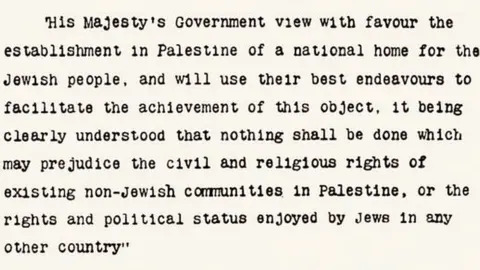
So this was not a statement from the government itself. It was a lofty well-meaning gracious nod from one grandee to another. But it had the effect of an earthquake.
A FAMOUS QUOTE FROM ARTHUR KOESTLER REGARDING THE BALFOUR DECLARATION
One nation solemnly promised to a second nation the country of a third.
SOME QUOTES
Some quotes in this book jumped out at me, such as this poignant one from Ahmad Samih Khalidi, a Palestinian writer :
For us to adopt the Zionist narrative would mean that the homes that our forefathers built, the land that they tilled for centuries, and the sanctuaries they built and prayed at were not really ours at all, and that our defense of them was morally flawed : we had no right to any of these to begin with.
Now let’s hear a painful burst of optimism from Theodore Herzl, the founder of Zionism :
Do you believe that an Arab who has a house or land in Palestine whose value is three or four thousand francs will greatly regret seeing the price of his land rise five or tenfold? For that is necessarily what will happen as the Jews come; and this is what must be explained to the inhabitants of the country. They will acquire excellent brothers, just as the Sultan will acquire loyal and good subjects, who will cause the region, their historic fatherland, to flourish.
This is dashed by a blast of common sense from Russian Zionist Vladimir Jabotinsky :
Every native population in the world resists colonialists as long as it has the slightest hope of being able to rid itself of the danger of being colonised. That is what the Arabs in Palestine are doing, and what they will persist in doing as long as there remains a solitary spark of hope that they will be able to prevent the transformation of “Palestine” into the ”Land of Israel”.
Whether Ian Black intended this or not, he gave me the strong impression in the first half of his book that the Arabs were doomed to failure, doomed to lose their country, that the Jewish immigrants were so much more educated, resourceful, they hadn’t been herding and grazing and farming in relative tranquility in a sleepy backwater of the vast Ottoman empire for 500 years, they came from the cities of Europe and from places of persecution, and they were done with being pushed around. The Arabic population seemed not to know what was happening to them until it was too late. Check these numbers – statistics are like weapons -
POPULATION OF PALESTINE
1918 : 512,000 Arabs; 66,000 Jews; 61,000 Christians
1922 : Jewish population 83,000 – this is now 11% of the total
1931 – Jewish population now 175,000 – 16.5% of the total
1936 – Jewish population 380,000 – almost 33% of the total
The immigrants bought land from the current owners, the Arabs. Clearly no Arab should ever have sold their land to the Jews! But they did, year after year! And this was “an embarrassing issue that has been little addressed in Palestine historical literature” says Ian Black.
As the book winds onward through all the twists and turns of almost-reasonable partition suggestions (The Peel Report 1937 argued for the Jews to get 25% of Palestine) and very-understandable rejections of partition and bubbling onrushing civil war population statistics give way to bodycounts, but I do not have the heart to quote any of those.
AND IN THE END
There will be no end. This conflict will outlive all of us. This is an excellent but depressing book.
David Ben-Gurion in 1918 :
Not everybody sees that there is no solution to this question. No solution! There is a gulf and nothing can fill this gulf. …I do not know what Arab will agree that Palestine should belong to the Jews ... And we must recognise this situation. …We, as a nation, want this country to be ours; the Arabs, as a nation, want this country to be theirs.
These days everyone talks vaguely about the Two State Solution. It seems ever more like a mirage. The Palestinian Center for Policy and Survey Research reported in 2023 that 82% of Israeli Jews and 75% of Palestinians believe the other side would never accept the existence of their state.
THE BALFOUR DECLARATION
a letter from British Foreign Secretary Arthur Balfour to Lord Walter Rothschild in 1917
So this was not a statement from the government itself. It was a lofty well-meaning gracious nod from one grandee to another. But it had the effect of an earthquake.
A FAMOUS QUOTE FROM ARTHUR KOESTLER REGARDING THE BALFOUR DECLARATION
One nation solemnly promised to a second nation the country of a third.
SOME QUOTES
Some quotes in this book jumped out at me, such as this poignant one from Ahmad Samih Khalidi, a Palestinian writer :
For us to adopt the Zionist narrative would mean that the homes that our forefathers built, the land that they tilled for centuries, and the sanctuaries they built and prayed at were not really ours at all, and that our defense of them was morally flawed : we had no right to any of these to begin with.
Now let’s hear a painful burst of optimism from Theodore Herzl, the founder of Zionism :
Do you believe that an Arab who has a house or land in Palestine whose value is three or four thousand francs will greatly regret seeing the price of his land rise five or tenfold? For that is necessarily what will happen as the Jews come; and this is what must be explained to the inhabitants of the country. They will acquire excellent brothers, just as the Sultan will acquire loyal and good subjects, who will cause the region, their historic fatherland, to flourish.
This is dashed by a blast of common sense from Russian Zionist Vladimir Jabotinsky :
Every native population in the world resists colonialists as long as it has the slightest hope of being able to rid itself of the danger of being colonised. That is what the Arabs in Palestine are doing, and what they will persist in doing as long as there remains a solitary spark of hope that they will be able to prevent the transformation of “Palestine” into the ”Land of Israel”.
Whether Ian Black intended this or not, he gave me the strong impression in the first half of his book that the Arabs were doomed to failure, doomed to lose their country, that the Jewish immigrants were so much more educated, resourceful, they hadn’t been herding and grazing and farming in relative tranquility in a sleepy backwater of the vast Ottoman empire for 500 years, they came from the cities of Europe and from places of persecution, and they were done with being pushed around. The Arabic population seemed not to know what was happening to them until it was too late. Check these numbers – statistics are like weapons -
POPULATION OF PALESTINE
1918 : 512,000 Arabs; 66,000 Jews; 61,000 Christians
1922 : Jewish population 83,000 – this is now 11% of the total
1931 – Jewish population now 175,000 – 16.5% of the total
1936 – Jewish population 380,000 – almost 33% of the total
The immigrants bought land from the current owners, the Arabs. Clearly no Arab should ever have sold their land to the Jews! But they did, year after year! And this was “an embarrassing issue that has been little addressed in Palestine historical literature” says Ian Black.
As the book winds onward through all the twists and turns of almost-reasonable partition suggestions (The Peel Report 1937 argued for the Jews to get 25% of Palestine) and very-understandable rejections of partition and bubbling onrushing civil war population statistics give way to bodycounts, but I do not have the heart to quote any of those.
AND IN THE END
There will be no end. This conflict will outlive all of us. This is an excellent but depressing book.

August 15, 2019
Enemies and Neighbors is one of, if not the, best researched book I’ve read on the subject of the Israeli-Palestinan conflict. Extremely insightful and detailed, it is a very interesting read for whoever is interested on that conflict. Nevertheless, it presents itself as a book that “tries to tell the story of both sides” (p. xix) when it clearly villainies one and victimizes an other, manipulating the sources to make Israel look like the evil in the story.
Firstly, he makes it seem like the reason behind Zionism as a movement was nostalgia for their ancient homeland (p. xxi), as opposed to the anti-semitism of Eastern European countries in the late 19th/early 20th century, which he doesn’t mention. When one goes through Herzl, Ha’am, Jabotinsky, Weissman and Ben-Gurion writings, it’s painfully obvious that Israel’s role was a refuge for Jews against anti-semitism.
Outside of historical errors like those, that make it harder to comprehend the problem in all its complexity, the narrative is clearly design to make the reader more compassionate of the Palestinian cause than the Zionist one. For example, when he explains how the 1947 partition was, in his view, unfair to the Israeli side, he states how “Jews were to obtain 55% of Palestine when they owned only 7% of Palestinian private land.” (p. 107), which leaves the reader to assume that Arabs owned the other 93%, when in reality, they owned 24% of it. The remaining 69% was owned by the English.
When speaking about the 1948 war, for example, he fails to acknowledge how devastating the war was for Israel too, and that it wasn’t a piece of cake for them to win it (they actually lost 1% of their population there). Over the course of that chapter, it’s clear how he manipulates the historical record of events throughout language or plain leaving-out events. When he speaks of the Deir Yassin massacre, for example, he makes no mention of how the Jewish Agency and the Hagganah, as well as David Ben-Gurion were quick to condemn the attack. Afterwards, he barely mentions the Arab revenge of the Haddasah convoy, where 78 Jewish doctors, nurses and patients where killed by Palestinan nationalist. The reader starts to note a trend in the description of Jewish and Palestinan attacks on each other: he goes on to humanize the victims of Deir Yassin and graphically describes the murder or some of them, quickly condemning the act as “brutality” by Israel. However, when talking about the Hadassah convoy, he only uses the word “killed” and doesn’t condemn the act. It is hardly an isolated case, when he first introduces Hamas, he refers to it as “a resistance movement”, just after having called Irgun “a terrorist organization”.
In the pages 250 and 251, he correctly points out how the bombing of two Palestinian mayors should be defined as “terrorism”. Nonetheless, on the very same pages he talks about the Fatah killing of four Israeli citizens ad ab example of their “efficacy of armed action.” There is no mention of terrorism here, or when four members of the PLO killed an elderly man on a wheelchair (p.267), or the multiple suicide bombings during the 1990s and early 2000s that killed multiple children, or the bombing of a pizzeria on 2001 (p. 382). All these actions immediately followed by exculpation of Yasser Arafat, who is given an extremely romanticized and heroic figure through the book.
When describing these acts, he always seems to personalize and humanize the Palestinan victims and “martyrs”, while Israeli losses are painted in a much more general picture. One example is the assassination of 20 Israeli citizens killed in a restaurant in Haifa in 2003 (p. 396): he does not tell us that entire families of grandparents, parents and grandchildren were wiped out in the event, or that two of the victims were children of Holocaust survivors, and their only child, 10 years old at the moment, survived and has been blind ever since. Black, instead, decides to tell the story of the bomber, a woman from Jenin who was named Hanadi Tayasser Darajat, was studying law, and was avenging the death of a brother that had been killed by the Israelis.
On the Palestinan side, the victims are always human: in July 2006, a twelve-year old was killed by a “ruthless explosion” while on his donkey cart to pick strawberries (p.412). Or the figure of a father collecting his son’s dismembered remains in a plastic bag (p. 453). On the Israeli side “x number were killed” and it always was preceded by previous incitement. The Palestinians “fighters” had invariably personal justification for their actions: the lynching of two Israelis had come after the attacker had “snapped the intolerable pressure of Israel’s blockade” (p. 378); Maher Hubashi, who blew himself up in a bus bombing that killed 15 civilians in Haifa was someone who “had sworn revenge after seeing the dismembered corpses of two Hamas leaders killed by the Israelis in Nablus.”
Security measures, such as the construction of a separation walls constructed by Israelis that was meant to stop suicide bombers (that dropped from hundreds to zero after the construction of the wall, something which is not mentioned) are racist, apartheid measures that have “nothing to do with Israel’s security.
Every Israeli Prime Minister is quoted with racist remarks (often taken out of context). On the other hand, Arafat and the PLO just signed a document that “confirmed the nullification of the offensive provisions” (p. 359). Black fails to mention that that very document called for “the end of Jewish presence in Palestine”.
Yasser Arafat, who in reality ordered killing of Israeli children and buses explosions is depicted as a freedom fighter, or as a naive who has no idea violence could be harmful, in p. 371, it reads: “Arafat countenanced violence as a political move but underestimated how uncontrollable the events might be.”, or in the pages 383 and 384, he is quick to refute Ariel Sharon’s statement that “Arafat is our Bin-Laden” by saying the former president of the PLO condemned the 9/11 attacks.
He often overlooks Palestinian terrorism, in p. 433 he quotes an article by The Economist assuring “Israel’s blockade on Gaza is more harmful than Palestinan killing of Israeli civilians.” When he mentions the kidnapping and assassination of two Israeli teenagers in 2014, he uses the word “terrorism” under quotation marks. In p. 457, after describing how a Palestinan rammed and killed for IDF soldiers, he quickly clarifies that two of them where settlers, as if he was justifying the murder because of that.
Throughout all the book, the language used to describe both people experience is biased: Hamas “catalogues” Israeli crimes while Israel “accuses” Hamas of crimes. (p. 467).
Enemies and Neighbors could have been one of the best books on its field if not for the imbalance of the narrative, that goes from the language, to omission of historical events to the use of sources like the openly anti-Zionist Ilan Pappe. Still, it is a good book to read only for an historical perspective, as it gives testament to the horrors of the ongoing occupation of the West Bank and Gaza. But it needs to be looked with a critical eye and attention to detail.
Firstly, he makes it seem like the reason behind Zionism as a movement was nostalgia for their ancient homeland (p. xxi), as opposed to the anti-semitism of Eastern European countries in the late 19th/early 20th century, which he doesn’t mention. When one goes through Herzl, Ha’am, Jabotinsky, Weissman and Ben-Gurion writings, it’s painfully obvious that Israel’s role was a refuge for Jews against anti-semitism.
Outside of historical errors like those, that make it harder to comprehend the problem in all its complexity, the narrative is clearly design to make the reader more compassionate of the Palestinian cause than the Zionist one. For example, when he explains how the 1947 partition was, in his view, unfair to the Israeli side, he states how “Jews were to obtain 55% of Palestine when they owned only 7% of Palestinian private land.” (p. 107), which leaves the reader to assume that Arabs owned the other 93%, when in reality, they owned 24% of it. The remaining 69% was owned by the English.
When speaking about the 1948 war, for example, he fails to acknowledge how devastating the war was for Israel too, and that it wasn’t a piece of cake for them to win it (they actually lost 1% of their population there). Over the course of that chapter, it’s clear how he manipulates the historical record of events throughout language or plain leaving-out events. When he speaks of the Deir Yassin massacre, for example, he makes no mention of how the Jewish Agency and the Hagganah, as well as David Ben-Gurion were quick to condemn the attack. Afterwards, he barely mentions the Arab revenge of the Haddasah convoy, where 78 Jewish doctors, nurses and patients where killed by Palestinan nationalist. The reader starts to note a trend in the description of Jewish and Palestinan attacks on each other: he goes on to humanize the victims of Deir Yassin and graphically describes the murder or some of them, quickly condemning the act as “brutality” by Israel. However, when talking about the Hadassah convoy, he only uses the word “killed” and doesn’t condemn the act. It is hardly an isolated case, when he first introduces Hamas, he refers to it as “a resistance movement”, just after having called Irgun “a terrorist organization”.
In the pages 250 and 251, he correctly points out how the bombing of two Palestinian mayors should be defined as “terrorism”. Nonetheless, on the very same pages he talks about the Fatah killing of four Israeli citizens ad ab example of their “efficacy of armed action.” There is no mention of terrorism here, or when four members of the PLO killed an elderly man on a wheelchair (p.267), or the multiple suicide bombings during the 1990s and early 2000s that killed multiple children, or the bombing of a pizzeria on 2001 (p. 382). All these actions immediately followed by exculpation of Yasser Arafat, who is given an extremely romanticized and heroic figure through the book.
When describing these acts, he always seems to personalize and humanize the Palestinan victims and “martyrs”, while Israeli losses are painted in a much more general picture. One example is the assassination of 20 Israeli citizens killed in a restaurant in Haifa in 2003 (p. 396): he does not tell us that entire families of grandparents, parents and grandchildren were wiped out in the event, or that two of the victims were children of Holocaust survivors, and their only child, 10 years old at the moment, survived and has been blind ever since. Black, instead, decides to tell the story of the bomber, a woman from Jenin who was named Hanadi Tayasser Darajat, was studying law, and was avenging the death of a brother that had been killed by the Israelis.
On the Palestinan side, the victims are always human: in July 2006, a twelve-year old was killed by a “ruthless explosion” while on his donkey cart to pick strawberries (p.412). Or the figure of a father collecting his son’s dismembered remains in a plastic bag (p. 453). On the Israeli side “x number were killed” and it always was preceded by previous incitement. The Palestinians “fighters” had invariably personal justification for their actions: the lynching of two Israelis had come after the attacker had “snapped the intolerable pressure of Israel’s blockade” (p. 378); Maher Hubashi, who blew himself up in a bus bombing that killed 15 civilians in Haifa was someone who “had sworn revenge after seeing the dismembered corpses of two Hamas leaders killed by the Israelis in Nablus.”
Security measures, such as the construction of a separation walls constructed by Israelis that was meant to stop suicide bombers (that dropped from hundreds to zero after the construction of the wall, something which is not mentioned) are racist, apartheid measures that have “nothing to do with Israel’s security.
Every Israeli Prime Minister is quoted with racist remarks (often taken out of context). On the other hand, Arafat and the PLO just signed a document that “confirmed the nullification of the offensive provisions” (p. 359). Black fails to mention that that very document called for “the end of Jewish presence in Palestine”.
Yasser Arafat, who in reality ordered killing of Israeli children and buses explosions is depicted as a freedom fighter, or as a naive who has no idea violence could be harmful, in p. 371, it reads: “Arafat countenanced violence as a political move but underestimated how uncontrollable the events might be.”, or in the pages 383 and 384, he is quick to refute Ariel Sharon’s statement that “Arafat is our Bin-Laden” by saying the former president of the PLO condemned the 9/11 attacks.
He often overlooks Palestinian terrorism, in p. 433 he quotes an article by The Economist assuring “Israel’s blockade on Gaza is more harmful than Palestinan killing of Israeli civilians.” When he mentions the kidnapping and assassination of two Israeli teenagers in 2014, he uses the word “terrorism” under quotation marks. In p. 457, after describing how a Palestinan rammed and killed for IDF soldiers, he quickly clarifies that two of them where settlers, as if he was justifying the murder because of that.
Throughout all the book, the language used to describe both people experience is biased: Hamas “catalogues” Israeli crimes while Israel “accuses” Hamas of crimes. (p. 467).
Enemies and Neighbors could have been one of the best books on its field if not for the imbalance of the narrative, that goes from the language, to omission of historical events to the use of sources like the openly anti-Zionist Ilan Pappe. Still, it is a good book to read only for an historical perspective, as it gives testament to the horrors of the ongoing occupation of the West Bank and Gaza. But it needs to be looked with a critical eye and attention to detail.

May 29, 2018
This is a one hundred year history of Palestine-Israel. Lord Balfour, the British foreign secretary, in November 1917 wrote that “His Majesty’s government view with favour the establishment in Palestine of a national home for the Jewish people”.
The book is chronological and well-documented presenting an excellent historical perspective of the protracted changes that have occurred in this adversarial region. It is a hundred years of endless confrontation between two very different sides. The author gives many personal observations of those who lived through it giving us the full scope and a greater understanding of the struggle. In reading I felt we are left to make our own decisions by this vast historical presentation. In other words the author is not out to sway us on either side of the pendulum.
The book is very event centred. I remembered the Six Day War (1967), Munich (1972), the Intifada’s... and all of these are presented in this long context of history.
Although Britain, Egypt, and the U.S. are mentioned the main focus is Palestine – Israel. There is no extensive analysis of the many personalities implicated – excepting their motivations and reactions to the turbulence around them.
As an aside I was struck by the hubris of Britain and how many disparate actions, besides the Palestinian Mandate, that she was dealing with in the 1930’s - the entire colonial empire from Africa, India, and Singapore – not to mention the escalating European conflict.
The book is chronological and well-documented presenting an excellent historical perspective of the protracted changes that have occurred in this adversarial region. It is a hundred years of endless confrontation between two very different sides. The author gives many personal observations of those who lived through it giving us the full scope and a greater understanding of the struggle. In reading I felt we are left to make our own decisions by this vast historical presentation. In other words the author is not out to sway us on either side of the pendulum.
The book is very event centred. I remembered the Six Day War (1967), Munich (1972), the Intifada’s... and all of these are presented in this long context of history.
Although Britain, Egypt, and the U.S. are mentioned the main focus is Palestine – Israel. There is no extensive analysis of the many personalities implicated – excepting their motivations and reactions to the turbulence around them.
As an aside I was struck by the hubris of Britain and how many disparate actions, besides the Palestinian Mandate, that she was dealing with in the 1930’s - the entire colonial empire from Africa, India, and Singapore – not to mention the escalating European conflict.

January 1, 2022
4.75⭐
GENRE - NON FICTION / HISTORY & POLITICS.
India - Pakistan (Kashmir) in the Subcontinent and Israel-Palistine in the Middle East are 2 regions on the face of the earth which are dangerously critical and the common thing between both these regions of the world is
1) They gained independence in almost the same period 1947-1948.
2)They were British occupied territory or overseas territory.
The British has a vast history of ruling many other countries with forced occupation, divide and rule policy,they divided the Bengal province of India 1912 which later on was partioned and is now presently known as Bangladesh.
During the same period I.e. 1914 - 1918 in order to win World War 1 by bringing US into the War and for impressing other Allied partners there came the Balfour Declaration of 1917.
On the basis of Sykes-Picot Agreement 1916 a secret agreement in which the French and British Diplomats secretly agreed to divide the Ottoman Empire provinces in the Arabian peninsula into French and British Mandates as a spoils of World War 1.
According to the Balfour Declaration the British was going to support the establishment of "A national home for Jewish people" in PALESTINE then an Ottoman Empire region with a small minority of Jewish people. Following this Declaration facilitated a slow but progressive immigration of jews people to Palestine. During the 1930 - 1940 due to growing anti Semitism in Austria, Germany and other neighboring countries followed by the Pograms in Russia the Jewish people started immigrating to Palestine in big numbers.Hitlers atrocities on the Jews was one major reason.
By the end of World War 2 altough Great Britain ended on the winning side it was very clear they were no longer powerful as they once used to be unable to control the Arabs and Jews of Palestine they decided to leave the country by 14th May 1948.And so the Country Israel 🇮🇱 came into existence.Palistine outrightly denied the independence of Israel which started the Israel - Palestine conflict which continues till date.
The British did a great job in occupying & ruling people and sucking out riches from its occupied territory and transferring wealth to UK. but when it came to pulling out of their occupied territory they did a pretty clumsy job the same to be noted when India - Pakistan was divided in August 1947.
About the Book - The Author Ian Black has done a fantastic job in narrating the history and politics of the region from the beginning of the conflict. His narrative is unbiased and shows in this book the amount of time and effort he has put in on his research.I am a pro Israeli but for the first time I myself sympathized for the people of Palestine and this book cleared alot of questions I had about the region.
A highly recommended read for all those who want to know about one of the mostly studied conflicts on earth.
The book is of 486 pages precisely and pages between 487 to 606 contain Notes, Bibliography & Index.
Thank you ✌
GENRE - NON FICTION / HISTORY & POLITICS.
India - Pakistan (Kashmir) in the Subcontinent and Israel-Palistine in the Middle East are 2 regions on the face of the earth which are dangerously critical and the common thing between both these regions of the world is
1) They gained independence in almost the same period 1947-1948.
2)They were British occupied territory or overseas territory.
The British has a vast history of ruling many other countries with forced occupation, divide and rule policy,they divided the Bengal province of India 1912 which later on was partioned and is now presently known as Bangladesh.
During the same period I.e. 1914 - 1918 in order to win World War 1 by bringing US into the War and for impressing other Allied partners there came the Balfour Declaration of 1917.
On the basis of Sykes-Picot Agreement 1916 a secret agreement in which the French and British Diplomats secretly agreed to divide the Ottoman Empire provinces in the Arabian peninsula into French and British Mandates as a spoils of World War 1.
According to the Balfour Declaration the British was going to support the establishment of "A national home for Jewish people" in PALESTINE then an Ottoman Empire region with a small minority of Jewish people. Following this Declaration facilitated a slow but progressive immigration of jews people to Palestine. During the 1930 - 1940 due to growing anti Semitism in Austria, Germany and other neighboring countries followed by the Pograms in Russia the Jewish people started immigrating to Palestine in big numbers.Hitlers atrocities on the Jews was one major reason.
By the end of World War 2 altough Great Britain ended on the winning side it was very clear they were no longer powerful as they once used to be unable to control the Arabs and Jews of Palestine they decided to leave the country by 14th May 1948.And so the Country Israel 🇮🇱 came into existence.Palistine outrightly denied the independence of Israel which started the Israel - Palestine conflict which continues till date.
The British did a great job in occupying & ruling people and sucking out riches from its occupied territory and transferring wealth to UK. but when it came to pulling out of their occupied territory they did a pretty clumsy job the same to be noted when India - Pakistan was divided in August 1947.
About the Book - The Author Ian Black has done a fantastic job in narrating the history and politics of the region from the beginning of the conflict. His narrative is unbiased and shows in this book the amount of time and effort he has put in on his research.I am a pro Israeli but for the first time I myself sympathized for the people of Palestine and this book cleared alot of questions I had about the region.
A highly recommended read for all those who want to know about one of the mostly studied conflicts on earth.
The book is of 486 pages precisely and pages between 487 to 606 contain Notes, Bibliography & Index.
Thank you ✌
February 1, 2018
I was looking for an an impartial analysis of the Arab Palestinian-Israeli conflict. Though touted as such, this is not it. The book is clearly pro Palestinian; not surprising coming from a former Guardian writer. I did enjoy the book's historical structure and the writing is good though the bias hard to take at times.
For the pre-mandate period, I recommend “Lawrence in Arabia” by Scott Anderson.
For the mandate period, I recommend “One Palestine, Complete” by Tom Segev.
For an understanding of the roots and causes of European Christian hatred of Jews (helping to explain Israel's security mindset), I recommend “Constantine's Sword” by James Carroll.
For American diplomatic efforts through several presidencies I recommend “Peace Process” by William Quandt; “Doomed to Succeed” by Dennis Ross; and,“A Path to Peace” by George Mitchell. For a left leaning view of the effect of the post 1967 war on Israel, I recommend “My Promised Land” by Ari Shavit.
For the pre-mandate period, I recommend “Lawrence in Arabia” by Scott Anderson.
For the mandate period, I recommend “One Palestine, Complete” by Tom Segev.
For an understanding of the roots and causes of European Christian hatred of Jews (helping to explain Israel's security mindset), I recommend “Constantine's Sword” by James Carroll.
For American diplomatic efforts through several presidencies I recommend “Peace Process” by William Quandt; “Doomed to Succeed” by Dennis Ross; and,“A Path to Peace” by George Mitchell. For a left leaning view of the effect of the post 1967 war on Israel, I recommend “My Promised Land” by Ari Shavit.

January 16, 2019
Overall 2.5 stars.
In the opening, Black positioned his book as a neutral as positive, acknowledging that facts are inevitably interpreted differently by both sides, but he would attempt to put them forward without bias. Unfortunately, I did not find the work to live up to this promise. I am interested in learning the perspectives and positions of both sides, so I would have still endeavored to read it had he proclaimed his bias, but instead found his blindness (or worse--deception) to his disposition frustrating and a turn-off.
Though not invoking stereotypes or anti-Semitism (that I could pick up on), Black spent a great deal of time giving color and space to the pain and suffering of the Palestinians, while shared little to no context for Zionism and the Jewish experience. The clear picture Black painted was of a Jewish people in need of a home, and ambivalent to the consequences, with a few lone dissenting voices. He could have provided so much more background and color to the Jewish perspective, without minimizing the plight of the Palestinians.
Unfortunately, this bias under the guise of neutrality is what diminished Black's credibility for me. I now know I need to a complementary book on the Jewish perspective to round out my understanding.
Beyond the positioning of the book, at times the level of painstaking detail became a listing of facts reminiscent of a textbook. My perseverance to finish the book was largely driven by a desire to discuss with a friend, more than Black's ability to compel a reader to continue.
I do appreciate getting more commentary on the "other side" of the story, since the American narrative is generally heavily pro-Israel. I also have a far greater appreciation for the current quagmire and the key players at work today. Arafat and Rubin were always more of abstract concepts to me, and understanding more about their dynamic, Oslo, and the events of the 90's is very valuable in ingesting today's news.
In the opening, Black positioned his book as a neutral as positive, acknowledging that facts are inevitably interpreted differently by both sides, but he would attempt to put them forward without bias. Unfortunately, I did not find the work to live up to this promise. I am interested in learning the perspectives and positions of both sides, so I would have still endeavored to read it had he proclaimed his bias, but instead found his blindness (or worse--deception) to his disposition frustrating and a turn-off.
Though not invoking stereotypes or anti-Semitism (that I could pick up on), Black spent a great deal of time giving color and space to the pain and suffering of the Palestinians, while shared little to no context for Zionism and the Jewish experience. The clear picture Black painted was of a Jewish people in need of a home, and ambivalent to the consequences, with a few lone dissenting voices. He could have provided so much more background and color to the Jewish perspective, without minimizing the plight of the Palestinians.
Unfortunately, this bias under the guise of neutrality is what diminished Black's credibility for me. I now know I need to a complementary book on the Jewish perspective to round out my understanding.
Beyond the positioning of the book, at times the level of painstaking detail became a listing of facts reminiscent of a textbook. My perseverance to finish the book was largely driven by a desire to discuss with a friend, more than Black's ability to compel a reader to continue.
I do appreciate getting more commentary on the "other side" of the story, since the American narrative is generally heavily pro-Israel. I also have a far greater appreciation for the current quagmire and the key players at work today. Arafat and Rubin were always more of abstract concepts to me, and understanding more about their dynamic, Oslo, and the events of the 90's is very valuable in ingesting today's news.
December 30, 2023
Black covers the events between Jewish/Israeli and Arab/Palestinian peoples post-Balfour declaration from 1917-2017. This book details the political back-and-forth movements in that period and also details several events of violence and atrocities committed by both sides. It was hard emotionally for me to take it all in, especially given current events.
April 19, 2024
This is a historian doing his best with primary sources from all interested parties.
December 3, 2017
The victims of "Control+Alt+Delete" - wry humour under occupation
This is a timely explanation of the Arab-Israeli conflict in the centenary year of the infamous glib Balfour Declaration in which the foreign secretary of what was then a major imperial power casually and irresponsibly promised the clearly irreconcilable goals of both establishing Palestine as a national home for the Jewish people and protecting from adverse resultant effects the existing non-Jewish communities in Palestine and Jews living in any other country.
With chapters defined by time periods from the arrival of the first Jewish settlers fleeing Russian pogroms in 1882, Ian Black presents the facts systematically up to the impasse with continual outbursts of violence in 2017, with “much of the world” favouring an independent state for the Palestinian people “alongside a secure and recognised Israel”, the conundrum being that this can only be accepted widely within the 1967 borders all but erased by decades of “illegal” Israeli settlements.
Perhaps because journalist author Ian Black is now a university senior fellow, he has felt the need for an academic approach, presenting minute detail backed by sources. The book is therefore very informative and often gripping because the facts are so telling, but it is heavy going at times by reason of the plethora of Arab and Israeli names, organisations, and italicised terms. All this gives a strong sense of authenticity and objectivity, but I could have done with glossaries of the above, plus a time-line of key events for quick reference and a few more maps embedded at various points to clarify various incidents – particularly since the index is of limited use in "checking back" on points .
Black leaves it to the reader to form her or his own judgements. In the welter of detail, certain themes recur: the weakening effects of poor leadership, corruption and divisions within Palestinian resistance; Arafat’s Fatah versus the more militant Hamas, with the West Bank Palestinian Authority at times co-operating with the Israeli defence forces to track down Hamas terrorists, their fanaticism often fuelled from an upbringing in the grim Gaza Strip. Similarly, a lack of cohesion between neighbouring Arab countries has prevented an effective response to the iron determination of the Israelis to obtain their ends with ruthless risk-taking in hunting down proactive opponents. The vicious cycle of Israeli intrusive security checks and time-wasting controls on movement in the occupied territories and inexorable defiant construction of new settlements is the inevitable response to the acts of violence by a democratically-supported Hamas and Hizbullah.
It is unclear that the conflict could have been averted completely, but the so-called Great Powers were slow to grasp the problem, with France and Britain more concerned over carving up the Middle East, and a general lack of understanding and respect for Arab culture. Sympathy with the Jews or a sense of guilt over the Holocaust made it hard for influential powers to take a firm line with the Israelis assuming they wished to do so. Even Obama, who was probably the US President keenest to obtain more justice for the Palestinians, was unsuccessful in making progress, and in view of the outcome of recent intervention in Afghanistan and Iraq one has to ask whether military action to enforce a fair settlement would have made matters even worse.
Even an already well-informed reader will find something new of interest. I was shocked by the “Olympian disdain” or arrogance with which Balfour told Curzon that “Zionism, be it right or wrong, good or bad,…. is of far profounder import than the desires and prejudices of the 700,000 Arabs who now inhabit that ancient land”. Although I was surprised by how little Black writes about the great wall of separation – up to thirty feet of concrete in height and often constructed to fit round new illegal settlements, I had not realised that many of the latter are accessed by new roads and tunnels for use by Israelis only, reinforced the growing situation of an apartheid between western-style modern settlements in West Bank territory, highly subsidised to increase their attractiveness, and the squalid and deprived Arab communities which few Israelis get to experience firsthand. The Gaza Strip is described as an “open-air prison” where ironically some welcome the recent Israeli siege as a “blessing in disguise” which has boosted a billion dollar annual trade ranging from looted rocket launchers to wedding dresses passing through tunnels from Eqypt – a “blockade-busting” lifeline which sustains the rule by Hamas.
I was struck by the argument that it may now be too late to achieve a two state solution, since Netanyahu’s laws, edicts and funding of new settlements, often cunningly clustered to fragment Palestinian territory or occupy the more fertile land needed for economic viability, have increased the reality of “one state for two peoples, first and second class”. Yet a single state presents many practical problems: not only would Israel lose its distinctiveness and raison d’être as the Jewish nation state, but high birthrates could lead to a clear Arab majority within two decades, with the risk of “endless civil war” over say, the distribution of land or the “right to return” for those on both sides. So, at the end of a fascinating read one is left with a sense of anger over injustice, and despair over future prospects.
This is a timely explanation of the Arab-Israeli conflict in the centenary year of the infamous glib Balfour Declaration in which the foreign secretary of what was then a major imperial power casually and irresponsibly promised the clearly irreconcilable goals of both establishing Palestine as a national home for the Jewish people and protecting from adverse resultant effects the existing non-Jewish communities in Palestine and Jews living in any other country.
With chapters defined by time periods from the arrival of the first Jewish settlers fleeing Russian pogroms in 1882, Ian Black presents the facts systematically up to the impasse with continual outbursts of violence in 2017, with “much of the world” favouring an independent state for the Palestinian people “alongside a secure and recognised Israel”, the conundrum being that this can only be accepted widely within the 1967 borders all but erased by decades of “illegal” Israeli settlements.
Perhaps because journalist author Ian Black is now a university senior fellow, he has felt the need for an academic approach, presenting minute detail backed by sources. The book is therefore very informative and often gripping because the facts are so telling, but it is heavy going at times by reason of the plethora of Arab and Israeli names, organisations, and italicised terms. All this gives a strong sense of authenticity and objectivity, but I could have done with glossaries of the above, plus a time-line of key events for quick reference and a few more maps embedded at various points to clarify various incidents – particularly since the index is of limited use in "checking back" on points .
Black leaves it to the reader to form her or his own judgements. In the welter of detail, certain themes recur: the weakening effects of poor leadership, corruption and divisions within Palestinian resistance; Arafat’s Fatah versus the more militant Hamas, with the West Bank Palestinian Authority at times co-operating with the Israeli defence forces to track down Hamas terrorists, their fanaticism often fuelled from an upbringing in the grim Gaza Strip. Similarly, a lack of cohesion between neighbouring Arab countries has prevented an effective response to the iron determination of the Israelis to obtain their ends with ruthless risk-taking in hunting down proactive opponents. The vicious cycle of Israeli intrusive security checks and time-wasting controls on movement in the occupied territories and inexorable defiant construction of new settlements is the inevitable response to the acts of violence by a democratically-supported Hamas and Hizbullah.
It is unclear that the conflict could have been averted completely, but the so-called Great Powers were slow to grasp the problem, with France and Britain more concerned over carving up the Middle East, and a general lack of understanding and respect for Arab culture. Sympathy with the Jews or a sense of guilt over the Holocaust made it hard for influential powers to take a firm line with the Israelis assuming they wished to do so. Even Obama, who was probably the US President keenest to obtain more justice for the Palestinians, was unsuccessful in making progress, and in view of the outcome of recent intervention in Afghanistan and Iraq one has to ask whether military action to enforce a fair settlement would have made matters even worse.
Even an already well-informed reader will find something new of interest. I was shocked by the “Olympian disdain” or arrogance with which Balfour told Curzon that “Zionism, be it right or wrong, good or bad,…. is of far profounder import than the desires and prejudices of the 700,000 Arabs who now inhabit that ancient land”. Although I was surprised by how little Black writes about the great wall of separation – up to thirty feet of concrete in height and often constructed to fit round new illegal settlements, I had not realised that many of the latter are accessed by new roads and tunnels for use by Israelis only, reinforced the growing situation of an apartheid between western-style modern settlements in West Bank territory, highly subsidised to increase their attractiveness, and the squalid and deprived Arab communities which few Israelis get to experience firsthand. The Gaza Strip is described as an “open-air prison” where ironically some welcome the recent Israeli siege as a “blessing in disguise” which has boosted a billion dollar annual trade ranging from looted rocket launchers to wedding dresses passing through tunnels from Eqypt – a “blockade-busting” lifeline which sustains the rule by Hamas.
I was struck by the argument that it may now be too late to achieve a two state solution, since Netanyahu’s laws, edicts and funding of new settlements, often cunningly clustered to fragment Palestinian territory or occupy the more fertile land needed for economic viability, have increased the reality of “one state for two peoples, first and second class”. Yet a single state presents many practical problems: not only would Israel lose its distinctiveness and raison d’être as the Jewish nation state, but high birthrates could lead to a clear Arab majority within two decades, with the risk of “endless civil war” over say, the distribution of land or the “right to return” for those on both sides. So, at the end of a fascinating read one is left with a sense of anger over injustice, and despair over future prospects.
November 10, 2017
An acceptable introduction to the history of the conflict. But for depth, I recommend:
Goldberg, 'To the Promised Land' on the history of Zionist ideology;
Kimmerling, 'The Palestinian People' on the development of Palestinian nationhood;
Palumbo, 'The Palestinian Catastrophe' on the Nakba/War of Independence;
Nathan, 'The Other Side of Israel' on the Arab-Israelis;
and Blumenthal, 'Goliath' on contemporary Israel.
Goldberg, 'To the Promised Land' on the history of Zionist ideology;
Kimmerling, 'The Palestinian People' on the development of Palestinian nationhood;
Palumbo, 'The Palestinian Catastrophe' on the Nakba/War of Independence;
Nathan, 'The Other Side of Israel' on the Arab-Israelis;
and Blumenthal, 'Goliath' on contemporary Israel.

June 23, 2024
A necessary but depressing journey through the long conflict between Israel & Palestine characterised by mutual mistrust, bad faith and unending violence.
The book ends with Trump's ascendancy to the White House and his establishment of the US embassy in Jerusalem. Despite the book ending its history in 2017, the book's dispiriting conclusions about prospects for peace are as true now as they've ever been - perhaps even more so.
The book ends with Trump's ascendancy to the White House and his establishment of the US embassy in Jerusalem. Despite the book ending its history in 2017, the book's dispiriting conclusions about prospects for peace are as true now as they've ever been - perhaps even more so.

August 26, 2020
Good, thorough street-level primer of the Arab-Israeli question since 1917 (though rest assured, it leads with an overview of the pre-Balfour period).
As critics have observed, it is commendably impartial for the most part (though I would have dwelled much longer on the post-Holocaust influx and the impact of the state’s psychology myself - it’s unimaginably important, rather than just 'grim'). The emphasis on street level and domestic attitudes is also refreshing, and it's here that some of the 'new news' for me came...little things like the influx of Israeli shoppers and tourists into Nablus and Gaza after 1967 (which I'd thought unimaginable) and the way events have made their way into pop songs and heckles. I also enjoyed the references to literature, poetry and TV - someone’s short story or poem. I knew Srulik, but I’d never known ‘Handala’ either.
Weirdly, I still think of the Oslo process as pretty recent (happening as it did in my formative years), and have tended to see the assassination of Rabin as an absolute freak derailing; this book is a reminder that, actually, it was all a bit of a fudge, the Palestinians were unlikely to accept it and a certain clerical fascist death cult was always going to make matters worse. The 'process' since has been moribund, and the much more troubling long-game ironing-out of Palestinian experience and the blurring of the Green Line is depressing as hell, but seemingly effective. There’s no denying the toxicity of recent governments, which have made being a moderate but committed Zionist an awkward experience. Just as sections of the left in Europe see Tel Aviv as no different to some nasty settlement outside Hebron, the actions of fat Cossack ghouls like Avigdor Lieberman and co have made it much easier for them to do so.
I’ve always been a Zionist, in the sense of believing wholeheartedly in the right of a strong Jewish state to exist (to say nothing of the miracle of the Hebrew language revival) and in its place as the ultimate beacon - one cannot trust the rest of the world on Jewish security. That has always meant accepting some unpalatable and long-suppressed facts: that it requires a Jewish majority and that it entails a minority Arab population that fundamentally won’t identify with HaTikva and the flag. It also means acknowledging that those rocks over there were once places with Arab names and wells and houses, conveniently chased out, evacuated or left of their own accord in fear - the same way that Germans left Danzig and Serbs left the Krajina. That, fortuitously, brought territorial contiguity and basic security with the 1948 lines - I accept that; it’s not always comfortable, but it’s a historical necessity and it’s the price of Auschwitz - even though, yes, we can’t hold Arabs responsible for that. And for every Palestinian house key, I can show you ten Jewish keys, five Armenian keys, three Greek keys and two Polish keys - and grandma wasn’t ever around to tell the story of the apricots that grew on the trees there, believe me.
But this - now - this trampling on the Green Line and those confident, fully tarmacked and mapped settlements of Ariel and Ofra? That was something else. That was reckless and spiteful. I’ve always despised the Mitnahalim - I think they’re callous, ignorant chauvinist fucks. They have always undermined the moral authority of the state and they’ve made it harder to argue for the state’s basic rights. A beacon does not need a garage, a summer house and a block of flats for 500 Russian chauvinists. They’re an embarrassment. They’re an embarrassment that will doubtless tick along for decades, but they’re still an embarrassment, and their consequences are separate roads, separate building rights, separate funding, separate checkpoints - all of which undermines Israel haKatana veYafa and suggests that *that* is what this state is about - when it never was.
Decent document. Worth a look.
As critics have observed, it is commendably impartial for the most part (though I would have dwelled much longer on the post-Holocaust influx and the impact of the state’s psychology myself - it’s unimaginably important, rather than just 'grim'). The emphasis on street level and domestic attitudes is also refreshing, and it's here that some of the 'new news' for me came...little things like the influx of Israeli shoppers and tourists into Nablus and Gaza after 1967 (which I'd thought unimaginable) and the way events have made their way into pop songs and heckles. I also enjoyed the references to literature, poetry and TV - someone’s short story or poem. I knew Srulik, but I’d never known ‘Handala’ either.
Weirdly, I still think of the Oslo process as pretty recent (happening as it did in my formative years), and have tended to see the assassination of Rabin as an absolute freak derailing; this book is a reminder that, actually, it was all a bit of a fudge, the Palestinians were unlikely to accept it and a certain clerical fascist death cult was always going to make matters worse. The 'process' since has been moribund, and the much more troubling long-game ironing-out of Palestinian experience and the blurring of the Green Line is depressing as hell, but seemingly effective. There’s no denying the toxicity of recent governments, which have made being a moderate but committed Zionist an awkward experience. Just as sections of the left in Europe see Tel Aviv as no different to some nasty settlement outside Hebron, the actions of fat Cossack ghouls like Avigdor Lieberman and co have made it much easier for them to do so.
I’ve always been a Zionist, in the sense of believing wholeheartedly in the right of a strong Jewish state to exist (to say nothing of the miracle of the Hebrew language revival) and in its place as the ultimate beacon - one cannot trust the rest of the world on Jewish security. That has always meant accepting some unpalatable and long-suppressed facts: that it requires a Jewish majority and that it entails a minority Arab population that fundamentally won’t identify with HaTikva and the flag. It also means acknowledging that those rocks over there were once places with Arab names and wells and houses, conveniently chased out, evacuated or left of their own accord in fear - the same way that Germans left Danzig and Serbs left the Krajina. That, fortuitously, brought territorial contiguity and basic security with the 1948 lines - I accept that; it’s not always comfortable, but it’s a historical necessity and it’s the price of Auschwitz - even though, yes, we can’t hold Arabs responsible for that. And for every Palestinian house key, I can show you ten Jewish keys, five Armenian keys, three Greek keys and two Polish keys - and grandma wasn’t ever around to tell the story of the apricots that grew on the trees there, believe me.
But this - now - this trampling on the Green Line and those confident, fully tarmacked and mapped settlements of Ariel and Ofra? That was something else. That was reckless and spiteful. I’ve always despised the Mitnahalim - I think they’re callous, ignorant chauvinist fucks. They have always undermined the moral authority of the state and they’ve made it harder to argue for the state’s basic rights. A beacon does not need a garage, a summer house and a block of flats for 500 Russian chauvinists. They’re an embarrassment. They’re an embarrassment that will doubtless tick along for decades, but they’re still an embarrassment, and their consequences are separate roads, separate building rights, separate funding, separate checkpoints - all of which undermines Israel haKatana veYafa and suggests that *that* is what this state is about - when it never was.
Decent document. Worth a look.

November 22, 2023
By no means is this an easy book to read but I’d say it’s pretty fucking essential if you want to understand where this conflict started and how it got to this point.
I had no understanding of the history behind what has been happening recently and it is deep. It’s 75 years of oppression, pain, misery and sheer audacity and while I didn’t feel comfortable speaking about it until I knew enough to formulate my own opinion I can now confidently say that I support the people of Palestine and their (seemingly impossible) quest for recognition, both of their state and people but also the suffering that they’ve endured at the hands of the Israeli Government and the people who fund and support them. And yes … I condemn Hamas.
Also, was in no way surprised to learn that the British Empire started all of this.
I had no understanding of the history behind what has been happening recently and it is deep. It’s 75 years of oppression, pain, misery and sheer audacity and while I didn’t feel comfortable speaking about it until I knew enough to formulate my own opinion I can now confidently say that I support the people of Palestine and their (seemingly impossible) quest for recognition, both of their state and people but also the suffering that they’ve endured at the hands of the Israeli Government and the people who fund and support them. And yes … I condemn Hamas.
Also, was in no way surprised to learn that the British Empire started all of this.

December 10, 2023
“Our right to defend ourselves against destruction does not confer upon us the right to oppress others . . . Occupation brings foreign rule; foreign rule brings resistance; resistance brings repression; repression brings terror and counter-terror; the victims of terror are usually innocent people.”
- Matzpen, an Israeli Marxist organization, in Haaretz, September 22, 1967
For those with eyes to see, it is now incontrovertible that Israel is engaged in a genocidal massacre of the Palestinian people in Gaza. The images of ubiquitous devastation, the vicious and dehumanizing rhetoric of Israeli policymakers—including that of several cabinet ministers, and indeed of the prime minister himself—and the harrowing testimony of civilians, aid workers, and journalists on the ground give the lie to apologetic fables: far from “targeted” strikes against Hamas militants in response to the October 7th attacks on Israeli civilians and military personnel, Israel is waging a war of annihilation on Gaza: razing its cities; destroying its electrical, water, and sanitary infrastructure; targeting hospitals, mosques, churches, ambulances, schools, and refugee camps*; flattening entire neighborhoods; killing tens of thousands of civilians (including, at this time, around 7000 children) as well as scores of aid workers and journalists; depriving its people of all but the merest trickle of food and medical supplies (somewhat like putting a band-aid on a severed artery); and forcing most of its 2 million inhabitants—who have been imprisoned in Gaza for sixteen years by an Israeli blockade, afforded little contact with the outside world, and deprived of anything resembling a normal, decent life—into a tiny pocket of the strip with stifling, unhygienic conditions that make it a haven for infectious disease.
The world is witnessing a hideous spectacle of racist violence on a scale largely unknown in our young century, and more reminiscent of such historical outrages as the Holocaust and the genocide of the indigenous people of the Americas. Israel seeks the obliteration of Gaza and the death or expulsion of its people as part of a larger project, now more than a century in the making, of achieving ethnic and political supremacy over the whole of what was formerly Mandatory Palestine. Neither the atrocities of October 7th nor the murderous Israeli response are isolated events, but must be understood as part of a larger history: the grotesque fruition of 141 years of colonization; 75 years of mass dispossession with the aid of imperial patronage and terroristic paramilitary violence; 56 years of military occupation and apartheid governance in the post-1967 Palestinian territories; decades of illegal, fascistic, and state-sponsored settler violence in the West Bank, along with the accompanying “Bantustanization” of the post-Oslo Palestinian sector; and, for the people of Gaza, 16 years of imprisonment in what both Israeli and foreign commentators from across the political spectrum have variously described as an open-air prison or a concentration camp, not altogether unlike the reservations onto which Native Americans were corralled in the United States.
Much of this ghastly enterprise is often attributed to the Balfour Declaration of 1917, in which the British Empire, as a wartime expediency and in apparent contradiction with both the Sykes-Picot Agreement and promises of Arab independence after the Great War, pledged itself to facilitate the establishment of “a national home for the Jewish people” in Palestine, despite the fact that Jews constituted only around 10 percent of the population—most of whom were recent arrivals—and owned an even smaller fraction of the land. Yet even this is only part of a larger history. Balfour provided only for the establishment of a Jewish homeland within Palestine, not that all of Palestine would be controlled by a Jewish ethnostate. It also included the caveat that “nothing shall be done which may prejudice the civil and religious rights of existing non-Jewish communities in Palestine”; a reservation which the British solidified with the 1939 White Paper, which called for radical restrictions of Jewish immigration and land purchases as well as the establishment of a Palestinian state within ten years.
The British armed and trained the Haganah during the Great Revolt of 1936-39, but they also became an enemy of Zionist forces (the Haganah, the Irgun, and Lehi—or “The Stern Gang,” as the British called it) when the balance of power between Jews and Arabs shifted dramatically in favor of the former and the Second World War obliged Britain to shore up the loyalties of its Arab subjects. The British used Zionism as a strategic tool to prevent the absorption of British Palestine into French Syria, but the Zionists also used the British for their own purposes; and when the latter became an obstacle to the nationalist ambitions of the former, they didn’t hesitate to engage in armed insurgency, assassinations, and terror bombings against their former British benefactors. In the end, the British were as flummoxed as anyone else by the intractability of the emerging conflict.
A broader historical perspective also shows us that the creation of the Israeli state and the tragedy of the Nakba—the “catastrophe,” referring to the mass expulsion of some 750,000 Palestinian Arabs from what became Israel in 1947-48, most of them never to return—were not the central framing events of the conflict, but rather were themselves framed by it. They were the most dramatic and consequential events in the long feud between Zionists and Arabs in the Holy Land, but they represented only one stage of a process of segregation, displacement, and exploitation that stretched back decades before the 1948 war. Israel is not a state with a settler movement, but a settler movement with a state; a movement synonymous with the exclusivist ambitions of a single ethnic group, making it perpetually unwilling to share power within a single polity.
The most ambitious Zionist settlers shared a certain (quasi-)religious sense of national mission with the pioneers of the American West: and the deep kinship between their respective experiences, moreso than the influence of the Israel lobby on American politics or an ideological commitment to supporting “the only democracy in the Middle East”**, is what explains the unconditional and unwavering financial, military, diplomatic, and even emotional support that Israel receives from the United States: even in moments like the present crisis, when Israel’s usage of these boons directly implicates America in crimes against humanity and sours its international reputation.
Israelis and Americans, many fleeing religious persecution, both settled an “empty land” that turned out not to be as empty as advertised; they both survived early on with the help of the indigenous population, but were unwilling to integrate with them as equals or include them in their national “story”; both were driven by a concept of “Manifest Destiny” to conquer the entirety of their promised land: “from sea to shining sea” in the American context, and “from the river to the sea” in the Israeli one—or perhaps, in the latter case, even beyond the river, since the most radical Zionist factions decried the “partition” between Palestine and Transjordan in 1922 and insisted that Balfour gave them title to both countries.***
Because of the dramatic imbalance in military power, wealth, and technological sophistication between the Israelis and their Palestinian neighbors, there is unlikely to be any real political solution to the conflict. A two-state solution has become virtually impossible: firstly, because Gaza is being bombed into rubble; secondly, because there is no longer enough contiguous Palestinian-held territory in the West Bank from which a real Palestinian state could be formed; and thirdly, because the lack of any external coercive authority behind a fair implementation of a peace process according to the paradigm of UNSC Resolution 242 allowed Israel to interpret its own obligations under Oslo for itself, and to turn the Palestinian Authority into an appendage of its military rule in the West Bank rather than a real institution of Palestinian sovereignty and self-determination.
Alternatively, there has been from the time of the British Mandate a noble tradition of advocacy for a bi-national state in which Jews and Arabs enjoy full equality in civil and political rights: a position historically favored by such prominent Jewish intellectuals as Martin Buber, Hannah Arendt, Gershom Scholem, Hans Kohn, and Albert Einstein. But although this is more logistically sound, it is unlikely to work well in practice since it would effectively recreate the conditions that existed in Mandatory Palestine, but with an even more extreme power differential between the Israeli and Palestinian elements. Now, just as then, there would be no mechanism to prevent the Jewish/Israeli element from creating its own parallel institutions and either undermining the federal political apparatus or bending it to its own purposes. Such an arrangement could only work if substantial and coercive international pressure could be placed upon Israel, as the stronger party, to respect the equality of the Arab/Palestinian element. But what external actor would be willing and able to take on such a responsibility?
The most likely outcome is the hardest to accept on a moral and emotional level: that Israel will simply continue to consolidate its rule over a permanently subordinated and disenfranchised Palestinian caste, and that the Palestinians will not receive any true recourse for generations of repression on this side of the eschaton. But perhaps we can avoid despair by clinging, against the wisdom of this world, to the faith of Dr. Martin Luther King, Jr. that “the arc of the moral universe is long, but it bends toward justice.”
* Though it must be said that all of Gaza could be fairly described as a refugee camp: about 70 percent of its inhabitants are refugees from the Nakba and their descendants.
** “This country is Jewish and democratic . . . Democratic towards Jews, and Jewish toward Arabs.” - Ahmed Tibi, Knesset member, Haaretz, December 22, 2009
*** The most fascistic elements of Israeli society continue to dream of this "Greater Israel". In March, finance minister Bezalel Smotrich gave a speech in Paris behind a podium featuring a map of Israel that included Jordan as well as the Palestinian territories.
- Matzpen, an Israeli Marxist organization, in Haaretz, September 22, 1967
For those with eyes to see, it is now incontrovertible that Israel is engaged in a genocidal massacre of the Palestinian people in Gaza. The images of ubiquitous devastation, the vicious and dehumanizing rhetoric of Israeli policymakers—including that of several cabinet ministers, and indeed of the prime minister himself—and the harrowing testimony of civilians, aid workers, and journalists on the ground give the lie to apologetic fables: far from “targeted” strikes against Hamas militants in response to the October 7th attacks on Israeli civilians and military personnel, Israel is waging a war of annihilation on Gaza: razing its cities; destroying its electrical, water, and sanitary infrastructure; targeting hospitals, mosques, churches, ambulances, schools, and refugee camps*; flattening entire neighborhoods; killing tens of thousands of civilians (including, at this time, around 7000 children) as well as scores of aid workers and journalists; depriving its people of all but the merest trickle of food and medical supplies (somewhat like putting a band-aid on a severed artery); and forcing most of its 2 million inhabitants—who have been imprisoned in Gaza for sixteen years by an Israeli blockade, afforded little contact with the outside world, and deprived of anything resembling a normal, decent life—into a tiny pocket of the strip with stifling, unhygienic conditions that make it a haven for infectious disease.
The world is witnessing a hideous spectacle of racist violence on a scale largely unknown in our young century, and more reminiscent of such historical outrages as the Holocaust and the genocide of the indigenous people of the Americas. Israel seeks the obliteration of Gaza and the death or expulsion of its people as part of a larger project, now more than a century in the making, of achieving ethnic and political supremacy over the whole of what was formerly Mandatory Palestine. Neither the atrocities of October 7th nor the murderous Israeli response are isolated events, but must be understood as part of a larger history: the grotesque fruition of 141 years of colonization; 75 years of mass dispossession with the aid of imperial patronage and terroristic paramilitary violence; 56 years of military occupation and apartheid governance in the post-1967 Palestinian territories; decades of illegal, fascistic, and state-sponsored settler violence in the West Bank, along with the accompanying “Bantustanization” of the post-Oslo Palestinian sector; and, for the people of Gaza, 16 years of imprisonment in what both Israeli and foreign commentators from across the political spectrum have variously described as an open-air prison or a concentration camp, not altogether unlike the reservations onto which Native Americans were corralled in the United States.
Much of this ghastly enterprise is often attributed to the Balfour Declaration of 1917, in which the British Empire, as a wartime expediency and in apparent contradiction with both the Sykes-Picot Agreement and promises of Arab independence after the Great War, pledged itself to facilitate the establishment of “a national home for the Jewish people” in Palestine, despite the fact that Jews constituted only around 10 percent of the population—most of whom were recent arrivals—and owned an even smaller fraction of the land. Yet even this is only part of a larger history. Balfour provided only for the establishment of a Jewish homeland within Palestine, not that all of Palestine would be controlled by a Jewish ethnostate. It also included the caveat that “nothing shall be done which may prejudice the civil and religious rights of existing non-Jewish communities in Palestine”; a reservation which the British solidified with the 1939 White Paper, which called for radical restrictions of Jewish immigration and land purchases as well as the establishment of a Palestinian state within ten years.
The British armed and trained the Haganah during the Great Revolt of 1936-39, but they also became an enemy of Zionist forces (the Haganah, the Irgun, and Lehi—or “The Stern Gang,” as the British called it) when the balance of power between Jews and Arabs shifted dramatically in favor of the former and the Second World War obliged Britain to shore up the loyalties of its Arab subjects. The British used Zionism as a strategic tool to prevent the absorption of British Palestine into French Syria, but the Zionists also used the British for their own purposes; and when the latter became an obstacle to the nationalist ambitions of the former, they didn’t hesitate to engage in armed insurgency, assassinations, and terror bombings against their former British benefactors. In the end, the British were as flummoxed as anyone else by the intractability of the emerging conflict.
A broader historical perspective also shows us that the creation of the Israeli state and the tragedy of the Nakba—the “catastrophe,” referring to the mass expulsion of some 750,000 Palestinian Arabs from what became Israel in 1947-48, most of them never to return—were not the central framing events of the conflict, but rather were themselves framed by it. They were the most dramatic and consequential events in the long feud between Zionists and Arabs in the Holy Land, but they represented only one stage of a process of segregation, displacement, and exploitation that stretched back decades before the 1948 war. Israel is not a state with a settler movement, but a settler movement with a state; a movement synonymous with the exclusivist ambitions of a single ethnic group, making it perpetually unwilling to share power within a single polity.
The most ambitious Zionist settlers shared a certain (quasi-)religious sense of national mission with the pioneers of the American West: and the deep kinship between their respective experiences, moreso than the influence of the Israel lobby on American politics or an ideological commitment to supporting “the only democracy in the Middle East”**, is what explains the unconditional and unwavering financial, military, diplomatic, and even emotional support that Israel receives from the United States: even in moments like the present crisis, when Israel’s usage of these boons directly implicates America in crimes against humanity and sours its international reputation.
Israelis and Americans, many fleeing religious persecution, both settled an “empty land” that turned out not to be as empty as advertised; they both survived early on with the help of the indigenous population, but were unwilling to integrate with them as equals or include them in their national “story”; both were driven by a concept of “Manifest Destiny” to conquer the entirety of their promised land: “from sea to shining sea” in the American context, and “from the river to the sea” in the Israeli one—or perhaps, in the latter case, even beyond the river, since the most radical Zionist factions decried the “partition” between Palestine and Transjordan in 1922 and insisted that Balfour gave them title to both countries.***
Because of the dramatic imbalance in military power, wealth, and technological sophistication between the Israelis and their Palestinian neighbors, there is unlikely to be any real political solution to the conflict. A two-state solution has become virtually impossible: firstly, because Gaza is being bombed into rubble; secondly, because there is no longer enough contiguous Palestinian-held territory in the West Bank from which a real Palestinian state could be formed; and thirdly, because the lack of any external coercive authority behind a fair implementation of a peace process according to the paradigm of UNSC Resolution 242 allowed Israel to interpret its own obligations under Oslo for itself, and to turn the Palestinian Authority into an appendage of its military rule in the West Bank rather than a real institution of Palestinian sovereignty and self-determination.
Alternatively, there has been from the time of the British Mandate a noble tradition of advocacy for a bi-national state in which Jews and Arabs enjoy full equality in civil and political rights: a position historically favored by such prominent Jewish intellectuals as Martin Buber, Hannah Arendt, Gershom Scholem, Hans Kohn, and Albert Einstein. But although this is more logistically sound, it is unlikely to work well in practice since it would effectively recreate the conditions that existed in Mandatory Palestine, but with an even more extreme power differential between the Israeli and Palestinian elements. Now, just as then, there would be no mechanism to prevent the Jewish/Israeli element from creating its own parallel institutions and either undermining the federal political apparatus or bending it to its own purposes. Such an arrangement could only work if substantial and coercive international pressure could be placed upon Israel, as the stronger party, to respect the equality of the Arab/Palestinian element. But what external actor would be willing and able to take on such a responsibility?
The most likely outcome is the hardest to accept on a moral and emotional level: that Israel will simply continue to consolidate its rule over a permanently subordinated and disenfranchised Palestinian caste, and that the Palestinians will not receive any true recourse for generations of repression on this side of the eschaton. But perhaps we can avoid despair by clinging, against the wisdom of this world, to the faith of Dr. Martin Luther King, Jr. that “the arc of the moral universe is long, but it bends toward justice.”
* Though it must be said that all of Gaza could be fairly described as a refugee camp: about 70 percent of its inhabitants are refugees from the Nakba and their descendants.
** “This country is Jewish and democratic . . . Democratic towards Jews, and Jewish toward Arabs.” - Ahmed Tibi, Knesset member, Haaretz, December 22, 2009
*** The most fascistic elements of Israeli society continue to dream of this "Greater Israel". In March, finance minister Bezalel Smotrich gave a speech in Paris behind a podium featuring a map of Israel that included Jordan as well as the Palestinian territories.

May 23, 2024
While I already feel pretty well-versed in the one hundred (and counting) years of the Israeli-Palestinian conflict since the Balfour Declaration of 1917, giving accordance to the first mention in international law - and thus the first recognition of the fringe Zionist movement and settlements since the 1880s - of ”the establishment in Palestine of a national home for the Jewish people, and will use their best endeavors [the British government’s] to facilitate the achievement of this object…” I feel as though Ian Black’s detailed account of both sides of the story throughout so many years really gave a more nuanced view of the conflict, helping readers to better understand the real victims of oppression.
Instead, so many throughout the world - especially in America and Britain, in which without their constant interference and support, the increasing demolition and occupation of Palestinian territory by ardent Zionists never would have come about - just believe the Israeli government hasbara (the literal Hebrew word for propaganda) about Israel being “under the constant threat of Hamas terrorists.” All of this despite the well-established facts of incomparable destruction and death tolls on the Palestinian side as opposed the very few harmed on the Israeli side.
When not thinking about propaganda and unbiased NGOs and any other independent investigative bodies who dare to challenge Israel’s official (and obviously blatantly biased version of events) - who unfortunately end up caving in to Israel’s constant accusations of “antisemitism” toward any of these groups which dares to challenge the status quo, it is quite obvious that even if a group of Muslim extremists were terrorizing Israeli civilians, they’d be no match for the Israeli government’s far superior military.
Unless you mean to tell me you truly think several artillery rocket launches into Israel that may, at most, kill a handful of Israeli civilians, is somehow grounds for Israel’s constant “self defense” proclamation - using advanced artillery fire, targeted drone and air strikes, high powered rifles and tanks to wipe out thousands of Palestinian civilians - and somehow still meeting international law’s requirement that any acts in a state’s self-defense must be proportional to the ones inflicted on it.
Does anyone truly believe that 18,000 Palestinian homes destroyed in Operation Protective Edge is “proportional” to ONE Israeli home destroyed by rocket attacks?
I really wanted to read a book that might at least challenge my view that perhaps the Israeli government did have some reasonable argument for their actions in all of these military operations carried out against civilian populations.
I knew I wasn’t going to get that in any of the pro-Palestinian literature (which I personally side with 100%), and especially not from any fanatical Zionist literature who refused to back down from using the awful suffering of the Holocaust Jews to justify their very similar actions to Nazis by a group they have increasingly marginalized and forced into near extinction with the aid, initially, of the British and UN who simply looked the other way, and later, bipartisan support from America and our constant inflow of military assistance.
Israel’s constant refusal to support peace treaties or to recognize Palestinian right of return, as well as a Palestine right to exist and self-govern, free from their occupiers, is why this continues to repeat itself. Israel has everything to lose and nothing to gain, at this point, by any two-state solution with the Palestinians. They will continue to try to destroy the Palestinian people until there are not even enough left to demand a separate state (which has clearly been the government’s stated goal behind closed doors, especially with the more radical governments like Netanyahu’s, who forge on with building Jewish settlements on land reserved for Palestinians despite outcry from the majority of the global community and human rights organizations.
The only way the American government can stop this charade is by allowing its people to become informed of what has truly happened in this region of the world. It is only when American public opinion and Israeli civilian opinion is against them that I can imagine their government backing down.
Unfortunately, as the years pass, and less and less Palestinian voices who experienced the 1948 Nakba (along with devastating losses of land in the 1967 war) are heard - because they’re either drowned out or that generation is has now been supplanted by three, four generations, as well as Israeli citizens having history whitewashed growing up and with each younger generation understanding less and less of the true story - any hope of a Palestinian state will never come to fruition. Unless something is done, and fast.
This book is a very important and comprehensive guide to understanding the conflict from the words of Jews and Arabs alike, and I recommend it for those interested in knowing what’s really going on - as well as those who already have a pretty clear understanding of what led to these present-day conditions. Unfortunately, as it usually happens, the people who most urgently need to read this story will never take the time out to do so. I wish these stories would be mandatory reading, especially for Americans who enjoy choosing sides despite knowing any real factual information as to why they’re doing so.
4.5 stars. I read this and then read Norman Finkelstein’s Gaza: An Inquest Into its Martyrdom, so if I can get to that review soon, I’ll better be able to reflect some of the quotes that should really resonate well with readers, than I was able to with this particular history. For more detailed information about the book itself, I’d recommending checking out the longer, top-rated reviews which more explicitly sum up the myriad aspects of life throughout this conflict than I have done here.
Instead, so many throughout the world - especially in America and Britain, in which without their constant interference and support, the increasing demolition and occupation of Palestinian territory by ardent Zionists never would have come about - just believe the Israeli government hasbara (the literal Hebrew word for propaganda) about Israel being “under the constant threat of Hamas terrorists.” All of this despite the well-established facts of incomparable destruction and death tolls on the Palestinian side as opposed the very few harmed on the Israeli side.
When not thinking about propaganda and unbiased NGOs and any other independent investigative bodies who dare to challenge Israel’s official (and obviously blatantly biased version of events) - who unfortunately end up caving in to Israel’s constant accusations of “antisemitism” toward any of these groups which dares to challenge the status quo, it is quite obvious that even if a group of Muslim extremists were terrorizing Israeli civilians, they’d be no match for the Israeli government’s far superior military.
Unless you mean to tell me you truly think several artillery rocket launches into Israel that may, at most, kill a handful of Israeli civilians, is somehow grounds for Israel’s constant “self defense” proclamation - using advanced artillery fire, targeted drone and air strikes, high powered rifles and tanks to wipe out thousands of Palestinian civilians - and somehow still meeting international law’s requirement that any acts in a state’s self-defense must be proportional to the ones inflicted on it.
Does anyone truly believe that 18,000 Palestinian homes destroyed in Operation Protective Edge is “proportional” to ONE Israeli home destroyed by rocket attacks?
I really wanted to read a book that might at least challenge my view that perhaps the Israeli government did have some reasonable argument for their actions in all of these military operations carried out against civilian populations.
I knew I wasn’t going to get that in any of the pro-Palestinian literature (which I personally side with 100%), and especially not from any fanatical Zionist literature who refused to back down from using the awful suffering of the Holocaust Jews to justify their very similar actions to Nazis by a group they have increasingly marginalized and forced into near extinction with the aid, initially, of the British and UN who simply looked the other way, and later, bipartisan support from America and our constant inflow of military assistance.
Israel’s constant refusal to support peace treaties or to recognize Palestinian right of return, as well as a Palestine right to exist and self-govern, free from their occupiers, is why this continues to repeat itself. Israel has everything to lose and nothing to gain, at this point, by any two-state solution with the Palestinians. They will continue to try to destroy the Palestinian people until there are not even enough left to demand a separate state (which has clearly been the government’s stated goal behind closed doors, especially with the more radical governments like Netanyahu’s, who forge on with building Jewish settlements on land reserved for Palestinians despite outcry from the majority of the global community and human rights organizations.
The only way the American government can stop this charade is by allowing its people to become informed of what has truly happened in this region of the world. It is only when American public opinion and Israeli civilian opinion is against them that I can imagine their government backing down.
Unfortunately, as the years pass, and less and less Palestinian voices who experienced the 1948 Nakba (along with devastating losses of land in the 1967 war) are heard - because they’re either drowned out or that generation is has now been supplanted by three, four generations, as well as Israeli citizens having history whitewashed growing up and with each younger generation understanding less and less of the true story - any hope of a Palestinian state will never come to fruition. Unless something is done, and fast.
This book is a very important and comprehensive guide to understanding the conflict from the words of Jews and Arabs alike, and I recommend it for those interested in knowing what’s really going on - as well as those who already have a pretty clear understanding of what led to these present-day conditions. Unfortunately, as it usually happens, the people who most urgently need to read this story will never take the time out to do so. I wish these stories would be mandatory reading, especially for Americans who enjoy choosing sides despite knowing any real factual information as to why they’re doing so.
4.5 stars. I read this and then read Norman Finkelstein’s Gaza: An Inquest Into its Martyrdom, so if I can get to that review soon, I’ll better be able to reflect some of the quotes that should really resonate well with readers, than I was able to with this particular history. For more detailed information about the book itself, I’d recommending checking out the longer, top-rated reviews which more explicitly sum up the myriad aspects of life throughout this conflict than I have done here.

May 27, 2025
Solid, balanced book that chronicles the complex and turbulent history that covers the Israel Palestine conflict from the Balfour Deceleration in 1917 to present day. Black delves into pivotal events such as the Arab Rebellion of the 1930s, the Holocaust, the establishment of Israel in 1948 (known to Palestinians as the Nakba, or catastrophe), the Six-Day War in 1967, the Oslo Accords, and the ongoing conflicts up to 2017. Drawing from a wealth of sources, including declassified documents, oral histories, and his own extensive reporting, Black presents a narrative that seeks to illuminate the perspectives and experiences of both Israelis and Palestinians. This is one of the few histories that are acclaimed by both Israeli and Palestinian historians for its rigor and impartiality which is rare with such a contentious topic.
I have read many books on this conflict so there wasn’t a ton here that was new to me but a very good, comprehensive and nuanced overview that is not ideologically skewed one way or the other. The author tells the story chronologically with each chapter representing a year or several years. You can obviously only go so deep when covering 100 years in 500 pages. Enemies and Neighbors stands as a significant resource that offers valuable insights into the historical and ongoing dynamics of the region.
I have read many books on this conflict so there wasn’t a ton here that was new to me but a very good, comprehensive and nuanced overview that is not ideologically skewed one way or the other. The author tells the story chronologically with each chapter representing a year or several years. You can obviously only go so deep when covering 100 years in 500 pages. Enemies and Neighbors stands as a significant resource that offers valuable insights into the historical and ongoing dynamics of the region.

February 2, 2019
Ian provides one of the best insight into Israeli brutal occupation on Palestinian lands, which is the main blockade of smooth peace process. I am appalled at Israel’s constant lack of understanding on the Mid East issues. If you’re into the real conflict that has driven the Palestinians to do what they’ve been branded as terrorists, read this. It is an unbiased source.

January 5, 2024
This book is so detailed yet still very readable. I learnt so much I had absolutely no idea about, loved it.

February 6, 2021
Aus Erinnerung bewertet.
December 18, 2023
With what is going on in Gaza, our book club felt it was important to understand the history of the region. This book takes a fairly dry, fact-based march through 100 years of the history, from the Balfour Declaration through escalating tit-for-tat atrocities. One is left with a high degree of sympathy for the Palestinians displaced by the events of 1945-1949; at the same time warring parties have eventually learned to put their grievances aside and settle differences (SE Asia/Japan; France/Germany; England/Scotland). This book helped me understand how difficult this will be in Israel.

November 23, 2023
At times laughably one-sided and polemical, as expected by someone from the Guardian - the author makes sure his opinions seep through on every page. To make myself clear, the book is in the post-colonial anti-imperial storytelling style. Still, an overview of quite a broad scope that does represent many viewpoints and from the very little I know most of the key historical events. Suffers from the usual (on both sides) tendency to misread or misrepresent sources and make broad generalist statements that simply aren’t justified given the actual claims made - I checked sources across chapters and when they were available online, very often you’d see the most extreme short sentences ripped out of long discourses without the actual context preserved. Again, this is par for the course and especially with this conflict; to the authors credit he doesn’t actively suppress (too many) sources which seems to be the major problem affecting most of the trashy-but-popular books on this conflict.

June 13, 2018
I have read three books now on the emergence of Israel and the modern Middle East. The first one focused mainly on Mandatory Palestine, the second one focused mostly on the Second Intifada, but this one takes in the whole epic sweep from Herzl and Ottoman-era Zionism through the Mandate, the UN partition plan, the Six-Day War and right up to Trump.
Some have criticized this book as being pro-Palestinian. But I found it very balanced; in one section I would be rooting for the Palestinians and in the next, the Israelis.
If you haven't read and don't want to read a zillion books about the Arab-Israeli conflict, read this one.
Some have criticized this book as being pro-Palestinian. But I found it very balanced; in one section I would be rooting for the Palestinians and in the next, the Israelis.
If you haven't read and don't want to read a zillion books about the Arab-Israeli conflict, read this one.

March 21, 2018
An excellent, unbiased reconstruction of this century-long conflict.
Ian Black combined the experiences of particular people and groups with grand events, giving the reader the fullest possible understanding of the Arab-Israeli conundrum, without any visible bias.
Definitely a must-read for anyone interested in that conflict, and history of the Middle East in general.
Ian Black combined the experiences of particular people and groups with grand events, giving the reader the fullest possible understanding of the Arab-Israeli conundrum, without any visible bias.
Definitely a must-read for anyone interested in that conflict, and history of the Middle East in general.

September 30, 2018
This was a hard book to read. It presented the history of the conflict in great detail. At times, however I felt that it was biased towards the Palestinian side, but that might be because I lean towards Israel. I think it is a good book to read, but only if one also reads other histories of the conflict from the Israeli perspective. I wouldn't call this book balanced.
February 13, 2019
Probably the most well-rounded book one could read about this intractable and enduring dispute. Not only is the book thoroughly researched, it has also been well-written and coherently structured.
Highly recommended to anyone seeking a neutral, unabashed account of this conflict.
Highly recommended to anyone seeking a neutral, unabashed account of this conflict.
December 27, 2023
I had I stop reading this book it is marketed as a balanced and well researched book, but it is actually an apology for Palestinians grievances. It barely scratches the arguments about Israeli concerns and is very pro Palestinian.
April 30, 2018
Well researched book
May 13, 2021
It's going to take me a long time to process all the names, dates, acronyms, abbreviations, locations, political parties, and everything else that this book goes through, but I'm beyond glad that I have read it. I feel more prepared to understand current events and have an informed discussion with people, as well as a strong interest in absorbing more works about this topic.
Enemies and Neighbors is conveniently split up into 3- to 5-year chunks to try to make this incredibly dense history digestible. Overall, it traces the rise of support for Zionism in the early 1900s, the influence of Zionist British policies on Palestine, the various methods of creating a deeper power imbalance (eg, immigration, forced "transfers," economic control, settlements, and development of infrastructure), the major sticking points that always stop a peace negotiation in its tracks, and the more recent shift to the right in Israeli government. It also has a frankly difficult amount of dates and numbers to get through, so those overarching elements can get muddled.
Ian Black took on the difficult job of focusing on the history. While he does acknowledge and write about the influence of elements such as religion and other sociological factors, he mostly sticks to what happened, what caused it to happen, what the effects were, and how those effects informed the next thing that happened. He accomplishes this on a slightly more micro level that I was expecting, but I know that the details of shorter periods of less intense violence are still important to understanding how things have escalated.
I started reading this because of the Human Rights Watch report that claimed that Israel's government was essentially operating an apartheid state. I went in thinking, "Okay, I don't know enough about this conflict, but I do understand that while both groups are a traumatized people, only one has been supported by two global imperialist superpowers (and it's not Palestine)." What I wanted from Enemies and Neighbors was to understand the mechanisms of the situation, why it has gotten to this point, and why the various internationally proposed "solutions" keep getting rejected.
Generally, I feel that the epilogue chapter held the most information that I had originally sought when I started this book. There are a precious few options remaining: either a two-state system (to which Israel consistently says, "No, not like that" and keeps building settlements that further occupy Palestine) or a one-state system, which can be seen as either a fascist victory by far-right Zionists who will feel as though they have conquered the enemy or as an attempt to blend both the cultures and economies of Israelis and Palestinians to achieve basic human rights across the board.
I almost screamed in frustration when I read on page 423 that "Olmert [Prime Minister of Israel at the time] offered Abbas [President of Palestine] a take-it-or-leave-it 'package deal'. It included a near-total withdrawal from the West Bank, proposing that Israel retain just 6.3 per cent of the territory in order to keep control of the major settlements. The Palestinians would be compensated with a swap of Israeli land equivalent to 5.8 per cent of the West Bank, along with a link to the Gaza Strip. The Old City of Jerusalem would be placed under international control. The two leaders met for the last time on 16 September 2008. Olmert showed Abbas a map but refused to give it to him so it would not be used as an 'opening position' in future negotiations. Abbas sketched the map on a paper napkin and said he was unable to decide and needed to consult colleagues. 'No,' Olmert replied. 'Take the pen and decide now. You'll never get an offer that is more fair or just. Don't hesitate. This is hard for me too, but we don't have the option of not resolving [the conflict].' Abbas groaned and then postponed another meeting arranged for the next day. It never took place."
I have always wondered why Jerusalem couldn't be a separate, internationally recognized state similar to the Vatican. I have grown to think that preserving Jerusalem and its holy sites would best be achieved by making it a neutral zone/state/country/whatever that is controlled by a committee with equal representation of religions with a vested interest in the region, as well as historians who are able to direct the best methods of preservation. And now I find out that it was an option on the table, only it was thwarted by pettiness and an inability to compromise? That a stupid ultimatum prevented this? Ugh. I fully acknowledge that Olmert was manipulative as hell and that it's not a hero move to offer to give back land that Israel had been occupying, but I wanted to throw something when I read about it. Black explains that even if Abbas had taken the deal, it may not have amounted to anything -- Olmert was on his way out of office and Abbas probably wouldn't have been able to get the full support of Hamas.
And finally, a bit that I thought summed this book up neatly is a quote from Gideon Levy: "When you claim that there is no occupation, or that there are no Palestinians, you effectively lose contact with reality in a way that can only be explained with recourse to terminology from the realm of pathology and mental health. And that's where we are" (461). Funny enough (or maybe not funny at all), this quote also can be applied to the current state of the right wing of the US government. So really, glass houses and all that.
In conclusion: My brain is very tired but this book is so informative and honestly worth the 480+ pages. This was the introduction I was looking for. This is the stepping stone to learning even more. I know that my opinion may be fluid and things are changing by the hour, but I feel that my feet are on much more solid ground.
Enemies and Neighbors is conveniently split up into 3- to 5-year chunks to try to make this incredibly dense history digestible. Overall, it traces the rise of support for Zionism in the early 1900s, the influence of Zionist British policies on Palestine, the various methods of creating a deeper power imbalance (eg, immigration, forced "transfers," economic control, settlements, and development of infrastructure), the major sticking points that always stop a peace negotiation in its tracks, and the more recent shift to the right in Israeli government. It also has a frankly difficult amount of dates and numbers to get through, so those overarching elements can get muddled.
Ian Black took on the difficult job of focusing on the history. While he does acknowledge and write about the influence of elements such as religion and other sociological factors, he mostly sticks to what happened, what caused it to happen, what the effects were, and how those effects informed the next thing that happened. He accomplishes this on a slightly more micro level that I was expecting, but I know that the details of shorter periods of less intense violence are still important to understanding how things have escalated.
I started reading this because of the Human Rights Watch report that claimed that Israel's government was essentially operating an apartheid state. I went in thinking, "Okay, I don't know enough about this conflict, but I do understand that while both groups are a traumatized people, only one has been supported by two global imperialist superpowers (and it's not Palestine)." What I wanted from Enemies and Neighbors was to understand the mechanisms of the situation, why it has gotten to this point, and why the various internationally proposed "solutions" keep getting rejected.
Generally, I feel that the epilogue chapter held the most information that I had originally sought when I started this book. There are a precious few options remaining: either a two-state system (to which Israel consistently says, "No, not like that" and keeps building settlements that further occupy Palestine) or a one-state system, which can be seen as either a fascist victory by far-right Zionists who will feel as though they have conquered the enemy or as an attempt to blend both the cultures and economies of Israelis and Palestinians to achieve basic human rights across the board.
I almost screamed in frustration when I read on page 423 that "Olmert [Prime Minister of Israel at the time] offered Abbas [President of Palestine] a take-it-or-leave-it 'package deal'. It included a near-total withdrawal from the West Bank, proposing that Israel retain just 6.3 per cent of the territory in order to keep control of the major settlements. The Palestinians would be compensated with a swap of Israeli land equivalent to 5.8 per cent of the West Bank, along with a link to the Gaza Strip. The Old City of Jerusalem would be placed under international control. The two leaders met for the last time on 16 September 2008. Olmert showed Abbas a map but refused to give it to him so it would not be used as an 'opening position' in future negotiations. Abbas sketched the map on a paper napkin and said he was unable to decide and needed to consult colleagues. 'No,' Olmert replied. 'Take the pen and decide now. You'll never get an offer that is more fair or just. Don't hesitate. This is hard for me too, but we don't have the option of not resolving [the conflict].' Abbas groaned and then postponed another meeting arranged for the next day. It never took place."
I have always wondered why Jerusalem couldn't be a separate, internationally recognized state similar to the Vatican. I have grown to think that preserving Jerusalem and its holy sites would best be achieved by making it a neutral zone/state/country/whatever that is controlled by a committee with equal representation of religions with a vested interest in the region, as well as historians who are able to direct the best methods of preservation. And now I find out that it was an option on the table, only it was thwarted by pettiness and an inability to compromise? That a stupid ultimatum prevented this? Ugh. I fully acknowledge that Olmert was manipulative as hell and that it's not a hero move to offer to give back land that Israel had been occupying, but I wanted to throw something when I read about it. Black explains that even if Abbas had taken the deal, it may not have amounted to anything -- Olmert was on his way out of office and Abbas probably wouldn't have been able to get the full support of Hamas.
And finally, a bit that I thought summed this book up neatly is a quote from Gideon Levy: "When you claim that there is no occupation, or that there are no Palestinians, you effectively lose contact with reality in a way that can only be explained with recourse to terminology from the realm of pathology and mental health. And that's where we are" (461). Funny enough (or maybe not funny at all), this quote also can be applied to the current state of the right wing of the US government. So really, glass houses and all that.
In conclusion: My brain is very tired but this book is so informative and honestly worth the 480+ pages. This was the introduction I was looking for. This is the stepping stone to learning even more. I know that my opinion may be fluid and things are changing by the hour, but I feel that my feet are on much more solid ground.

January 3, 2024
As it is impossible to summarize a book that is in essence a summary of a very complicated, emotional and long lasting conflict, where many people hold deeply entrenched opinions, so let me just make a few observations.
I thought the book is well written and focuses on events without going off on tangents about for example about the lives of the many actors. This allows for focus, and whilst it is some 500 pages long it captivated my attention. As a European hailing from the country with the highest proportion of jews being murdered during WWII (the Netherlands), I have a strong basic sympathy for Israel, and I have followed events with above average attention since 1973. What the book did to me is that it did increase my sympathy for the plight of the Palestinian people. That being said, and now with the book in hand, it appears to me that their leadership was never really focused on finding a real solution for their people. Although from a strictly Palestinian perspective their situation is certainly unfair, the book shows how generations of Palestinian leadership have either been spectacularly incapable or unwilling to find a realistic and sustainable way forward. With the 7 October atrocities in mind (also the reason we read the book) it is chilling to read about the many Hamas terror acts over the last 20 years. The last sentence rings true ..."no end to their conflict was in sight"...
One last comment - admittedly pedantic - "Arabs and Jews" in the title suggests that these groups are mutually exclusive; an argument can be made that many Jews are Arabs. This is obviously controversial, but for example Golda Meir (in her 1972 with Oriana Fallaci) referred to Jews from Arab countries as Arab Jews"...
I thought the book is well written and focuses on events without going off on tangents about for example about the lives of the many actors. This allows for focus, and whilst it is some 500 pages long it captivated my attention. As a European hailing from the country with the highest proportion of jews being murdered during WWII (the Netherlands), I have a strong basic sympathy for Israel, and I have followed events with above average attention since 1973. What the book did to me is that it did increase my sympathy for the plight of the Palestinian people. That being said, and now with the book in hand, it appears to me that their leadership was never really focused on finding a real solution for their people. Although from a strictly Palestinian perspective their situation is certainly unfair, the book shows how generations of Palestinian leadership have either been spectacularly incapable or unwilling to find a realistic and sustainable way forward. With the 7 October atrocities in mind (also the reason we read the book) it is chilling to read about the many Hamas terror acts over the last 20 years. The last sentence rings true ..."no end to their conflict was in sight"...
One last comment - admittedly pedantic - "Arabs and Jews" in the title suggests that these groups are mutually exclusive; an argument can be made that many Jews are Arabs. This is obviously controversial, but for example Golda Meir (in her 1972 with Oriana Fallaci) referred to Jews from Arab countries as Arab Jews"...
Displaying 1 - 30 of 191 reviews