

What do you think?

Little Brown
A grumpy and lonely little dog at the dog park decides to take matters into his own paws.
Little Brown is one cranky canine because no one ever plays with him at the dog park. Or maybe no one ever plays with him because he is cranky. Either way, Little Brown decides today is the day to take action, so he takes all of the toys and sticks and blankets from all of the dogs at the park and won’t give them back. But what will happen now?
Little Brown is one cranky canine because no one ever plays with him at the dog park. Or maybe no one ever plays with him because he is cranky. Either way, Little Brown decides today is the day to take action, so he takes all of the toys and sticks and blankets from all of the dogs at the park and won’t give them back. But what will happen now?
32 pages, Hardcover
First published October 2, 2018
About the author
Marla Frazee
80 books186 followersMarla Frazee was awarded a Caldecott Honor for All the World and A Couple of Boys Have the Best Week Ever and the Boston Globe Horn Book Award for Picture Book for The Farmer and the Clown. She is the author-illustrator of Roller Coaster, Walk On!, Santa Claus the World’s Number One Toy Expert, The Boss Baby, and Boot & Shoe, as well as the illustrator of many other books including The Seven Silly Eaters, Stars, the NYT bestselling Clementine series, and God Got a Dog. Marla has three grown sons, a Little Free Library in her front yard, and a studio in her back yard under an avocado tree.
Ratings & Reviews
Friends & Following
Create a free account to discover what your friends think of this book!
Community Reviews
Displaying 1 - 30 of 193 reviews

August 11, 2024
یک پایانه بازه سگی 🦮
خببب! بیاید ببینیم داستان لیتل براون چیه:
(بخش اول حاوی اسپویل)
یک سگ خیلی خیلی بداخلاق به اسم قهوه ای کوچولو توی پناهگاه سگها/مهد سگها در کنار تعدادی از سگها با سن و نژادهای مختلف زندگی میکنه، اما مشکل اینجاست که مسگهای دیگه با اون بازی نمیکنن. و قهوه ای کوچولو مطمئن نیست که بداخلاق شده چون اونها باهاش بازی نمیکنن یا اینکه اونها نمیخوان باهاش بازی کنن چون اون بداخلاقه؟ قهوه ای کوچولو هیچ ایده ای نداره که برای حل مشکلش چکار کنه و عوض هرکاری، گوشه محوطه فنسی پناهگاه کز میکنه و سگهای دیگه رو تماشا میکنه؛ در حالیکه سگهای بزرگ با توپ بازی میکنن، سگ های کوچکتر توی یک مسیر دایره ای دنبال هم میدوان (آخ که چقد من عاشق این کار احمقانه سگ هام😁)، سگهای پیر چرت میزنن و جوان ترها خودشونو تو گل میپلکونن. قهوه ای کوچولو توی سنی هست که میتونه و دلش میخواد هر کدوم از این کارها رو انجام بده ولی خب هیچ کس ازش نمی خواد بهشون ملحق بشه... تا این که یه توپ میاد سمتش. و بعد قهوه ای قصه شروع میکنه با قلدری همه وسایل بازی بقیه سگها رو برای خودش جمع کردن و گوشه ای که کز کرده بود روی هم تلنبارشون میکنه، بدون اینکه باهاشون بازی کنه یا اجازه بازی به بقیه سگها بده.
حالا برای بقیه سگها این سوال پیش میاد که باید چکار کنن؟ برن به زور اسباب بازی ها رو پس بگیرن؟ با قهوهای کوچولو دوست بشن و ازش دعوت کنن بیاد باهاشون بازی کنه؟ ولی اگه بداخلاقیش مسری باشه و اونام بد اخلاق بشن چی؟ و خب دیگه شب شده و همه سگها میرن داخل پناهگاه و تصمیم گیری برای فردا میمونه...
بخش دوم:
بعنوان یک کتاب کودک ، این کتاب تصاویر خیلی گوگولی رنگی، و علیرغم فضای ابری و گرفته اش حال و هوای شادی داره. بخصوص با وجود اونهمه سگ توی شکل و اندازه های مختلف، بچه ها حتما عاشق تصاویر کتاب میشن. تا اینجا اوکیه.
اما اگه شما هم مثل من فکر کردید که این یک داستان سلف هلپ در مورد دوستیابی، مهربونی، یا پذیرش خود هستش، باید ناامیدتون کنم. یعنی تا دو سوم ابتدای کتاب همه چیز دقیقا مطابق همین فرضیه پیش میرفت و منتظر بودم ایده ام تحقق پیدا کنه اما یکهوو نویسنده با یک پلات توییست سورپرایزم کرد؛ همونجا قهوهای کوچولو توپ رو گرفت و پس نداد و بعد با قلدری بقیه اسباببازیها، پتوها، تخته ها رو هم بعنوان غنیمت گرفت و پس نداد. داستان دقیقا همینجا وارد یه بن بست می شه چون هر دو طرف ماجرا با خودشون فکر میکنن که اگر کوتاه بیان و طرف مقابل کوتاه نیاد اونوقت چی میشه؟ و این چالش اصلا حل نمیشه چون همه برمیگردن خوابگاه و مشکل برای فردا میمونه. اما اگه فردا هم حل نشه چی؟
خب این کتاب قراره یک داستان برای بچه ها بگه دیگه درسته؟ اونم با توجه به سادگی تصاویر و جملات، میشه گفت برای بچه های زیر هفت سال (فونت کتاب جوریه که بعید میدونم بچه های سال اول و دوم بتونن خودشون به تنهایی متن داستان رو بخونن). اما این کتاب چیزی به بچه ها نمیده، منظورم اینه تهش هیچ پیامی نداره، بچه قراره چی بفهمه؟ حتی اگه قرار بود با دیدن عکس ها بهش خوش بگذره اما با شنیدن داستان قطعا گیج میشه و این اصلا خوب نیست.
تکنیک پایان باز شاید برای خیلی از ما بزرگسالان جذاب باشه، چالش های اخلاقی و منطقی برامون بوجود بیاره تا چندین راه حل مختلف رو توی ذهنمون بررسی کنیم و تفکر واگرا رو تقویت کنه، اما اخه این داستان برای بچه هاست. مک بارنت که ننوشته کتاب رو که انتظار داستان دارک یا پوچ داشته باشیم :)
داستانی که مستقیما مخاطبش بچه ها هستن، باید نتیجه گیری روشن داشته باشه و به یک پایان برسه، یا حداقل یک سرنخ به بچه ها بده تا خودشون بتونن نتیجه گیری کنن. اما این داستان تهش خیلی ابزورد همه چیو رها کرد و من اگه بچه بودم بعدش دلشوره میگرفتم جدی.
.....
گمون نکنم تا حالا برای کتاب کودک اینهمه طولانی ریویوو نوشته باشم. راستش یکم عصبی شدم بعد خوندن داستان و دیگه سررفت.
امیدوارم بقیه هم کتابو بخونن و کامنت بدن، شاید هم من زیادی سختگیرانه قضاوت کرده باشم.
خببب! بیاید ببینیم داستان لیتل براون چیه:
(بخش اول حاوی اسپویل)
یک سگ خیلی خیلی بداخلاق به اسم قهوه ای کوچولو توی پناهگاه سگها/مهد سگها در کنار تعدادی از سگها با سن و نژادهای مختلف زندگی میکنه، اما مشکل اینجاست که مسگهای دیگه با اون بازی نمیکنن. و قهوه ای کوچولو مطمئن نیست که بداخلاق شده چون اونها باهاش بازی نمیکنن یا اینکه اونها نمیخوان باهاش بازی کنن چون اون بداخلاقه؟ قهوه ای کوچولو هیچ ایده ای نداره که برای حل مشکلش چکار کنه و عوض هرکاری، گوشه محوطه فنسی پناهگاه کز میکنه و سگهای دیگه رو تماشا میکنه؛ در حالیکه سگهای بزرگ با توپ بازی میکنن، سگ های کوچکتر توی یک مسیر دایره ای دنبال هم میدوان (آخ که چقد من عاشق این کار احمقانه سگ هام😁)، سگهای پیر چرت میزنن و جوان ترها خودشونو تو گل میپلکونن. قهوه ای کوچولو توی سنی هست که میتونه و دلش میخواد هر کدوم از این کارها رو انجام بده ولی خب هیچ کس ازش نمی خواد بهشون ملحق بشه... تا این که یه توپ میاد سمتش. و بعد قهوه ای قصه شروع میکنه با قلدری همه وسایل بازی بقیه سگها رو برای خودش جمع کردن و گوشه ای که کز کرده بود روی هم تلنبارشون میکنه، بدون اینکه باهاشون بازی کنه یا اجازه بازی به بقیه سگها بده.
حالا برای بقیه سگها این سوال پیش میاد که باید چکار کنن؟ برن به زور اسباب بازی ها رو پس بگیرن؟ با قهوهای کوچولو دوست بشن و ازش دعوت کنن بیاد باهاشون بازی کنه؟ ولی اگه بداخلاقیش مسری باشه و اونام بد اخلاق بشن چی؟ و خب دیگه شب شده و همه سگها میرن داخل پناهگاه و تصمیم گیری برای فردا میمونه...
بخش دوم:
بعنوان یک کتاب کودک ، این کتاب تصاویر خیلی گوگولی رنگی، و علیرغم فضای ابری و گرفته اش حال و هوای شادی داره. بخصوص با وجود اونهمه سگ توی شکل و اندازه های مختلف، بچه ها حتما عاشق تصاویر کتاب میشن. تا اینجا اوکیه.
اما اگه شما هم مثل من فکر کردید که این یک داستان سلف هلپ در مورد دوستیابی، مهربونی، یا پذیرش خود هستش، باید ناامیدتون کنم. یعنی تا دو سوم ابتدای کتاب همه چیز دقیقا مطابق همین فرضیه پیش میرفت و منتظر بودم ایده ام تحقق پیدا کنه اما یکهوو نویسنده با یک پلات توییست سورپرایزم کرد؛ همونجا قهوهای کوچولو توپ رو گرفت و پس نداد و بعد با قلدری بقیه اسباببازیها، پتوها، تخته ها رو هم بعنوان غنیمت گرفت و پس نداد. داستان دقیقا همینجا وارد یه بن بست می شه چون هر دو طرف ماجرا با خودشون فکر میکنن که اگر کوتاه بیان و طرف مقابل کوتاه نیاد اونوقت چی میشه؟ و این چالش اصلا حل نمیشه چون همه برمیگردن خوابگاه و مشکل برای فردا میمونه. اما اگه فردا هم حل نشه چی؟
خب این کتاب قراره یک داستان برای بچه ها بگه دیگه درسته؟ اونم با توجه به سادگی تصاویر و جملات، میشه گفت برای بچه های زیر هفت سال (فونت کتاب جوریه که بعید میدونم بچه های سال اول و دوم بتونن خودشون به تنهایی متن داستان رو بخونن). اما این کتاب چیزی به بچه ها نمیده، منظورم اینه تهش هیچ پیامی نداره، بچه قراره چی بفهمه؟ حتی اگه قرار بود با دیدن عکس ها بهش خوش بگذره اما با شنیدن داستان قطعا گیج میشه و این اصلا خوب نیست.
تکنیک پایان باز شاید برای خیلی از ما بزرگسالان جذاب باشه، چالش های اخلاقی و منطقی برامون بوجود بیاره تا چندین راه حل مختلف رو توی ذهنمون بررسی کنیم و تفکر واگرا رو تقویت کنه، اما اخه این داستان برای بچه هاست. مک بارنت که ننوشته کتاب رو که انتظار داستان دارک یا پوچ داشته باشیم :)
داستانی که مستقیما مخاطبش بچه ها هستن، باید نتیجه گیری روشن داشته باشه و به یک پایان برسه، یا حداقل یک سرنخ به بچه ها بده تا خودشون بتونن نتیجه گیری کنن. اما این داستان تهش خیلی ابزورد همه چیو رها کرد و من اگه بچه بودم بعدش دلشوره میگرفتم جدی.
.....
گمون نکنم تا حالا برای کتاب کودک اینهمه طولانی ریویوو نوشته باشم. راستش یکم عصبی شدم بعد خوندن داستان و دیگه سررفت.
امیدوارم بقیه هم کتابو بخونن و کامنت بدن، شاید هم من زیادی سختگیرانه قضاوت کرده باشم.

January 23, 2019

Little Brown was cranky.
Probably because no one ever played with him.
Or maybe no one ever played with him because he was cranky.
At this point, it was hard to know.
This book is a bit depressing. It's about a bunch of dogs (~17) who live in a dog shelter and they've been let loose into the dog run to play.
I know the summary on GR says it's a dog park, but frankly I don't believe the summary on GR. It's a shelter. None of these dogs are wearing collars and all file back into a grey cinder-block government-looking building at the end.
All the dogs have names - we see them on the end pages. Someone at the shelter has posted polaroids of the dogs with labels:
Ursull
Brooklyn
Pappy
Angel-Baby
Kibbeh
Dallas
Patch
Decaf
Gus
Marlita
Zuma
Judson
Laika
Rocket
Kokonut
Mavis
But the little brown dog has no name. Next to his polaroid, the person has put a Post-It that has a big question mark on it.
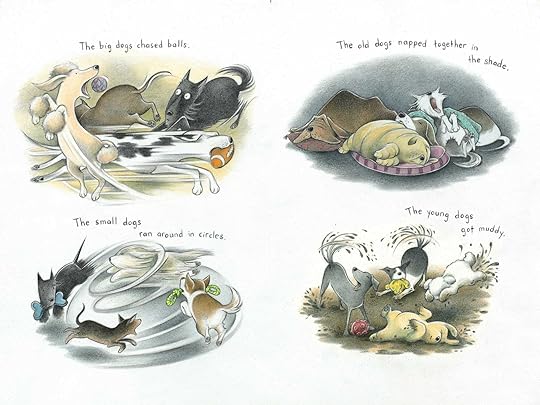
The big dogs chased balls.
The small dogs ran around in circles.
The old dogs napped together in the shade.
The young dogs got muddy.
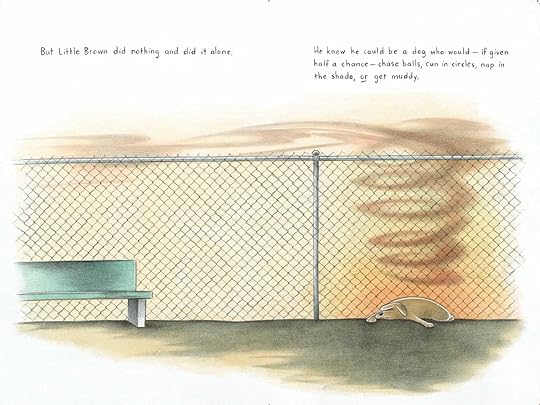
But Little Brown did nothing and did it alone.
He knew he could be a dog who would - if given half a chance - chase balls, run in circles, nap in the shade, OR get muddy.
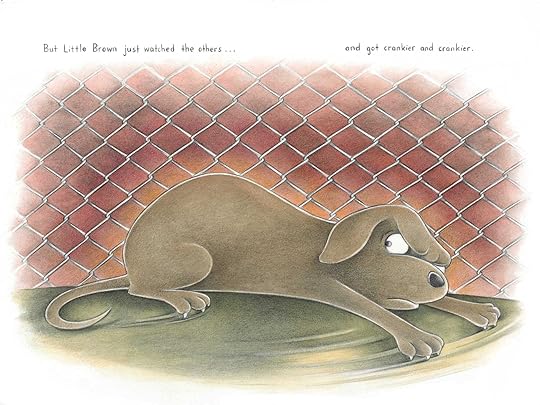
But Little Brown just watched the others... and got crankier and crankier.
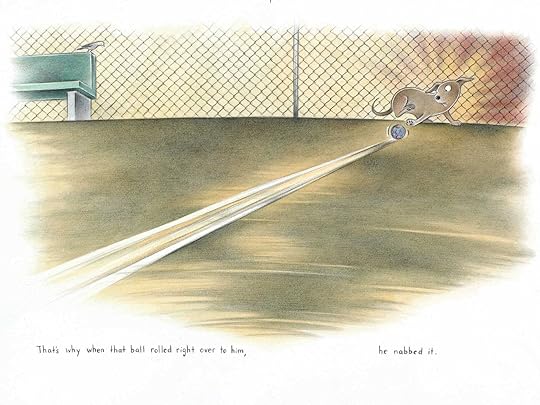
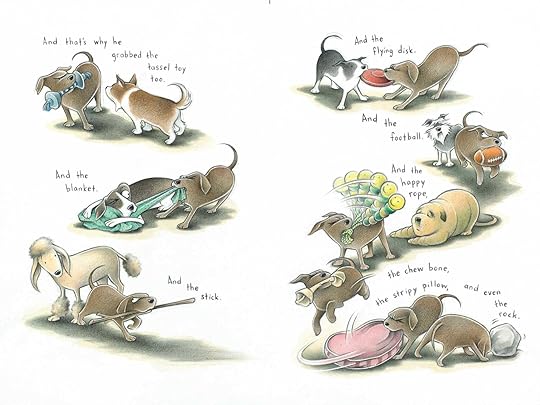
That's why when that ball rolled right over to him, he nabbed it.
And that's why he grabbed the tassel toy too.
And the blanket.
And the stick.
And the flying disk.
And the football.
And the happy rope, the chewbone, the stripy pillow, and even the rock.
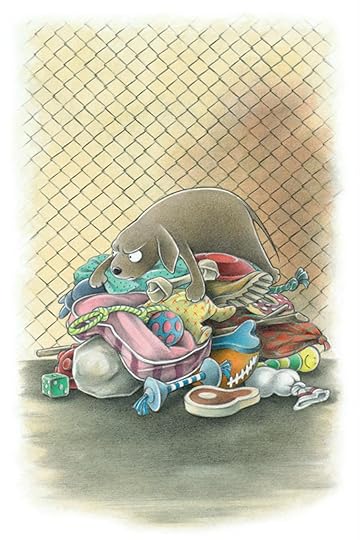
Soon he had collected quite a lot of things that didn't belong to him.
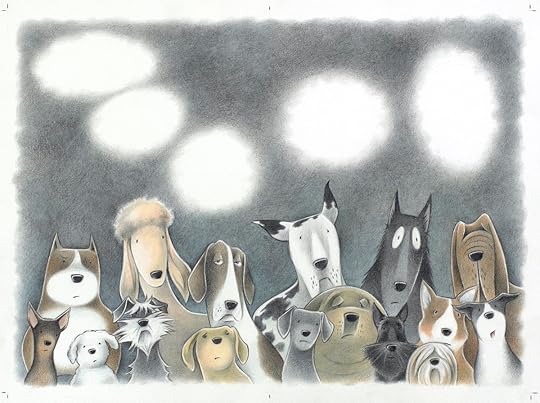
The big dogs and small dogs and old dogs and young dogs stopped what they were doing and looked at Little Brown.
They looked at the stuff. They wanted it back.
But Little Brown wasn't giving in.
This was a dilemma.
The dogs wondered things, some of which they'd wondered before...
Is Little Brown cranky because we don't play with him?
Or do we not play with him because he is cranky?
Should we play with him to get the stuff back?
Or will that make us cranky too?
What then?
Little Brown wondered things too.
If I give it all back, will they like me?
Then will they play with me?
What if I give it all back and they still won't play with me?
What then?
None of the dogs could figure it out. Neither could Little Brown.
It was a lot to wonder about.
So they all sat around wondering and scratching until it was time to go in.
Maybe tomorrow...
they would know what to do.
THE END.
Are you depressed yet?
This dark, gloomy book which features rainy, dreary, grey weather can be considered good. The illustrations are cute. The dogs are full of personality. Not every book has to end happily, but readers might be disappointed that nothing is resolved and that Little Brown remains unloved and friendless - lashing out at others because he's at a loss of what else to do.
The dogs are wondering if they should act differently. Should they start treating Little Brown differently? Would that make him act friendlier?
And Little Brown is also considering his actions. Should he act differently? What can he do to get the other dogs to like him? Is he just naturally unlovable? How can he fit in with the group? Socializing comes so easy to the other dogs. But Little Brown really struggles with it.
I wish the book had a resolution. Frazee (most famous for her book The Boss Baby which was turned into a movie) leaves everything up in the air. "Realism" or "open endings" might be okay or even sometimes lauded in adult fiction, but with kids, I would like a bit more solid of a conclusion than this.
TL;DR Interesting and unique book. Not your typical dog-book for kids. Unfortunately, I think the ending detracts from the overall story. I see what Frazee is doing from an artistic point - and I respect it - but in reading books to kids I don't want a maudlin, uncertain ending like this.
I'm fine with the gloomy pictures - the book has a distinctive atmosphere. I'm fine with the complex message about an unloved dog (child) lashing out but wishing inside desperately to be liked / loved and being problematic as a result. But IMO the book would have been better with a dog making a friendly overture at the end or perhaps the dogs could decide that tomorrow they would all play together, or something.

August 4, 2024
چو فردا شود، فکر فردا کنیم.

September 29, 2019
Little Brown is kind of a jerk. He steals all the other dogs' toys, presumably because he wants to be included. The synopsis asks, "What will happen now?" The answer, unfortunately, is, "Not much."
I don't like open-ended books at the best of times. Even for adults. I like some resolution to the stories I read. If I've put in the time to read the whole story, I want to know how it's going to end. The whole "let's let the reader decide what happens" is a cop-out, as far as I'm concerned. I honestly thought that my e-book copy was glitched and that I was missing a page. But by looking at other reviews on Goodreads, I see that that's not the case. This is simply a story that abruptly ends before the actual ending.
The illustrations are cute. I mean, it's a motley crew of dogs of all shapes and sizes doing what dogs do (play, nap, run in circles, etc.). But even the best illustrations wouldn't make me love this.
I enjoyed The Boss Baby , so I guess I was hoping to have a similar reading experience here. This book might work for some readers... but not ones who like their stories to have a resolution.
I don't like open-ended books at the best of times. Even for adults. I like some resolution to the stories I read. If I've put in the time to read the whole story, I want to know how it's going to end. The whole "let's let the reader decide what happens" is a cop-out, as far as I'm concerned. I honestly thought that my e-book copy was glitched and that I was missing a page. But by looking at other reviews on Goodreads, I see that that's not the case. This is simply a story that abruptly ends before the actual ending.
The illustrations are cute. I mean, it's a motley crew of dogs of all shapes and sizes doing what dogs do (play, nap, run in circles, etc.). But even the best illustrations wouldn't make me love this.
I enjoyed The Boss Baby , so I guess I was hoping to have a similar reading experience here. This book might work for some readers... but not ones who like their stories to have a resolution.

October 3, 2018
It's more like 1.5 stars.
I had a lot of issues with this children's book. The main dog is depicted as cranky and wonders if it's cranky because no one will play with him or maybe no one will play with him because he's cranky. When I read the first page I honestly thought this was going to be a thoughtful book about social anxiety and how it manifests. But, nope. This was just a cranky dog who then goes on a stealing spree because the others won't play with him.
And the book just ends. Nothing resolved. I mean NOTHING. I don't need a book to be all happy and cheery and I actually sad kids book are needed. But the ending is so abrupt with no resolution at all and no real teachable moments.
I had a lot of issues with this children's book. The main dog is depicted as cranky and wonders if it's cranky because no one will play with him or maybe no one will play with him because he's cranky. When I read the first page I honestly thought this was going to be a thoughtful book about social anxiety and how it manifests. But, nope. This was just a cranky dog who then goes on a stealing spree because the others won't play with him.
And the book just ends. Nothing resolved. I mean NOTHING. I don't need a book to be all happy and cheery and I actually sad kids book are needed. But the ending is so abrupt with no resolution at all and no real teachable moments.

October 14, 2018
Wow, I'm already thinking of so many ways to use this book.
This is one of those books that people may love or hate over the open ending. I think it's a book that will spark a lot of great discussion.
This is one of those books that people may love or hate over the open ending. I think it's a book that will spark a lot of great discussion.

December 26, 2018
Little Brown was a very cranky dog. The other dogs in the play-yard wouldn't play with him, and whether this was because he was cranky, or he was cranky because of this, the situation remained unresolved. When our canine anti-hero went on a stealing spree, amassing all of the other dog's playthings in a pile that he refused to surrender, it led to a face-off. Would the other dogs agree to play with Little Brown? Would Little Brown return the playthings...?
Readers expecting a sweeter, more stereotypical resolution of the story in Little Brown are in for a bit of a surprise, as . On the one hand, this ending made me laugh out loud, with its realistic and very human anti-resolution of the crisis. On the other hand, I do wonder whether child readers, who often have a much more immediate sense of justice than their elders, would find it appealing and/or acceptable. Leaving the issue of story resolution aside, this was a cute exploration of feeling cranky and/or unhappy, and the social effect that this can have. Marla Frazee's artwork is, as is to be expected, darling, and increased my enjoyment of the book significantly. Recommended to Frazee fans, and to anyone looking for less-than-edifying children's stories about playground behavior.
Readers expecting a sweeter, more stereotypical resolution of the story in Little Brown are in for a bit of a surprise, as . On the one hand, this ending made me laugh out loud, with its realistic and very human anti-resolution of the crisis. On the other hand, I do wonder whether child readers, who often have a much more immediate sense of justice than their elders, would find it appealing and/or acceptable. Leaving the issue of story resolution aside, this was a cute exploration of feeling cranky and/or unhappy, and the social effect that this can have. Marla Frazee's artwork is, as is to be expected, darling, and increased my enjoyment of the book significantly. Recommended to Frazee fans, and to anyone looking for less-than-edifying children's stories about playground behavior.

November 9, 2018
Wish I could give it NO stars. It is a bleak, awful story with no resolution. How dare Marla Franzee depict dogs this way?
What a hateful, depressing book. How did this get published?
What a hateful, depressing book. How did this get published?

June 11, 2019
When it's raining too hard to have recess outside, read this to your K-6 students instead.
Or read it during the 'welcome to school' unit right away.
Or read it during the 'welcome to school' unit right away.

October 26, 2018

This review was originally written for The Baby Bookworm. Visit us for new picture books reviews daily!
Hello, friends! Our book today is Little Brown by Marla Frazee, the tale of a very cranky dog.
Little Brown is very cranky. The other dogs don’t play with him – he’s not sure if he’s cranky because they don’t to play, or if they don’t want to play because he’s cranky. Instead, he watches the other dogs from a corner of their chain-link enclosure (a dog park? Doggie daycare? Animal shelter?) – the big dogs chase balls, the small dog run in circles, the old dogs nap, and the young ones play in the mud. Little Brown is sure he could do any of these things, but no one asks him to. That is, until a start ball rolls his way…
So, I was really thinking that this was going to be a story about making friends – the setup certainly seems to indicate so. But the plot took a rather unexpected twist: Little Brown steals the ball. Then he steals all the other toys, blankets, beds, and even a rock, piling them into a mountain and sitting atop the spoils, keeping the other dogs from using them. This leads to a stalemate, where the other dogs stare and wonder if they should play with Little Brown to get the toys back – or will that make them cranky too? – and Little Brown wonders if he should give the goods back or not to make the others like him. Then, abruptly, the dogs are called inside, nothing is resolved, and the story indicates that this will all happen again tomorrow? Um.. what? Was that a kids’ story? What’s the lesson? Where was the fun? I can usually understand if a picture book lacks one or the other, but both? The length was fine, and art is very cute, with adorably charismatic dogs of all shapes and sizes, but it certainly doesn’t save the confusing, unsatisfying, and somewhat pointless storyline. Even JJ seemed pretty puzzled. Quite weird, and not for us.
(Note: A copy of this book was provided to The Baby Bookworm by the publisher in exchange for an honest review.)
Be sure to check out The Baby Bookworm for more reviews!

November 7, 2018
Really enjoyed this until the end. It was a cop out. The whole story built up to a moment no decision is made and nothing happens.

January 25, 2019
Little Brown is a cranky canine. When he steals the toys and blanket and bed of the other dogs, will the dogs play with him if he gives it all back, or will they not play with him even if he returns their stuff? The dogs are thinking "Is Little Brown cranky because we don't play with him?" "Or do we not play with him because he is cranky?" It's all too difficult to figure out. "Maybe tomorrow they would know what to do."
The ending is realistic, open-ended. This is not the typical resolution of a happy ending. The atmosphere of the book is rather gloomy. The body language and facial expressions of Little Brown are cranky and realistic. The text is bleak and sad -- gloomy. I feel like the story looks at the feelings of an outsider wanting to fit into the group, and the group not knowing why the outsider is an outsider. It could also be about how outsiders are treated. With an open-ending, there are a lot of questions left unanswered and numerous possibilities.
The ending is realistic, open-ended. This is not the typical resolution of a happy ending. The atmosphere of the book is rather gloomy. The body language and facial expressions of Little Brown are cranky and realistic. The text is bleak and sad -- gloomy. I feel like the story looks at the feelings of an outsider wanting to fit into the group, and the group not knowing why the outsider is an outsider. It could also be about how outsiders are treated. With an open-ending, there are a lot of questions left unanswered and numerous possibilities.

January 25, 2019
It takes a LOT for a picture book to surprise me these days. The ending here was so unexpected, I laughed right out loud. I LOVED it! A person who understands dogs definitely wrote this. There's no moral, no "happy ending," no resolution at all, really, but great illustrations and a lot to talk about with whoever may be reading this book together. More like this, please!

January 18, 2025
ته دل دو طرف رو نشون میده، بنظرم منظورش این بود که اگه در مورد حست بگی قابل درکه و بقیه متوجهش میشن، ولی کسی برای تغییر وضعیت خیلی تلاشی نمیکنه، مگر یه انفجار که اونم باز قابل درک بود ولی حل کننده نبود.

January 21, 2019
This was a cute turned ridiculous book. The illustrations and different dogs are lovely. The beginning was wonderful -- I thought we were going to get some child-appropriate reflection on self-fulfilling prophecy, maybe some thoughts on a dog who acts badly because he doesn't know how to act better.
Instead, the book just ends. With no resolution. The dog is cranky, no one knows why, the end.
I can remember my first grade teacher drawing a diagram of a story on the chalkboard. A story has a beginning, a climax, and a resolution. Or something like that -- it was a long time ago. Except here's one that doesn't. This story has no resolution. Adding insult to injury, it has the other parts. It begins. There's a climax -- the dog takes all the toys! What will we do? -- but there's no resolution. What will we do? Nothing, apparently. Why is he like this? I dunno. Oh well.
This book suffers from either extreme laziness or a completely misplaced attempt to be thought provoking. Honestly, I'd be quicker to forgive the former, because if it's the latter, it's such a pathetic and misguided attempt that it should never have been accepted as being a reasonable idea by any of the people who encountered it.
This is a picture book, with cute dogs and short text. Its target audience is, presumably, kids the age of my kids (they are five). Five year olds are concrete, black and white thinkers, with particular expectations for a story. There's a structure that stories tend to follow for a reason (see my first grade teacher's referenced diagram above). While we love to speculate as much as the next person, that doesn't mean the author gets to throw up their hands and make the reader speculate all the things. If that's the case, don't even bother with the book. Let it remain a tree.
Worth mentioning, I checked this book out on a trip to the library where I was particularly salty about the trend to market children's books to adults at the expense of children. I'm not talking about content as much as approach and thought process. The two particular books that set me off were "The Rabbit Listened," which in my opinion was way too vague and pithy to provide any useful or interesting to story to children -- these are children, not adults on the internet looking to share insightful self-improvement articles -- and a picture book of Buffy the Vampire Slayer, which is a marketing gimmick aimed only at parents who are fans of Buffy the Vampire Slayer. I'm weary of it. And all the trendy books seem to assume that having respectable and important moralizing content is a replacement for having a decent story.
It's not. These are children. Give them a story. Give them age and developmentally appropriate words to wrestle with complex ideas and problems. By all means give them the complex ideas and problems, but BRING IT DOWN to the level of a child who reads a picture book. That's an extremely difficult task. Do it. Stop taking the lazy way out, leading kids halfway into the mire, and then throwing up your hands and saying "OH WELL! I DON'T KNOW WHAT TO DO! MAYBE TOMORROW!"
It's lazy and kids deserve better. This book is lazy and kids deserve better.
Instead, the book just ends. With no resolution. The dog is cranky, no one knows why, the end.
I can remember my first grade teacher drawing a diagram of a story on the chalkboard. A story has a beginning, a climax, and a resolution. Or something like that -- it was a long time ago. Except here's one that doesn't. This story has no resolution. Adding insult to injury, it has the other parts. It begins. There's a climax -- the dog takes all the toys! What will we do? -- but there's no resolution. What will we do? Nothing, apparently. Why is he like this? I dunno. Oh well.
This book suffers from either extreme laziness or a completely misplaced attempt to be thought provoking. Honestly, I'd be quicker to forgive the former, because if it's the latter, it's such a pathetic and misguided attempt that it should never have been accepted as being a reasonable idea by any of the people who encountered it.
This is a picture book, with cute dogs and short text. Its target audience is, presumably, kids the age of my kids (they are five). Five year olds are concrete, black and white thinkers, with particular expectations for a story. There's a structure that stories tend to follow for a reason (see my first grade teacher's referenced diagram above). While we love to speculate as much as the next person, that doesn't mean the author gets to throw up their hands and make the reader speculate all the things. If that's the case, don't even bother with the book. Let it remain a tree.
Worth mentioning, I checked this book out on a trip to the library where I was particularly salty about the trend to market children's books to adults at the expense of children. I'm not talking about content as much as approach and thought process. The two particular books that set me off were "The Rabbit Listened," which in my opinion was way too vague and pithy to provide any useful or interesting to story to children -- these are children, not adults on the internet looking to share insightful self-improvement articles -- and a picture book of Buffy the Vampire Slayer, which is a marketing gimmick aimed only at parents who are fans of Buffy the Vampire Slayer. I'm weary of it. And all the trendy books seem to assume that having respectable and important moralizing content is a replacement for having a decent story.
It's not. These are children. Give them a story. Give them age and developmentally appropriate words to wrestle with complex ideas and problems. By all means give them the complex ideas and problems, but BRING IT DOWN to the level of a child who reads a picture book. That's an extremely difficult task. Do it. Stop taking the lazy way out, leading kids halfway into the mire, and then throwing up your hands and saying "OH WELL! I DON'T KNOW WHAT TO DO! MAYBE TOMORROW!"
It's lazy and kids deserve better. This book is lazy and kids deserve better.

May 4, 2018
Comme ci comme ca. Marla Frazee's signature illustrations deserve kudos. The text however, is quite frankly gloomy. The questions pondered by the cranky main character seem rather unsettling. No resolution which I suppose is very true to life but when it comes to children's books I prefer a happy ending. I don't need sunshine and rainbows, I'm not the fluffy, pink unicorn type but this one left me feeling a bit unresolved.
January 10, 2019
This could have been a great book about sharing and/or making friends. Instead, everyone just goes home because "tomorrow they will know what to do." Way to procrastinate y'all. The only redeeming quality was that the pictures were nice, but not the greatest. I do NOT recommend this book for anything.

October 19, 2018
First sentence: Little Brown was cranky. Probably because no one ever played with him. Or maybe no one ever played with him because he was cranky. At this point, it was hard to know.
Premise/plot: Little Brown is the star of this picture book. When the book opens he is cranky and lonely. When the book closes he is cranky and lonely. In between Little Brown and the other dogs--whose names we learn on the end pages--wonder about life's complexities.
Why doesn't Little Brown have friends? Does his crankiness keep the other dogs from liking him, playing with him, being his friends? Or is it his loneliness--his lack of friends and playmates--making him cranky? If the other dogs were his friends--if they took the first step--would he stop being cranky? What if he took the first step--would they reject him? Wouldn't that make him even crankier to be rejected?
Here is a line that got to me, "But Little Brown did nothing and did it alone."
My thoughts: The first time I read this book I was frustrated. I didn't want to think about the complexities of friendship--of life--and the golden rule (do unto others as you would have them do unto you). I wanted a lesson tied up with a bow. I wanted Little Brown to return what he'd stolen. I wanted Little Brown to have been forgiven by the other dogs. I wanted Little Brown to have been accepted by the other dogs. I wanted him to make a friend. Or else I wanted another dog to step forward and make the first step of friendship. In short I wanted a happy ending--to be assured that even cranky, lonelypeople dogs are worthy of love and friendship. But that is not this story.
The second time I read this one I liked it better. I identified with it more. Who hasn't been Little Brown at some point? (Is Little Brown the dog version of Alexander and the Terrible, Horrible, No Good Very Bad Day?! Not really. It lacks the humor.) Who hasn't experienced cranky days? Who hasn't experienced loneliness?
The truth is that it is almost always scary to take that first step. I don't know that kindness is ever super-super easy. But. It is true that it easier to be a kind to someone who is "nice" and "friendly" and "cheerful." It is more difficult to be kind to someone who is "cranky" or "mean" or "sad" or "angry" or "lonely" or "bitter." The people who need our kindness the most can be the most difficult to reach out to.
"First of all," he said, "if you can learn a simple trick, Scout, you'll get along a lot better with all kinds of folks. You never really understand a person until you consider things from his point of view--"
"Sir?"
"--until you climb into his skin and walk around in it." (Harper Lee, To Kill A Mockingbird, 30)
If there is a lesson in Little Brown, perhaps it's an interactive lesson in perception and empathy. When Little Brown is cranky what other emotions could he be feeling?
Text: 3 out of 5
Illustrations: 4 out of 5
Total: 7 out of 10
Premise/plot: Little Brown is the star of this picture book. When the book opens he is cranky and lonely. When the book closes he is cranky and lonely. In between Little Brown and the other dogs--whose names we learn on the end pages--wonder about life's complexities.
Why doesn't Little Brown have friends? Does his crankiness keep the other dogs from liking him, playing with him, being his friends? Or is it his loneliness--his lack of friends and playmates--making him cranky? If the other dogs were his friends--if they took the first step--would he stop being cranky? What if he took the first step--would they reject him? Wouldn't that make him even crankier to be rejected?
Here is a line that got to me, "But Little Brown did nothing and did it alone."
My thoughts: The first time I read this book I was frustrated. I didn't want to think about the complexities of friendship--of life--and the golden rule (do unto others as you would have them do unto you). I wanted a lesson tied up with a bow. I wanted Little Brown to return what he'd stolen. I wanted Little Brown to have been forgiven by the other dogs. I wanted Little Brown to have been accepted by the other dogs. I wanted him to make a friend. Or else I wanted another dog to step forward and make the first step of friendship. In short I wanted a happy ending--to be assured that even cranky, lonely
The second time I read this one I liked it better. I identified with it more. Who hasn't been Little Brown at some point? (Is Little Brown the dog version of Alexander and the Terrible, Horrible, No Good Very Bad Day?! Not really. It lacks the humor.) Who hasn't experienced cranky days? Who hasn't experienced loneliness?
The truth is that it is almost always scary to take that first step. I don't know that kindness is ever super-super easy. But. It is true that it easier to be a kind to someone who is "nice" and "friendly" and "cheerful." It is more difficult to be kind to someone who is "cranky" or "mean" or "sad" or "angry" or "lonely" or "bitter." The people who need our kindness the most can be the most difficult to reach out to.
"First of all," he said, "if you can learn a simple trick, Scout, you'll get along a lot better with all kinds of folks. You never really understand a person until you consider things from his point of view--"
"Sir?"
"--until you climb into his skin and walk around in it." (Harper Lee, To Kill A Mockingbird, 30)
If there is a lesson in Little Brown, perhaps it's an interactive lesson in perception and empathy. When Little Brown is cranky what other emotions could he be feeling?
Text: 3 out of 5
Illustrations: 4 out of 5
Total: 7 out of 10

February 24, 2019
The first time I read this book, my jaw dropped when I got to the end. It just wasn't what I expected. But then I realized the incredible amount potential it offers for discussing a difficult topic - why the other dogs didn't like Little Brown. He's a lonely, cranky dog who keeps to himself in the dog playground, sitting by the fence, with his back turned away from everyone and his head hanging. Little Brown wonders if the other dogs don't play with him because he is cranky, or if he is cranky because the other dogs wouldn't play with him? The other dogs wondered if Little Brown was cranky because they don't play with him, or if they don't play with him because he's cranky? It's quite a standoff, made worse when Little Brown takes all their toys and keeps them. The book ends with all the dogs wondering what to do, but with no solution to the problem. This frustrated some of my young readers, but others offered all kinds of ways the standoff could end. Interestingly, some kids felt empathy for Little Brown, others for the rest of the dogs. Frazee's pencil and gouache illustrations are simple, direct and add volumes to the text, all done in somber brown tones except for the dog toys done in muted color. The palette used is definitely a reflection of the attitudes explored in this interesting picture book.

December 23, 2018
This was kind of a funny book. I don't know if it was meant to be funny, but it made me laugh. It's about a little dog who is grumpy because none of the other dogs want to play with him. Or maybe they don't want to play with him because he's grumpy. Determined to solve this problem, Little Brown takes matters into his own paws and does something that puts him in a stand-off with all the other dogs.
The weird/best/strangest part of this book is that there's no conclusion. The problem doesn't get solved.
The reason I liked the way it ended is because that's how life is most of the time. Life doesn't happen in short little stories with happy endings all the time. Most of the time, tensions are left unresolved, issues are still there the next day, and not every problem has a simple fix. Sometimes, you're just left hanging.
Kids will easily be able to see themselves in this story. It's very cute and pretty funny too.
Source: The publisher sent me a copy of this book.
The weird/best/strangest part of this book is that there's no conclusion. The problem doesn't get solved.
The reason I liked the way it ended is because that's how life is most of the time. Life doesn't happen in short little stories with happy endings all the time. Most of the time, tensions are left unresolved, issues are still there the next day, and not every problem has a simple fix. Sometimes, you're just left hanging.
Kids will easily be able to see themselves in this story. It's very cute and pretty funny too.
Source: The publisher sent me a copy of this book.

October 26, 2018
I love it when children's book authors don't underestimate kids. And I love children's books that offer a little conundrum or ambiguity or (best of all, IMO) a twist. And Little Brown offers all three along with Frazee's whimsical illustrations.
This is a chicken-or-egg story. We know that Little Brown - a smallish, lumpy dog - is cranky. But is he cranky because no one will play with him? Or does no one play with him because of he's cranky?
Frazee explores the question, bringing into the story a pack of 16 other various dogs (their names and photos are helpfully laid out on the inside front and back cover spreads). But the story isn't wrapped up a nice bow. The dilemma is left unsolved - or rather, it's left for the readers to ponder, discuss, and decide for themselves.
This is a chicken-or-egg story. We know that Little Brown - a smallish, lumpy dog - is cranky. But is he cranky because no one will play with him? Or does no one play with him because of he's cranky?
Frazee explores the question, bringing into the story a pack of 16 other various dogs (their names and photos are helpfully laid out on the inside front and back cover spreads). But the story isn't wrapped up a nice bow. The dilemma is left unsolved - or rather, it's left for the readers to ponder, discuss, and decide for themselves.

April 25, 2019
This book is depressing and ends abruptly. I can see what the story is trying to convey, and I understand that it's probably supposed to be a "thinker." But I would have appreciated an actual resolution more. As it stands, I can't give this book a blanket recommendation. If you really know your audience and plan to use as it a conversation starter, it might work.

March 26, 2021
This is a BEAUTIFUL book that celebrates the complexities of life and reminds us that things might not always be what they seem. This book is perfect to launch conversations with children AND adults. I've been Little Brown, I've worked with Little Brown, I've ignored Little Brown and I've supported Little Brown and the outcome depends on how I think and what I do next. A must read.

March 8, 2019
I was really liking this book until the end. I thought it was a great book about someone feeling left out and how they could be included. But... the end? I just don't get it. Love the illustrations and the original idea.

December 7, 2018
I love Marla Frazee. There's nothing I don't love about every bit of her.

April 18, 2019
This is one of the few picture books that has no resolution at the end, which is unusual for a picture book. I love Frazee's illustrations, and how the sky mirrors Little Brown's emotions.
This entire review has been hidden because of spoilers.

Read
April 9, 2020This is a depressing little story with no resolution. It delivers the bleak message that difficulties between people (or dogs) are inexplicable and cannot be overcome. While this may be a realistic perspective, it is not exactly what I was looking for in story time.

March 5, 2022
What kind of mid-20th centaury European Arthouse movie unresolved complex emotional ambiguous kind of ending was that?? Ugh, absolutely loved it. Long Live cranky old Little Brown. Love that dog.
This entire review has been hidden because of spoilers.

January 24, 2019
This book just gobsmacked me. Poor cranky Little Brown. To be honest, the ending shocked me. I don't know why I expected anything else from the author of The Farmer and the Clown. The first time I read it, I was alone. I had to go back for another read to make sure I hadn't missed anything.
Today I read it to a group of grade 1's and 2's.
They responded with, "Wait! Huh? That's not the ending? How could that be?"
The skits that followed presented brilliantly simple solutions for what to do tomorrow.
Two dogs just decided to sleep together. So they slept together on a cushion.
One dog just asked Little Brown if he wanted to play. Then they played.
Little Brown gave the toys back and another dog invited him to join the rest. And he did.
Got a big problem? Ask a kid what to do.
Today I read it to a group of grade 1's and 2's.
They responded with, "Wait! Huh? That's not the ending? How could that be?"
The skits that followed presented brilliantly simple solutions for what to do tomorrow.
Two dogs just decided to sleep together. So they slept together on a cushion.
One dog just asked Little Brown if he wanted to play. Then they played.
Little Brown gave the toys back and another dog invited him to join the rest. And he did.
Got a big problem? Ask a kid what to do.

October 16, 2018
It was not satisfying as a book all by itself. However, the purpose of the book seems to be as a tool for talking about empathy and playing with others. The dogs are cute.
Displaying 1 - 30 of 193 reviews