Jump to ratings and reviews
Rate this book

In Defense of the Poor Image

Rate this book
"The poor image is no longer about the real thing—the originary original. Instead, it is about its own real conditions of existence: about swarm circulation, digital dispersion, fractured and flexible temporalities. It is about defiance and appropriation just as it is about conformism and exploitation.

In short: it is about reality."

9 pages, ebook

Published January 1, 2009

Loading...
Loading...

About the author

Hito Steyerl

40 books297 followers
Hito Steyerl (sometimes spelled Štajerl) is a German filmmaker, visual artist, and author in the field of essayist documentary video. Her principal topics of interest are media, technology, and the global circulation of images. Steyerl holds a Ph.D in Philosophy from the Academy of Fine Arts Vienna. She is currently a professor of New Media Art at the Berlin University of the Arts.

Ratings & Reviews

What do you think?
Rate this book

Friends & Following

Create a free account to discover what your friends think of this book!

Community Reviews

5 stars
155 (67%)
4 stars
59 (25%)
3 stars
10 (4%)
2 stars
3 (1%)
1 star
3 (1%)
Displaying 1 - 24 of 24 reviews
Profile Image for caroline.
64 reviews1 follower
May 3, 2021
Loved this essay when i first read it, and love it even more with the extra 2021 layer of NFTs.
Steyerl says: "the dematerialized art object turns out to be perfectly adapted to the semioticization of capital, and thus to the conceptual turn of capitalism," which couldn't apply more to the further radicalization of "culture as commodity" we see with NFTs and this growing desire of ownership over the poor image.
Profile Image for sofi lira s.
91 reviews8 followers
November 14, 2022
"Las imágenes pobres muestran lo extraordinario, lo obvio y lo increíble, siempre y cuando seamos todavía capaces de descifrarlo."

"Las imágenes pobres son pobres porque están muy comprimidas y viajan rápidamente. Pierden materia y ganan velocidad. Pero también expresan una condición de desmaterialización, que comparten no solo con el legado del arte conceptual sino sobre todo con los modos contemporáneos de producción semiótica."

Ojalá pudiese escribir tan bien.
Gracias clase de Historia de la Imagen por invitarme a leer cosas tan bellas y tan inteligentes
Profile Image for Michel.
95 reviews
December 25, 2019
The vulgar crowd always is taken by appearances, and the world consists chiefly of the vulgar.
Profile Image for Úrsula.
20 reviews2 followers
March 29, 2025
Hito ets increïble. La teva associació de classes amb les imatges. La teva manera de reivindicar la imatge amateur i la pirateria. M'he quedat amb genes de saber dels pirates-fans....Visionària abans d'una pandèmia.
Profile Image for lalala Manel.
41 reviews1 follower
April 17, 2026
Dana dawud devia ler esse mambo, ligar com o blur em monad movies, a iamba kakaka
1-Comentário pós estruturalista mais do mesmo(NÃO NÃO‼️)
2-quotes
3-ANÁLISE IMAGEM INTERNET (CHUMBOX ADS) A PARTIR DE OUTRI VETOR E QUE É TAMBÉM BOA IDEIA PRA UMA EXPOSIÇÃO OU PROJETO ARTÍSTICO QUALQUER


(Ligar com baudrillard conception of our society as obscene, where no secret (and consequently eroticism etc) exist anymore, everything being instantaneous and immediate and acessível, pornography is our only common culture because our culture as already become pornographied, se corpo social existe então está nu de maneira crua e violenta, sem veil coquete. Neste âmbito, a low resolution image difere pelo nível de mistério e interpretação interação necessária que exige, quase formalismo russo linguagem (imagistica?) a apontar para a sua artificialidade e através do estranho a desautomatizar a maneira automática e geométrica como apreendemos os objetos (no caso dos formalistas objetos “representados” a partir da linguagem, na nossa cultura (visual, televisual (Mclhuan)) e neste caso representados maioritariamente a partir de imagens, logo troca se o meio mas o fim/logica fica o mesmo) (Also esse tipo de images carregadas de voyeurism e dimensão sexual, com dimensão de transgressão e proibição e erotismo etc… sem the cheap transparency and nudity of porn, of a moral correspondence between signifier and signified, to go back to the Russian formalists- Yes, most porn is moral!!!- neurotics are porn addicts after all, I mean what do the femeninist say? It reduces woman, but not to an unfamiliar other radically different from man, as some might have, and if so only its empty caricature, its status as different is not even acknowledged, they’re sexual apetites are male after all, that’s the complaint, they’re sex is penetrative and artificially perfect (also it’s anal, is that therefore the true male fantasy, projected descritly and SUSly to an outside that’s in truth an inside, do they simply want to be pegged? It would seem so…) in a way only a neurotic vanilla male would conceive. Back to the Bataille drawing board, as we can also speak of an excess of the low resolution image, there is something that the high quality screen, with its totalized and completely transparent/perfect image cannot render- an excess of signification in the photograph contrasting with a silence particular to the screenshot (Barthes, Camera Lucida) that enables an excess of truth rather than meaning (Lacan: Analysis aims at truth, not meaning), mas aqui já estou a misturar contraditoriamente as coisas só porque me apetece.)

Também: Novo critério para julgar imagens, não a sua autenticidade, veracidade, etc, mas a sua reproditicibilidade, a sua capacidade de propagação e disseminação, de passar despercebida por falta de clareza pelos censores digitais community policies no violence or nudity etc, indo um passo mais longe que Walter Benjamin quando descreveu a passagem da arte ritualistica antiquada para a de massas contemporânea.(Chumbox ads read bellow also)

A new value of the image marked by something other than quality, which could be said to be connected to representationality, a image is good as far as its quality permits the dectection of every little detail (sometimes with a fidelity to the transparency of the image that could lead to its inverse directio)?-“value of the message is purely that of its circulation, its passage from one image to another, one screen to another”(Baudrillard, The transparency of evil); Focuse on quality of the image: pre-modern, representational, Focuse on circulation: post modern, anti representational art par Benjamin Walter


“The contemporary hierarchy of images, however, is not only based on sharpness, but also and primarily on resolution. Just look at any electronics store and this system, described by Harun Farocki in a notable 2007 interview, becomes immediately apparent.- In the class society of images, cinema takes on the role of a flagship store. In flagship stores high-end products are marketed in an upscale environment. More affordable derivatives of the same images circulate as DVDs, on broadcast television or online, as poor images.”

“The networks in which poor images circulate thus constitute both a platform for a fragile new common interest and a battleground for commercial and national agendas. They contain experimental and artistic material, but also incredible amounts of porn and paranoia.
While the territory of poor images allows access to excluded imagery, it is also permeated by the most advanced commodification techniques.
While it enables the users' active participation in the creation and distribution of content, it also drafts them into production. Users become the editors, critics, translators, and (co-)authors of poor images.
Poor images are thus popular images - images that can be made and seen by the many.
They express all the contradictions of the contemporary crowd: its opportunism, narcissism, desire for autonomy and creation, its inability to focus or make up its mind, its constant readiness for transgression and simultaneous submission. Altogether, poor images present a snapshot of the affective condition of the crowd, its neurosis, paranoia, and fear, as well as its craving for intensity, fun, and distraction.”


“In this light, perhaps one has to redefine the value of the image, or, more precisely, to create a new perspective for it. Apart from resolution and exchange value, one might imagine another form of value defined by velocity, intensity, and spread. Poor images are poor because they are heavily compressed and travel quickly. They lose matter and gain speed. But they also express a condition of dematerialization, shared not only with the legacy of conceptual art but above all with contemporary modes of semiotic production. 1° Capital's semiotic turn, as described by Felix Guattari,' plays in favor of the creation and dissemination of compressed and flexible data packages that can be integrated into ever-newer combinations and sequences. 12
This flattening-out of visual content - tre concept-in-becoming of the images - positions them within a general informational turn, within economies of knowledge that tear images and their captions out of context into the swirl of permanent capitalist deterritorialization. 13 The history of conceptual art describes this dematerialization of the art object first as a resistant move against the fetish value of visibility. Then, however, the dematerialized art object turns out to be perfectly adapted to the semioticization of capital, and thus to the conceptual turn of capitalism. 14 In a way, the poor image is subject to a similar tension. On the one hand, it operates against the fetish value of high resolution. On the other hand, this is precisely why it also ends up being perfectly integrated into an information capitalism thriving on compressed attention spans, on impression rather than immersion, on intensity rather than contemplation, on previews rather than screenings.
5. Comrade, what is your visual bond today?
But, simultaneously, a paradoxical reversal happens. The circulation of poor images creates a circuit, which fulfills the original ambitions of militant and (some) essayistic and experimental cinema - to create an alternative economy of images, an imperfect cinema existing inside as well as beyond and under commercial media streams. In the age of file-sharing, even marginalized content circulates again and reconnects dispersed worldwide audiences. Bla bla bla”

A new value of the image marked by something other than quality, which could be said to be connected to representationality, a image is good as far as its quality permits the dectection of every little detail (sometimes with a fidelity to the transparency of the image that could lead to its inverse directio)?-“value of the message is purely that of its circulation, its passage from one image to another, one screen to another”(Baudrillard, The transparency of evil


‼️‼️‼️‼️‼️‼️‼️‼️‼️‼️‼️‼️‼️‼️‼️‼️‼️‼️
!!!!!!!
: Sobre imagem (CHUMBOX ad)
internet no final de um artigo/site qualquer que era uma batata com um buraco no meio que parecia o anus:
O maior inimigo da hemorróida!
Leia este artigo
WellCare
16:26
Que imagem adequada
16:26 //
Será que alguém escolheu isto ou é daqueles sites ai generated que somehow teem um conhecimento indutivo do inconsciente humano por tarem treinados algoritmicamente em human responses to images e assim.
Tipo todos aqueles algoritmos que veem quanto tempo passas numa imagem ao dares scroll e que trace your activity through different websites pra te darem targeted adds e etc acabam por chegar a conclusões provavelmente muito interessantes, mas tipo não por refletirem a priori e sem tirarem conclusões de nada ou pensarem (como nós pensamos podem tar a pensar machine like novas formas de cognição bla bla bla) apresentam esse simples resultado de um estudo do que nos capta a atenção e é mesmo acertado e evocativo, olha tipo free floating attention o método psicanalitico de análise do discurso neurótico que não se prende completamente ao que o analysand diz mas à maneira como o diz (entoação, (entoação, tempo, slips, etc); E claro que a cena tinha que ser de hemorroidas...
16:32 //
Tipo capacidade de uma cena tão neutra que monitora só a nossa presença na internet na sua dimensão scrollastica pra efeitos comerciais chega a conclusões tão profundas sobre a existência (Anal) humana como side effect
16:45

Existe uma esquizofrenia da imagem, um medo que prenuncia um surto coletivo, patente nomeadamente na ansiedade que surge com a popularização e acessibilidade da ampliação. O filme Patlabor 2 é disso exemplo, a ampliação que descobre aviões de combate não identificados nos céus de Tokyo, e que afinal se mentiu funcionou contudo como verdade, tendo os mesmos efeitos e sendo até mais efeciente, enquanto covert operation based na manipulação de imagens. Como Walter Benjamin referiu, a distância representacional no espaço pictórico tradicional, nos quadros dos séculos passados, permitia um canto de interpretação e artística que deixava espaço pra respirar e existir subjectivamente. Com a invenção da fotografia esta distância sofre o seu primeiro encurtamento, acrescido pelas inovações técnicas que permitem maior qualidade de imagem, e que culminam na ampliação. Aqui, o espaço representacional é abolido, e a fotografia toma o lugar do real, seu equivalente. Aliás, esta consegue até suplanta lo, por exemplo, com a ampliação, tornando se mais real que o real, permitindo ir mais fundo na procura por um objecto “real” cuja natureza é sempre determinada pela mediação (da representação, língua, etc), sendo que se a excluímos cada vez mais entramos num vórtice que elimina os marcos simbólicos e vê o seu objeto regredir infinitamente. Este processo é comprável à metonimia, onde o significante desliza sem amparo. Coletivamente, este surto ignora o papel da metáfora, que aceita ser influênciada, substituída, MEDIADA, por um outro termo, criando um novo significado a partir da junção/comparação dos dois, que embora seja limitado enquanto consenso que cobre (em vez de esgotar) parte dos significados possíveis dos dois termos em questão, não totalizando numa realidade absoluta as suas possibilidades qua fotografia. A pintura impressionista é disto exemplo, enquanto expressão altamente metafórica, cujos traços representam o exterior filtrado pelo sentimento e romantismo do pintor, pela sua noção de luz e sombra, atingindo mesmo assim (e precisamente por isso) uma representação que acaba por ser quiçá mais fiel da paisagem representada.

Write a comment...
124 reviews49 followers
June 4, 2020
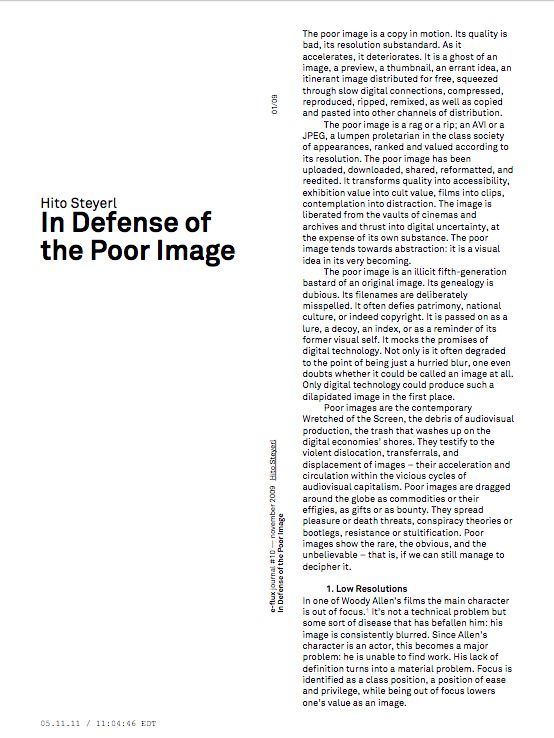
"The poor image is a copy in motion. Its quality is bad, its resolution substandard. As it accelerates, it deteriorates. It is a ghost of an image, a preview, a thumbnail, an errant idea, an itinerant image distributed for free, squeezed through slow digital connections, compressed, reproduced, ripped, remixed, as well as copied and pasted into other channels of distribution.
The poor image is a rag or a rip;an AVI or a JPEG, a lumpen proletariat in the class society of appearances, ranked and valued according to its resolution. The poor image has been uploaded, downloaded, shared, reformatted, and reedited.
It transforms quality into accessibility, exhibition value into cult value, films into clips, contemplation into distraction. The image is liberated from the vaults of cinemas and archives and thrust into digi- tal uncertainty, at the expense of its own substance. The poor image tends toward abstraction: it is a visual idea in its very becoming."
1 review
January 26, 2021
“The circulation of poor images thus creates “visual bonds,” as Dziga Vertov once called them. This “visual bond” was, according to Vertov, supposed to link the workers of the world with each other. He imagined a sort of communist, visual, Adamic language that could not only inform or entertain, but also organize its viewers. In a sense, his dream has come true, if mostly under the rule of a global information capitalism whose audiences are linked almost in a physical sense by mutual excitement, affective attunement, and anxiety.”
Profile Image for Janice Chung.
48 reviews
March 17, 2025
I'm not one who reads essays, but after reading Lisa Lowe's “Immigration, Citizenship, Racialization: Asian American Critique” for English class, I realized how insightful essays are. I probably wouldn't have thought much of poor images, but this essay brings a new perspective. Here's my favorite excerpt,
"The history of conceptual art describes this dematerialization of the art object first as a resistant move against the fetish value of visibility. Then, however, the dematerialized art object turns out to be perfectly adapted to the semioticization of capital, and thus to the conceptual turn of capitalism."


This took me a while to digest, but it's a really interesting insight about how poor images are paradoxical. I feel like I can never look at low-resolution, distorted images the same way lol.
Profile Image for amber.
68 reviews1 follower
Read
June 10, 2025
i wasn't expecting essays that aren't book-length to be on here, so i haven't really logged any that i've read, but this is here, so why not log it. anyway, i finally read this highly cited article after trying for years; we repairing our attention spans with this one! shout out all the deep-fried memes on my phone and laptop. shout out ubuweb, youtube (in very specific cases), dailymotion (also in very specific cases), vimeo (also also in very specific cases).

(very interesting to think of the poor image as an object that shows its history visually. with each screenshot, download, upload, rip, whatever, you get visual artifacts or you lose visual data. plus the metadata that follows it.)
Profile Image for Guilherme Santos.
10 reviews
January 17, 2026
Interessante para interpretar em nosso mundo digital sobre como o compartilhamento em massa de imagens, a pirataria e o armazenamento de mídias na internet é em geral como uma forma de democratizar a mesma. Mesmo deformada pelo tempo de sua reutilização, ela ainda existe e é vista, revista, editada e difundida até que se torne algo totalmente diferente de sua premissa original. Não é algo bom nem ruim, apenas é.
53 reviews2 followers
April 21, 2023
"Poor images are poor because they are not assigned any value within the class society of images - their status as illicit or degraded grants them exemption from its criteria. Their lack of resolution attests to their appropriation and displacement."
Profile Image for Alexandre Mury.
1 review1 follower
November 9, 2025
Steyerl’s exploration of low-resolution image circulation is fascinating. In my work, 'Theory as Poor Image,' I extend this idea to critical texts, examining how they circulate in algorithmic environments and become machine-readable. It opens new questions about the circulation of knowledge today.
Profile Image for roi ­.
7 reviews
Read
April 22, 2026
tan lista tan exactamente lo que necesitaba ahora mismo muchas gracias hito steyerl
Profile Image for maria ⋆˙♡ .
159 reviews12 followers
April 28, 2026
it is about reality!!!!!!!!

lovely short essay on the realities and contradictions of fast image propagation (and, consequently, propaganda) in the digital as well as hyper-(post-)capitalist era we are currently experiencing. though written in 2009, it could've just as well been published today, without changing a single word in it (only, perhaps, adding), a feat I can't remember seeing in any old essays I've read so far
Profile Image for Casey Browne.
218 reviews15 followers
January 1, 2021
Relevant when thinking of 2000-2010, where image format was something to get past, progressing towards futures of high resolution and cloud-based storage networks
Displaying 1 - 24 of 24 reviews