First Edition hardcover with clipped dust jacket, however adhesive Penguin price label (£10.00) is attached above clipped edge. Jacket is sunned, and edges are creased, with a small tear at the front upper edge, where the board edge is also bumped. Pages are clear and bright throughout. LW
Mervyn Laurence Peake was an English modernist writer, artist, poet and illustrator. He is best known for what are usually referred to as the Gormenghast books, though the Titus books would be more accurate: the three works that exist were the beginning of what Peake conceived as a lengthy cycle, following his protagonist Titus Groan from cradle to grave, but Peake's untimely death prevented completion of the cycle, which is now commonly but erroneously referred to as a trilogy. They are sometimes compared to the work of his older contemporary J.R.R. Tolkien, but his surreal fiction was influenced by his early love for Charles Dickens and Robert Louis Stevenson rather than Tolkien's studies of mythology and philology.
Peake also wrote poetry and literary nonsense in verse form, short stories for adults and children ("Letters from a Lost Uncle"), stage and radio plays, and Mr Pye, a relatively tightly-structured novel in which God implicitly mocks the evangelical pretensions and cosy world-view of the eponymous hero.
Peake first made his reputation as a painter and illustrator during the 1930s and 1940s, when he lived in London, and he was commissioned to produce portraits of well-known people. A collection of these drawings is still in the possession of his family. Although he gained little popular success in his lifetime, his work was highly respected by his peers, and his friends included Dylan Thomas and Graham Greene. His works are now included in the collections of the National Portrait Gallery and the Imperial War Museum.
An extraordinary collection of poems, plays, short stories and drawings, displaying something of Peake's extraordinary range, and also exposing recurring themes, especially islands, isolation, and the longing for security. There is even a story he wrote when he was 11, though it has the very un-PC title, "The White Chief of the Umzibooboo Kaffirs"! It also has Peake's own introduction to a collection of his pictures.
Darkstones to Gormenghast
I had already read Boy in Darkness, a Titus novella (my review HERE) and seen some of the pictures, but most of the other material was new to me, including other short works that have prototypical Gormenghast aspects. In one of these, The House of Darkstones, Lord Groan has the violet eyes that end up being so typical of Titus. He was also "taller than there was any need to be" and meets Mr Stewflower on, of course, an island.
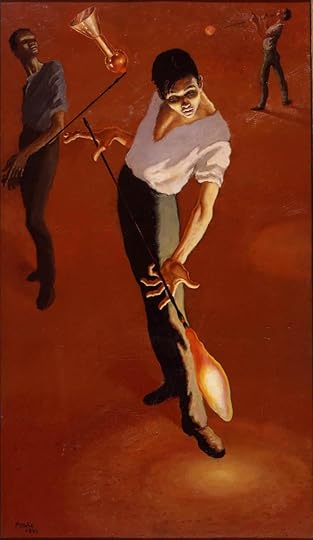
Glassblowers
Peake was mesmerised watching the unspoken choreography of glassblowers, the graceful grotesqueness of cathode-ray tube production. He sketched, painted, and wrote prose, and a famous poem.
Peake's painting of glassblowers at work
The factory: “Darkness, brickwork; hall after mammoth hall, pseudo archaic, absurd, begrimed, impressive, sinister; a setting for some film of gloomy passion… In this huge womb, fires roar.”
On sand: “Far from the full-wailing strands, it has become the burning mother of transparency. Sand… It has found it purpose. And from its huge transmutation lucence breaks.”
Poetry
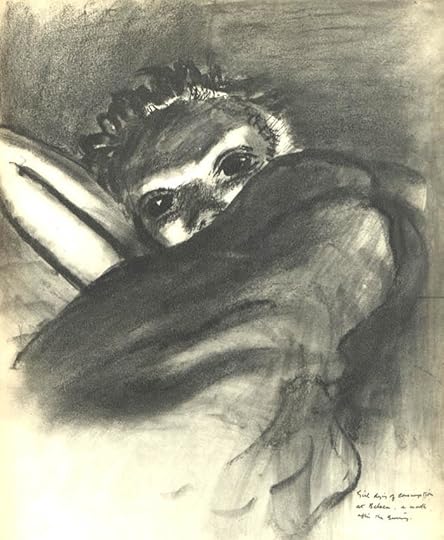
One often hears how being a war artist at the liberation of Belsen affected Peake, but some of his wartime poetry set in the London blitz is very powerful too.
There is a horrifically vivid poem, The Consumptive of Belsen (there are several versions, of varying length) and associated pictures. He explicitly wrestles with the guilt of not only observing but recording:
“Is this my traffic? For my schooled eye to see The ghost of a great painting, line and hue, In this doomed girl of tallow?” Also: “a huddled boy whose eyes had died... his eyes like broken glass – the shattered panes of a deserted house."
Peake's picture of a consumptive at Belsen
Chinese Influence
This book also reminds one of the lasting influence of his Chinese childhood - even down to the way he held a pencil like a Chinese calligraphy brush. See my reviews of his biographies for more details, especially Winnington’s Vast Alchemies, which I reviewed HERE.
Nonsense
Then, in total contrast to the war poems, there are nonsense poems (slightly reminiscent of Lear, Carroll and Belloc, complete with nonsense illustrations), and, as if to emphasise the fact he was an artist as well as a writer, some poems about great artists. See my separate review of A Book of Nonsense HERE .
All My Peake Reviews
All my Peake/Gormenghast reviews (including biographies/memoirs and books about his art) are on a shelf, HERE.
In my review of Titus Alone I begin with a seemingly outrageous claim, and now that I have made it through this massive collection of various works by Mervyn Peake, my fears have been laid to rest that my claim may have been overstated.
Peake's Progress is a massive (and I must say, beautifully bound) smorgasbord of Mervyn Peake's poems, short stories, plays, and art, meant to display the wide range of Peake's talent and aspirations, and it succeeds beautifully. After seeing the wide range of Peake's work, it is definitely clear that Peake had a command of language that not only towers above most human minds, but a playfulness that can only be admired for its sheer pleasure. Mervyn Peake's name during his life was made by his art and illustrations, but in his writing it is clear that he was able to paint with words as adeptly as with any color palette.
Mervy Peake was like a dog trainer for words (stay with me here): he had a clear vision of what he wanted to happen, and the words obeyed, with gleeful obedience. Many people can power language into doing what it wants, and making language submit to their whims, but what makes Mervyn Peake such a master is that he never has to resort to such shallowness. He isn't the Cesar Millan of words, where he teaches the words who the boss is and bullies them into submission. He treats his words with respect; he loves them, and he cares for them. He tolerates no abuse of language. Instead, he allows language to go free, and off-leash. He lets language run about, jump up with playful abandon, and lick people's faces. Language, to Peake, should be used for its own sake, and for its own happiness; it is a living, breathing, feeling thing. We readers are simply lucky enough to observe it at play from time to time, and when we do we are able to draw beautiful stories and insights into the human heart and mind.
I picked away at this compendium slowly, usually reading a work at a time before bed, and every night I fell asleep with beautiful imagery dancing in my head. Peake, like most under-appreciated writers, never saw financial success in his life, but reading his works makes it clear that he absolutely loved what he did. His passion, joy, and love of life are what shine through his work, and I can only hope that some of the shine gets reflected upon me.
It was inevitable that I was going to give this large volume five stars. It contains so much that is good that even the parts that are less good are carried upwards by the eruption of bliss into the high realms of delight, charm, wit and even terror. I first obtained this volume back in 1986 when I was a student and I read parts of it. Then I lost the book (or maybe returned it to the library; I am not sure) but I have thought about it occasionally ever since. And finally, this year, I purchased a copy with the intention of reading it from cover to cover, an objective I am delighted to say I have just achieved.
There are excellent prose stories between these covers, funny and fine plays, touching and brilliant poems, wonderful drawings. There are even some pages of memoirs. The novella 'Mr Slaughterboard' (sadly incomplete) is one of the great weird pirate adventures of 20th Century literature. The novella 'Boy in Darkness' (fully complete) is a masterpiece of baroque and gothic horror (and Peake absolutely was capable of merging the baroque successfully with the gothic, even though the two styles are meant to be opposed). There are some strange and ghostly short stories here too, and very effective they are!
Peake was not especially known as a playwright, but the plays here are very good indeed. 'The Wit to Woo' is a comedy of errors (deliberate and accidental) about death and love, a ripe farce that ought to be resurrected as a regular work for the stage (it has rarely been performed). 'Noah's Ark' is a wryly ironic interpretation of the Biblical story. 'For Mr Pye - an Island' is a brisk fantastical radio comedy that Peake adapted from his novel Mr Pye (I recall the 1980s television adaptation with great fondness).
But it the poems here that I enjoyed the most, both the nonsense verse of which he was a master and the more serious (and often profound) pieces, some of which are long narrative works ('The Rhyme of the Flying Bomb' is particularly noteworthy for its length and power, also for the stark force of its black and white illustrations).
This is a great collection of pieces of Mervyn Peake's work, apart from anything from the Gormenghast novels. I had read a lot of the short stories and poems which had been re-released around the same time as this anthology in other volumes, but there was much that was new to me. I think my favourite was a play script 'The Wit To Woo', a farcical country manor play filled with characters that could have been close relatives of the Gormenghast clan. There were notes from an intended autobiography covering Peake's childhood in China, and the radio script he wrote based on his novel Mr Pye, along with plenty of illustrations. The quality of the edition was very high, a fitting tribute to a brilliant author and artist.
What an enormous grab bag of a book! It takes bits and pieces of Peake's work, from a number of different sources (both published and unpublished), and I suppose it results in a sort of teaser-representation of the author... but then again I'm not sure that's quite accurate. In saying so, however, I'm aware that, for me, Peake's appeal resides firmly in his Gormenghast novels, which I adore. There's nothing of them here, bar a reprint of the related novella Boy in Darkness, which is outstanding. There's far more of the poet and playwright, which is why this is knocked down a star. I love his novels, I do really enjoy his poetry... but there's no denying that his plays don't have the same appeal. The Wit To Woo was apparently an enormous flop back in the day, and if I were reviewing it on its own I'd be hard-pressed to give it more than two stars - the thing really is a tedious slog, with the odd bit of fantastic language. The Noah's Ark play for kids isn't particularly outstanding either, but there's an improvement with the radio play version of Mr. Pye. What makes this collection worth reading, however, is the sheer impression of range that it leaves - Peake was really enormously talented in a number of fields - and as always his artwork is a sheer delight.
Originally published on my blog here in August 2000.
A collection of Peake's writings (much of which is previously unpublished) and drawings put together by his widow, Peake's Progress seems to give a fuller picture of the man than can be seen in his best known work (his completed novels, especially the Gormenghast trilogy, and the illustrations not included here). By choosing the unknown and little known, Maeve Gilmore has created a volume which is of great interest to any fan.
The written works which make up most of Peake's Progress include poems, short stories, plays, and notes for a projected autobiography. Of these, the poems are perhaps the most accomplished, particularly The Rhyme of the Flying Bomb (whose powerful illustrations are among Peake's very last work) and the Poems of Love. Quite a number of nonsense poems are included, though I feel that Peake was not a master of this genre - it is the illustrations which delight, such as the pear-shaped fairies of O Here It Is, and There It Is.
There are three plays, one being an adaptation of the novel Mr Pye for radio, one a children's play never produced or published about a revolt of some of the animals on Noah's ark, and The Wit to Woo, a romantic comedy which received such disastrous notices when it was produced that Peake suffered a nervous breakdown.
The written work mostly has an unfinished quality, and gives the impression that Peake tended to get bored in the realisation of a good idea; this is perhaps particularly obvious in the plays. The Wit to Woo has a plot reminiscent of Joe Orton, in which a young man fakes suicide in order to show the woman he loves that he is serious; he then pretends to be his own cousin - forceful and brash where he himself is shy - to woo her again. It has a wonderful moment when the undertakers realise that the person they have come to bury is alive, and demand that he kill himself so that they won't have been wasting their time.
However, it is marred by three problems: discontinuities in plotting; a tendency to fall into awkward and artificial verse; and surreal interruptions (such as a head poking in at a window to ask "Is this Cloudyfold?"). This sort of play works better when it is more naturalistic, because otherwise it tends to become heavy handed rather than witty. The idea is good, but the play could have done with at least one more draft. The same is true of Noah's Ark, which would probably benefit from having the first act cut entirely.
Unless the Gormenghast trilogy has turned you into a real Peake fan, this collection will not seem to be terribly good; but to anyone who enjoyed that series and wants to know more about Peake and his work, it will be fascinating. It also has a very good biographical introduction, by John Watney.
Brilliant collection showing the author/artist in nearly every guise
Most people who get to know the work of the English novelist, poet, and artist Mervyn Peake (1911-1968), if they get to know him at all, will do so through the three published "Gormenghast" books - the beginnings of what would have been a lengthy roman-fleuvre covering the life and exploits of Titus Groan. I believe the "Titus" books (a better name for them, as the third book doesn't touch on Gormenghast castle at all) are among the great imaginative novels of the last century, and they made me a Peake-devotee for life. This collection of miscellaneous writings and art, compiled by his widow Maeve Gilmore a decade after his death, is a great place to continue (or start) an exploration of this amazing multitalented artist's life and work.
Peake the poet is well-represented here - his lengthy "Rhyme of the Flying Bomb", various "Nonsense" poems and a large number of shorter works are present; Peake the prose stylist is on evidence, in a selection of short stories and also, fascinatingly, in early renditions of his children's story "Captain Slaughterboard" and an early prose-sketch of Titus and Gormenghast, "The House of Darkstones." The previously-published "Boy in Darkness" is also here, but most of the contents in this lengthy volume (576 pages in the Overlook 1st US edition I have) are previously unpublished. The real revelations are in the author's fascinating full-length plays, "The Wit to Woo" and "Noah's Ark" - the fascination with grotesquerie and the fantasy-lives of children are fully in evidence in both of these works, the first ostensibly an "adult" play and the second clearly aimed at children. Both were unpublished before this volume was put out, and remain unavailable anywhere else, as is the case with the majority of work herein.
There are also plenty of reproductions of Peake's drawings: pencil sketches, pen-and-ink, charcoal washes, block prints and woodcuts, etc. It would have been nice to have had some color plates, though the artist wasn't as far as I can tell all that prolific as a painter; one can't have everything though. Lovingly produced, nicely printed (in the edition I have, at any rate), next to the "Titus" books, I'd recommend this to anyone planning a sojourn through the gothic weirdness of Mervyn Peake.
2010: Intressant antologi som dels ger en bild över Mervyn Peakes skapande, men som också blir väldigt splittrad, eftersom han rörde sig över en mängd olika genrer. Vissa saker är guldklimpar, medan annat har mer gråsten över sig.
Läsvärt om man vill grotta ner sig i Peakes produktion och - typ - navigera sig fram till de ådror man vill bryta mer malm ur. Annars kan man nog hoppa över den, tror jag. Guldklimparna till trots.
2020: Läser om "Boy in darkness". En suggestiv och vagt obehaglig novell som skulle ha gjort sig bättre som helt fristående från Gormenghast-böckerna, istället för att - som nu - Ha Titus Groan som huvudperson. Den rör sig obehindrat mellan fantastikens olika genrer och de tre karaktärerna Goat, Hyena och Lamb är väldigt snyggt skildrade. Finns tydligen att hitta som teater på YouTube. Läsvärd!
Peake's Progress is a collection of some of the works of Mervyn Peake collected into one volume by his wife some years after his death.
It contains short stories, poems, drawings, plays, radio scripts, many of which had been published previously, but quite a few which were never published in the author’s lifetime.
I am never quite sure what to think about stuff that was never published in the first place being published after their death as if it was never published in the first place then maybe there was a reason why it was never published, and you never know whether the author would have been happy with this either.
As a result this is a mixed bag (some of it is very strange, some of it is magnificent, some of it just doesn't hit the mark), but shows a supremely talented and created man who had plenty of strings to his bow and was never short of ideas.
The Gormenghast books are some of my favourites ever, so I've been wanting to read this for a while. I probably needn't have bothered. The short story A Boy In Darkness is technically connected to Gormenghast but really it's a tiresome surreal fable. I don't care for Peake's poetry, which takes up a lot of space in this volume and which I found mannered and too flowery for my taste. I skimmed or skipped most of it, and after a couple of pages each gave up entirely on the two play scripts. The short stories are much better, with the undoubted highlight being Mr Slaughterboard, a dark and phantamsagorical pirate tale, marred only by some unnecessary racism.
Very cool miscellany of Peake's shorter non-Gormenghast work (including some Gormeghast prototype pieces). Peake's amazing. So few artists are able to develop a recognizably unique style of their own in any one given field, yet Peake managed to define a "Peakean" style in both his writing and his sketch work.
Mervyn Peake is a delightful writer, as in 'full of delights.' This miscellany is made up of poems, plays, memoir, short stories, and songs. While one should start with his magisterial 'Gormenghast' novels this book is also a testament to what a wonder he was.
Peake's Progress is a wonderful compendium of work by the brilliant artist and author, Mervyn Peake. It is, in concept, much like Mervyn Peake: Writings & Drawings, but this book features more of his works and a more in-depth biography of his life by John Watney, further illustrating Peake's wide range of talent as an author and artist.
Short Stories and Novellas Peake's Progress features a wide range of stories, including The White Chief of the Uzimbooboo Kaffirs, one of his earliest works. It was written he was 11 years old and features his fascinating style and charm that would fully develop in his later years. Also featured are a range of 5 short stories, also published in Boy in Darkness and other Stories , written in a variety of genres, from satire to horror, psychedelic to nonsense. Of course, the famous Boy in Darkness is also featured, a brilliant novella written with an unsettling tone, and a most interesting addition to the Gormenghast lore.
Plays The Wit to the Woo, Noah's Ark and the radio play For Mr. Pye - An Island are 3 plays of Mervyn Peake that are included in this book. The Wit to the Woo, a satirical, comedic play, was the only one of his plays that was ever commercially performed, but, unfortunately, it failed miserable commercially and critically, causing Peake to go into a mental breakdown. I found the play to be quite fantastic, featuring absurd characters, witty dialogue and incredible imagery, but my favourite of the plays was Noah's Ark, an entertaining twist on the Bible story.
Poetry A large selection of poetry can be found in Peake's Progress. Some of the most powerful come under the subheading Poems of War and Place. Peake was commissioned as a war artist in WWII, and many of the sights he saw haunted him for the rest of his life. The poetry he wrote is beautiful and sympathetic, and they often dealt with how people's lives were affected by the war. Surprisingly, however, one of his most touching and a favourite of mine deals with the topic of a dead rat found among the fields. Were I a farmer I would call you vermin Because you’d be the villain of my crops And gnaw my wealth, but I am not a farmer, But only one that walks the farmers’ fields, And so when I came on your stiffen’d body Lying alone and flowered with frost, your eyeballs Glazed and your little front paws so beseeching Crossed on your breast and pink like human fingers, And when I saw your deadness in the frozen Light of the winter morning, I, unmanly, Unfarmerly, and most impractically Felt that rats even have a right to live And knew that there was beauty in your body Dusted with starry marvels of bright frost, And beauty in the little hands you crossed Upon your breast before you died this morning. Also included are some fantastical and funny nonsense poems, including the famous Aunts and Uncles and many others. There are also narrative poems, including the brilliant The Rhyme of the Flying Bomb, a poem set during WWII about a baby found on the street, that evokes incredible imagery and rich symbolism.
Drawings Many of the drawing included in this book are things that Peake drew for other peoples work, such as Treasure Island, Bleak House, The Hunting of the Snark and The Quest for Sita. He also illustrated a lot of his own work, from his poetry to his novels to his plays, the range was quite versatile.
Peake's Progress is an incredible compendium of work by an incredible man. This collection is a wonderful piece that showcases Mervyn Peake's skill as an artist. His passion for his art, for his family, for life is reflected through his work, which makes this collection all the more charming.