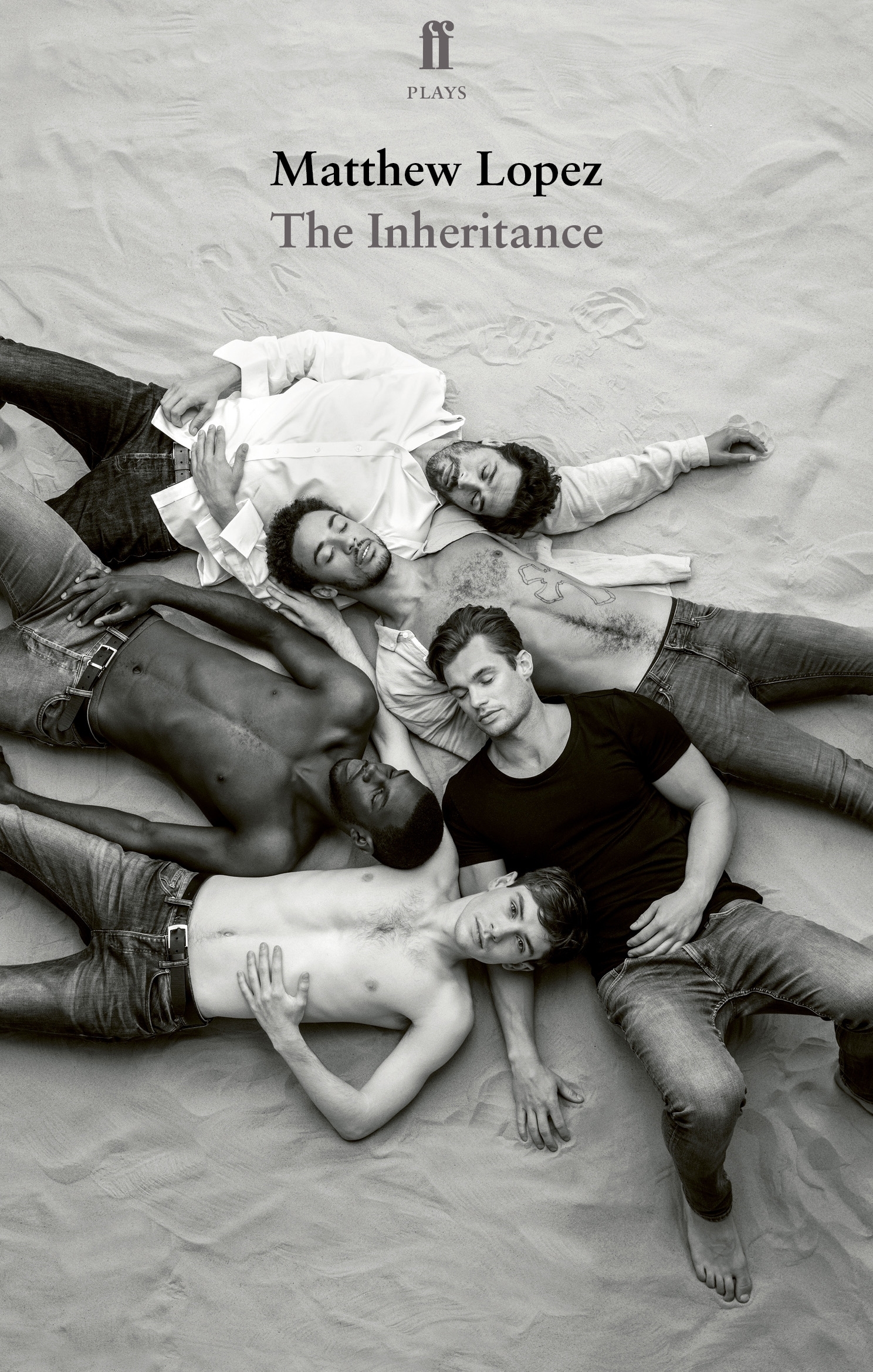
The last play I read was ‘Harry Potter and the Cursed Child’, a two-parter that translated into about four hours on stage, as far as I can recall. I was singularly unimpressed, due largely to the fact that I felt the anaemic writing was largely dependent on it being a major stage production, with all the razzmatazz that implies. The text, by itself, was a rather bare and rickety scaffold, scarcely supported by the playwright’s imagination.
What surprised me about ‘The Inheritance’ is how quickly I read this approximately 300-page play, which translates into a six-hour running time on stage, I think. Six hours? Granted, it is an easy read, as conversational as a novel, with minimal stage direction in the text itself. (What I found confusing is that there are large chunks of text that read like stage direction, but which I think are meant to be actor monologues. Go figure).
Another confusion is the plethora of Young Men, who are only referred to by numbers, and of whom I suspect several of the main characters get to portray as well. Then there is the fact that the actors often break off in the middle of a scene to comment on their own acting or thought process at that precise moment, or to engage in reflection with the eponymous Morgan (E.M. Forster, who gets told quite rudely to ‘fuck off’ in an excoriating scene where the Young Men accuse him of living his entire life with his head in the sand).
There are certain scenes – like a graphic sex scene early on – that had me scratching my head as to how on earth it’d be translated onto stage. We’ll probably have to wait for the (inevitable) television mini-series to appreciate the full impact of such scenes. Adam’s extended monologue about his rampant orgy in Prague is, of course, much easier to relate on stage, as it is essentially a single descriptive speech that is very powerful and vivid.
All in all, I think this is a very actorly play, to the point that its large cast is likely to make or break it, especially the key roles, which call for a daunting level of intimacy and immediacy with the audience. The success of the play at the West End, and its October debut on Broadway, with much of the original UK cast reprising their roles, seems to attest to its success in this regard.
What also struck me while reading this is how unapologetically ‘gay’ the play is. There is a lone female role, Lois Smith as Margaret (Vanessa Redgrave in the West End version). She only appears towards the end, making her something of a stock character, even though she delivers quite a powerful speech.
Another troubling element for me was the inclusion of E.M. Forster as an Omniscient Narrator or Impartial Observer. Much has been made as to how Matthew Lopez based his play on the framework of Howards End, but I honestly feel you could remove all of these references, and probably end up with a much tighter and more hard-hitting play.
I also feel there is nothing really that revolutionary in this play that has not been done in novel form to date. E.M. Forster’s lifelong battle with his gayness is explored with wonderful tenderness in Arctic Summer by Damon Galgut. The generational impact of HIV/Aids has been the subject of novels as recent as The Great Believers by Rebecca Makkai (2018) and Christodora by Tim Murphy (2016).
Of course, any ‘gay play’ has to contend with the intimidating shadow cast by ‘Angels in America’. In many respects, I think Matthew Lopez represents a particular response, or reaction, to the highly stylised and symbolic approach adopted by Tony Kushner. This is a far messier and cluttered play, swept up in the quotidian details of the numerous domestic dramas of its large cast. (One also cannot imagine Kushner ever putting a word like ‘wanna’ in a character’s mouth, or a phrase like ‘fuck me harder’).
Much like ‘The Handmaid’s Tale’ on television captured something of the Far Right zeitgeist sweeping the world at present, ‘The Inheritance’ grapples quite directly with the ongoing impact of Trump. There is an astonishing scene where his presidency is described as a malignant form of HIV infecting the American body politic.
Also, what I found interesting is how one of the main (older) characters is a Republican supporter, who ends up having to defend his position (with great reason and vigour, I might add), against the indignation of a bunch of younger characters. Here the dialogue crackles with quiet fury; Lopez balances quite a tightrope in not turning his characters’ viewpoints into soapbox polemic.
What is even more interesting in this debate is Eric (a young, liberalised, radicalised Democrat), and his reasoning for agreeing to marry Henry in the first place. There is no sex between the two, but Henry is quite happy with an open arrangement. All he wants is affection … But we know that human motivations are often more complex and subversive.
If there is one thing that stood out for me from this play is how divided the gay community remains: not only politically, but generationally. There is the ‘older’ generation dealing with the fallout and trauma of the Aids era, and the ‘younger’ generation born thereafter that has its own problems to deal with. (There is another interstitial generation caught in-between; perhaps a glaring omission of ‘The Inheritance’ is its omission of gender and racial issues, but to its credit it has a very specific focus).
Both camps (as it were) are leery and wary of each other on either side of their generational fence. The great question asked by this play is how our community can heal itself, and how the old can learn to trust the young. It is the responsibility of the older generation to teach the young about compassion and intimacy, as forged in the hellfire of the Aids era. The young, on the other hand, can teach everyone else about the joy, freedom, and sheer wonder of being alive. That is a true inheritance not only for the gay community, but for humanity as a whole.