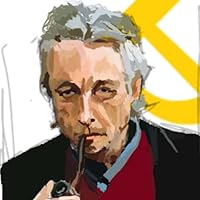
The analytic impression of Michel Foucault is of a radical relativist whose views on truth entail linguistic idealism. C.G. Prado's book lays this misperception to rest, showing analytic philosophers that Foucault's ideas about truth are defensible and merit serious attention, while also demonstrating to Continental philosophers that Searle's ideas about truth can not be ignored. Prado rebuts the analytic impression of Michel Foucault as a radical relativist whose views on truth entail denial of the objective world, and demonstrates that Foucault is not only a realist, but also much closer than many imagine to John Searle and Donald Davidson, both model analytic thinkers.
The writing wasn't my cup of tea, but Prado clearly knows his stuff. I think overall both Searle and Foucault make annoying problematising comments about their own theories of truth (Searle's rejection of correspondism, and Foucault's rejection that he's analysing historical and ideological deviations of truth). It just makes me aware of how advanced Heidegger and Bergson were on this issue.
For Searle, truth is a property of propositions. The property is fulfilled when a sentence accurately depicts an extra-linguistic world as it is. The existence of that extra-linguistic world is necessary for communication. Searle is an analytic who desires conceptual clarity. This involves breaking down concepts to their most basic parts.
Language is composed of speech acts, which are utterances formed “according to rules”. Speech acts differ in their content and predication. Speech acts also differ in their forces, each forces contains differences within themselves. There are three forces, locutionary, illocutionary and perlocutionary. The locutionary force communicates the proposition (to state a ‘house is on fire’). Illocutionary is the intention of the communication (to warn a ‘house is on fire’). Perlocutionary is the effect of the communication (to cause panic in stating a ‘house is on fire’).
The 5 broad type of illocutionary forces are: commissives (promises), directives (imperatives), assertives (descriptions), expressives (opinions) and declarations (legal force). The condition of fulfilment for each speech act is different. It can be ‘world-to-world’ (i.e. the world of a statement must align with the world to be true) and ‘world-to-word’ (i.e. the world must allign with the word to be fulfilled, e.g. ‘shut the door’ requires one to shut the door).
The intuitive capacity to understand and apply these rules is called ‘the background’, “a collection of nonintentional, nonrepresentational capacities that enable representation, [and] communication” (p. 40).
Speech acts are the product of the mind applying intentionality to utterances (p. 38). Intentionality is a irreducible feature of matter. Thus, Searle opposes the idea that 'scientifically observable brain activity' is what makes statements concerning intentionality (he is thinking) true. Hence Searle’s famous Chinese-room thought experiment, which denied that mimicking syntax (applying rules) could illustrate semantics (the comprehension of meaning). This leaves him unable to verify mental facts, leaving the possibiltiy of philosophical zombies.
One form of intentionality is ‘we-intentionality’. We-intentionality explains how individual acts of intentionality can create general social constructs in the form “X counts as Y when Z’, i.e. a physical aggregate of material counts as a wall (social construct) only when it encloses someones private property’ (X counts as Y when Z). The levying of functionality requires the cognitive capacity of intentionality (we need to intentionally graft a function onto objects). Intentionality is something possessed by individual agents which poses a problem for social constructs which necessarily rely on a collective intentionality (hence the problem of methodological individualism). Searle’s solution is that individuals can (rightly or wrongly) simply state “we-intend” internally. Because we can cognise our intentionalities as a collective (rightly or wrongly), and our capacity to assign functionality onto objects is derived from this power of intentionality, we can collectively assign functionality in general. Functionality is an observer-reliant fact, the assignment of a collective functionality (status functions) as provided by we-intentionality is an institutional reality and creates institutional facts (as opposed to brute facts). In assigning a collective functionality, we divorce an object from its mere brute-factness, and endow it with a institutional reality. The complex network of we intentional statements is responsible for the interconnection of social constructs. The necessity for we-intentionality to be articulated realises the necessity of ‘language’.
For Searle, truth is a factual proposition. A proposition gains its truth via an extralinguistic state of affairs, “statements are made true by how things are in the world”. P is true if and only if P. Stating "P is true" is diffrerent from the fact of P (which Frege denies). P is true makes a metalinguistic claim.
On the other hand, Foucault's concern is not with finding the conditions for truth. He is investigating why standards of truth are historically variable (although Foucault denies his philosophy is about false ideological constructions of truth (p.84)). Foucault identifies power as responsible for 'truth' production. Power for Foucault is the continuously evolving social relationships which reproduce themeslves. The question of true truth does not interest Foucault. Foucault is a realist, he denies that "there is nothing there and that everyhing comes out of somebody's head".
Foucault’s genealogy is concerned with how history fabricates its own purpose. Foucault is exposing the Augustian view of history as linear and teleological, and he views it as sustained by power. Foucault's account of power is as a kind of impersonal social force which produces subjectivity. Our subjectivity is the product of our "self-image, perspectives, attitudes, values, desires and objectives." Each is determined by a coterie of intersecting social norms and behaviours. The intentional and unintentional ways some actions determine the acceptability of other actions is power. The concept of objectivity hides the vested (political-economic) interests of power, the truth is thus not “how things are, but is instead the highest-order value in a discourse and set of practices”.