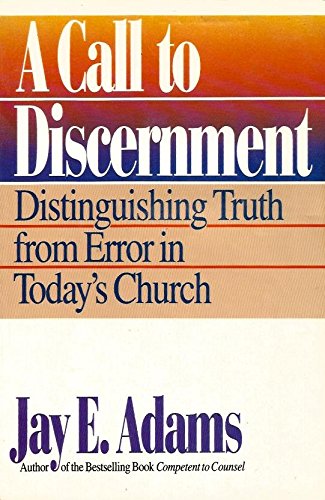
I read this for a class several months ago so I'm a little fuzzy on the details, but, like many, I distinctly remember that I had a hard time with Adams' tone. I found it really unhelpful and off-putting. He seems to find a way to insult the reader at regular intervals and assumes that they're lazy, dumb, spiritually immature or ambivalent - which is kind of ironic because would someone who is any of those things be reading a book about these topics? I doubt it. His assumptions about the people reading his books or seeking counseling in his style are really discouraging and counter-productive.
Adams is very dogmatic about things and suffers from the subjectivity that he bemoans in the book. There was more than one example in this book where he takes a position on something that I think he totally misconstrued (but, of course, people who see it differently are not discerning). As an example, we writes:
"Abortion should not be fought on the basis that killing a human being is wrong because he or she is so valuable, but on the basis that, when a child bearing God's image is slaughtered, it is God who is attacked because that child bears his image...An attack on the image of God is serious, not becomes of man's supposed great worth, but because of the One whose image he reflects. Yet undiscerning Christians, some of whom have good discernment when it comes to other things, seem to fall apart in their thinking at this point."
This is such an unnecessary (and untrue) way to think about abortion. Abortion is wrong (and harmful) for a whole slew of reasons. Of course humans have value (Matthew 10:30-31, Psalm 139:13-14). It is derived from God, but that doesn't mean that we should renounce all mention of human worth. Refusing to validate any reason except that it is an attack on the image of God is just reductionistic and an over-spiritualization of the issue.
Elsewhere he ridicules people who sing certain hymns using as one of his examples, "The Church's One Foundation." The author is aghast at why we would sing about talking with the dead because of the line "mystic sweet communion with those whose rest is won." The hymn is clearly (as the title implies) about our communion with Christ and how that communion exists among believers of all ages.
It's examples like these that demonstrate that "discernment" is not as black and white and the author would like the reader to believe. He's clearly missing the point in some areas and letting his own flawed intellect get in the way. We all do - but he seems to be unaware that it's something he needs to worry about.
Toward the end he gives a system for developing your discernment that involves taking a topic, recording what you know about it (including questions you have about it), testing it against scripture, identifying a biblical alternative (if necessary) and implementing that truth in your own life and with others. For some people, this program could be helpful, although it's very rigid and structured (and he expects you to follow it religiously if you want to see improvements).
I'm not going to disagree what we're experiencing an extreme lack of discernment in our day and age, but belittling everyone about it is not the way to go. This was a short book and there were a few tidbits that were helpful, but there was nothing profound enough to make up for the constant scolding.