

What do you think?
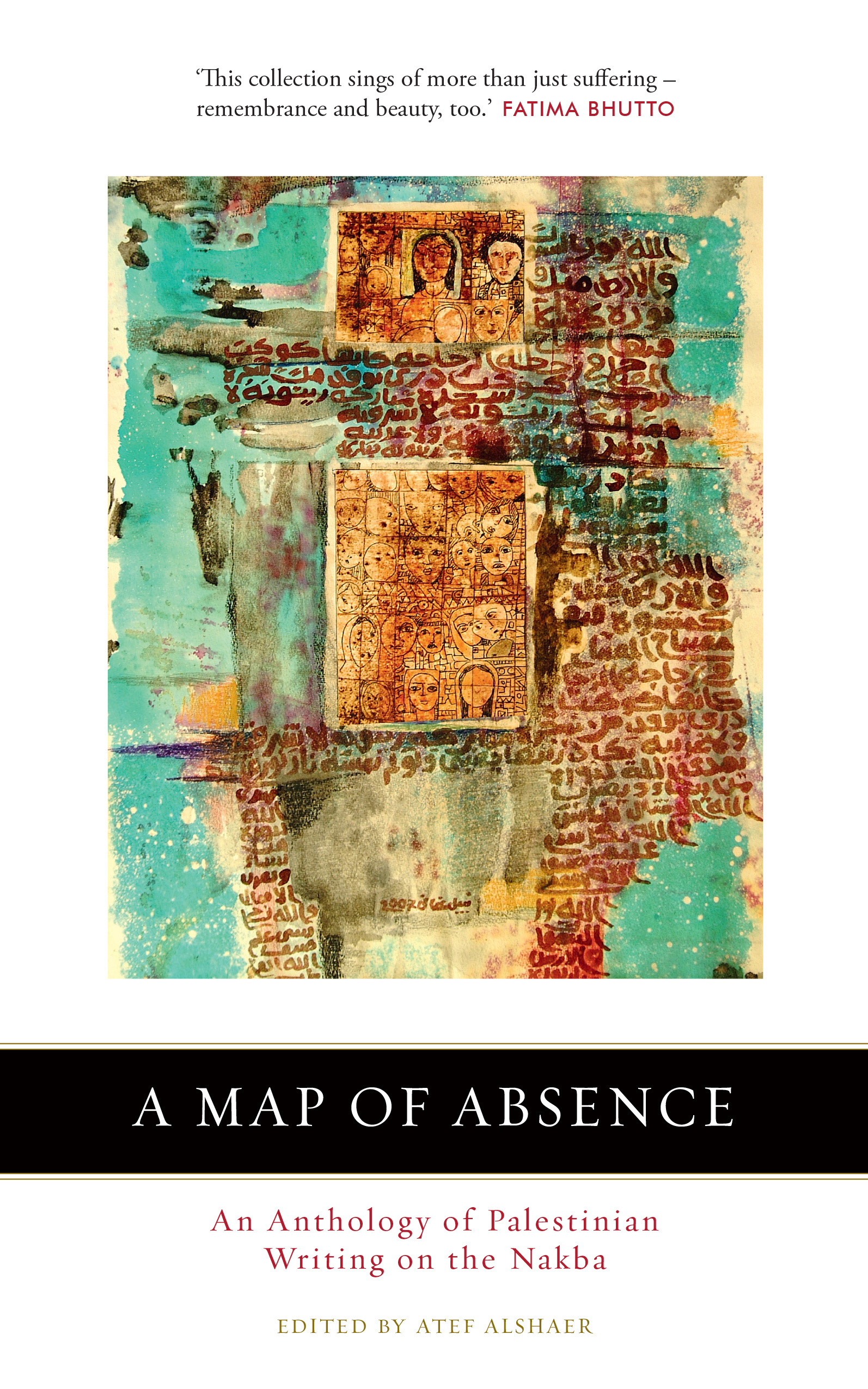
A Map of Absence: An Anthology of Palestinian Writing on the Nakba
A Map of Absence presents the finest poetry and prose by Palestinian writers over the last seventy years. Featuring writers in the diaspora and those living under occupation, these striking entries pay testament to one of the most pivotal events in modern history – the 1948 Nakba.
This unique, landmark anthology includes translated excerpts of works by major authors such as Mahmoud Darwish, Ghassan Kanafani and Fadwa Tuqan alongside those of emerging writers, published here in English for the first time. Depicting the varied aspects of Palestinian life both before and after 1948, their writings highlight the ongoing resonances of the Nakba.
An intimate companion for all lovers of world literature, A Map of Absence reveals the depth and breadth of Palestinian writing.
This unique, landmark anthology includes translated excerpts of works by major authors such as Mahmoud Darwish, Ghassan Kanafani and Fadwa Tuqan alongside those of emerging writers, published here in English for the first time. Depicting the varied aspects of Palestinian life both before and after 1948, their writings highlight the ongoing resonances of the Nakba.
An intimate companion for all lovers of world literature, A Map of Absence reveals the depth and breadth of Palestinian writing.
320 pages, Paperback
First published May 13, 2019
Ratings & Reviews
Friends & Following
Create a free account to discover what your friends think of this book!
Community Reviews
Displaying 1 - 30 of 33 reviews

July 8, 2019
Today we commemorate Ghassan Kanafani's memory as he died/ was killed this day 47 years ago . So I figured this would make the perfect opportunity for me to review this book that gathers some of the finest palestenian writers and poets.
I have always loved anthologies . I have always been fond of that beautiful mixture of prose and poetry keeping me intrigued from start to finish .
A map of absence is no different as I enjoyed reading every single poem , short story and essay .
Darwich , E.Said and Fadwa Tuqan are my absolute favourites and I loved reading Darwich's translated poems in particular since i only know the original ones in arabic.
Great poems , outstanding short stories and engaging essays that will leave you with a bittersweet feeling : sweet for the delicacy of the writing and bitter for their sad memories.
I have always loved anthologies . I have always been fond of that beautiful mixture of prose and poetry keeping me intrigued from start to finish .
A map of absence is no different as I enjoyed reading every single poem , short story and essay .
Darwich , E.Said and Fadwa Tuqan are my absolute favourites and I loved reading Darwich's translated poems in particular since i only know the original ones in arabic.
Great poems , outstanding short stories and engaging essays that will leave you with a bittersweet feeling : sweet for the delicacy of the writing and bitter for their sad memories.
May 21, 2021
Palestinian literature has a special status in my heart. It has shaped my awareness of the Palestinian cause, and has enabled me to glimpse into the suffering of our Palestinian people.
Nakba Day was six days ago (15 May), marking 73 years. And this anthology gives you a piece of 70 years worth of prose and poetry, written by Palestinian writers, some whom I am already familiar with, and have read, and some I discovered with this anthology.
I loved revisiting some of Mahmoud Darwish's poetry in English, which is as poignant in any language. I also loved discovering voices I never heard of, such as Hanan Ashrawi, for instance.
I consider this anthology to be the perfect initiation to anyone who has never read any Palestinian literature, as it has great recommendations for further reading (since some of the works included are excerpts only).
Nakba Day was six days ago (15 May), marking 73 years. And this anthology gives you a piece of 70 years worth of prose and poetry, written by Palestinian writers, some whom I am already familiar with, and have read, and some I discovered with this anthology.
I loved revisiting some of Mahmoud Darwish's poetry in English, which is as poignant in any language. I also loved discovering voices I never heard of, such as Hanan Ashrawi, for instance.
I consider this anthology to be the perfect initiation to anyone who has never read any Palestinian literature, as it has great recommendations for further reading (since some of the works included are excerpts only).

March 27, 2021
This anthology of Palestinian poetry and prose ( excerpts from novels, stories and various nonfiction writings) covers a period of over 70 years of writing but takes as its center the Nakba of 1948, that time when Palestinians were forcibly removed or driven from their homes between the Jordan River and the Mediterranean. The writers represented include some of the most distinguished in Palestinian cultural history followed by younger writers also lauded for their work. There are brief biographies of all at the end of the volume.
The works vary in tone but all incorporate some sense of loss. There might be anger; possibly hate; maybe mourning of someone lost or a home bulldozed or a village no longer existing or grandparents graves disappeared under a new foreign community. Some are written from the point of view of prison. So much emotion, so well expressed. Some evidence nostalgia for what they remember or have been told by parents while living abroad or in refugee camps in Lebanon, Jordan, etc. Yes this is political writing but also highly personal.
This is an excellent collection. I chose to read it slowly which worked well for me. Highly recommended.
The works vary in tone but all incorporate some sense of loss. There might be anger; possibly hate; maybe mourning of someone lost or a home bulldozed or a village no longer existing or grandparents graves disappeared under a new foreign community. Some are written from the point of view of prison. So much emotion, so well expressed. Some evidence nostalgia for what they remember or have been told by parents while living abroad or in refugee camps in Lebanon, Jordan, etc. Yes this is political writing but also highly personal.
This is an excellent collection. I chose to read it slowly which worked well for me. Highly recommended.

May 15, 2019
Nakba Day (Arabic: Yawm an-Nakba, meaning ‘Day of the Catastrophe’) is observed annually on 15th May and commemorates the mass displacement of some 700,000 Palestinians who were expelled or forced to flee their homes following (and preceding) the Israeli declaration of independence in 1948.
'A Map of Absence' is comprised of poetry, prose and essays written by Palestinians over the last seventy years; writers living in the diaspora and those living under occupation.
Yes, this book depicts suffering, but it is also about the beauty in the mundane, the everyday- the sounds, smells and sights that make our home, home. It is about the things we are never prepared to lose, the loss hitting harder still because there is no knowing when, if ever, you might get them back.
I think it's rare that an anthology hits the mark completely and there were definitely some contributions that I was able to read more easily than others. At the same time, one reading isn’t enough to grasp all that is contained within this book but the richness of language that runs throughout is easily appreciated.
Mostly translated, the descriptions and depictions of both prose and poetry remained palpable. I could quote many of the entries endlessly in all of their heart-wrenching beauty but they also serves to remind the reader that, as hard as it is to imagine the reality, these are lives that are still being lived.
Thank you so much to the publisher for the gifted copy of this book. It’s one I see myself returning to time and time again.
'A Map of Absence' is comprised of poetry, prose and essays written by Palestinians over the last seventy years; writers living in the diaspora and those living under occupation.
Yes, this book depicts suffering, but it is also about the beauty in the mundane, the everyday- the sounds, smells and sights that make our home, home. It is about the things we are never prepared to lose, the loss hitting harder still because there is no knowing when, if ever, you might get them back.
I think it's rare that an anthology hits the mark completely and there were definitely some contributions that I was able to read more easily than others. At the same time, one reading isn’t enough to grasp all that is contained within this book but the richness of language that runs throughout is easily appreciated.
Mostly translated, the descriptions and depictions of both prose and poetry remained palpable. I could quote many of the entries endlessly in all of their heart-wrenching beauty but they also serves to remind the reader that, as hard as it is to imagine the reality, these are lives that are still being lived.
Thank you so much to the publisher for the gifted copy of this book. It’s one I see myself returning to time and time again.
January 19, 2021
The stories in this book are ones of human interest. Organized by three successive eras, it has many descriptive poems and excerpts of fiction and nonfiction. Palestinian literature is a bonanza of good writing. Often, it is realistic. Even so, some horrendous situations must psychologically affect the characters. There, an author may turn to magical realism because the occurrences become too intense or inescapable. At the same time, a reader wonders why. International organizations did not exercise enough authority and oversight.

January 18, 2020
Quite a mixed bag. Unfortunately, some of the younger authors’ writings felt like Instagram poetry and angry tweets - which is not my cup of tea. The selection of older authors was a lot better. Also: Jabra Ibhrahin Jabra’s short story was so beautiful, so evocative.

January 4, 2021
This anthology contains a selection of some of the best Palestinian authors, and writers about Palestine, from the 1930s to the present. It has poetry, short stories and nonfiction. It also has some excerpts from longer works, which I always dislike in an anthology; the novels were not designed to be read in excerpts and the context is missing. Most, but not all, of the selections are about the Nakba, the "catastrophe": the driving out or massacre in 1948 of 780,000 Arab Christian and Moslem Palestinians by terrorist methods to create the single ethnic and religious state of Israel, one of the major atrocities of the twentieth century. The selections which directly describe the Nakba in realistic style are brutal and heart-wrenching, and gave me a better understanding of what happened in 1948; other selections, especially the poetry, are more literary, and describe the events in images and symbols. A smaller number are concerned with the results of the Nakba: the struggle of the Palestinians to regain their homeland, the invasion of Lebanon, and the everyday life of Palestinians both in Israel and the diaspora.
A highlight of the anthology was the poetry of Mahmoud Darwish; I am looking forward to reading more of his poetry next month.
While the focus on the Nakba might seem to limit the scope of the anthology, I imagine most Palestinian writing since that time focuses on the loss of their homeland and the trauma of exile. The Palestinians have been betrayed, first by the Western "liberals" who almost all supported Israel and ignored the Palestinians, secondly by the bourgeois Arab states which gave only token assistance, more fearful of mobilizing their own people than of the Israelis, and ultimately and most tragically by their own leadership.
Of course, after almost three quarters of a century, conditions have changed and the solutions put forward in the past are no longer possible. Having been pro-Palestinian since the 1967 war, I have little respect for liberals who, having ignored the Palestinians when they could have made a difference, now want to get liberal brownie points for being anti-Israel and repeating the old slogans. Most of those driven out in 1948 died in exile, and even the children of that time are in their seventies and eighties; the present Jewish population of Israel are no longer foreign occupiers but were born there, and even second and third generation. No one can say with Darwish, go home and give us back our country, any more than Native Americans can seriously say that in America. The secular democratic leadership of the Palestinian struggle in the fifties and sixties has been largely displaced by Islamicists who think in terms of religious jihad, forgetting that the victims of the Nakba were not all Moslem. Today, the fight of the Palestinians must be, not to destroy Israel, but to forge alliances with Israeli Jewish workers to transform Israel into a secular democratic state with equal rights for Jews, Christians, and Moslems, Arab and non-Arab; and to fight for the same thing in the Arab states and wherever they are in the diaspora.
But having said that, there is no excuse for erasing the history, the facts about the Nakba, and the long and heroic struggle of the Palestinian people, any more than the changed conditions in Northern Ireland would justify forgetting the martyrs of the IRA. If this anthology contributes to preserving that memory, then I can ignore its faults and recommend it.
A highlight of the anthology was the poetry of Mahmoud Darwish; I am looking forward to reading more of his poetry next month.
While the focus on the Nakba might seem to limit the scope of the anthology, I imagine most Palestinian writing since that time focuses on the loss of their homeland and the trauma of exile. The Palestinians have been betrayed, first by the Western "liberals" who almost all supported Israel and ignored the Palestinians, secondly by the bourgeois Arab states which gave only token assistance, more fearful of mobilizing their own people than of the Israelis, and ultimately and most tragically by their own leadership.
Of course, after almost three quarters of a century, conditions have changed and the solutions put forward in the past are no longer possible. Having been pro-Palestinian since the 1967 war, I have little respect for liberals who, having ignored the Palestinians when they could have made a difference, now want to get liberal brownie points for being anti-Israel and repeating the old slogans. Most of those driven out in 1948 died in exile, and even the children of that time are in their seventies and eighties; the present Jewish population of Israel are no longer foreign occupiers but were born there, and even second and third generation. No one can say with Darwish, go home and give us back our country, any more than Native Americans can seriously say that in America. The secular democratic leadership of the Palestinian struggle in the fifties and sixties has been largely displaced by Islamicists who think in terms of religious jihad, forgetting that the victims of the Nakba were not all Moslem. Today, the fight of the Palestinians must be, not to destroy Israel, but to forge alliances with Israeli Jewish workers to transform Israel into a secular democratic state with equal rights for Jews, Christians, and Moslems, Arab and non-Arab; and to fight for the same thing in the Arab states and wherever they are in the diaspora.
But having said that, there is no excuse for erasing the history, the facts about the Nakba, and the long and heroic struggle of the Palestinian people, any more than the changed conditions in Northern Ireland would justify forgetting the martyrs of the IRA. If this anthology contributes to preserving that memory, then I can ignore its faults and recommend it.

November 13, 2021
I am quite conflicted about this book, so I chose in the end the middle of the road, 3 stars. That's because this book contains mostly poetry and it is hard for me to enjoy/understand/appreciate poetry, but on the other hand the love for the land, the anger, the power, these were really fascinating to me. Palestine has some awesome authors and I will use the resources at the end to explore further. I am usually not a poetry reader, but still, read this book.
August 18, 2023
4.75/5 Stars. Haunting. A Very Haunting Book.

May 30, 2023
"I think of Palestine, the country that invented God, thus causing the bloodshed of millions of souls in the name of God."
This devastating, yet beautiful collection recalls one of the most atrocious acts of cruelty with striking eloquence. It is a poignant yet urgent collection, forcing non-Palestinians not to look away from the historical and daily injustices wrought by the Israeli government. Such writing is painful but necessary.
"They were poets and have become Reporters With Borders; they were already tired and now they're even more tired."
This devastating, yet beautiful collection recalls one of the most atrocious acts of cruelty with striking eloquence. It is a poignant yet urgent collection, forcing non-Palestinians not to look away from the historical and daily injustices wrought by the Israeli government. Such writing is painful but necessary.
"They were poets and have become Reporters With Borders; they were already tired and now they're even more tired."

May 28, 2023
Like most anthologies, the poetry (and there is a lot of poetry) and stories are variable. But it’s a marvelous introduction to Palestinian writers and writing. Not a book to be read at one sitting, but dipped into
July 1, 2026
A great collection of Palestinian poets and authors who have written about the Nakba, literally the catastrophe of 1948 where around 750.000 Palestinians had to flee their houses and became refugees, internally or externally displaced until now.
Famous writers like Ghassan Kanafani, Mahmoud Darwish and Edward Said are featured in this book, but also a great collection of lesser known voices. All bear witness to the crimes against humanity committed by zionists in 1948 and the lasting impact on the grandchildren of the Palestinians who fled their homes in 1948.
An important work if you want to understand the impact of the nakba and the roots of today's genocide committed in Gaza by zionist terrorists.
Free Palestine from the river to the sea
🇵🇸🇵🇸🇵🇸🇵🇸🇵🇸🇵🇸
Famous writers like Ghassan Kanafani, Mahmoud Darwish and Edward Said are featured in this book, but also a great collection of lesser known voices. All bear witness to the crimes against humanity committed by zionists in 1948 and the lasting impact on the grandchildren of the Palestinians who fled their homes in 1948.
An important work if you want to understand the impact of the nakba and the roots of today's genocide committed in Gaza by zionist terrorists.
Free Palestine from the river to the sea
🇵🇸🇵🇸🇵🇸🇵🇸🇵🇸🇵🇸

October 17, 2023
‘Excerpt from Call of the Land
I ask nothing more
Than to die in my country
To dissolve and merge with the grass,
To give life to a flower
That a child of my country will pick,
All I ask
Is to remain in the bosom of my country
As soil,
Grass,
A flower.’
deeply profound, incredibly heartbreaking. a glimpse of Palestinian lives under brutal occupation told through poetry and various other writings and a must read for those of us who wish to understand, to advocate and to help propel the world towards change
I ask nothing more
Than to die in my country
To dissolve and merge with the grass,
To give life to a flower
That a child of my country will pick,
All I ask
Is to remain in the bosom of my country
As soil,
Grass,
A flower.’
deeply profound, incredibly heartbreaking. a glimpse of Palestinian lives under brutal occupation told through poetry and various other writings and a must read for those of us who wish to understand, to advocate and to help propel the world towards change

December 17, 2022
A collection of poems and novel excerpts.. written by the best of Palestinan writers (Edward Said, Ghassan Kanafani, Mahmoud Darwish, Ramzy Baroud to name a few). Common themes include the plight that Palestinians face within Occupied Palestine and in refugee camps, the sense of loss and longing for a faraway homeland, and that of a diaspora.. firmly attached to their Palestinian roots. Great read!
November 8, 2023
From the poem "Nakba" by Remi Kanazi:
"she spoke in Arabic
broken English
wounded words
and murmurs
her eyes closed
but every so often
they blinked brilliance
memories that could not
be erased, uprooted
or cleansed
she had not forgotten
we have not forgotten
we will not forget
veins like roots
of olive trees
we will return
that is not a threat
not a wish
a hope
or a dream
but a promise"
FROM THE RIVER TO THE SEA PALESTINE WILL/MUST BE FREE!!!
"she spoke in Arabic
broken English
wounded words
and murmurs
her eyes closed
but every so often
they blinked brilliance
memories that could not
be erased, uprooted
or cleansed
she had not forgotten
we have not forgotten
we will not forget
veins like roots
of olive trees
we will return
that is not a threat
not a wish
a hope
or a dream
but a promise"
FROM THE RIVER TO THE SEA PALESTINE WILL/MUST BE FREE!!!

July 30, 2024
A moving and wide-ranging anthology of Nakba literature, drawing on the writing of contemporary Palestinians and of earlier generations. It has a big emphasis on poetry - at least half of this collection consists of poems expressing the loss, pain and resilience associated with Palestine's struggle for justice.

May 3, 2020
I can’t fully explain how much I loved this anthology and how deeply it hit me. It is by far the best anthology I have read, although I know I will definitely have to go back to it sometime and re-read it all over again.

March 20, 2022
Sometimes, you learn about history through textbooks. Other times, you can learn from others' experiences, and that's what this anthology allows. A beautiful collection of poems and short stories, it reveals the impacts on those the Nakba turned into fighters, refugees, and their ancestors.

January 12, 2024
In my head, I'm wondering the possibility of this book stays in Arabic. Because Palestinians, they use the finest Arabic. I imagine it will be so much more beautiful (even if I can't read it well for I'm so lacking in Arabic language)

December 10, 2019
The line that stood out:
“ Mankind has been given long enough to prove it has a conscience on the question of Palestine, but unfortunately so far it’s proved that it doesn’t have a conscience”
“ Mankind has been given long enough to prove it has a conscience on the question of Palestine, but unfortunately so far it’s proved that it doesn’t have a conscience”

January 1, 2021
so good - glad i got to end the year w/ an amazing, forever memorable read !!

May 24, 2021
a mixed bag like all anthologies but there are several bits that just make you righteously mad and keep you righteously mad for a long time
March 14, 2024
3.5 stars

April 14, 2024
A fascinating collection of poetry, essays, short stories and memoir. Tales by and from the Palestinian diaspora showing the range of ideas, experiences and culture of a displaced people.
August 18, 2024
Beautiful but very sad poems about the Nabka and occupation of Palestine.

September 13, 2024
Very beautiful read. A diverse collection of writings from Palestinians poets and authors. Different writing styles and views... very rich and nostalgic.

September 28, 2023
Many years ago someone gave me a copy of "Literature from the Axis of Evil. Despite its unfortunate title, the excerpts contained therein were a wonderful collection from parts of the world where authors are silenced and sanctions block even the information and art. This collection is equally wonderful and as one of the author's stated even in collections of Arabic Literature, Palestinian writing was often taboo and restricted due to its political nature. The poems and excerpts are heart-rending, hopeful, melancholy, and every bit as melodic as the Arabic language itself, even in translation to English, also a nod to the translators as well as the authors.
May 2, 2026
A collection of poems, prose, & excerpts from longer works on the Nakba.

June 12, 2021
Why I'm interested in this book at the first place
One of the recommend literature about Palestine by Saqi Books , via their Instagram post:
https://www.instagram.com/p/CO0Y8u_rJ...
This is the second book I picked from the list.
What do I think of this book... now that I've done reading it
As mentioned on the book cover, it's an anthology of Palestinian writing on the Nakba
There's poems, short stories, and exceprts from longer fiction; where poems covers about 80% of the content.
The chapters are divided under the featured authors.
+
Some of my favorites:
1. Man and his alarm clock by Samira Azzam (short stories)
2. Mapping my return by Salman Abu Sitta (short stories)
3. Travel Tickets (poetry)
4. Without My Passport (poetry)
-
I felt connected through the short stories more than the poetries in this. I felt bad for even mentioning this, I understand there are a slight fragments of fiction, but the stories had gave me perspective of what is like to be in their shoes, during Nakba.
Get this
1. If you love poetries.
2. If you love collecting anthologies, specifically from Palestinian writers, I'd recommend this book.
One of the recommend literature about Palestine by Saqi Books , via their Instagram post:
https://www.instagram.com/p/CO0Y8u_rJ...
This is the second book I picked from the list.
What do I think of this book... now that I've done reading it
As mentioned on the book cover, it's an anthology of Palestinian writing on the Nakba
There's poems, short stories, and exceprts from longer fiction; where poems covers about 80% of the content.
The chapters are divided under the featured authors.
+
Some of my favorites:
1. Man and his alarm clock by Samira Azzam (short stories)
2. Mapping my return by Salman Abu Sitta (short stories)
3. Travel Tickets (poetry)
4. Without My Passport (poetry)
-
I felt connected through the short stories more than the poetries in this. I felt bad for even mentioning this, I understand there are a slight fragments of fiction, but the stories had gave me perspective of what is like to be in their shoes, during Nakba.
Get this
1. If you love poetries.
2. If you love collecting anthologies, specifically from Palestinian writers, I'd recommend this book.
Displaying 1 - 30 of 33 reviews