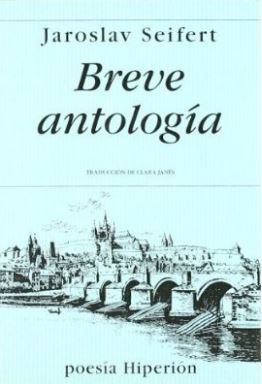
Jaroslav Seifert recibió el Premio Nobel de Literatura en 1984. Al premiarle se reconocía el valor de su poesía, pero también el hecho de ser el único superviviente de una generación de poetas extraordinaria, única en la historia de su país, que vivió, sufrió y cantó con maestría los acontecimientos del siglo XX. Seifert parte de las vanguardias de los años veinte, se integra en el ‘poetismo’ de influjos dadaístas y cultiva la poesía revolucionaria. A partir de los años treinta su obra se inclina hacia un clasicismo que se remansa y se enraíza en su Praga natal para dar a luz libros de gran belleza que culminaron con Ser poeta en 1983. La Academia Sueca, al concederle el Premio Nobel, destacó que «con su poesía, de una sensualidad ardiente y gran riqueza de invención, da una imagen liberadora de una humanidad indomable y diversa».
Awarded 1984 Nobel Prize in Literature "for his poetry which endowed with freshness, and rich inventiveness provides a liberating image of the indomitable spirit and versatility of man."
For me, the poetry ranged from ones that I didn't like or understand to ones that I liked very much. What tipped the scale from 3.5 to 4* was the selection of reminiscences at the end (entitled "All the Beauties of the World" & translated by George Gibian).
Even in translation, this collection was well-written enough to warrant some serious consideration of my own writing. There is absolutely nothing contrived in Seifert's work. In fact, it apparently wasn't for him 'work' at all, as these poems read like postcards or letters to an old friend. And the voice is consistent, so the reader feels as if he/she *is* that old friend. I will definitely revisit this book in a couple years.
my favourites: a hundred times nothing, when in the history books, how painful i would find it, SOMETIMES WE ARE TIED DOWN, halley's comet, once only..
i do like his poems, but the way he writes about women sometimes irritates me (attributing this to him being born in 1901, and me being hypersensitive)
note to self: try to find 'concert on the island' and 'halley's comet'
I found this collection uneven, sometimes admiring a breathtaking line and other times rolling my eyes at the maudlin excess (lying on a grave to “hold hands” with a dead lover) or overused poetic images (the lover is variously an angel, a rose, a poem, a dream, etc.). It's the kind of popular poetry that would appeal to middle-class Czech readers in the postwar era as an emotional outlet, much like the movie Titanic or the novel Water for Elephants in the US. It’s adequate, middle-brow, and beloved by a certain kind of reader in a specific time and place, but otherwise largely forgettable — not because it’s bad but because it’s just so fair-to-middling.
Note: After writing this review, I see the Nobel committee lauded Seifert for his "freshness, and rich inventiveness." I have to ask if they were reading the same poetry! The biggest problem I had with this collection was the reliance on tired old poetic clichés and and soapy imagery. Oh well ...
Tiene momentos de armonía, versos filosóficos que salen a la calle y se detienen en ciertos lugares, personas y sentimientos. Aunque a veces redunda y se queda en la definición predecible de algunas cosas, no se expande o se atreve a ir más allá.
Una poética con sus altos y bajos, no tan consecuente, quería que gustara más, pero no fue así.
I love finishing a book of poetry and immediately thinking, "I must go and write some of my own now!" This book was bliss to flip through, but I love it more for the inspiration and thought it provoked in me. Definitely one of the stand-outs in terms of poetry this year.
Jaroslav Seifert brings me back to my favorite city in the world: Prague. He brings the streets and the river and the parks and the castle and the churches to such vivid life, it's like I never left when I read these poems. He also has such a tender way with words, bringing to life such beautiful, simple, domestic moments, and these simple moments are the weight to bring down lofty themes of love, suffering, guilt, beauty. In fact, Jaroslav is obsessed with beauty, with women's beauty - through the twist of a wrist, a smile, the way the hair falls over the shoulder. He lived in Prague through some of its painful times of the twentieth century and through his poetry he brings those upheavals, those sufferings to life. He mourns over the Holocaust, feels intense guilt over the pain of his Jewish neighbors, over the destruction of the Kralupy. He revels in love, in beauty, in the greatness and splendor of his ancient city, Prague. Some of his poems were so sensuous and languid, invoking memories of young love and the desperation of it, the flames of a single touch. The line in 'Lost Paradise': "There is no time without murder" is absolutely heart wrenching and poignant, and clearly embodies the hopelessness of so many after the end of World War II and the despair that was a pall over so much of Eastern Europe. I was deeply moved and impressed with so much of his poetry - for the duality of it, the homage to such beautiful things and to suffering, that these poems embodied a sense of freedom and memory. I really did love so many of them. My one issue came to the pieces at the end of the collection and were his reminisces. I suppose I realized that his view on women, while shaped during the early twentieth century, is a bit more idealized rather than real. Women and beauty are ideals to which he worships and in turn, women are more dehumanized, turned into objects of desire and beauty and art rather than humans with emotions and needs and complexities. It reshaped my perceptions of his poems after I read those pieces. Nonetheless, I very much enjoyed this collection and hope to see more of his work translated into English.
Jaroslav Seifert's poetry reflects a sensibility which is essentially sunny despite a bald recognition of life's darker side, and his commitment to his role as a poet is without resentment.
Seifert's translations of Baudelaire, Rimbaud, and his clear appreciation of Heinrich Heine's work seethes like a lightning bolt through the work; Seifert is a working class poet who spent much of his youth with these poets, but he individuates himself very well in these poems.
This collection makes the majority of Czech poetry look pale--clearly written with craft, in the hands of a skilled translator. Seifert's music is what comes across the most strongly.
"PROLOGUE
To be a poet is no easy task:
He spots a warbler in the woods flying above its nest and he can't stop himself from thinking --O Wicked Ecstasy!-- of the warm tousled dimple in his girl's armpit.
Yet he walks onto the wood because he can hear voices and everything around is softly trembling. And what d'you know? Quite close he'll see leaves and flowers, the pinkish trunks of the tall spruces glistening after the rain. They are most beautiful during the day and then at night. But it's not me.
Once, in the past, the poet raised his voice and blood crowed loud. Men rushed to take up arms and women did not hesitate to cut their honey-hued and dark-red hair ]bowstrings. They're more elastic than our nylon strings.
Unless the tyrant falls ---and that's hereditary too-- the poet is condemned to silence and the sharp-edged hand of prison bars will shut his mouth with iron claws. But he will scream his verses through the bars while the burners of books get down to work. But that's not me!
Sometimes he'll desperately clash his words together to produce some certainty-- but there's no certainty win our world And vainly does he fling his fiery words far, even beyond death, to lighten the darkness that lies motionless on this mass grave and merely clings to miserable bones, spattered with verdigris from the lighter they over looked in the executed man's trouser pocket. But that's not me!"
Love Czech writers and poets....but my heart is especially attached to Jaroslav Seifert. His poems about Prague, the destructive war years in the Czech city overtaken by Nazis, and his romances are unbelievably touching, emotional and real. No other poet like him....
Imagine um Nobel de Literatura que não tem um único livro publicado no Brasil. É Jaroslav Seifert, poeta tcheco que ganhou o Nobel de 1984. Tive que recorrer então a essa edição em espanhol. A despeito de eventuais dificuldades que eu possa ter tido com a língua e com o gênero da poesia, que não é o meu forte, posso dizer que a leitura foi bem agradável.
O livro abrange produções de toda a vida do autor, mas, seja quando era ainda jovem ou já maduro, a sua poesia me pareceu "simples", no melhor sentido que essa palavra pode ter. Seus versos me pareceram encadeados de tal maneira que, muitas vezes, poderiam ser ditos em prosa, o que é uma virtude para quem, como eu, está acostumado com a prosa mesmo.
Fala-se bastante em primavera (e não se poderia esperar outra coisa de um poeta), de campos, de relvas e de amores, mas também é preciso destacar a cidade de Praga, que é retratada de diferentes maneiras, com interessantes abordagens de sua história e personagens. No tempo de sua juventude, porém, o que atraía a sua atenção era Paris.
Dei-me ao trabalho de traduzir dois poemas para o português. Um curtinho, que é o que posto aqui, e outro, maior, vai nos comentários. O poema maior é sobre a derrubada da Coluna Mariana, uma estátua da Virgem Maria em Praga, durante os eventos que levaram à formação da Tchecoslováquia em 1918. Aos tchecos, a estátua representava o domínio austríaco sobre as suas terras.
Mas aqui vai o singelo poema curtinho:
Lâmpada (Jaroslav Seifert)
Em torno da luz fria das lâmpadas, a agitação incansável de asas batendo
E o senhor Edison, levantando os olhos do livro que lia, sorriu.
"como en primavera. Es primavera, y como al beber el vino chispeante los ojos brillan. Ya sé por qué es el blanco color de luto en China."
"En sueños hablamos con lo realmente inexistente, y yo me encontré hoy con su sueño."
"Los pájaros nocturnos serán mis testigos las lechucitas y los caprimulgos que ven bien incluso en la oscuridad No se suele creer a los niños. Se dice que mienten, pero yo estuve allí, ¡yo estuve allí aquella vez! Fue pasada ya la medianoche, las estrellas centelleaban, como si llorasen, y yo temblaba de frío en los últimos peldaños, muy arriba, como en lo alto de la escala de Jacob. Estaba sólidamente en tierra y se apoyaba en una nube. Y a la mitad del camino por encima de las nubes de estrellas me paralicé de horror"
"¿Qué crecerá en los surcos pues sembraste grano sangriento? Tronó el cielo y se acumulan los asesinatos y no hay final. Estalló una granada, levantaré un trozo vacío y hecho astillas y les felicitaré a ustedes en su banquete de bodas."
"Érase el antiguo palacio del almirantazgo, la concha imperial de la que nació Venus con gorra de marinero… Érase un pequeño milagro. Eso es todo. ... Es de noche. Como una araña borracha con la cruz en la espalda monstruo del templo se tambalea a través de las tinieblas de la noche. En las columnatas, entre los negros iconos retumba el grito revolucionario. ... en tus muros escribió el sable versos rojos, resonaron aquí cañones y no palabras de amor. Era la revolución. Eso es todo."
“Whenever I gaze out on Prague — and I do so constantly and always with bated breath because I love her — I turn my mind to God wherever he may hide from me, beyond the starry mists or just behind that moth-eaten screen, to thank him for granting me this magnificent setting to live in."
Nobel Prize in Literature 1984.
Jaroslav Seifert's poems are full of Prague, one of my favourite places in the world. The main landmarks are all there: the Castle, Charles Bridge, St. Vitus Cathedral, Mala Strana. They are also full of love for the many women he encountered. This collection of poems is surprisingly accessible and attractive for foreign readers. I have not tried to find the original Czech versions, but in translation they work very well already. One more quote that I felt was particularly appropriate for myself:
“Rooster, I was awakened by your song and, as if I had forgotten those who were sleeping, I sang out loud, and picked a bunch of grapes — we’d just been riding through a vineyard. How nicely one can live in this world of ours; you resemble me, it seems. We both sing, flapping our wings, and both remain down on the ground. Your metal image on the ridge of the roof turns with the wind as I do. Our dreams go on and on; our fleas keep jumping. No, I’m not weeping for love; crocodile tears are like chicken feed that I picked by the sea in an idle moment.”
Beautiful as on a jug a painted flower is the land that bore you, gave you life, beautiful as on a jug a painted flower, sweeter than a loaf from fresh-ground flour into which you've deeply sunk your knife.
Countless times disheartened, disappointed, always newly you return to it, countless times disheartened, disappointed, to this land so rich and sun-anointed, poor like springtime in a gravel-pit.
Beautiful as on a jug a painted flower, heavy as our guilt that will not go away —never can its memory decay. At the end, at our final hour we shall slumber in its bitter clay.
Este mes no he tenido muy buenas lecturas. Para mi sorpresa, los poemas de Jaroslav Seifert se han convertido en mi mejor lectura de septiembre 2024.
La poesía de Seifert es sencilla, pero tierna y humana. Habla de las relaciones humanas, aunque sobre todo del amor, de una forma que te conmueve. También tiene poemas sobre la naturaleza con descripciones dignas de un artista. Quizás los poemas que menos me gustaron fueron los que hablaba sobre la guerra, pues ahí no profundiza en el terror ni en la tragedia detrás de los conflictos bélicos, y sin embargo no son malos poemas.
Espero que, en un futuro, se traduzcan más poemarios de este importante autor checo.
I thought that Winston Churchill was the most puzzling Nobel laureate in Literature, but no, it's Jaroslav Seifert. I just don't see how can anyone read these poems and come to any conclusion other than that they're very bad. Between their extremely simplistic to non-existent imagery and figurative language, and very simple and cliche ideas, I feel like he was a pioneer of Instagram poetry. For example: "Remember wise philosophers/Life is but a moment/Yet whenever we waited for our girlfriends/it was an eternity". Come on, what isn this?
Pues una antología bonita con ciertos poemas que destacan bastante, entre ellos: <>, <<¡Que difícil me fue! >> y <>, el lenguaje me gustó y habían una formulaciónes bastante geniales. Pero con eso dicho, me parecía la temática un poco repetitiva y ajena (nunca he visitado Praga), y eché de menos las rimas, que a mi me gustan mucho, no sé como será en original, pero igual le echo un vistazo.
I could only get my hands on a shorter collection of poems: A Chaplet of Sage A Song At The End Dance of Girls' Chemeses Lost Paradise Place of Pilgrimage Sometimes we are tied down by memories St. George's Basilica Struggle With The Angel The Plague Column The Year 1934
But I quite liked it - it's narrative poetry some with religious themes (maybe more scriptures than spirituality?).
De ungdomliga dikterna är inte mycket att hänga i julgran: Men de senare är strålande. Från 1945 och frammåt är de dikter som är vemodiga, tjeckiskpatriotiska och erotiska alla oerhört välfunna. Översättningen är tidvis klumpig - vilket inte är förvånande. Men även med den slöjan, är det en oerhört vacker text.
The first 1/3 of the poetry is crap. And then suddenly it's pretty good. Not earthshattering, but pretty good. I think he sort of reminded me of Neruda. I also read some essays at the end of the poetry section, and I think I like him better as an essayist.