

What do you think?

The Magic Wood: A Poem
A mysterious man befriends an unwitting visitor in a nighttime wood filled with hidden danger.
256 pages, Hardcover
First published January 1, 1992
About the author
Henry Treece
94 books40 followersHenry Treece (1911-1966) was a British poet and writer, who also worked as a teacher and editor. He wrote a range of works but is mostly remembered as a writer of children's historical novels.
Ratings & Reviews
Friends & Following
Create a free account to discover what your friends think of this book!
Community Reviews
Displaying 1 - 12 of 12 reviews

December 24, 2018
I had never heard of this author or this poem before and only found out about it thanks to one of my favourite authors: Neil Gaiman.
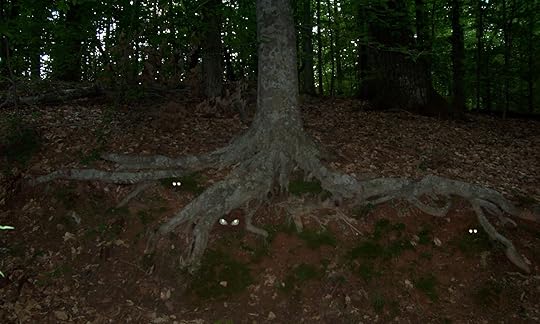
The poem tells of what is lurking in the forest, especially at night. Darkness, sounds, sights (real or imagined), magic or imagination or both? Who knows.
You can listen to a great audio version as read by Peter Capaldi here https://www.bbc.co.uk/sounds/play/p06... with an intro by Neil Gaiman.
A very nice Christmas present. Thank you, BBC. :)
The poem tells of what is lurking in the forest, especially at night. Darkness, sounds, sights (real or imagined), magic or imagination or both? Who knows.
You can listen to a great audio version as read by Peter Capaldi here https://www.bbc.co.uk/sounds/play/p06... with an intro by Neil Gaiman.
A very nice Christmas present. Thank you, BBC. :)

July 29, 2020
If The Magic Wood seems like it wasn't written with children in mind, it wasn't.
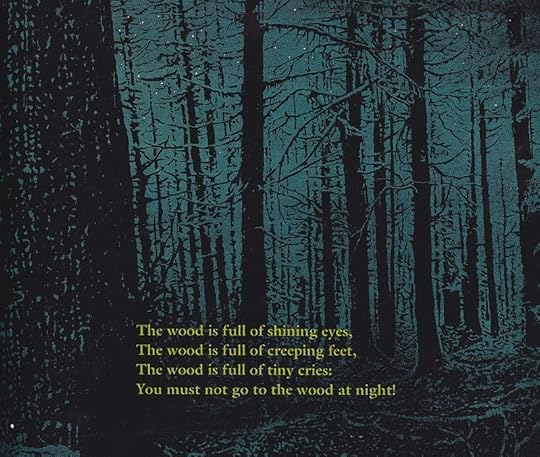
British author Henry Treece first published the poem "The Magic Wood" in his brooding--and sometimes frightening--book of poetry, The Black Seasons, released by Faber & Faber in 1945. A year later, The Magic Wood was included in Treece's Collected Poems. As far as I know, this was the last time it appeared in print until 1992 when American artist Barry Moser plucked out this dusty old poem, illustrated it, and gave it new life as a startling and satisfying picture book for children.
I've long admired Moser for his atmospheric woodcuts and his beautiful publishing company Pennyroyal Press. Most of Pennyroyal's catalog consists of exquisite (and expensive) editions of classic works designed and illustrated by Moser. (Works like Alice and Wonderland, Frankenstein, and Huckleberry Finn.)
With this edition of The Magic Wood, Moser does something similar to his Pennyroyal work, but in the mysterious, relatively unknown poem, has space to let his imagination off the chain.
(Spoilers ahead)
In Moser's interpretation, the protagonist is a child who wanders into danger, meets a friendly, sinister stranger, is almost lost, but keeps his wits and escapes. The ominous eyes sparkling in the forest, the persistent warning, "You must not go to the woods at night!" can make a listener squirm with anxiety, and some imagery is bound to leave an impression, "I saw his teeth through the back of his head, and a rat's eyes winking from his hair."
It's effectively frightening, but there is no actual violence. The language and images fit together like pieces of an enchantment. Moser's deft pacing and illustration rescues and reinterprets this obscure luminous poem. The story ends in a place of hope and safety.
Where is the Magic Wood? Treece's poem is set in Old World forests where kings are buried in barrows and larks are common. Moser, who grew up in Tennessee like I did, illustrates an American forest with wild grape vines, ferns, pines, and Spanish moss. Either way, the woods are magic.
British author Henry Treece first published the poem "The Magic Wood" in his brooding--and sometimes frightening--book of poetry, The Black Seasons, released by Faber & Faber in 1945. A year later, The Magic Wood was included in Treece's Collected Poems. As far as I know, this was the last time it appeared in print until 1992 when American artist Barry Moser plucked out this dusty old poem, illustrated it, and gave it new life as a startling and satisfying picture book for children.
I've long admired Moser for his atmospheric woodcuts and his beautiful publishing company Pennyroyal Press. Most of Pennyroyal's catalog consists of exquisite (and expensive) editions of classic works designed and illustrated by Moser. (Works like Alice and Wonderland, Frankenstein, and Huckleberry Finn.)
With this edition of The Magic Wood, Moser does something similar to his Pennyroyal work, but in the mysterious, relatively unknown poem, has space to let his imagination off the chain.
(Spoilers ahead)
In Moser's interpretation, the protagonist is a child who wanders into danger, meets a friendly, sinister stranger, is almost lost, but keeps his wits and escapes. The ominous eyes sparkling in the forest, the persistent warning, "You must not go to the woods at night!" can make a listener squirm with anxiety, and some imagery is bound to leave an impression, "I saw his teeth through the back of his head, and a rat's eyes winking from his hair."
It's effectively frightening, but there is no actual violence. The language and images fit together like pieces of an enchantment. Moser's deft pacing and illustration rescues and reinterprets this obscure luminous poem. The story ends in a place of hope and safety.
Where is the Magic Wood? Treece's poem is set in Old World forests where kings are buried in barrows and larks are common. Moser, who grew up in Tennessee like I did, illustrates an American forest with wild grape vines, ferns, pines, and Spanish moss. Either way, the woods are magic.

October 3, 2012
A good, creepy poem for Halloween. The illustrations are much more elegant than you see in most spooky children's books, and the backgrounds are beautiful.

July 8, 2022
My parents gave me this when I was like five or six and the imagery is still stuck in my head. I found my copy of it recently and looked through it--still creepy. No wonder I'm a weirdo.

September 22, 2021
For children insofar as the protagonist is young and nothing is actively inappropriate. But it doesn't feel written for kids, and the poem originally wasn't; if there's a moral, it's more "your wiles will protect you from fairies" than something about make-believe. And I'm not complaining!
It's not exceptional poetry; Moser's woodcuts sometimes have an uncanny/Photoshop-filter-esque realism. But in combination they're delightful: the spooky poetry is richly indulged by deep black-on-blue illustrations, and it goes all-in on atmosphere where most picture books intentionally hold back. You must not go into the woods at night! so a glimpse between the branches is moody, strange, and irresistibly forbidden.
It's not exceptional poetry; Moser's woodcuts sometimes have an uncanny/Photoshop-filter-esque realism. But in combination they're delightful: the spooky poetry is richly indulged by deep black-on-blue illustrations, and it goes all-in on atmosphere where most picture books intentionally hold back. You must not go into the woods at night! so a glimpse between the branches is moody, strange, and irresistibly forbidden.
Read
July 19, 2008The illustrations are stunningly creepy, emphasizing the mood of the poem. The repetitive refrain is good for student participation. (Choice)

December 22, 2018
Peter Capaldi reads this for the BBC.
What happens when you meet a stranger in the wood?
Listen here:
https://www.bbc.co.uk/sounds/play/p06...
The wood is full of shining eyes…
Well, I learnt something today: Dylan Thomas was the most famous member of this poetry group known as the New Apocalyptic Movement.
4 stars
What happens when you meet a stranger in the wood?
Listen here:
https://www.bbc.co.uk/sounds/play/p06...
The wood is full of shining eyes…
Well, I learnt something today: Dylan Thomas was the most famous member of this poetry group known as the New Apocalyptic Movement.
4 stars
February 19, 2020
This book was not my favorite. Honestly, I found it kind of scary! I did not like how it discussed staying out of the woods at night for something might get you. I figured that if I found it a little scary, I don't know what a class of kindergarteners would think. I will say that I like the colors used in the book, they were very dreary like.
March 17, 2022
A good fantasy with a good lesson of not exploring the woods at night. Not sure the audience aside from children who live near wooded areas, but the poem and the art work is can be enjoyed by all ages. I would say that due to the level of analogies, second grade and up would probably be the most ideal age to have them read themselves.
December 24, 2018
I listened to the Peter Capaldi narration - it was excellent, but wasn’t enough for me. Maybe I would have liked better to have read it, but it does seem to me as if the idea of this poem was far better than its execution.
January 1, 2019
Read by Peter Capaldi.

January 19, 2021
Loved this book as a child
Displaying 1 - 12 of 12 reviews