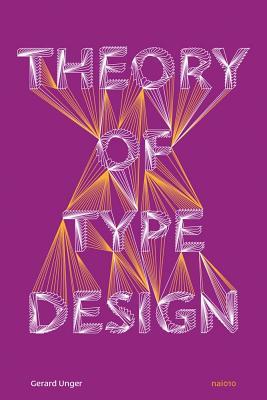
"An assessment of the diversity and creativity of type and how design makes sense of communicating text." – Typeroom Theory of Type Design , by internationally renowned Dutch graphic designer and typographer Gerard Unger (born 1942), is the first complete and accessible theory of the breathtakingly varied field of typography. "Of all designed objects letters are probably the most pervasive," as Unger explains at the beginning of his study. "Very familiar yet amazingly diverse in their appearance … there seems to be no limit to human ingenuity when it comes to varying letterforms." Unger approaches the diversity and creativity of the field with a wide-ranging, reflective, critical theory of how we design and make sense of text. The history of typography is surveyed, from cuneiform script to Wim Crouwel's New Alphabet and today's digital developments, and explored in relation to how our eyes and brain process various letter shapes in order to understand text. This volume consists of 24 concise chapters, each clearly describing a different aspect of type design (from practical considerations like spacing and rhythm, legibility, size and italics to more ineffable considerations like personality and preference). This theoretical material is illuminated by more than 200 illustrations and practical examples, and an extensive glossary succinctly explains terminology and key ideas. Internationally oriented, and taking into consideration the past, present and future of typography, Theory of Type Design will be an indispensible resource for graphic design students, professionals, and those with a general interest in text and printed matter.
Gerard Unger was a world-renowned type designer. He studied graphic design, typography and type design at the Gerrit Rietveld Academy and later taught there as well as at at the University of Reading and the University of Leiden. A freelance designer since 1975, he designed stamps, coins, magazines, newspapers, books, logos, corporate identities, and many typefaces.
In 1984 he was awarded the H.N. Werkman Prize for his typographic work, for digital type designs in particular, and for his reconciliation of technology and typographic culture. In 1988 he won the Gravisie-prijs for the concept of his typeface Swift, and in 1991 he was awarded the international Maurits Enschedé-Prize. He wrote articles for the trade press, and several larger publications such as ‘Landscape with Letters’, linking the usually limited scope of type and typography with a much wider cultural view. His book ‘Terwijl je leest’ on the process of reading was published in 1995 and a new edition was published in 2006.
In the fourteenth chapter, “Fitting”, Mr Unger notes that the letter pairing ‘rv’ creates a large negative space and attempts to illustrate the dangers of overcompensating by showing how the word ‘harvest’ looks when kerned too tightly. But fate is not on Mr Unger’s side and that deliberately mis‐kerned ‘harvest’ has fallen at just the wrong spot in the paragraph; the layout software has automatically hyphenated it across two lines, the critical r–v pairing sundered and thus irrelevant.
This failure of design is a sadly fitting exemplar of Theory of Type Design, which was published just three days before its author’s death. While the gears of the publishing process turn too slowly for this near‐concurrence to have been forecasted with accuracy, the confusion and carelessness that permeates every aspect of this work suggest that allowing Mr Unger to hold a copy in his hands was prioritized over making a substantive and useful volume. Errors and inconsistencies can be found on the majority of pages; they range in significance from missing spaces to misidentified typefaces. The book is heavily illustrated, but the illustrations are neither in‐line with the text nor numbered, so matching each to the paragraph that describes its relevance is unending, page‐flipping drudgery. And, most disappointingly, the writing is meandering and grammatically tangled, suitable for off‐the‐cuff blog posts but not the substance of a professionally edited book with a $50 suggested retail price.
Mr Unger was a talented type designer of great influence (the current era of tall x-heights and generous counters might aptly called the Ungerian age of type), but this book does not capture his genius and it is not a good reference.
auch wenn der titel etwas in die irre führt (ich weiß ja nicht wo hier die „theorie“ sein soll) lohnt es sich. es ist ein rundumschlag zur schriftgestaltung, zeigt die verschiedenen parameter auf, die eine schrift ausmachen, die es beim entwerfen zu bedenken gibt, erklärt manche geschichtlichen hintergründe und lässt sich ganz gut lesen (angenehmes papier). bisschen nervig ist das blättern zwischen der text- und bildebene. es fehlt mir aber die versprochene theorie. alles wissenschaftliche wird halbherzig über verweise aufgezeigt. eine theoretische beschäftigung mit schrift (zum beispiel im kontext zu den verschiedememn medien, in denen sie auftritt, im umterschied zu bildern, in gesellschaften, als kulturgut) fehlt völlig. das buch könnte such heißen „some things about type design“.
Considerably more elementary/introductory than I expected, but would certainly make a fine intro to the basic concepts and ideas of the field.
My favorite chapter was the epilogue, where he details some of the influences and considerations that went into a couple of his typefaces (the classic Swift and the newer Alverata, which the book is set in) — I’d have read an entire book of that!