

What do you think?
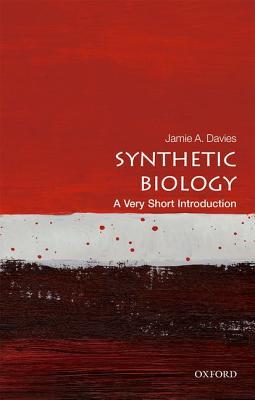
Very Short Introductions #573
Synthetic Biology: A Very Short Introduction
Synthetic biology is one of the 21st century's fastest growing fields of research, as important for technology as for basic science. Building on traditional genetic engineering, which was restricted to changing one or two genes, synthetic biology uses multi-gene modules and pathways to make very significant changes to what cells can do. Synthetic biologists aim to have an impact in fields as diverse as drug manufacture, biofuel production, tackling pollution, and medical diagnostics. Further ahead, synthetic biology may even make possible the long-standing goal of creating new life from non-living starting materials.
This Very Short Introduction provides a concise explanation of what synthetic biology is, and how it is beginning to affect many fields of technology. Jamie Davies also discusses the considerable controversies surrounding synthetic biology, from questions over the assumption that engineering concepts can be applied to living systems easily, to scepticism over the claims for commercial promise, fears that the dangers of engineering life are worse than its benefits, and concerns over whether humans should be designing living systems at all.
ABOUT THE The Very Short Introductions series from Oxford University Press contains hundreds of titles in almost every subject area. These pocket-sized books are the perfect way to get ahead in a new subject quickly. Our expert authors combine facts, analysis, perspective, new ideas, and enthusiasm to make interesting and challenging topics highly readable.
This Very Short Introduction provides a concise explanation of what synthetic biology is, and how it is beginning to affect many fields of technology. Jamie Davies also discusses the considerable controversies surrounding synthetic biology, from questions over the assumption that engineering concepts can be applied to living systems easily, to scepticism over the claims for commercial promise, fears that the dangers of engineering life are worse than its benefits, and concerns over whether humans should be designing living systems at all.
ABOUT THE The Very Short Introductions series from Oxford University Press contains hundreds of titles in almost every subject area. These pocket-sized books are the perfect way to get ahead in a new subject quickly. Our expert authors combine facts, analysis, perspective, new ideas, and enthusiasm to make interesting and challenging topics highly readable.
144 pages, Paperback
Published October 1, 2018
Ratings & Reviews
Friends & Following
Create a free account to discover what your friends think of this book!
Community Reviews
Displaying 1 - 5 of 5 reviews

February 16, 2022
Jamie A. Davies delivers a very readable introduction to synthetic biology. For best results you'll probably want to have some familiarity with genetics, biochemistry, ethics, and perhaps a bit of the debate between vitalists (dualists) vs. materialists. If anything's unclear there are Wikipedia articles and other titles in the VSI series to provide background (e.g., Genes: A Very Short Introduction; Genomics: A Very Short Introduction; Viruses: A Very Short Introduction; and others).
Perhaps my favorite part of the book described the "remote-control worm" - an unfortunae individual of Caenorhabditis elegans made to crawl around and change direction on a scientist's command. There was no mention in the book as to when we may expect remote-control people although sometimes it seems Fox News has already figured that out.
In the last chapter, Davies expresses skepticism about the feasibility of a pathogen engineered to target only individuals of a particular race or ethnicity, given that the clustering of genetic similarity in human population groups is "only" statistical. But that only seems to mean that such a weapon could have at most similarly statistical accuracy. Given that there are genetic markers enabling highly-accurate determination of an individual's race (very handy in forensic science), it seems at least hypothetically possible for an engineered pathogen to target individuals with those same markers. And if it's not perfectly accurate, what terrorist would care? In every war there are friendly-fire casualties. And ordinary terrorists occasionally blow themselves up by accident when they make bombs. It would seem to me that if someone were crazy enough to build a weapon to target persons of a given race or ethnicity, such a person might not demand high precision. Not many terrorists seem to worry much about collateral damage.
In any case, even if it's not possible to target members of an ethic group, how about individuals or biological relatives? A pathogen designed to spread easily in a population, producing no symptoms in everybody except for one high-value targeted individual would seem to have plenty of uses. Instead of sending in the Seals to assassinate Osama bin Laden, you could just have an infected agent sneeze on his kids.
I suspect a larger problem with such an engineered pathogen would be evolution. When microbes get into the wild they start evolving. There would be strong selective pressure on a microbial species to target more hosts, rather than to hurt its own chances by remaining narrowly targeted.
Perhaps my favorite part of the book described the "remote-control worm" - an unfortunae individual of Caenorhabditis elegans made to crawl around and change direction on a scientist's command. There was no mention in the book as to when we may expect remote-control people although sometimes it seems Fox News has already figured that out.
In the last chapter, Davies expresses skepticism about the feasibility of a pathogen engineered to target only individuals of a particular race or ethnicity, given that the clustering of genetic similarity in human population groups is "only" statistical. But that only seems to mean that such a weapon could have at most similarly statistical accuracy. Given that there are genetic markers enabling highly-accurate determination of an individual's race (very handy in forensic science), it seems at least hypothetically possible for an engineered pathogen to target individuals with those same markers. And if it's not perfectly accurate, what terrorist would care? In every war there are friendly-fire casualties. And ordinary terrorists occasionally blow themselves up by accident when they make bombs. It would seem to me that if someone were crazy enough to build a weapon to target persons of a given race or ethnicity, such a person might not demand high precision. Not many terrorists seem to worry much about collateral damage.
In any case, even if it's not possible to target members of an ethic group, how about individuals or biological relatives? A pathogen designed to spread easily in a population, producing no symptoms in everybody except for one high-value targeted individual would seem to have plenty of uses. Instead of sending in the Seals to assassinate Osama bin Laden, you could just have an infected agent sneeze on his kids.
I suspect a larger problem with such an engineered pathogen would be evolution. When microbes get into the wild they start evolving. There would be strong selective pressure on a microbial species to target more hosts, rather than to hurt its own chances by remaining narrowly targeted.

December 3, 2019
It's a wonderful piece of writing ..... True to its name , it's a very good short introduction to Synthetic Biology to a layman.
Detailed review will follow
Detailed review will follow

June 3, 2026
It was great to get a peek into this discipline. The desire to manipulate life (e.g., to create life out of inanimate matter; to create new life forms; to “play god”) is an old one. Synthetic biology is in effect the fulfillment of that desire. I appreciated how the author was particular in emphasizing the limitations in even the most cutting edge of this discipline’s capacity to do so, however. The author even suggested that it is impossible to manipulate life forms in a fine-grained way. For example, certain cellular processes can be understood in terms of circuits as found in electrical engineering and computer science. But this finding does not obviously scale to various other critical processes that need to be understood in order to “engineer” life forms to have desirable properties.
The author offered the following a useful way of thinking of the underlying principles of this scientific discipline and for understanding its limitations: In synthetic biology, it is assumed that (1) life forms are “modular,” i.e., that complicated biological constructions ought to be constituted by connections between elementary building blocks, and (2) a complicated project can be “decoupled” or broken down into various sub-projects that can be each worked on in isolation by distinct research groups, where knowledge does not have to be shared across these groups. For many issues, these assumptions appear to hold up. Difficulties in achieving various research goals might be explainable by appeal to that, metaphysically, (1) doesn’t always hold up, or epistemologically, neither does (2).
Some facts that were quite interesting. I’ve been familiar with GMOs and such as products of synthetic biology. But this discipline also makes possible inducing specific diseases and conditions in mice, such that drugs can be tested on them, or they can be studied in general. It is even possible to make DNA-based computers (analogously to how there are quantum-based computers, a topic I know pretty much nothing about). There are certain math problems that require tons of computing (i.e., “NP problems,” also a topic I’ve only heard about in passing and barely understand), and DNA can help here because DNA molecules randomly collide into one another, and so mechanistically/physically, it can be used to “race through staggering numbers of possible solutions in seconds.” I didn’t fully understand how this is supposed to work, but I got the impression that it involves the fact that DNA consists in 4 symbols (A, T, C, G) and these can be mapped onto 1s and 0s, which form the basis of information. Then, one could “encode” a question concerning a finite number of objects by letting certain DNA sequences stand in for these objects, and then let possible DNA combinations that happen through chemical reactions stand in for possible manipulations on these objects.
Anyways, I’ve perused a couple of the books from this “very short introduction” series by Oxford University Press. Some have been unhelpful and superficial. Others have been seemingly helpful. I’m not sure, however, whether these impressions reflect actual variation in quality, or whether all of them might be not so helpful overall, and this variation rather is to be explained by variation in my background knowledge on the areas these books are on, such that when I know very little, a book can look more impressive.
The author offered the following a useful way of thinking of the underlying principles of this scientific discipline and for understanding its limitations: In synthetic biology, it is assumed that (1) life forms are “modular,” i.e., that complicated biological constructions ought to be constituted by connections between elementary building blocks, and (2) a complicated project can be “decoupled” or broken down into various sub-projects that can be each worked on in isolation by distinct research groups, where knowledge does not have to be shared across these groups. For many issues, these assumptions appear to hold up. Difficulties in achieving various research goals might be explainable by appeal to that, metaphysically, (1) doesn’t always hold up, or epistemologically, neither does (2).
Some facts that were quite interesting. I’ve been familiar with GMOs and such as products of synthetic biology. But this discipline also makes possible inducing specific diseases and conditions in mice, such that drugs can be tested on them, or they can be studied in general. It is even possible to make DNA-based computers (analogously to how there are quantum-based computers, a topic I know pretty much nothing about). There are certain math problems that require tons of computing (i.e., “NP problems,” also a topic I’ve only heard about in passing and barely understand), and DNA can help here because DNA molecules randomly collide into one another, and so mechanistically/physically, it can be used to “race through staggering numbers of possible solutions in seconds.” I didn’t fully understand how this is supposed to work, but I got the impression that it involves the fact that DNA consists in 4 symbols (A, T, C, G) and these can be mapped onto 1s and 0s, which form the basis of information. Then, one could “encode” a question concerning a finite number of objects by letting certain DNA sequences stand in for these objects, and then let possible DNA combinations that happen through chemical reactions stand in for possible manipulations on these objects.
Anyways, I’ve perused a couple of the books from this “very short introduction” series by Oxford University Press. Some have been unhelpful and superficial. Others have been seemingly helpful. I’m not sure, however, whether these impressions reflect actual variation in quality, or whether all of them might be not so helpful overall, and this variation rather is to be explained by variation in my background knowledge on the areas these books are on, such that when I know very little, a book can look more impressive.

April 2, 2023
Great introduction into the topic.
Detailed enough to learn a lot, broad enough to get a good overview of everything that’s happening (which is mindblowing).
Could have taken ethical issues (like the spreading of modified dna) more seriously though. Still 5 stars because it’s still a really nice intro into the subject
Detailed enough to learn a lot, broad enough to get a good overview of everything that’s happening (which is mindblowing).
Could have taken ethical issues (like the spreading of modified dna) more seriously though. Still 5 stars because it’s still a really nice intro into the subject

August 3, 2020
Well written. Brief enough to be read on a flight but detailed enough to capture the essence of synthetic biology.
Displaying 1 - 5 of 5 reviews