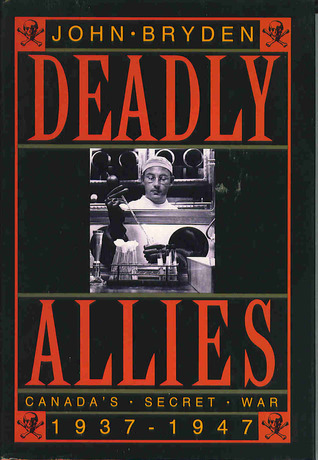
A ground-breaking book that traces Canadas pioneering role in the development of biological weapons; including insidious gases, germs, poisons, & viruses; before, during, & immediately after the Second World War. Discover how Canada mass-produced deadly anthrax at a secret island lab in the St. Lawrence River & permitted hundreds of volunteers to be exposed to lung-searing mustard gas at a research station in Alberta. With 8 pages of photos, its a story of ingenuity, heroism, & horror, culled from files that had been closed for almost half a century. A strong book . . . a book to be reckoned with.
Dear sweet innocent Canada: this is not an easy book for me to read. During the Second World War, competing with nazi scientists, Canada rushed to develop stockpiles of chemical and biological weapons. We had an anthrax factory on an island. We tested mustard gas on “volunteers”—not all survived the experience.
We experimented with botulism as a weapon and tried vaccines for weaponized botulism and people died— not in battle but as these products were being manufactured and tested (on Allied troops). These wartime stories are always over the top, during the rush and the panic, so I shouldn’t have been too surprised at all the risk and foolhardiness but yet I was shocked. Who knew there was an anthrax factory in Canada, so close to major cities?
I was shocked by dear sweet Canada— who knew what evil lurks in the hearts of Canucks?
Now when I hear myself saying things like, “but we are not as bad as THEM,” I’m going to think of this book. I’ve lost my sweet pure Canadian innocence—perhaps for ever.
Using a mix of archival information and interviews, Bryden's book is still pretty shocking, even 25 years after its publication (and 60 after the events described). That Canada developed chemical weapons for WWII is not altogether surprising (despite government denials for many years after); however, the careless way in which they were often handled and the tests on unknowing Canadian soldiers is not something that I expected.
The early movers on Canada's chemical and biological weapons programs have some big names including Banting, Seagram (of distillery fame), and Eaton (of department store fame). From there, the program metastasised as the British and American governments both saw the benefits in having thriving programs.
Interestingly, the perceived balance of chemical weapons stock between the Allies and Germany created a kind of balance, which stopped either side from using them and foreshadowed the nuclear world. The author postulates that Germany could have seriously affected the war had it used its nerve gases on Allied troops (including sarin). The loss of life that would have resulted from the addition of chemical warfare could have been horrendous, especially with the addition of the botulinus toxin, potent enough to kill with a drop less than the size of a micron.
The author is a solid writer with the tendency to go on tangents (though his tangent on the Habbakuk, the proposed air craft carrier made of ice, is fascinating). This is a well-researched and valuable addition to the history of Canada's role in WWII.
This was an interesting book about a part of Canadian history I was never really aware of. Living in Ottawa made the book extra interesting as it mentions all the buildings and addresses in the city where all these important meetings, discussions, and experiments happened. It was also fascinating to read this in the context of Canada and the USA's current relationship, as the book talks about predictions for the future which have happened since it was published in the 90s.
This book is an extremely interesting and thorough explanation of Canada's checkered past working with biological and chemical weapons during World War 2. Everything from anthrax factories to testing the effects of highly refined mustard gas on Canadian soldiers. I highly recommend this book because it shines a light on a part of Canadian history that is not well known.