

What do you think?
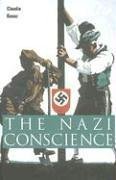
The Nazi Conscience
The Nazi conscience is not an oxymoron. In fact, the perpetrators of genocide had a powerful sense of right and wrong, based on civic values that exalted the moral righteousness of the ethnic community and denounced outsiders.
Claudia Koonz's latest work reveals how racial popularizers developed the infrastructure and rationale for genocide during the so-called normal years before World War II. Her careful reading of the voluminous Nazi writings on race traces the transformation of longtime Nazis' vulgar anti-Semitism into a racial ideology that seemed credible to the vast majority of ordinary Germans who never joined the Nazi Party. Challenging conventional assumptions about Hitler, Koonz locates the source of his charisma not in his summons to hate, but in his appeal to the collective virtue of his people, the Volk.
From 1933 to 1939, Nazi public culture was saturated with a blend of racial fear and ethnic pride that Koonz calls ethnic fundamentalism. Ordinary Germans were prepared for wartime atrocities by racial concepts widely disseminated in media not perceived as political: academic research, documentary films, mass-market magazines, racial hygiene and art exhibits, slide lectures, textbooks, and humor. By showing how Germans learned to countenance the everyday persecution of fellow citizens labeled as alien, Koonz makes a major contribution to our understanding of the Holocaust.
The Nazi Conscience chronicles the chilling saga of a modern state so powerful that it extinguished neighborliness, respect, and, ultimately, compassion for all those banished from the ethnic majority.
Claudia Koonz's latest work reveals how racial popularizers developed the infrastructure and rationale for genocide during the so-called normal years before World War II. Her careful reading of the voluminous Nazi writings on race traces the transformation of longtime Nazis' vulgar anti-Semitism into a racial ideology that seemed credible to the vast majority of ordinary Germans who never joined the Nazi Party. Challenging conventional assumptions about Hitler, Koonz locates the source of his charisma not in his summons to hate, but in his appeal to the collective virtue of his people, the Volk.
From 1933 to 1939, Nazi public culture was saturated with a blend of racial fear and ethnic pride that Koonz calls ethnic fundamentalism. Ordinary Germans were prepared for wartime atrocities by racial concepts widely disseminated in media not perceived as political: academic research, documentary films, mass-market magazines, racial hygiene and art exhibits, slide lectures, textbooks, and humor. By showing how Germans learned to countenance the everyday persecution of fellow citizens labeled as alien, Koonz makes a major contribution to our understanding of the Holocaust.
The Nazi Conscience chronicles the chilling saga of a modern state so powerful that it extinguished neighborliness, respect, and, ultimately, compassion for all those banished from the ethnic majority.
368 pages, Paperback
First published November 26, 2003
Ratings & Reviews
Friends & Following
Create a free account to discover what your friends think of this book!
Community Reviews
Displaying 1 - 30 of 46 reviews

July 28, 2010
Yes, that's right: the Nazi conscience. Koontz's thesis is that the holocaust can only be understood by taking into account the constant campaign of indoctrination that--by stressing the necessity of racial purity--endeavored to persuade every good German that "not everything that wears a human face is human."
In terms of legal statutes enacted or the tone of much popular culture, pre-Hitler Germany was no more antisemitic than many other European countries (Great Britain not excepted), and, even at the height of Nazi power, it was possible for Germans to express private opinions about--or engage in act of compassion toward--Jews without suffering extreme reprisal. Because of this, it is reasonable to assume that the average German wasn't impelled by hatred or paralyzed by fear; instead, he was constrained by the conviction that his duty to the "Volk" superseded all instinctive impulses toward justice and compassion. His participation in the holocaust, in a very real (and a very horrible) sense, constituted a moral victory over the weak, naturally compassionate self.
Koonz makes her case by amassing a wealth of evidence, showing how the Nazis achieved this change in consciousness by spreading their message throughout the primary and secondary schools, youth groups and summer camps, controlling appointments to university professorships, manipulating the media, and establishing think tanks for racist versions of biology, anthropology, archeology and other sciences.
For me, it is the details of her book that make it fascinating: good Germans who called beautiful blue-sky days "Hitler weather"; high school instructors who referred to Nazi-appointed teacher's aides (read "spies") as "appendixes," because, like the bodily organ, they were completely useless yet still able to flare up suddenly and hurt you; the party-line physicist who tried to advance in his profession by condemning "Jew physics"--that is, the achievements of Einstein and Heisenberg--and yet failed to impress the Nazi hierarchy (who probably were more concerned with getting the atomic bomb); Nazi propagandists who praised the United States for its Jim Crow laws and sterilization efforts; and many others.
Koonz also presents her reader with a large number of illustrations: prosperous Jewish men (all looking like fat Woody Allens) menacing athletic blonde German girls; Hitler smiling among the little children, close-ups of the Fuhrer's graceful poetic hands, etc.
It is certainly worth a read, even if it is a little heavy at times. But even if you don't wish to take the time to read it, browse through it for anecdotes and look at the pictures.
I doubt you will emerge from the encounter unaffected.

November 1, 2011
Claudia Koonz sets out to answer the question of why Germans were so willing to participate or at least stand aside for the murder of millions of innocent citizens. She puts forward the proposition that Christian Germans were prepared by the Nazis through a carefully executed program that included relentless denigration of Jews as subhuman enemies of the German "Volk," coordinated with powerful enforcement against any who strayed from the Nazi line. Altogether she makes a sickeningly convincing case against both the Nazis and the Christian Germans, opposite sides of the same repulsive coin.
SELECTED EXCERPTS ...
... The popular risers of anti-Semitism the planners of genocide followed a coherent set of severe ethical maximums derived from broad philosophical concepts … they denied the existence of universal moral values and instead promoted moral maxims which they saw as appropriate to their Aryan community ... Asserting the superiority of their own communitarian values above all others
... Having fully absorbed knowledge of the "Jewish menace" … a Nazi was ready to accept deportation and murder as just … if he had a Jewish friend, he would say "what a misfortune that my friend is Jewish" rather than "how terrible it is at we are murdering Jews"
... The expulsion of Jews from Germans' universe of moral obligations was carefully engineered
... The Nazi program sought to break ties between Jews and their surroundings … until Jews were totally isolated from the Christian German population
... The Nazis implemented an acceptance of "ethnic fundamentalism" which summoned its followers to seek vengeance for past wrongs and to forge a glorious future cleansed of ethnic aliens … Germans were enticed to participate in a moral universe accessible only to the favored
... Jews, who before 1933 were friends, neighbors, and colleagues … were now to be considered pariahs, a plague on Germany
... Hitler linked "Jewish" with despised values, such as urbanism, materialism, and greed … link the Jewish press with promoting decadence … blame moral degeneration on sexual intercourse between Jews and Christians
... Most Germans tacitly approved of persecution so long as they did not feel personally threatened or inconvenienced
... Heydrich: too many German citizens perceive Jews as harmless … they must be defined as a threat, loathsome as well as lethal
... Der Sturmer and Das Schwarze Korps both portrayed Jews as not only dangerous but also subhuman … words like "extinction" and "annihilation" he came routine … the intent was to create a German conscience that minimize the psychic stress they might experience when murdering Jews
... The final solution did not develop as evil incarnate but rather as the dark side of ethnic righteousness … to German Christians caught up what they perceived as a high moral purpose purification of racial aliens became a difficult but necessary duty
SELECTED EXCERPTS ...
... The popular risers of anti-Semitism the planners of genocide followed a coherent set of severe ethical maximums derived from broad philosophical concepts … they denied the existence of universal moral values and instead promoted moral maxims which they saw as appropriate to their Aryan community ... Asserting the superiority of their own communitarian values above all others
... Having fully absorbed knowledge of the "Jewish menace" … a Nazi was ready to accept deportation and murder as just … if he had a Jewish friend, he would say "what a misfortune that my friend is Jewish" rather than "how terrible it is at we are murdering Jews"
... The expulsion of Jews from Germans' universe of moral obligations was carefully engineered
... The Nazi program sought to break ties between Jews and their surroundings … until Jews were totally isolated from the Christian German population
... The Nazis implemented an acceptance of "ethnic fundamentalism" which summoned its followers to seek vengeance for past wrongs and to forge a glorious future cleansed of ethnic aliens … Germans were enticed to participate in a moral universe accessible only to the favored
... Jews, who before 1933 were friends, neighbors, and colleagues … were now to be considered pariahs, a plague on Germany
... Hitler linked "Jewish" with despised values, such as urbanism, materialism, and greed … link the Jewish press with promoting decadence … blame moral degeneration on sexual intercourse between Jews and Christians
... Most Germans tacitly approved of persecution so long as they did not feel personally threatened or inconvenienced
... Heydrich: too many German citizens perceive Jews as harmless … they must be defined as a threat, loathsome as well as lethal
... Der Sturmer and Das Schwarze Korps both portrayed Jews as not only dangerous but also subhuman … words like "extinction" and "annihilation" he came routine … the intent was to create a German conscience that minimize the psychic stress they might experience when murdering Jews
... The final solution did not develop as evil incarnate but rather as the dark side of ethnic righteousness … to German Christians caught up what they perceived as a high moral purpose purification of racial aliens became a difficult but necessary duty

May 12, 2014
I stopped reading this polemic when her intent to vilify all Germans as being complicit became evident. Amidst other disingenuous claptrap, she claims that independent choices were still very possible because "Everyone 𝒌𝒏𝒆𝒘 that the Gestapo were 𝒖𝒏𝒅𝒆𝒓𝒔𝒕𝒂𝒇𝒇𝒆𝒅!" (emphasis mine) Which begs the question, exactly how many Gestapo officials does it take to terrify an entire subjugated populace into submission? 5? 10? You know, the guys that take your entire family, and torture them to death in front of you, because a block leader informed on you for not saying “Heil Hitler!” with sufficient gusto. Ms. Koonz doesn’t think that the Nazi State was at all intimidating.
She's as myopic as Daniel Goldhagen, in believing the sole defining characteristic of a German is their bloodlust, conveniently ignoring that the Konzentrationslager system was designed for, and evolved by, its practise upon the German citizenry. But we won’t allow these inconvenient facts to intrude upon the narrative...
She's as myopic as Daniel Goldhagen, in believing the sole defining characteristic of a German is their bloodlust, conveniently ignoring that the Konzentrationslager system was designed for, and evolved by, its practise upon the German citizenry. But we won’t allow these inconvenient facts to intrude upon the narrative...

September 29, 2024
As someone says in the big Lebowski, “say what you want you want about the tenants of National Socialism, Dude, at least it’s an ethos.” And so Claudia Koonz brilliantly and painstakingly elucidates that twisted ethos using a wide variety of original sources. Such a wonderful book to explain how so many different institutions and disciplines and sources of authors helped to shape or reflect or perpetuate the core elements of a viciously racist ideology. I’m reading a number of books on Nazism at the moment to prepare me for a course I’m teaching. But this is one of the best I’ve encountered.

February 24, 2020
The book didn't convince me that "Nazi conscience" is not an oxymoron.
Quite the opposite.
Because, what should pass as "conscience" turns out to be loads of ideological superstructure built on foundation of bullshit.
In short, it's rationalizations on top of other rationalizations of hatred and darkness of handful of disturbed individuals, that manifested in years of brainwashing the rest of the nation, previously mostly normal people, into thinking like these sickos. Thinking like "us" against "them".
Besides, can you consider it a "conscience" if the result is Holocaust?
I don't consider myself as having a car if it's sitting in my backyard, rusty and undrivable.
However, this book is the most detailed examination of the topic I've come across. The analysis is masterful, super in-depth and right in the bullseye in so many cases I stopped counting.
Just don't call it conscience, whatever it is.
Quite the opposite.
Because, what should pass as "conscience" turns out to be loads of ideological superstructure built on foundation of bullshit.
In short, it's rationalizations on top of other rationalizations of hatred and darkness of handful of disturbed individuals, that manifested in years of brainwashing the rest of the nation, previously mostly normal people, into thinking like these sickos. Thinking like "us" against "them".
Besides, can you consider it a "conscience" if the result is Holocaust?
I don't consider myself as having a car if it's sitting in my backyard, rusty and undrivable.
However, this book is the most detailed examination of the topic I've come across. The analysis is masterful, super in-depth and right in the bullseye in so many cases I stopped counting.
Just don't call it conscience, whatever it is.

August 19, 2016
So many of us wonder, "How could the German nation, the people of Goethe, Kant, and Beethoven, have turned so evilly antisemitic? How could they have built the death factories like Auschwitz and killed millions of innocent people?" Many past analysts of Nazi Germany simply shrug it off with the old retorts that the fanatical military was "just following orders" and the common folk just didn't really know the extent of the horrible deeds being done in their name; or at least variations on those themes.
Claudia Koonz's book is different. She approaches the question as an issue of conscience--Nazi conscience--which is a refreshing take on this conundrum.
As I grapple with understanding my own family history, and the large part of it affected by WWII and the Holocaust, this book really put some pieces of the puzzle together for me. It is so easy today, in our"politically correct" world, to look at the Nazis' development of a new "morality" and shake our heads at how our ancestors were so gullible to buy into it, but we tend to forget that Hitler did not form a populist government by solely focusing on hateful antisemitism. He carefully displayed that aspect only occasionally so as not to scare off the majority. In the meanwhile the rabid minority was reading between his lines that expounded a brave, virtuous new Germany marching proudly forward into a technologically advanced future of full employment, family values, and its rightful place in the family of nations, free of the chains of double-dealing international corporations and corrupt cartels. Perhaps this is why our modern political correctness has an important role. We need to be a bit overly sensitive to the language of race and religion and fully aware of what the "innocuous" slurs and jokes can ultimately come to, especially in these times of "The Donald" and "The Brexit".
Claudia Koonz's book is different. She approaches the question as an issue of conscience--Nazi conscience--which is a refreshing take on this conundrum.
The Final Solution did not develop as evil incarnate but rather as the dark side of ethnic righteousness. Conscience, originally seen to protect the integrity of the individual from the inhumane demands of the group, in the Third Reich became a means of underwriting the attack by the strong against the weak. To Germans caught up in a simulacrum of high moral purpose, purification of racial aliens became a difficult but necessary duty.That is, the Nazi Conscience arose from a certain susceptibility in early 20th Century Europe from a fecund mixture of inherent antisemitism (not just in Germany by the way), tough economic times, and overly harsh reparations at the end of the first world war. The citizens in the Third Reich became compelled by a new culture steeped in racial superiority, the cult of Hitler's personality, and constant propaganda that kept subtly driving the former. Over a series of carefully evolving steps through the 1930s, the Aryan volk were taught to accept the escalating mistreatment of the Jews and to ignore one's feelings of compassion and old-fashioned conscience. A new folk must put away those childish sentiments and replace them with the reality of eugenic "science" and true natural laws. Doing the right thing for Germany and its people might "look" harsh with the segregation/expulsion/annihilation of this foreign element, but in the end, it would be best for both Aryans and Jews.
As I grapple with understanding my own family history, and the large part of it affected by WWII and the Holocaust, this book really put some pieces of the puzzle together for me. It is so easy today, in our"politically correct" world, to look at the Nazis' development of a new "morality" and shake our heads at how our ancestors were so gullible to buy into it, but we tend to forget that Hitler did not form a populist government by solely focusing on hateful antisemitism. He carefully displayed that aspect only occasionally so as not to scare off the majority. In the meanwhile the rabid minority was reading between his lines that expounded a brave, virtuous new Germany marching proudly forward into a technologically advanced future of full employment, family values, and its rightful place in the family of nations, free of the chains of double-dealing international corporations and corrupt cartels. Perhaps this is why our modern political correctness has an important role. We need to be a bit overly sensitive to the language of race and religion and fully aware of what the "innocuous" slurs and jokes can ultimately come to, especially in these times of "The Donald" and "The Brexit".

January 15, 2015
I've docked this otherwise impressive book one star for its misleading title. Anyone expecting an exploration of Nazi idealism or morality per se won't find it here.
Instead, Koonz is almost exclusively interested in how the Nazis artfully manufactured a mass consensus for their racial policies through manipulation of elite and popular opinion. Initially, Nazi racial thuggery tended to alienate rather than persuade, so Hitler largely suppressed public discussion of his agenda for long periods, while cultivating the civil service and intelligentsia. Once seduced, the latter produced enormous quantities of seemingly respectable scholarship designed to make anti-Semitism appear ethically sound; to aid in the production of all this academic propaganda Hitler more or less invented what we now call the "think tank".
By this means the public was primed for each escalation of racial persecution, although many remained recalcitrant students, uncomfortable with or indifferent to what they were told to believe. Provided lack of enthusiasm did not develop into political activism (as it rarely did), this rarely brought down the wrath of the authorities.
The book is very well-written and should appeal to casual readers as much as specialists. There are some fascinating if poorly reproduced illustrations.
Instead, Koonz is almost exclusively interested in how the Nazis artfully manufactured a mass consensus for their racial policies through manipulation of elite and popular opinion. Initially, Nazi racial thuggery tended to alienate rather than persuade, so Hitler largely suppressed public discussion of his agenda for long periods, while cultivating the civil service and intelligentsia. Once seduced, the latter produced enormous quantities of seemingly respectable scholarship designed to make anti-Semitism appear ethically sound; to aid in the production of all this academic propaganda Hitler more or less invented what we now call the "think tank".
By this means the public was primed for each escalation of racial persecution, although many remained recalcitrant students, uncomfortable with or indifferent to what they were told to believe. Provided lack of enthusiasm did not develop into political activism (as it rarely did), this rarely brought down the wrath of the authorities.
The book is very well-written and should appeal to casual readers as much as specialists. There are some fascinating if poorly reproduced illustrations.

August 29, 2013
The Nazi Conscience by Claudia Koonz
A study on how Nazi propaganda and reasoning worked. Starting with discussions of how the original anti-Semitism had to be seriously veiled by profusions of praise for the marvelousness of the German race, emphasis on the unity of the Volke, and only after that, attacks on its enemies.
A study on how Nazi propaganda and reasoning worked. Starting with discussions of how the original anti-Semitism had to be seriously veiled by profusions of praise for the marvelousness of the German race, emphasis on the unity of the Volke, and only after that, attacks on its enemies.

January 25, 2018
Sľubovala som, že o knihe napíšem blog a fakt sa mi to podarilo!
https://dennikn.sk/blog/1029171/3-myt...
https://dennikn.sk/blog/1029171/3-myt...

May 1, 2016
In the years immediately following the Second World War, it was common for historians to describe Nazism as “nihilism,” “barbarism,” or as an utterly amoral phenomenon. As time passed and wounds healed, scholars began examining more seriously the ideology of fascists and National Socialists and began to discover positive beliefs among the statements of opposition and “anti-“ positions. In 2003, Claudia Koonz went to the logical extreme of this trend and asserted that the Nazis acted primarily from motivations of morality and goodness as they saw it. While many people will still find this argument difficult to accept, Koonz has contributed a fascinating and original work to the research on the period, by virtue of examining sources with a very different mindset than most historians bring to it.
According to Koonz, the Nazi conscience was grounded in an ethnic understanding of the world, supported by centuries of European belief in superiority and recent developments in genetics, eugenics and racial “science.” She identifies four elements or assumptions that go into this moral outlook: that races or Volks are comparable to living organisms, capable of birth, growth, sickness, and death; that a community’s values are developed according to its needs and environment, not according to universal moral laws; that aggression towards unwanted groups was justified by the long-term benefit to the ethnic community; and that the government had the right to identify “undesirable” groups within the body politic and to exclude them from the protections of citizenship. Only this last, she says, was really unique to German National Socialism. Each of the others were shared with at least some other European states at the time.
In testing or proving this theory, Koonz looks at a variety of aspects of German National Socialist culture, including higher and lower education, the party faithful, activists, converts, physicians (critical to the regime’s campaign of mass murder), and administrators, as well as considering Hitler’s role “as a preacher of communitarian morality.” In doing so, she examines many areas that are not well-known among researchers, elevating for example the minor figure of Walter Gross and his “Office of Racial Politics” to significant positions in the development of public morality. There is enough new material to keep any researcher interested in following the narrative, and the book, a-typically for a scholarly text, is adorned with numerous fascinating illustrations and images from the period. Far from the usual stills from Nuremberg rallies and military marches, these include educational posters, political cartoons, clippings from National Socialist periodicals like “Das Schwarze Corps,” and even a rare picture of the recently-outed Martin Heidegger in his Nazi regalia.
While the book is fascinating, and I am predisposed to agree with theories of fascism that take the fascists themselves seriously, examining their own claims for motivations rather than assuming that they lie about the positive sides of their beliefs, I find Koonz’s conclusions ultimately unsatisfying. Particularly disappointing is her failure to engage with existing theoretical material from other fields of study, especially that of Roger Griffin, whose concept of palingenesis or rebirth could add much to this account, it seems to me. Griffin is a political scientist, who is theorizing a generic and reproducible phenomenon, while Koonz is a historian studying a particular case, but it still appears to me that the two have much to say to one another, if someone would just open the dialogue respectfully. So far, the various branches of fascist studies – history, political science, and sociology, to name three obvious ones – remain at odds with one another and unable to interpret one another’s contributions so as to create a “grand unified theory” of fascism, which seems to me to be a loss for our understanding of this important and dangerous tendency in world history and politics.
According to Koonz, the Nazi conscience was grounded in an ethnic understanding of the world, supported by centuries of European belief in superiority and recent developments in genetics, eugenics and racial “science.” She identifies four elements or assumptions that go into this moral outlook: that races or Volks are comparable to living organisms, capable of birth, growth, sickness, and death; that a community’s values are developed according to its needs and environment, not according to universal moral laws; that aggression towards unwanted groups was justified by the long-term benefit to the ethnic community; and that the government had the right to identify “undesirable” groups within the body politic and to exclude them from the protections of citizenship. Only this last, she says, was really unique to German National Socialism. Each of the others were shared with at least some other European states at the time.
In testing or proving this theory, Koonz looks at a variety of aspects of German National Socialist culture, including higher and lower education, the party faithful, activists, converts, physicians (critical to the regime’s campaign of mass murder), and administrators, as well as considering Hitler’s role “as a preacher of communitarian morality.” In doing so, she examines many areas that are not well-known among researchers, elevating for example the minor figure of Walter Gross and his “Office of Racial Politics” to significant positions in the development of public morality. There is enough new material to keep any researcher interested in following the narrative, and the book, a-typically for a scholarly text, is adorned with numerous fascinating illustrations and images from the period. Far from the usual stills from Nuremberg rallies and military marches, these include educational posters, political cartoons, clippings from National Socialist periodicals like “Das Schwarze Corps,” and even a rare picture of the recently-outed Martin Heidegger in his Nazi regalia.
While the book is fascinating, and I am predisposed to agree with theories of fascism that take the fascists themselves seriously, examining their own claims for motivations rather than assuming that they lie about the positive sides of their beliefs, I find Koonz’s conclusions ultimately unsatisfying. Particularly disappointing is her failure to engage with existing theoretical material from other fields of study, especially that of Roger Griffin, whose concept of palingenesis or rebirth could add much to this account, it seems to me. Griffin is a political scientist, who is theorizing a generic and reproducible phenomenon, while Koonz is a historian studying a particular case, but it still appears to me that the two have much to say to one another, if someone would just open the dialogue respectfully. So far, the various branches of fascist studies – history, political science, and sociology, to name three obvious ones – remain at odds with one another and unable to interpret one another’s contributions so as to create a “grand unified theory” of fascism, which seems to me to be a loss for our understanding of this important and dangerous tendency in world history and politics.

February 2, 2021
How does something like the Holocaust happen? With lots of ideological groundwork. Koonz looks at how the ideology of the German people shifted in the years between Hitler taking power and before World War 2 began in earnest. It reveals that Nazi ideology took many forms, adopted many routes, and used a multitude of tactics to change the way people treated their neighbors, how German Jewish citizens slowly became alienated outsiders destined for extinction.
The title of the book essentially refers to how non-Jewish Germans created a culture and ideology that enabled and justified their later cruelty, aided not just by propagandists, but also scholars and bureaucrats, ordinary citizens who didn't turn a blind eye to what was happening.
There is not such a vast gulf between, "These people need to be wiped out" and "These people had it coming." It's a harrowing lesson to learn, mostly due to how (relatively) easy it is to shift the way people think.
The title of the book essentially refers to how non-Jewish Germans created a culture and ideology that enabled and justified their later cruelty, aided not just by propagandists, but also scholars and bureaucrats, ordinary citizens who didn't turn a blind eye to what was happening.
There is not such a vast gulf between, "These people need to be wiped out" and "These people had it coming." It's a harrowing lesson to learn, mostly due to how (relatively) easy it is to shift the way people think.

January 1, 2021
This is a very interesting book about how Nazi Germany (meaning not just those in the Nazi Party, but Germany under the Nazis) came to believe that genocide was morally right. Koonz lays it out very carefully, so that although it's an alien thought-process, you can follow the logic step by step. You have to start by believing that your Volk, your people, is more important than anything else, including yourself. And YOUR Volk is of course better than anyone else's Volk. Once you believe that, believing that anything that strengthens the Volk is good and anything that weakens the Volk is bad, is a pretty easy next step, and the language of social Darwinism---the idea that your Volk is in competition with all these other Volks---is a comfortable fit. And since your Volk is the best Volk, anything you have to do to ensure its superiority is morally right, up to and including mass murder. The rhetoric, used by Nazi propaganda, of the Jews as a disease, as a threat to the health of the Volk is easy to see (and was apparently easy to believe). Koonz shows all the links in the chain.

November 17, 2011
Sounds like such an oxymoron, doesn't it? Yet another one of my garage sales discoveries, the Nazi Conscience is really an in-depth study of Nazi propaganda and exactly how it was spread through first Germany and then the rest of the countries. It was almost impressive how well every aspect of culture was slowly taken over by the Nazi propaganda. There are several excellent interviews, and even people who hated Nazis, who were Jewish, were impressed by some of the rallies. One of Hitler's mastermind ideas was to never actually address the Jewish issue in any of his speeches. He hints to a different Germany but never directly says anything about Jews. Hitler left that to the people who wrote his propaganda.
All in all, though horrifying, the Nazi's subtle brainwashing of Germany is impressive. They not only changed the culture but the morals of the people. They made certain things like genocide seem okay, and even years later people will deny anything bad happened because they simply couldn't believe this much bad could be accomplished by one group. Fascinating read, even if it was a little dry at time. Recommended for WWII buffs.
All in all, though horrifying, the Nazi's subtle brainwashing of Germany is impressive. They not only changed the culture but the morals of the people. They made certain things like genocide seem okay, and even years later people will deny anything bad happened because they simply couldn't believe this much bad could be accomplished by one group. Fascinating read, even if it was a little dry at time. Recommended for WWII buffs.
November 9, 2019
How the Nazis got people to think participation in crime against humanity was an ethical thing to do. Read it to inoculate yourself against the next one.

January 20, 2018
A really interesting book. Well researched and well written. This book examines the collective consciousness that formed in the “regular” Germans that stood behind the Nazis. Basically - what happened to make a whole country change their ideology to allow the Nazis and WW2 and all those atrocities to happen.

December 31, 2023
In The Nazi Conscience, historian Claudia Koonz explains the social construction of what she calls the “Nazi conscience” in the pivotal years after Hitler came to power in 1933. “‘The Nazi conscience’ is not an oxymoron,” Koonz insists, contrary to those who can only envision the Nazis as the literal manifestation of evil. “The popularizers of antisemitism and the planners of genocide followed a coherent set of severe ethical maxims derived from broad philosophical concepts”—even if, like Koonz, we are inclined to dismiss those maxims as patently unethical and self-evidently evil (1). For Koonz, “the term ‘Nazi conscience’ describes a secular ethos that extended reciprocity only to members of the Aryan community, as defined by what racial scientists believed to be the most advanced biological knowledge of the day” (6). Across ten chapters, Koonz describes how Nazi party leaders and politicians recast the liberal morality of the Weimar Republic as moral depravity and, in its place, offered a particularized form of “ethnic fundamentalism”—a term used by Koonz to describe “the deeply anti-liberal collectivism that was the hallmark of public culture in the Third Reich” (13). The social construction of the Nazi conscience, Koonz asserts, was the sine qua non without which the German public could not have passively assented to and often collaborated with the Final Solution to the “Jewish Question.” It successfully expelled German Jews from their fellow citizens’ sphere of moral concern.
Koonz identifies four central assumptions that lay behind the Nazi conscience, only the last of which she claims was truly unprecedented. First, the life of the political community is like an organism susceptible to disease and even death unless its citizens fastidiously tend to its health. Second, the moral values of a political community are appropriate to its nature and historical context; in this sense, moral values are culturally relative. Third, wars of conquest are justified against undesirable populations, be they outside or inside the borders of the political community. The fourth—and the sole unprecedented assumption—is that governments reserve the right “to annul the legal protections of assimilated citizens on the basis of what the government defined as their ethnicity” (8). Koonz points out that, unlike the Armenians of the Ottoman Empire or the Native Americans and African Americans of the United States, most German Jews bore no physical or cultural markers of their difference. They were assimilated citizens who shared the heritage, language, and culture of their murderers. In less than a decade of Nazi rule, they were transformed into subhuman aliens in their own country.
Koonz meticulously documents the various mechanisms by which the Nazis achieved this dramatic transformation. Her narrative focuses on the subtle ways that Nazi party leaders and politicians remade the public culture to reflect their racist worldview. Koonz stresses at various points in The Nazi Conscience that citizens in pre-war Germany were not more antisemitic than their peers in other European countries. Rather, Nazi racial policy, supplemented by the work of academics, physicians, and bureaucrats, created a social and political environment in which antisemitism flourished. Crucial to this development was the “rationalization” of the 1935 Nuremberg Race Laws by historians, social scientists, and other scholars of the newly minted field of “racial studies” (Rassenkunde). With its veneer of respectability and objectivity, antisemitic research helped clear Germans’ consciences in the face of widespread anti-Jewish persecution and, ultimately, genocide. Within the “moral” framework of ethnic fundamentalism, non-Jewish Germans could understand the extermination of the Jewish community as a necessary form of self-preservation in defense of a threatened and deeply vulnerable Volk.
Occasionally, Koonz touches on how Nazi propagandists manipulated Christian and liberal moral principles to conform to ethnic fundamentalism. For example, she explains how “Nazi educators appropriated the Golden Rule to mean . . . love your ethnic comrades so deeply that you would willingly die for them.” Similarly, “in a handbook for Nazi teachers, Immanuel Kant’s categorical imperative—‘Act only on that maxim which you would wish to become a universal law’—was described ‘as the only conceivable basis for collective life’ because it praised ‘a spirit of mutual assistance’ and condemned egotism” (146). To better understand the social construction of the Nazi conscience and the transvaluation of values that it achieved, Koonz would have done well to subject these and other examples of moral manipulation to deeper analysis. Was it really so easy to undermine the universalist and humanistic ethos of Christian ethics and liberal political theory by way of such crude reinterpretations? Were citizens persuaded by these efforts? Admittedly, Koonz is a historian, not an ethicist, but I would like to learn more about Nazi attempts to recast the Bible, Immanuel Kant, and other canonical moral thinkers to suit their own ends.
Koonz identifies four central assumptions that lay behind the Nazi conscience, only the last of which she claims was truly unprecedented. First, the life of the political community is like an organism susceptible to disease and even death unless its citizens fastidiously tend to its health. Second, the moral values of a political community are appropriate to its nature and historical context; in this sense, moral values are culturally relative. Third, wars of conquest are justified against undesirable populations, be they outside or inside the borders of the political community. The fourth—and the sole unprecedented assumption—is that governments reserve the right “to annul the legal protections of assimilated citizens on the basis of what the government defined as their ethnicity” (8). Koonz points out that, unlike the Armenians of the Ottoman Empire or the Native Americans and African Americans of the United States, most German Jews bore no physical or cultural markers of their difference. They were assimilated citizens who shared the heritage, language, and culture of their murderers. In less than a decade of Nazi rule, they were transformed into subhuman aliens in their own country.
Koonz meticulously documents the various mechanisms by which the Nazis achieved this dramatic transformation. Her narrative focuses on the subtle ways that Nazi party leaders and politicians remade the public culture to reflect their racist worldview. Koonz stresses at various points in The Nazi Conscience that citizens in pre-war Germany were not more antisemitic than their peers in other European countries. Rather, Nazi racial policy, supplemented by the work of academics, physicians, and bureaucrats, created a social and political environment in which antisemitism flourished. Crucial to this development was the “rationalization” of the 1935 Nuremberg Race Laws by historians, social scientists, and other scholars of the newly minted field of “racial studies” (Rassenkunde). With its veneer of respectability and objectivity, antisemitic research helped clear Germans’ consciences in the face of widespread anti-Jewish persecution and, ultimately, genocide. Within the “moral” framework of ethnic fundamentalism, non-Jewish Germans could understand the extermination of the Jewish community as a necessary form of self-preservation in defense of a threatened and deeply vulnerable Volk.
Occasionally, Koonz touches on how Nazi propagandists manipulated Christian and liberal moral principles to conform to ethnic fundamentalism. For example, she explains how “Nazi educators appropriated the Golden Rule to mean . . . love your ethnic comrades so deeply that you would willingly die for them.” Similarly, “in a handbook for Nazi teachers, Immanuel Kant’s categorical imperative—‘Act only on that maxim which you would wish to become a universal law’—was described ‘as the only conceivable basis for collective life’ because it praised ‘a spirit of mutual assistance’ and condemned egotism” (146). To better understand the social construction of the Nazi conscience and the transvaluation of values that it achieved, Koonz would have done well to subject these and other examples of moral manipulation to deeper analysis. Was it really so easy to undermine the universalist and humanistic ethos of Christian ethics and liberal political theory by way of such crude reinterpretations? Were citizens persuaded by these efforts? Admittedly, Koonz is a historian, not an ethicist, but I would like to learn more about Nazi attempts to recast the Bible, Immanuel Kant, and other canonical moral thinkers to suit their own ends.

April 22, 2026
Really good and Goodreads deleted my review but it’s good and you should read it if you are interested in a really thorough analysis of how the Nazis made the general public feel like their genocidal project was not only not evil, but was a moral imperative which unfortunately had to be achieved through unpleasant means. It’s a very harrowing read but a timely one.
July 22, 2025
Basing this review on the five tenants of morality, harm/care, fairness/reciprocity, in group/loyalty, authority/respect, and purity/sanctity, the Nazi movement was based upon a profound victimhood of an “aryan race” perpetrated by a “Jewish race.” Hitler and his underlings were successful in creating a moral narrative of the victimized “aryan.” Anything that had befallen the “Aryan” such as the Treaty of Versailles, The Great Depression, Hyper Inflation, reorientation of the European Map, sexual depravity, ect. was the fault of the “Jewish race. Drawing this us vs. them dichotomy, Hitler and his underlings craft a message of hate for a broad spectrum of the German people, from the most virulent antisemite SA man to a more respectable intellectual racism (is there such a thing?) the German people by and large fall under the Nazi spell. The book does highlight fissures within the Nazi movement and its transformation from the hotheaded Brownshirt racist to the cool rational black uniformed SS man. Even so, this transformation leads to one of the greatest tragedies of the 20th Century being the Holocaust.
People in the 21st Century should be wary, this us vs. them, profound victimhood narrative has reared its head and we as people should see the humanity of our neighbor full stop. These ideas took hold in Weimar Germany, and they can happen anywhere.
People in the 21st Century should be wary, this us vs. them, profound victimhood narrative has reared its head and we as people should see the humanity of our neighbor full stop. These ideas took hold in Weimar Germany, and they can happen anywhere.

October 7, 2017
This was a very interesting book. The author had the guts to go beyond the "they just hate them and want war" that you so often get with Nazis in popular culture. Neither did she shy away from drawing connections with other movements outside of Germany, which is not surprising as you had many Nazis outright saying whom and what they considered and inspiration.
The book starts promising by stating that The road to Auschwitz was paved with rightneousness. The author had the guts to say that our conscience often dictates who and who is not worthy of it. It doesn't shy away to say that in the Bible outsiders are treated harshly, Christian charity extends primarily to Christians and Greek philosophy denied barbarians, slaves and women fully human status. Many treaties were the same.
The author underlines that of the four assumptions that defined Nazi conscience only one was new, the others already present elsewhere. The three were:
1) Life of the people is like that of an organism.
2) Every community develops the values appropriate to its nature and to the environment in which it evolved.
3) Justification of outright aggression against "undesirable" populations living in conquered lands.
And that alone might already ruffle some feathers, but her saying things like rabid antisemites praising the lynch mobs that kept African Americans "in their place," more sober but equally determined racial policymakers expressing hope that one day Nazi racial codes would be as widely accepted as U.S. immigration quotas, antimiscegenation laws, involuntary sterilization programs in twenty-eight states, and segregation in the Jim Crow South would surely make some people very angry.
Also, unlike the regular outlook, the author argues that Germans did not become Nazis because they were anti-Semites but became anti-Semites because they were Nazis and that this way to Nazism was paved with the promise of egalitarianism within the “Volk” (“race” was too dubious a term to use) and the promise of a new moral order.
Furthermore she aimed to explore how the Nazi party managed its ascendance and what economics had to do with it as well as the advertisement of moral behavior. This of course sounds rather daring and probably not something many would want to hear.
Also, the Nazis did manage to portray themselves as much more moderate than they were, although anti-Semitism was not censored from subsequent editions of Mein Kampf, it became easier with each passing year for Hitler's moderate supporters to attribute the book's vulgar racism to a bygone phase of Hitler's life (in fact his benign benign public image and careful news management minimized their impact, and media reporting on concentration camps and mass arrests described Nazi terror as protective). Not to mention that in 1933, after the first Nazi violence, there was international condemnation against violence targeting Jews but the actions against Communists were praised. And so the government did damage control, Hitler urged his vice chancellor to write an open letter reassuring the ACC that Jews were safe in Germany, Göring apologized to major Jewish organizations, government delegations met with businesses etc. A far cry from the rabid lunatics that are so often portrayed in popular media. And despite common stereotypes, not only did the April1933 laws soothe fears of many Jews and those with Jewish ancestors but at the same time in Hollywood actors changed their names to obscure their "racial" background and a supreme justice court refused to address his Jewish colleague, among other things. Also the today infamous boycott could be pretty different depending on how much regional power the Nazis had, e.g. in Berlin it was described as pretty tame.
It was quite interesting to read how the Nazis focused on ethnic unity and revival as well as pastoral romanticism instead of anti-Semitism when in public. Also how some teachers found the anti-Semitic illustrations could be counterproductive because the Jewish pupils looked so different from it that the others could not make a connection, or how much leeway even some Nazi teachers had.
Of course zealous Nazis demanded a more aggressive approach and yet, at the same time even though it became increasingly obvious that no physical marker of the blood they despised could be found there were hair-splitting disagreements about the percentage of Jewish blood that made a citizen Jewish. In fact citing antimiscegination laws in the United States, Achim Gercke favored 1/16 because he did not wish to be less rigorous than the Americans. And not only was that rejected, but these guys ignored the antimiscegination laws passed in the German African colonies from 1904 to 1907 and instead stated their admiration for the USA as a model both because antimiscegination laws and immigration quotas seemed so clear-cut and because public opinion accepted them as natural. And speaking of that, if back then these ethnocrats and think tanks gave up defining Jewishness on physical traits because they didn't find any and switched to behavioral traits, why is the nose thing still repeated if even they gave it up back then?
For me this book really shows how bad it is when shows, stories, people etc. cannot keep the differing right wing organizations back then apart. You see the competition between the SA and SS actually heightened persecution and racism and each side could claim that they are better than the other, e.g. the thuggish SA could claim to be braver than the SS; who claimed to be more rational and effective.
The book in fact “ends” at about 75 %, the rest being bibliography and all. However, it does not end on a low note. The author states that in the second half of the twentieth century, the outbreak of ethnic strife and the emergence of populist regionalism during the break-up of colonial empires and the collapse of Soviet power made it clear that Nazis had not been a final atavistic outcropping of tribalism but a harbinger of ethnic fundamentalism.
I doubt that this is a book for everybody and there is not much in the popular mind that even considers Nazism beyond anti-Semitism, but this is an interesting book nonetheless and worth reading in my opinion.
The book starts promising by stating that The road to Auschwitz was paved with rightneousness. The author had the guts to say that our conscience often dictates who and who is not worthy of it. It doesn't shy away to say that in the Bible outsiders are treated harshly, Christian charity extends primarily to Christians and Greek philosophy denied barbarians, slaves and women fully human status. Many treaties were the same.
The author underlines that of the four assumptions that defined Nazi conscience only one was new, the others already present elsewhere. The three were:
1) Life of the people is like that of an organism.
2) Every community develops the values appropriate to its nature and to the environment in which it evolved.
3) Justification of outright aggression against "undesirable" populations living in conquered lands.
And that alone might already ruffle some feathers, but her saying things like rabid antisemites praising the lynch mobs that kept African Americans "in their place," more sober but equally determined racial policymakers expressing hope that one day Nazi racial codes would be as widely accepted as U.S. immigration quotas, antimiscegenation laws, involuntary sterilization programs in twenty-eight states, and segregation in the Jim Crow South would surely make some people very angry.
Also, unlike the regular outlook, the author argues that Germans did not become Nazis because they were anti-Semites but became anti-Semites because they were Nazis and that this way to Nazism was paved with the promise of egalitarianism within the “Volk” (“race” was too dubious a term to use) and the promise of a new moral order.
Furthermore she aimed to explore how the Nazi party managed its ascendance and what economics had to do with it as well as the advertisement of moral behavior. This of course sounds rather daring and probably not something many would want to hear.
Also, the Nazis did manage to portray themselves as much more moderate than they were, although anti-Semitism was not censored from subsequent editions of Mein Kampf, it became easier with each passing year for Hitler's moderate supporters to attribute the book's vulgar racism to a bygone phase of Hitler's life (in fact his benign benign public image and careful news management minimized their impact, and media reporting on concentration camps and mass arrests described Nazi terror as protective). Not to mention that in 1933, after the first Nazi violence, there was international condemnation against violence targeting Jews but the actions against Communists were praised. And so the government did damage control, Hitler urged his vice chancellor to write an open letter reassuring the ACC that Jews were safe in Germany, Göring apologized to major Jewish organizations, government delegations met with businesses etc. A far cry from the rabid lunatics that are so often portrayed in popular media. And despite common stereotypes, not only did the April1933 laws soothe fears of many Jews and those with Jewish ancestors but at the same time in Hollywood actors changed their names to obscure their "racial" background and a supreme justice court refused to address his Jewish colleague, among other things. Also the today infamous boycott could be pretty different depending on how much regional power the Nazis had, e.g. in Berlin it was described as pretty tame.
It was quite interesting to read how the Nazis focused on ethnic unity and revival as well as pastoral romanticism instead of anti-Semitism when in public. Also how some teachers found the anti-Semitic illustrations could be counterproductive because the Jewish pupils looked so different from it that the others could not make a connection, or how much leeway even some Nazi teachers had.
Of course zealous Nazis demanded a more aggressive approach and yet, at the same time even though it became increasingly obvious that no physical marker of the blood they despised could be found there were hair-splitting disagreements about the percentage of Jewish blood that made a citizen Jewish. In fact citing antimiscegination laws in the United States, Achim Gercke favored 1/16 because he did not wish to be less rigorous than the Americans. And not only was that rejected, but these guys ignored the antimiscegination laws passed in the German African colonies from 1904 to 1907 and instead stated their admiration for the USA as a model both because antimiscegination laws and immigration quotas seemed so clear-cut and because public opinion accepted them as natural. And speaking of that, if back then these ethnocrats and think tanks gave up defining Jewishness on physical traits because they didn't find any and switched to behavioral traits, why is the nose thing still repeated if even they gave it up back then?
For me this book really shows how bad it is when shows, stories, people etc. cannot keep the differing right wing organizations back then apart. You see the competition between the SA and SS actually heightened persecution and racism and each side could claim that they are better than the other, e.g. the thuggish SA could claim to be braver than the SS; who claimed to be more rational and effective.
The book in fact “ends” at about 75 %, the rest being bibliography and all. However, it does not end on a low note. The author states that in the second half of the twentieth century, the outbreak of ethnic strife and the emergence of populist regionalism during the break-up of colonial empires and the collapse of Soviet power made it clear that Nazis had not been a final atavistic outcropping of tribalism but a harbinger of ethnic fundamentalism.
I doubt that this is a book for everybody and there is not much in the popular mind that even considers Nazism beyond anti-Semitism, but this is an interesting book nonetheless and worth reading in my opinion.

January 5, 2017
This book had interesting information about how the Hitler used propaganda to prepare the Germans for the extermination of the Jews. I didn't realize how carefully the treatment of the Jews was orchestrated and how long it took before most of the population saw them as enemies of the state and how the Jews contaminated the German people with inferior genes.
I also didn't realize how the Christian church was also seen as the enemy. German society was almost completely secular Hitler used the schools to plant the ideas of a master race, or the German "folk." Man, or rather the "folk" was the measure of all things.
I also didn't realize how the Christian church was also seen as the enemy. German society was almost completely secular Hitler used the schools to plant the ideas of a master race, or the German "folk." Man, or rather the "folk" was the measure of all things.
July 27, 2008
This book gives you a lot to think about by challenging the traditionalist history of the Nazis and introducing a new assessment of the collective psychology of the nation (with interesting evidence).

August 12, 2026
A compelling analysis of the moral meltdown that overtook Germany during the Weimar and post-Weimar days leading up to WWII. The book demonstrates the insidiousness of how a fully committed totalitarian system operates beyond the heavily militarized fascist thuggery of Nazism. The book carefully walks through the process of transforming a decent citizenry into a complicit, indifferent, or outright hostile one; a process that is gradual and deliberate rather than abrupt and forced. The process is a methodical one that penetrates the entire society and culture years before concentration camps begin popping up, where every level of society is targeted-from political, bureaucratic, and judicial systems, to academics and scientific institutions, to cultural and entertainment industries. Relentless forms of propaganda successfully permeated the entire bedrock of society and culture.
As George Orwell pointed out in his writing at the time and echoes Koonz's framing of the Nazi conscience, even language and critical thinking are targeted through radio, film, documentaries, magazines, newspapers, tabloids, and posters-all worked to penetrate the thinking of average citizens over time and change the minds of normal people to render them compliant with Nazism. As Koonz poignantly summarized:
"Germans' readiness to expel Jews from their universe of moral obligation evolved as a consequence of their acceptance of knowledge disseminated by institutions they respected. Like citizens in other modern societies, residents of the Reich believed the facts conveyed by experts, documentary films, popular science, educational materials, and exhibitions. What haunts us is not only the ease with which soldiers slaughtered helpless civilians in occupied territories but the specter of a state so popular that it could mobilize individual consciences of a broad cross-section of citizens in the service of moral catastrophe. This persuasive process has little in common with brainwashing, which aims at turning its subjects into mindless automatons. In Nazi Germany, faith in a virtuous Führer and joy at belonging to a superior Volk cultivated grassroots initiatives and allowed for a margin of choice."
This book, in conjunction with Jonathan Glover's 'Humanity: A Moral History of the Twentieth Century ', will help the reader examine the long-asked question of "how this could happen in a developed country like Germany?" More directly, the author asks us to contemplate how "decent human beings collaborate in evil?" and "How can we understand civilian compliance-bystanders' callous disregard as well as collaborators' zeal-in the humiliation, impoverishment, persecution, and expulsion of fellow citizens in their midst?"
The reader will be left realizing a painful and disquieting truth about humanity: That they too, along with their country, are just as susceptible to the moral meltdown, to the groupthink, to the growing complacency and indifference, and to the conversion to becoming moral psychopaths as that which befell the ordinary citizens of Nazi Germany at the behest of a fully committed totalitarian state rooted in the engineering of fear and hatred of others. It is a sobering work that will give you pause time and again and leave you wondering if humanity will ever outgrow our sinister delusions.
As George Orwell pointed out in his writing at the time and echoes Koonz's framing of the Nazi conscience, even language and critical thinking are targeted through radio, film, documentaries, magazines, newspapers, tabloids, and posters-all worked to penetrate the thinking of average citizens over time and change the minds of normal people to render them compliant with Nazism. As Koonz poignantly summarized:
"Germans' readiness to expel Jews from their universe of moral obligation evolved as a consequence of their acceptance of knowledge disseminated by institutions they respected. Like citizens in other modern societies, residents of the Reich believed the facts conveyed by experts, documentary films, popular science, educational materials, and exhibitions. What haunts us is not only the ease with which soldiers slaughtered helpless civilians in occupied territories but the specter of a state so popular that it could mobilize individual consciences of a broad cross-section of citizens in the service of moral catastrophe. This persuasive process has little in common with brainwashing, which aims at turning its subjects into mindless automatons. In Nazi Germany, faith in a virtuous Führer and joy at belonging to a superior Volk cultivated grassroots initiatives and allowed for a margin of choice."
This book, in conjunction with Jonathan Glover's 'Humanity: A Moral History of the Twentieth Century ', will help the reader examine the long-asked question of "how this could happen in a developed country like Germany?" More directly, the author asks us to contemplate how "decent human beings collaborate in evil?" and "How can we understand civilian compliance-bystanders' callous disregard as well as collaborators' zeal-in the humiliation, impoverishment, persecution, and expulsion of fellow citizens in their midst?"
The reader will be left realizing a painful and disquieting truth about humanity: That they too, along with their country, are just as susceptible to the moral meltdown, to the groupthink, to the growing complacency and indifference, and to the conversion to becoming moral psychopaths as that which befell the ordinary citizens of Nazi Germany at the behest of a fully committed totalitarian state rooted in the engineering of fear and hatred of others. It is a sobering work that will give you pause time and again and leave you wondering if humanity will ever outgrow our sinister delusions.

July 13, 2017
This is an intriguing theory of how civilised German people could be persuaded to murder their neighbors, shopkeepers, educators, entertainers and friends. It starts with a review of the historical mindset of many (not all) Germans and Austrians after the first World War. The sense that the German people were being unfairly treated by the terms of the Treaty of Versailles, that the humiliations they suffered at the hands of their enemies were the making of someone other than themselves made the rise of that insignificant -in the 1920s - failed artist Adolf Hitler very nearly inevitable. He and his band of thugs created a world view, a conscience, that considered only the Volk, the Aryans that were "pure blooded" Germans, to be worthy of life. All other peoples were to be exterminated or enslaved for the benefit of the Volk.
It is a well written book. It has posters and propaganda of the time to illustrate how Germans were led into accepting this thinking. Well worth the time reading it.
It is a well written book. It has posters and propaganda of the time to illustrate how Germans were led into accepting this thinking. Well worth the time reading it.

December 27, 2019
⭐s: 4½
___________
interesting and intriguing examination of the elements which provided the foundation for and proliferation of Nazism - and Hitler's initially inexplicable rise in popularity.
it's important to note that one way anti-Semitic Nazis and Nazi-sympathisers felt justified in their behaviour was by recognising and pointing out US Jim Crow laws, segregation, eugenics/sterilisation practises, and the then-socially-acceptable atrocity of lynching.
not all Germans were culpable, and the author points out the various ways in which many of them helped their fellow ostracised citizens - however, she illustrates why the myth of total ignorance is, by and large, just that.
an especially timely read considering the current political climate in the States as well as the destructive global rise of white supremacy.
___________
interesting and intriguing examination of the elements which provided the foundation for and proliferation of Nazism - and Hitler's initially inexplicable rise in popularity.
it's important to note that one way anti-Semitic Nazis and Nazi-sympathisers felt justified in their behaviour was by recognising and pointing out US Jim Crow laws, segregation, eugenics/sterilisation practises, and the then-socially-acceptable atrocity of lynching.
not all Germans were culpable, and the author points out the various ways in which many of them helped their fellow ostracised citizens - however, she illustrates why the myth of total ignorance is, by and large, just that.
an especially timely read considering the current political climate in the States as well as the destructive global rise of white supremacy.
Currently Reading
July 17, 2025The nazi party faced a dilemma: the radicalism which was the goal of the nazi party alienated the ordinary citizens on whose support long term stability depended.
During the lat 3 years (1933-1936) the nazi party scored stunning electoral victories by downplaying sectarian issues like race and appealing to ethnic fundamentalism.
Emotionally powerful but programmatically vague slogans such as freedom and bread and order at home and expansion abroad APPEALED TO ALL GERMANS, but the passion that fueled the movement flowed from fanatics who had little patience with platitudes.
The nazi party went from 2% support in 1928 to 41% in 1932, however their political views did not change - only their approach to the german middle class.
Doesn't this remind you of something?
During the lat 3 years (1933-1936) the nazi party scored stunning electoral victories by downplaying sectarian issues like race and appealing to ethnic fundamentalism.
Emotionally powerful but programmatically vague slogans such as freedom and bread and order at home and expansion abroad APPEALED TO ALL GERMANS, but the passion that fueled the movement flowed from fanatics who had little patience with platitudes.
The nazi party went from 2% support in 1928 to 41% in 1932, however their political views did not change - only their approach to the german middle class.
Doesn't this remind you of something?

January 19, 2024
2.5 stars rounded up to 3. The book does well highlighting the many avenues used to change the minds of the average German citizen and dispels some common misconceptions about the Nazi Party. However the book lacks a lot of structure and the author frequently repeats themselves. The author also lacks nuance and oftentimes makes blanket statements that is not acceptable for what is supposed to be an intellectual book. I think it’s a decent book for those who already have a good understanding of Nazi Germany, but not for those who are just beginning to learn about it.

January 5, 2019
This is an excellent and expertly researched analysis of Nazi ideology. Koonz does a great job of deconstructing the ideas, especially ethnic nationalism and a rejection of human equality, that shaped the policies and crimes of the Third Reich. Perhaps the best parts of the book are where the author explores how these ideas were integrated into daily life though media, art, entertainment, and education.

December 30, 2023
Un buen análisis del fundamentalismo étnico y la ideología racial para conocer las bases teóricas del nazismo y las consecuencias que tuvieron, aunque desde mi punto de vista isla demasiado la cuestión racial (y, casi exclusivamente, haciendo referencia a los judíos) del resto de pilares ideológicos del nazismo y del resto de colectivos que fueron reprimidos y que sufrieron esas consecuencias.

January 29, 2021
Fascinating study of how the Nazis developed an ethnic morality -- what is good for the ethnic community is good. A bit disjointed and meandering at times, but a valuable contribution to the how Germans became Nazis literature.

April 20, 2023
Had to read this for a class* Claudia does a great job arguing how the Nazis indoctrinated a nation with the end goal of preparing Germans for the racial policies to come during WWII. It’s quite easy to follow for those who don’t typically read historical books!
Displaying 1 - 30 of 46 reviews