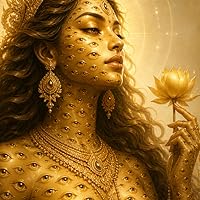
The tale of Satyavan and Savitri is recited in the Mahabharata as a story of conjugal love conquering death.But the legend is,as shown by many features of the human tale,one of the many symbolic myths of the Vedic cycle,Satyavan is the soul carrying the divine truth of being within itself but descended into the grip of death and is the Divine Word,daughter of the Sun,goddess of the supreme Truth who comes down and is born to Lord of the Horse,her human father,is the Lord of Tapasya,the concentrated energy of spiritual endeavour that helps us to rise from the mortal to the immortal of the shining Hosts,father of Satyavan,is the Divine Mind here fallen blind,losing it's ceslestial kingdom of vision,and through that loss it's kingdom of glory.Still this is not a mere allegory,the characters are not personified qualities,but incarnations of emanations of living and conscious forces with whom we can enter into concrete touch and they take human bodies in order to help man and show him the way from his mortal state to a divine consciousness and immortal life.
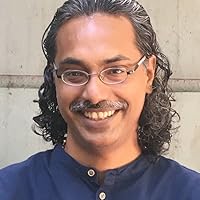
Sri Aurobindo (Bengali: শ্রী অরবিন্দ Sri Ôrobindo) was an Indian nationalist and freedom fighter, major Indian English poet, philosopher, and yogi. He joined the movement for India's freedom from British rule and for a duration (1905–10), became one of its most important leaders, before turning to developing his own vision and philosophy of human progress and spiritual evolution.
The central theme of Sri Aurobindo's vision is the evolution of life into a "life divine". In his own words: "Man is a transitional being. He is not final. The step from man to superman is the next approaching achievement in the earth evolution. It is inevitable because it is at once the intention of the inner spirit and the logic of Nature's process."
- "God can be realized through all paths." ~ Sri Ramakrishna - "He who chooses the Infinite has been chosen by the Infinite." ~ Sri Aurobindo, The Synthesis Of Yoga - "I purify earth and heaven by the Truth." (Rig Veda I. 133 1.)
I am not in a position to assess Savitri fairly (it is quite beyond me, and likely more so than I can imagine), but due to my awe and love and gratitude I must at least try to sing its praises; of its seemingly boundless inexhaustible miracle-splendour.
If you have the great fortune of being open to Savitri or if you have had enough experience for it to reveal itself partially to you, then I consider you blessed. It is truly a wondrous blessing. That such a book exists.. It seems as if all books are like early prototypes for a real Book, and the first real Book being Savitri.
It is unfair to downplay numerous other books as there are countless sacred texts and as I continue my studies and work more and more such texts open up and I can see what treasures were already there, still, Savitri.. what can I say... It is a wonderous miracle. I hope to read it at least a thousand times. Otherwise to waste such a blessing.. Regardless I imagine I could study it for lifetimes and lifetimes, moving forward as fast as I am willing, with God holding my hand, and carrying me along. Boundless precious treasure.
The rewards of Savitri are timeless, but it not always easy. It was, at first, completely inaccessible to me but I knew it would be worth the work and it has been. I knew this, at least mentally, due to my previous studies of Sri Aurobindo and my acknowledging of His towering-genius. He had wrote a vast majority of his works in a 4 year period, which are uncompromisingly heavy studies, but Savitri he worked on for 30+ years, making it seem as if infinitely unfold-able, containing as if literally everything, as ridiculous as that sounds.
It is like all the Divine attributes can be found there in full. Goodness, Truth, Beauty, Love, Guidance, Consciousness, Ecstasy, etc. I feel at times as if I am in there, where I am, where I am going, other people, where they are. I have had countless weird experiences where the book has been as if a GPS of my state and stage of development, I would wander from the book a few weeks, go through this whole journey and ordeal, get stuck somewhere and surrender and turn back to the book to find the occurrence documented there.
I have also been led to believe all solutions to all problems can be found there. At least by a means of general abstracted solution, or how to go to where the answers are.
Nothing I can say will come close in revealing its splendour, as all I say is under-exaggerated. It is much more than I can say. More than I know. I am at a loss for words.
There is so much I can say about it, I could roll on about it probably forever, but there is not enough room here [character allowance] and one could write a series of books just in reviewing Savitri. But I will potentially link to more review later.
#### AUTHORS NOTE FROM BOOK SAVITRI #### "The Tale of Satyavan and Savitri is recited in the Mahabharata as a story of conjugal love conquering death. But this legend is, as shown by many features of the human tale, one of the many symbolic myths of the Vedic cycle. Satyavan is the soul carrying the divine truth of being within itself but descended into the grip of death and ignorance; Savitri is the Divine Word, daughter of the Sun, goddess of the supreme Truth who comes down and is born to save; Aswapati, the Lord of the Horse, her human father, is the Lord of Tapasya, the concentrated energy of spiritual endeavour that helps us to rise from the mortal to the immortal planes; Dyumatsena, Lord of the Shining Hosts, father of Satyavan, is the Divine Mind here fallen blind, losing its celestial kingdom of vision, and through that loss its kingdom of glory. Still this is not a mere allegory, the characters are not personified qualities, but incarnations or emanations of living and conscious Forces with whom we can enter into concrete touch and they take human bodies in order to help man and show him the way from his mortal state to a divine consciousness and immortal life."
#### QUOTES ABOUT SAVITRI #### - "It does not matter if you do not understand it - Savitri, read it always." - The Mother
- "Savitri alone is sufficient to make you climb to the highest peaks. If truly one knows how to meditate on Savitri, one will receive all the help one needs. For him who wishes to follow this path, it is a concrete help as though the Lord himself were taking you by the hand and leading you to the destined goal. And then, every question, however personal it may be, has its answer here, every difficulty finds its solution herein; indeed there is everything that is necessary for doing the Yoga." - The Mother
"My child, yes, everything is there: mysticism, occultism, philosophy, the history of evolution, the history of man, of the gods, of creation, of Nature. How the universe was created, why, for what purpose, what destiny — all is there. You can find all the answers to all your questions there. Everything is explained, even the future of man and of the evolution, all that nobody yet knows. He has described it all in beautiful and clear words so that spiritual adventurers who wish to solve the mysteries of the world may understand it more easily. But this mystery is well hidden behind the words and lines and one must rise to the required level of true consciousness to discover it." - The Mother
- '"Savitri", the poem, the word of Sri Aurobindo is the cosmic Answer to the cosmic Question. And Savitri, the person, the Godhead, the Divine Woman is the Divine's response to the human aspiration. - The world is a great question mark. It is a riddle, eternal and ever-recurring. Man has faced the riddle and sought to arrive at a solution since he was given a mind to seek and interrogate. What is this universe? From where has it come? Whither is it going? What is the purpose of it all? Why is man here? What is the object of his existence?' ~ Nolini Kanta Gupta, Savitri
'The Mother on Savitri' section below is the large majority of the words of The Mother that she had spoken to a disciple Mona Sarkar about Savitri; words which were recorded later from memory which he then showed to the Mother and she partly revised it. The full original of The Mother words can be found in Mona Sarkar's book "Sweet Mother", it can also be found online.
Review Extension: Its been over 8 years since I have been studying Savitri as my main text and feel some need to say more about it.
One potential area of discussion is the revelation of the truth behind the Mothers talk on Savitri, to what degree it has been revealed to be true. I am not sure exactly what to talk of next here, but mostly I wanted to delete the very important Talk from here to create space for future edits at least. But really if you have not read the talk, it is more important than my review.
A riddling infinite from which one may drink as much Gold or Light, or gold and light as one wishes or is capable.
To exhaust an Infinite, is to exceed the Infinite.
As the Truth reveals portions of itself, we grow in likeness to His consciousness. For who can understand this autobiography but Himself?
I think next I will either add some quotes from the text or go full ham and write love poetry of it or transmute revelations from it into the highest form I can. Another option is to write of my resistances to it, or how I use it to measure conscious progression or use it as a standard for gauging state of consciousness.
remembrance, forgetfulness, obscurity and difficulties so much of Savitri, is usually obscure, as I go through it I have been marking each line variously as a means to measure something like capacity of appreciation for the line. When there are long or were long regions of the text where at times multiple pages went unmarked, such stretches can be very difficult to read as it is a good representation of a complete lack of any understanding of its truth. So at times, the value of the book if not revealed, similarly are there periods where God's value is obscured. One major goal in reading Savitri then, has been to try to increase love of the work such that it is easier and easier to read, turning more from Work to Play or Love. Now though, there are countless instances that are so clearly wonderful that there are ways to reinvoke love for the text without much difficulty. There is a measure I use taken from the Mother's talk on Savitri, as she says both "everyday you are going to read Savitri" and "read it always". I take this as a measure from between 0.1 and 1, where 1 is reading it always and > 0 is a minimal everyday.
I apologize for the low quality of the end of this review but its a WIP and the hideous costliness along the way must be bared.
When people ask 'What is the best book you've ever read?' I've always had some difficulty in naming one; instead, I've listed a few in no particular order and still somewhat unsure.
That situation has changed now - Savitri is the unquestionable numero uno. It even surpasses 'The Life Divine' (Sri Aurobindo's definitive magnus opus in prose) because of the ineffable splendor of spiritual poetry and the mantric intonation of each of the 24000 lines across 49 Cantos.
Together, this teaching and transmission is easily the greatest, purest, deepest, most comprehensive, most integrated and sweetest I have ever come across. It represents the ultimate in transcendence and the ultimate in immanence. It is a life-changer in ways unimaginable until one embarks on the sunlit path.
To the serious seeker, I recommend reading both books together if possible: Savitri in the morning, preferably starting before dawn, and TLD later in the day. It is very important to not over-read at a time, so as to allow a juicy metabolism of arguably the most potent download one can receive. I would suggest taking a month off and dedicating it to these two books for the most powerful impact.
I cannot overexpress my gratitude to Sri Aurobindo and The Mother for who they were/are, and what they've left behind for humanity.
My favorite poetry, introduced to me by Sri Maa many years ago. Utterly soaring from the first line to the last. Aurobindo wrote it while in exalted samadhic states over years. I've never been able to get through more than a few pages without pausing, holding my heart, or crying. Unimaginable use of language and metaphor, lifts one merely by reading it.
Always on my nightstand. Another copy on my desk. Love. Love. Love. Enjoy forever if a page or two or in long sittings.
The poetic verse in this massive work is truly majestic. Yes, I know...I said majestic, just work with me here, this is an 800 page love poem to the ineffable, omniscient, transcendent, all-loving Brahman...mkay.
A one liner review: A source book of consciousness, where we can dip in and take a ‘bath’ whenever we choose to.
When I first picked up Savitri, I did not understand anything. A good friend who used to read this book a lot said, ‘Even if you do not understand, no problem. Read it and be aware of any images that arise in you’. So I read by concentrating beyond the words, as if I was connecting to something that was present behind the words. Sometimes I read in order and sometimes at random. I started noticing that whenever I came back to the same pages after some time, it seemed to automatically get clearer. What I could not understand first, by itself seemed to wake up in awareness and understanding within me. Thus is how my journey continues. The story of Satyavan and Savitri is the backbone around which the author seems to have embedded experiences of consciousness. Realm by realm of consciousness seems to have been condensed from his experience and made potent into the book.
This book warrants several re-reads and is meant to be a companion of our spiritual journey. And I do hope I will never 'finish' reading this book!
Read a lot of this in the edition from Auroville. Aurobindo was my would-be guru (I read lots of his works when I was in my late teens and early twenties). Still remains for me one of the great guru sages of India.
My homage to Sri Aurobindo, prolific creator of many a great Works. Savitri is sublime spiritual poetry of epic proportion, Work of a lifetime. It is learnt, He continued to write and rewright Savitri till the end. Whenever I read from It, I transcend to a higher realm of spiritual bliss.
Inspiring and beautiful, one intuitively felt it only appropriate to pay homage to a such a great spiritual poet deserving of our consideration. One presented a passage along with imagery, so that others may catch a glimpse of the written splendor and be inspired by the eloquent beauty that is Savitri...
The eighth book of Aurobindo's epic work entitled"Savitri:A Legend and a Symbol" seems to be the pinacle of that poetic work. I am referring to the Book of Death.
Very very heavy stuff. Actually I have a soft corner for Aurobindo, though his sensibility is entirely different from mine. But i grew up reading his unreadable stuff and have digested his ill influence.
The narrative follows Savitri, a divine feminine embodiment of grace and transformative power, who challenges death itself to rescue her beloved Satyavan. But this is no ordinary love story. Aurobindo uses this mythic framework to articulate his complex philosophical vision of human potential and cosmic consciousness.
Aurobindo's language is mesmerising - dense with metaphysical insight yet lyrical and evocative. Each line seems to pulse with an almost mystical energy, inviting readers into a deeper understanding of existence beyond material reality. The poem becomes a spiritual transmission, a vibrational experience that goes far beyond mere storytelling.
The epic's true genius lies in its multilayered symbolism. Characters are not just individuals but represent cosmic principles. Savitri embodies divine intervention, Satyavan represents the human soul's potential, and their journey symbolises humanity's collective spiritual transformation. Structurally, the work is breathtaking in its complexity.
Aurobindo weaves together philosophical discourse, mystical revelation, and poetic narrative with extraordinary skill. The result is a text that defies simple categorisation - part poem, part spiritual treatise, part visionary revelation. What makes "Savitri" truly remarkable is Aurobindo's radical reimagining of human potential. He suggests that consciousness is not fixed but evolutionary, that humans can transcend current limitations through spiritual practice and divine grace. The poem becomes a roadmap for spiritual awakening, a blueprint for collective human transformation. The work is not just a literary achievement but a spiritual document. Aurobindo spent decades refining these lines, considering them a form of yogic practice. Each verse is carefully crafted to carry vibrational energy, potentially awakening readers to higher states of consciousness.
For those willing to dive deep, "Savitri" offers an extraordinary journey. It challenges readers to expand their understanding of reality, to see beyond material existence into the realm of pure consciousness. It is a text that demands and rewards multiple readings, revealing deeper layers of meaning with each encounter.
Savitri is not merely a retelling of a myth but a spiritual treatise that uses the story as a symbolic framework. The titular character, Savitri, represents the Divine Grace or Supreme Shakti incarnate in human form, while Satyavan symbolizes the human soul striving for higher realization. Their journey—culminating in Savitri's confrontation with Death to reclaim her beloved—becomes an allegory for humanity's collective spiritual transformation. Through this narrative, Aurobindo articulates his vision of an evolutionary consciousness, where humans transcend their limitations through divine grace and spiritual practice.
Aurobindo's use of language in Savitri is both dense and lyrical, imbued with metaphysical insight and evocative imagery. Each line carries a vibrational energy that seeks to elevate the reader's consciousness beyond material reality. The poem serves not just as a literary work but as a spiritual document—a "mantric" epic meant to inspire inner awakening. Aurobindo himself viewed the writing process as a form of yogic practice, refining the verses over decades to embody his spiritual realizations.
Thematically, Savitri addresses universal questions about life, death, destiny, and the purpose of human existence. It posits that life is not an illusion but a field for divine manifestation and transformation. Unlike traditional epics that often emphasize heroic deeds or linear storytelling, Savitri frequently shifts focus to explore philosophical dimensions and cosmic principles. This complexity challenges readers but also offers immense rewards for those willing to engage deeply with its layers of meaning.
Ultimately, Savitri is more than an epic; it is a visionary roadmap for spiritual evolution. By blending mythic narrative with profound philosophical insights, Sri Aurobindo presents a work that speaks to both individual self-realization and humanity’s collective destiny. It remains one of the most ambitious and spiritually resonant poetic achievements in modern literature, inviting readers to transcend ordinary perceptions and glimpse the infinite possibilities of existence.
A review of Savitri seems somehow redundant. This is one of the greatest epic poems of all time. It is, however, not as widely read as it should be. I read the poem aloud with a group of fellow travellers. Took us well over two years to get through it, reading every two weeks and often reading each section aloud twice and sometimes thrice in order to catch all the nuances in the text. I suppose it will not appeal to everyone, but all those who love epics, especially in poetic form, should find much of interest here. Of course, Sri Aurobindo's text is not only a great literary text, it is also a deep spiritual text, and it lends itself to being read aloud, despite its vast length (26000 lines of poetry). The story is the love between Savitri and Satyavan as recorded in the Vedas, but Sri Aurobindo recasts the narrative into an acounting of how spiritual growth is achieved both personally and at the level of civilization. The writing is endlessly beautiful; in addition, it shifts rhythms constantly so the reading never becomes boring. Sri Aurobindo was a master of the English language, making its reading a profound pleasure and a delight. Sri Aurobindo uses this story to present his philosophy to the world, but whe/ther or not you agree with him, this book is a source of boundless delight.
Sri Aurobindo's Savitri: A Legend and a Symbol is an ambitious and enigmatic work, challenging readers with its sheer scale, philosophical depth, and unique blend of epic poem, philosophical treatise and spiritual allegory.
Savitri is a rich tapestry of symbolism, with characters, events, and settings carrying deeper meanings. This invites close reading and reflection, offering opportunities for personal interpretation and discovery. Aurobindo's mastery of language is undeniable. The poem is filled with evocative imagery, lyrical beauty, and a powerful command of rhythm and meter.
Unlike traditional epics, Savitri does not focus solely on a linear story. It frequently shifts focus and explores different philosophical and symbolic dimensions, which might challenge readers seeking a straightforward narrative.
Overall, Savitri: A Legend and a Symbol is a monumental work with the potential to be an enriching and thought-provoking experience for dedicated readers. However, its complexity and unique approach make it a work best suited for those with a strong interest in Indian philosophy, symbolism, and the willingness to invest time and effort in unraveling its depths.
Savitri- Legend & Symbol. Mahabharat contains story of Savitri- who wins back her husband Satyavaana from clutches of Yama & gives sight to her father in law and restores his lost Kingdom/Empire-in around 200 shlokas. Aurobindo spent his life time to expand, evolve and stretch it to massive 24000 almost verses, without thwarting/spoiling the original, but breathtakingly and magnanimously and sublimely treating Savithri as every human being's inherent unlimited spirit and juice of beauty to transcend everything and regain the glory of mankind having such possibility.
It was the hour before the Gods awoke--- what an arresting beginning line of the book!
Aurobindo's this magnus opus has all the power and potential to ignite the reader's dormant states and to expose himself to his own wisdom and virtues which he inherited and interplays with the universe.
There is no magic in this book to change anybody's life. But this rich and insightful book has concentrated capsules of true wisdom.
This book (if it could be called one) is a reference point for not just humans, but also the great gods. A blueprint of the creation, a mystique plan of the great mother. This is Rig veda 2.0, but written in English. Read it from your heart and not the mind, and it will reveal things yet to manifest in the universe.
A book that is understood and enjoyed as the reader becomes spiritual fellow traveller of the one who wrote it not with vital mind but in overmind; not only with knowledge and imagination of ancient Rishi but a Yogi who knows the future that has delved in past and present. Savitri is not only a legend of a lady who retrieved her husband and love from the fate of death but asserted herself with will to take humanity tangentially away from the helical circles of her animalistic instincts and intelligence of vital mind. The book is assertion of a change towards, rather a leap on to, life divine on earth.