

What do you think?

A Future of Faith: The Path of Change in Politics and Society
Pope Francis met with French reporter and sociologist Dominique Wolton for an unprecedented series of twelve fascinating and timely conversations—open dialogues revolving around the political, cultural, and religious issues dominating communication and conflict around the world—now published in A Future of Faith: The Path of Change in Politics and Society.
Inspiring and insightful, Pope Francis’s views on immigration, poverty, diversity, globalization, and more are borne from his Christian faith and basic humanity. Meeting the challenges of the twenty-first century requires compassion for those in need, a willingness to work towards common goals without domineering other cultures, and the ability to negotiate with trust, respect, and dignity. And for the first time, Pope Francis shares insights into his own personality, and the formation of his faith, including his experience with psychotherapy, and some of the most important women in his upbringing.
Controversial, bold, personal, and illuminating— A Future of Faith will serve to be essential reading for not only Catholics, but those who want to see how the “people’s pope” confronts the social injustices of the world with the foresight to create positive change.
Inspiring and insightful, Pope Francis’s views on immigration, poverty, diversity, globalization, and more are borne from his Christian faith and basic humanity. Meeting the challenges of the twenty-first century requires compassion for those in need, a willingness to work towards common goals without domineering other cultures, and the ability to negotiate with trust, respect, and dignity. And for the first time, Pope Francis shares insights into his own personality, and the formation of his faith, including his experience with psychotherapy, and some of the most important women in his upbringing.
Controversial, bold, personal, and illuminating— A Future of Faith will serve to be essential reading for not only Catholics, but those who want to see how the “people’s pope” confronts the social injustices of the world with the foresight to create positive change.
320 pages, Hardcover
Published August 7, 2018
About the author
Pope Francis
1,314 books1,020 followersPope Francis (Latin: Franciscus; Italian: Francesco; Spanish: Francisco; born Jorge Mario Bergoglio, 17 December 1936) was the 266th Pope of the Roman Catholic Church, a title he held ex officio as Bishop of Rome, and Sovereign of the Vatican City. He chose Francis as his papal name in honor of Saint Francis of Assisi. Francis was the first Jesuit pope, the first from the Americas, the first from the Southern Hemisphere and the first non-European pope since the Syrian Gregory III, who died in 741.
Born in Buenos Aires, Argentina, Bergoglio worked briefly as a chemical technologist and nightclub bouncer before beginning seminary studies. He was ordained a Catholic priest in 1969 and from 1973 to 1979 was Argentina's provincial superior of the Society of Jesus. He was accused of handing two priests to the National Reorganization Process during the Dirty War, but the lawsuit was ultimately dismissed. He became the Archbishop of Buenos Aires in 1998 and was created a cardinal in 2001 by Pope John Paul II. He led the Argentine Church during the December 2001 riots in Argentina, and the administrations of Néstor Kirchner and Cristina Fernández de Kirchner considered him a political rival. Following the resignation of Pope Benedict XVI on 28 February 2013, a papal conclave elected Bergoglio as his successor on 13 March.
Throughout his public life, Pope Francis had been noted for his humility, emphasis on God's mercy, concern for the poor, and commitment to interfaith dialogue. He was credited with having a humble, less formal approach to the papacy than his predecessors, for instance choosing to reside in the Domus Sanctae Marthae guesthouse rather than in the papal apartments of the Apostolic Palace used by his predecessors. In addition, due to both his Jesuit and Ignatian aesthetic, he was known for favoring simpler vestments void of ornamentation, including refusing the traditional papal mozzetta cape upon his election, choosing silver instead of gold for his piscatory ring, and keeping the same pectoral cross he had as Cardinal. He maintained that the church should be more open and welcoming. He did not support unbridled capitalism, Marxism, or Marxist versions of liberation theology. Francis maintained the traditional views of the church regarding abortion, euthanasia, contraception, homosexuality, ordination of women, and priestly celibacy. He opposed consumerism, irresponsible development, and supported taking action on climate change, a focus of his papacy with the promulgation of Laudato si'. In international diplomacy, he helped to restore full diplomatic relations between the U.S. and Cuba.
Born in Buenos Aires, Argentina, Bergoglio worked briefly as a chemical technologist and nightclub bouncer before beginning seminary studies. He was ordained a Catholic priest in 1969 and from 1973 to 1979 was Argentina's provincial superior of the Society of Jesus. He was accused of handing two priests to the National Reorganization Process during the Dirty War, but the lawsuit was ultimately dismissed. He became the Archbishop of Buenos Aires in 1998 and was created a cardinal in 2001 by Pope John Paul II. He led the Argentine Church during the December 2001 riots in Argentina, and the administrations of Néstor Kirchner and Cristina Fernández de Kirchner considered him a political rival. Following the resignation of Pope Benedict XVI on 28 February 2013, a papal conclave elected Bergoglio as his successor on 13 March.
Throughout his public life, Pope Francis had been noted for his humility, emphasis on God's mercy, concern for the poor, and commitment to interfaith dialogue. He was credited with having a humble, less formal approach to the papacy than his predecessors, for instance choosing to reside in the Domus Sanctae Marthae guesthouse rather than in the papal apartments of the Apostolic Palace used by his predecessors. In addition, due to both his Jesuit and Ignatian aesthetic, he was known for favoring simpler vestments void of ornamentation, including refusing the traditional papal mozzetta cape upon his election, choosing silver instead of gold for his piscatory ring, and keeping the same pectoral cross he had as Cardinal. He maintained that the church should be more open and welcoming. He did not support unbridled capitalism, Marxism, or Marxist versions of liberation theology. Francis maintained the traditional views of the church regarding abortion, euthanasia, contraception, homosexuality, ordination of women, and priestly celibacy. He opposed consumerism, irresponsible development, and supported taking action on climate change, a focus of his papacy with the promulgation of Laudato si'. In international diplomacy, he helped to restore full diplomatic relations between the U.S. and Cuba.
Ratings & Reviews
Friends & Following
Create a free account to discover what your friends think of this book!
Community Reviews
Displaying 1 - 30 of 47 reviews
July 30, 2018
In this book Pope Francis lays out his thoughts on a variety of issues, during a series of twelve meetings with French researcher, intellectual and writer Dominique Walton. In addition to a summary of the discussions, the text includes extracts from sixteen speeches delivered by the Pope since his election in 2013. The subject matter includes, amongst other things: globalisation, diversity, communication and what the the pontiff believes to be the greatest threat to world peace.
My position on religion is that of an agnostic, or perhaps (a new word I was recently introduced to) an apatheist. I'm certainly not against religion, in any of it’s many forms; I believe that, at its best, religion can propose a set of moral guidelines or rules by which societies and individuals can set out their stall or judge themselves by. In other words, I do think that the church, by working as common conscience and by vocalising its thoughts on important issues, can serve a useful purpose.
So what of this book? Well, the first thing to say is that it’s not an easy read. To me, it quickly highlights one of the issues the church has, that of clearly communicating its message to non-believers. Pope Francis is clearly a very intelligent, well read and articulate man and when he speaks on a number of topics I found myself having a good deal of sympathy with his thoughts. The problem is that there is a lot of difficult stuff to get through to fully comprehend where he’s coming from. Religions have their own vocabulary and there are numerous terms, words and references that left me puzzled. I confess I ended up skipping over much of this stuff.
Here are some of the elements that did grab me, though:
His statement that we are going through ‘World War 3 in instalments’, I found interesting. In his view the biggest threat to world peace is money, in that weapons are supplied around the world by the West, who then bemoan the fact that they have to resolve issues, often by force, that they’ve contributed to creating. He talks a lot here about the need for social and political engagement – clear communication with all sides actively listening to each other. In fact, communication is a big theme in this book: the need for dialogue, negotiation and a desire to ‘build bridges’ (a phrase he repeats often).
He has strong views on globalisation too. He feels that it removes diversity, and that’s a bad thing. There is a need for unity, he says, not uniformity. His view is that we should accept and embrace difference. A common sense overview, maybe, but not one that is holding much sway in today’s world. He also talks of the danger represented by fundamentalists who only accept their own view of how things should be done. Again, a view that is hard to disagree with but but it's a problem that's going to be so very hard to resolve.
In a speech in 2015, the Pope made three key points:
1. That the economy ‘should not be a mechanism for accumulating goods, but rather the proper administration of our common home’
2. The idea that peoples culture, language and social processes should be respected
3. The need to ‘defend Mother Earth’ (primarily this being focused on the need for humanity to address climate change and rebalance its relationship with the planet and each other)
It’s hard to argue with these points, I think!
Overall I found this book to be a fascinating insight into the thinking of the head of the Catholic Church. I was impressed by his breadth of knowledge and his depth of thinking. It certainly doesn’t change my stance on religion but it does strengthen my view that religious leaders do have a valuable role to play in ‘big’ politics, though certainly not party political politics, if (and it’s quite a big if) we can find an effective way of harnessing it.
My sincere thanks to Don Shanahan from Bluebird and NetGalley for providing a copy of this book in exchange for an honest review.
So what of this book? Well, the first thing to say is that it’s not an easy read. To me, it quickly highlights one of the issues the church has, that of clearly communicating its message to non-believers. Pope Francis is clearly a very intelligent, well read and articulate man and when he speaks on a number of topics I found myself having a good deal of sympathy with his thoughts. The problem is that there is a lot of difficult stuff to get through to fully comprehend where he’s coming from. Religions have their own vocabulary and there are numerous terms, words and references that left me puzzled. I confess I ended up skipping over much of this stuff.
Here are some of the elements that did grab me, though:
His statement that we are going through ‘World War 3 in instalments’, I found interesting. In his view the biggest threat to world peace is money, in that weapons are supplied around the world by the West, who then bemoan the fact that they have to resolve issues, often by force, that they’ve contributed to creating. He talks a lot here about the need for social and political engagement – clear communication with all sides actively listening to each other. In fact, communication is a big theme in this book: the need for dialogue, negotiation and a desire to ‘build bridges’ (a phrase he repeats often).
He has strong views on globalisation too. He feels that it removes diversity, and that’s a bad thing. There is a need for unity, he says, not uniformity. His view is that we should accept and embrace difference. A common sense overview, maybe, but not one that is holding much sway in today’s world. He also talks of the danger represented by fundamentalists who only accept their own view of how things should be done. Again, a view that is hard to disagree with but but it's a problem that's going to be so very hard to resolve.
In a speech in 2015, the Pope made three key points:
1. That the economy ‘should not be a mechanism for accumulating goods, but rather the proper administration of our common home’
2. The idea that peoples culture, language and social processes should be respected
3. The need to ‘defend Mother Earth’ (primarily this being focused on the need for humanity to address climate change and rebalance its relationship with the planet and each other)
It’s hard to argue with these points, I think!
Overall I found this book to be a fascinating insight into the thinking of the head of the Catholic Church. I was impressed by his breadth of knowledge and his depth of thinking. It certainly doesn’t change my stance on religion but it does strengthen my view that religious leaders do have a valuable role to play in ‘big’ politics, though certainly not party political politics, if (and it’s quite a big if) we can find an effective way of harnessing it.
My sincere thanks to Don Shanahan from Bluebird and NetGalley for providing a copy of this book in exchange for an honest review.

July 12, 2018
A Future Of Faith: The Path Of Change In Politics And Society by Pope Francis, Dominique Wolton and Jorge Mario Bergoglio is a comprehensive set of questions and answers with Pope Francis. He addresses the issues of today, urging us to build bridges and not walls between us.
Pope Francis sees money as the greatest threat to peace in society today.
There were speeches of Pope Francis' included in the book too.
This was a title I was invited to read and not my usual choice of book. I recognise that Pope Francis is wise and educated on today's world. I must admit, I found the book very intellectual and normally prefer lighter reads, so I only read half of the book as it became too heavy going for me. The fault lies with me. The book is well written and Pope Francis is very likable. It is a great read if you like question and answer sessions on the state of today's world.
I received this book for free from Net Galley. A favourable review was not required and all views expressed are my own.
Pope Francis sees money as the greatest threat to peace in society today.
There were speeches of Pope Francis' included in the book too.
This was a title I was invited to read and not my usual choice of book. I recognise that Pope Francis is wise and educated on today's world. I must admit, I found the book very intellectual and normally prefer lighter reads, so I only read half of the book as it became too heavy going for me. The fault lies with me. The book is well written and Pope Francis is very likable. It is a great read if you like question and answer sessions on the state of today's world.
I received this book for free from Net Galley. A favourable review was not required and all views expressed are my own.
July 31, 2018
Receiving an invitation via Netgalley to read and review this book, I was intrigued. I am not a Catholic and know very little about the Catholic faith so I was interested to learn about Pope Francis' take on the world's problems.
The book is based around twelve interviews which the author, Dominique Wolton, a sociologist, conducted with Pope Francis. Each chapter reports on one of these with additional complementary material from public speeches he has made, relating to the broad theme of the chapter.
I found it quite a difficult read. The Pope is very well read and often cited works of philosophy with which I am not familiar. The extensive footnotes helped a little but are not easy to follow on a Kindle. And obviously he also cited Catholic authors and thinkers unknown to me. But even a reader without the necessary depth of understanding gets a picture of a very wise and thoughtful man, eager to use his power and influence for the good of the world. I found that quite consoling at a time when we lack strong moral leadership.
My only real criticisms of the book stem from my own background as a social science researcher. Interviews are tricky, even with lesser mortals then the Pope as your subject and I would have liked to know more of the thinking behind Wolton's approach than is provided in the introduction. What the book provides is a series of conversations, rather than what I would regard as interviews. The twists and turns give the Pope an opportunity to present his views in an accessible way but the dialogue reads very smoothly and I'd like to know how it was recorded and edited. It's also not entirely clear what language was used. The translator, Shaun Whiteside, is a very well respected translator, but, again, I would like to know a bit about the process.
This book will be of great interest to anyone wanting insights into the role of the Pope and the way the present incumbent is addressing his responsibilities, Catholic or not.
(Thanks to Bluebird and Netgalley for the ARC.)
The book is based around twelve interviews which the author, Dominique Wolton, a sociologist, conducted with Pope Francis. Each chapter reports on one of these with additional complementary material from public speeches he has made, relating to the broad theme of the chapter.
I found it quite a difficult read. The Pope is very well read and often cited works of philosophy with which I am not familiar. The extensive footnotes helped a little but are not easy to follow on a Kindle. And obviously he also cited Catholic authors and thinkers unknown to me. But even a reader without the necessary depth of understanding gets a picture of a very wise and thoughtful man, eager to use his power and influence for the good of the world. I found that quite consoling at a time when we lack strong moral leadership.
My only real criticisms of the book stem from my own background as a social science researcher. Interviews are tricky, even with lesser mortals then the Pope as your subject and I would have liked to know more of the thinking behind Wolton's approach than is provided in the introduction. What the book provides is a series of conversations, rather than what I would regard as interviews. The twists and turns give the Pope an opportunity to present his views in an accessible way but the dialogue reads very smoothly and I'd like to know how it was recorded and edited. It's also not entirely clear what language was used. The translator, Shaun Whiteside, is a very well respected translator, but, again, I would like to know a bit about the process.
This book will be of great interest to anyone wanting insights into the role of the Pope and the way the present incumbent is addressing his responsibilities, Catholic or not.
(Thanks to Bluebird and Netgalley for the ARC.)

April 10, 2019
I don't feel that Wolton is a very competent interviewer, though he clearly thinks very highly of himself. He jumps from topic to topic without much attempt at thoughtful followup questions. His research into the Pope and the church seems very shallow, reflected in the misplaced accusatory tone of many of his questions. As a point of comparison, I found the interview-based book "A Big heart Open to God: A Conversation With Pope Francis," to be both revelatory and insightful. This one not so much. Among the interesting tidbits from the interviews: Francis' first language was Piedmontese, a dialect from the North of Italy. He says he can still understand it but no longer speak it. Also, he tells a brief anecdote of his friendship with a communist woman in Argentina, who ended up being abducted and murdered by the state. He says that she taught him how to think politically. Anyway, the book was worth reading, but I was expecting more from the reviews I read of it.
August 3, 2018
I was intrigued at receiving an invitation to read this book as it is certainly not one I would choose. I'm not a Catholic and have little time for organised religion, but was interested in reading what a seemingly very popular Pope had to say about the modern world.
On a practical level I found the book quite difficult to read with so many footnotes and at times I found the translation a bit grating. I also felt that although Dominique Wolton asked some interesting questions he felt almost fawning at times.
This book wouldn't make me change my views on Catholicism or feel that the Pope's views on such things as women and homosexuality will ever move further forward. However, he does come across as a man who thinks deeply and wants to build bridges with other people and religions so maybe there is hope for the world.
On a practical level I found the book quite difficult to read with so many footnotes and at times I found the translation a bit grating. I also felt that although Dominique Wolton asked some interesting questions he felt almost fawning at times.
This book wouldn't make me change my views on Catholicism or feel that the Pope's views on such things as women and homosexuality will ever move further forward. However, he does come across as a man who thinks deeply and wants to build bridges with other people and religions so maybe there is hope for the world.
January 17, 2021
A great insight of Pope Francis’ personal ideas and vision for the future of the Catholic Church. I found some of them controversial, but that’s irrelevant to my review of the actual book itself. The author did a great job of pushing for answers and usually got a direct one. Although I did knock off a star because at times, it seemed Dominique Wolton was more focused on promoting his own ideas/published works (or at least framing the question to encourage a particular answer) than actually interviewing the Pope for HIS ideas. I’m interested in reading about His Holiness, not Mr. Wolton.
December 8, 2018
My favorite words? Joy, tenderness, closeness, amazement, wonder.
My people are poor, and I am one of them.
I would simply say that I like listening to other people. Because I discover that every life is different. And that each person has his or her own path. Listening. Not to gossip, to judge, but to open oneself up to different lifestyles or different kinds of success . . .
Silence is tender, affectionate, warm. And it’s equally painful at difficult moments. You can’t have a communication of any quality without the capacity for silence. It’s in silence that the capacity for listening is born, the capacity for understanding, trying to understand, suffering when you can’t understand. But true communication is human.
Don't confuse happiness with a sofa.
(As I sat comfortably reading on my sofa, ha!)
This accessible series of 12 open and wide-ranging conversations between French intellectual and reporter Dominique Wolton and Pope Francis was a great way to get to know more about the heart and mind of this most human and open spiritual leader. I think this particular book would be accessible to anyone no matter what their beliefs. Excerpts from 16 addresses given to a wide variety groups all over the world, a short biographical sketch, and bibliographies of Francis and Wolton round out the book. Reading this each morning over the past month has inspired me in many ways.
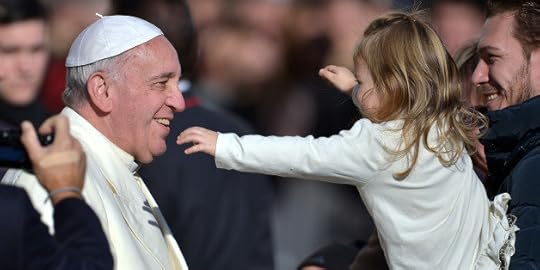
(Photo: FILIPPO MONTEFORTE/AFP/Getty Images)
Why do [the refugees] leave their home? Because of a lack of work, or because of war. . . Lack of work, because they have been exploited--Europe has exploited Africa. . . one African head of state proposed a law of reforestation for his country--and it was passed. The global economic powers had cut down all the trees. Reforestation. The land is dry from having been over-exploited . . . The other reason for migration is war. . . And who's making war? Who's giving them weapons? We are. . . . We supply them with weapons so that they destroy themselves. . . The West--and some non-Western countries also sell weapons. We cause chaos, people flee, and what do we do? We say "Come on, sort yourselves out!" I don't want to express myself too harshly, but we have no right not to help the people who arrive here. They are human beings.
My people are poor, and I am one of them.
I would simply say that I like listening to other people. Because I discover that every life is different. And that each person has his or her own path. Listening. Not to gossip, to judge, but to open oneself up to different lifestyles or different kinds of success . . .
Silence is tender, affectionate, warm. And it’s equally painful at difficult moments. You can’t have a communication of any quality without the capacity for silence. It’s in silence that the capacity for listening is born, the capacity for understanding, trying to understand, suffering when you can’t understand. But true communication is human.
Don't confuse happiness with a sofa.
(As I sat comfortably reading on my sofa, ha!)
This accessible series of 12 open and wide-ranging conversations between French intellectual and reporter Dominique Wolton and Pope Francis was a great way to get to know more about the heart and mind of this most human and open spiritual leader. I think this particular book would be accessible to anyone no matter what their beliefs. Excerpts from 16 addresses given to a wide variety groups all over the world, a short biographical sketch, and bibliographies of Francis and Wolton round out the book. Reading this each morning over the past month has inspired me in many ways.
(Photo: FILIPPO MONTEFORTE/AFP/Getty Images)
Why do [the refugees] leave their home? Because of a lack of work, or because of war. . . Lack of work, because they have been exploited--Europe has exploited Africa. . . one African head of state proposed a law of reforestation for his country--and it was passed. The global economic powers had cut down all the trees. Reforestation. The land is dry from having been over-exploited . . . The other reason for migration is war. . . And who's making war? Who's giving them weapons? We are. . . . We supply them with weapons so that they destroy themselves. . . The West--and some non-Western countries also sell weapons. We cause chaos, people flee, and what do we do? We say "Come on, sort yourselves out!" I don't want to express myself too harshly, but we have no right not to help the people who arrive here. They are human beings.

March 15, 2021
I'm fairly convinced that Pope Francis will go down in history as among the most important people of the 21st Century.
This set of interviews, speeches, and quotes is worth engaging with for anyone interested not just in him, or the church he leads, but also in the history and future of Europe, and the history and future of democracy and human rights.
Pope Francis is eminently practical in his advice, and equally compassionate and thoughtful in his demeanor. To my mind, he is a living saint among us, a modest, caring pontiff trying to steer the ship of the church in a time of great general turmoil and crisis throughout the world.
His focus on humility, and on the poor, and the downtrodden (migrants are called out many times), is a balm in a world that can feel so upside down.
He made me want to go back and read the Beatitudes (https://www.loyolapress.com/catholic-...) and Matthew 25 (he argues both are core to Catholic belief).
Here's a quote from Francis on the latter in Nov 2014:
I think it would be a fine gesture for each of you to pick up the Gospel at home today, the Gospel of St Matthew, Chapter 25, verses 14 to 30, Matthew 25:14-30, and read this, and meditate a bit: “The talents, the treasures, all that God has given me, all things spiritual, all goodness, the Word of God, how do I make this grow in others? Or do I merely store it in a safe?”.
All-in-all, this is a great set of interviews, and would move anyone interested in human rights or how we should treat each other. Good stuff, Pope Francis!
I listened on audiobook through the Libby app through SFPL.
This set of interviews, speeches, and quotes is worth engaging with for anyone interested not just in him, or the church he leads, but also in the history and future of Europe, and the history and future of democracy and human rights.
Pope Francis is eminently practical in his advice, and equally compassionate and thoughtful in his demeanor. To my mind, he is a living saint among us, a modest, caring pontiff trying to steer the ship of the church in a time of great general turmoil and crisis throughout the world.
His focus on humility, and on the poor, and the downtrodden (migrants are called out many times), is a balm in a world that can feel so upside down.
He made me want to go back and read the Beatitudes (https://www.loyolapress.com/catholic-...) and Matthew 25 (he argues both are core to Catholic belief).
Here's a quote from Francis on the latter in Nov 2014:
I think it would be a fine gesture for each of you to pick up the Gospel at home today, the Gospel of St Matthew, Chapter 25, verses 14 to 30, Matthew 25:14-30, and read this, and meditate a bit: “The talents, the treasures, all that God has given me, all things spiritual, all goodness, the Word of God, how do I make this grow in others? Or do I merely store it in a safe?”.
All-in-all, this is a great set of interviews, and would move anyone interested in human rights or how we should treat each other. Good stuff, Pope Francis!
I listened on audiobook through the Libby app through SFPL.

June 25, 2019
It's an interesting book in the sense that it is actually a series of interviews conducted by the Pope and the author of the book. Its a good read if you like the Pope's insights on events going on in the world. However, one thing that is noticeable about the book is that sometimes when the Pope answers a question, it doesn't seem to be a direct answer. Sometimes it seems to be more of an evasive answer or seems to be an answer on an unrelated topic to the question. The book covers several interviews and actually has excerpts of some of his sermons at Saint Peter's Basilica. The book covers everything from poverty to his opinions on human rights. One such topic he refers to repeatedly is a crisis that took place in Africa which he goes back and talks about in answering several questions. Admittedly, the conversation can get a little dry at points. This is not about theology. It is more about his personal viewpoints on various topics and uses his education to support those viewpoints. I, however, found the book very entertaining and interesting to read, and gave me an insight into his childhood and a little bit about how he came to be who he is today. I would recommend the book to anyone who would like some personal insight or his opinion on various topics.
March 8, 2019
To be honest, I would probably have given this book a 1 star if it wasn’t the Pope. I personally found this book challenging for several reasons. I found the format of the book as an interview to be a difficult read. It just didn’t provide for smooth reading. It also felt like the questions and topics kept jumping around. Even though the chapters were broken out into different topics it seemed like they were all very similar. Finally, the material was difficult for me to understand. If you get globalization, modernity, secularism, the French, and the Church then you might find this to be a better read. The only chapter I seemed to enjoy was chapter 7 “Tradition is a movement”. It spoke about how tradition is not a fixed thing but evolves and changes as we do. And there’s nothing wrong with that. In that chapter, there is also a discussion on marriage and how it relates to same sex relationships which I found enlightening.

August 25, 2018
**3.4-3.7/5**
There were a lot of things the Pope said that were really great and impactful and could apply to life outside of religion, and I really enjoyed that part. I was also presently settled by his "I don't know, I'll have to talk more about that" response to questions he didn't know the answer to, but knew that a good answer was needed. I think, overall, the Pope has good insight and is progressive enough for the Church to broaden their reach, but not too much in that the Church loses its essence.
There were a few things I didn't enjoy, though. The structure of the book was fine, but at times it felt like Wolton would just abruptly leave a topic of questioning when there was plenty more to ask. She especially didn't press him very hard about the Pastoral abuse within the Church that has been covered up for decades, and didn't press him for action on the issues either. (I know that this book was pre-the current issues, but there've always been Priests molesting children.) I thought the little blip it got was too short and it deserved more attention and more pressing from her. His defense of priests that had been accused/convicted of sexual abuse was...yikes. I wasn't a fan of that and it was concerning how little he seemed to speak up on how not okay it was, and then to see him, today, go and pray over a candle in memorial of those victims. Words aren't enough.
The last chapter was "nice" but I didn't really care about the spotlight being on the Pope and his personal opinions of himself. I was glad that they were close and could be jovial and comfortable around one another, but I just wasn't interested in that.
They were both also wrong on "gender theory" and "gender is decided by nature" and that whole topic. That was a frustrating section to read just because they weren't....correct and were spinning off their own beliefs on it. But I digress.
Wolton's infatuation with the horrors of technology also got old. Technology creates barriers, yes, and it does take the warmth out of some conversations (emails are formal and stiffy in nature, yes), but on the whole technology and its impact has allowed for people on one side of the world to connect with, contact, communicate with and interact with someone on the other side of the world. And it's frustrating, too, to act like prior to technology there were absolutely No distractions that existed (as if people didn't read, didn't do things that took them away from the group they were in). I did agree with and like the Pope's comments about silence being rigid and us being afraid of it when silence is beautiful.
He's still rigid on feminism and homosexuality and his viewpoints on those topics are a bit disappointing, especially after he went on and on defending tradition needing growth/being about growth.
Some things were also a bit hypocritical, but that's just my personal opinion. I'm not religious, but I really appreciated his ability to say things and have them be applicable in all of society. My opinion on the Church and religion itself hasn't changed after reading this and I don't think anyone else's will, either.
There were a lot of things the Pope said that were really great and impactful and could apply to life outside of religion, and I really enjoyed that part. I was also presently settled by his "I don't know, I'll have to talk more about that" response to questions he didn't know the answer to, but knew that a good answer was needed. I think, overall, the Pope has good insight and is progressive enough for the Church to broaden their reach, but not too much in that the Church loses its essence.
There were a few things I didn't enjoy, though. The structure of the book was fine, but at times it felt like Wolton would just abruptly leave a topic of questioning when there was plenty more to ask. She especially didn't press him very hard about the Pastoral abuse within the Church that has been covered up for decades, and didn't press him for action on the issues either. (I know that this book was pre-the current issues, but there've always been Priests molesting children.) I thought the little blip it got was too short and it deserved more attention and more pressing from her. His defense of priests that had been accused/convicted of sexual abuse was...yikes. I wasn't a fan of that and it was concerning how little he seemed to speak up on how not okay it was, and then to see him, today, go and pray over a candle in memorial of those victims. Words aren't enough.
The last chapter was "nice" but I didn't really care about the spotlight being on the Pope and his personal opinions of himself. I was glad that they were close and could be jovial and comfortable around one another, but I just wasn't interested in that.
They were both also wrong on "gender theory" and "gender is decided by nature" and that whole topic. That was a frustrating section to read just because they weren't....correct and were spinning off their own beliefs on it. But I digress.
Wolton's infatuation with the horrors of technology also got old. Technology creates barriers, yes, and it does take the warmth out of some conversations (emails are formal and stiffy in nature, yes), but on the whole technology and its impact has allowed for people on one side of the world to connect with, contact, communicate with and interact with someone on the other side of the world. And it's frustrating, too, to act like prior to technology there were absolutely No distractions that existed (as if people didn't read, didn't do things that took them away from the group they were in). I did agree with and like the Pope's comments about silence being rigid and us being afraid of it when silence is beautiful.
He's still rigid on feminism and homosexuality and his viewpoints on those topics are a bit disappointing, especially after he went on and on defending tradition needing growth/being about growth.
Some things were also a bit hypocritical, but that's just my personal opinion. I'm not religious, but I really appreciated his ability to say things and have them be applicable in all of society. My opinion on the Church and religion itself hasn't changed after reading this and I don't think anyone else's will, either.

October 1, 2018
3.5/5 stars.
Thoughts & Opinions
I received this book for review from Bluebird which is linked to Pan Macmillan. However, this will be an honest review of my thoughts on this book. I do have a Catholic background myself but have become a non-believer so when this book was marketed as a book that is for religious and non-believers made me interested and intrigued in it.
One of the positives of this book was the interesting character of the pope himself. Even though I have been from a religious background I never knew that much about the most important figure of religion, the pope himself. It was interesting to read about his childhood and learn how he became the figure he is today. Another positive aspect of this book is how many topics the pope discusses with Dominique Wolton including globalisation, poverty, diversity and modernity including others. One of the main issues that I enjoyed reading the pope's views about was the issue with social media. It was interesting to read that the pope had reached out to some YouTubers around the world and to hear their opinions on topics. I do hope that the pope decides to do these type of events more in the future.
However, even though I have listed some positives there were some negatives. Throughout the book it is made obvious that the pope is an intellectual man because of the many references that he uses when discussing different topics. This could be jarring sometimes since a lot of them I didn't understand and even though there were footnotes for them because it was an e-book the footnotes appeared a few pages later after the reference was made. This made it difficult to understand some of the sentences that the references were placed in because of the weird format that the kindle e-book had. Generally, I found the format of the Kindle e-book quite a jarring thing to read sometimes because of titles of chapters were placed in the middle of pages where they weren't supposed to.
Overall, this book was an interesting concept and some of the points I found to be intriguing to read about what the pope thought of them. Some of the points he made I did disagree with so if you're going into this book wanting to know if the pope had points that are agreeable with everyone then you will be disappointed. I did find learning about the pope interesting and I enjoyed reading some of his points on different topics but for me I wasn't fully invested in the non-fiction book. Some of the parts I found to be hard reading and quite a lot of the references, like I stated before, jarred my reading experience. This hasn't stopped me from being interested in other non-fiction books in the future because of the fact that I was able to learn so much from this one. Again, thank you to Bluebird for sending me this e-book to review.
Thoughts & Opinions
I received this book for review from Bluebird which is linked to Pan Macmillan. However, this will be an honest review of my thoughts on this book. I do have a Catholic background myself but have become a non-believer so when this book was marketed as a book that is for religious and non-believers made me interested and intrigued in it.
One of the positives of this book was the interesting character of the pope himself. Even though I have been from a religious background I never knew that much about the most important figure of religion, the pope himself. It was interesting to read about his childhood and learn how he became the figure he is today. Another positive aspect of this book is how many topics the pope discusses with Dominique Wolton including globalisation, poverty, diversity and modernity including others. One of the main issues that I enjoyed reading the pope's views about was the issue with social media. It was interesting to read that the pope had reached out to some YouTubers around the world and to hear their opinions on topics. I do hope that the pope decides to do these type of events more in the future.
However, even though I have listed some positives there were some negatives. Throughout the book it is made obvious that the pope is an intellectual man because of the many references that he uses when discussing different topics. This could be jarring sometimes since a lot of them I didn't understand and even though there were footnotes for them because it was an e-book the footnotes appeared a few pages later after the reference was made. This made it difficult to understand some of the sentences that the references were placed in because of the weird format that the kindle e-book had. Generally, I found the format of the Kindle e-book quite a jarring thing to read sometimes because of titles of chapters were placed in the middle of pages where they weren't supposed to.
Overall, this book was an interesting concept and some of the points I found to be intriguing to read about what the pope thought of them. Some of the points he made I did disagree with so if you're going into this book wanting to know if the pope had points that are agreeable with everyone then you will be disappointed. I did find learning about the pope interesting and I enjoyed reading some of his points on different topics but for me I wasn't fully invested in the non-fiction book. Some of the parts I found to be hard reading and quite a lot of the references, like I stated before, jarred my reading experience. This hasn't stopped me from being interested in other non-fiction books in the future because of the fact that I was able to learn so much from this one. Again, thank you to Bluebird for sending me this e-book to review.
This entire review has been hidden because of spoilers.
February 3, 2019
I thought that this was an excellent book. This is a pope who understands politics, gender identity issues, philosophy, the drawback of internet communication, poverty, the environment, the dignity of work, and human nature pretty well.
Essentially a series of interviews, this book presents an incredibly vibrant pope, one who isn't afraid to intervene in what he calls "big politics." Some of the things that I found interesting included the following:
1. His complete agreement with the separation of church and state. Yet, he believes that Catholicism isn't just a sub culture. It's part of the culture itself. State and culture have to work together. You can have a secular state, but he would argue that you need a state that is embedded in a culture that has Christian or Catholic values.
2. His recognition that the biggest sins have very little to do with sexuality. Sure, there are sexual sins, but they're the least important ones.
3. On the other hand, he's both honest and Catholic in his approach to same sex marriage. Marriage he argues is between a man and a woman. I agree with him. It's not that it's a traditional definition of marriage. Rather, the issue is that this definition of marriage recognizes the fundamental biology that is the core of marriage. He argues that civil unions are appropriate; gay marriage is not. I have to agree with that logic.
4. He's incredibly well read. He's read philosophy, literature, and science. He has an impressive intellect.
5. He is a voice of sanity about work and its place in people's lives. Work, he says, confers dignity on the human person. In the age of welfare, huge inheritances, and the discussion of UBIs, he's a voice of sanity that proclaims that work actually helps to make us more human.
A very good book from a very incredible Pope.
Essentially a series of interviews, this book presents an incredibly vibrant pope, one who isn't afraid to intervene in what he calls "big politics." Some of the things that I found interesting included the following:
1. His complete agreement with the separation of church and state. Yet, he believes that Catholicism isn't just a sub culture. It's part of the culture itself. State and culture have to work together. You can have a secular state, but he would argue that you need a state that is embedded in a culture that has Christian or Catholic values.
2. His recognition that the biggest sins have very little to do with sexuality. Sure, there are sexual sins, but they're the least important ones.
3. On the other hand, he's both honest and Catholic in his approach to same sex marriage. Marriage he argues is between a man and a woman. I agree with him. It's not that it's a traditional definition of marriage. Rather, the issue is that this definition of marriage recognizes the fundamental biology that is the core of marriage. He argues that civil unions are appropriate; gay marriage is not. I have to agree with that logic.
4. He's incredibly well read. He's read philosophy, literature, and science. He has an impressive intellect.
5. He is a voice of sanity about work and its place in people's lives. Work, he says, confers dignity on the human person. In the age of welfare, huge inheritances, and the discussion of UBIs, he's a voice of sanity that proclaims that work actually helps to make us more human.
A very good book from a very incredible Pope.
November 13, 2019
This was an interesting look into the psyche of Pope Francis. His unique take on the Papacy, especially from his Latin American background, makes for a interesting perspective on his role and that of the Catholic Church. He seems to be a very revolutionary figure with a mind to transitioning the Church into a period of reconnection with the people.
I enjoyed the friendly banter that developed between the author and Pope Francis. My major issues with the book are the scattered pattern of discussions and questions and the lack of further development of some of the discussion points that the author brings up with Pope Francis. At times, I felt that they touched on very interesting concepts and I wanted to hear the question gone into more detail or developed further and the author would transition to an entirely new topic. I could not determine if this was an author issue or a Papacy dictate but felt the book was lesser for it.
Pope Francis seems to be reconnecting with the youth, the author points out his twitter follwers and social media aspects. Both ways to try and communicate his, and the Church’s, message to a new generation on their level. I especially his concept of Land, Labor and Lodging, and that this is the true definition of what everyone one needs.
This was an interesting read. The dialogue was a unique perspective and I found it easier to ingest it as an audio book than reading. It gives a nice introduction to whom the new Pope is and I am intrigued to see how his unique perspective may look to transform the Church and the Papacy.
I enjoyed the friendly banter that developed between the author and Pope Francis. My major issues with the book are the scattered pattern of discussions and questions and the lack of further development of some of the discussion points that the author brings up with Pope Francis. At times, I felt that they touched on very interesting concepts and I wanted to hear the question gone into more detail or developed further and the author would transition to an entirely new topic. I could not determine if this was an author issue or a Papacy dictate but felt the book was lesser for it.
Pope Francis seems to be reconnecting with the youth, the author points out his twitter follwers and social media aspects. Both ways to try and communicate his, and the Church’s, message to a new generation on their level. I especially his concept of Land, Labor and Lodging, and that this is the true definition of what everyone one needs.
This was an interesting read. The dialogue was a unique perspective and I found it easier to ingest it as an audio book than reading. It gives a nice introduction to whom the new Pope is and I am intrigued to see how his unique perspective may look to transform the Church and the Papacy.

November 23, 2018
Another book that I chose to read for Non-Fiction November, The Path To Change is an official biography of Pope Francis (the current pope) conducted through interviews with the author. I personally am not religious, but Pope Francis seems to be more in contact with the current social climate than previous popes and I was interested to hear his thoughts and learn a little more about him.
This book tells us a little about his background and childhood, where he started and how he has developed into the sort of man he is today, but the main focus of the interviews is his opinion of events today. How the Church communicates with its members, various political concepts which are hot topics and also opinions on morality. Although I found him repeating himself a lot (building bridges is a favourite topic of his), it was interesting to see what he thought about these topics and learn a little more about the head of the Catholic Church.
I won't lie, this wasn't the easiest of reads, the interview format does not lend itself to easy reading and the repetition, whilst emphasising points, did make me zone out a few times. However, I am glad that I have read this book and have learned more about an area of the world to which I am not connected.
I gave this book 3/5 stars. Thank you to NetGalley for an ecopy of this book in return for an unbiased review.
From my blog: autumnofpellinor.wordpress.com
This book tells us a little about his background and childhood, where he started and how he has developed into the sort of man he is today, but the main focus of the interviews is his opinion of events today. How the Church communicates with its members, various political concepts which are hot topics and also opinions on morality. Although I found him repeating himself a lot (building bridges is a favourite topic of his), it was interesting to see what he thought about these topics and learn a little more about the head of the Catholic Church.
I won't lie, this wasn't the easiest of reads, the interview format does not lend itself to easy reading and the repetition, whilst emphasising points, did make me zone out a few times. However, I am glad that I have read this book and have learned more about an area of the world to which I am not connected.
I gave this book 3/5 stars. Thank you to NetGalley for an ecopy of this book in return for an unbiased review.
From my blog: autumnofpellinor.wordpress.com

January 27, 2019
So - I keep telling people, "It's not a great boo, but it's not the pope's fault." All in all, this is a quick read - it's just a series of interviews between the author and the pope. The author is a French intellectual which, as a relatively over-educated reader, I don't mind - but his questions are a bit random and off-beat. He tends to ask why the pope doesn't address this or that issue, which Francis responds with either "I did talk about it in this or that encyclical (or that a prior pope did)" or is the weirdest thing for the Church to have a laser-focus speech/encyclical about. But, if one can ignore the interviewer, I did learn more about the pontiff and his thoughts than I knew going in. I gained more an appreciation of how his South American background makes him unique over prior pontiffs. I do like his idea that we are currently in a slow motion World War III in regards to the pursuit of money hurting mankind. Some thoughtful stuff in here, but maybe that can be found in another book about this pope's ideas.
October 8, 2018
The Pope's visit to Ireland in August 2018 was completely dominated by the issue of sexual abuse by Catholic priests and the subsequent coverup. I bought this book to try and understand what else the Pope has to say. It is a series of interviews with Pope Francis in 2016 and 2017. Both Pope Francis and the interviewer are highly educated people and, invariably, the language used by both men gets very 'heavy at times. But I was impressed by the Pope's desire to build bridges with all peoples of the world, irrespective of their views.
At times the interviewer challenges the Pope to speak out on behalf of the church about certain issues. The Pope, in response, is either reluctant to speak as suggested or knows that he will not be allowed to do so and I suspect the latter.
Overall, I didn't get as much out of this book as I would have liked.
At times the interviewer challenges the Pope to speak out on behalf of the church about certain issues. The Pope, in response, is either reluctant to speak as suggested or knows that he will not be allowed to do so and I suspect the latter.
Overall, I didn't get as much out of this book as I would have liked.

January 4, 2019
There are moments of meaningful and important insight through the interviews between Francis and atheist french sociological intellectual Dominique Wolton. One gets a deep sense of Wolton's respect for the office of the Pope, and in this Pope in particular. One also gets the sense that Wolton has a few ideas he hopes the Pope will latch onto to address challenges facing the world. I particularly enjoyed the excerpts provided from some of Pope Francis' many speaking engagements to various audiences. His fearless call to step back from materialism, toward caring for the other, and for avoiding pitfalls in spiritual leadership are all inspiring.

January 5, 2020
Not the most enjoyable read. Comes across like there was a language barrier between interviewer and interviewee (and there was). Also felt like the interviewer was constantly trying to inject his own agenda and try and influence Pope Francis to move in a certain direction or commit to what the interviewer wanted to see the Church do...which didn't really work, nor I think should it, in this case.
I need to read something else, preferably by Pope Francis himself to get a better feel for this Pontiff.
I need to read something else, preferably by Pope Francis himself to get a better feel for this Pontiff.
Read
February 23, 2025I can't rate a book that includes statements like 'Make bridges not walls because walls fall', or those that suggest Jesus is inside the church door knocking because we won't let him out or saying that politics should be an act of charity. Powerful, true words, I don't feel I can assess them! The joy within these interviews made me cry. So yes, this book is incredible, very thankful to have read it and to have it to hand. The last direct words of the Pope in this book express his need for the prayers of the people. He's got them right now, all round the world. 🙏🏻
June 28, 2025
I'm enjoying this deeper dive into phase 1 of the Papal Literary Universe (PLU) and I appreciate that this installment gives us insight into the origins of Jorge Bergoglio, alias the fan-favorite Pope Francis and hints at the return of much-hyped antagonist Martin Luther in future installments. While I did enjoy the scene of all the cardinals of the curia discussing the morality of astrology, I did find it a little on the nose when the narrator focused in on Robert Prevost saying "me? Oh... I'm a Leo."

November 1, 2018
Quotable:
We must do everything in our power to avoid the hatred of “the other.”
We are all migrants. We are all refugees.
Christians who close their doors to refugees or those who need aid are hypocrites.
Today is the time of grandparents.
We have no desire to conquer hatred with more hatred, violence with more violence, terror with more terror.
The world is weary of lying charmers.
We must do everything in our power to avoid the hatred of “the other.”
We are all migrants. We are all refugees.
Christians who close their doors to refugees or those who need aid are hypocrites.
Today is the time of grandparents.
We have no desire to conquer hatred with more hatred, violence with more violence, terror with more terror.
The world is weary of lying charmers.

November 22, 2018
Some good nuggets buried in obscure historical and theological references. I love history and am not opposed to working for a full understanding of a book, but I spent so much time referring to the notes and looking up things online that it became more of a distraction than anything helpful. The format of transcripts and excerpts from public sermons and addresses feels both formal and awkward, while devoid of the warmth and compassion Pope Francis is known for.

July 8, 2024
Not my usual sort of book but I thought I would expand my repertoire. Pope Francis is clearly a well-read and educated man, but this does make the book quite difficult to read at times with all the references to works I am not familiar with. Still, an interesting basis for a book, a variety of social and cultural issues discussed over the course of 12 interviews - which are more like conversations really. They are digestible and easy to read though.

January 22, 2026
kaitlyn starting to read my copy made me realize I logged the wrong book... that's on me. I really enjoyed the first few chapters and the topics that guided their discussions but I found the latter part of the book to be quite convoluted. I liked that Wolton included a relevant speech for each chapter, but I didn't like that in some chapters, he referenced a few particular speeches OFTEN and those were not included at the end of those chapters

Read
October 8, 2018Interesting concept on communication as a movement as in “toward”. Much insight to be hand in reading these discussions between the author, a French writer, and Pope Francis.
On page 264 - The language of great dictators when communicating: “Yo, me, mi,conmigo y para, mi.” (“I, me, myself, with me and for me.”)
On page 264 - The language of great dictators when communicating: “Yo, me, mi,conmigo y para, mi.” (“I, me, myself, with me and for me.”)

April 20, 2019
A beautiful and sensitive reading of interviews with Pontifex in 2015-16. His Holiness is responsive, emotionally mature and shows compassion and humility. His gentle humour shines through the discussions of ecumenism, secularism, listening, humility and dialogue. The material deserves re-reading and scanning; so I purchased the hard copy book for my reference.

January 21, 2020
Vatican City Book around the World.
This book was very readable. I am a non-Catholic and found this very engaging. The author/journalist did a good job of hammering in important point and maintaining a theme no matter the subject.
While repetitive at points, I would definitely recommend this book.
This book was very readable. I am a non-Catholic and found this very engaging. The author/journalist did a good job of hammering in important point and maintaining a theme no matter the subject.
While repetitive at points, I would definitely recommend this book.
December 31, 2024
Like many other reviewers, I found this book hard to read because of its format and the organization of topics. I found a lot of the conversations interesting, and it was nice to get some insight into the Pope's life, as he's usually seen as this larger-than-life concept rather than a man. Overall, it was ok.

August 9, 2018
When I saw The Path to Change advertised I was intrigued despite being an atheist, after all its not very often you get to read a book written by a pope.
Read more of my review here: http://www.bookerworm.com/reviews/263...
Read more of my review here: http://www.bookerworm.com/reviews/263...
Displaying 1 - 30 of 47 reviews