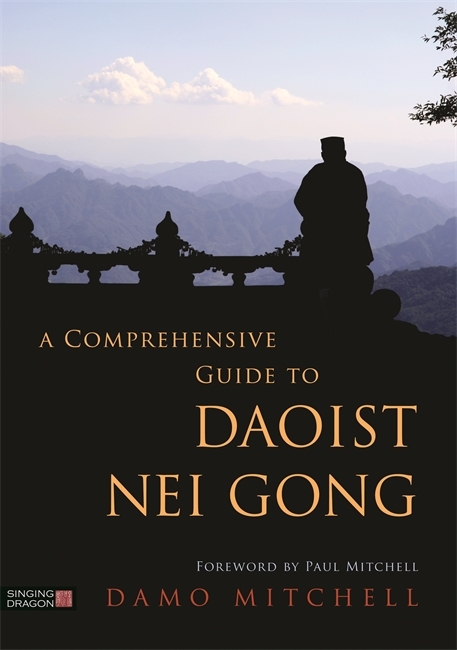
Nei Gong is the practice leading to attainment of real internal skill and transformation, and the philosophical art of change that runs through all Daoist practice.
This book provides a unprecedented insight into the entire Nei Gong process, expanding upon the foundations laid in the author's previous widely read book, Daoist Nei Gong, to provide a deeper and more comprehensive understanding of the practice.
Going into unparalleled detail whilst remaining accessible, it explains the philosophy at the heart of Nei Gong , and the steps whereby transformation is achieved. A foundational knowledge of Chinese medicine will help the reader appreciate the explanation more deeply, but is not required for understanding. Essential reading for anyone seriously interested Qi Gong, Chinese martial arts, and the Daoist tradition, the book will also be an invaluable resource for practitioners of Chinese medicine, or advanced meditation.
This book by Damo Mitchell is a solid breakdown and guide to the foundations of this type of neigong practice. I haven't compared it to much other contemporary material published on such subjects in the past 10-15 years, but this guide surprised me with its clear language and attempts at thorough explanation of the context and material itself.
While I don't question Mitchell's experience or skillset and welcome his communication skills, I don't understand why there is no mention anywhere in the book of the lineage or school of what is being shared. As another reviewer mentioned, this book is a foundational primer on the practice of Quanzhen (Complete Reality) Daoist neigong, a school founded in the 12th century with teachings today most widely transmitted by the Longmen (Dragon Gate) lineage. Usually it's not a great sign when a teacher does not make any particular mention of their own principal teacher(s) and lineage. As of this review, Mitchell does not designate a formal lineage of transmission on his personal "about" page on the website for his Lotus Neigong organization. It says he is a full initiate in Longmen pai but he refrains from saying who his teachers are because they wish to avoid attention and are reclusive.
I don't think this material is illegitimate and I don't think Damo is dishonest, and given the trajectory of his training background, the author might have ended up learning in unique circumstances. Different lines of Longmen have their own idiosyncratic expressions of formality as well. My teacher is very traditionally formal: students begin neigong training by invitation only, and the material is not casually shared with non-students (nor is this stage the inner door process of full initiation). Other Longmen lines are more open and have a variety of techniques and practices which yield a healthy foundation of practice for lay students (see Wang Liping's books of translated talks, for examples distinct from either Damo Mitchell's or my aforementioned teacher's).
A distinct contrast to my example experience would be the various modern traditional martial arts teachers in China who welcome students from around the world to train with them for a couple of years, giving a license at the end so the overseas student can teach the style or some aspects of it back home (sometimes completely independently, sometimes as a "satellite school"). These kinds of licenses also vary in their significance (and are all very recent developments in an era in which these arts have become very different and very endangered); for obvious reasons many teachers might put together a "package" curriculum to make publicly accessible, while only a small number of select long-term students are privately trained in the full lineage transmission.
At the same time, hiding the source has historically in martial arts transmission to the west been a business calculation, keeping international students from going directly to the source of the material (and the inverse). I'm not saying that's what is going on here! But all these scenarios previously have and still do exist. There's also the usual questions with modern frameworks for classical arts: what lineage does a serious student in Mitchell's system trace themselves? Will they become an inner door student of Longmen as well? It's possible the school is just beginning, I'm not doubting these things, I'm just curious.
For those who are trying to begin this type of neigong training based upon the book material alone, or perhaps are trying to expand/supplement their background of internal/martial training, keep the practice in context as incomplete without the guidance of a teacher who can give feedback. For instance, certain portions of the author's overall curriculum for new students are particular to his own experiences and training background and martial arts styles, which differs subtly from some curriculums and martial frameworks. The way Mitchell does and teaches the structure when standing is articulating subtly the flavor of energy/power (jin) that eventually forms the root and movement of his martial arts practice. The power exertion and structure and rooting that he uses is similar to the kind used in Chen styles of Taijiquan, or perhaps some systems like Bajiquan or Pigguaquan, as opposed to Yang Taijiquan or Baguazhang. I mention this not because Mitchell is wrong in any way, but because the Chen paradigm of jin does not contain the Yang paradigm of jin within it, and vice versa. When certain famous gongfu teachers teach Yang style Taijiquan as just another additional curriculum of stuff next to their sets of Chen, Shaolin, White Crane, Mantis, Wing Chun, etc, they are not actually teaching Yang Taijiquan as their jin and structure is that of another art.
The last paragraph gets a bit beyond the scope of what is important here for most people though. And Damo's ethical and preferential guidelines are healthy perspectives and he recommends new students use proportional kinds of exercises and practices from their own background and system should that integrate better overall. But he offers his own honed curriculum if new students have not already developed a primary foundation, or perhaps are trying to start fresh. And I do think if you happen to be approaching this material from or alongside a Chen Taiji system doing stuff like Silk Reeling (or a Yang line in the approach of Damo's style), his preparatory supplementary exercises in his other books will mesh quite effectively into a full foundational curriculum.
Damo Mitchell has dedicated his whole life to Daoism and the Daoist arts. Not many of us can say that we've been studying the internal arts since four years old, but Damo can. With over thirty years of experience, he is an authority on Daoism and especially the path of Nei Gong. In A Comprehensive Guide to Daoist Nei Gong Mitchell flexes his knowledge like no one else on the topic has ever before. The book will leave you with a comprehensive view of the Daoist tradition, Qi Gong, Chinese medicine, and martial arts. In this book Damo Mitchell unleashes his spirit for all of us to learn and grow from on the sacred path of Dao.
I started this book with a lot of questions in mind (especially because my Teacher refused to explain anything, for i am still an "outer door" student so to speak). Damo was capable to give me the answers i seek and more. His explanations are systematic and detailed, which revealed how experienced and deep he is into this art. The author really possessed a rare gift of synthesizing his own studies and experiences, and to break it down into a clear exposition-- a task that will not be easy, especially in spiritual arts!
A lot of respects for Damo. This book helped me a lot.
THE LOWER DAN TIAN IS THE DRIVEING FORCE FOR QI THROUGHOUT THE REST OF YOUR BODY.
Wei wu wei can be translated into doing, not doing.
Sinking your mass actively means to drop your weight down to the ground through your body so that it has the effect of stretching all of the connective tissues on its way past.
Daosim has a close connection to the development of various medical practices such as acupuncture and herbal remedies.
Human mind lies at the heart of all internal sickness.
Fascia is referred to as Huang.
Tension is what prevents you from relaxing your mass to the floor.
The knees are bent so that our centre of gravity can drop down from the upper chest to the lower abdomen.
In standing postures, sit dont squat.
With 'closing' the centre of gravity and lower dan tian are in the same place. With 'opening' the centre of gravity is above the lower dan tian = Qi Gong.
Quality type precepts - cultivate humility - cultivate humour - live with simplicity - adhere to and develop wu wei - cultivate compassionate qualities
What we have with an addiction is an ingrained habit; often combined with a strong base desire.
Jing (essence) is experienced as heat or a warm fluid that feels as though its moving. Qi (energy) is experienced as movement, vibration or sensory changes. Shen (spirit) is experienced as light or colour.
By setting your awareness in your lower dan tian you are adjusting the frequency of your awarenss so that it can connect with your Qi.
(the book got difficult to follow/too complex from page 300 and I stopped reading around page 400)
This entire review has been hidden because of spoilers.
I got this book as a gift from my student. Damo's books are all very good, but this one is by far his best as he manages to demystify the mysteries of Daoist Neigong far beyond what any other english language book has managed to do so far (imho). I've read many of them from big names such as Yang Jwing Ming, Mantak Chia etc.
I like the fact that he has shared without holding back in this book (as many masters of the daoist internal arts tend to do).
As much as I think that he has covered most major avenues of approach towards daoist neigong, I got the distinct feeling that due to the way he has organized the material, there seems to be an expectation of linear progression in the material (if one were to follow the methodology/sequence outlined in the book). In my experience, the reality of practice and experiences are far from linear - rather the follow the same pattern as everything else in nature -- spiraling, overlapping in many places.
I think the book is excellent to get an intellectual grasp of Daoist neigong and the practices thereof, but a sincere student would be best served learning from a master in person.
Mitchell's Nei Gong, which really is Quanzhen Nei Gong, delivers in its practical applications, with no visualizations and imagining anything. That makes a big difference when actually trying to master these methods. Highly recommended for the serious student, but if you start the Nei Gong process, be prepared to practice more then you would think. It is also a very good idea to find a teacher.