

What do you think?

The Encyclopedia of Misinformation: A Compendium of Imitations, Spoofs, Delusions, Simulations, Counterfeits, Impostors, Illusions, Confabulations, ... ... ... Conspiracies & Miscellaneous Fakery
This edition is no longer available.
The Encyclopedia of Fakery is a compendium of misinformation, deception, and self-delusion throughout history. The lens is wide—fakery is examined in the context of science and advertising, humor and law, sports and video games. Entries span eclectic topics: Artificial Intelligence, Auto-Tune, Chilean Sea Bass, Clickbait, Cognitive Dissonance, Cryptids, False Flag Operations, Gaslighting, Gerrymandering, Kayfabe, Laugh Tracks, Milli Vanilli, P.T. Barnum, Photoshopping, Potemkin Villages, Rachel Dolezal, Strategery, Truthiness, and the Uncanny Valley. From A to Z, this is the definitive guide to how we are tricked, and how we trick ourselves.
The Encyclopedia of Fakery is a compendium of misinformation, deception, and self-delusion throughout history. The lens is wide—fakery is examined in the context of science and advertising, humor and law, sports and video games. Entries span eclectic topics: Artificial Intelligence, Auto-Tune, Chilean Sea Bass, Clickbait, Cognitive Dissonance, Cryptids, False Flag Operations, Gaslighting, Gerrymandering, Kayfabe, Laugh Tracks, Milli Vanilli, P.T. Barnum, Photoshopping, Potemkin Villages, Rachel Dolezal, Strategery, Truthiness, and the Uncanny Valley. From A to Z, this is the definitive guide to how we are tricked, and how we trick ourselves.
260 pages, Kindle Edition
Published March 27, 2018
Ratings & Reviews
Friends & Following
Create a free account to discover what your friends think of this book!
Community Reviews
Displaying 1 - 22 of 22 reviews
![Profile Image for s.penkevich [hiatus-will return-miss you all].](https://i.gr-assets.com/images/S/compressed.photo.goodreads.com/users/1735525095i/6431467._UX200_CR0,11,200,200_.jpg)
January 13, 2025
A book of the sort of weird stories that are fun to bring up at parties. Or the stories your weird uncle brings up at parties because he believes them.
Do you have a favorite wild conspiracy theory? Personally I get laughs from the theories that the Earth was sucked into a black hole created by the Large Hadron Collider in 2012 or that Avril Lavigne is actually dead or the Avril Lavigne replacement theory revving the old “Paul is dead” conspiracy theory from the Beatles era. That said, it’s actually rather sad that people have to spend serious time discrediting such theories while others have discovered that you can easily market false information to manipulate the masses and its no longer something fairly silly and innocuous like aliens built the pyramids but dangerous and ordinary people getting death threats over absurd ideas that make conspiracy theorists of old sound reasonable by comparison. Many have warned we are living in a post-truth society where objective facts are less influential in shaping public opinion than marketable appeals to emotion and personal belief and the internet is a breeding ground for conspiracy theories, fake quotes, hoaxes, mis/disinformation and more. Approaching a serious topic in a fun yet informative way is Rex Sorgatz’s The Encyclopedia of Misinformation cataloguing a human history of false history, pranks, conspiracies and the people who fall for them, create them or perpetuate them. With a rather impressive scope going all the way back to Ancient Greece for some entries—though mostly focusing on recent history—these alphabetically arranged encyclopedia-style entries are a fascinating read. We have hoaxes like the Bonsai Kitten or the Cardiff Giant, or the Piltdown Man; prankster groups like Operation Mindfuck spreading absurd conspiracy theories; The War of the Worlds broadcast; internet gags and a whole slew of bad information purported as truth. While there are better books out there on misinformation and how to deal with or identify it, this is a fun compendium that taught me a lot of things and is sure to send you down a rabbit hole of internet searches looking up some of the more wild stories (just check your sources so you don’t end up on a snipe hunt–also an entry in here).
‘Our inherent cognitive biases make us ripe for manipulation and exploitation by those who have an agenda to push, especially if they can discredit all other sources of information.’
Lee McIntyre, Post-Truth
I’m currently on a library committee around ideas of misinformation and was eager to check this book out as part of my learning (and then finding ways to do programming, library blogs and other educational opportunities around misinformation). While books like Foolproof: Why Misinformation Infects Our Minds and How to Build Immunity offer more insight into how misinformation works and books like Attack From Within or On Disinformation: How to Fight for Truth and Protect Democracy get into the legal difficulties around combatting mis/disinformation, this is more of a fun approach that collects wild stories. As a former marketing major that finds marketing to be pretty evil but fascinating, I loved learning about things like the Great Moon Hoax of 1835 where the New York newspaper The Sun published a series of articles about life found on the moon (bisons, unicorns and bat-winged humans) to sell more newspapers.
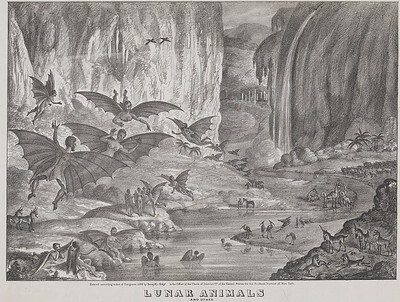
artist rendition of moon life published in The Sun
It was intended as a farce of course, but still, people fell for it. Similarly there is an entry on the
lonelygirl15 youtube series that was passed off as real until people started to find the story too convenient (there are entries for other “found footage” films like the 1980 Italian film Cannibal Holocaust or The Blair Witch Project and how those fooled some audiences).
Theres a lot of fun in here, such as the entry on Mondegreens—commonly misheard lyrics—with a list of common examples from popular music and while it does list a Taylor Swift song its not the one I misheard because for a solid year I thought she was singing “the bakers gonna bake bake bake” instead of “fakers gonna fake” and truthfully, I prefer my version of some happy bakers happily baking through her struggles all c'est la vie about it. Alas.
There are even more jokey examples of things from tv that worked themselves into popular internet lexicon, such as the Chewbacca Defense from an episode of South Park which, as Sorgatz writes, becomes shorthand for ‘a mix of prevaricating filibuster, lunatic troll logic, semantic nitpicking, derailing smoke screens, and vituperative shouting’ as a way to win an argument. This isn’t misinformation, per say, but it is a valuable lesson in how society will choose to declare someone a winner in an argument regardless of validity. Look at how often social media arguments break down into whomever got the best, funny insult in gets applauded and facts become secondary.
It is interesting to think how, like the Chewbacca Defense, little memes and such often become cultural topics or integrated into the cultural lexicon, such as reactionary doomcasting leading to new terms like the Tamagotchi effect to describe the emotional attachment with machines, robots or software agents. In a way, the internet has created its own mythology and folklore. Hear me out now. Folklore is essentially cultural indicators on how a group or society maintains and passes on a shared way of life. The internet and especially internet hoaxes have brought so many things into common knowledge that are cultural artifacts, such as Slenderman or Momo being recognizable figures or internet cryptids not unlike Big Foot or the Loch Ness Monster, and there was even a narrative such as Momo forcing you to complete tasks or die that is something straight out of folklore. So, sure, misinformation, but it is fascinating to consider.
The Encyclopedia of Misinformation takes a rather troublesome topic and manages to make it as fun as it is informative. Definitely worth picking through, there is lots to learn!
3.5/5
Do you have a favorite wild conspiracy theory? Personally I get laughs from the theories that the Earth was sucked into a black hole created by the Large Hadron Collider in 2012 or that Avril Lavigne is actually dead or the Avril Lavigne replacement theory revving the old “Paul is dead” conspiracy theory from the Beatles era. That said, it’s actually rather sad that people have to spend serious time discrediting such theories while others have discovered that you can easily market false information to manipulate the masses and its no longer something fairly silly and innocuous like aliens built the pyramids but dangerous and ordinary people getting death threats over absurd ideas that make conspiracy theorists of old sound reasonable by comparison. Many have warned we are living in a post-truth society where objective facts are less influential in shaping public opinion than marketable appeals to emotion and personal belief and the internet is a breeding ground for conspiracy theories, fake quotes, hoaxes, mis/disinformation and more. Approaching a serious topic in a fun yet informative way is Rex Sorgatz’s The Encyclopedia of Misinformation cataloguing a human history of false history, pranks, conspiracies and the people who fall for them, create them or perpetuate them. With a rather impressive scope going all the way back to Ancient Greece for some entries—though mostly focusing on recent history—these alphabetically arranged encyclopedia-style entries are a fascinating read. We have hoaxes like the Bonsai Kitten or the Cardiff Giant, or the Piltdown Man; prankster groups like Operation Mindfuck spreading absurd conspiracy theories; The War of the Worlds broadcast; internet gags and a whole slew of bad information purported as truth. While there are better books out there on misinformation and how to deal with or identify it, this is a fun compendium that taught me a lot of things and is sure to send you down a rabbit hole of internet searches looking up some of the more wild stories (just check your sources so you don’t end up on a snipe hunt–also an entry in here).
‘Our inherent cognitive biases make us ripe for manipulation and exploitation by those who have an agenda to push, especially if they can discredit all other sources of information.’
Lee McIntyre, Post-Truth
I’m currently on a library committee around ideas of misinformation and was eager to check this book out as part of my learning (and then finding ways to do programming, library blogs and other educational opportunities around misinformation). While books like Foolproof: Why Misinformation Infects Our Minds and How to Build Immunity offer more insight into how misinformation works and books like Attack From Within or On Disinformation: How to Fight for Truth and Protect Democracy get into the legal difficulties around combatting mis/disinformation, this is more of a fun approach that collects wild stories. As a former marketing major that finds marketing to be pretty evil but fascinating, I loved learning about things like the Great Moon Hoax of 1835 where the New York newspaper The Sun published a series of articles about life found on the moon (bisons, unicorns and bat-winged humans) to sell more newspapers.
artist rendition of moon life published in The Sun
It was intended as a farce of course, but still, people fell for it. Similarly there is an entry on the
lonelygirl15 youtube series that was passed off as real until people started to find the story too convenient (there are entries for other “found footage” films like the 1980 Italian film Cannibal Holocaust or The Blair Witch Project and how those fooled some audiences).
Theres a lot of fun in here, such as the entry on Mondegreens—commonly misheard lyrics—with a list of common examples from popular music and while it does list a Taylor Swift song its not the one I misheard because for a solid year I thought she was singing “the bakers gonna bake bake bake” instead of “fakers gonna fake” and truthfully, I prefer my version of some happy bakers happily baking through her struggles all c'est la vie about it. Alas.
There are even more jokey examples of things from tv that worked themselves into popular internet lexicon, such as the Chewbacca Defense from an episode of South Park which, as Sorgatz writes, becomes shorthand for ‘a mix of prevaricating filibuster, lunatic troll logic, semantic nitpicking, derailing smoke screens, and vituperative shouting’ as a way to win an argument. This isn’t misinformation, per say, but it is a valuable lesson in how society will choose to declare someone a winner in an argument regardless of validity. Look at how often social media arguments break down into whomever got the best, funny insult in gets applauded and facts become secondary.
It is interesting to think how, like the Chewbacca Defense, little memes and such often become cultural topics or integrated into the cultural lexicon, such as reactionary doomcasting leading to new terms like the Tamagotchi effect to describe the emotional attachment with machines, robots or software agents. In a way, the internet has created its own mythology and folklore. Hear me out now. Folklore is essentially cultural indicators on how a group or society maintains and passes on a shared way of life. The internet and especially internet hoaxes have brought so many things into common knowledge that are cultural artifacts, such as Slenderman or Momo being recognizable figures or internet cryptids not unlike Big Foot or the Loch Ness Monster, and there was even a narrative such as Momo forcing you to complete tasks or die that is something straight out of folklore. So, sure, misinformation, but it is fascinating to consider.
The Encyclopedia of Misinformation takes a rather troublesome topic and manages to make it as fun as it is informative. Definitely worth picking through, there is lots to learn!
3.5/5

November 5, 2018
While I have some quibbles with the author's expansive definition of misinformation (e.g. Esperanto may be invented, but it's not fake), nearly every entry is interesting and crisply written. It's a good book for dipping into when you only have a few minutes. As a bonus, it's beautifully designed with a clever cover and fun interior illustrations.

March 7, 2019
I read this book for my research paper, but it's actually really good (and kind of funny)!

May 24, 2018
One of the most interesting books Ive ever read. A whole history of nothingness!

January 10, 2025
I wanted to like this one more... I really did. But while I found it enjoyable, enthralling, entertaining, and educational, I also had a few issues with it.
For the most part, the entries contained in this compendium were pretty fascinating. They weren't always 100% complete, but that's no big deal -- there was enough information included that I could use the topics as jumping-off points for my own further perusal. But in a number of places, the subject matter didn't really rise to the level of "misinformation"; instead, some of the articles were just entertaining trivia.
And for a book that stretches all the way back to classic Greek and Roman times, there was a LOT of stuff that focused on mostly the last 10 years, and it all was pretty clear which side Rex Sorgatz fell on as he told the tales. I mean, I assumed that even though the book was written during Trump's first term, the mere inclusion of the word "misinformation" was a clear signal that The Donald was going to merit a few mentions. But SO MANY mentions, and not all of them were even to do with him -- they were just random references apparently to drive home the fact that a lot of people don't like the way Trump does... well, the way Trump does. And when early on, the author referred to someone getting involved in "icky" conservatism (yes, he used the word "icky," one of the more acceptable of the many four-letter words that were sprinkled throughout the book, I would guess in an effort to seem cool and hip), I knew what I was getting into and kept reading anyway. There was enough other stuff to make it worth the read, anyway.
But there were some pretty glaring errors, too. In the entry about "Mondegreens," he lists a number of misheard or misinterpreted song lyrics as examples. One of the most famous, of course, is the perception that in the song "Blinded by the Light," the lyric "revved up like a deuce" is often mistaken for "wrapped up like a douche." Everyone knows this, and sometimes they even sing the alternate lyrics for fun. However, Sorgatz says this misheard lyric is from Bruce Springsteen, which is NOT correct. Springsteen did write and originally record the song, but it was Manfred Mann's Earth Band's version that contained the misheard lyric -- Springsteen's version says, instead, "cut loose like a deuce," and it's much easier to understand.
Another error that should have been spotted and corrected is referring to a Muppet named "Bart." Nope. There is a Bart Simpson that's an animated character, but the name Sorgatz was looking for is Ernie's pal BERT, not Bart.
But maybe Sorgatz was too busy with his thesaurus to get these things right. His text is so full of 75-cent words that it almost becomes tedious. At one point in a fake interview with Terry Gross of NPR's "Fresh Air" program, Sorgatz actually uses the word "shambolic" twice in as many pages. I'm pretty prone to dropping some fancy words into my own daily language, but I don't think I use "shambolic" twice in a year, let alone in two pages.
And then there's this: As I'm reading this, covering everything from the Trojan Horse to Rasputin's role in the "work of fiction" disclaimer on virtually every movie, I was like, "Who is this guy? Is he a journalist? An expert in spotting fabrications? An academic specializing in random ephemera?" So I look at the author bio, expecting to see some credentials or at least a reasonable CV. I mean, even Stephen King and James Patterson have bios that list some of their books, and those guys are pretty much brand names. And here's what I learned: "Rex Sorgatz is a writer, designer, and technologist based in New York City." I suppose that could be impressive if there were a few more details, but that wording could also appear on the homemade business cards of your third-favorite barista at the Starbucks on the corner.
Anyway, I'm not telling you NOT to read the book. As I said, I walked away with some information I didn't have before. But as a comprehensive encyclopedia of misinformation, I felt like it could use some work.
For the most part, the entries contained in this compendium were pretty fascinating. They weren't always 100% complete, but that's no big deal -- there was enough information included that I could use the topics as jumping-off points for my own further perusal. But in a number of places, the subject matter didn't really rise to the level of "misinformation"; instead, some of the articles were just entertaining trivia.
And for a book that stretches all the way back to classic Greek and Roman times, there was a LOT of stuff that focused on mostly the last 10 years, and it all was pretty clear which side Rex Sorgatz fell on as he told the tales. I mean, I assumed that even though the book was written during Trump's first term, the mere inclusion of the word "misinformation" was a clear signal that The Donald was going to merit a few mentions. But SO MANY mentions, and not all of them were even to do with him -- they were just random references apparently to drive home the fact that a lot of people don't like the way Trump does... well, the way Trump does. And when early on, the author referred to someone getting involved in "icky" conservatism (yes, he used the word "icky," one of the more acceptable of the many four-letter words that were sprinkled throughout the book, I would guess in an effort to seem cool and hip), I knew what I was getting into and kept reading anyway. There was enough other stuff to make it worth the read, anyway.
But there were some pretty glaring errors, too. In the entry about "Mondegreens," he lists a number of misheard or misinterpreted song lyrics as examples. One of the most famous, of course, is the perception that in the song "Blinded by the Light," the lyric "revved up like a deuce" is often mistaken for "wrapped up like a douche." Everyone knows this, and sometimes they even sing the alternate lyrics for fun. However, Sorgatz says this misheard lyric is from Bruce Springsteen, which is NOT correct. Springsteen did write and originally record the song, but it was Manfred Mann's Earth Band's version that contained the misheard lyric -- Springsteen's version says, instead, "cut loose like a deuce," and it's much easier to understand.
Another error that should have been spotted and corrected is referring to a Muppet named "Bart." Nope. There is a Bart Simpson that's an animated character, but the name Sorgatz was looking for is Ernie's pal BERT, not Bart.
But maybe Sorgatz was too busy with his thesaurus to get these things right. His text is so full of 75-cent words that it almost becomes tedious. At one point in a fake interview with Terry Gross of NPR's "Fresh Air" program, Sorgatz actually uses the word "shambolic" twice in as many pages. I'm pretty prone to dropping some fancy words into my own daily language, but I don't think I use "shambolic" twice in a year, let alone in two pages.
And then there's this: As I'm reading this, covering everything from the Trojan Horse to Rasputin's role in the "work of fiction" disclaimer on virtually every movie, I was like, "Who is this guy? Is he a journalist? An expert in spotting fabrications? An academic specializing in random ephemera?" So I look at the author bio, expecting to see some credentials or at least a reasonable CV. I mean, even Stephen King and James Patterson have bios that list some of their books, and those guys are pretty much brand names. And here's what I learned: "Rex Sorgatz is a writer, designer, and technologist based in New York City." I suppose that could be impressive if there were a few more details, but that wording could also appear on the homemade business cards of your third-favorite barista at the Starbucks on the corner.
Anyway, I'm not telling you NOT to read the book. As I said, I walked away with some information I didn't have before. But as a comprehensive encyclopedia of misinformation, I felt like it could use some work.

October 4, 2018
In this very interesting encyclopedia, the book covers various hoaxes and ideas that have existed for years or were recent. Subjects included are lonelygirl15, conspiracy theories as well as some interesting facts such as foods that you think came from one country but were from another entirely different one. The book has some entries that aren't that interesting, as most encyclopedias contain but I appreciated the fresh outlook.
January 11, 2025
As the author says, this is not a book to read page by page, but to dip into and follow the leads. It's original and perceptive, and crucially, passed the teen test with a well-judged entry on the simulation Hatsuni Miku. You know, that woman with the long blue ponytails you keep seeing everywhere....

February 2, 2019
Quite a few books have been published on this and nearby topics recently--I wonder why? /s
I love these kind of books, and this one was exceptional. Kind of glad I read it in 2019, so it wouldn't have to compete with Bunk by Kevin Young for my favorite book of 2018.
I love these kind of books, and this one was exceptional. Kind of glad I read it in 2019, so it wouldn't have to compete with Bunk by Kevin Young for my favorite book of 2018.

December 29, 2021
This was a fun book if a bit weird. With topics ranging from 3D Printing to Cosplay to Joseph McCarthy's List to the Mechanical Turk this is just a big grouping of all sorts of interesting and weird stuff. Sure, I skimmed through a lot, but what I did read was rather interesting.

May 20, 2026
Really fun collection of entries about myth, misunderstandings, mimics, and misinformation of all types. Published in 2018, it was correct in the ending "interview" in stating that it was going to get so much worse...

July 17, 2018
The author says not to read from start to finish, but I did anyway. Very interesting entries, well-written.
July 26, 2018
Such a weird mix of info.

June 27, 2019
Interesting. A random mix of misinformation.

January 9, 2020
Fun. Silly. Something to return to for lols at the coffee table.

April 7, 2021
This book is entertaining and eye-opening. It covers things from benign, to serious, to fascinating.
August 12, 2022
3.5 stars. Would have been four, except that I caught a couple points where things were over simplified to the point of being wrong.
May 21, 2023
Decent book filled with a lot of information, took me a while to finish it though
March 16, 2024
Good book, has misinformation
This entire review has been hidden because of spoilers.

November 1, 2018
On the one hand, I am perhaps the ideal reader for this book. The author certainly has known his smark here, in talking about those who rejoice in the redneck theater of fake wresting [1] or talking about those who hatewatch (or hateread) things knowing they will dislike them just for the point of blasting them. Yet even if I am someone whose writing has touched on many of the subjects dealt with by the author [2], I did not find this book to be as enjoying as I would have hoped. A large part of my dissatisfaction with the book comes with the fact that the author is highly selective about the sort of flimflam and fakery he wants to criticize, and the author assumes that the reader of this book is going to be some sort of atheist hipster who looks down on Republicans, as he has very little nice to say about Sarah Palin or Ronald Reagan or Donald Trump. Considering my own worldview commitments, the author comes off as someone who wants to believe that he is a rational soul but who believes in an awful lot of fakery himself of a left-wing variety.
That isn't to say that the author doesn't deliver at least some of the goods he promises in his long subtitle. This book is an alphabetically organized compendium of a great deal of exaggerations and lies and manipulations and mistaken beliefs that are common in a wide variety of fields. The author shows himself to have an acerbic sense of humor and even as the author is flattering the reader, there is an underlying sense that human beings are subject to deception because in many ways we want to be deceived. We want to believe that we know what others do not, and are inclined to misinform others and accept misinformation of others given our own self-interest. One gets the sense that the author understands himself to be as subject to this universal human tendency as everyone else, but that he appreciates trolling his audience even when it is not obvious that the audience is going to appreciate being trolled by him. I must admit that I did not enjoy the author's ideologically biased trolling, even if it was fun to see him tweak the New York Times a couple of times for their inability to own up to/retract some of their more dubious statements.
Even so, if you are willing to overlook the author's partisan hackery there is a lot of insight that can be gained here. For one, fakery has been around for a long time, and the author's grudging respect for P.T. Barnum and the way he leaned into disputes and doubt about the validity of some of his claims signifies that he is aware both of the long pedigree of various manipulations and misunderstandings, including things like Roman vomitoriums, and the fact that the future is likely to be rich with newspeak and truthiness and extreme doubts on the part of people that evidence is valid. Indeed, the corrosive skepticism of the author suggests that it is a difficult matter to overcome skepticism in a world where everyone's views can be backed up by some sort of research or argumentation and where honest conviction of others of their mistakes is not likely to be an easier matter than it was in the past. There is a lot to laugh about in this book, but a lot that will make one think about oneself and others and about the barriers to understanding truth and acting on it.
[1] See, for example:
https://edgeinducedcohesion.blog/2011...
[2] See, for example:
https://edgeinducedcohesion.blog/2010...
https://edgeinducedcohesion.blog/2013...
https://edgeinducedcohesion.blog/2016...
https://edgeinducedcohesion.blog/2018...
https://edgeinducedcohesion.blog/2018...
https://edgeinducedcohesion.blog/2016...
That isn't to say that the author doesn't deliver at least some of the goods he promises in his long subtitle. This book is an alphabetically organized compendium of a great deal of exaggerations and lies and manipulations and mistaken beliefs that are common in a wide variety of fields. The author shows himself to have an acerbic sense of humor and even as the author is flattering the reader, there is an underlying sense that human beings are subject to deception because in many ways we want to be deceived. We want to believe that we know what others do not, and are inclined to misinform others and accept misinformation of others given our own self-interest. One gets the sense that the author understands himself to be as subject to this universal human tendency as everyone else, but that he appreciates trolling his audience even when it is not obvious that the audience is going to appreciate being trolled by him. I must admit that I did not enjoy the author's ideologically biased trolling, even if it was fun to see him tweak the New York Times a couple of times for their inability to own up to/retract some of their more dubious statements.
Even so, if you are willing to overlook the author's partisan hackery there is a lot of insight that can be gained here. For one, fakery has been around for a long time, and the author's grudging respect for P.T. Barnum and the way he leaned into disputes and doubt about the validity of some of his claims signifies that he is aware both of the long pedigree of various manipulations and misunderstandings, including things like Roman vomitoriums, and the fact that the future is likely to be rich with newspeak and truthiness and extreme doubts on the part of people that evidence is valid. Indeed, the corrosive skepticism of the author suggests that it is a difficult matter to overcome skepticism in a world where everyone's views can be backed up by some sort of research or argumentation and where honest conviction of others of their mistakes is not likely to be an easier matter than it was in the past. There is a lot to laugh about in this book, but a lot that will make one think about oneself and others and about the barriers to understanding truth and acting on it.
[1] See, for example:
https://edgeinducedcohesion.blog/2011...
[2] See, for example:
https://edgeinducedcohesion.blog/2010...
https://edgeinducedcohesion.blog/2013...
https://edgeinducedcohesion.blog/2016...
https://edgeinducedcohesion.blog/2018...
https://edgeinducedcohesion.blog/2018...
https://edgeinducedcohesion.blog/2016...

October 8, 2021
This book has real character, the introduction and side notes are pretty amusing and the content is a very interesting collection of fringe facts. It's a light read and would make a good coffee table book, would definitely recommend

February 4, 2026
fun entries to read while i was in-between books
the illustrations are also super cool !
i wish there was an audiobook
the illustrations are also super cool !
i wish there was an audiobook
January 8, 2021
And Compendium of Overused Words
Interesting, well researched, and cleverly tied together. However, why did his editor not catch the frequent use of singular nouns with plural verbs? The fixation and overuse of certain words over and over became irritating: provenance, portmanteau, and especially TROPE !
Interesting, well researched, and cleverly tied together. However, why did his editor not catch the frequent use of singular nouns with plural verbs? The fixation and overuse of certain words over and over became irritating: provenance, portmanteau, and especially TROPE !
Displaying 1 - 22 of 22 reviews