Jump to ratings and reviews
Rate this book

Шагал

Rate this book
Марк Шагал (1887–1985) е един от най-забележителните художници на 20. век. Той е поет, мечтател, ексцентрична личност. Неговият живот и изкуство изграждат представата за самотен мечтател, за гражданин на света, за странник, зареян в своите видения. Шагал е дълбоко религиозен и пламенно обича родината си, а творчеството му безспорно е най-настойчивият призив за толерантност и уважение към всичко различно в съвременния свят. В картините си той създава един уникален свят, изпълне с патос, поезия, хумор и очарование. Освен живописни платна Шагал твори акварели, графики, скулптури, керамика, мозайки и витражи. Авторите разглеждат житейския и творческия път на художника по периоди в контекста на художествените търсения на времето. Текстът е илюстриран с висококачествени черно-бели и цветни репродукции.

96 pages, Paperback

First published January 1, 1987

16 people are currently reading
933 people want to read

About the author

Ingo F. Walther

133 books51 followers
Ingo F. Walther was born in Berlin in 1940 and studied medieval studies, literature, and art history in Frankfurt am Main and Munich. He has published numerous books on the art of the Middle Ages and of the 19th and 20th centuries.

Ratings & Reviews

What do you think?
Rate this book

Friends & Following

Create a free account to discover what your friends think of this book!

Community Reviews

5 stars
668 (49%)
4 stars
433 (31%)
3 stars
220 (16%)
2 stars
30 (2%)
1 star
11 (<1%)
Displaying 1 - 25 of 25 reviews
Profile Image for Caterina.
260 reviews82 followers
December 14, 2020


Why is there no other artist like Marc Chagall?!

A million stars for the artist and his work, which somehow seems more deeply rooted in the fabric of life, love, heart and soul, than that of many other modern artists — and soars to such heights of imagination, color, composition and fluidity.

4 stars for the generous selection of reasonably high quality color images of paintings*
4 stars for the reader-friendly organization and layout of this Taschen series
3 stars for the text, a basic introduction to Chagall’s life and work

Here are a few quotes and images that have lingered with me …


The people who supported Chagall in his chosen approach, sharing his taste for poetry and likewise questing for the hidden significance of things, were literary people. (p. 22)

Nevertheless, remarkably, ”It is not right to paint pictures with symbols. If a work of art has total authenticity, symbolic meaning will be contained in it of its own accord,” Chagall once said. (p. 65)


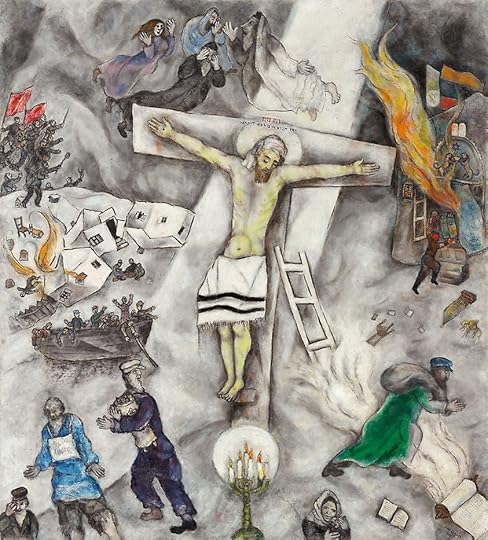
His counterpart to Picasso’s historical painting ‘Guernica’. which speaks of suffering, is the devotional painting ‘White Crucifixion’, which feels its way into that suffering. (p. 65)

In 1933, Chagall had described his aesthetic aims in these words: “If a painter is a Jew and paints life, how is he to keep Jewish elements out of his work! But if he is a good painter, his painting will contain a great deal more. The Jewish content will be there, of course, but his art will aim for universal relevance.” (p. 62)


that first decade in Paris . . .”was the happiest time of my life”

Chagall’s loving couples are one of the most magnetic aspects of his work for me. He was blessed with a long marriage to his first true love Bella Rosenfeld, who died tragically of a virus after they enjoyed nearly thirty years of marriage (how that hits me now, in the time of COVID -- also as my husband and I approach 28 years). This book mentions his falling into depression and inability to work after Bella’s death. It does not mention Chagall’s second love and unmarried domestic partner of seven years, Virginia Haggard McNeil, who bore him a son! Then, in 1952, he was blessed with a second marriage, to Valentina Brodsky, that lasted the rest of his long and productive life.

******************************

In 1937, fifty-nine (!!!) of Chagall’s paintings were confiscated by the Nazis and exhibited as “degenerate art.” This appalling occurrence is mentioned only as a brief chronological note in the book’s appendix, with no further explanation. Wait, what? What happened to those paintings? Were they destroyed? Have they ever been found since 1987 when the book was published? Could they still be found?

*******************************
* With regard to the color reproductions: They were printed in Italy in 1987 when (and where) the color printing of art books was better than it is today. However, a few of the images of earlier paintings appear muddy. In most of the images, however, the colors are subtle and the linen texture visible. But when comparing with images in my other Chagall book (printed in Italy in 1975) the colors are sometimes significantly different and the images crisper and brighter in the older book. Obviously I don’t have any of the originals nearby to compare.


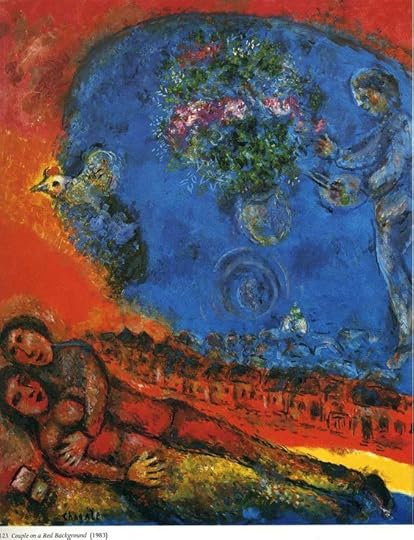
Couple on a Red Background, 1983, a late painting with color grown autonomous (pp. 76, 80) Image source for this review: https://www.wikiart.org/en/marc-chaga...

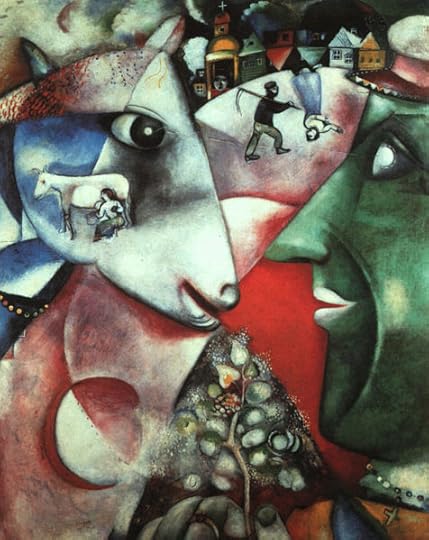
I and the Village, 1911 — one of his earliest masterpieces
Image source for this review, via Wikipedia: By Marc Chagall - http://cgfa.sunsite.dk/chagall/index...., PD-US, https://en.wikipedia.org/w/index.php?...

White Crucifixion, 1938. Image source for this review: https://www.artic.edu/artworks/59426/...

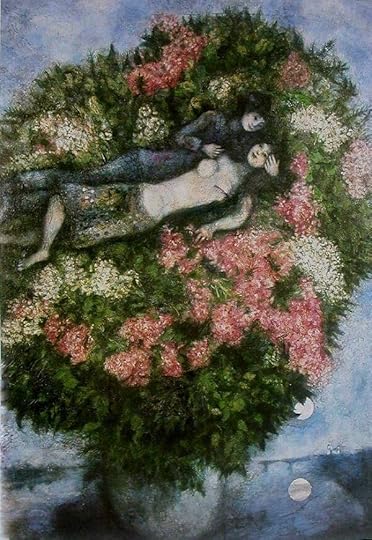
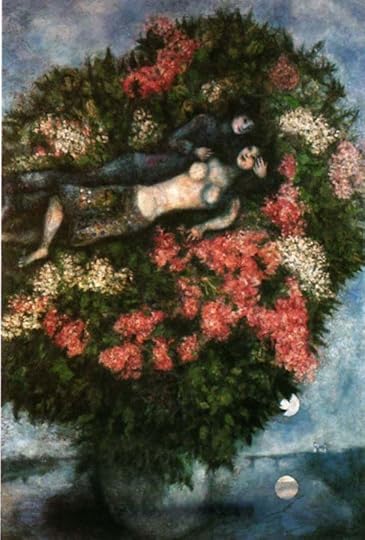
Lovers in the Lilacs, 1930. Image source for this review:
https://www.marcchagall.net/lovers-in...
Profile Image for Moira Macfarlane.
862 reviews103 followers
September 4, 2018
Prachtige afbeeldingen van Chagall in dit boekje, erg mooi samengesteld!

Maar wat vond ik het kunsthistorische gedeelte ver beneden peil. Ik zie de kleine Taschenboeken als kennismaking met een kunstenaar en ik vind dat de tekst daar rekening mee dient te houden. Schets een tijdsbeeld, laat de mens achter zijn kunstwerken zien en als je een vergelijking maakt met een ander werk van een andere kunstenaar plaats dat er dan ook bij of licht het beter toe. Verzand niet in technische beschrijvingen die mensen die niet thuis zijn in de kunst slecht kunnen volgen.

Dan blijf over dat als je het wel kunt volgen het compleet oninteressant wordt beschreven. Los daarvan vond ik het kunst-historisch inhoudelijk ronduit eenzijdig en zéér ter discussie waar de schrijver de kunstwerken interpreteert. Ik weet niet precies op welke grond de schrijver/onderzoeker zijn beweringen maakt, maar ik ben het nog nooit zó totaal oneens geweest met een kunstcriticus als hier. Ik vraag me dan ook af of dat de reden is waarom de iets uitgebreidere uitgave over Chagall van Taschen door een ander iemand is geschreven en samengesteld. Het boekje is echt van een ander kaliber dan de basisboeken van Taschen die ik tot dusver las.
Profile Image for Cynda.
1,435 reviews180 followers
April 29, 2018
I have long been mesmerized by certain aspects of Chagall's work. As a slowly developing colorist, I notice color. I see Chagall's intense forest green often used in faces and wonder at what the forest green is about. About developing a workable color palette, one Chagall liked? About the green often seen in the settlement where Chagall was born: Liozna, near town Vitebsk, in country of Belarus? Picasso used many varieties of green in his cubist portraits, none this forest green hat I can see online and none I remember. The only other time I have seen that forest green is in the illustrations of Joel Stewart that graced Tales of Hans Christian Andersen. So Chagall rather unusual almost unique in use of forest green in faces.

Also as a colorist, I am enchanted by the intensity of colbolt blues, parrot greens,carmine red, Tuscan red. . . .

Possible understanding of the wide range and wide usage of blues. Throat chakra. Chagall struggling to communicate? Communicating through art is both subtle and loud and never exactly the same to two people.

As a yoga practitioner, as pagan/flower child, I understand colors in terms of chakras as well. Possible understanding of greens, reds, roses/pinks. Heart Chakra. Chagall's heart was expansive.

Chagall operated within spiritual/religious constructs. He started out as a provincial boy in an Orthodox Jewish family as a Orthodox Jewish boy. Yet he started to expand his world view by going to study and practice in St Peterburg and in Paris and to practice in US. along the way, Chagall incorporated artistic elements of Roman Catholicism. I am not sure that Judiasm in its most traditional forms is diametrically opposed to Orthodox/Catholic forms. In my mid-sized city, we have a small group of Messianic Christians, first-centurynstyle Christianity, a belief system bridging Judaism and Christianity. Was Chagall interested in first-century-type belief system? Possibly.

As an artist, Chagall studied and incorporated elements of Fauvism, Cubism,and Surrealism. But never can Chagall be defined by these constructs. Based on the (rhetorical) argument presented in this small book, Chagall kept re-using images in different artistic methods as listed above in this paragraph. Maybe Chagall was striving for synthesis. Maybe life is too complicated, changeable, has too much variety and wonders that a syntjesis could not be created of all Chagall knew and experienced.

And I thought I did not have much to say about this petite book.
Profile Image for Troy.
38 reviews
May 19, 2025
Het allermooiste blauw ter wereld
Profile Image for Veronika.
6 reviews6 followers
November 4, 2024
Marc Chagall - A rêverie in colour

« Je m’appelle Marc, j’ai l’intestin très sensible et pas d’argent, mais on dit que j’ai du talent. »
- Marc Chagall – Ma vie
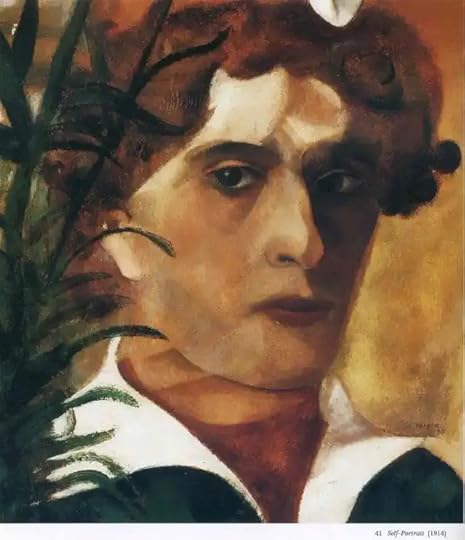

<i>Autoportrait au col blanc, 1914</i>
Autoportrait au col blanc, 1914

Numerous attributes come to my mind each time my eyes brush against a canvas bearing the indelible Chagall signature, the most prominent of which would certainly be tenderness, and rêverie. The timeless charm, a certain childlike naïveté of his depictions combined with the iridescent hue of colours make for a unique experience that touches the soul. Above all that, there is also an element of incomparable seduction and invitation in Chagall, encouraging one in a very intimate engagement with his work through its astounding richness of meaning that offers a plenitude of interpretation. As in a dream one is transported into a world where each colour has its own definite implication and context, where mere shapes tell their own stories, where cultural influence espouses deeper spiritual significance.

Born in 1887 in Vitebsk, the firstborn of nine children, Chagall’s life, like his work, gives the impression of a pilgrim in a constant movement between worlds and between cities, rising from humble origin into a wealthy milieu, traveling the world and yet longing for the warm place of simplicity and familiarity that is so strikingly evident mainly in his touching depiction of village life where family, religion, nature and music are closely interconnected. A child of a devoted Jewish family, his decision to embark on an artist’s path was definitely not without obstacles, but a steady flow of artistic output that followed his starting point at the studio of Yehuda Penn in 1906 shows a man wholeheartedly devoted to a vocation that he with the same characteristic charm reflected also in his paintings made entirely his own.

« Muni de mes vingt-sept roubles, les seuls que j’aie reçus de mon père, dans ma vie (pour mon enseignement artistique), je m’enfuis, toujours rose et frisé, à Petersbourg, suivi de mon camarade. C’était décidé. »
- Marc Chagall – Ma Vie
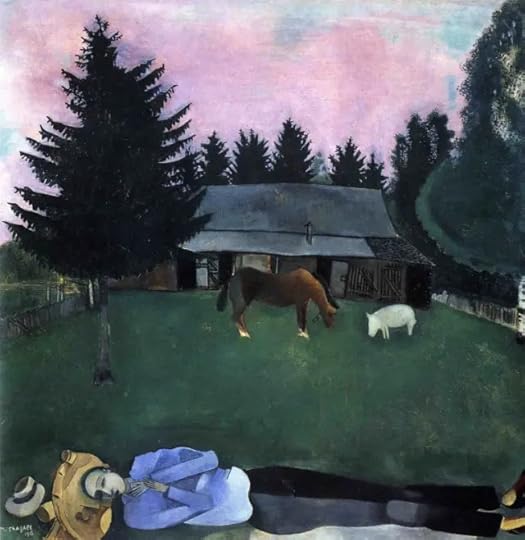

<i>Le Poète allongé, 1915</i>
Le Poète allongé, 1915

As I was able to follow Chagall’s life through his artwork thanks to a beautifully arranged biography of the Taschen painters edition, I felt as though I were entering a world where even time itself pauses to take a deep breath in its wild race towards eternity, where the only thing that matters is to watch with eyes and heart wide open to fully perceive the beauty, the depth of the moment captured with both intensity and gentleness that the painter offers, as if he were giving each of his paintings a life of its own. One of the most suggestive examples of this realm of peaceful quiet and halted time I found in the Le Poète allongé, whose relatively restrained and subdued hues endow the scenery with an air of fragility and profound calmness spreading like a blanket over the poet’s dream, and the painting seems as though knitted from the melody of the famous Schumann Träumerei. I don’t think it would be very far from truth to say that one almost feels invited into the poet’s dream, a dream that remains thus locked in one’s imagination yet becomes an integral part of the whole experience this painting evokes.

« J’ouvrais seulement la fenêtre de ma chambre et l’air bleu, l’amour et les fleurs pénétraient avec elle. Toute vêtue de blanc ou tout en noir, elle survole depuis longtemps à travers mes toiles, guidant mon art. »
-Marc Chagall – Ma vie

chagall5
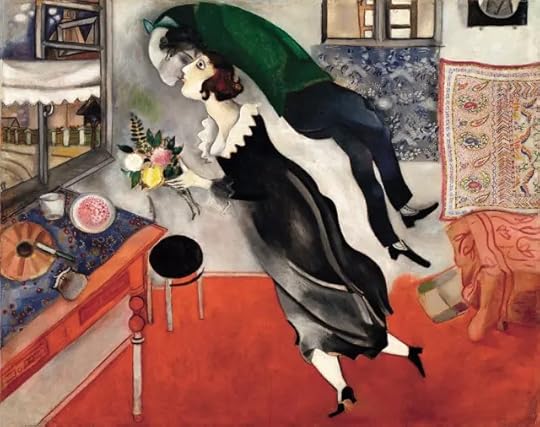
L’Anniversaire, 1915

Another theme pervading Chagall’s work like the scent of cherry blossoms is the one inspired by his great love for his fiancée and later his first spouse Bella Rosenfeld, the daughter of a wealthy jeweler, whom he married in 1915 – an event resulting in L’Anniversaire, a deeply touching testimony to the purity of the couple’s love where the tenderly kissing pair, the cozy room evoking the glow of a newfound happiness, the village behind the window and the little bouquet in Bella’s hands make one the privileged witness of a very personal moment. Accordingly, an apt choice of colours accompanies this scene of marital bliss where the bolder tones of red emanating warmth are finely balanced with the cooling shades of black, grey, white and blue. What fascinates me particularly about this painting is the great emphasis on an exquisite work of detail like that of the embroidered tapestry in the background, and the table with objects of daily usage, bringing to the picture also the pleasurable, earthy presence of the quotidian as a pillar of solidity amidst this fluttering, amorous dream.

« L’essentiel, c’est l’art, la peinture, une peinture différente de celle que tout le monde fait. Mais laquelle ? Dieu, ou je ne sais plus qui, me donnera-t-il la force de pouvoir souffler dans mes toiles mon soupir, soupir de la prière et de la tristesse, la prière du salut, de la renaissance ? »
- Marc Chagall – Ma vie
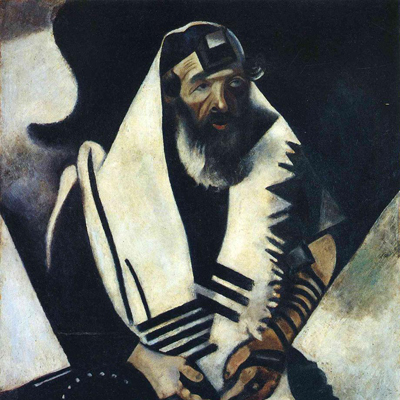
<i>Le Juif en prière, 1914</i>
Le Juif en prière, 1914

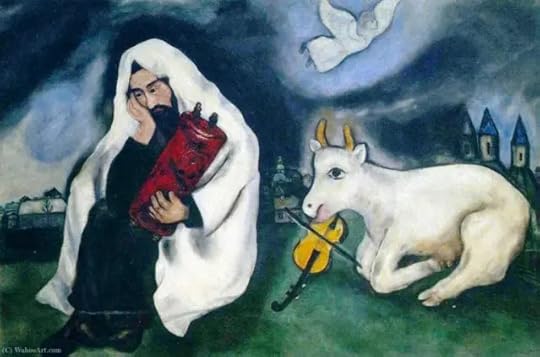
<i>Solitude, 1933</i>
Solitude, 1933

The third major object of the painter’s brush is not merely a religion clothed in Chagall’s unique perception of colour and concept; the spiritual dimension which the painter so generously bestows upon majority of his artworks with Judeo-Christian motives entails also all the tragedy, loneliness and suffering stemming from a deep devotion to the word of God which many a spiritual person encounters in life. In his paintings, the reality of suffering being inseparable from a life of faith comes in repeated patterns, as though the very history of the Israelites and their tribulations across the centuries were the core of Chagall’s principal inspiration. Just like in Le Juif en prière, his painting of a solitary Jew in Solitude holding a roll of Torah firmly in his hands while absorbed in pensive melancholy reveals much of the pain of those loyal to their ethnoreligious background, and also grimly and eerily foretells all the terrors to come during the Second World War.

« Mais mon art, pensais-je, est peut-être un art insensé, un mercure flamboyant, une âme bleue, jaillissant sur mes toiles. »
- Marc Chagall – Ma vie
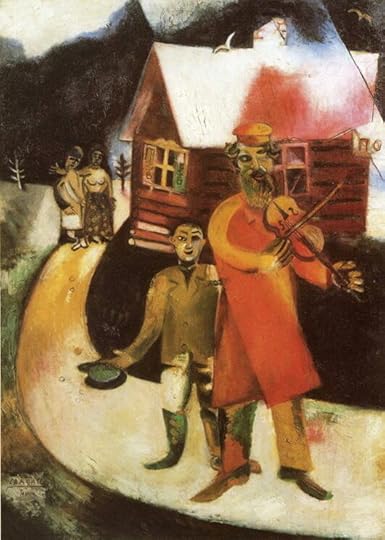
<i>Le Violoniste, 1911 – 1914</i>
Le Violoniste, 1911 – 1914

Chagall’s palette is not only bursting with a whole array of tonal progression, making one highly susceptible to each slight shift of mood in his paintings, but it also offers a unique walk down the memory lane into the innocent days of childhood where the simple joys of everyday existence were a pretext enough for merry celebration, like in Le Violoniste where an old musician with a young beggar boy by his side share the extatic moment of a freshly married couple standing timidly in the background, as though abashed by the very magnitude of their own happiness – not merely a depiction of a Jewish wedding, but also a passionate celebration of life in its unstoppable cycle of constant rebirth, the rebirth of love and hope, underlined by the choice of earthy tones evoking the certitude of repetition.

As it is the case with all great artists, Chagall’s work and life are united in an intimate relationship where the one mirrors the other with much ebullience, sensitivity and deep reflection to a degree when it is no longer possible to retell the painter’s biography without a careful and attentive study of his magnificent, multi-faceted paintings full of playful hints and allusions, chromatic gradation and deep love above all; love towards the world with all its sorrows and towards art itself, for it is art that serves as a saving rope which connects the world of emotion with the world of reality and helps to sustain the latter by expressing, expanding and nurturing, with loving care, the former.

d35a4ed185e48739da877e8cd30a37c8-metropolitan-museum-oil-on-canvas
Les Amoureux dans le lilas, 1930


N.B. Also posted on my blog which I somehow neglected and then abandoned...
Profile Image for El.
1,355 reviews491 followers
April 5, 2008
As a Russian Jew Marc Chagall incorporated mysticism, mythology, Russian and Jewish folktales, dreams, experience (in love and war) and visions in his paintings, making him what is often considered a poet. This glossy Taschen publication retains the vivid colors of many of his paintings and shows all the minute details which made Chagall's art so impressive. The paragraphs about some of the paintings left a little to be desired, skimming over a lot of historical and religious context; though considering the size of the book, it was to be expected. There were so many images I was hoping to see in the book that I have seen in person which were not in this collection, but again it was mostly to be expected. The works which were included were beautiful and showed the tender side of Chagall which I personally find especially endearing. His paintings involving his first wife, Bella, and his later paintings of his second wife, Valentina, are intense and heartbreaking.

For me, looking at one Chagall painting is like reading an entire book. There are symbolic pieces within a painting (none of which, he claimed, were intentional at the time), some of which are hard to find; when I do find an image I had not expected I feel a certain pleasure, like I cracked a secret code. Perhaps it's as simple as I read into it something more than Chagall planned, but as in all great literature, that is part of what makes great art as well.

Favorites (in this collection): Lovers in the Lilacs (1930), The Birthday (1915), The Falling Angel (1923-47), The Concert (1957), The Fall of Icarus (1975).
Profile Image for Ania z Krainy Dwóch Wiązów.
41 reviews1 follower
May 3, 2022
Bardzo ciekawe i dobrze wykonane przestawienie postaci Marca Chagalla. Treści towarzyszą liczne dobrej jakości reprodukcje. Książka w sposób bardzo miły dla oka przekazuje życiorys artysty, lecz niestety czegoś mi zabrakło, może większej ilości anegdot i pewnego rodzaju swobodności języka. Niemniej polecam serdecznie, gdyż zdecydowanie jest to książka warta przeczytania. (Przeczytałam ją, w celu wcześniejszego zapoznania się z portretem psychologicznym i życiowym Chagalla, przed obejrzeniem wystawy jego kilku dzieł w MNW w Warszawie i była to bardzo dobra decyzja:))
Profile Image for Bernie.
103 reviews
February 1, 2017
It is a nice introduction to the artist and the illustrations are of good quality. But I don't feel the best of Chagall's paintings were shown in this book. I have often read Taschen books on other artists and felt I got to know a little about the person behind the paintings, but not in this case. Yes, it does give facts about Marc's life but I don't feel I found out much about the type of man he was compared to other publications by Taschen.
Profile Image for Lee Kofman.
Author 11 books135 followers
June 19, 2016
Reading this book was a joy, just another way of indulging my interest in Chagall. it’s not too much of an art criticism book, more a biographical overview. I’d have loved more discussion of individual artworks and of the painting techniques. But nevertheless I enjoyed the main essay for its information and readability, and the choice of illustrations.
Profile Image for Jane.
884 reviews
April 15, 2018
I found this a bit of a challenge to engage with. I wanted to find out more about Marc Chagall for a couple of reasons - firstly a friend had mentioned his style to me a year or so ago, and secondly because I’m seeing “The flying lovers of Vitebsk” as part of Brighton Festival and that is about Marc and Bella.

After being unsure how to approach this book - the pictures and the text don’t always completely align - I decided to read the words first, and look at the pictures when they were referenced in the text.

I then looked at the chronology at the back and looked at the referenced pictures again.

And finally I looked at all the pictures, and read the quotes in the side parts of the book.

My three favourite pictures in this book are, in the order they appear in the book, The Cattle Dealer, The Birthday, and Lovers in the Lilacs.

I find some of the work quite challenging and confusing with all the various layers of imagery. I find that I like art that I can rest in, that bring a sense of peace. Or art that tells a story. I saw Marc Chagal’s stained glass window at Chichester Cathedral on Thursday - a glorious, rich red - and the timing of experiencing that fits in well with the reading of this book. I’d be interested in seeing some more of his work in “the flesh” and to experience that in a different setting.
Profile Image for Julio The Fox.
1,715 reviews117 followers
February 7, 2023
I'm going to tell you a story that will make you believe in destiny. A young starving artist living in a land that is both foreign and hostile to him, and vice versa, submits his drawings to the Fine Arts Academy in his homeland and is stunningly turned down for application. He believes himself a genius, so the fault must lie with the Academy, which failed to appreciate his enormous talent. He vows to prove it wrong by changing the world to fit his aesthetic taste, and that means blowing up all notions of acceptable art, aesthetics and ethics. You know the artist, his fate, and the impact he had on the world---Marc Chagall. (If you thought I was writing about Adolf Hitler, you are also correct. Curiously, Chagall was two years younger than Hitler. Could The Fuhrer have lived until 1985?) Chagall gave the world blue cows and peasants flying off the earth. His monument, however, is the painted ceiling of the Israeli Knesset Building in Jerusalem. This richly illustrated introduction to Chagall, from the small village of Vibetsk in the Russian Pale, or modern-day Belarus, to Paris and finally Jerusalem demonstrates both his great talent and limitations. Chagall ranks below contemporaries such as Picasso, Braque and Dali precisely because he turned the objects of the world upside down without blowing them up, in an artistic sense, first. You admire the tone with which he paints, of course, but where's the Picasso's bloody bull or Dali's burning giraffe? Still, a fine tribute to a versatile man, rooted and unrooted in the Russian soil and the Talmudic tradition.
36 reviews6 followers
April 2, 2019
I love poetry and I love Marc Chagall. There's something piquant and adorable about him. His art is a fable; it reminds me of Cherries in the Snow or the Adante stories of Marly Youmans. It hits my spot which is very particular and always hungry. Like the mad play of children it is beyond thought and beyond feeling and belongs to a certain fugue state that is intensely sweet - as if heaven touches earth.
Profile Image for Eric.
178 reviews2 followers
March 12, 2021
Marc Chagall’s cultural and religious subject matter, juxtaposition of motifs and bold use of color make him one of the most iconic painters of the 20th century. In about 100 pages, this book does a nice job presenting his work, a surprising amount of which is in private collections, and his life. I enjoyed reading the Chagall quotes in the page margins. The quality of painting reproductions, my top criterion in deciding to buy an art book, is high: images are large and the colors are vibrant. I would have liked to see more images of his stained glass.
Profile Image for Patricia Boksa.
245 reviews2 followers
August 16, 2020
Many lovely colored pictures, which were a delight. The text was good to medium. It did give insight into Chagall's life and evolution as a painter, although I've read more exciting and informative texts about painters before. Have to give it 4 stars for the lovely reproductions.
Profile Image for Piet.
595 reviews1 follower
June 12, 2025
Zoals we van Ingo Walther gewend zijn beschrijft hij in een heldere stijl, zonder opsmuk of jargon, de werken van een schilder die hij bewondert. De biografische details zijn summier maar voldoende.
Chagall is de dichter onder de schilders.
Profile Image for Parker.
126 reviews
January 29, 2017
I enjoy look at Chagall's work on a daily basis. I have a particular fondness for his painting called "The Artist and His Wife." Unfortunately, this picture is not in the book. However, looking at this picture made me wonder: Why does he always paint chickens into his art? That's why I picked up this book. Apparently, many artists like to substitute humans for animals. Other than that I'm still not clear on his thing for chickens. Or cows for that matter. This book is a good starter for anyone who is newly learning about or liking Chagall's art. However, after this book I think I'm going to look for a book that shows more of his art. Some of my favourite pieces were missing from this book.
Profile Image for Sarah .
184 reviews4 followers
May 21, 2015
I can't score this book on the fabulous paintings ,as those are the artists creations not the authors. What remains therefore is the text, the story of a life told in painting, a rich and fascinating life, which the writer has managed to make into a dull read.
There was a good balance of informing the reader about the meaning and symbolism in Chagall's work, and his technique, yet even that was hampered by the text not being placed on the same page as the painting being discussed.
Ok as a coffee table picture book only.
Profile Image for Suzanne.
140 reviews16 followers
March 18, 2010
This book made me appreciate Chagall even more than I previously did. It also made me realize that you cannot just glance at a Chagall but you need to really pay attention. There is so much there, so much visual information to feed the painting.
Profile Image for Yoana.
434 reviews15 followers
March 4, 2015
I thought the text was a bit scattered, the methodology behind the analysis of the paintings was inconsistent, and the argumentation rather thin. Gorgeous reproductions though, obviously.
Profile Image for Karena.
265 reviews45 followers
July 2, 2015
Browsed through. Simple enough.
Displaying 1 - 25 of 25 reviews

Can't find what you're looking for?

Get help and learn more about the design.