What do you think?
Rate this book


98 pages, Kindle Edition
First published January 1, 1990
...their whole life spent admiring themselves
For their own long-suffering.
Licking their wounds
And flashing them around like decorations.
I hate it, I always hated it, and I am
A part of it myself.
.
.
And a part of you,
For my part is the chorus, and the chorus
Is more or less a borderline between
The you and the me and the it of it
.
.
Between
The gods' and human beings' sense of things.
.
.
And that's the borderline that poetry
Operates on too, always in between
What you would like to happen and what will --
Whether you like it or not.
Of course. Of course. What else could you expect?
The gods do grant immunity, you see,
To everybody except the true and the just.
The more of a plague you are, and the crueller,
The better your chances of being turned away
From the doors of death. Whose side are gods on?
What are human beings to make of them?
How am I to keep on praising gods
If they keep disappointing me, and never
Match the good on my side with their good?
History says, Don't hope
On this side of the grave.
But then, once in a lifetime
The longed-for tidal wave
Of justice can rise up,
And hope and history rhyme.
.
.
So hope for a great sea-change
On the far side of revenge.
Believe that a further shore
Is reachable from here.
Believe in miracles
And cures and healing wells.
Now it's high watermark
And floodtide in the heart
And time to go
The sea-nymphs in the spray
Will be the chorus now
What's left to say?
.
.
Suspect too much sweet talk
But never close your mind,
It was a fortunate wind
That blew me here. I leave
Half-ready to believe
That a crippled trust might walk
.
.
And the half-true rhyme is love.
First, some necessary back-story. Philoctetes, a celebrated archer, in possession of the bow and arrows presented to him by Herakles, sets off for the Trojan War. But this has angered Hera who causes him to be bitten on the ankle by a snake. The wound festers, and the smell and the archer's cries of agony are so disturbing that Odysseus abandons him on the island of Lemnos, and goes to war without him. Now nine years have passed and the Greeks have still not captured Troy. They hear a prophecy that Troy will not fall until Philoctetes rejoins the Greek army with his invincible bow. So Odysseus sets out to recruit him. But because Philoctetes hates him for his former betrayal, he cannot intervene directly. In the first scene, therefore, he orders the young Neoptolemus, Achilles' son, to befriend the wounded man by telling him lies.
Philoctetes on Lemnos, by James Barry, 1770
So the trick you’re going to have to turn is this:This is Odysseus in the Heaney version, which sounds almost colloquial. I suspect that Heaney put in the mid-line breaks to increase the off-hand quality of Odysseus' scheming; there is no equivalent in the Greek. Certainly, it is far from the heroic speech of most Greek Tragedies—but then Odysseus the wily deceiver is no tragic hero either. Heaney takes it farther, but both Freeman and McNamee do something similar. The tone is important as a moral baseline, for this is essentially a play about morality and honor. Neoptolemus reluctantly accepts the order, meets Philoctetes, and gains the sick man's trust. The play quickly adds further layers of deception, but in the end Neoptolemus revolts, determined to do what he knows to be right, regardless of his orders and the fate of Troy. It is a play with little action, even offstage, but huge moral and emotional shifts in the intimate space between the characters. Though classified as a tragedy because it deals with epic events and personal suffering, it ends with a deus-ex-machina appearance by Herakles himself, giving it a positive, uplifting ending.
Sweet talk him and relieve him
Of a bow and arrows that are actually miraculous.
But, of course, son, I know what you are like.
I know all this goes against the grain
And you hate it. You’re a very honest lad.
But, all the same, even you have to enjoy
Coming out ahead.
Do it my way, this once.
All right, you’ll be ashamed
but that won’t last.
And once you’re over it,
you’ll have the whole rest of your life
To be good and true and incorruptible.
So what of Heaney's "version"? As we have seen, he translates most of the action with the no-nonsense everyday diction that has become the hallmark of his translations; my first reaction to his Beowulf, for example, was amazement at how well the poet conceals his poetry. So here is Philoctetes, thinking that Neoptolemus is leaving Troy for good, begging him to take him home:
A scene from the play by François-Xavier Fabre, 1800
You could do it all in a day.I quote this passage also to call attention to an Irish lilt that comes through the text at times, most notably here at "and me not fit to move hardly." Heaney has written before of hearing familiar Irish voices as he writes. I imagine that this sense was intensified with the obvious reflection of Troy in the long-festering Troubles in Northern Ireland. But this is not a theme that Heaney hammers at all hard. This is not a pièce-à-clef in which one character represents one side of the Irish struggle and someone else the other, although Odysseus has the forked tongue of all too many politicians. The parallels with Mandela are stronger, in that Philoctetes too comes out of his island prison to work for the country that had rejected him. But Heaney does not have to belabor that; it is already there in the text.
One single day. You can stow me anywhere.
The hold. The stern. Up under the prow.
Wherever I’m the least bother to the men.
Come on now, son. It’s in you to do this.
You’re not going to leave a wounded man behind.
I’m on my knees to you, look, and me not fit
To move hardly. I’m lamed for life. I’m done.
Philoctetes.These first lines of Heaney's play, and the two dozen that follow, are not in the Sophocles at all. For where the poet has felt most free to reshape the original and build on it has been in the Choruses, ordinary people, yearning for normality but tainted with extremism. This new opening works perfectly for the play, which might equally well have begun with such a chorus. But anyone who grew up with first-hand knowledge of Ulster Orangemen and Irish Republicans, as I did, will recognize the truth of that self-regard that flashes ancient wounds around like decorations. A plague on both extremist houses!
Hercules.
Odysseus.
Heroes. Victims. Gods and human beings.
All throwing shapes, every one of them
Convinced he’s in the right, all of them glad
To repeat themselves and their every last mistake,
No matter what.
People so deep into
Their own self-pity, self-pity buoys them up.
People so staunch and true, they’re fixated,
Shining with self-regard like polished stones.
And their whole life spent admiring themselves
For their own long-suffering.
Licking their wounds
And flashing them around like decorations.
I hate it, I always hated it, and I am
A part of it myself.
All through the play, the most poetic writing is reserved for the Chorus. Heaney does not add any more separate scenes, so far as I can see, but he can radically transform the original material. The most striking example of this is in the deus-ex-machina arrival of Herakles. Here he is in the Kathleen Freeman translation: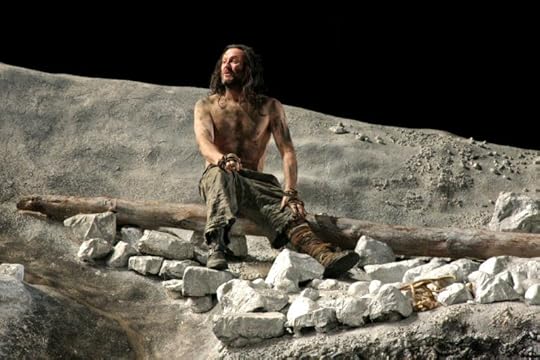
A production of Heaney's play in Seattle
Not yet, my Philoctetes.With a certain amount of theatrical magic, it could be effective enough. Heaney also calls for special effects: An air of danger, settling into a kind of threatened, pre-thunder stillness. Darker stage, a kind of purpled twilight. But now it is not some god, but the poet himself, speaking through ordinary people like himself and most of his countrymen. It is a text that leaps forward into the twentieth century, whether to South Africa or Northern Ireland. It is a text that has become famous, quoted for example by President Bill Clinton on his 1995 visit to Derry, where the bloodshed all began. And it is a text where the poet has moved from blank verse into rhyme. Here are the first three stanzas:
First listen to me.
You hear the voice,
You see the face, of Heracles.
My care for you has broght me down from Heaven
To reveal the will of God to you
And stay you from your present journey.
Human beings suffer,The final, and perhaps the most important, thing that Heaney has done in his adaptation of Sophocles is give the play a new title. It is no longer some suffering figure marooned on his volcanic island; no longer just a neutral name, but the hint of a something positive, a hoped-for outcome at a place we never see, The Cure at Troy. But Heaney is no sappy optimist; he knows that reconciliation requires work. He expands the final chorus from three lines into twelve. Half-hopeful, yes, but laced with caution:
They torture one another,
They get hurt and get hard.
No poem or play or song
Can fully right a wrong
Inflicted and endured.
The innocent in gaols
Beat on their bars together.
A hunger-striker’s father
Stands in the graveyard dumb.
The police widow in veils
Faints at the funeral home.
History says, Don’t hope
On this side of the grave.
But then, once in a lifetime
The longed-for tidal wave
Of justice can rise up,
And hope and history rhyme.
What’s left to say?
Suspect too much sweet talk
But never close your mind.
It was a fortunate wind
That blew me here. I leave
Half-ready to believe
That a crippled trust might walk
And the half-true rhyme is love.