As a kid in the 1970s and '80s, Carina Chocano was confused by the mixed messages all around her; messages that told her who she could be—and who she couldn’t. Dutifully absorbing all the conflicting information the culture has to offer on how to be a woman, Chocano grappled with sexed-up sidekicks, princesses waiting to be saved, and morally infallible angels who seemed to have no opinions of their own. She learned that "the girl" is not a person, but a man's idea of what a woman should be—she’s whatever the hero needs her to be in order to become himself. It wasn't until she spent five years as a movie critic and was laid off just after her daughter was born that she really came to understand how the stories the culture tells us about what it means to be female limit our lives and shape our destinies. She resolved to rewrite her own story.
In You Play the Girl, Chocano blends formative personal stories with insightful and emotionally powerful analysis. Moving from Bugs Bunny to Playboy Bunnies, from Flashdance to "Frozen," from the progressive ’70s through the backlash ’80s, the glib ’90s, and the pornified aughts—and at stops in between—she explains how growing up in the shadow of “the girl” taught her to think about herself and the world and what it means to raise a daughter in the face of these contorted reflections. In the tradition of Roxane Gay, Rebecca Solnit, and Susan Sontag, Chocano brilliantly shows that our identities are more fluid than we think, and certainly more complex than anything we see on any kind of screen.
As research for a novel I'm writing, I'm not only reading detective fiction but branching out to read memoirs by women or Black, Hispanic and Asian writers for looks at how they see, or don't see, themselves reflected in popular culture. While I'd never followed the reviews of Carina Chocano during her tenure at the Los Angeles Times from 2003-2008, like Manohla Dargis--whose departure to the New York Times slid Chocano over from TV to film--Chocano was a trustworthy voice from my generation, thoughtful, analytical and enjoyable to read.
Chocano's memoir You Play the Girl: On Playboy Bunnies, Stepford Wives, Train Wrecks & Other Mixed Messages mixes stories of her childhood (she was born in Sao Paulo, Brazil in 1968 and moved to New Jersey at the age of 5 when her father, a marketing executive for a pharmaceutical company, was transferred to New York), school days, marriage and motherhood (she gave birth to a daughter the year she was laid off from the Times) with criticism of how women are portrayed in a dozen or so pop culture institutions.
Nearly every print publication be it ink or electronic has someone like Chocano reviewing film and TV daily. What makes her book special is how much I realized I had in common with her beyond her impressions of Ghostbusters 2016 (good but not great summer movie). Like me, Chocano grew up in the suburbs in the '70s and '80s, went to school, dated and all the while absorbed many of the same magazines, books and movies that I did. Her book is sharp, creative, passionate and candid. She lays it all out there. She taught me a great deal about how women are misrepresented in film. Even better, she's often very funny.
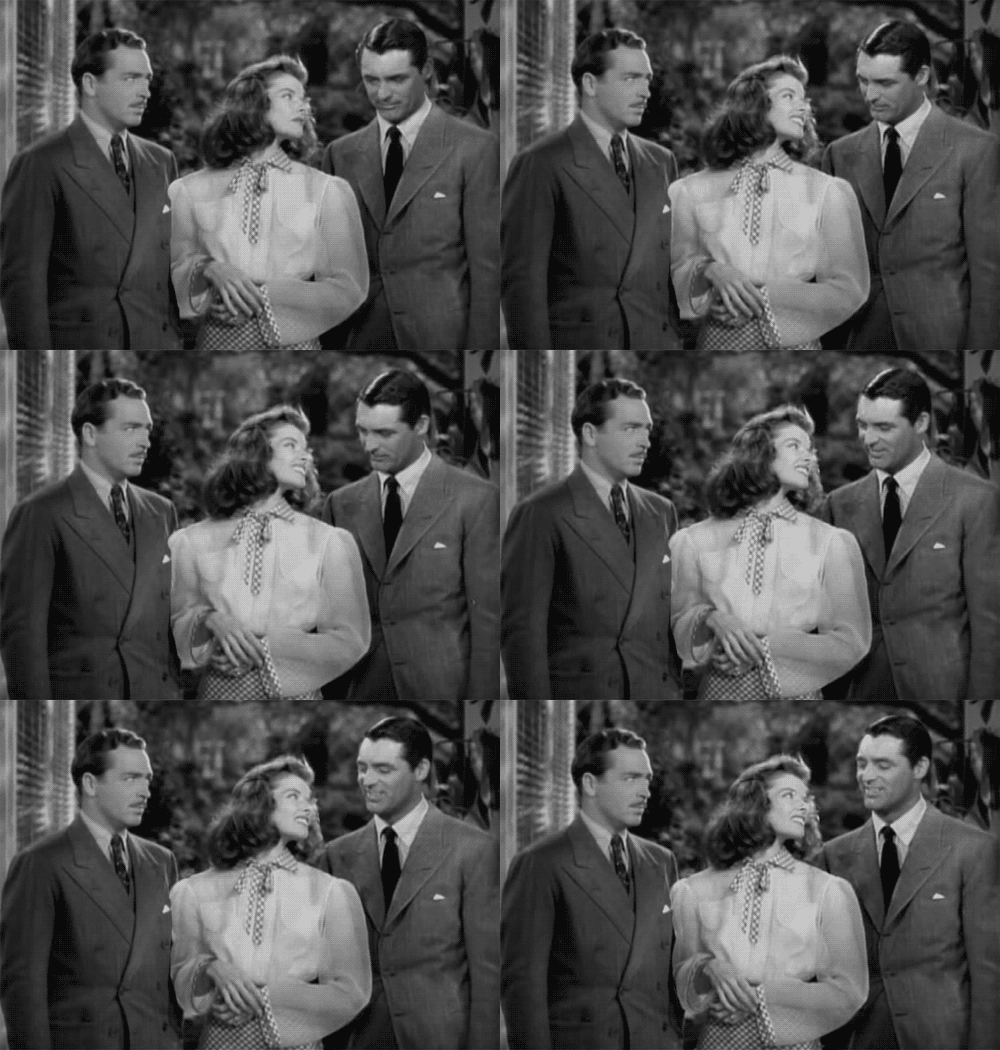
On discovering Katharine Hepburn when she was 12 years old:
Before watching The Philadelphia Story, it had never occurred to me that femininity and femaleness were not one and the same thing. I'd dutifully absorbed the lessons embedded in movies, TV shows, ads, magazines, commercials, and cartoons. The frillier, flightier, wilier, sweeter, gentler, kinder, bitchier, more nurturing, scarier, more insecure, more insincere a character was, the more of a "girl" she was. I'd learned to rank female characters by prettiness. Little girls like to claim their heroines' beauty as their own. It's like picking a team, though it's unclear what's being won. The Philadelphia Story marked the first time I remember encountering the idea that this ephemeral but familiar thing I'd recognized all my life as the feminine ideal might be not just distinct from but also possibly oppressive to women. It came as a shock.
Here was Tracy, a heroine--a bride, no less--and she was different. She was experienced. She had learned from her youthful mistakes and was making deliberate choices. She had agency. She had a horse. (Not that this was germane, but I really loved horses.) She was comfortable in her own skin, secure, and she believed in herself. She radiated confidence of a kind I'd never seen before in a movie heroine. It wasn't the kind of confidence you usually saw in movie stars. It wasn't just that she was secure in her sexiness. On the contrary, she didn't seem to think about her sexiness at all. What made her attractive was that she acted like a person, not a girl. I did think it was strange to be encountering this in 1980, given that The Philadelphia Story was released in 1940.
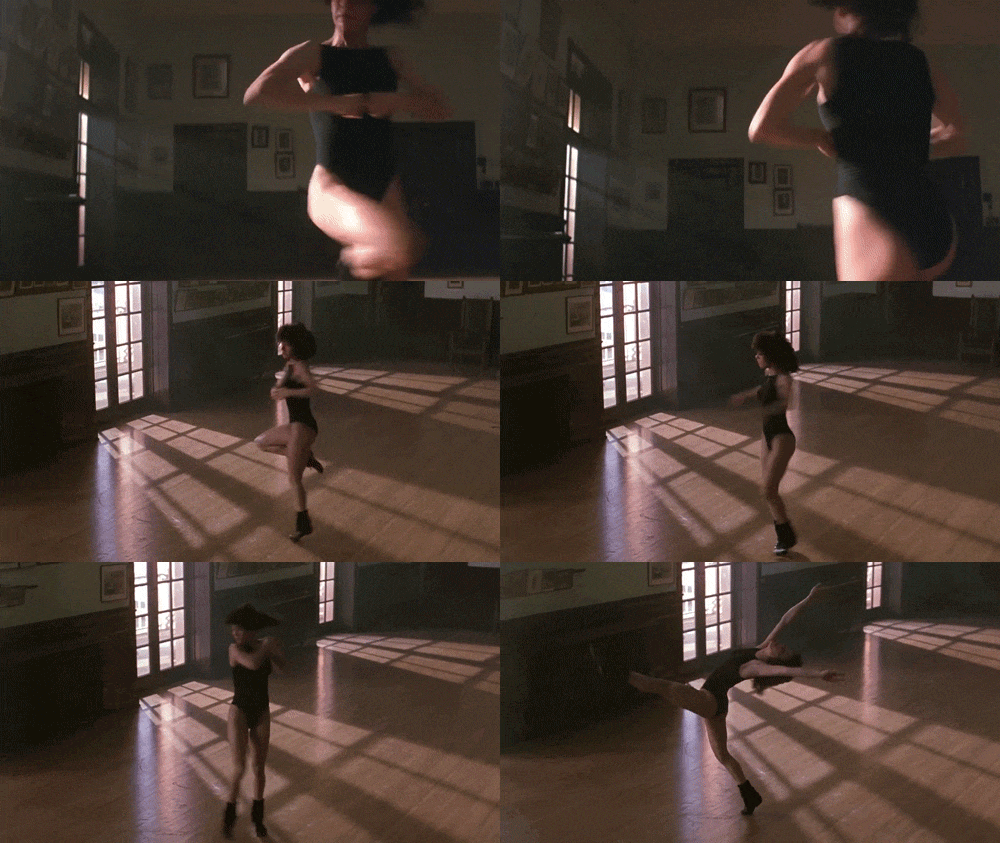
On revisiting a movie she was obsessed with at 15:
Only now, decades later, do I see Flashdance for what it was: a fantasy of self-creation ungrounded in political, material, or economic reality. It was a feature length music video hawking the individualist, bootstrapping Reagan-era fantasy. It said you can do anything (in your imagination). All it takes to lift yourself off the lowest social rung and be borne aloft on wings of stardom and true love is a big dream, a flashy style, a psychotic belief in yourself, and a willingness to sleep with your boss. You just have to want it. You can do it! Girl power! Dream on, sister!
And hey, if it doesn't work out, remember you have only yourself to blame. Maybe you weren't good enough, did you ever consider that? Here are some tips for self-improvement. Flashdance taught us that stripping was cool and a great way to put yourself through school. It taught us that the window to success is open for a very short time. Without Nick, Alex would have curdled into something monstrous in no time.
I must pause to give Chocano credit for some awesome chapter titles:
A Modest Proposal for More Backstabbing in Preschool
The Kick-Ass
The Bronze Statue of the Virgin Slut Ice Queen Bitch Goddess
You Play the Girl was already good but when Chocano turned her lens on the Seth Rogen-Katherine Heigl comedy Knocked Up, which she saw while trying to have a baby, her memoir really took off for me.
The problem with Knocked Up wasn't that it was full of moments that made it more than a little bit sexist, even though it was. The problem was that it presented an adolescent boy's perspective of what it means to be an adult woman in a world that has not yet come to terms with the idea of women as autonomous subjects. The problem was that it reveled in its hero's unearned advantage in this world while at the same time refusing to acknowledge what it's like on the other side. The movie refused to so much as utter the word abortion. (It makes somebody say "smashmorshun" instead.) Knocked Up wasn't interested in Alison's life or in her experience or in her options; it was the life stages of a woman as they are seen in fairy tales: child, maiden (hot chick), mother, and crone. Alison was an incubator, not only for her baby but for Ben's maturity.
The trouble wasn't only Knocked Up, of course. This take on gender relations circa 2007 was the only perspective anyone got. It was the most suffocating dude-bro imperialism; patriarchy rebranded as "fratiarchy." Watching it, I felt the way I imagine Khrushchev must have felt as Nixon tried to undermine his self-esteem with a tour of the modern American kitchen. Khrushchev was, like, we have kitchens in Russia, too, you know ... But nobody listened.
I'm listening and I'd like to hope that content creators either have a jewel like Chocano reading their work before it's shipped worldwide, or has her terrific book on their shelf.
A whip-smart essay collection about how we portray women in movies, TV shows, magazines, and more, as well as how women learn to internalize and emulate these portrayals. Carina Chocano does an amazing job discussing the problematic ways women's stories get told, ranging form how women face objectification and sexualization, to how women always end up in marriages no matter how fierce or strong they seem, to how we glorify youth and innocence and slight playfulness in women and devalue all other attributes. She discusses an impressive array of pop culture, including in-depth analyses of PLayboy magazine, Flashdance, Trainwreck, Mad Men, Sex and the City, and so much more. A solid quote about ageism that highlights her conversational yet compelling tone:
"When I first moved to Los Angeles, in my late twenties, I remember being shocked by how readily women my own age accepted the 'fact' that they had aged out of desirability; how resigned they were to their own irrelevance; how uncritically so many accepted this ideology propping up privilege and power inequality as being synonymous with reality rather than helping produce and maintain reality; how readily they mistook culture for nature. 'It's like when a female reaches the age of 39 or 40 she simply needs to go away,' Lauzen says. 'When any group is not featured in the media they have to wonder, 'Well, what part do I play in the culture?' There's actually an academic term for that. It's called symbolic annihilation.'"
I appreciate how Chocano integrates critical analysis and memoir in these essays. She combines pop culture analysis with stories about how she learned about girlhood growing up, as well as how her daughter has interacted with portrayals of women in the media. Reading this book reinforced for me the difficulty of raising a daughter in our society in such a way that would reject the plethora of sexist, dehumanizing portrayals of women that we see everywhere. We see women suffer. We see women objectified. We see women's ambitions tamed for the sake of marriage. Chocano points out these patterns with great skill and I hope we can learn to create better representations of women in film and television, as well as a less patriarchal world for women - and everyone - to inhabit. Another quote, this one about Frozen, that shows how Chocano refuses to take things deemed "feminist" at face value:
"Frozen was sometimes talked about as a feminist princess movie because it did not end with a wedding. But, if anything, it was a feminist movie in that its heroine is being gaslit and put into one impossible double bind after another. It was not so feminist in the way independence is conflated with solitude and loneliness, and creativity and power with madness. Despite her rehabilitation, Elsa still bears all the vestiges of the Disney villainess, but she isn't bad. She just does bad things. She can't help it. She can't control her powers, because she can't control her terrifying feelings. It's her feelings that are dangerous... Ultimately, Elsa does manage to break free, sort of. But the forces that hold her back are diffuse and insidious, and she never really embraces her desire."
Overall, a solid essay collection I would recommend to anyone interested in feminism or film and media. I deduct half a star just because I feel that some essays did not go as deep as they could have; their analysis felt curtailed, like more could have been said or a stronger conclusion could have been reached. Still, an amazing book that appeals to my love of dissecting pop culture.
“(…) there’s nothing like trying to live up to an impossible standard to keep a woman in her place.”
Last weekend, I watched “Desperados” on Netflix. I was bored, I guess, and I loved Lamorne Morris in “New Girl” so I figured why not? He was great, but the movie itself sucked. Not only did it suck, but it kinda pissed me off. The credits rolled and I think I said: “I can’t believe we still make this kind of trash chick flicks in 2020!” out loud (but there was probably more profanities in what I actually said). You know, stories about women in their 30s who are still boy-crazy, surrounded by enabling friends who indulge the insanity and who project unrealistic Disney-inspired fantasies on the men they meet and then lose their fucking minds when the fantasy doesn’t become reality. Why is this still happening? If women like that are real (which I doubt, but I’ve been wrong before), why are we glorifying their dysfunction/belittling it, by making it an object of ridicule and then tying it up with a happy ending bow that makes no sense? Why is this entertainment? I ranted about it for a few minutes to my bestie, then watched “Mr. Jones”, a movie about the investigative journalist who exposed the Holomodor and inspired George Orwell to write “1984”. Because THAT, my friends, is interesting, albeit bleak, stuff (written and directed by a woman, too!). I also remembered I had a copy of “You Play the Girl” tucked away somewhere and I dug it out and put on my desk.
As a (pop-culture) nerd, I was very curious as soon as I had heard about this book. I have been a (sometimes unwilling) consumer of pop culture almost my entire life, and yet I can count on the fingers of one hand the amount of times I felt I could truly identify with a female character. I spent a lot of time wondering if I was so abnormal as to not be worthy of representation. I also struggled a lot with the “dammed if you do, damned if you don’t” reality of growing up a girl.
“I believed that the days of telling girls to keep their opinions to themselves were over because I’d been encouraged to speak up in class my whole life.” Insert sarcastic laughter here.
This collection of essays bring together fascinating analysis of how women are portrayed in pop culture (from Disney princesses to sitcoms, musical icons and many more examples that we see on an almost daily basis) and the author’s personal stories, to illustrate how we internalize those representations, and how weird and confusing that is. I have personally experienced a lot of the mixed messages described in these pages, and it was fascinating and validating to read Chocano’s analysis; she brilliantly articulates the thoughts that often pop in my head when I watch TV or a movie and become livid at the madness being peddled at me. It’s always good to know you aren’t absolutely insane because you think “if I hear one more actress talk about how nice and refreshing it is to play a strong female character, so help me…”. I loved every chapter, but here are some thoughts and quotes that especially stuck in my mind.
“Sometimes, it seems like popular media exists primarily to set impossible standards and then to shame people who don’t try their hardest to meet them.”
The idea that society promotes motherhood but attaches so many responsibilities and standards to it that the woman’s personhood is eradicated in the process is also discussed, as is the toxicity of mommy wars, mom-shaming and all that vileness, and the design flaw of giving women no real way to work and fulfil the “biological duty” simultaneously (“We don’t live in an equitable society, we just pretend we do and are punished when we suggest otherwise. We force women into a false choice that isn’t a choice, really. Then we make them feel bad no matter which option they ‘choose’.”).
She uses “Frozen” to look at the concept of princesses, and what that means now (I was called “princess” by a man once; to me it felt like a slap in the face, but he obviously thought of it as a term of endearment; there was no second date). I haven’t seen the movie, but I’ve seen enough Disney garbage to get the gist of it: a princess with a power of some sort has that power restrained or taken away from her somehow (for her own good!), and there is a sort of quest/”journey” to get that power back. Often, princes save the day, and “Frozen” is supposed to be different because that doesn’t actually happen, but reading about it, it sounds just as psychotic as the other movies - except “Mulan”, which everyone conveniently forgets about all the damn time. The other thing that everyone conveniently forgets a lot is that fairy tales were originally cautionary tales… It wasn’t something you’d want to live, it was about all the bad stuff that could happen and how you could get out of it, but that’s not how we think of them now… I loved that she notes how everything is a damn “journey” now, because using that word reframes bad decision-making and misery into just one hurdle to be jumped before the big happy ending.
“When I was growing up, the assumption was that as older generations were replaced by younger generations, sexism would fade. This narrative was not only rarely challenged but remains popular to this day. It’s hard to reconcile where we are with these obsessive, persistent, psychotically virulent attacks on anyone who refuses to conform to gender stereotypes, this insistence that certain fondly held ideas not to be sullied with empirical reality”, she writes in a chapter discussion the much-reviled 2017 “Ghostbusters” reboot (which I *gasp* adored, because the female characters in it are, well, people). She uses the insane reaction to the movie to parallel the criticism Virginia Woolf had received, eons before there were internet trolls, to sadly conclude that some things die very, very hard.
“It’s easy to deplore past injustices. It makes you look good. It’s much harder (…) to confront why injustice arises, how injustice is consciously and unconsciously perpetuated, and why it is allowed to continue while we are fed fairy tales about the way things are now.”
Wry, insightful, and something I think anyone raising daughters ought to read. I will be re-reading “Alice in Wonderland”, but I’ll have a whole new perspective on it now…
**Watching this video again made me laugh: it is so 90s, but it reminded me where my undying love of liquid liner and ruby red lipstick comes from.
Pop culture has labeled "girls" for decades and they are portrayed as anything but empowering or even realistic. For decades, the women on the screen are seen as dumb sex objects, maddening incompetent nitwits or raging "bitches" out to get revenge. It has slowly started to change but it is still pervasive in all forms of media. Author Carina Chocano has written an excellent book on just how and why we got there. If you have a teenage daughter, you might want to pick up a copy and do a read together. There is much to discuss about her ideas so this is also a good book choice for bookclub reads. Four stars.
This book started out strong. I was entranced and horrified by my own ignorance, and this book was going to help me see past the wool covering my eyes.
Then, it got...different. It stopped being an empowering look at how women are manipulated, or how many of us have forgotten our own history, and felt bitter and meandering.
Quite a few pieces of the essays read to me like they'd been shoved in sideways to bulk up the text rather than written because that was where they belonged. For instance, on page 73 she throws in someone named Craig. Who? There's been no reference to this person (who it turns out much later is her husband, but how would I know that?) and it's a transition from an eye-opening discussion (that I was seriously enjoying) about women in early film production to something about an artist named Peyton. I was so baffled I tried to use google to figure out who these people were and what they had to do with early film mavens. I had no luck, so just shrugged and kept going. This type of seeming non-sequitur happens a bit, and would work if it were a consistent form of adding personal revelation/experience, but instead it left me feeling like the book needed better editing.
I felt like the essays were strongest and most interesting to read when they were dissecting pop culture or offering insights to historic women in the arts. I liked the author's insights, even when I didn't agree with them. The book's largest and most glaring weakness was the lack of any intersectionality. This book felt very white and very privileged, and that undercut much of the emotional message for me.
Overall, this was a fast read for anyone looking to think critically about the media we consume on a daily basis. Movies like Pretty Women, Knocked Up, Thelma and Louise, The Stepford Wives... TV shows like Mad Men, The Bachelor, Inside Amy Schumer... All are dissected and analyzed critically. Carina Chocano had a career as a movie critic. Almost every essay uses TV/film examples to illuminate her thoughts.
Here's what I didn't like...
1. Chocano paints a vivid picture of the roles assigned to heterosexual, white women. No essay in this book includes examples of women of color or women in the LGBT+ community and how they are portrayed in films/television. Why did The Princess and the Frog perform poorly in the box office compared to Frozen, Tangled, and others? If white women are assigned roles in Hollywood and elsewhere, what roles are assigned to non-white women? She talks briefly about women in the sex industry -- particularly Playboy -- but how are lesbians portrayed in porn and male-consumed media? Chocano missed a huge opportunity here.
2. Most of her essays had excellent thesis statements. But most of them fell flat. I would come across the final few paragraphs of the piece, thinking, "She's going to end this with a bang!" And she wouldn't. Most of her essays involved facts, facts, facts, minor opinion, facts, end. I finished some of the essays like, "I genuinely don't know how Chocano feels about this." The Amy Schumer chapter, for instance. Halfway through the piece, she's criticizing Trainwreck, then she's praising Inside Amy Schumer, then she's praising Trainwreck. It brought up some great points that reaffirmed my love of Inside Amy Schumer but just didn't feel cohesive. Does Chocano think Amy is a feminist we should look up to or simply an unrelatable woman looking to cash in on being a hot mess? I genuinely don't know. (My personal thoughts are a combo of the two, leaning more toward the former, but I'm not the one who wrote a book here.)
3. The Frozen essay. This one got on my nerves. •In one chapter, Chocano is praising women for being openly sexual and themselves. In this one, she sees Elsa's transition into a "sexy" outfit during 'Let It Go' as out-of-touch. "[Highly stylized hotness] demonstrates how transforming yourself into a trophy is a good outlet for any strength of will or creativity you may have been cursed with at birth... It teaches girls that self-objectification is a great strategy for neutralizing the qualities others may find threatening, and deflects attention away from them." Or perhaps Elsa's stripping of her coats symbolizes her acceptance of her powers -- "The cold never bothered me anyway" -- and her attractive new getup displays her newfound confidence and empowerment, which is synonymous with her femininity rather than her masculine/gender-neutral attributes (as the empowered Mulan and Merida have displayed in their respective films). Plus, don't we want to empower our daughters that the most "beautiful" women are the ones that are empowered and truly themselves? Materializing this inner beauty into outer beauty gives our daughters multiple reasons to say, "I want to be like Elsa!" •As for the language of 'Let It Go,' Chocano says, "Is she submitting or rebelling? 'Let it go' isn't what anybody says when they want to encourage you to own your strength... It's what people say to other people when they want them to get over themselves, to move on, give up. 'Let it go' is silencing." Actually, letting go can be quite empowering for some people. For people with anxiety, letting go means not sweating the small stuff, not allowing what people think to ruin their whole day. For others, letting go can be ignoring other people's thoughts and preconceptions about them, so they can be themselves. Elsa is telling herself to let it go. In fact, this is one of the first times in her life she isn't being told what to do. 'Let It Go' is the modern-day 'Hakuna Matata,' but with a powerhouse vocalist and catchier melody. •Chocano considered it non-feminist of Elsa to return to her sister rather than living independently and creatively. This, to me, is interesting, as one of the essays in the book talks about how Disney princesses' villains are almost always female because, well, female rivalry. To me, Frozen is a breath of fresh air. The whole ending involves the mending of a relationship between two females. Sure, Kristof is there, but it's clear that Anna and Elsa's relationship trumps Anna's relationship with Kristof. Rather than pitting women against each other (Rapunzel vs. Mother Gothel, Cinderella vs. stepmother, Ariel vs. Ursula, Aurora vs. Malificent, etc.), Disney has finally pushed for female empowerment in the form of female bonding.
It's not that I disliked this book. I didn't. It's simply that I expected more.
August 2017 My Book Box Non-Fiction Selection Recently, I watched part of Keeping Up with the Jones. It’s a movie about a suburban couple whose new neighbors turn out to be spies/special agents/CIA something or other. It has a good cast, and there were parts that were quite funny. I didn’t watch all of it, however, because it soured. The two men become buds, in fact the movie is really a bromance despite the couples, but the two women nope. In fact, the suburban wife dislikes the spy woman even before the truth comes out. Because, as you know, women can never be friends with prettier women. It was like, really? The wife is right, there is something sneaky going on, but her belief comes from jealously more than anything else. Additionally, proving her right also indicates that the female spy is not as good her husband, but it was really the whole friendship thing – men are friends, and that is emotionally important – while women can never be friends with other women. Not really. I’m tired of that shit. I think Chocano would agree with me. Chocano’s book details the messages that pop culture seems to be giving women and girls, whether it is intentionally or unintentionally. Honesty, I want to kiss her because I thought I was the only one who was disturbed by Elsa’s change of dress in the movie. Her writing about Cinderella will ensure that you will never look at a Cinderella movie the same way. Her comments about being trained in English Literature are tattooed on everyone who has a literature degree. The book is actually quite good because she focuses on things that are seen or meant to be “women’s” stories – like Sex in the City. It isn’t just the primary focus of the book – it is on pop culture and women, so shows like Mad Men are also discussed. She also addresses the desire to like something while realizing that it is problematic. Chocano’s tone is conversational, and the book is an easy and engrossing read.
Note: I received this book from NetGalley in exchange for an honest review
Similar to Bad Feminist, I often found myself nodding in agreement as I read You Play the Girl. For example, I also felt the same way as Chocano after watching Trainwreck. Why did Amy’s character think there was something wrong with her? Why did she have to use her father’s mistakes to justify her own life? Couldn’t she have both enjoyed having fun with no strings and then settle down when she wanted to? Couldn’t she just enjoy her life without defining it by both the absence, and then presence, of a relationship?
I also had the same issues with Frozen, and I can’t stand how it overshadows Mulan as Disney’s most feminist movie. I’m for anything that makes girls feel like they can be the leads in their own stories, but let’s not forget that Mulan took on the Huns.
Reading about Chocano’s experience with Playboy magazines just reinforces how damaging sexualized media images can be for young girls, and the Hefner interview she references reminded me of the definition of a slut: a woman with the morals of a man. Hefner has several relationships at once but expects his girlfriends to only sleep with him. I doubt any women who admitted to being in relationships with several men at once would be the exalted head of a magazine.
Chocano’s essays covered a lot of topics, and I mean A LOT. She moves from Amy Schumer’s Trainwreck to Alice in Wonderland to Playboy to Frozen with wit and ease. While I loved her insights, she didn’t really go as in depth on several topics as I would have liked. However, what she did cover was insightful and relevant, and I definitely recommend this book for those looking for a feminist take on pop culture.
Carina Chocano is the essay writer I wish I was. She examines how pop culture treats women and girls- and how it affects us. From Katherine Hepburn and how her image had to be toned down for people to accept her movies; ‘I Dream of Jeannie’ and ‘Bewitched’ (how two insanely powerful women constantly deferred to men); to the huge Disney princess phenomena wherein a princess is someone to be saved by a man or presented to a man. ‘Desperate Housewives’, ‘Real Housewives’, ‘Desperately Seeking Susan’, ‘Flashdance’, the misogyny in ‘Can This Marriage Be Saved’- in a women’s magazine, no less, ‘Thelma and Louise’, ‘Pretty Woman’, Disney, ‘Mad Men’ and a lot more all come under her feminist microscope. And while you can tell she’s very frustrated by the way the media presents women, she is always entertaining and easy to read. I’d love to read what she thinks about ‘Wonder Woman’ and the new Dr. Who! Five stars out of five.
I'm not really into this. It's very personal, with the author constantly relating thing to her own experience, which is not what I thought I'd be reading. And even though it says "Essays" on the cover, I somehow missed that, and expected the book to have a more cohesive point.
“You Play the Girl: On Playboy Bunnies, Stepford Wives, Train Wrecks and Other Mixed Messages” is a four part book of well written and analytical essays of various cultural themes. Popular films, books, articles and famous people and events are added and highlight author Carina Chocano’s stories and observations. Chocano, a journalist and storyteller takes pride in the creative thinking process, her short stories and articles have been featured in several notable publications including the NYT, Texas Monthly, Elle, and others.
In the first essay, Chocano revealed she learned about sex through Playboy Magazines and Bugs Bunny in Drag (no relation to the sexy human toon Jessica Rabbit). As children, many of us knew about the forbidden nature of the carefully hidden adult magazines. Playboy reached its peak of readership between 1966-1976. Heffner called his beautiful hostesses and models “Playboy Bunnies” featured by the Bunny logo. Heffner influenced American culture in numerous ways, more notably the unrealistic beauty standards and behavior for American women. Chocano explored this theme further with the emergence of “The Feminine Mystique” (1963). This was at a time when there were few single parent households, and women typically worked outside the home for extra spending money, not because they needed a double income. “The Stepford Wives” (1972) existed only to please, nurture, and reflect a positive manner on their husbands social and economic status. If a marriage failed in the 1950’s-1970’s— it didn’t matter that the husband was a womanizer, had a gambling, drinking, or domestic violence problem, the broken marriage was typically blamed on the “regrettable lack of wifely effort”. The popular Ladies Home Journal “Can This Marriage Be Saved” column (1953-2014) totally advised women on the strategies of keeping their marriages intact.
The wedding has always been another way for a woman of lesser means to snag a gazillionare, and live a life of luxury and prestige. So goes the story when Chocano worked in the Silicon Valley in 1992, going into debt buying overpriced sandwiches in the company lobby. The wages were low/pitiful, and the rumor was that a $3,000 Christmas bonus was to materialize, so she remained on the job… was it a good decision? It was too easy to fantasize about a fairy tale wedding-- Cosmopolitan Magazine reminded women: “It was just as easy to date a rich man as a poor one.” The drawback was that these wealthy men had unrealistic standards (a lot of them, in fact) as to what their princess bride should look like. The Bachelor transports viewers to a “fantasy world” of Grand Canyon romance. Helicopters whirl over the grand mansion setting, long walks, sincere talks and sweet picnics with food and flowers—a girl can be seen winning her bachelor, she is lovely and admired by all. Will the implied wedding date follow? The bachelor and his bride may date briefly, and likely break it off. In any event, the show is romantic and fun to watch.
In her 4oth year, Chocano was not feeling as brave or courageous as Elizabeth Gilbert in her book “Eat, Pray, Love” (2006). Following the birth of her daughter Kira, Chocano took her time reading Gilbert’s book. In fact, she was overeating Cheetos and googling “how to put a hex on someone’s balls” while reading it. Traveling to exotic locations as “Liz” had done after shedding her annoying husband was out of the question for Chocano, she certainly would never find “balance and spirituality in the pursuit of pleasure” in India or in an Ashram. With Oprah Winfrey’s promotion of the book, and 9 million copies sold, Gilbert was a wealthy woman. However, at the start of her memoir, LIz presented herself in an entirely different manner. Are the elements of romance, escapism, exotic getaways combined with self-help advice that connect readers with the author’s life experience for real? There were some pointed questions to consider.
In “Girls Love Math” we realize that women have an expiration date, this date arrives long before a man’s. Older men are distinguished as they age,(George Clooney, Richard Gere). Chocano has laid awake mentally calculating how much time she would have before reaching the age when women were expected (at age 39 or 40) to simply go away. Even talking Barbie dolls have said: “Math is hard” (I agree). The films Chocano chose to write about were overly long and less interesting. However, Chocano makes up for it in a big way: by the topics she writes about from “Gothic Celebrity” (which was excellent)- -to “Train Wreck”-- to writing about Kira's pre-school (Mom jeans and all). The stories shared about Kira were alright. Despite the topic of Virginia Woolf being overly written about, (the closing essay) there was really a good spin on this presentation, which matched the overall style of the book. *With thanks and appreciation to Mariner Books- (Houghton-Miffin-Harcourt) via NetGalley for the direct e-copy for the purpose of review.
3.5 stars for a thought-provoking compilation of essays about pop culture portrayals of women. Great to read if you want to increase your awareness of how women are identified and have been identified in the past, through movies and TV shows especially.
Anyone thinking of reading this book should be aware, first of all, that these essays are predominantly about pop culture portrayals of straight white women. I'm not sure why Chocano didn't go into topics of race, sexuality, ect. But I will say that pop culture does focus on straight white women, so there's a lot to unpack just in that sliver and perhaps that's why Chocano focused on that. Additionally, a lot of the messages are generalizable to other groups of women. But just know what group is being focused on.
On the positive end, I found a lot of interesting information here, and I was left with a ton to think about. It was uncomfortable to have to confront how I unconsciously accepted the harmful messages of some of my favorite movies, but fascinating to think about how insidious those messages are, and how ubiquitous. For example, I loved the movie Pretty Women (and, honestly, probably still do), but somehow I was totally unaware of Julia Roberts' ingenue (innocent, unsophisticated, characterized by her lack of control over events, which end up controlling her) role and Richard Gere's ability to mold Roberts into exactly the kind of woman he wants. To be sure, there are some stellar moments in that movie, and it often feels like Roberts has control over her life. But there are problematic aspects too, which I was totally unaware of. I'll have to re-watch it.
On the negative end, this is a serious pop culture book. Chocano goes into detail about many movies and TV shows, but she also merely references many others, without providing an explanation. If you haven't seen that reference, as often happened to me, you're totally lost.
Chocano also sometimes made claims of which I was skeptical. She made many points that were well-explained and provided a lot of evidence, which I appreciated. But sometimes it seemed like she claimed something without providing a solid-enough explanation, and I just didn't buy it. Or she seemed to be making some sort of claim, but wasn't clear about it.
I don't want the negative aspects to overshadow the positive, though. Overall, this book presented a lot of rich topics for thought, and would be great for anyone who wanted to have more awareness of the subliminal messages about women in pop culture.
Carina Chocano is a former movie / TV critic and author of these brilliant essays. Here she explores the underlying sexist messages of pop culture.
I’ve only seen a few of the movies Chocano references, and I don’t necessarily agree with all her observations. But I don’t have to agree to appreciate her insight.
She got my wheels turning about the specific gender stereotypes I've absorbed from birth. As a preschooler, I colored while my mother’s soap operas played in the background. Those ladies were wealthy. I couldn't identify. In elementary school, I was glued to The Little Mermaid and Miss America competitions. I wanted to grow up to sweep all the categories. Not on the stage. Just in life. As a young adult, I cringed my way through The Bachelor, fully aware I was consuming disingenuous smut. I was entertained in spite of myself.
Like most people, I didn't think too deeply about my media consumption. I do distinctly remember my ten year old self turning to my best friend and saying, “Ariel doesn’t know anything about Eric. She just sees him on a ship. Why does she like him so much?” My BFF considered. “She saw him playing with his dog. A guy with a dog is probably okay.” (shrug) We were more interested in singing along to the beats. (still know every word)
Chocano's perspective isn't lost on me. Of course, society tells women how to behave. I recently came across a vintage magazine list of 106 tips to get a husband, published in the fifties. Number 40: Stand in a corner and cry until a man asks you what's wrong.
And yet, for me, entertainment can just be entertainment. The messaging didn't stick or so I tell myself. I'd like to think I can embrace the Moanas and dismiss the desperate housewives without a second thought. I've never wept crocodile tears to meet a man or begged one to choose me over a roomful of rivals. There's that, at least.
But I’m still in awe of Chocano’s thoughts. She has a great mind, and her sharp wit made me smile.
Chicano's focus on women's issues fills me with hope, and some anger. She explores the state of our lives through popular books, movies, and happenings and she does it with literary skill and always a sense of humor and fun which helps when the reader's gut reaction is likely anger or even helplessness. I last had the sense of being in the presence of someone who's wise years ago,when I read Faludi's Backlash and Wolf's Beauty Myth though neither of those women had he same joie de vivre that Chicano brings.
It's difficult to look at these issues no matter how important they are but the medicine went down more easily because of her humor. The only place I felt lost is when she wrote about the possible meaning behind the movie Frozen. She falters on this topic but to be fair she's up front about being in the deep end of the pool or I think more likely we're al floundering in the shallows when dealing with Disney's popularity. The messages in these movies are so mixed it's hard to nail down why we can feel such an upswell of emotion. I also think the Frozen topic stands out so starkly because of the clarity Chicano brings in other topics. You Play the Girl is well worth your time.
Thank you to th publisher for providing an advance reader's copy.
Chocano takes the reader through a fast-paced yet precise history of roles women have played over time in real life and on screen & in texts, seamlessly showing the parallels between the literal and the symbolic worlds. There's even a brief history of the waves of feminism told through movies. She's a brilliant essayist and cultural critic, with strong one-liners, poignant questions, and a masterful way of weaving personal anecdotes, literary analysis, groundbreaking legislation, film reviews, and feminist critiques all in one. By the end, she touches on over 70 works, including novels, movies, media articles, and academic studies, in a way that's so organized and captivating that you forget how much you're learning. It's an essay collection that's unforgettable and important.
This has been a great year for essay collections and this one is at the top of the heap. "Celebrity Gossip" is easy one of the best pieces of cultural criticism I've read this year.
Have you ever watched a movie that made you feel icky for some reason that you can't precisely identify? This author can describe the reason, clearly and articulately. And spoiler alert, it's usually because the movie sends a pretty messed up message about women.
Movies discussed include Flashdance, Pretty Woman, Desperately Seeking Susan, Stepford Wives, Fatal Attraction, Knocked Up, Lars & the Real Girl, Frozen, and others. Don't get me wrong, I like some of these movies. I didn't stop to think about the message they were sending. For example, have you ever noticed how many movies suggest women can be easily replaced by robots (Her, Stepford Wives, Ex Machina, Lars, etc.)? Or how so many female protagonists are portrayed as likable for the sole reason that they are anomalies, somehow exceptional, and therefore worthy of our admiration? WTF Hollywood?!?!
I really expected to love Carina Chocano's collection of feminist essays, "You Play the Girl: On Playboy Bunnies, Stepford Wives, Train Wrecks, & Other Mixed Messages," published in 2017. Mixing slight bits of memoir with a lifetime of accumulated outrage from consuming sexist pop culture, this book is the literary equivalent of listening to Halsey's 2019 pop music hit, "Nightmare." This is a good book, and I would recommend it to anyone who is interested in learning more about pop culture and feminism. I just personally wasn't learning anything from it, and Chocano's analysis wasn't insightful or hard-hitting enough to keep my attention.
This book has an audience. But I ain't it.
For readers who avoid intersectional feminist tomes, and avoid reading radical feminist works like those penned by bell hooks, Andrea Dworkin, Jackson Katz, Robert Jensen, Gail Dines, Jean Kilbourne, Kimberlé Crenshaw, and so many others, then "You Play the Girl" will probably be much more revelatory and compelling.
But if you've plunged into radical intersectional feminist literature before, then you might be sorely disappointed by "You Play the Girl," which is focused solely on the trials and tribulations faced by white or white-passing, neurotypical, able-bodied, middle-class and upper-class cisgender women.
While I'm not denying that the patriarchy oppresses this demographic, my own intersectional radical feminism has moved well beyond the limited insights Chocano offers up in this book, which is honestly just a super watered-down version of modern feminist theory, packaged around pop culture. This book will appeal to a much broader audience than the works of radical intersectional feminists ever do, and for that reason, I'm grateful to this book. It's bringing a palatable version of feminism to the mass market, and that's always a good thing.
But for me personally, I wasn't learning anything new, I definitely wasn't engaged, and even though this book is easy to read, there was just too much lacking for me to find this enjoyable, and I had to DNF before the halfway point.
When I read feminist literature, I need the steak and potatoes version. This book is crème brûlée. As a dessert, this is fine. It's just not enough for me at a mealtime.
A couple of notes --
1. Chocano mentions and quotes the radical feminist firebrand, Shulamith Firestone (1945-2012), early in this book, but pointedly never mentions her in Chapter 5: "The Eternal Allure of the Basket Case," which contains this quote on page 81: "Marriage or the nuthouse. One or the other. It started to dawn on me that it wasn't that I was attracted to stories about girls who went mad, I was attracted to stories about girls with ambitions who wound up institutionalized. Getting locked up was not the result of adventure, it was the price you paid for adventure, it was your punishement. I had mistaken correlation for causation. Rookie mistake."
How much more poignant it would have been if Chocano had pointed out that Firestone herself was institutionalized, and tragically died in one. The feminists who have helped Chocano resist and speak out against the patriarchy have faced the same punishment as the creative artists she mentions. But I don't think Chocano is actually aware of Firestone's fate, and that's why this link is missing, like so many other missing links that could have been made in these essays, but weren't.
Here is a brilliant piece that ran in "The New Yorker" about Firestone, for those who are interested --
^^It's titled, "Death of a Revolutionary," by Susan Faludi, and was published on April 8, 2013. It's an amazing essay. I learned more from that essay than I did in 108 pages of "You Play the Girl."
2. Chocano doesn't off up any analysis of "Fatal Attraction" in Chapter 5, and she certainly never uses the word "ableism" (as in: this film is incredibly ableist against the mentally ill), but if you're interested in some truly insightful analysis of this film, here is a link to Jonathan Rosenbaum's excellent review, which was written for the Chicago Reader in 1987, right after the movie came out -- it's titled, "Fear of Feminism [Fatal Attraction]" --
^^Rosenbaum makes it more than clear that this movie was a backlash film against feminism, a point many other feminists were quick to state as well, most especially Susan Faludi in her 1991 landmark book, "Backlash: The Undeclared War Against American Women," which argued that the 1980s saw the media profit from a number of misogynist slurs and lies in order to scare women against the strides they’d made during the feminist revolution of the 1970s. I don't recall "Backlash" or Susan Faludi mentioned anywhere in "You Play the Girl." Her name and her work are not mentioned at all in the "Works Consulted" and recommended reading list at the end of the book.
3. Chocano takes a tiny stab at discussing the (very patriarchal and capitalist) film, "Pretty Woman," in Chapter 6: "The Ingenue Chooses Marriage or Death." If you're interested in reading a more in-depth analysis of the potent combination of assumed-and-undermined feminism/patriarchal spectacle of male capitalist power on display in that film, I would highly recommend you read Mari Ruti's 2016 nonfiction book, "Feminist Film Theory and Pretty Woman," which contains a much more in-depth analysis of that film and its (overall non-feminist) messaging.
While Ruti does not condemn the movie (not at all!) and she wrote the book to defend the movie's female fan base from the misogynistic contempt these viewers receive for loving the film, the overall takeaways are damning.
Since I only saw "Pretty Woman" once as a child, at age eleven or twelve, and absolutely hated the film, I read Ruti's book as an act of catharsis, and it was incredibly useful for me. While Ruti dismisses all claims by the movie's critics that the film has "an unrealistic portrayal of prostitution," stating that only "male misogynists" would expect a rom com to be "realistic" about prostitution, I was able to read past this f*cking bullshit, and see what insights Ruti could actually offer. I was glad that I did. I forgave Ruti her shitty dismissal of the portrayal of prostitution (which has definitely had incredibly harmful effects on American culture), and really enjoyed her analysis of the film as a whole. Her book is easy to read and a lot of fun. Highly recommended!
4. Chapter 1: "Bunnies" was like reading a watered-down, far less informative version of Ariel Levy's 2005 nonfiction book, "Female Chauvinist Pigs: Women and the Rise of Raunch Culture." I only gave that book 3 stars, but after reading Chocano's first chapter, I felt like Levy's book deserved a full 5 stars, because it was such a stronger piece of nonfiction text than these essays.
5. My favorite part of "You Play the Girl" is the Introduction. I loved those few pages. Five full stars to that section.
*****
I skim-read a few of the later chapters in this book, and they were so banal and dull that I was glad I chose to DNF on page 108.
For me, "You Play the Girl" is to feminism what reading "Shrill" felt like for the fat-acceptance/body-acceptance movement: a good text for beginners, especially if readers relate better when the text does not discuss the intersection of race, class, or ability level at all. When readers are asked to examine their intersecting cultural bias, the text can often be really overwhelming, so paring down oppression to simply examine one type of oppression (in this case: gender oppression) can often allow the reading to feel much more productive and useful.
For me personally, I'll take bell hooks and Andrea Dworkin any day over this. Give me all the radical intersectional feminist texts. They are my steak and potatoes, and I feast.
Three stars. "You Play the Girl" is a good book for an initial understanding of looking at pop culture through a feminist lens. The text is easy to read and accessible, and focused especially on the middle and upper-middle class.
This was a case of picking a book based on its title. What I didn't realize is that it's a collection of essays (yup...didn't read all the way to the bottom of the cover) or that these essays focus primarily on film/television criticism.
Criticism is not my jam. Literary Criticism was the one required course in my English degree that I was afraid I was going to fail. (I got a D on my first paper and panicked, because I didn't get Ds.) But I eventually learned to "talk the talk" and dissect a poor hapless e.e. cummings poem through a multitude of lenses. I think I may have even pulled a B out of the class, but I never learned to love critical theory. It has a tendency to ruin a reading (or viewing) experience for me. (For example, after reading this book, watching early seasons of Big Bang Theory with my sons has become less enjoyable, although the introduction of more female characters has improved things.)
Ms. Chocano's essays are very personal, tying in experiences from her childhood, career, and personal life with analysis of various movies and television shows, charting trends in the messages that Hollywood sends about what it means to be a woman. I haven't seen all of the works she references, but she includes enough detail to familiarize readers. Overall, her pieces are interesting and perceptive. I just prefer my non-fiction (and my fiction -- not a big fan of short story collections) to have one over-arching idea. In this genre, I preferred Cinderella Ate My Daughter: Dispatches from the Frontlines of the New Girlie-Girl Culture and Trainwreck: The Women We Love to Hate, Mock, and Fear... and Why, both of which Ms. Chocano references.
!!!! An essay collection that is cohesive, educational, and inspirational in a quietly riotous way. Carina Chocano takes us through the heights and depths of various tropes, stereotypes, and hardened realities of women (sometimes meandering a little, I will say) while weaving her personal anecdotes as girl growing up in the 70s and 80s, a film critic, and mother - all written through the lens of comparison to Alice in Wonderland. Her ability to present and analyze a huge variety of topics while mostly managing to stay on the overarching topic was impressive. You Play the Girl isn’t necessarily trying to come to one concrete conclusion in its contents, but rather to expose and name what women have known for centuries, and then to send the reader off with that knowledge to begin the heroine’s journey, which she describes as progressing in spirals, “a corkscrew, a recursive journey inward to discover the authentic self.” She presents the possibility that anyone can “face her own symbolic death” and “move past the illusion of a perfect world and a straight shot to selfhood” (in a nice dig at the hero’s journey) in order to “move forward in spirals and burrows inward, to understanding.” What better way to start ourselves off on the real heroine’s journey.
Favorites: The Eternal Allure of the Basket Case The Ingenue Chooses Marriage or Death The Kick-Ass The Redemptive Journey A Modest Proposal for More Backstabbing in Preschool Girls Love Math Look at Yourself Phantombusters; or, I Want a Feminist Dance Number
I liked this book, but I felt that at times it became redundant. The author is a former movie critic, and you can see that in her writing (not in a bad way).
I liked that this wasn’t an “educational” read, meaning large words and theories, but rather broken down into easily digestible essays. How girls and women are to be one thing, but never too much of the thing, lest she is showing off. These essays outlined different ways in which women perform womanhood, whether it’s playboy bunnies for Hefner and the patriarchy, men who want docile wives and women who feel like they have to settle to attain the marriage life, and how “strong female characters,” in order to be strong, have to be humorless and suffer a great loss in order to be taken seriously.
On that note, I greatly enjoyed “The Kick-Ass” essay that talks about how “strong female characters” are depressed, cynical, never funny, etc., while the males were just allowed to be. They never needed some tragedy and they could be both funny, have fun, and be strong and the leading role. Why paint women this way?
En realidad son 4,5⭐️ Me ha encantado y he aprendido un montón. La autora nos hace una reflexión punto por punto de películas y series muy conocidas, como pueden ser Pretty woman, Mujeres desesperadas o Frozen, todo ello alternado con experiencias personales suyas o de su hija. Tiene un punto de vista muy interesante y la manera de enfocar la narrativa y el punto de mira me han gustado en especial. Muy muy recomendado para quienes quieran informarse de feminismo, tanto como para iniciarse como para leer algo nuevo y fresco desde una perspectiva distinta.
Life-changing, though fails to often (or ever?) talk about race. Still, I feel relief and validation from reading how a woman cultural critic also feels angry and disappointed by pop culture. I learned the terminology for a feeling I often have when watching movies and television -- "symbolic annihilation". I am symbolically destroyed when characters who look like me are either never there, or represented as tropes, with very little of what makes us real.
Haz el Papel de Chica es un libro interesante y que te hará reflexionar. Hay muchas ideas acerca de cómo los medios audiovisuales (cine y TV) han representado, especialmente desde la revolución sexual de los años 60 a las mujeres, enfocado, obviamente en el país donde ha crecido la autora, Carina Chocano.
El estilo del libro va cambiando a lo largo de la obra, entre la observación externa, la propia experiencia y los films que analiza, lo que a veces se vea de forma irregular.
El ensayo desde luego, te deja con ideas para las que pensar, en momentos en los que coincides con ella (como con Pretty Woman) y otros no tanto.
En cualquier caso, no puedes evitar pensar en la cantidad de esterotipos representados aquí, que ves una y otra vez en la pantalla (la conejita Playboy, la prostituta de buen corazón, la esposa de Stepford, la chica guerra y fuerte, la chica manic-pixie...), especialmente en los últimos años. Son retazos de personalidad femenina, fantasía masculina en otros casos, que no representan a la mujer de a pie.
El libro se encuadra en una crítica feminista de los últimos 10-15 años (que no los últimos 5), y lo recomiendo. Y no sólo hay comparativas con lo audiovisual, también hay momentos relacionados con cultura popular, literatura, revistas, cuentos...
I really expected to like this book. I really wanted to like it. The book is focused on a topic that is of great interest to me. How women (and men) are portrayed in the media. How those roles influence beliefs, values and behaviors in children, teens and adults - both female and male. How we - all of us - blindly absorb what we see and read without really thinking about the underlying message. Whether it’s Disney movies "Being the prettiest was the pinnacle of womanly achievement.” or Playboy magazine "He wasn’t selling pictures of girls, he was selling a particular male identity via consumption of girls as consumer objects.” or movies "The Stepford Wives isn’t really about men and women, or husbands and wives, but about how patriarchy and capitalism use “traditional” marriage—that is, the single-income, “family wage,” upper-middle-class model that became dominant in the nineteenth century—to reinforce the existing global patriarchal power structure." or billboards, magazines, posters for movies, cosmetics, etc. "a world that literally never stops yelling at her that her primary value is sexual; that her identity is fungible (there is always a fresh crop of newer, younger, prettier girls); that her perspective is marginal, suspect, niche, and therefore not of real importance” the message to girls and women is always the same: “at their core they continue to gently guide women toward a choice that’s not really a choice, to choose half of what they really want, and to blame themselves if that half fails to satisfy their needs.”
The book jumps around all over the place: summarizing, theory, reflection, opinion, theory, reflection. At slightly less than the half-way point I found myself skimming pages. I wasn’t much further along when I quit reading altogether. I skipped to the last chapter and, thankfully, the end. The book is full of good material, full of very valid points; unfortunately, it is dry as dirt. It reads like somebody’s dissertation - and, maybe it is?! IDK Seriously, I would recommend this book to anyone conducting research on women in the media. For everyone else, consider yourself forewarned.⭐️⭐️⭐️
“But alas, I’d have to find a way to be opinionated without being too opinionated, authoritative without being a bitch about it, smart without being elitist, fair without being a pushover. If the boyfriends of my youth found me too authoritative when I should have been cheering on the sidelines as they kicked and tossed and smacked balls toward the vanguard, the male colleagues of my adulthood kept reminding me of my lack or authority as they unconsciously displayed theirs. I was always failing someone’s standard of legitimacy, as a girlfriend, as a producer of opinions. It was an eternal no-win. I was always too big or too small, like Alice, and forever being told, in one way or another, ‘Eat me.”
“Every new generation of women, it seems, feminist and housewife alike, is encouraged by popular culture to disavow its forebears and rebrand itself as an all-new, never-before-seen generational phenomenon, completely different in every way from what came before. The 'housewives' of the 1970s gave way to the Martha Stewart 'homemakers' of the 1980s, then the 'soccer moms' of the 1990s, then the stay-at-home moms of the 2000s. Next may come the homeschooling homesteaders of the impending post-apocalypse - who knows? What's significant is that the cycle of idealization, devaluation, and revision gives an appearance of progress, of superficial change, that distracts us from the big picture.”
For more book reviews follow me on Instagram at #emptynestreader and on Goodreads. #youplaythegirl #carinachocano #marinerbooks #nonfiction #essays #feminism #bookstagram #bookstagrammer #bookstagramalabama #bookstagrammichigan #bookreview #bookreviewer #bookrecommendations #readingbringsjoy #whatimreading #bookclubbook #goodreadschallenge #igbooks #booklove #bookstafam #readingbringsjoy #whatimreading #readingismylife #bookaddicts #februaryreads #kindlebooks #ebooks
In this book, Carina Chocano talks about stereotypical women and prejudiced/toxic representations of them in various cultural media, particularly in the film and the music industry but also in tv shows, literature, pornography, women's magazines and the gutter press. She also explores the status and role of women facing the recent technological evolutions - my favourite example being the one of sex dolls that she thoroughly presents in one chapter. From the Odyssey to Andersen's fairytales, Pretty Woman to Disney princesses, the Bachelor(ette) to the Kardashians, Alice in Wonderland to Amy Schumer, Chocano adroitly zigzags on a wide but tricky road to womanly freedom. We can say that her corpus of analysis is extremely diverse and allows us to understand the real impact of sexism, which is - in short - everywhere around us, and from there, free ourselves from gender roles, pressure, expectations and limitations. It was a very enriching read and Chocano's analysis on today's society and representations is very accurate.
The only reason I didn't put 5 stars is because I didn't know some of the references she made and the way her arguments were articulated with the actual media was too specific to be able to grasp her ideas entirely while being unfamiliar with the media in question. To say it in simpler way: I have not seen or read certain movies/tv shows she talked about and even though she summarises the plot and outcomes, it was difficult to fully relate sometimes.
A wide-ranging and thought-provoking look at the way women have been portrayed in movies, magazines, books, and in the wider culture over the past 50 years. As the author notes, "Between the time I was a curious little girl in the 1970s and the time I was an utterly confused and bewildered adult woman in the 2000s, I got lost in a nonsense world of double binds and mixed messages until I wasn't sure who I was or what I was supposed to do. Yet it was clear that I was supposed to do something, because there was always someone there to tell me that what I was doing was wrong."
My favourite line in the book is also the most devastating. Chocano writes about "the shock of waking up to the fact that the world does not also belong to you; the shame at having been so naive as to have thought it did; the indignation, depression, and despair that follow this realization; and, finally, the marshaling of the handy coping mechanisms, compartmentalism, pragmatism, and diminished expectations."