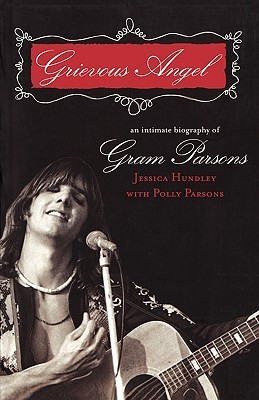
There has never been a better time for a book on Gram Parsons. At the thirty-year anniversary of his death, his sound, a mix of country and rock 'n' roll, is absolutely everywhere. Popular musicians of today trace their inspiration to pick up a guitar to when they first heard his music. His songs and his style have had a lasting effect on the music of our time. Now, together with Parsons's daughter, Polly, Jessica Hundley has created an intimate and extensive biography that brings together never-before-seen photos and illustrations, unpublished letters, and in-depth interviews with some of the many artists whose work was shaped by Parsons, including Keith Richards, Emmylou Harris, Wilco, and Ryan Adams, among many others. Grievous Angel is the tribute that the legions of Parsons fans have been waiting for—a book that brings to life the story of the Southern boy who revolutionized the way music sounds.
I’ve been listening to a lot of Gram Parsons lately, and this is the first book I read about him. I already knew a little about his tragic life since I read I’m with the band and I’m a fan of the Rolling Stones. It was an interesting biography, smelling of dust and desert and marijuana, and it makes me want to learn more about that talented musician. Yet, the interviews strewn throughout the book seemed pointless to me - except for the ones with Keith Richards and Emmylou Harris.
How does one write an "intimate biography" of someone who probably no one knew very intimately? In this case, by giving in to the temptation to speculation, fantasy, and not-bad purple prose.
Gram Parsons' short life seems to go even more quickly, as the reader devours basic facts padded by cotton-candy mood and a little armchair psychology. Once we find out that Gram learned not to trust at an early age, no explanation for his immature behavior (which fills the volume) is needed. We've all known people like this, if we don't identify with them ourselves. And yet explanations and excuses are provided at at every turn, too often simply chalking it up to his wild spirit or "demons."
Anyone not familiar with Parsons' life and musical career will get a basic outline, but not much more. Little justice is done to the subject by the star-struck author, the involvement of Parsons' daughter (who was a toddler when he died, and who admits she knew hardly anything about his life and music until recently), or the inclusion of interviews with various people, most of whom never met their idol, a few who actually hung out with him. Interestingly, terminal groupie Pamela Des Barres provides some the most eloquent and insightful comments of anyone who spent time with Parsons.
Makes one long for the talents of biographers like Albert Goldman.
What I learned from this book: Lots of musicians, many of whom I've never heard of, have been influenced by the music of Gram Parsons.
GP is one of my all time faves so it's hard to be objective on this book, I tore through it mainly due to my interest in the subject matter and it's readability. I did have some issues with the writing; Jessica Hundley gets a little too intimate in this intimate biography for my tastes. Seriously...how can you know what the guy was feeling on his deathbed, for chrissakes? There were also way too many interviews with no-name dudes in obscure bands that never met Gram Parsons. I'm in a band, I like his music and I have some involved thoughts and feelings on it - she might as well have interviewed me instead. But there were some really good interviews thrown in there as well: Steve Earle, Phil Kaufman and surprisingly Jonathan Richman, who was pretty good friends with Gram towards the end of his life. Gram was even going to make a cameo on the first Modern Lovers record but tragedy got in the way of that.
If you want a good intro to his life, work and the legend of his death the documentary "Fallen Angel" is the way to go, I think. Or just buy "The Gilded Palace of Sin" by the Flying Burrito Brothers, or "Sweetheart of The Rodeo" by the Byrds or "GP" or "Return of the Grievous Angel." Then you'll buy an acoustic guitar, start drinking whiskey for breakfast and hang out with a bunch of underage hippy girls in the valley.
Does Jessica know that historical fiction is a genre bc that’s what she really wanted to write. The amount of fluff and ridiculous phrases was unlike anything I’ve read.
“another young man safely strummed his silver string guitar, and he played to people everywhere, some say he was a star. but he was just a country boy, his simple songs confess, and the music he had in him, so very few possess”
oh gram, my heart. i absolutely devoured this book. it was so wonderful to learn about gram’s life coming from the voices of so many people who loved him. hundley’s prose were beautiful and it was clear from every page that she is just as in love with this man as i am. i also loved hearing from gram’s daughter, polly, keith richards, phil kaufman, pamela des barres, margaret fisher and of course, emmylou harris. it’s wild how much of an influence this man had in such a short amount of time! all the amazing music that he has inspired? i, of course, have first aid kit to thank for getting me into gram’s music.
gram parsons was a wild, imperfect and broken man, but he was also kind, he kept humble and positive throughout his life and he lived on the edge to the very end. he will continue to inspire me forever i think. ever since i went to cap rock in joshua tree, i knew me and him were going to be friends for a long time.
thank you for the music, gram, the true cowboy angel. <3
This book sucked. I feel like it was never even read by an editor before it was published because I counted like four spelling and/or factual inconsistencies within the first twenty pages. If a casual beach reader can pick up these errors quickly, why the hell can't some intern at the publisher? Then, I felt the telling of Gram's life was way too saccharine (sp?) and cheesed-up. The author was obviously in love with him and not very objective and then towards the end starts actually talking (spoiler alert, ha) about his death, like the things that are going through his head as he is dying. Who the hell could know that? Barf. This book made me like Gram Parsons less than I did before reading that and I honestly cant tell if its because he was kind of a lame self-centered alcoholic from a crazy family or if it is because this author sucked so hard. Probably a combination. Too bad because I am extra lenient with rock biopics.
I couldn't put this book down, but it wasn't because it was so good...it was because I wanted it to get better. I worship Gram Parsons, but this book fell short for me. The plus was having all his lyrics running through my head while reading--an internal soundtrack.
Generally well-written, with some valuable information and insights, particularly into Parson's early life and the period after he'd been shown the door at Nellcote, this book suffers from two very major distracting elements: the authors presume to delve into the inner thoughts of several of the "characters" involved in the narrative, to the degree that this book could easily be classified as a novel; and the book is peppered with a slew of mini interviews, which interrupt the text rather annoyingly. Perhaps the interviews could have been gathered together between chapters, perhaps (dare I say) several of the interviews might have been eliminated all together, as the interviews of contemporary musicians, circa the early aughts, tended towards redundancy (I lost count of how many musicians adduced "Juanita's Song" and "Hickory Wind" as their favorite Gram songs). Still, a worthwhile read.
I have read many musician biographies, and this by far is the most poorly edited work I have come across. The writing is good, even though you have a feeling that there is no way what is being told to you is probably really accurate, as it is other people's memories. You still don't get a chance to enjoy the writing because mid-sentence you are thrown into an interview with some briefly mentioned childhood friend that has been hastily and haphazardly thrown in mid-thought. All of the poor quality photographs and not so interesting interviews should be grouped together and put mid book (the photos) or at the end of the work (the interviews - which really could be written into the work) so you can read it easily and keep the flow of telling a story. They should really look at a re-edit and re-release of this book. It could be so much better.
It's all right, but there's these random blurbs from people who didn't even know Gram and it throws it off track. Repetitive if you've read other books on him.
Grievous Angel: An Intimate Biography of Gram Parsons by Jessica Hundley with Polly Parsons (Thunder's Mouth Press 2005)(Biography) is an interesting biography of one of the true pioneers and innovators of the concept of "country rock" in the late 1960's and early 1970's. He's best remembered as a singer-songwriter, for playing with the Byrds and the Flying Burrito Brothers, and for giving Emmylou Harris her first introduction into the L.A. music scene. Gram Parsons was born into wealth in Florida and became part of L.A.'s infamous Laurel Canyon scene. He died in 1973 at the age of twenty-six. A truly memorable piece of trivia about his death is described briefly in this book. After Gram Parsons died in the Joshua Tree Inn in California, his coffin (with body enclosed) was being held at LA International Airport waiting to be claimed by Gram's stepfather. Pursuant to drunken promises made with a couple of his pals, Gram's buddy Phil Kaufman drove a hearse to the warehouse at LAX where the coffin awaited, and after some fast talking, was allowed to load up Gram's coffin and drive away. As Gram had requested, Kaufman followed through on his promise to his friend: Kaufmann drove to the desert to Joshua Tree National Monument (now Park), doused his friend's body with flammable liquid, and set Gram Parson's body aflame so that he could be cremated in the desert. My rating: 7/10, finished 12/15/2013.
I thought the author was a bit over the top at times (or maybe I just don't read enough bios about dead people??), but I'm really into GP so of course I liked it. Includes interviews with people in his life like his high school sweetie (who was there the nite he died) willie nelson (who didn't even know him) keith richards (BFF) and many more (some good, some bad). B + W photos throughout.
Not quite done with this yet, about 20 more pages. But what a let down. Not the book, but the story. I think if I met Gram Parsons I would knee him in the groin. This book reminded me of why I stopped reading books about musicians. It will be a long time before I pick up another one. Back to some solid fiction.
This book was written with Gram's daughter Polly Parsons who wanted to know about her dad so there is a lot of love, but not too much. It's factual and thorough. If you're interested in Parsons and love his music you won't put it down. She takes an honest look at her legendary dad.