Jump to ratings and reviews
Rate this book

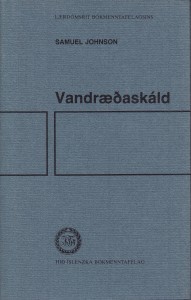
Vandræðaskáld

Rate this book
Vandræðaskáld er frásögn hins kunna breska rithöfundar og orðabókarsmiðs Samuels Johnson af ævi samtímamanns síns, skáldsins Richards Savage. Johnson, sem var uppi á 18. öld, var eftir dauða sinn hylltur sem mesti bókmenntajöfur sinna tíma en lífshlaup hans var markað erfiðleikum, deilum og þunglyndi eins og greint er frá í inngangi að þessu riti. Þekking hans á bókmenntum, ritsnilld og hin gríðarlegu fræðiafrek sem orðabók hans er til vitnis um, auk litríks persónuleika Johnsons, hafa þó markað honum óumdeildan sess sem eins af merkilegustu rithöfundum Breta fyrr og síðar.

Vandræðaskáld er um margt merk heimild um tíðarandann í Lundúnum á þeim tíma sem ýmiss konar útgáfustarfsemi var í örum vexti, launuð blaðamennska var að verða til og bókmenntasamfélagið samanstóð að miklu leyti af fátækum skáldum sem bitust um að selja útgefendum efni fyrir lága þóknun. Einn þessara manna var Richard Savage, sem setti mikinn svip á þetta samfélag og Johnson kynntist náið. Annar var svo um tíma Johnson sjálfur. Vandræðaskáld er sérkennileg og einstaklega glögg mannlýsing þar sem Johnson dregur fram bresti hins hrokafulla skálds, sem steypti sjálfum sér markvisst í glötun, en finnur þó til svo ríkrar samkenndar og samúðar með honum að hann leitast við að réttlæta jafnharðan breytni hans, þótt hvergi sé dregin fjöður yfir gallana. Sagan verður því harmræn og er öðrum þræði hugleiðing um stöðu listamannsins í samfélaginu, en Savage leit svo á að skáldgáfa sín veitti sér forréttindi og ætlaðist til virðingar og raunar framfærslu af hendi annarra. Reyfarakennd ætternissaga hans þar sem hann hélt því fram að hann væri óskilgetinn sonur aðalsfólks á líklega ekki við rök að styðjast, en Savage kúgaði þó um tíma fé af fólkinu sem hann hélt fram að væri fjölskylda sín. Hann fann sárt til þess að vera ofurseldur duttlungum og smekk manna, en var fyrirhyggjulaus og taldi sér ekki sæmandi að hegða sér í samræmi við aðstæður sínar, sólundaði jafnharðan því fé sem honum áskotnaðist og var alla tíð haldinn sárri biturð yfir hlutskipti sínu. Hvað sem líður skáldgáfu hans, lýsir Johnson honum sem þversagnakenndum einstaklingi, snillingi sem skorti alla almenna skynsemi, siðapostula sem drýgði þó flestar syndir og fáguðum herramanni sem dvaldi þó heimilislaus meðal ógæfufólks.

Atli Magnússon greinir í inngangi frá ævi og verkum Johnsons og tíðaranda Lundúna á tímum þessara tveggja sérvitringa.

212 pages, Hardcover

First published October 17, 1744

1 person is currently reading
256 people want to read

About the author

Samuel Johnson

4,714 books412 followers
People note British writer and lexicographer Samuel Johnson, known as "Doctor Johnson," for his Dictionary of the English Language (1755), for Lives of the Poets (1781), and for his series of essays, published under the titles The Rambler (1752) and The Idler (1758).

Samuel Johnson used the first consistent Universal Etymological English Dictionary , first published in 1721, of British lexicographer Nathan Bailey as a reference.

Beginning as a journalist on Grub street, this English author made lasting contributions to English literature as a poet, essayist, moralist, novelist, literary critic, biographer, and editor. People described Johnson as "arguably the most distinguished man of letters in English history." James Boswell subjected him to Life of Samuel Johnson , one of the most celebrated biographies in English. This biography alongside other biographies, documented behavior and mannerisms of Johnson in such detail that they informed the posthumous diagnosis of Tourette syndrome (TS), a condition unknown to 18th-century physicians. He presented a tall and robust figure, but his odd gestures and tics confused some persons on their first encounters.

Johnson attended Pembroke college, Oxford for a year before his lack of funds compelled him to leave. After working as a teacher, he moved to London, where he began to write essays for The Gentleman's Magazine. His early works include the biography The Life of Richard Savage and the poem " The Vanity of Human Wishes ." Christian morality permeated works of Johnson, a devout and compassionate man. He, a conservative Anglican, nevertheless respected persons of other denominations that demonstrated a commitment to teachings of Christ.

After nine years of work, people in 1755 published his preeminent Dictionary of the English Language, bringing him popularity and success until the completion of the Oxford English Dictionary in 1905, a century and a half later. In the following years, he published essays, an influential annotated edition of plays of William Shakespeare, and the well-read novel Rasselas . In 1763, he befriended James Boswell, with whom he later travelled to Scotland; A Journey to the Western Islands of Scotland , travel narrative of Johnson, described the journey. Towards the end of his life, he produced the massive and influential Lives of the Most Eminent English Poets , which includes biographies and evaluations of 17th- and 18th-century poets.

After a series of illnesses, Johnson died on the evening; people buried his body in Westminster abbey. In the years following death, people began to recognize a lasting effect of Samuel Johnson on literary criticism even as the only great critic of English literature.

Ratings & Reviews

What do you think?
Rate this book

Friends & Following

Create a free account to discover what your friends think of this book!

Community Reviews

5 stars
22 (18%)
4 stars
24 (20%)
3 stars
42 (35%)
2 stars
21 (17%)
1 star
9 (7%)
Displaying 1 - 7 of 7 reviews
Profile Image for Bill Kerwin.
Author 2 books84.3k followers
April 3, 2019

It is perhaps ironic that the greatest short biography produced in the Age of Reason was written by a biased observer with an irrationally strong affection for its subject. That, however, is the case with Samuel Johnson’s biography of the poet Richard Savage.

Because of Boswell’s Life of Johnson—that great long biography written by a biased observer with an irrationally strong affection for its subject—most readers have a mental image of the old man called “Dictionary” Johnson, a renowned lexicographer and literary critic notorious for his eccentric appearance and celebrated for his great conversation. But a generation earlier, Sam was an aspiring writer new to London, laboring to complete his tragedy Irene and living hand to mouth on whatever writing work he could find.

It was during this period that the profligate though respected poet Richard Savage—forty years of age, and a decade past the zenith of his fame—met the professional hack, twenty-eight-year-old Sam Johnson. Johnson was grateful for the established writer’s friendship, and Savage no doubt valued having another person to borrow money from. They admired each other’s intellects and conversation, and often talked the night away, frequenting taverns if they had money, and if not, walking the London streets until dawn.

Johnson labored assiduously, Savage spent and drank; five years later, Savage was dead (probably from a busted liver). Within a year, Johnson had completed his Life of Richard Savage (1744), a sincere and loving tribute to his friend.

Johnson makes no attempt to be even-handed. He is passionate and partial toward his friend, and uncritically angry at the woman he holds responsible for much of Savage’s misery: Mrs. Brett (the divorced Lady Macclesfield), whom Savage claimed was his natural mother. (Johnson accepted Savage’s account of his birth at face value, even though Mrs. Brett never acknowledged the connection, and the evidence is contradictory at best.) Notwithstanding, Johnson—although he clearly loved his friend—examines keenly his failures of judgment and character, and gives the reader one of the most revealing portraits on record of a self-destructive artist who, although gifted with wit and charm, consistently alienates every one of his friends.

Johnson’s tirades against Mrs. Brett’s are great rhetorical fun, easily worth the price of the book. Instead, though, I have decided to include a sample of Johnson’s insights into Savage’s character:
He was compassionate both by nature and principle, and always ready to perform offices of humanity; but when he was provoked (and very small offences were sufficient to provoke him), he would prosecute his revenge with the utmost acrimony till his passion had subsided.

His friendship was therefore of little value; for though he was zealous in the support or vindication of those whom he loved, yet it was always dangerous to trust him, because he considered himself as discharged by the first quarrel from all ties of honour or gratitude, and would betray those secrets which, in the warmth of confidence, had been imparted to him. This practice drew upon him an universal accusation of ingratitude: nor can it be denied that he was very ready to set himself free from the load of an obligation, for he could not bear to conceive him self in a state of dependence; his pride being equally powerful with his other passions, and appearing in the form of insolence at one time, and of vanity at another.
Profile Image for Dusty.
811 reviews243 followers
October 12, 2010
In 2010, it's a novelty to pick up a biography that's any less than 600 pages -- even when the subject has been dead for three-hundred years, as is the case with Octavio Paz's book on Sor Juana, which has been languishing in my "currently reading" shelf now for two months. It's refreshing to find a volume like this one, unafraid to encapsulate a great man's life in about a fifth as many pages.

Perhaps I should write "great man" in quotations. When it comes to the subject of this biography -- the British poet Richard Savage -- the epithet can't be applied without irony. Was Savage a "great man"? Johnson seems to think he could have been, had his fortune not been obstructed from birth by poverty, a wicked mother, and the 18th-Century British system of literary patronage. In fact, Savage was, well, more of a savage person -- ungrateful, infuriatingly self-centered, and contemptuous most especially of people who offered him charity. A real life Ignatious Reilly.

Thankfully, Johnson's approach is to humanize Savage rather than to lionize him. In other places, Johnson wrote that the purpose of a biography is not to recount a great person's greatness so much as it is to put forward the events of one person's life so that the rest of us can learn from them. Lessons to be learned from the Life of Savage? For one, when the Queen supplies you an annual income large enough to sustain a family of four for a year, don't trash it in one weekend, on booze and prostitutes.
Profile Image for Thordur.
338 reviews4 followers
January 28, 2023
Af öllum þeim bókum sem eru að koma út á vegum lærdómsritasafns Hins íslenska bókmenntafélags þá er þessi bók ein sú skemmtilegasta. Höfundurinn Samuel Johnson var uppi á 18. öld í Englandi og er bók hans um vandræðaskáldið Richard Savage eitt hans frægasta ritverk.

Einna skemmtilegast við lestur þessarar bókar er hversu textinn nær að verða meitlaður og hreinasta fljúgandi. Það er sjaldnast að maður lesi verki eftir nokkurn rithöfund sem sé svona meistaralega vel gerður og snilldarlega framsettur. Með örfáum orðum þá fjallar bókin um skáldið Richard Savage sem er hataður af móður sinni út í hið óendanlega, er á hrakhólum meira eða minna allt sitt líf, ýmist dáður eða smánaður, jafnvel á sama augnablikinu, og hvar hans líf endar síðan...

Profile Image for Alyssa.
524 reviews41 followers
January 19, 2018
A very interesting account of someone's life and their troubles after having killed a man (during a bar fight). I would have liked to see more information about his life and the trial, especially as the trial is pretty important in Savage's life, but also as it finishes with a letter to the Sovereign to beg for his Mercy. Pleasant to read but clearly very subjective.
Profile Image for Rachael.
Author 43 books81 followers
June 29, 2017
Another book that I read under duress. I would have not picked this up by choice. But it is quite an amusing character sketch, and the over-the-top and florid language of the 18th century is entertaining.
Profile Image for Rico.
93 reviews
August 16, 2015
Johnson's description of Savage might seem at times to be the depiction of a egotistical scoundrel, but the immediately redeeming feature of any such moment is how nearly condemning "The Life of Savage" is, not for Savage, but for us. Nearly every fault of Savage is the lived out and realized impulse felt by everyone at one point or another. Savage lived with the intensity of our selfish lives, trying to be good but without the structure to do so. This is a sobering biography.
Profile Image for Joy Pauline Richardson.
24 reviews3 followers
October 8, 2013
For heaven's sake spare yourself from this work. It is in fact a short novel but so incredibly tedious, repetitive and dripping with redunancy that it might as well be as long as William Clark's Sacagawea.
Displaying 1 - 7 of 7 reviews

Can't find what you're looking for?

Get help and learn more about the design.