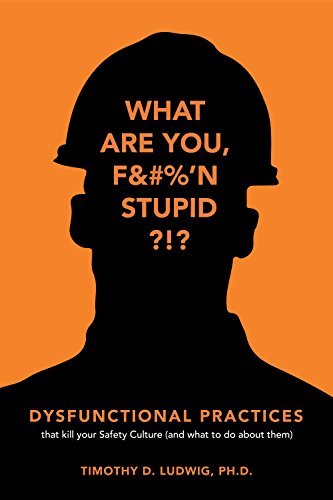
A MAN FINDS HIMSELF on the top step of a step ladder; a woman removes the guard to her machine; a worker is not wearing her safety glasses in the plant; a roustabout uses the wrong sized clamp instead of retrieving the right tool from the supply truck; a supervisor teaches a new worker to take short cuts; a mechanic climbs on top of the active machine to find the oil leak. Why do these folks do these things? Is it because they are stupid? One tendency is to blame workers for safety errors and label their personal failings as the cause of the error. Labeling does not solve problems that cause error and, frankly, it may all be an illusion of human perception leading us to false conclusions. Our human tendencies result in interactions that hurt the safety of our workers and the effectiveness of the systems we put in place to protect them. These tendencies build dysfunctional management practices that create fear associated with your safety programs. I want to teach you a better way to analyze the behaviors of your employees to understand why they were put in a position to take the risk in the first place. Your system may be perfectly designed to promote risks and create safety traps. By analyzing the context of behavior we can discover ways to change your system to optimize safe behavior and reduce injury. This book presents new ideas and methods using stories we can all relate to. Human behavior is at the crux of your safety program. Physics and chemistry create hazards ready to be released when things go wrong. Human behavior happens right before that release. Therefore, we look at the behavior associated with the resulting injury and blame the person as the root cause. We label the person “stupid” and feel we have solved the problem. We haven’t. Instead, a dysfunctional practice creeps into our safety management system blinding us from finding the true root causes of at-risk behavior. If our goal is to create a safety culture in which workers are engaged with situational awareness, peer coaching, and reporting, we will fail. Our offensive labeling will create avoidance of the very engagement we desperately need from our workers. We can’t fix people, let’s not be that pompous. But we can change behavior… we know how; there is a science behind it. We want to define behaviors in a way that are as open to unbiased analysis as the elements of physics and chemistry. Behavior is not a static variable of study. It’s not a geologic formation changing over the epoch of time. Behavior is a dynamic variable, reacting with each passing moment along predictable paths, like water in a river, but always ready and able to jump its banks and forge new paths. We will discover that behavior is neutral, not good or bad, right or wrong. We will learn that for every safe behavior you want from your workers, there are a plethora of competing alternative behaviors that can put them at-risk. What determines this decision is predominantly the work context and your management systems. With this perspective we can better ask what put the worker in a position to take the risk. We will build an alternative to labeling with dispassionate, actionable and effective analyses to help build the system that helps workers discriminate the best behaviors for the situation. This book is for managers who seek to shape their safety culture to drive out fear and engage their workforce as they drive out risk. I want to help leaders at the top break through their biases and look at safety through a different, more effective lens. Similarly, this book is for the noble safety professional who must build safety management systems to avoid biases and other human tendencies; systems that focus on the controls, PPE, senior leadership involvement, and adequate safety resources that shape and
I am the manager of a Sand and Gravel Mining company and we are using this book to build our safety culture up. I really enjoyed reading this book from beginning to end. I was genuinely impressed by the real world application of the concepts and how relatable the situations and solutions were. I was a bit skeptical at first, because I have read many safety books and sometimes you just don't want another professor in some university to tell you how "you should be safe", when they probably haven't spent a lot of time in the real world of working with machinery and large equipment. HOWEVER, Timothy Ludwig did a great job of blending the academic side of the psychology behind human behavior and real world application of the concepts. I have purchased this book both in print and as an audiobook on Audible. it is WELL WORTH the investment! In fact, after listening to it on audiobook, I purchased 10 copies to give to my foremen and superintendents so we can read it together and apply the concepts in our daily routines.
If you would like to listen to this book for FREE on audible, click the link below.
Note: I sincerely hope you enjoy the book and the free trial offer. As an Amazon Associate I earn from qualifying purchases. That being said, I highly recommend this book to anyone working in a plant or around machinery.
Applying tenants of behavioral science, Ludwig simply and effectively targets the (largely psychological) barriers to deep, actionable root cause analysis and lays out a framework for demystifying employee behavior to improve incident investigation, training, process inspections, and organizational safety culture as a whole.
Ludwig argues the conclusion of operator error in incidents is essentially defaulting to a vacuous label, a value-judgment of a person, which misses the boat in 94% of cases and always limits further root cause analysis.
Only through unbiased investigation (suppressing tendency to make value-judgements) and extensive conversation with operators (safety culture), can we penetrate superficially-obscure operants (behaviors) to reveal the course of neutral and predictable outcomes.
To fully comprehend and learn from behaviors we must look to the extensive web of circumstances in which employees make decisions, allowing us to isolate and address deviation, both positive (eg, hacks and best practices) and negative (eg, drift, process/training deficiencies).
Ludwig’s book covers all this and more in a style that’s open, entertaining and well-organized into digestible chapters which are complete with example scenarios and other anecdotal insights gleaned from a lengthy career of consulting in organizational behavior. This is the perfect little book to share and discuss with EHS professionals and operations managers who could all certainly benefit from a better understanding of employee behavior.
I have recently had the experience of sailing onboard a LPG tanker, and working in the engine room of the ship. Everything mentioned in this book was so relatable to the challenges we faced onboard.
I had a lot of insights and a better understanding on the subject of safety, but the reason I really loved the book was its ideas on the subject of 'labelling' , working onboard I have had first hand experience on how this impacts work and safety.
Would recommend this to everyone working in an industrial (high risk) setup.
Really good for book about behavior based safety. I would recommend it if you are in the industry or for some strange reason curious about behavior based safety.
A must-read for every leader, not just safety professionals
Dr. Timothy Ludwig did not just talk about safety, he exposed the hidden organizational habits and leadership behaviors that quietly destroy a safety culture. What I found most powerful is how practical and behavior-based his solutions are.
As an HR professional, studying behavioral science, I found this book equally relevant for improving accountability, communication, and trust across all levels of an organization. Every supervisor, HR leader, and manager who cares about shaping workplace behavior and culture should read this. It’s clear, insightful, and backed by real-world examples that can transform not only safety performance but overall employee engagement.