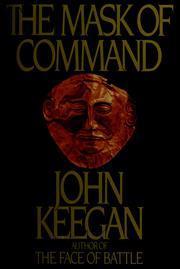
The Mask of Command examines in a unique fashion what great commanders did and did not do. Keegan does not seek to forcibly find the similarities as much as the unique capabilities that each of his four chosen subjects brought to their era and commands. Three of them, Alexander the Great, the Duke of Wellington, and Ulysses S Grant were successful beyond wildest imagination and thus became legendary. The fourth subject, Adolf Hitler the definition of epic failure, however not in the obvious way that Germany lost the War and Hitler killed himself, is presented by Keegan as the soldier he truly was.
Each of these great commanders brought unique skills and were truly people of their age in a way that was serendipitous. Luck, right man, right time, but also the right preparation was vital. The preparation and its end result was wildly different for each of the four. The persona and self imposed behaviours that are written about are each of their Masks assumed to allow for the greatness. Keegan’s central argument is that what should leaders reveal and what should they conceal at all cost to effectively lead their men. “ The leader of men in warfare can show himself to his followers only through a mask, a mask that he must make for himself, but a mask made in such form as will mark him to men of his time and place as the leader they want and need.”
Alexander was a heroic ancient warrior who got into the mix and individually and personally shed a great deal of blood. Alexander wasn't above using killing as a political tool. He was required to be constantly proving his own worthiness to have succeeded both his father and others, great warriors among them, as the leader and commander of the great forces under his command. Drinking, debauching, individual combat, and political machination all were things he had to excel at to maintain his role. He led by heroic example and in that sense he bleed and fought as he expected his men to fight. He suffered 8 wounds and one nearly fatal across his numerous battles. Superhuman though he sought to appear, he accepted and indulged the ordinary human nature of his soldiers.
The Duke of Wellington, one of the greatest figures in the history of the British Empire, was obsessed with noblesse oblige to the extreme. His personal discipline to the study and practice of blood and iron may never have been exceeded. able to direct the battle as a whole. Keegan's analysis of Wellington's command at Waterloo gives an excellent picture of the Duke's tireless movement from one section of the battlefield to the next, in close range of the fighting. His used personal direction of the action, using the topography to screen his troops. He scrutinised enemy movements in search of an advantage and moved decisively when an opportunity arose. Wellington was, in Keegan's words, "perhaps the most perfect embodiment of the gentlemanly ideal England has ever produced." He was disciplined, modest, self-assured, and reticent. Wearing civilian clothes, he avoided all self-dramatisation and scorned Napoleon's dramatics. His was a deliberately antiheroic style. If Wellington's style suited aristocratic Georgian England, Ulysses Grant's reflected both the mood of American democracy and the vast technological changes that transformed war in the next half-century.
Grant a professional soldier who though educated beyond almost any of his non military contemporaries was so ill struck by fate that he couldn't find work as an engineer and during a peacetime sojourn failed at farming and nearly at every business he tried. Grant had those great leadership abilities including but not limited to being able to withstand the horror of war, a innate understanding of the men he commanded, like the previous two as well the ability to deliver both oral and written orders that were clear and correct in what they needed to say. Grant was actually the best Civil War General in terms of a modern strategy and logistics. Like those he studied, Grant knew, along with Sherman, that the war had to be taken to the enemy. It was not merely a holding action and thus the formulation of what would be known as Sherman's march to the Sea as the penultimate act of 'taking it to the enemy'. Grant would be at great personal risk at times and engaged in actions that add to his 'story' that modern commanders might never have taken.
Keegan's final example of command is Hitler, who, like Alexander, combined in one personality, supreme political ability and the planning inconsistencies that marred the invasion of Soviet Russia. Numerous accounts have detailed his stubborn refusal to contemplate the real circumstances of his armies in the East. Keegan offers a fresh and perspective on Hitler's strengths and deficiencies as a military leader. The figure that emerges from this analysis is more soldier and front-fighter than politician. Hitler politics was war, at least the preparation for war, and his unswerving goal was to realize the victory that seemed near in 1918. While stubbornness epitomised his larger strategy, meddling with details increasingly substituted for professional tactics. This, Keegan argues, was superficial generalship, haphazard, amateurish. It was also "false heroic," chiefly because it sought to eliminate the distance between commander and combat troops. Propaganda portrayed Hitler as a suffering hero allowing him to share the hardships of his soldiers.
Each of these four case studies forms a separate entity of its own. Combined, they show a general theme about the reshaping of heroic leadership in response to social and military change. This has contemporary significance as well, and Keegan concludes with the nuclear age. His comments are brief, more tantalising than substantive. He notes that the inevitable secrecy surrounding nuclear command procedures conflicts with democratic openness, but does little to explore the consequences. Keegan calls for a "post-heroic" style, one that will inhibit, not instigate, conflict. He calls for less posturing, less readiness to use foreign policy for domestic political ends, and more modesty, prudence and rational thinking to counter the computerized technology. Keegan's recommended style may be is too limited and too passive in the contemporary environment but, there is need for a different kind of heroism. Perhaps the courage to pursue forthrightly and unambiguously new strategies requires our leaders' place to be out in front, like Alexander. The Mask of Command causes us to think about what this new leader would look like.
An important book for those studying any facet of the leadership, command, and heroic behaviour. The battlefield descriptions are superb and Keegan’s argument is well presented – even if not wholly convincing as their shades of heroism which are beyond the physical domain. Still, regardless if you are new to military history or a veteran of any military genre, I think you’ll enjoy this book.