Acclaimed as the greatest comic actress of her day, Dora Jordan played a quite different role off-stage as lover to the future king, William IV, third son of George III. In fact, Dora bore no less than ten children and the couple lived happily in a villa on the Thames until William bowed to pressure and abandoned her. Making full use of Dora's letters to William, Claire Tomalin vividly re-creates the royal, political and theatrical worlds of late eighteenth-century England. The story of how Dora moved between stage and home, of how she battled for her family and her career makes a classic tale of royal perfidy and womanly courage. 'Intelligent, finely made and wonderfully readable. As gripping as the best fiction' - Jan Dalley, "Independent on Sunday".
Born Claire Delavenay in London, she was educated at Newnham College, Cambridge.
She became literary editor of the 'New Statesman' and also the 'Sunday Times'. She has written several noted biographies and her work has been recognised with the award of the 1990 James Tait Black Memorial Prize and the 1991 Hawthornden Prize for 'The Invisible Woman The Story of Nelly Ternan and Charles Dickens'.
In addition, her biography of Samuel Pepys won the Whitbread Book Award in 2002, the Rose Mary Crawshay Prize in 2003, the Latham Prize of the Samuel Pepys Club in 2003, and was also shortlisted for the Samuel Johnson Prize in 2003.
She married her first husband, Nicholas Tomalin, who was a prominent journalist but who was killed in the Arab-Israeli Yom Kippur War in 1973. Her second husband is the novelist and playwright Michael Frayn.
She is Vice-President of the Royal Society of Literature and of the English PEN (International PEN).
When Harry married Meghan, a lot of people had the exciting feeling that it was something new for the royal family. In some ways it was – but the story of a prince getting involved with a famous actress is an old and often rather depressing one. In the late eighteenth and early nineteenth century, just like now, it was something all the gossip columns were talking about.
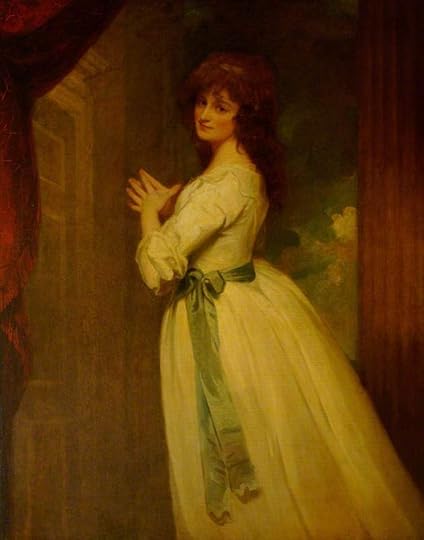
Dorothy Jordan (or Dora, as Tomalin calls her) had come from an insignificant Irish family to become one of the megastar actresses of her day, acclaimed by everyone from Coleridge to Charles Lamb as the greatest comic performer the stage had ever produced. (She didn't do tragedy – ‘I find laughing agree with me better than crying,’ she wrote.) Drury Lane was packed to the rafters when she was on the bill, and painters lined up to do her portrait for free. It was just good advertising.
George Romney, Dorothy Jordan as Peggy in The Country Girl, 1787
Among her admirers was the king's third son, Prince William the Duke of Clarence. To say that she became his lover gives slightly the wrong impression. She lived with him unmarried in a villa on the Thames for twenty-five years, and gave him ten children; clearly, they were devoted to each other and succeeded in creating an unconventional little domestic paradise under extremely difficult circumstances. Unlike other actresses who got involved with their social betters, Dora refused to stop working and indeed was responsible for bringing in most of the family's cash – the Duke was better at running up debts, and if he wanted money he had to ask his dad for some.
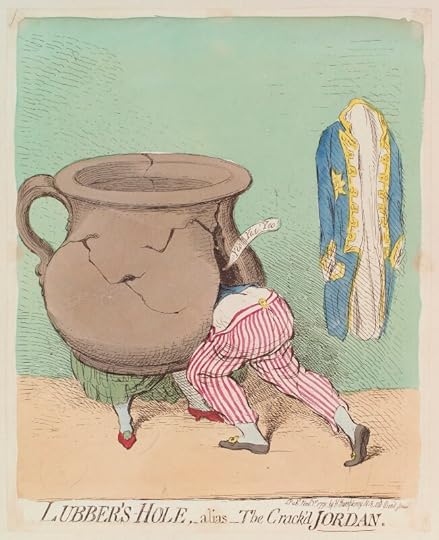
The public loved Dora but the press saw a tempting target. It was unfortunate that they were living during the golden age of satirists, a few of whom, like James Gillray, were geniuses. It didn't help that ‘jordan’ was slang for a chamber pot, offering up a handy visual pun.
James Gillray, Lubber's Hole, alias The Crack'd Jordan, 1791
The public, however, loved her. There is a very moving story of Dora performing on stage the day after a vicious attack had appeared in The Times; when one of the characters spoke the lines, ‘You have an honest face and need not be ashamed of showing it anywhere’, the audience shouted its applause for so long that tears came into her eyes. By this stage I was losing it a bit, too, because the end of her story is not a happy one.
The Duke could always be a slightly ridiculous figure – without any real public role, he was in danger of seeming ‘a royal Bottom to Dora's Titania’, as Tomalin comments. But as she also points out, this was ‘a world in which men took themselves, and were taken, very seriously indeed’. With legitimate heirs to the throne thin on the ground, William was pressed by advisors to give Dora up and make a proper marriage, and eventually he did so (finally marrying Adelaide of Saxe-Meiningen, whom he did not love or even like much). Dora, now too old to act the girlish parts she was famous for, and financially taken advantage of by a son-in-law, had to flee England because of debts, and ended up dying almost completely alone in a lodging-house in France.
The Duke had made financial provisions for Dora and the children, but as Tomalin says, ‘It is the failure of love, friendship, imagination and simple decency that appals.’ And after her death, her life was systematically erased from memory. The Duke of Clarence, rather unexpectedly, became King William IV in 1830, and by the time of his successor, Victoria, Dora's story had become utterly unacceptable. Her virtues, so well brought out in this biography, ‘were troubling to the Victorian age, and her private behaviour still more so’.
The first biography of William IV, in the 1880s, noted only that the King had ‘formed a connection with a well-known actress…there is no need to do more than to chronicle the fact, as the subject is a distasteful one’. It is a devastating remark once you know her story. Tomalin tells it at her usual steady pace, and with her seemingly all-encompassing knowledge of the period. It's a great life story to have excavated from the archives, and one that Meghan might do well to stick in her beach bag.
Another wonderful Tomalin biography in which every available piece of evidence is tracked down, teased out, dissected and analysed. The author has slightly more success on this occasion, but Dora Jordan remains effectively hidden from view to the modern observer.
Once again we can blame the Victorians - an 1884 two-volume biography of Jordan’s partner, King William IV, reduces her to half a sentence: the King had ‘formed a connection with a well-known actress…there is no need to do more than chronicle the fact, as the subject is a distasteful one.’ Strange, when the ‘connection’ comprises a relationship of twenty years and the fathering of seven children.
In fact, the eldest (George Fitzclarence 1794-1842) would (had he been legitimate) have ascended the throne in 1837 rather than his cousin, Victoria. Instead he committed suicide in 1842. Such is life.
I had enjoyed Claire Tomalin's introduction to her curated collection of "Katherine Mansfield's Short Stories", a writer I really esteem, so was on the lookout for some of her biographies and a copy of this has just come to hand. I devoured it immediately and can confirm that her writing continues to impress me, despite her exhaustive, exacting attention to detail.(1/4 of the book is given over to extensive notes, appendices, references, bibliography AND an index!).
Initially, the first chapters feel a trudge but once I ignored the comprehensive annotation, concentrated on the pages in front of me and explored the occasional footnote, I began to revel in this well-documented history of the finest comic actress of the Regency period in the British Isles. There are also really good representative photographs of her characterisations particularly her theatrical parts, of which her cross-dressing performances were the most notorious. Even Jane and Cassandra Austen saw her in person and she was wellknown to Fanny Burney, Samuel Taylor Coleridge et al.
As William Hazlitt commented(when comparing her daughter, Fanny's performance as Rosalind, unfavourably to that of her mother):
'Mrs Jordan's excellencies were all natural to her; it was not as an actress, but as herself, that she charmed everyone. Nature has formed her in most prodigal humour, and when nature is in the humour to make a woman all that is delightful, she does it most effectually. Mrs Jordan was the same in all her characters, and inimitable in all of them, because there was no one else like her.
Her face, her tears, her manners were irresistible. Her smile had the effect of sunshine, and her laugh did one good to hear it. Her voice was eloquence itself: it seemed as if her heart was always at her mouth. She was all gaiety, openness and good nature. She rioted in her fine animal spirits, and gave more pleasure than any other actress, because she had the greatest spirit of enjoyment in herself.'
Unfortunately, that reputation put her always within reach of the rapacious clutches of the men who frequented the stage and the footlights, and despite her mother's experiences of an identical but less successful career, Dora/Dorothea was destined to follow in her path of multiple failed relationships with men. These ranged from her first seducer/rapist who was a married theatre manager with a pregnant wife to a prince of the realm who subsequently became King William IV.
She ended up after 2 decades of living with the latter, being despatched from her family stately home, and was no longer able to care for the 10 living children she had by him. Prior to this, she had another 3 children by a couple of other men who had continued the stain of illegitimacy to the subsequent generation. And had had other pregnancies resulting in miscarriages as well. Despite her 25 years of ceaseless pregnancies, she had worked incessantly, even going into labour on the stage on 1 occasion! Yet only 1 of her children died in infancy, for she clearly was a committed and resourceful mother always continuing to be the breadwinner of the family. Surely, for the age, this must have been quite a record in both avoidance of maternal but also infant mortality? The following Beatles song I would like to emphasise her feat.
'Lady Madonna, children at your feet Wonder how you manage to make ends meet Who finds the money? When you pay the rent? Did you think that money was Heaven sent? Friday night arrives without a suitcase Sunday morning creep in like a nun Monday's child has learned to tie his bootlace See how they run
Lady Madonna, baby at your breast Wonder how you manage to feed the rest See how they run Lady Madonna, lying on the bed Listen to the music playing in your head
Tuesday afternoon is never ending Wednesday morning papers didn't come Thursday night your stockings needed mending See how they run
Lady Madonna, children at your feet Wonder how you manage to make ends meet'
Then, there's the press and the poison pen trolls. In Regency England, there was no Facebook or Internet to fan the flames, instead there were broadsheets and malicious cartoonists. There's no protection from them, and all you could do is to stand up to your detractors alone, there are no laws to protect your reputation. Nor any laws to prevent your impoverishment by incompetent common law husbands, even prodigal princes.
Perhaps when I hear celebrities whine about the mischievous mainstream media, I can think about the mistreatment of a true heroine of the Regency stage who died alone abroad of a broken heart, having given her all to her family, friends, lovers, colleagues and the theatre-going populace. There was never any welfare state to enhance her life, accommodate her prodigious maternal output, nor to accommodate her in the twilight of her career.
Perhaps, then to finish, another Beatles song comes to mind:
'I look at you all, see the love there that's sleeping While my guitar gently weeps I look at the floor, and I see it needs sweeping Still my guitar gently weeps
I don't know why nobody told you How to unfold your love I don't know how someone controlled you They bought and sold'
A brilliant, beautiful book which I can recommend to the bottom of the heart.
I've needed time to think about this one..and I'm in danger of running out of superlatives.
Dora Jordan was an immense super star in her day, deservedly so. Hugely talented as a comic actress with an immense range of roles from Shakespeare to slapstick (18/19 century equivalent). Astutely aware of her wide ranging public, musically talented and commercially shrewd she was also a very decent human being. Her stamina was super human, touring widely, often with a newish born baby in tow (13 survived and she miscarried at least twice). A working mother and a very good one as Claire Tomalin shows, particularly in her wide use of Dora's correspondence (she was a prolific letter writer). She bore 10 children to her royal lover, the future William IV and in many ways it seems to have been a love match. Even after she was "dumped" and had restricted access to her "royal" children she remained loyal to Wm and encouraged the children to be so too (it was in their best interests, admittedly).
Dora was a victim of a morally bankrupt Establishment but this was almost 200 years before Diana Princess of Wales who played by a very different set of rules.
Claire Tomalin has tears in her eyes at times when writing this but the book is none the worse for that. I thoroughly recommend it.
I love Claire Tomalin - best living biographer? and this is a good one.
Mrs Jordan has appeared as a bit-part player in lots of other stuff I've read, and it was fascinating to learn more about an extraordinary woman. If you're interested in the history of the theatre, women's roles in society, the way George III screwed up all his children's relationships... the power of satire and the changing (or not changing) way the media deals with people who don't fit the current definition of 'moral behaviour' this is a cracker.
Mistresses are practically as established a tradition in the Royal Family as Trooping the Colour or the Opening of Parliament. From Rosamund Clifford to Jane Shore, Nell Gwynn to Alice Keppell, there has been a long list of them, and Dora Jordan fits comfortably into that list. Like many of them too, she was discarded when her royal paramour tired of her, swept under the rug and effectively whitewashed from history. One previous historian dismissed the Duke of Clarence's, later King William IV, relationship with Dora as 'a connection with a well-known actress' and left it at that.
But such a dismissal does a grave disservice to both Dora and her relationship with Clarence. It wasn't a brief affair or a fling, a casual relationship that served both parties and flickered out of its own accord. Dora and the Duke of Clarence were married in all but name, living together for twenty years and producing ten children together. They were devoted to one another, and the Duke was an attentive and loving father to his own brood and a kind stepfather to Dora's earlier children. Dora did not rely on the Duke financially - indeed, her successful career on the stage and his tendency to accumulate debt meant that more often than not she was the one supporting the family. Her presence was grudgingly accepted by the Royal Family and whilst she herself was never acknowledged by the King and Queen, her children eventually were.
The story of Dora Jordan is a truly remarkable one, rising from poverty and deprivation to the position of acclaimed actress and royal mistress, bearing grandchild and children to kings. She fought her way up on her own merits and abilities, taking control of her own career and proving herself a shrewd manager. In Claire Tomalin's wonderful book, she comes across as an immensely likeable and sympathetic character, and I ended these pages enraged at the way she was treated at the end of her life.
This is the best kind of biography, bringing a long-lost and forgotten personality back to life, giving her a chance to shine on a public stage once again. I have thoroughly enjoyed every one of Tomalin's biographies and she has rapidly become one of my favourite authors, a writer whose every new work I look forward to immensely. I cannot rate this highly enough.
I finished this book on the bus on my way home from work, then sat quietly for a few minutes in reflection, got off at my stop, walked up to the house, got in the door, then turned to my significant other and said, "I am so disappointed in William IV right now." Despite him being one of our lesser-celebrated monarchs - and I have always known that he had precious little political achievements which one could celebrate - I had always kind of liked him. I knew that he was not a clever man, or a practical one, or even tactful - in fact, I knew he had few talents but I had always thought he was 'nice'. As a child, I picked up from my reading somewhere - possibly Horrible Histories but more likely Plantagenet Somerset Fry - that he had hated Queen Victoria's mother so much that he had been determined to thwart her chances of being appointed Regent by not dying while Victoria was a minor. When he did finally succumb to one of his many ailments, Victoria was eighteen years and three weeks old. That is some serious will power. What I had not quite realised though was quite how cold-bloodedly selfish and cruel he had been in his domestic conduct and it was that which aroused my disgust. I was completely wrong about him. The man was a louse and the woman he betrayed was one of the most truly remarkable figures of her age.
Dorothy Jordan styled herself as Mrs Jordan for most of her life, but as certain parties pointed out after her death, not only was she never officially married, there was never any Mr Jordan figure in her life at all. She was born Dora Bland, but even that name was only held on a technicality since her parents had not gotten round to getting married. Both working in the theatre, Dora's parents had fled respectable homes for a life around the stage but when Dora was around thirteen, her father repented of his wicked life and abandoned his common law wife and the nine children she had borne him to go and marry someone officially. Contact afterwards was sporadic at best and suddenly Dora was the main wage-earner. This was a pattern that would repeat itself throughout her life.
Claire Tomalin clearly developed a very warm feeling towards her subject but it is not hard to see why. Through her letters, Dora does come across as an intelligent and witty woman - circumstances prevented her from being a lady, meaning that she had to be surprisingly modern in her outlook. Throughout her life, no matter the peaks or troughs of her personal fortunes, Mrs Jordan was forever having to bail her siblings, offspring and finally and most disastrously sons-in-law out financially and no matter how difficult she found it, she always did her best to help them out. She was generous to all, hugely talented and ambitious for her own career, celebrated as the finest comic actress of her generation, acclaimed as having the best legs to ever grace a stage - it feels incredibly unjust that she is best known for being the Duke of Clarence's discarded mistress.
While still a teenager, Dora was seduced by her married theatre manager and left pregnant. Fleeing to England, she was able via contacts to get a job with a northern theatre company but due to her visible pregnancy, was advised to style herself as Mrs, and her theatre manager suggested the name 'Jordan' since Dora had crossed water to arrive in England. This would later cause her trouble since the word was also synonymous with chamber pot. In the company of her mother and dragging her siblings along with her (none of the younger Broads ever seemed to master the art of earning their own living), Dora climbed the theatrical ladder and tried to do the best for her young daughter Fanny. She even managed to garner a few shreds of respectability, since it was observed that although there was no Mr Jordan, there was no obvious sign of a lover either - Mrs Jordan was an honest woman trying to earn a living.
All this changed though when she met Richard Ford, a police magistrate who promised to marry her once his father gave consent. The two settled into a domestic arrangement which produced three children, although the middle child, Dora's first son, seems to have died shortly after birth. The years passed though with no wedding and as Dora's fame grew, she caught the eye of the Duke of Clarence. Growing frustrated with Ford and recognising that he was not going to commit, she seems to have given him an ultimatum - either he propose, or she would leave him for the prince. Tomalin hastens to Dora's defence here, worrying lest the reader think her mercenary or that she did not love either of the men in question. More than anything though, Dora comes across as a practical woman who realised that she had to look out for her own best interests and those of her children because nobody else was going to do so.
Dora Jordan was mistress to the Duke of Clarence for nigh on two decades. She bore him ten children. She wrote him letters full of warmth and affection, which Tomalin quotes extensively. The writer and diarist Fanny Burney recalls a friend's embarrassment on being introduced to Mrs Jordan and taking her to be the duke's wife and thus being mortified afterwards at having given precedence to a kept woman. Of course, Dora was never really kept - she continued to work, often bailing the duke out of his debts, although over time he grew insecure about her fame and demanded that she stop performing in London. She was no Alice Perrers. Even King George III, generally so despairing of his sons' inability to form conventional marriages, funded Clarence's purchase of Bushey, appearing to recognise that one decent mistress was better than a troublesome wife - Caroline of Brunswick caused more bother than Dora ever did.
It was so easy to see the warmth of the Bushey home - William wrote fretful notes of how Dora had been 'complaining' for several hours in her labour for their latest infant, when his brothers might suggest that he marry someone rich, he solemnly responded that he was quite content with Mrs Jordan. As pseudo-duchess, Dora seems to have set up a local school and been heavily involved in local charity work, having firsthand experience of poverty. The Prince of Wales and his brothers visited their home and afforded Dora ever precedence as hostess. Yet still, the cracks were always there. Every so often, bishops would be dispatched to Bushey to remonstrate with Clarence on his way of life. And Clarence's mother and sisters were never able to speak to Dora - they could only watch her performing on stage from the Royal box. I was really caught by this image - of how this little cluster of unhappy spinsters must have looked down on the mother of their nieces and nephews, the woman who had helped their awkward brother find contentment and thought - what? Did they hope to meet her? Did they believe her to be a fallen woman? Given that Princess Sophia herself had a child out of wedlock and that they all longed for liberty, could they have truly condemned her, their almost-sister-in-law?
The tragedy while reading this though is the knowledge that all this contentment, the affectionate letters, the love of these two people, it all has to come to an end. I had always harboured the impression that William parted ways from Dora following the death of Princess Charlotte, when pressure intensified to produce a legitimate heir. I was wrong. It was several years before. Earlier biographers excused him tiring of Dora, claiming that she had gotten fat (she had borne ten of his children and he was none so slim himself) and wheezy. Tomalin is far more critical, her indignation simmers from the page. Eldest daughter Sophia seems to have realised quickly which side her bread was buttered on, but second son Henry wrote a heartbreaking letter to his elder brother, catching the pain of a child realising that his family is disintegrating and proclaiming his mother 'a most injured woman'. He never seems to have quite forgiven his father and died young. William set about courting younger women, but without success - he was old, fat and had no money. Who would ever have loved him but Dora?
It is not just the cruelty of Clarence though but also that of those around him - whenever he was disposed to be clement, they urged him to be harsh. It was advisers who stated that Dora could not retain custody of her daughters by Clarence and continue her stage career. It was they who lowered the age at which the children should move to their father. When problems around the settlement arose, Dora wrote to the Prince of Wales, who had always appeared her friend. He thought it a very inappropriate move and refused to respond. The petty dishonesty of this, the lack of common decency in terms of interactions, it is that which turns the stomach. There was nobody to speak for Dora, to stand up for what was right - she was a discarded mistress and given her fame, she was a nuisance in her refusal to fade into the background. Rumours spread that Mrs Jordan planned to publish Clarence's letters to her - Princess Charlotte thought it would have served him right - but Dora returned them for fear that the gossip would injure the children in his eyes. Indeed, the parable of King Solomon and the mothers comes to mind - Dora wanted to keep her daughters with her, but she seems to have recognised that the best path for their lives lay with what their father's family could offer and, having heard disturbing reports that Clarence was being urged to disown his daughters, she gave up custody. As Tomalin points out, this decision served her girls well, as they all made good marriages but it was devastating for their mother.
It is hard not to have contempt for William in his behaviour towards the woman who had essentially been his wife for twenty years. After they parted, he went about gathering up every image of her he could find - he could revere the portrait as he was never able to do for the flesh and blood woman. Unable to attract a wife, he lived on in Bushey, still burdened by debt. Tomalin refers to this 'Micawber-like' existence, surrounded by his children and all of them longing for a note from Dora, which tended to include a pound note from her theatrical wages, meaning that food could be put on the table. Yet for all his disastrous decision-making, William was not the only villain of this particular piece. Dora had long been plagued by her daughter Fanny's poor behaviour, and then that of Fanny's husband. Her second daughter's husband appeared a more pleasant fellow and in one of her customary feats of generousity, she allowed him access to her bank accounts. This was fatal - he bankrupted her. While he could sit comfortably, with none of the debt in his name, Dora was forced to flee to France to escape his creditors. Nobody offered to help. Death came quickly and, one would suspect, was welcomed. Her rise had been meteoric, but her fall had been equally so.
In death, William could love Dora again. Once he was King, he commissioned a statue of her, which subseqently had a long and chequered history, with nobody willing to take responsibility for it. He married Adelaide who proved an adept stepmother, but still kept all his Dora portraits and commented on her worthiness to observers. His children were given titles after he acceded to the throne and the eldest George seems to have hoped that he might manoevre his way to the throne, finally committing suicide in middle age. Dora herself faded, becoming a paragraph in a biography - Victorians acknowledged that William IV had once lived with an actress but proclaimed that the less said about it, the better. My King and Queens book kept everything to a four line maximum - I knew her name and nothing else and dimly put her on a par with Mrs Fitzherbert, when in fact Dora came far closer to acting as a wife than the former ever did.
This was a book that made me so sad - like Tomalin, I really took to Dora. Her letters make her seem very approachable, she had experiences and understanding of all walks of life, formidable intelligence and an incredible work ethic. She got to the top of her profession through hard graft and perseverance but also through a determination to do right by those who depended upon her - her tragedy was that she never seems to have truly had anyone in her life that she could rely on. I have read biographies of Dora's contemporaries - Emma Hamilton, Georgiana Duchess of Devonshire, Princess Charlotte, but I have never liked any of the subjects as much as I liked Dora. I can well imagine why Clarence fell in love with her - he seems to have been the best possible version of himself while he was her partner but he could not live up to his commitment - certainly not to her and clearly she did not trust him to do so for their children. What came across forcefully within Mrs Jordan's Profession was that George III's sons were a group of spoilt and immature children who could only stick with something while it suited them and that they were content to abandon their toys the second they stopped being amusing, and that they could do so without guilt. By virtue of being royal, they lost their consciences.
Mrs Jordan's Profession may have lost me a 'king I quite liked', but it has given me a new heroine - Dorothy Bland. Tomalin makes her here so much more than the scandalous woman who acted as companion to a king - we see Dora for the remarkable person she truly was, a woman ahead of her time, someone of magnificent heart and passionately loyal to those she cared about. If fate had been kinder, she could have been a truly spectacular queen. One could argue, and William IV most certainly did, that the final author of Dora's downfall was her son-in-law, but William did not lift a finger to assist her in her distress. I think of John of Gaunt, forced to part from Katherine Swynford due to the pressure of public opinion and in a far more brutal age, but he still managed to act with honour and dignity and he made sure that it was known what would happen to those who injured the mother of his children - she was no longer kept but she had not lost his protection. The history of Mrs Jordan does not paint the male race or indeed the monarchy as a whole in a good light - I finished it feeling genuinely teary and full of sadness for this tough woman who was trampled by those who may have been her social betters but who were certainly her inferiors in every other respect.
Lots of history on the theater and social levels in the eighteenth century. I love Claire's work, and I learn so much, but sometimes the hundreds of details in the political and social scene are too much, and I get confused as to who is who, and then I just don't care anymore. I didn't find this nearly as interesting as Samuel Pepys, also written by Claire Tomalin. I gave up half way through.
Someone needs to make a movie about this remarkable British actress. In her prime she was as popular as any rock star is today. She had lots of children, so we're grateful the term baby bump hadn't yet been foisted on the world.
Fascinating. Recently, I've been drawn to biographies, and it's always a pleasure to learn about other people, places, times, locations. Tomalin is a fine biographer.
Another well-written gem by the talented biographer Claire Tomalin. Though MRS. JORDAN has a tad more personal interjection by the author than needed in a biography, it is easily forgiven. Tomalin started out with a massive study of actresses during Jordan's time period before refocusing on solely the life & times of Mrs. Jordan. Tomalin's passion for Jordan's life & the common issues of the time bubbles over into personal conjecture; in a lesser biographer's hand this would be cloying & overbearing, but luckily it is infrequent & thankfully bearable. All in all an entertaining, inspiring & fascinating read about a fascinating woman that could have easily been lost in the annals of history.
My Mum passed this on to me recently saying "you MUST read this" and I dithered around for a little while before finally starting it last week. And my Mum (as always) was right. I loved this book so much. I have never read any of Claire Tomalin's biographies before but I will definitely be looking out for them now. She really knows how to draw the characters and their lives, she does insert her own thoughts into the narrative but in a really sympathetic way, you know she really cares about Mrs. Jordan and I think that just makes the book better. I really started to care about Dora Jordan too, having raced through the first two thirds of the book, I could barely bring myself to pick it up the last few days because I knew what was coming and didn't want to read of the ways this amazing woman was let down by all the people closest to her at the end of her life. The book is also really interesting not only because of the life of Mrs Jordan but because of the ways it highlights the society she lived in; the hypocrisies and machinations of the wealthy and in particular the royal family and the government. The huge misogyny and double standards that meant society had no problem with men fathering illegitimate children, but would never accept their mother - or would never accept the mother mixing with unmarried women and "real" wives. I also think it's fascinating how history whitewashes some things out but in a way that affects forever how things are seen. I would never have known about the different nuances of the ways people lived together - how many people were married by law but not in church, how many men did marry actresses but who were then accepted - all these different ways of living which I feel like we think of as being modern but have actually been happening for hundreds of years - but we just see the past as more black and white. Perhaps because the Victorian era came next with its more "moralistic" outlook. I was also really surprised at how many female playwrights and musicians Claire Tomalin references. The history I have been taught is that they just didn't exist because, you know, *sexism*, and while it is true they faced sexism and misogyny at the time and that would have affected how many there were, they have also been the victim of sexism posthumously by being written completely out of history, just as Dora Jordan herself was. As a huge Georgette Heyer fan I found all the knowledge of this era fascinating. I really want to go back and reread her books again to hopefully find that I can understand even more of her references! I'm sure the Duke of Clarence pops up briefly in Regency Buck to flirt with the heroine! So finally, as my Mum said, you MUST read this book. Dora Jordan was truly an amazing and fascinating person and I only wish that I could have seen her act.
Mrs Jordan’s Profession is a surprising and moving biography about a very successful actress who performed under the name of Dora Jordan and who was also the mistress of William Duke of Clarence and future King William IV. What’s interesting about this biography is that although it’s about an actress and a mistress, it is not a raunchy work full of monocle-popping stories and naughty behaviour. It’s mostly domestic, a ‘nice’ story about a woman who worked hard at her career and to keep her family together. It’s also a tragedy.
Dora’s profession was important to her, she was born into a broadly theatrical family (I was surprised how many in acting families had clergymen close down the line) and she was on the stage at a relatively young age. It’s impressive how quickly she developed a coherent stage persona, not a glamorous figure but a ‘girl-next-door’ lovability and an appearance of naturalness that she maintained her whole career. She specialised in ‘pert’ roles, confident, tom-boyish women with an active role to play in the story.
After appearances in Ireland, she moved to the northern circuit with a baby in arms and conspicuously, no husband. Her professionalism bore her through these problems and she became beloved, moving to the London stage where she was introduced in a role she’d been quietly working on and making her own. A clear thread in the piece is her dedication to her profession, the work behind the scenes and on the stage - her costume was set on fire during a performance, she stripped off to her underwear and continued.
The second thread is her dedication to her children. Whether it was the first, unwanted but not unloved daughter Fanny, the children with her next partner, a man she was said to have married but who she later left after it became clear that he was never going to pop the question.
This led her to William, Duke of Cumberland. The third of the royal princess, he and Dora settled down to a cosy life in Bushy, where they had ten children, all during a busy performing and touring schedule. It’s clear she wasn’t with him for his wealth, she spent more of her money propping up the family than he did but they shared simple pleasures and the pleasure of their children.
There was some scandal, a fair amount of rude commentary but as before, Dora bore all this on the shield of her professionalism, declaring that the public only had a right to enquire into her public life. This near idyll went on for twenty years before the Duke decided he had better have a proper marriage and dropped Dora. The children had a strange position in society, illegitimate grandchildren of the King (later illegitimate children of a new King). It seems the girls had an easier time of it then the boys, marrying into genuine nobility.
The book is written with clarity and emotion. It is a real gut-wrenching moment when the family that Dora has worked so hard to maintain is scattered to the winds and she dies soon after. We were definitely on her side throughout, partly because she seems to have been a genuinely wonderful person but also because the reader is kept from any details that might make us dislike her.
I’d have liked more shades and shadows on Dora’s character. It’s not that I crave nastiness but the portrait of her seemed a little too bleached out.
The lady vanishes: a thesis on the vagaries of fame, the erasure of women, and the way the Royal family treats inconvenient females, that could almost have been written about any period in the last 200 years.
The joy of this is not that anyone needs to know about Dora Jordan, in her day a celebrity actress and courtesan, because they don’t: in historical terms she’s a slight figure who has little influence on the course of events. It’s that pleasure in finding someone who has thoroughly researched and immersed themselves in a subject few would trouble with, and then is able to tell it in a way that’s so wonderfully engaging that the reader begins to share their commitment.
A minorly fascinating figure - Mrs Jordan was the best-known and best-loved performer of her generation, hence the title and focus as much on her work as on the family life that brought her infamy and prurience - Dora sparkles from these pages as an outspoken, determined, fiercely maternal, career-minded, altruistic individual ahead of her time and out of place as minor prince’s shameful secret. The clash between her character and that of William, Duke of Clarence - a stupid little shortarse (the original Silly Billy) whose only claim to attention was an accident of birth - is as good an illustration as any of inherent female superiority, should you require it.
He ditched her in the end. Never mind 10 children and 20 years of effective married life. Wave a wad of money and a titled bride at a royal and that’s what you get. Mrs Jordan died in poverty and obscurity in France, separated from her beloved children and iced out by courtiers and lawyers. It couldn’t happen now, could it? (Well, they didn’t have the Daily Mail back then. There’s no peace these days.)
I wish I’d read this before peregrinating round Bushy a couple of years back - it’d have made more sense. Now, slightly enamoured of Mrs J, I must dig out Goddess of the Green Room by J Plaidy, one of the few times before La Tomalin when she got her props.
[2017] This is a beautifully written biography of Dorothy Jordan, the long-term partner of William, Duke of Clarence, son of King George III. It is exceptionally well researched, is comprehensive in coverage and written in easy, straight forward prose which is engaging, highly readable and enjoyable. You really become involved in her character and start to really become involved. She was an unusual personality, strong, determined and able to pursue her own life, but also vulnerable, unfortunately and at time amazingly naive. In many ways her life was very modern. Two failed relationships with theatre colleagues and three children later she met the Duke of Clarence and lived with him in a semi-official capacity for twenty years and proceeded to have ten more children. She was not content to be a 'kept-women' and worked hard as an actress, while understanding with humility the reputation of actresses at the time. She was a loving parter and caring mother, with no pretensions or demands. In fact, unbelievably, her hard work supported the profligate ways of the Prince and maintained thirteen children and in time, her sons-in-law, with disastrous effects.
This book captures the character of a modest hard working women who only ever wanted to be loved and to love in return. Ultimately the Prince abandoned her when it looked like he might inherit the throne and would need to produce a legitimate heir. Although extensive use of letters and witness accounts are made there is something about the description of her passivity around her abandonment that makes you rage on her behalf.
Well illustrated, three helpful family trees, extensive references and a well informed bibliography make this a resource for further reading. This is, in my opinion, a beautifully written biography, almost an exemplar of a biography. It gives a comprehensive account of a life, written in engaging form, while avoiding imposing modern values or suggesting emotional responses when they are unknown. I am usually able to find some negative or area for improvement in most books that I review, but here I could not. I'm not saying it is perfect as no book is, but if it did have errors I did not notice them. If you want to know how a biography should be written, to understand late eighteenth century theatre and the exploits of the Royal family and to really know a women of real substance this is, without doubt, the book for you.
Mrs. Dora Jordan is one of those fascinating historical figures. Her life is almost anachronistic, but not quite - she managed to break the rules in many ways, although they got her in the end. I read Jean Plaidy's excellent HF novel about Dora and the Duke of Clarence earlier this year, Goddess of the Green Room, and it made me want to learn more.
Dora was widely considered to be one of the greatest actors of her generation, managed to raise 13 children to adulthood, and balanced all of this while being the main breadwinner and dealing with social drama (mistress of a royal duke!) and her unemployed domestic partner. I ended the book feeling rather sad for her. She was a goodhearted soul from beginning to end, but so many people failed her, especially the men in her life. The historical sources used in this biography are fascinating in and of themselves, too. The author shares many portraits of Dora at the end, and they're remarkable.
A fascinating biography of one of the most well known comic actresses of the late eighteenth/early nineteenth century and the partner of the future King William IV for more than twenty years. Through her extensive correspondence including letters to her thirteen children, Tomalin shows that Mrs. Jordan was a devoted mother who was also passionate about her career on the stage, continuing to tour until close to the end of her life. Tomalin also reveals how her legacy fell into obscurity after her death during the Victorian era where her career, children out of wedlock and passionate defense of her own reputation through letters to the newspapers were out of step with changing social and cultural expectations of women. Includes an annotated bibliography and notes on sources. Be sure to read the footnotes for the story of Louisa Fairbrother, another actress who started a family with a nineteenth century Prince.
Dora Jordan's story is a surprisingly modern one for a woman whose life straddled the eighteen and nineteenth centuries. The child of broken family, she became a successful actress and never married, despite having children with three different men. She is most well-known for her last lover, a royal prince who later became King William IV. This biography does a good job of presenting what is known about Dora Jordan and offering educated speculation for the gaps in her life. The most frustrating part is unpacking the motivation of William when he left Dora after twenty years, but some things might never be known about this relationship. Overall, this was a great read, even if I was saddened by Dora's eventual fate.
Highly readable and hugely entertaining biography of actress Dora Jordan, the megastar of the late 1700s.
The highlight for me was not so much learning about Jordan herself, but the floodlight Tomalin shines on the acting profession and the relationship between people considered 'unfit for decent society' due to the travelling nature of their work, and the rich and influential. The small details of how acting was thought of, and the social conditions under which actors/theatre people lived despite their sometimes huge popularity that Tomalin treats us to, is a lasting lesson in human nature.
Hugely recommended for anyone interested in English culture, English literature, theatre, actors, the dynamics of fame, and unique women.
Discovering a trove of letters would have seemed a wonderful opportunity to delve into this story. Despite the material available, the story feels thin. And the shocking behaviour of the so-called “royal” family towards Mrs Jordan has strong echoes even in the last 100 years. Persistent hypocrisy, entitlement, remoteness et al pervade the Windsors and I felt this was a rich seam that could have been made more of a subject.
Tomalin is a wonderful writer and this book is full of early nineteenth century information that is new to me. Many sad moments. I was left with the feeling that many of Mrs. Jordan's children were a lot more worthwhile than the legitimate descendants of the British family of that time, and Mrs. Jordan was a much better mother than Queen Victoria ever was.
Excellent! A fascinating glimpse into the theatre and royal family in the reign of George III; not forgetting the unusual FitzClarence family. Well written and very readable - prepare to be charmed by, and for the sad demise, of an icon of her age.
Fascinating book which at time’s felt like fiction and I was gripped following a story remembering its real. Very easy read that shines a light on a great celebrity of her day overshadowed by Victorian prudishness.
A fascinating and inspiring woman and subject for the book. A riveting glimpse into late Georgian society both theatrical and royal. An extremely detailed account, though the level of detail on occasion slows the pace of reading.
Claire Tomalin's biography of the great Georgian comic actress Mrs Jordan is both readable and comprehensive. It tells of her rise to fame on the stage of the Theatre Royal, Drury Lane, and how she became the longstanding mistress of the Duke of Clarence, the future William IV.
I was particularly struck by the number of men in Dora’s life who let her down: her father, who abandoned her mother to marry an heiress; her first theatre manager, Richard Daly, who seduced her and made her pregnant; her lover Richard Ford, who did not care enough for her to marry her and prevent her from becoming the Duke of Clarence’s mistress; the Duke of Clarence, who, after living with her happily for years, abandoned her so he could make an advantageous marriage; and finally, John Barton, one of the Duke’s advisors, who failed to sort out her debts, leaving her to die in poverty abroad, away from her beloved children.
One of the things that I learned from this book was just how uncertain Dora’s position in society was. Although she was famous in her own right as an actress, her relationship with the Duke closed doors to her that were open to her contemporary, Mrs Siddons. Dora had ten children with the Duke; the children went into society with their father, but she was not invited.
Despite his royal position, I believe that the Duke was the gainer in the relationship. As Tomalin explains, Dora preached good sense to the Duke and supported him with her earnings rather than the other way round. I found Dora’s abandonment by the Duke quite heartless and his attempt to appease his conscience by commissioning an elaborate memorial to her when he became King rather pathetic.
My favourite anecdote in the book—which I had not heard before—was the story of how Mrs Jordan acquired her stage name. After escaping from her Irish stage manager, Daly, Dora started to work for Tate Wilkinson’s Yorkshire company. As she was pregnant, it was imperative that she was billed as ‘Mrs’—but Mrs what? Wilkinson made a biblical allusion, comparing Dora’s crossing of the Irish Sea to safety with his company to the Israelites crossing the River Jordan into the Promised Land. Dora liked the illusion and so the famous Mrs Jordan was born.
I borrowed this book from the library, but I would be happy to add it to my bookshelves as a detailed account of the life of an important figure in late Georgian England.
This is a biography of Dora Jordan, 'mistress' of William Duke of Clarence before he became King William the Fourth. Today she would be called his wife. She was the the leading comic actress of the day but this was no stage door affair. They set up house and had ten children together. And she was the main provider. The Duke of Clarence was one of King George the Third's improvident younger sons and Mrs Jordan's hard work both on stage and as a theatre impresario paid his gambling bills and constant debts. She was a steadying influence on him as well as keeping him solvent. She was loving and generous but his family refused to meet her or acknowledge her.
When it appeared that he was to be next in line to the throne he was pressured to abandon her. This he did and he married a minor European Royal person who became Queen Adelaide to his King William. Queen Adelaide had the grace to arrange for the acceptance of the children of Dora and William by the Royal family but Dora herself moved to France to avoid embarrassing William and she died there in poverty after only a few months. Shabby treatment for a decent person.
Dora Jordan was a famous and respectable comic actress and was adored by her public. She was a loyal and loving common law wife to a man who was not able to match her in loyalty and dignity.
This is a lovely insight into so much of the late 18thC and early 19thC . I enjoyed the world of theatre and travelling players as well.
One of the enduring images for me is of the cartoon by Gillray published in 1797 of The Duke and Mrs Jordan walking in the park. Mrs Jordan is walking apart and studying a script and the Duke in the foreground has a doll hanging out of his pocket and is pulling a pram with three of their children in it. It was a satirical poke at the Duke and what was considered his irregular lifestyle but I found it quite a touching domestic scene and an acknowledgment of Mrs Jordan's professional life.
I found this book on a stall at a country market, that is completely accidently, and I can't stress enough how much pleasure it gave me and what a revelation it was. I followed it up with Princesses:The Six Daughters of George the Third by Flora Fraser. Another wonderful read and an insight into the family of George Duke of Clarence.
The author said she did not have much information to draw upon to write this book. Possible because many around her burnt her letters. She spent many years as consort to the Duke of Clarence, a title the king bestowed upon his childish and silly 4th (?) son. Neither the child nor the man appeared to have any talents. He WAS, however besotted with Mrs. Jordon, who by all accounts, was an excellent actress. Why the feeling was reciprocated is a mystery to me. And why Mrs. Jordan bore ten of his children is another mystery. Mrs. Jordan was in France often and should have picked up some tricks as to how to forego pregnancy. It is clear that both parents were lovers of children, but I can't get past the idea that Mrs. Jordan especially with the noble circles she ran in, could not have learned something. I can only conclude that she wanted to have all these children, and it is maybe unfair to judge her by the standards of today. But here's another thing: it should have been clear that women were routinely dumped by their noble benefactors, leaving them with barely a crust of bread. It seemed to me that Mrs. Jordan routinely turned a blind eye to the future. This makes me scorn her a bit. She ignores reality left and right. And eventually (it says so in the book jacket) she is left penurious to die alone. I never felt I got to know this character or why she behaved as she did. Coming from a poor background, you would think she would be even more alert as to what happens to good actresses who stray from the rules of the time.