

What do you think?

Gormenghast #1-3
The Gormenghast Novels
A doomed lord, an emergent hero, and a dazzling array of bizarre creatures inhabit the magical world of the Gormenghast novels which, along with Tolkien's Lord of the Rings, reign as one of the undisputed fantasy classics of all time. At the center of it all is the seventy-seventh Earl, Titus Groan, who stands to inherit the miles of rambling stone and mortar that form Gormenghast Castle and its kingdom, unless the conniving Steerpike, who is determined to rise above his menial position and control the House of Groan, has his way.
In these extraordinary novels, Peake has created a world where all is like a dream — lush, fantastical, and vivid. Accompanying the text are Peake's own drawings, illustrating the whole assembly of strange and marvelous creatures that inhabit Gormenghast.
Also featuring:
- Introductory essays by Quentin Crisp and Anthony Burgess
- Twelve critical essays curated by Peake scholar G. Peter Winnington
- Fragment of the unpublished novel Titus Awakes
In these extraordinary novels, Peake has created a world where all is like a dream — lush, fantastical, and vivid. Accompanying the text are Peake's own drawings, illustrating the whole assembly of strange and marvelous creatures that inhabit Gormenghast.
Also featuring:
- Introductory essays by Quentin Crisp and Anthony Burgess
- Twelve critical essays curated by Peake scholar G. Peter Winnington
- Fragment of the unpublished novel Titus Awakes
1173 pages, Trade Paperback
First published January 1, 1959
About the author
Mervyn Peake
102 books1,196 followersMervyn Laurence Peake was an English modernist writer, artist, poet and illustrator. He is best known for what are usually referred to as the Gormenghast books, though the Titus books would be more accurate: the three works that exist were the beginning of what Peake conceived as a lengthy cycle, following his protagonist Titus Groan from cradle to grave, but Peake's untimely death prevented completion of the cycle, which is now commonly but erroneously referred to as a trilogy. They are sometimes compared to the work of his older contemporary J.R.R. Tolkien, but his surreal fiction was influenced by his early love for Charles Dickens and Robert Louis Stevenson rather than Tolkien's studies of mythology and philology.
Peake also wrote poetry and literary nonsense in verse form, short stories for adults and children ("Letters from a Lost Uncle"), stage and radio plays, and Mr Pye, a relatively tightly-structured novel in which God implicitly mocks the evangelical pretensions and cosy world-view of the eponymous hero.
Peake first made his reputation as a painter and illustrator during the 1930s and 1940s, when he lived in London, and he was commissioned to produce portraits of well-known people. A collection of these drawings is still in the possession of his family. Although he gained little popular success in his lifetime, his work was highly respected by his peers, and his friends included Dylan Thomas and Graham Greene. His works are now included in the collections of the National Portrait Gallery and the Imperial War Museum.
Peake also wrote poetry and literary nonsense in verse form, short stories for adults and children ("Letters from a Lost Uncle"), stage and radio plays, and Mr Pye, a relatively tightly-structured novel in which God implicitly mocks the evangelical pretensions and cosy world-view of the eponymous hero.
Peake first made his reputation as a painter and illustrator during the 1930s and 1940s, when he lived in London, and he was commissioned to produce portraits of well-known people. A collection of these drawings is still in the possession of his family. Although he gained little popular success in his lifetime, his work was highly respected by his peers, and his friends included Dylan Thomas and Graham Greene. His works are now included in the collections of the National Portrait Gallery and the Imperial War Museum.
Ratings & Reviews
Friends & Following
Create a free account to discover what your friends think of this book!
Community Reviews
Displaying 1 - 30 of 782 reviews

April 14, 2013
Years pass but spells cast on me by the Gormenghast hold.
The world is divided in two parts: the domain of ugliness and the realm of beauty, the morass of useless and stale traditions and the enigmatic and enticing life on the land outside. And the lonely boy Titus Groan, the heir of the monstrously huge castle of Gormenghast, must grow up and fight the lethargic, deadly inertia and crush fatal cosmic evil surrounding him.
And the language of the saga is a creation of an unadulterated wizardry:
The Gormenghast is an ultimate coming-of-age tale, a real Armageddon of good and evil and it is one of the best and most original books of the twentieth century.
When we grow up we pass the point of no return so there is no way for us to come back to the serene and cozy world of our childhood.
The world is divided in two parts: the domain of ugliness and the realm of beauty, the morass of useless and stale traditions and the enigmatic and enticing life on the land outside. And the lonely boy Titus Groan, the heir of the monstrously huge castle of Gormenghast, must grow up and fight the lethargic, deadly inertia and crush fatal cosmic evil surrounding him.
And the language of the saga is a creation of an unadulterated wizardry:
It gave Mr Flay what he imagined must be pleasure. He was discovering more and more in this new and strange existence, this vastness so far removed from corridors and halls, burned libraries and humid kitchens, that gave rise in him to a new sensation, this interest in phenomena beyond ritual and obedience – something which he hoped was not heretical in him – the multiformity of the plants and the varying textures in the barks of trees, the varieties of fish and bird and stone. It was not in his temperament to react excitedly to beauty, for, as such, it had never occurred to him. It was not in him to think in terms. His pleasure was of a dour and practical breed; and yet, not altogether. When a shaft of light fell across a dark area his eyes would turn to the sky to discover the rift through which the rays had broken. Then they would return with a sense of accomplishment to the play of the beams.
The Gormenghast is an ultimate coming-of-age tale, a real Armageddon of good and evil and it is one of the best and most original books of the twentieth century.
‘In the sight of all! In the sight of the Castle’s Southern wing, in the sight of Gormenghast Mountain, and in the sacred sight of your forefathers of the Blood, I, Warden of the immemorial Rites proclaim you, on this day of Earling, to be the Earl, the only legitimate Earl between heaven and earth, from skyline to skyline – Titus, the Seventy-seventh Lord of Gormenghast.’
A hush most terrible and unearthly had spread and settled over the lake, over the wood and towers and over the world. Stillness had come like a shock, and now that the shock was dying, only the white emptiness of silence remained. For while the concluding words were being cried in a black anger, two things had occurred. The rain had ceased and Titus had sunk to his knees and had begun to crawl to the raft’s edge with a stone in one hand and an ivy branch in the other. And then, to the horror of all, had dropped the sacrosanct symbols into the depths of the lake.
When we grow up we pass the point of no return so there is no way for us to come back to the serene and cozy world of our childhood.

May 14, 2007
I know of no author in all of the English language who is like Peake, or who could aspire to be like him. His voice is as unique as that of Milton, Bierce, Conrad, Blake, Donne, or Eliot, and as fully-realized. I am a hard and critical man, cynical and not easily moved, but there are passages in the Gormenghast series which so shocked me by the force of their beauty that I snap the book shut, overwhelmed with wonderment, and take a moment to catch my breath.
I would drop my head. My eyes would search the air; as if I could find, there, the conclusion I was seeking. My brow would crease--in something like despondency or desperation--and then, of its own accord, a smile would break across my face, and I would shake my head, slowly, and laugh, and sigh. And laugh.
Peake's writing is not easy fare. I often needed room to breathe and time for contemplation, but he is not inaccessible, nor arduous. He does not, like Joyce or Eliot, require the reader to know the history of western literature in order to understand him. His story is deceptively simple; it is the world in which he sets it that can be so overwhelming.
Peake writes with a painter's eye, which is natural enough, as he is more famous as an illustrator than a writer (the only self-portrait in the National Portrait Gallery). He paints each scene, each moment, in such careful, loving, playful detail that it can only be described by the original definition of 'sublime': a vista which is so grand and beautiful that it dwarfs our humanity, evoking a wonder akin to fear.
But Peake's writing is not so entirely alienating; on the contrary: he is vividly concerned with life. Gormenghast is the story of a life starting at birth, though our hero only got as far as the cusp of manhood before Peake was seized by malady and death. Each character is brightly and grotesquely alive. The 'fantasy' of this book is not, like so many epics, magic signifying moral conflict. The magic of Peake's world is the absurdly perfect figures that people it.
They are stylized and symbolic, but like Gogol, Peake is working off of his own system of symbology instead of relying on the staid, familiar archetypes of literature. Unusual as they may be, there is a recognizable verisimilitude in the madness imbued in each. Their obsessions, quirks, and unpredictability feel all too human. They are frail, mad, and surprising.
Like the wild characters of his sketches, Peake writes in exaggerated strokes, but somehow, that makes them more recognizable, realistic, and memorable than the unadorned reality of post-modernists. Since truth is stranger than fiction, only off-kilter, unhinged worlds will seem real--as Peake's does. This focus on fantastical characters instead of fantastical powers has been wryly dubbed 'Mannerpunk' or a 'Fantasy of Manners'. It is a much more enveloping and convincing type of fantasy, since it engages the mind directly with visceral artistic techniques instead of relying on a threadbare language of symbolic power. Peake does not want to explain the world, but paint it.
Tolkien can certainly be impressive, in his way, but after reading Peake, it is difficult to call him fantastical. His archetypal characters, age-old moral conflict, and epic plot all seem so hidebound against the wild bulwark of Peake's imagination. The world of Gormenghast is magical and dreamlike, without even needing to resort to the parlor tricks of spells, wizards, and monsters.
Peake's people are more fantastical than dragons because their beings are instilled with a shifting and scintillating transience. Most dragons, fearsome as they may be on the outside, are inwardly little more than plot movers. Their fearful might is drawn from a recognizable tradition, and I question how fantastical something can really be when its form and behavior are so familiar to us.
Likewise Peake's world, though made up of things recognizable, is twisted, enchanted, and made uncanny without ever needing to stretch our disbelief. We have all experienced wonder, confusion, and revelation at the world, so why do authors think that making it less real will make it more wonderful? What is truly fantastical is to find magic in our own world, and in our own lives.
But then, it is not an easy thing to do. Authors write in forms, cliches, archetypes, and moral arguments because it gives them something to work with; a place to start, and a way to measure their progress, lest they lose themselves. To write unfettered is vastly more difficult, and requires either great boldness, or great naivete.
Peake is ever bold. You will never catch him flat-footed; his pen is ever moving. He drives on in sallies and skirmishes, teasing, prodding, suggesting, and always, in the end, he is a quantum presence, evading our cumbersome attempts to catch him in any one place. Each sentence bears a thought, a purpose, a consciousness. The only thing keeping the book moving is the restless joy of Peake's wit, his love and passion for his book, its places, characters, and story.
He also has a love for writing, and for the word, which is clear on every page. A dabbler in poetry, his careful sense of meter is masterful, as precise as Bierce. And unlike most fantasists, Peake's poetry is often the best part of his books, instead of the least palatable. Even absent his amusing characterization and palpable world, his pure language is a thing to behold.
In the introduction, Quentin Crisp tells us about the nature of the iconoclast: that being different is not a matter of avoiding and rejecting what others do--that is merely contrariness, not creativity. To be original means finding an inspiration that is your own and following it through to the bitter end.
Peake does that, here, maintaining a depth, pace, and quality that is almost unbelievable. He makes the book his own, and each time he succeeds in lulling us into familiarity, we can be sure that it is a playful ruse, and soon he will shake free again.
Alas, not all readers will be able to keep up with him. Those desiring repetition, comfort, and predictability will instead receive shock, betrayal, and confusion. However, for those who love words, who seek beauty, who relish the unexpected, and who find the most stirring sensation to be the evocation of wonder, I have no finer book to suggest. No other fantasist is more fantastical--or more fundamentally human.
My Fantasy Book Suggestions
I would drop my head. My eyes would search the air; as if I could find, there, the conclusion I was seeking. My brow would crease--in something like despondency or desperation--and then, of its own accord, a smile would break across my face, and I would shake my head, slowly, and laugh, and sigh. And laugh.
Peake's writing is not easy fare. I often needed room to breathe and time for contemplation, but he is not inaccessible, nor arduous. He does not, like Joyce or Eliot, require the reader to know the history of western literature in order to understand him. His story is deceptively simple; it is the world in which he sets it that can be so overwhelming.
Peake writes with a painter's eye, which is natural enough, as he is more famous as an illustrator than a writer (the only self-portrait in the National Portrait Gallery). He paints each scene, each moment, in such careful, loving, playful detail that it can only be described by the original definition of 'sublime': a vista which is so grand and beautiful that it dwarfs our humanity, evoking a wonder akin to fear.
But Peake's writing is not so entirely alienating; on the contrary: he is vividly concerned with life. Gormenghast is the story of a life starting at birth, though our hero only got as far as the cusp of manhood before Peake was seized by malady and death. Each character is brightly and grotesquely alive. The 'fantasy' of this book is not, like so many epics, magic signifying moral conflict. The magic of Peake's world is the absurdly perfect figures that people it.
They are stylized and symbolic, but like Gogol, Peake is working off of his own system of symbology instead of relying on the staid, familiar archetypes of literature. Unusual as they may be, there is a recognizable verisimilitude in the madness imbued in each. Their obsessions, quirks, and unpredictability feel all too human. They are frail, mad, and surprising.
Like the wild characters of his sketches, Peake writes in exaggerated strokes, but somehow, that makes them more recognizable, realistic, and memorable than the unadorned reality of post-modernists. Since truth is stranger than fiction, only off-kilter, unhinged worlds will seem real--as Peake's does. This focus on fantastical characters instead of fantastical powers has been wryly dubbed 'Mannerpunk' or a 'Fantasy of Manners'. It is a much more enveloping and convincing type of fantasy, since it engages the mind directly with visceral artistic techniques instead of relying on a threadbare language of symbolic power. Peake does not want to explain the world, but paint it.
Tolkien can certainly be impressive, in his way, but after reading Peake, it is difficult to call him fantastical. His archetypal characters, age-old moral conflict, and epic plot all seem so hidebound against the wild bulwark of Peake's imagination. The world of Gormenghast is magical and dreamlike, without even needing to resort to the parlor tricks of spells, wizards, and monsters.
Peake's people are more fantastical than dragons because their beings are instilled with a shifting and scintillating transience. Most dragons, fearsome as they may be on the outside, are inwardly little more than plot movers. Their fearful might is drawn from a recognizable tradition, and I question how fantastical something can really be when its form and behavior are so familiar to us.
Likewise Peake's world, though made up of things recognizable, is twisted, enchanted, and made uncanny without ever needing to stretch our disbelief. We have all experienced wonder, confusion, and revelation at the world, so why do authors think that making it less real will make it more wonderful? What is truly fantastical is to find magic in our own world, and in our own lives.
But then, it is not an easy thing to do. Authors write in forms, cliches, archetypes, and moral arguments because it gives them something to work with; a place to start, and a way to measure their progress, lest they lose themselves. To write unfettered is vastly more difficult, and requires either great boldness, or great naivete.
Peake is ever bold. You will never catch him flat-footed; his pen is ever moving. He drives on in sallies and skirmishes, teasing, prodding, suggesting, and always, in the end, he is a quantum presence, evading our cumbersome attempts to catch him in any one place. Each sentence bears a thought, a purpose, a consciousness. The only thing keeping the book moving is the restless joy of Peake's wit, his love and passion for his book, its places, characters, and story.
He also has a love for writing, and for the word, which is clear on every page. A dabbler in poetry, his careful sense of meter is masterful, as precise as Bierce. And unlike most fantasists, Peake's poetry is often the best part of his books, instead of the least palatable. Even absent his amusing characterization and palpable world, his pure language is a thing to behold.
In the introduction, Quentin Crisp tells us about the nature of the iconoclast: that being different is not a matter of avoiding and rejecting what others do--that is merely contrariness, not creativity. To be original means finding an inspiration that is your own and following it through to the bitter end.
Peake does that, here, maintaining a depth, pace, and quality that is almost unbelievable. He makes the book his own, and each time he succeeds in lulling us into familiarity, we can be sure that it is a playful ruse, and soon he will shake free again.
Alas, not all readers will be able to keep up with him. Those desiring repetition, comfort, and predictability will instead receive shock, betrayal, and confusion. However, for those who love words, who seek beauty, who relish the unexpected, and who find the most stirring sensation to be the evocation of wonder, I have no finer book to suggest. No other fantasist is more fantastical--or more fundamentally human.
My Fantasy Book Suggestions

April 11, 2012
A thing of beauty, like the words it contains: carefully bound, with sumptuous illustrations. I'm often wary of pictures in adult books, but Peake was a painter and illustrator as well as a writer, so I make an exception in this case. He sketched in the margins of most of his writings, as he wrote. Artistic symbiosis.
Two of my three favourite books, plus a third I’ve learned to like, in one volume, with an excellent introduction by China Mieville, and Sebastian Peake's note about the illustrations.
The content is covered in separate reviews:
Titus Groan: review HERE.
Gormenghast: review HERE.
Titus Alone: review HERE.
All my Peake/Gormenghast reviews (including biographies/memoirs and books about his art) are on a shelf,
HERE.
Most of the biographical detail is in my review of Winnington’s Vast Alchemies, HERE.
Overview
Peake planned many Titus books, but managed only these three, plus the short story Boy in Darkness (which I reviewed HERE). After Titus Groan, he wrote to his wife, Maeve:
“Groan I feel could grow giant, imaginative wings, flare out majestically, ludicrously, fantastically, earthly, gloriously into creation, unlike anything else in English literature.”
These three books are in many ways uncategorisable: often classed as fantasy, the first two have the feel of historical fiction, but with a twist of magical realism. But the third volume has futuristic aspects. What is perhaps more surprising is that in the decades since Titus Groan was first published, there haven't been any successful books in that unique category.
They are whimsical, detailed, leisurely, poignant, vivid, gothic, caricatures (but believable, not surreal). Amazingly detailed descriptions, and extraordinarily extended metaphors, especially of characters' faces, skin and other physical features and of candles and their drips! Not afraid to go off on a lengthy tangent (eg when likening the cracks in plaster to an ancient map, he goes on to imagine journeys across such a landscape). So, in some ways, quite slow, yet always a page turner. Peake is not afraid to kill off (numerous) significant characters.
There is an overwhelming sense of place in the first two, but the time/period is slippery. There is a medieval air (swords and feet, not guns an cars), but medicines, safety pins, liqueurs, tea, and celluloid are mentioned. However, there is no mention of shops and businesses, news, politics, theatres, concerts, or police: no society or institutions other than the castle itself. The third book is definitely in the near future (floating electronic spying devices and death rays), but there it’s the location that is disorientingly elusive and yet vivid.
Regarding the place, Gormenghast is a central character. Maybe the main character - even in Titus Alone, which mostly takes place elsewhere. And yet although Peake sketched most of the main characters, often more than once, and often with great beauty and detail, his illustrations of the castle itself are few and sketchy.
There are echoes of Dickens (characterisation and odd names for people), Kafka (insignificant individual subsumed by tradition and procedure; also hard to locate the historical period), Tolkien is often mentioned though I can't see much of a similarity. Conversely, it is perhaps a minor influence for Paul Stewart's Edge Chronicles for children.
Quotes from Titus Groan
My review HERE.

Peake's sketch of Steerpike and Barquentine
• “Lord Sepulchrave walked with slow strides, his head bowed. Fuchsia mouched. Doctor Prunesquallor minced. The twins propelled themselves forward vacantly. Flay spidered his path. Swelter wallowed his.”
• Swelter’s voice is “like the warm, sick notes of some prodigious mouldering bell”.
• Cracks in the wall “A thousand imaginary journeys might be made along the banks of these rivers of an unexplored world”. (A similar idea in Boy in Darkness, when Titus looks at a mildewed spot on the ceiling.)
• The Countess’s room was “untidy to the extent of being a shambles. Everything had the appearance of being put aside for the moment.”
• “His [Sourdust] face was very lined, as though it had been made of brown paper that had been crunched by some savage hand before being hastily smoothed out and spread over the tissues.”
• The Earl’s life, and to some extent everyone else’s, is governed by detailed and largely pointless arcane ritual. “The second tome was full of blank pages and was entirely symbolic... If, for instance, his Lordship.. had been three inches shorter, the costumes, gestures and even the routes would have differed from those described in the first tome.” “It was not certain what significance the ceremony held... but the formality was no less sacred for it being unintelligible”.
• “She [Fuchisa] appeared to inhabit, rather than to wear her clothes.”
• “as empty as an unremembered heart” (the “stage” in Fuchsia’s attic).
• "Today I saw a great pavement among the clouds made of grey stones, bigger than a meadow. No one goes there. Only a heron. Today I saw a tree growing out of a high wall, and people walking on it far above the ground. Today I saw a poet look out of a narrow window... I saw today... a horse swimming in the top of a tower: I saw a million towers today."
• The twins’ faces “were quite expressionless, as though they were preliminary layouts for faces and were waiting for sentience to be injected”.
• An extraordinary metaphor at the end of this one about Irma Prunesquallor: “more the appearance of having been plucked and peeled than of cleanliness, though clean she was... in the sense of a rasher of bacon”!
• “Treading in a pool of his own midnight”.
• “We are all imprisoned by the dictionary. We choose out of that vast, paper-walled prison our convicts, the little black printed words, when in truth we need fresh sounds to utter, new enfranchised noises which would produce a new effect.”
• Burned books are “the corpses of thought”.
• “lambent darkness” is a good oxymoron.
• Lightning is, “a light like razors. It not only showed to the least minutiae the anatomy of masonry, pillars and towers, trees, grass-blades and pebbles, it conjured these things, it constructed them from nothing... then a creation reigned in a blinding and ghastly glory as a torrent of electric fire coursed across the heavens.”
• “The outpouring of a continent of sky had incarcerated and given a weird hyper-reality of closeness to those who were shielded from all but the sound of the storm.”
Quotes from Gormenghast
My review HERE.

Peake's illustration of Bellgrove and Titus (+ marbles)
• “porous shadow-land... not so much a darkness... as something starved for moonbeams.”
• “There is nowhere else... you will only tread a circle... everything comes to Gormenghast.”
• “suckled on shadows, weaned as it were on webs of ritual”
• “He was pure symbol... even the ingenious system of delegation whereon his greatness rested was itself worked out by another”
• He “had once made a point of being at least one mental hour ahead of his class... but who had long since decided to pursue knowledge on an equal footing”.
• “a smile she was concocting, a smile more ambitious than she had so far dared to invent. Every muscle in her face was pulling its weight. Not all of them knew in which direction to pull, but their common enthusiasm was formidable.”
• words that are “proud with surrender”.
• “Their presence and the presence of their few belongings... seemed to reinforce the vacancy of their solitude.”
• “A window let in the light and, sometimes, the sun itself, whose beams made of this silent, forgotten landing a cosmos, a firmament of moving motes, brilliantly illumined, an astral and at the same time solar province. Where the sunbeams struck, the floor would flower like a rose, a wall break out in crocus-light, and the banisters would flame like rings of coloured snakes.”
• “the very lack of ghosts... was in itself unnerving”
• It’s positively Wodehousian in places, “made one wonder how this man [Fluke] could share the self-same world with hyacinths and damsels” and his [Perch Prism’s] “eyes with enough rings around them to lasso and strangle at birth any idea that he was under 50”.
• Around the lake “trees arose with a peculiar authority” an one spinney was “in an irritable state”, another “in a condition of suspended excitement” while other trees were variously aloof, mournful, gesticulating, exultant and asleep.
• The boys changed ammunition to paper pellets only after the THIRD death and “a deal of confusion in the hiding of the bodies”!
• “A cloud of starlings moved like a migraine across the upper air”
• “A symbol of something the significance of which had long been lost to the records”
• “Countless candles dribbled with hot wax, and their flames, like little flags, fluttered in the uncharted currents of air.”
• The wick of an enormous oil lamp was “as wide as a sheep’s tongue”!
• “the long drawn hiss of reptilian rain”
• In the snow, “the terrain bulged with the submerged features of a landscape half-remembered”
• “as empty as tongueless bells”
• “as a withered spinster might kiss a spaniel’s nose”
Quotes from Titus Alone
My review HERE.

Peake's illustration of Muzzlehatch
• “The very essence of his vocation was ‘removedness’... He was a symbol. He was the law”. (Magistrate)
• “sham nobility of his countenance” (Old Crime)
• “a light to strangle infants by”
• The “merest wisp of a man... his presence was a kind of subtraction. He was nondescript to the point of embarrassment”. (Scientist)
• “a man of the wilds. Of the wilds within himself and the wilds without; there was no beggar alive who could look so ragged and yet... so like a king” (Muzzlehatch)
• “Within a span of Titus’ foot, a beetle minute and heraldic, reflected the moonbeams from its glossy back.”
• “What lights had begun to appear were sucked in by the quenching effect of the darkness.”
• “A flight of sunbeams, traversing the warm, dark air, forced a pool of light on the pillow.”
• “The sun sank with a sob and darkness waded in”
• “What light there was seeped into the great glass buildings as though ashamed.”
• “The old and the worn, who evolved out of the shades like beings spun from darkness.”
• “his responses to her magnetism grew vaguer... he longed to be alone again... alone to wander listless through the sunbeams.”
• “that he abhorred her brain seemed almost to add to his lust for her body”
• “He was no longer entangled in a maze of moods.” (Titus)
• “Head after head in long lines, thick and multitudinous and cohesive as grains of honey-coloured sugar, each grain a face... a delirium of heads: an endless profligacy.”
• “I don’t like this place one little bit. My thighs are as wet as turbots.”!
• “a loquacious river”.
• A floating spy cam is a “petty snooper, prying on man and child, sucking information as a bat sucks blood.”
• “a voice of curds and whey”
• Brief but unexpected sexual references ("scrotum tightening", "his cock trembled like a harp string") and when he first regains consciousness and sees Cheeta, his greeting is "let me suck on your breasts, like little apples, and play upon your nipples with my tongue"
• Cormorant fishing – as in China!
• “they were riding on the wings of a cliché”
From China Mieville's introduction to this edition
“With its first word the work declares itself, establishes its setting and has us abruptly there, in the castle and the stone. There is no slow entry, no rabbit-hole down which to fall, no backless wardrobe, no door in the wall. To open the first book is not to enter but to be already in Mervyn Peake's astonishing creation. So taken for granted, indeed, is this impossible place, that we commence with qualification. "Gormenghast," Peake starts, "that is, the main massing of the original stone," as if, in response to that opening name, we had interrupted him with a request for clarification. We did not say "What is Gormenghast?" but "Gormenghast? Which bit?"
It is a sly and brilliant move. Asserting the specificity of a part, he better takes as given the whole - of which, of course, we are in awe. This faux matter-of-fact method makes Gormenghast, its Hall of Bright Carvings, its Tower of Flints, its roofscapes, ivy-shaggy walls, its muddy environs and hellish kitchens, so much more present and real than if it had been breathlessly explained. From this start, Peake acts as if the totality of his invented place could not be in dispute. The dislocation and fascination we feel, the intoxication, is testimony to the success of his simple certainty. Our wonder is not disbelief but belief, culture-shock at this vast, strange place. We submit to this reality that the book asserts even as it purports not to.
...
It is in the names, above all, perhaps, that Peake's strategy of simultaneous familiarising and defamiliarising reaches its zenith; Rottcodd, Muzzlehatch, Sourdust, Crabcalf, Gormenghast itself... such names are so overburdened with semiotic freight, stagger under such a profusion of meanings, that they end up as opaque as if they had none. 'Prunesquallor' is a glorious and giddying synthesis, and one that sprays images – but their portent remains unclear.”
China Mieville on fantasy and Peake's relationship with it (thanks to Traveller for this quotation):
"Tolkien is the wen on the arse of fantasy literature. His oeuvre is massive and contagious - you can't ignore it, so don't even try. The best you can do is consciously try to lance the boil. And there's a lot to dislike - his cod-Wagnerian pomposity, his boys-own-adventure glorying in war, his small-minded and reactionary love for hierarchical status-quos, his belief in absolute morality that blurs moral and political complexity. Tolkien's clichés - elves 'n' dwarfs 'n' magic rings - have spread like viruses. He wrote that the function of fantasy was 'consolation', thereby making it an article of policy that a fantasy writer should mollycoddle the reader.
That is a revolting idea, and one, thankfully, that plenty of fantasists have ignored. From the Surrealists through the pulps - via Mervyn Peake and Mikhael Bulgakov and Stefan Grabinski and Bruno Schulz and Michael Moorcock and M. John Harrison and I could go on - the best writers have used the fantastic aesthetic precisely to challenge, to alienate, to subvert and undermine expectations."
- China Mieville
"... The madness is illusory, and control never falters. It is, if you like, a rich wine of fancy chilled by the intellect to just the right temperature. There is no really close relative to it in all our prose literature. It is uniquely brilliant, and we are right to call it a modern classic."
- Anthony Burgess, in his 1988 introduction to Titus Groan
And finally:
The Gormenghast page of the official Mervyn Peake site:
http://www.mervynpeake.org/gormenghas...
The Peake Studies site:
http://www.peakestudies.com/
Two of my three favourite books, plus a third I’ve learned to like, in one volume, with an excellent introduction by China Mieville, and Sebastian Peake's note about the illustrations.
The content is covered in separate reviews:
Titus Groan: review HERE.
Gormenghast: review HERE.
Titus Alone: review HERE.
All my Peake/Gormenghast reviews (including biographies/memoirs and books about his art) are on a shelf,
HERE.
Most of the biographical detail is in my review of Winnington’s Vast Alchemies, HERE.
Overview
Peake planned many Titus books, but managed only these three, plus the short story Boy in Darkness (which I reviewed HERE). After Titus Groan, he wrote to his wife, Maeve:
“Groan I feel could grow giant, imaginative wings, flare out majestically, ludicrously, fantastically, earthly, gloriously into creation, unlike anything else in English literature.”
These three books are in many ways uncategorisable: often classed as fantasy, the first two have the feel of historical fiction, but with a twist of magical realism. But the third volume has futuristic aspects. What is perhaps more surprising is that in the decades since Titus Groan was first published, there haven't been any successful books in that unique category.
They are whimsical, detailed, leisurely, poignant, vivid, gothic, caricatures (but believable, not surreal). Amazingly detailed descriptions, and extraordinarily extended metaphors, especially of characters' faces, skin and other physical features and of candles and their drips! Not afraid to go off on a lengthy tangent (eg when likening the cracks in plaster to an ancient map, he goes on to imagine journeys across such a landscape). So, in some ways, quite slow, yet always a page turner. Peake is not afraid to kill off (numerous) significant characters.
There is an overwhelming sense of place in the first two, but the time/period is slippery. There is a medieval air (swords and feet, not guns an cars), but medicines, safety pins, liqueurs, tea, and celluloid are mentioned. However, there is no mention of shops and businesses, news, politics, theatres, concerts, or police: no society or institutions other than the castle itself. The third book is definitely in the near future (floating electronic spying devices and death rays), but there it’s the location that is disorientingly elusive and yet vivid.
Regarding the place, Gormenghast is a central character. Maybe the main character - even in Titus Alone, which mostly takes place elsewhere. And yet although Peake sketched most of the main characters, often more than once, and often with great beauty and detail, his illustrations of the castle itself are few and sketchy.
There are echoes of Dickens (characterisation and odd names for people), Kafka (insignificant individual subsumed by tradition and procedure; also hard to locate the historical period), Tolkien is often mentioned though I can't see much of a similarity. Conversely, it is perhaps a minor influence for Paul Stewart's Edge Chronicles for children.
Quotes from Titus Groan
My review HERE.
Peake's sketch of Steerpike and Barquentine
• “Lord Sepulchrave walked with slow strides, his head bowed. Fuchsia mouched. Doctor Prunesquallor minced. The twins propelled themselves forward vacantly. Flay spidered his path. Swelter wallowed his.”
• Swelter’s voice is “like the warm, sick notes of some prodigious mouldering bell”.
• Cracks in the wall “A thousand imaginary journeys might be made along the banks of these rivers of an unexplored world”. (A similar idea in Boy in Darkness, when Titus looks at a mildewed spot on the ceiling.)
• The Countess’s room was “untidy to the extent of being a shambles. Everything had the appearance of being put aside for the moment.”
• “His [Sourdust] face was very lined, as though it had been made of brown paper that had been crunched by some savage hand before being hastily smoothed out and spread over the tissues.”
• The Earl’s life, and to some extent everyone else’s, is governed by detailed and largely pointless arcane ritual. “The second tome was full of blank pages and was entirely symbolic... If, for instance, his Lordship.. had been three inches shorter, the costumes, gestures and even the routes would have differed from those described in the first tome.” “It was not certain what significance the ceremony held... but the formality was no less sacred for it being unintelligible”.
• “She [Fuchisa] appeared to inhabit, rather than to wear her clothes.”
• “as empty as an unremembered heart” (the “stage” in Fuchsia’s attic).
• "Today I saw a great pavement among the clouds made of grey stones, bigger than a meadow. No one goes there. Only a heron. Today I saw a tree growing out of a high wall, and people walking on it far above the ground. Today I saw a poet look out of a narrow window... I saw today... a horse swimming in the top of a tower: I saw a million towers today."
• The twins’ faces “were quite expressionless, as though they were preliminary layouts for faces and were waiting for sentience to be injected”.
• An extraordinary metaphor at the end of this one about Irma Prunesquallor: “more the appearance of having been plucked and peeled than of cleanliness, though clean she was... in the sense of a rasher of bacon”!
• “Treading in a pool of his own midnight”.
• “We are all imprisoned by the dictionary. We choose out of that vast, paper-walled prison our convicts, the little black printed words, when in truth we need fresh sounds to utter, new enfranchised noises which would produce a new effect.”
• Burned books are “the corpses of thought”.
• “lambent darkness” is a good oxymoron.
• Lightning is, “a light like razors. It not only showed to the least minutiae the anatomy of masonry, pillars and towers, trees, grass-blades and pebbles, it conjured these things, it constructed them from nothing... then a creation reigned in a blinding and ghastly glory as a torrent of electric fire coursed across the heavens.”
• “The outpouring of a continent of sky had incarcerated and given a weird hyper-reality of closeness to those who were shielded from all but the sound of the storm.”
Quotes from Gormenghast
My review HERE.
Peake's illustration of Bellgrove and Titus (+ marbles)
• “porous shadow-land... not so much a darkness... as something starved for moonbeams.”
• “There is nowhere else... you will only tread a circle... everything comes to Gormenghast.”
• “suckled on shadows, weaned as it were on webs of ritual”
• “He was pure symbol... even the ingenious system of delegation whereon his greatness rested was itself worked out by another”
• He “had once made a point of being at least one mental hour ahead of his class... but who had long since decided to pursue knowledge on an equal footing”.
• “a smile she was concocting, a smile more ambitious than she had so far dared to invent. Every muscle in her face was pulling its weight. Not all of them knew in which direction to pull, but their common enthusiasm was formidable.”
• words that are “proud with surrender”.
• “Their presence and the presence of their few belongings... seemed to reinforce the vacancy of their solitude.”
• “A window let in the light and, sometimes, the sun itself, whose beams made of this silent, forgotten landing a cosmos, a firmament of moving motes, brilliantly illumined, an astral and at the same time solar province. Where the sunbeams struck, the floor would flower like a rose, a wall break out in crocus-light, and the banisters would flame like rings of coloured snakes.”
• “the very lack of ghosts... was in itself unnerving”
• It’s positively Wodehousian in places, “made one wonder how this man [Fluke] could share the self-same world with hyacinths and damsels” and his [Perch Prism’s] “eyes with enough rings around them to lasso and strangle at birth any idea that he was under 50”.
• Around the lake “trees arose with a peculiar authority” an one spinney was “in an irritable state”, another “in a condition of suspended excitement” while other trees were variously aloof, mournful, gesticulating, exultant and asleep.
• The boys changed ammunition to paper pellets only after the THIRD death and “a deal of confusion in the hiding of the bodies”!
• “A cloud of starlings moved like a migraine across the upper air”
• “A symbol of something the significance of which had long been lost to the records”
• “Countless candles dribbled with hot wax, and their flames, like little flags, fluttered in the uncharted currents of air.”
• The wick of an enormous oil lamp was “as wide as a sheep’s tongue”!
• “the long drawn hiss of reptilian rain”
• In the snow, “the terrain bulged with the submerged features of a landscape half-remembered”
• “as empty as tongueless bells”
• “as a withered spinster might kiss a spaniel’s nose”
Quotes from Titus Alone
My review HERE.
Peake's illustration of Muzzlehatch
• “The very essence of his vocation was ‘removedness’... He was a symbol. He was the law”. (Magistrate)
• “sham nobility of his countenance” (Old Crime)
• “a light to strangle infants by”
• The “merest wisp of a man... his presence was a kind of subtraction. He was nondescript to the point of embarrassment”. (Scientist)
• “a man of the wilds. Of the wilds within himself and the wilds without; there was no beggar alive who could look so ragged and yet... so like a king” (Muzzlehatch)
• “Within a span of Titus’ foot, a beetle minute and heraldic, reflected the moonbeams from its glossy back.”
• “What lights had begun to appear were sucked in by the quenching effect of the darkness.”
• “A flight of sunbeams, traversing the warm, dark air, forced a pool of light on the pillow.”
• “The sun sank with a sob and darkness waded in”
• “What light there was seeped into the great glass buildings as though ashamed.”
• “The old and the worn, who evolved out of the shades like beings spun from darkness.”
• “his responses to her magnetism grew vaguer... he longed to be alone again... alone to wander listless through the sunbeams.”
• “that he abhorred her brain seemed almost to add to his lust for her body”
• “He was no longer entangled in a maze of moods.” (Titus)
• “Head after head in long lines, thick and multitudinous and cohesive as grains of honey-coloured sugar, each grain a face... a delirium of heads: an endless profligacy.”
• “I don’t like this place one little bit. My thighs are as wet as turbots.”!
• “a loquacious river”.
• A floating spy cam is a “petty snooper, prying on man and child, sucking information as a bat sucks blood.”
• “a voice of curds and whey”
• Brief but unexpected sexual references ("scrotum tightening", "his cock trembled like a harp string") and when he first regains consciousness and sees Cheeta, his greeting is "let me suck on your breasts, like little apples, and play upon your nipples with my tongue"
• Cormorant fishing – as in China!
• “they were riding on the wings of a cliché”
From China Mieville's introduction to this edition
“With its first word the work declares itself, establishes its setting and has us abruptly there, in the castle and the stone. There is no slow entry, no rabbit-hole down which to fall, no backless wardrobe, no door in the wall. To open the first book is not to enter but to be already in Mervyn Peake's astonishing creation. So taken for granted, indeed, is this impossible place, that we commence with qualification. "Gormenghast," Peake starts, "that is, the main massing of the original stone," as if, in response to that opening name, we had interrupted him with a request for clarification. We did not say "What is Gormenghast?" but "Gormenghast? Which bit?"
It is a sly and brilliant move. Asserting the specificity of a part, he better takes as given the whole - of which, of course, we are in awe. This faux matter-of-fact method makes Gormenghast, its Hall of Bright Carvings, its Tower of Flints, its roofscapes, ivy-shaggy walls, its muddy environs and hellish kitchens, so much more present and real than if it had been breathlessly explained. From this start, Peake acts as if the totality of his invented place could not be in dispute. The dislocation and fascination we feel, the intoxication, is testimony to the success of his simple certainty. Our wonder is not disbelief but belief, culture-shock at this vast, strange place. We submit to this reality that the book asserts even as it purports not to.
...
It is in the names, above all, perhaps, that Peake's strategy of simultaneous familiarising and defamiliarising reaches its zenith; Rottcodd, Muzzlehatch, Sourdust, Crabcalf, Gormenghast itself... such names are so overburdened with semiotic freight, stagger under such a profusion of meanings, that they end up as opaque as if they had none. 'Prunesquallor' is a glorious and giddying synthesis, and one that sprays images – but their portent remains unclear.”
China Mieville on fantasy and Peake's relationship with it (thanks to Traveller for this quotation):
"Tolkien is the wen on the arse of fantasy literature. His oeuvre is massive and contagious - you can't ignore it, so don't even try. The best you can do is consciously try to lance the boil. And there's a lot to dislike - his cod-Wagnerian pomposity, his boys-own-adventure glorying in war, his small-minded and reactionary love for hierarchical status-quos, his belief in absolute morality that blurs moral and political complexity. Tolkien's clichés - elves 'n' dwarfs 'n' magic rings - have spread like viruses. He wrote that the function of fantasy was 'consolation', thereby making it an article of policy that a fantasy writer should mollycoddle the reader.
That is a revolting idea, and one, thankfully, that plenty of fantasists have ignored. From the Surrealists through the pulps - via Mervyn Peake and Mikhael Bulgakov and Stefan Grabinski and Bruno Schulz and Michael Moorcock and M. John Harrison and I could go on - the best writers have used the fantastic aesthetic precisely to challenge, to alienate, to subvert and undermine expectations."
- China Mieville
"... The madness is illusory, and control never falters. It is, if you like, a rich wine of fancy chilled by the intellect to just the right temperature. There is no really close relative to it in all our prose literature. It is uniquely brilliant, and we are right to call it a modern classic."
- Anthony Burgess, in his 1988 introduction to Titus Groan
And finally:
The Gormenghast page of the official Mervyn Peake site:
http://www.mervynpeake.org/gormenghas...
The Peake Studies site:
http://www.peakestudies.com/

October 12, 2017
Last read by me : about a hundred years ago. Would this favourite from my youthy youth stand up to mature scrutiny? Short answer : YES! Gormenghast is still wonderful, grotesque, and more than a little outrageous. I remembered its many logorrheic delights and here they were, intact : spilth, rabous, fumid, lapsury, abactimal, and many other fulminant obscurities were all present and correct and spooled out in sentence upon long, involved sentence. But it’s not just the words, it’s the order he puts ‘em in. The reader must be prepared for paragraphs like this :
Drear ritual turned its wheel. The ferment of the heart, within these walls, was mocked by every length of sleeping shadow. The passions, no greater than candle flames, flickered in Time’s yawn, for Gormenghast, huge and adumbrate, out-crumbles all. The summer was heavy with a kind of soft grey-blue weight in the sky – yet not in the sky, for it was as if there were no sky, but only air, an impalpable grey-blue substance, drugged with the weight of its own heat and hue.
You should be warned that although there is a plot, don’t read this for the story. You will not be happy. There’s an actual fight at one exciting point, and it lasts for around 15 pages, because every single thrust and fall is ponderously described, every gout of blood becomes an elaborate three para event.
Gormenghast is like Edgar Allen Poe but with a very wicked sense of humour, a dash of PG Wodehouse even, more than a few crumbs of Dickens of course, and umpteen gallons of Gothic sensibility sloshed in. It's seriously unserious.
As minutely imagined as the gigantic castle and its inhabitants are, yet still, the more I thought about the lives here displayed, the less it all made sense – why does no one have any kind of married life? Why do the characters live in such solitude? How does this vast castle pay for itself? Where did Lord Groan’s thousands of books come from? Is this a Christian universe? (I spotted one single Christian reference but religion is strictly avoided even throughout such things as christenings and funerals). But I guess it’s better not to ask fantasy to behave like reality. So I stopped being bothered by such stuff and let the monstrousness of Gormenghast drown me deliciously in its abactinal spilth.
Drear ritual turned its wheel. The ferment of the heart, within these walls, was mocked by every length of sleeping shadow. The passions, no greater than candle flames, flickered in Time’s yawn, for Gormenghast, huge and adumbrate, out-crumbles all. The summer was heavy with a kind of soft grey-blue weight in the sky – yet not in the sky, for it was as if there were no sky, but only air, an impalpable grey-blue substance, drugged with the weight of its own heat and hue.
You should be warned that although there is a plot, don’t read this for the story. You will not be happy. There’s an actual fight at one exciting point, and it lasts for around 15 pages, because every single thrust and fall is ponderously described, every gout of blood becomes an elaborate three para event.
Gormenghast is like Edgar Allen Poe but with a very wicked sense of humour, a dash of PG Wodehouse even, more than a few crumbs of Dickens of course, and umpteen gallons of Gothic sensibility sloshed in. It's seriously unserious.
As minutely imagined as the gigantic castle and its inhabitants are, yet still, the more I thought about the lives here displayed, the less it all made sense – why does no one have any kind of married life? Why do the characters live in such solitude? How does this vast castle pay for itself? Where did Lord Groan’s thousands of books come from? Is this a Christian universe? (I spotted one single Christian reference but religion is strictly avoided even throughout such things as christenings and funerals). But I guess it’s better not to ask fantasy to behave like reality. So I stopped being bothered by such stuff and let the monstrousness of Gormenghast drown me deliciously in its abactinal spilth.

Read
April 13, 2014As it happened I read this in three separate volumes. I wouldn't recommend going for a one volume edition unless you have very big hands. But out of convenience I'll lump them all together in a single review.
Titus Groan is the first volume of Mervyn Peake's distinctive Gormenghast trilogy. The first two volumes of which come across as being strongly inspired by Peake's childhood as a missionary's son in China while the third has the taste of post World War II Europe.
The Earls of Groan rule Gormenghast. A great crazy twisted pile of rooms, wings, buildings and extensions that towers above a township, rather like a gothic Forbidden City built with unlimited acesss to scaffolding. The Earls of Groan seem to be completely isolated from the wider world and live a life governed by strict ceremony. Further they and their servants are largely cut off from the township and interaction between the two is to be limited to certain persons and ceremonial occasions.
At the beginning of the story, a son and heir has just been born to the melancholy Earl of Groan and his robust but absent wife, the Lady of Groan, and the novel runs through the first year or so of Titus' life ending in an important ceremony which is completed in an ill omened way.
The strict hierarchies of the life of Gormenghast are transgressed by several characters. While others accept or resent the dependence imposed on them. The constraints take their psychic toil. It is hard not to see this as a novel at least informed by the experience of colonialism, from the point of view of the colonisers, and the creation of hierarchies of culture and caste incomprehensible to those outside the system. Indeed incomprehensible to all, a baroque exuberance created as an end in its self, even the ceremonial appears to be arbitrary, a later plot point suggests that the master of ceremonies can invent entirely new ceremonies and impose them upon the Earl.
Gormenghast is the sequel to Titus Groan, it is more clearly a Bildungsroman covering Titus' school years.
The emphasis on bizarre characters, or their odd characteristics, is Dickensian. The world of Gormenghast never made a great deal of sense to me - where do all the teachers come from? Where do the pupils come from in a society in which jobs and roles are inherited (which leads me to wonder how they cope with population change particularly given the atmosphere of autumnal decay that permeates the first two books)? Which I suppose all serves to emphasis the missionary experience perhaps, these people coming from nowhere to do tasks that only have meaning for a peculiar group of people isolated from the population in which they live and increasingly isolated from the places that they came from.
Finally there is (or was, a fourth book written by Peake's widow based on some of his notes has since appeared in print) Titus Alone. It is a book that is still growing on me. The ending suggests a coming to terms with his childhood.
It is a brief work in comparison with the two earlier volumes in the trilogy and seems very much a picture of of the immediate post World War II world. The world of Gormenghast is as incomprehensible as the life in the colonies must have seemed in the Britain of the early 1950s. Written in declining health, apparently Peake wrote the last of it sitting under his kitchen table.
It would be hard for this series not to be the most fantastical mirror image of mid-century Britain, written and illustrated by a leading draughtsman, bizarrely decadent and hauntingly memorable.
Titus Groan is the first volume of Mervyn Peake's distinctive Gormenghast trilogy. The first two volumes of which come across as being strongly inspired by Peake's childhood as a missionary's son in China while the third has the taste of post World War II Europe.
The Earls of Groan rule Gormenghast. A great crazy twisted pile of rooms, wings, buildings and extensions that towers above a township, rather like a gothic Forbidden City built with unlimited acesss to scaffolding. The Earls of Groan seem to be completely isolated from the wider world and live a life governed by strict ceremony. Further they and their servants are largely cut off from the township and interaction between the two is to be limited to certain persons and ceremonial occasions.
At the beginning of the story, a son and heir has just been born to the melancholy Earl of Groan and his robust but absent wife, the Lady of Groan, and the novel runs through the first year or so of Titus' life ending in an important ceremony which is completed in an ill omened way.
The strict hierarchies of the life of Gormenghast are transgressed by several characters. While others accept or resent the dependence imposed on them. The constraints take their psychic toil. It is hard not to see this as a novel at least informed by the experience of colonialism, from the point of view of the colonisers, and the creation of hierarchies of culture and caste incomprehensible to those outside the system. Indeed incomprehensible to all, a baroque exuberance created as an end in its self, even the ceremonial appears to be arbitrary, a later plot point suggests that the master of ceremonies can invent entirely new ceremonies and impose them upon the Earl.
Gormenghast is the sequel to Titus Groan, it is more clearly a Bildungsroman covering Titus' school years.
The emphasis on bizarre characters, or their odd characteristics, is Dickensian. The world of Gormenghast never made a great deal of sense to me - where do all the teachers come from? Where do the pupils come from in a society in which jobs and roles are inherited (which leads me to wonder how they cope with population change particularly given the atmosphere of autumnal decay that permeates the first two books)? Which I suppose all serves to emphasis the missionary experience perhaps, these people coming from nowhere to do tasks that only have meaning for a peculiar group of people isolated from the population in which they live and increasingly isolated from the places that they came from.
Finally there is (or was, a fourth book written by Peake's widow based on some of his notes has since appeared in print) Titus Alone. It is a book that is still growing on me. The ending suggests a coming to terms with his childhood.
It is a brief work in comparison with the two earlier volumes in the trilogy and seems very much a picture of of the immediate post World War II world. The world of Gormenghast is as incomprehensible as the life in the colonies must have seemed in the Britain of the early 1950s. Written in declining health, apparently Peake wrote the last of it sitting under his kitchen table.
It would be hard for this series not to be the most fantastical mirror image of mid-century Britain, written and illustrated by a leading draughtsman, bizarrely decadent and hauntingly memorable.

June 13, 2007
Rotting shadows and incongruous beams of light are what I remember most from this... novel, if you can call it that. Incarnation would likely be more accurate. Characters are merely spectres generated by the stones of Gormenghast Castle. The fragile mind of the author had descended just far enough to see the music in the movements of the grotesque pieces we cannot bring ourselves to look upon. Months after reading this, I'm still not entirely sure what it is that I took away from Gormenghast. The straight answer has to do with what happens when we let the past have absolute rule over the present and the future. It ties into the museum cities of Europe, the homesteads of the opening American West. It gives us the the various options of what humans can become when they are not allowed to become themselves.

September 28, 2010
WARNING: The posts below are purely fictional. They never happened, and were not posted by real people. Any similarities to anyone, including myself, are purely your imagination. Even the posts posted by real people were not posted by real people.
Any similarities between this thread and reality are entirely coincidental. But, that scary picture of the blond guy crying? Oh, that's real. That's so sad, and so real.
Any similarities between this thread and reality are entirely coincidental. But, that scary picture of the blond guy crying? Oh, that's real. That's so sad, and so real.

July 25, 2019
The kingdom of Gormenghast, a kind of gothic medieval fantasy land, is like a giant institution in which everyone, including the ruling class suffers from a sense of oppression. One senses Peake has often deployed his memories of public school for inspiration. Every character is firmly glued to his or her duties. There's little freedom of movement. Only two characters actively rebel. The malevolent and Machiavellian Steerpike and the young earl, Titus.
The first thing that got my attention was the quality of writing. Peake is a brilliant descriptive writer, especially impressive when it comes to the natural world. No surprise he was also an artist.
The plot takes a while to surface as he provides us with a large cast of characters, all as humorously madcap as the others. Think early Evelyn Waugh when he was continually making fun of the teaching profession.
So, the first two books, extending to 800 odd pages are fabulous. Then, apparently, the dementia that would kill Peake began to surface and the third book, only 200 odd pages, suffers as a result. The third part is sketchy, lacking in design and artistry, rambling and repetitive. I found it difficult to read. It's a shame he didn't end it after book two.
A unique feature of this book is that it contains sketches by the author of many of his characters. I have to say I didn't quite see eye to eye with this feature. Picturing characters myself is for me an important part of reading. It felt a bit too controlling on the part of the author to deny me this bit of imaginative freedom!
The first thing that got my attention was the quality of writing. Peake is a brilliant descriptive writer, especially impressive when it comes to the natural world. No surprise he was also an artist.
The plot takes a while to surface as he provides us with a large cast of characters, all as humorously madcap as the others. Think early Evelyn Waugh when he was continually making fun of the teaching profession.
So, the first two books, extending to 800 odd pages are fabulous. Then, apparently, the dementia that would kill Peake began to surface and the third book, only 200 odd pages, suffers as a result. The third part is sketchy, lacking in design and artistry, rambling and repetitive. I found it difficult to read. It's a shame he didn't end it after book two.
A unique feature of this book is that it contains sketches by the author of many of his characters. I have to say I didn't quite see eye to eye with this feature. Picturing characters myself is for me an important part of reading. It felt a bit too controlling on the part of the author to deny me this bit of imaginative freedom!

January 4, 2023
hey tu straniero venuto da lontano sappi che qui sei nel reame di Gormenghast governato dall'augustissima e nobilissima casata de' Lamenti
Se non ci fosse stato LOTR, GORMENGHAST sarebbe stata La Trilogia Fantasy per eccellenza
Tieniti forte alla legge dell'ultimo freddo tomo
Dove la terra della verità Giace fitta sulla pagina
E il terriccio della fede nell'inchiostro è fuggito a lungo...
Dal ronzio del pennino fluisce,
Fino all'ultimo della prima partenza
E l'ultimo del passato è polvere;
E la polvere! La polvere è persa!
Tieni duro Gormenghast!
Se non ci fosse stato LOTR, GORMENGHAST sarebbe stata La Trilogia Fantasy per eccellenza
Tieniti forte alla legge dell'ultimo freddo tomo
Dove la terra della verità Giace fitta sulla pagina
E il terriccio della fede nell'inchiostro è fuggito a lungo...
Dal ronzio del pennino fluisce,
Fino all'ultimo della prima partenza
E l'ultimo del passato è polvere;
E la polvere! La polvere è persa!
Tieni duro Gormenghast!

November 30, 2012
La oscuridad cayó sobre el castillo, sobre el Bosque Retorcido y sobre la montaña de Gormenghast. Las largas mesas de los Moradores de Extramuros desaparecieron en el espesor de una noche sin estrellas. Los cactos y la avenida de acacias que Tata Ganga había recorrido, y la vetusta oxiacanta en el patio de los criados, se escondieron bajo el mismo sudario. Oscuridad en las cuatro alas de Gormenghast.
Los libros de Titus: Titus Groan, Gormenghast y Titus Solo, son una trilogía accidental, parte de lo que iba a ser un ciclo más amplio, que contaría la vida de Titus Groan, Septuagésimo séptimo conde de Gormenghast, desde su nacimiento hasta el fin de sus días.
Estamos ante un tipo de fantasía diferente, en la que no encontramos ninguno de sus elementos clásicos, no hay seres fantásticos, ni magia, ni grandes batallas… es un mundo que roza el surrealismo, más influenciado por el gótico y los clásicos que por otras obras fantásticas.
¿Qué es Gormenghast? Podríamos decir que es la galería de las Tallas Brillantes, la Torre de los Pedernales, sus tejados, las cocinas, sus sombras, el polvo y las ratas, el Ritual... un mundo que fascina, en el que nos perdemos, que nos descoloca e intoxica. Un lugar que ni sus propios habitantes conocen del todo y el protagonista principal de estos libros. Una tierra limitada al Castillo, una ciudad en sí mismo, y sus extramuros, la tierra de los moradores.
Aislado totalmente, solo sabemos que existe un mundo más allá, como lo saben también sus habitantes, pero nos es totalmente desconocido hasta el tercer libro.
Es un lugar antiguo, atemporal y decadente, fuera de nuestro espacio conocido, a pesar de que a veces, si queremos buscar un paralelismo con nuestro mundo, pueda recordar a la Inglaterra del s. XIX.
Gormenghast es su Ritual, su tradición, demencial y que ha de cumplirse día a día, que nadie entiende ni discute, desde el color en que han pintarse las paredes o el recorrido que debe seguirse para llegar a un lugar, hasta el festival de las tallas, que han realizado los moradores durante todo el año y en el que se escogen las tres mejores para exponerlas en la Galería de las Tallas Brillantes.
Es también la tensión entre la tradición y el cambio, entre esas férreas leyes y la insurrección de Pirañavelo, que se niega a aceptar su destino de ser toda su vida un esclavo en las cocinas. Con esto, amenaza el ritual, y todo lo que logra lo consigue gracias a lo que Gormenghast es: un lugar tan cuadriculado, tan fiel a su tradición, que los actos del rebelde escapan de su comprensión.
Junto con el Castillo, nos encontramos con sus habitantes, cuyos nombres, en el original, tienen claros ecos dickensianos: Rottcodd, Steerpike (Pirañavelo), Fuchsia, Prunescuallor, Flay (Excorio), Abiatha Swelter (Abiatha Vulturno), Lord Sepulchrave, Deadyawn (Bostezoyerto)… sonoros, musicales, no están puestos al azar. Son personajes reales, de carne y hueso, aunque sean exagerados, excéntricos y, en muchas ocasiones, grotescos.
A pesar del ambiente onírico que se crea, se tratan aquí temas universales: la búsqueda de la libertad, del amor, el ansia de poder. Todo ello contado en muchas ocasiones de forma irónica, sarcástica, un modo quizás de burlarse de las debilidades humanas.
Poco se puede decir de su trama. Como en un sueño, hay una especie de lógica interna en el mundo de Gormenghast, regido por unas leyes que no son las de la vigilia. Una concatenación de actos que llevan a los personajes a un destino inevitable.
A esta atmósfera contribuye sin duda el estilo de Peake, una prosa lírica y penetrante, hipnótica. Un lenguaje exuberante, barroco, rico y recargado, de otro tiempo. En consonancia con el escenario, con descripciones minuciosas hasta la locura. Su escritura es inmensamente poderosa, inconfundible. Con una gran capacidad para crear estados de ánimo y atmósferas, sentimientos de asfixia, encierro, impotencia.
Podríamos decir que esto es lo que son los dos primeros libros, inseparables uno del otro. En el tercero, Titus Solo, conocemos el mundo más allá de Gormenghast, un mundo que en teoría debería ser más parecido al nuestro, y en cierto modo lo es, pero que se nos hace más extraño e incomprensible todavía. Este libro, publicado en 1959, anticiparía muchos de los elementos que años después se conocerían como Steampunk, y del que se considera su precursor.
Es quizás el más melancólico de los tres, donde está menos presente el humor que llenaba los anteriores, seguramente por el momento en el que el autor lo escribió, tras su vuelta del campo de concentración de Belsen (al que fue tras su liberación, contratado como dibujante), e incluso uno de los personajes parece sacado de allí: Black Rose (la Rosa Negra).
Del cuarto libro, Peake dejó un capítulo y una serie de notas inconexas. Su mujer, Maeve Gilmore, escribió Titus Awakes: The Lost Book of Gormenghast basándose en ellas, aunque más que una continuación, podemos considerarlo un homenaje a la obra de su marido, un experimento catártico, sin intención de publicarlo, fue encontrado a su muerte, en 1983, y publicado años después.
Estos libros son hoy en día una obra de culto en Reino Unido, a pesar de que en el momento de su publicación fueron acogidos con entusiasmo por la crítica, y no tanto por el público en general. Sus más firmes defensores y entusiastas seguidores fueron los compañeros, en ocasiones amigos, de Peake: Dylan Thomas, Michael Moorcock, Anthony Burgess, Robertson Davies o Graham Greene.
No mayores que la llama de una vela, las pasiones titilaban en el bostezo del Tiempo, pues Gormenghast, inmenso y oscuro, todo lo aplasta.
Boy in Darkness, #2.5
Los libros de Titus: Titus Groan, Gormenghast y Titus Solo, son una trilogía accidental, parte de lo que iba a ser un ciclo más amplio, que contaría la vida de Titus Groan, Septuagésimo séptimo conde de Gormenghast, desde su nacimiento hasta el fin de sus días.
Estamos ante un tipo de fantasía diferente, en la que no encontramos ninguno de sus elementos clásicos, no hay seres fantásticos, ni magia, ni grandes batallas… es un mundo que roza el surrealismo, más influenciado por el gótico y los clásicos que por otras obras fantásticas.
¿Qué es Gormenghast? Podríamos decir que es la galería de las Tallas Brillantes, la Torre de los Pedernales, sus tejados, las cocinas, sus sombras, el polvo y las ratas, el Ritual... un mundo que fascina, en el que nos perdemos, que nos descoloca e intoxica. Un lugar que ni sus propios habitantes conocen del todo y el protagonista principal de estos libros. Una tierra limitada al Castillo, una ciudad en sí mismo, y sus extramuros, la tierra de los moradores.
Aislado totalmente, solo sabemos que existe un mundo más allá, como lo saben también sus habitantes, pero nos es totalmente desconocido hasta el tercer libro.
Es un lugar antiguo, atemporal y decadente, fuera de nuestro espacio conocido, a pesar de que a veces, si queremos buscar un paralelismo con nuestro mundo, pueda recordar a la Inglaterra del s. XIX.
Gormenghast es su Ritual, su tradición, demencial y que ha de cumplirse día a día, que nadie entiende ni discute, desde el color en que han pintarse las paredes o el recorrido que debe seguirse para llegar a un lugar, hasta el festival de las tallas, que han realizado los moradores durante todo el año y en el que se escogen las tres mejores para exponerlas en la Galería de las Tallas Brillantes.
Es también la tensión entre la tradición y el cambio, entre esas férreas leyes y la insurrección de Pirañavelo, que se niega a aceptar su destino de ser toda su vida un esclavo en las cocinas. Con esto, amenaza el ritual, y todo lo que logra lo consigue gracias a lo que Gormenghast es: un lugar tan cuadriculado, tan fiel a su tradición, que los actos del rebelde escapan de su comprensión.
Junto con el Castillo, nos encontramos con sus habitantes, cuyos nombres, en el original, tienen claros ecos dickensianos: Rottcodd, Steerpike (Pirañavelo), Fuchsia, Prunescuallor, Flay (Excorio), Abiatha Swelter (Abiatha Vulturno), Lord Sepulchrave, Deadyawn (Bostezoyerto)… sonoros, musicales, no están puestos al azar. Son personajes reales, de carne y hueso, aunque sean exagerados, excéntricos y, en muchas ocasiones, grotescos.
A pesar del ambiente onírico que se crea, se tratan aquí temas universales: la búsqueda de la libertad, del amor, el ansia de poder. Todo ello contado en muchas ocasiones de forma irónica, sarcástica, un modo quizás de burlarse de las debilidades humanas.
Poco se puede decir de su trama. Como en un sueño, hay una especie de lógica interna en el mundo de Gormenghast, regido por unas leyes que no son las de la vigilia. Una concatenación de actos que llevan a los personajes a un destino inevitable.
A esta atmósfera contribuye sin duda el estilo de Peake, una prosa lírica y penetrante, hipnótica. Un lenguaje exuberante, barroco, rico y recargado, de otro tiempo. En consonancia con el escenario, con descripciones minuciosas hasta la locura. Su escritura es inmensamente poderosa, inconfundible. Con una gran capacidad para crear estados de ánimo y atmósferas, sentimientos de asfixia, encierro, impotencia.
Podríamos decir que esto es lo que son los dos primeros libros, inseparables uno del otro. En el tercero, Titus Solo, conocemos el mundo más allá de Gormenghast, un mundo que en teoría debería ser más parecido al nuestro, y en cierto modo lo es, pero que se nos hace más extraño e incomprensible todavía. Este libro, publicado en 1959, anticiparía muchos de los elementos que años después se conocerían como Steampunk, y del que se considera su precursor.
Es quizás el más melancólico de los tres, donde está menos presente el humor que llenaba los anteriores, seguramente por el momento en el que el autor lo escribió, tras su vuelta del campo de concentración de Belsen (al que fue tras su liberación, contratado como dibujante), e incluso uno de los personajes parece sacado de allí: Black Rose (la Rosa Negra).
Del cuarto libro, Peake dejó un capítulo y una serie de notas inconexas. Su mujer, Maeve Gilmore, escribió Titus Awakes: The Lost Book of Gormenghast basándose en ellas, aunque más que una continuación, podemos considerarlo un homenaje a la obra de su marido, un experimento catártico, sin intención de publicarlo, fue encontrado a su muerte, en 1983, y publicado años después.
Estos libros son hoy en día una obra de culto en Reino Unido, a pesar de que en el momento de su publicación fueron acogidos con entusiasmo por la crítica, y no tanto por el público en general. Sus más firmes defensores y entusiastas seguidores fueron los compañeros, en ocasiones amigos, de Peake: Dylan Thomas, Michael Moorcock, Anthony Burgess, Robertson Davies o Graham Greene.
No mayores que la llama de una vela, las pasiones titilaban en el bostezo del Tiempo, pues Gormenghast, inmenso y oscuro, todo lo aplasta.
Boy in Darkness, #2.5

January 28, 2024
Titus Groan
This is clearly the masterpiece of the trilogy. Here, everything is strange and new with a focus on worldbuilding. We experience full immersion as we learn all about Gormenghast and its inhabitants. Peake is at the height of his descriptive powers. The prose is sumptuous; each sentence sings. It is a book made for readers to get deliciously lost within its pages.
Gormenghast
After gorging on the first book and plunging headlong into this one, I suddenly stopped short and took a yearlong break somewhere in the middle of it. I don’t recall specifically why, but it was probably just due to a temporary change in reading taste. At any rate, when I picked it up a year later I started reading right where I’d left off, not bothering to flip back and reacquaint myself with what had been happening. The book had become a fairly straightforward hero’s quest kind of story, with Titus playing the main role. Coming-of-age themes dominated. Quite easily I fell right back into it. There was a lot of dramatic action and death. The rest of the book flew by quickly—a real page-turner, in contrast to some of the earlier writing, which though lovely to read could be quite plodding and ponderous at times.
Titus Alone
This is a very different book from the previous ones. Apparently, Peake was in the early stages of Parkinson’s disease when he wrote it, which could at least in part explain the periodic disjointedness of the narrative. Now that Titus has departed the all-consuming environment of Gormenghast, we travel with him into unfamiliar territory. Largely abandoning the fantasy tropes of the two previous books, here Peake instead incorporates elements of science fiction. An aura of dystopia creeps in at the edges of the story, comprising threats of authoritarian surveillance, mysterious agents, a team of menacing scientists, and a nefarious factory. In the midst of this, Titus roams lost within himself: he is unmoored—adrift from his home with his very identity in question. No one he meets has even heard of Gormenghast, which shatters his sense of self, given that his home and his position within it have always been inseparable from himself. At this point in his life, he has seen and done things of which the severity and import are beyond his capacity to understand yet, which places him in an odd, vulnerable position of seeming old beyond his years, yet inside himself not having matured enough to grasp it all. This quality draws women to him, though the incongruity in his nature precludes any possibility of a mature, meaningful relationship.
Having placed Titus in a state of developmental stasis, Peake turns his attention to fashioning a wonderful cast of supporting characters, with the inimitable Muzzlehatch taking center stage. This larger-than-life oddball becomes the thread tying together the fractured mini-narratives within the larger story. While I was uncertain about the book in the beginning, by the end I had grown to really enjoy it.
Though some readers consider Titus Alone to be a flawed, lesser novel than the previous two books, I disagree. I think it is important to consider it separately, for its merits have less to do with its connection to the other books and more to do with Peake’s capacity as a storyteller. Likewise, it’s worth noting that this book was not meant to be a close to the series, which had never been planned by Peake with an ending in mind. Considering that, it would do the book a disservice to dismiss is as merely a weird, offbeat closing to the larger story of Gormenghast.
This is clearly the masterpiece of the trilogy. Here, everything is strange and new with a focus on worldbuilding. We experience full immersion as we learn all about Gormenghast and its inhabitants. Peake is at the height of his descriptive powers. The prose is sumptuous; each sentence sings. It is a book made for readers to get deliciously lost within its pages.
Gormenghast
After gorging on the first book and plunging headlong into this one, I suddenly stopped short and took a yearlong break somewhere in the middle of it. I don’t recall specifically why, but it was probably just due to a temporary change in reading taste. At any rate, when I picked it up a year later I started reading right where I’d left off, not bothering to flip back and reacquaint myself with what had been happening. The book had become a fairly straightforward hero’s quest kind of story, with Titus playing the main role. Coming-of-age themes dominated. Quite easily I fell right back into it. There was a lot of dramatic action and death. The rest of the book flew by quickly—a real page-turner, in contrast to some of the earlier writing, which though lovely to read could be quite plodding and ponderous at times.
Titus Alone
This is a very different book from the previous ones. Apparently, Peake was in the early stages of Parkinson’s disease when he wrote it, which could at least in part explain the periodic disjointedness of the narrative. Now that Titus has departed the all-consuming environment of Gormenghast, we travel with him into unfamiliar territory. Largely abandoning the fantasy tropes of the two previous books, here Peake instead incorporates elements of science fiction. An aura of dystopia creeps in at the edges of the story, comprising threats of authoritarian surveillance, mysterious agents, a team of menacing scientists, and a nefarious factory. In the midst of this, Titus roams lost within himself: he is unmoored—adrift from his home with his very identity in question. No one he meets has even heard of Gormenghast, which shatters his sense of self, given that his home and his position within it have always been inseparable from himself. At this point in his life, he has seen and done things of which the severity and import are beyond his capacity to understand yet, which places him in an odd, vulnerable position of seeming old beyond his years, yet inside himself not having matured enough to grasp it all. This quality draws women to him, though the incongruity in his nature precludes any possibility of a mature, meaningful relationship.
Having placed Titus in a state of developmental stasis, Peake turns his attention to fashioning a wonderful cast of supporting characters, with the inimitable Muzzlehatch taking center stage. This larger-than-life oddball becomes the thread tying together the fractured mini-narratives within the larger story. While I was uncertain about the book in the beginning, by the end I had grown to really enjoy it.
Though some readers consider Titus Alone to be a flawed, lesser novel than the previous two books, I disagree. I think it is important to consider it separately, for its merits have less to do with its connection to the other books and more to do with Peake’s capacity as a storyteller. Likewise, it’s worth noting that this book was not meant to be a close to the series, which had never been planned by Peake with an ending in mind. Considering that, it would do the book a disservice to dismiss is as merely a weird, offbeat closing to the larger story of Gormenghast.

July 29, 2017
 Lady Gertrude Groane, by Braen on DeviantArt
Come, oh, come, my own! my Only!Ah, Gormenghast! I have only got through Titus Groan, so far, which is the first book of the trilogy. Here is the blurb for that part of the trilogy, for anyone not familiar with it: 'Titus Groan starts with the birth and ends with the first birthday celebrations of the heir to the grand, tradition-bound castle of Gormenghast. A grand miasma of doom and foreboding weaves over the sterile rituals of the castle. Villainous Steerpike seeks to exploit the gaps between the formal rituals and the emotional needs of the ruling family for his own profit.'
Through the Gormenghast of Groan.
Lingering has become so lonely
As I linger all alone! (p.99)
Initially, I was not enjoying the book. I am not sure if this was due to listening to an audio version, which sometimes works for me and sometimes not, or something else, but mostly, I believe that it was the loathing and malice of the characters towards one another that put me off. Early on in the story, there seemed not to be a single ray of mercy, kindness, love, or hope breaking through the grim darkness. I set it aside thinking I might try again later when not in midwinter.
In the meantime, I ordered this grand illustrated hardcover. After receiving it and noticing its beauty, I could not wait to resume the story. Alas, Keda entered the picture not long after the point where I'd left off! Keda is selected by Nanny to be the nursemaid of Baby Titus, so I could stop worrying that he would be dropped on the stone floor of the castle again, only to have his parents and most of the other adults in the room stare with indifference at his crying. (Disclosure: I worked for a long time with abused and traumatised children so I have no sense of humour when it comes to hurting them, whether they are real or imagined.) From this point on, I was able to enter into the spirit of the novel.
Once you get lost as a watcher and wanderer in the vast and dripping halls of Gormenghast, there really is nothing like it. Perhaps if Dickens had grown up in a haunted castle set in an imaginary land, and co-authored his books with Lewis Carroll, they might have given birth to something similar. There are similarities, to be sure, in Dickens' genius for soap-opera, Carroll's brilliance for turning everything topsy-turvy, and Peake's remarkable creative vision.
'But I don’t want to go among mad people,' Alice remarked.As in Wonderland, so in Gormenghast. If you find yourself in the company of the Groans, you are no doubt at least a bit mad. Nevertheless, after resuming the book, I began to feel connected to several of the characters and concerned for their well-being: Fuchsia, Keda, Titus, and Nanny, especially. But also, I found that the funny bits are really hilarious. I cannot get enough of Cora and Clarice Groan. A scene that made me laugh aloud is when the twins are dressed up for Titus' birthday breakfast and using one another as a mirror:
'Oh, you can’t help that,' said the Cat: 'we’re all mad here. I’m mad. You’re mad.'
'How do you know I’m mad?' said Alice.
'You must be,' said the Cat, 'or you wouldn’t have come here.'
― Lewis Carroll, Alice in Wonderland
There is another silence. Their voices have been so flat and expressionless that when they cease talking the silence seems no new thing in the room, but rather a continuation of flatness in another colour.Dr. Prunesquallor, it must be said, is also hilarious, and I am endlessly fascinated by Lady Gertrude, with her cats and birds. Since I have a cat and bird obsession myself, I think she touches some dark part of me that lives in a tower in a semi-feral state, sporting outrageous piles of hair and billowing garments covered in candle wax.
'Turn your head now, Cora. When I'm looked at at the Breakfast I want to know how they see me from the side and what exactly they are looking at; so turn your head for me and I will for you afterwards.'
Cora twists her white neck to the left.
'More,' says Clarice.
'More what?'
'I can still see your other eye.'
Cora twists her head a fraction more, dislodging some of her powder from her neck.
'That's right, Cora. Stay like that. Just like that. Oh, Cora!' (the voice is still as flat), 'I am perfect.'
She claps her hands mirthlessly, and even her palms meet with a dead sound. (p.276)
Update on 30 July 2017: I keep reflecting on the soliloquies and silent reflections of Lord Groan, and I believe that these remind me most of Shakespeare's tragic kings, especially Lear. This book is a uniquely strange brew of hilarity and sorrow. There is a particularly poetic speech by Lord Groan, who utters it near his sleeping daughter's door whilst in a somnambulist's dream himself, that is immediately followed by a long scene of horrific violence between the grotesque cook, Swelter, and Lord Groan's valet, the angular and spiky Flay. Horrific, yes, but I could also imagine the Monty Python troupe, in its halcyon days, carrying off this sprawling fight to the death with unparalleled gore and glee. So, if I have already said that this book is something like the love child of Dickens and Carroll, I would have to toss in Shakespeare and Monty Python, for good measure, and conclude too that some of the poetry had been inspired by Poe! Really, though, Peake's writing, taken as a whole, can only be likened to itself. Utterly enchanting, outrageously funny, and brimming with pathos.
To follow, for your reading pleasure and mine, is Lord Groan's gorgeous soliloquy that I've mentioned above, which he utters in his sleep while Flay and Swelter stalk each other and try not to wake him. Lord Groan, having lost his great library (his sole passion and reason for living) in a fire, is saying these words outside the bedroom door of his daughter, Fuchsia. The loss of his library has pushed him from melancholy to madness so that he believes himself to be not a Lord, but one of the bloodthirsty Gormenghast owls. He is saying goodbye and taking himself off to the tower where the owls are known to gather, to offer himself in sacrifice. Perhaps this should read as a parody of Shakespeare but it doesn't because it is genuinely sorrowful and too lovely by half to be a parody. When one reads it, in context, it is not at all funny but only tragic:
As Flay reached the last step he saw that the Earl had stopped and that inevitably the great volume of snail-flesh had come to a halt behind him.I owe it to the excellent reviews by friends on Goodreads that, firstly, I heard about Mervyn Peake and Gormenghast and, secondly, that I stuck with it long enough for its magical genius to reveal itself to me. A fantastic literary masterpiece!
It was so gentle that it seemed as though a voice were evolving from the half-light ― a voice of unutterable mournfulness. The lamp in the shadowy hand was failing for lack of oil. The eyes stared through Mr. Flay and through the dark wall beyond and on and on through a world of endless rain.
'Goodbye,' said the voice. 'It is all one. Why break the heart that never beat from love? We do not know, sweet girl; the arras hangs: it is so far; so far away, dark daughter. Ah no ― not that long shelf ― not that long shelf: it is his life's work that the fires are eating. All's one. Good-bye . . . good-bye.'
The Earl Climbed a further step upwards. His eyes had become more circular.
'But they will take me in. Their home is cold; but they will take me in. And it may be their tower is lined with love ― each flint a cold blue stanza of delight, each feather, terrible; quills, ink and flax, each talon, glory!' His accents were infinitely melancholy as he whispered: 'Blood, blood, and blood and blood for you, the muffled, all, all for you and I am on my way, with broken branches. She was not mine. Her hair as red as ferns. She was not mine. Mice, mice; the towers crumble ― flames are swarmers. There is no swarmer like the nimble flame; and all is over. Good-bye . . . Good-bye. It is all one, for ever, ice and fever. Oh, weariest lover ― it will not come again. Be quiet now. Hush, then, and do your will. The moon is always; and you will find them at the mouths of warrens. Great wings shall come, great silent, silent wings . . . Good-bye. All's one. All's one. All's one.'(pps. 307-308.)
Note: This review will be ongoing, updated from time to time as I read my way through the trilogy.

Lady Gertrude Groan, by Mervyn Peake
 Ladies Cora and Clarice Groan, by Mervyn Peake
 Lady Fuchsia Groan, by Mervyn Peake
Read
November 29, 2021Prompted finally after nine years to read this by the unfortunate circumstance that my library is being held hostage by a transcontinental conglomerate... but enough of that. My library did not burn. Gods forfend. What a horrific scene that was. Pure evil to burn a library. I'll pay the ransom soon and be again at one with my library. We'll have a little drink at that time, you and I.
Truly haply surprised by this slab of the fantastic, this touch of the gothic, these Gormenghast novels. File it in the fantasy genre if you insist, but it is all pure novel to my mind, pure imagination. I've got a few of ye ole comparisons for it if you don't mind. I saw a touch of The Cat here, what with some of that vocabulary and ever-bloating overstuffed sentences; but too with that foreboding of the gothical as adapted by a 20th cent kerl who himself may not be all that up-to-date (Alex and Merv being both a bit of the old school methink, times gone by). And truly I thought some of that dialogue, the grotesqueries of some of that banter rang a Beckett's bell. And just about as laugh out loud (lol!) funny. Who else? (why the hell folks even mention Tolkien? it's beyond me. That's not here).
There's of course the question of it's third appendage, its Titus Alone. This I enjoyed as much as its predecessors. Different in tone etc as it is. Perhaps it sped along just a bit more quickly without some of the slow-mo scenes of the middle book because our poor failing author was unable to return to it and pack in more bloat (but oh! if he had wouldn't that be grand!). And its world, shifting from the castle far far away in a time long long ago to a world more of familiarity to those of us with first world problems. (Tying a car to a tree ain't so strange to those living in northern climes (I'm looking at you O Canada!)). I won't say more just that there's a few critical pieces at the end of this volume that might convince you that your love for Castle Gormanghast, well, that may not be such a healthy love.
Deep appreciation and thanks to Bill and Jeff for your patience, two who have hounded me now for years to pick this up. I say, the longer the hounding endures the more pure the happiness upon finally picking up that which is hounded about.
Truly haply surprised by this slab of the fantastic, this touch of the gothic, these Gormenghast novels. File it in the fantasy genre if you insist, but it is all pure novel to my mind, pure imagination. I've got a few of ye ole comparisons for it if you don't mind. I saw a touch of The Cat here, what with some of that vocabulary and ever-bloating overstuffed sentences; but too with that foreboding of the gothical as adapted by a 20th cent kerl who himself may not be all that up-to-date (Alex and Merv being both a bit of the old school methink, times gone by). And truly I thought some of that dialogue, the grotesqueries of some of that banter rang a Beckett's bell. And just about as laugh out loud (lol!) funny. Who else? (why the hell folks even mention Tolkien? it's beyond me. That's not here).
There's of course the question of it's third appendage, its Titus Alone. This I enjoyed as much as its predecessors. Different in tone etc as it is. Perhaps it sped along just a bit more quickly without some of the slow-mo scenes of the middle book because our poor failing author was unable to return to it and pack in more bloat (but oh! if he had wouldn't that be grand!). And its world, shifting from the castle far far away in a time long long ago to a world more of familiarity to those of us with first world problems. (Tying a car to a tree ain't so strange to those living in northern climes (I'm looking at you O Canada!)). I won't say more just that there's a few critical pieces at the end of this volume that might convince you that your love for Castle Gormanghast, well, that may not be such a healthy love.
Deep appreciation and thanks to Bill and Jeff for your patience, two who have hounded me now for years to pick this up. I say, the longer the hounding endures the more pure the happiness upon finally picking up that which is hounded about.
January 22, 2008
As of late, whenever it is cold and inhospitable outside, preferably raining or snowing, I become a wanderer of long corridors and twisted stairwells, of crumbling roofs and jutting turrets, of cobwebbed dungeons and cavernous cloisters. I descend into the fathomless depths of the imagination with author Mervyn Peake. One of the fathers of the modern Fantasy genre, Peake is little known outside literary circles. His masterpiece, The Gormenghast Trilogy, was published around the time of Tolkien’s Lord of the Rings. In the wake of his contemporary’s success, Peake’s work has been undeservedly neglected. The Gormenghast Trilogy, Gothic and Dickensian in style, tells the life of the heir to an ancient, vast, and crumbling castle and the intrigue, treachery, and murder therein. I have recently delved into the trilogy, and though I am at times exhausted by its dense prose, I always emerge from its unique world in awe of Peake. His descriptive talent is singular. Through intricate, wonderfully crafted descriptions, Peake creates memorable, wonderfully eccentric, characters. His work is filled with his own pencil expressive sketches of the characters. The face of the servant, Flay, for example, is described as follows: “It did not look as though such a bony face as his could give normal utterance, but rather that instead of sounds, something more brittle, more ancient, something dryer would emerge, something perhaps more in the nature of a splinter or a fragment of stone.”
Peake conveys his deep insight into the human condition through character development. His psychologically rich and complex characters have allowed me to experience previously unexplored depths of human emotion. The way he describes melancholy, for example, left me feeling emptier than I had ever felt before. Written at a time of great suffering because of the failure of his previous work, The Gormenghast Trilogy is inundated in a deep sense of woe that encompasses both the setting and the characters; however, rather than merely weighing me down, Peake has shown me the deeper and darker chasms of the human soul. I will never forget the character of Lord Sepulchrave, the very personification of melancholy, as he sits alone in his vast castle library in the dark of the night. Peake, however, also vividly captures romanticism in the character of Fuchsia, Lord Sepulchrave’s daughter. Naively awaiting her knight in shining armor, Fuchsia spends most of her childhood fantasizing and sulking on long walks and in secret attic rooms. Surprisingly, the trilogy can be very humorous as well. The local physician, Doctor Prunesquallor, an eccentric fellow with a high-pitched laugh, is one of the funniest characters I have ever met in literature. C. S. Lewis’ words on Peake poignantly summarize his genius: “[Peake's works] are actual additions to life; they give, like certain rare dreams, sensations we never had before, and enlarge our conception of the range of possible experience.” The Gormenghast Trilogy has without doubt done so for me.
Peake conveys his deep insight into the human condition through character development. His psychologically rich and complex characters have allowed me to experience previously unexplored depths of human emotion. The way he describes melancholy, for example, left me feeling emptier than I had ever felt before. Written at a time of great suffering because of the failure of his previous work, The Gormenghast Trilogy is inundated in a deep sense of woe that encompasses both the setting and the characters; however, rather than merely weighing me down, Peake has shown me the deeper and darker chasms of the human soul. I will never forget the character of Lord Sepulchrave, the very personification of melancholy, as he sits alone in his vast castle library in the dark of the night. Peake, however, also vividly captures romanticism in the character of Fuchsia, Lord Sepulchrave’s daughter. Naively awaiting her knight in shining armor, Fuchsia spends most of her childhood fantasizing and sulking on long walks and in secret attic rooms. Surprisingly, the trilogy can be very humorous as well. The local physician, Doctor Prunesquallor, an eccentric fellow with a high-pitched laugh, is one of the funniest characters I have ever met in literature. C. S. Lewis’ words on Peake poignantly summarize his genius: “[Peake's works] are actual additions to life; they give, like certain rare dreams, sensations we never had before, and enlarge our conception of the range of possible experience.” The Gormenghast Trilogy has without doubt done so for me.

August 1, 2025
This was a five star read all day long for the first two books of the trilogy but sadly the last instalment let it down badly. In hindsight, I wished I stopped after book two because the last book tainted the experience somewhat. I admit that I skim read the last 100 pages because it was beyond ridiculous.
I made a few notes throughout reading so my first thoughts prior to the last book follow.
What do you get if you cross Middle Earth, Monty Python and Discworld? This absolute genius lunacy, that is Gormenghast, that’s what! 🤪
The Gormenghast Trilogy is so unique I can’t even begin to review it properly, all I know is that it’s up there with my all time favourites! 🤷🏻♀️ (last book aside!)
Epic in size, detailed within an inch of its life, beautifully crafted, and, above all, absolutely bonkers, The Illustrated Gormenghast Trilogy deserves no less than five stars. (But I cannot award all five!) The sketches scattered throughout the book are very weird. It is not a book that moves along at a quick pace due to the descriptions. Patience, careful reading and a love of deep descriptions will get you through it.
All in all it was an unforgettable experience but I’d rather forget the last book ‘Titas Alone’ completely.
I made a few notes throughout reading so my first thoughts prior to the last book follow.
What do you get if you cross Middle Earth, Monty Python and Discworld? This absolute genius lunacy, that is Gormenghast, that’s what! 🤪
The Gormenghast Trilogy is so unique I can’t even begin to review it properly, all I know is that it’s up there with my all time favourites! 🤷🏻♀️ (last book aside!)
Epic in size, detailed within an inch of its life, beautifully crafted, and, above all, absolutely bonkers, The Illustrated Gormenghast Trilogy deserves no less than five stars. (But I cannot award all five!) The sketches scattered throughout the book are very weird. It is not a book that moves along at a quick pace due to the descriptions. Patience, careful reading and a love of deep descriptions will get you through it.
All in all it was an unforgettable experience but I’d rather forget the last book ‘Titas Alone’ completely.

October 1, 2023
First two books - absolutely astonishing. Titus Alone, on the other hand, did not work for me at all

July 29, 2007
Don't compare to lord of the rings..compare to Kafka, Poe, Lewis Carroll,or maybe Edward Gorey..a mostly drop dead funny book(or books) that retains a sense of unbearable grimness.

June 24, 2012
One reviewer once quipped that Gormenghast reads like "Dickens on crack"- a statement which, perhaps, accurately describes the weird, wonderful and whimsical world of Gormenghast; from the cantankerous Flay to the Machiavellian Steerpike, to the lachrymose Lord Gormenghast and the eccentric Doctor Prunesquallor, the cast of characters who populate the novel only serve to accentuate the outlandish and grotesque, drug-addled atmosphere which pervades the novel.
Not only this, but the reader's senses are worn out by a cacophony of images and colours; from the bilious sun-rise, to the dank and dreary forest, there is something nightmarish and decadent about the world in which Gormenghast is set. A world perpetually stuck in an endless cycle of pointless traditions and stifling conventions and whose peacefulness is ripped apart by the simultaneous rise of Steerpike and birth of Titus, which act as electric shocks jolting the world of Gormenghast from somnambulism.
"“This tower, patched unevenly with black ivy, arose like a mutilated finger from among the fists of knuckled masonry and pointed blasphemously at heaven. At night the owls made of it an echoing throat; by day it stood voiceless and cast its long shadow."
Although Gormenghast represents the pinnacle of fantasy, in the atmosphere Peake is able to create, in his grim ironic humour and wonderful use of language, in the uniqueness of his characters and the beautiful, poetic descriptions of nature, there is something fundamentally discombobulating about the novel; its very weirdness soon gets tiresome, the unreality of its characters begins to grate on the reader who soon tires the megalomaniacal twin-sisters, cantankerous servants and lugubrious lords and eventually begins to hark after something more grounded and human. A work of genius, but one best taken in bite-sizes.
Not only this, but the reader's senses are worn out by a cacophony of images and colours; from the bilious sun-rise, to the dank and dreary forest, there is something nightmarish and decadent about the world in which Gormenghast is set. A world perpetually stuck in an endless cycle of pointless traditions and stifling conventions and whose peacefulness is ripped apart by the simultaneous rise of Steerpike and birth of Titus, which act as electric shocks jolting the world of Gormenghast from somnambulism.
"“This tower, patched unevenly with black ivy, arose like a mutilated finger from among the fists of knuckled masonry and pointed blasphemously at heaven. At night the owls made of it an echoing throat; by day it stood voiceless and cast its long shadow."
Although Gormenghast represents the pinnacle of fantasy, in the atmosphere Peake is able to create, in his grim ironic humour and wonderful use of language, in the uniqueness of his characters and the beautiful, poetic descriptions of nature, there is something fundamentally discombobulating about the novel; its very weirdness soon gets tiresome, the unreality of its characters begins to grate on the reader who soon tires the megalomaniacal twin-sisters, cantankerous servants and lugubrious lords and eventually begins to hark after something more grounded and human. A work of genius, but one best taken in bite-sizes.

March 23, 2011
I remember vividly the night that I began reading Mervyn Peake's Titus Groan (first in the Gormenghast trilogy). Seventeen years old and awake all night, almost every night, incapable of shutting the mind off for some peace and shut eye. I remember looking down at my instant favorite in my lap not being able to believe my luck to have found such a book. Escape! Mervyn Peake's trilogy are not books that will ease loneliness... What they did give to me were these sets of images that will not leave my mind.
Okay, it wasn't luck as much as intensive fandom of The Cure. Their song The Drowning Man (off of the Faith album) is about Fuchsia Groan from these books. Robert Smith felt like the drowning man because he couldn't get into the story and change things for Fuchsia. As far as I'm concerned, that's about the best recommendation for a book possible. That's why I read, to be able to feel that strongly for someone (real or not, matters naught to me because it did come out of someone's mind). I want badly to get into the pages and know someone. Leap in and save them with my awesomeness 'cause I just know that if circumstances were right, we'd be the best of friends (as I'll likely never be known that way either). (My other favorite recommendation from a Cure song is Penelope Farmer's Charlotte Sometimes. Others I'd surely have read anyway, like Albert Camus' classic The Stranger. I read tons and tons of classics back then because every book store had their own cheap edition. I loved being able to go to the book store with any money I had and make the most of it. Money was my reasoning more often than not. I'd count songs on albums and make my choice based on that. Money's worth...) Robert Smith, I still love you. I don't care if anyone who ever reads this rolls their eyes that I took a list to the library of Robert Smith recommendations when a teenager.
Fuchsia is a character that I strongly identified with. She's drawn more to the light than to the dark. (I'd say about myself that happiness isn't my default mood.) Everything about her is led by those most basic moods to be happy or sad. Easily led because she feels so strongly and is that impulsive. Easily hurt because she's come to expect to be let down. I can't help be fascinated by how things could have gone the other way, if a mood had leaned a little to the lighter side, or anything different. She's a most tragic figure to me. I almost think of her as like the childhood imaginary friend that got lost (not cast aside as Christopher Robin does to Pooh. I'd never!). For me it's like my old hobby of tracing trains of thoughts and feelings. "Why'd I think about that?" Then I'd go back over every thing to get back. It's that kind of connection to Fuchsia that I've had ever since that first read. She could get stuck in the tub with the water running. I like to use that train of thought method to try and understand what had happened to them. Maybe something else could happen.
If I were to list my top character physical descriptions it would resemble this:
1. Fuchsia's slight twist of smile that could suddenly make her beautiful. I love this almost happens.
2. Roger in Dodie Smith's 101 Dalmatians having a face that you'd never get tired of.
3. One of Haruki Murakami's novels about a girl looking like she'd grow a beard if she could. Probably Sputnik Sweetheart or Norwegian Wood (if I had to bet my Star Wars toys collection, I'd go with the latter. Not betting my life 'cause the old memory really does stink up the joint).
Mervyn Peake puts things in terms that makes me really see it, because his word choices provoke something new yet familiar, like how The Beatles always sound fresh and "How I've missed you!" at the same time.
I remember reading reviews of these way back when about the Dickensian vibe. David Simon (of The Wire) no doubt found that more annoying than Peake would have, as the Gormenghast/Dickens comparisons were purely for aesthetic reasons of mood and character naming (I've a love/hate relationship with Dickens [Bought 'em all at the clearance rate, too]. Brilliant, but often way too soppy for what fits in with my own overly dramatic truths.) I personally feel the names are more like butler naming. Jerry Seinfeld once joked you were dooming your child to a career of butlering with names like Jeeves. Jeremiah. Steerforth. Steerpike. Kitchen boy, butler: same difference. (Three syllable names are butler names.) Butlers and street urchins were Dickens bread and butter. I suspect the critics were at a loss as to where to categorize this, and the reading can take a moment to learn how to swim in that trapped world (Peake spent time in China and that culture influenced the world of Gormenghast. They don't want your almosts). Kitchen boy! Aha! Label and tag. (Written in the 1960s it'd have been kitchen sink?) My own description of Peake as a writer and draughtsman is that he's the group of kids that you fall into playing their games without having to ask the rules. You know it because it's the story you hope to find (wish there were more of) and can't believe your luck is right in your lap. I LOVE the grotesque and the haunted world of no escape.
Boy in Darkness is my other all-time favorite Mervyn Peake. I'd say it was Kafkaesque but after that scene in Noah Baumbach's The Squid and the Whale, I only wanna call Kafka himself Kafkaesque. "Of course it is, he wrote it." (Loved it!) Maybe Peake is Lewis Carollesque in that damned lucky to be there on that story sharing day way. I did like the Alice drawings he did (seen only online. Never could find a print copy with 'em). I use these comparisons in the train of thought. If musical descriptions were "If you liked this, then you'll like this" (instead of "perfect for driving in the South of France"), I'd be much happier. So, if you like Lewis Caroll... I like to play.
Okay, it wasn't luck as much as intensive fandom of The Cure. Their song The Drowning Man (off of the Faith album) is about Fuchsia Groan from these books. Robert Smith felt like the drowning man because he couldn't get into the story and change things for Fuchsia. As far as I'm concerned, that's about the best recommendation for a book possible. That's why I read, to be able to feel that strongly for someone (real or not, matters naught to me because it did come out of someone's mind). I want badly to get into the pages and know someone. Leap in and save them with my awesomeness 'cause I just know that if circumstances were right, we'd be the best of friends (as I'll likely never be known that way either). (My other favorite recommendation from a Cure song is Penelope Farmer's Charlotte Sometimes. Others I'd surely have read anyway, like Albert Camus' classic The Stranger. I read tons and tons of classics back then because every book store had their own cheap edition. I loved being able to go to the book store with any money I had and make the most of it. Money was my reasoning more often than not. I'd count songs on albums and make my choice based on that. Money's worth...) Robert Smith, I still love you. I don't care if anyone who ever reads this rolls their eyes that I took a list to the library of Robert Smith recommendations when a teenager.
Fuchsia is a character that I strongly identified with. She's drawn more to the light than to the dark. (I'd say about myself that happiness isn't my default mood.) Everything about her is led by those most basic moods to be happy or sad. Easily led because she feels so strongly and is that impulsive. Easily hurt because she's come to expect to be let down. I can't help be fascinated by how things could have gone the other way, if a mood had leaned a little to the lighter side, or anything different. She's a most tragic figure to me. I almost think of her as like the childhood imaginary friend that got lost (not cast aside as Christopher Robin does to Pooh. I'd never!). For me it's like my old hobby of tracing trains of thoughts and feelings. "Why'd I think about that?" Then I'd go back over every thing to get back. It's that kind of connection to Fuchsia that I've had ever since that first read. She could get stuck in the tub with the water running. I like to use that train of thought method to try and understand what had happened to them. Maybe something else could happen.
If I were to list my top character physical descriptions it would resemble this:
1. Fuchsia's slight twist of smile that could suddenly make her beautiful. I love this almost happens.
2. Roger in Dodie Smith's 101 Dalmatians having a face that you'd never get tired of.
3. One of Haruki Murakami's novels about a girl looking like she'd grow a beard if she could. Probably Sputnik Sweetheart or Norwegian Wood (if I had to bet my Star Wars toys collection, I'd go with the latter. Not betting my life 'cause the old memory really does stink up the joint).
Mervyn Peake puts things in terms that makes me really see it, because his word choices provoke something new yet familiar, like how The Beatles always sound fresh and "How I've missed you!" at the same time.
I remember reading reviews of these way back when about the Dickensian vibe. David Simon (of The Wire) no doubt found that more annoying than Peake would have, as the Gormenghast/Dickens comparisons were purely for aesthetic reasons of mood and character naming (I've a love/hate relationship with Dickens [Bought 'em all at the clearance rate, too]. Brilliant, but often way too soppy for what fits in with my own overly dramatic truths.) I personally feel the names are more like butler naming. Jerry Seinfeld once joked you were dooming your child to a career of butlering with names like Jeeves. Jeremiah. Steerforth. Steerpike. Kitchen boy, butler: same difference. (Three syllable names are butler names.) Butlers and street urchins were Dickens bread and butter. I suspect the critics were at a loss as to where to categorize this, and the reading can take a moment to learn how to swim in that trapped world (Peake spent time in China and that culture influenced the world of Gormenghast. They don't want your almosts). Kitchen boy! Aha! Label and tag. (Written in the 1960s it'd have been kitchen sink?) My own description of Peake as a writer and draughtsman is that he's the group of kids that you fall into playing their games without having to ask the rules. You know it because it's the story you hope to find (wish there were more of) and can't believe your luck is right in your lap. I LOVE the grotesque and the haunted world of no escape.
Boy in Darkness is my other all-time favorite Mervyn Peake. I'd say it was Kafkaesque but after that scene in Noah Baumbach's The Squid and the Whale, I only wanna call Kafka himself Kafkaesque. "Of course it is, he wrote it." (Loved it!) Maybe Peake is Lewis Carollesque in that damned lucky to be there on that story sharing day way. I did like the Alice drawings he did (seen only online. Never could find a print copy with 'em). I use these comparisons in the train of thought. If musical descriptions were "If you liked this, then you'll like this" (instead of "perfect for driving in the South of France"), I'd be much happier. So, if you like Lewis Caroll... I like to play.

February 7, 2009
One of the great hermetic works of literature. A complete and total world unto itself, almost to the point of detaching from the Earth and assuming its own orbit. If it were to do this it would be a strangely barren world however, a barren world of endlessly ramifying imagination, an almost airless world, a world both vast and microscopic. These books, this world, induced a tremendous sense of mental claustrophobia in this reader, yet all these years later I still long to return to it.

April 13, 2012
One of the more pernicious aspects of epic fantasy is medieval stasis. Even as we celebrate the freedoms made possible through democracy, we revel in escapism to an inherently oppressive setting, where hereditary titles are standard-issue and the plot often involves helping a rightful heir regain the throne. This is but one of the many tensions that arises in Mervyn Peake’s Gormenghast (or Titus) books. The eponymous castle is a grand affair in its own right, but it is the locus of a much grander, older tradition that involves and enslaves the entire castle. Titus Groan will be the 77th Earl of Gormenghast, and one day too he will live to perform the endless rituals set out in the ancient books and prescribed by their Master of Rituals. Gormenghast is more than just a castle or a place; it’s a world suspended in a water droplet.
I wasn’t surprised, when I read all the various introductions and critical assessments in this volume, to learn that Peake was an illustrator and a poet. The imagery and poetry of the Gormenghast books are profound. Peake creates in his description of Gormenghast and its inhabitants an atmosphere of stillness. The isolation of Gormenghast is so total that the people of the castle and the village that surrounds it have turned inwards and become professional navel-gazers. The only exception to this is Dr. Prunesquallor and, in later books, Titus himself. Prunesquallor seems to be something of a traveller; he speaks of having visited other lands. Titus eventually grows up and abandons Gormenghast to explore and try to find something meaningful in his life. For the majority of the books, however, Gormenghast is cut off from the outside world. Its inhabitants go through the motions of life, but it’s more like they are sleep-walking or automata moving on tracks. This sense of stasis is the backdrop against which Steerpike and Titus’ rebellions occur.
Steerpike is my favourite thing about these books. He is a villain but also, in many ways, a protagonist, and a character with whom the reader can identify (at least at first). When we first meet Steerpike, he has escaped from the kitchens and the tyranny of its cook, Swelter. He finds himself locked in a room, his own method of escape a dangerous ascent to the tiled roof of the castle. Gradually Steerpike inveigles himself into the affairs of the most prominent people in Gormenghast. His motivations are pure in the sense that all he is interested in doing is gaining power. The fact that he does this through a series of increasingly complicated plots is a bonus. Overall, watching Steerpike hatch schemes and manipulate people is a pleasure.
Titus, on the other hand, is a more problematic character. He’s just a baby in the first book, and more of a symbol than anything else. In Gormenghast he becomes the protagonist and a hero, confronting Steerpike in a climactic, heavily symbolic battle for the castle and the Groan honour. But this is not enough for Titus; he feels too constrained by the ceremonies and rituals imposed upon him as Earl. So in Titus Alone he strikes out on his own, turning his back on Gormenghast, and transforming from Earl to vagrant.
Titus Alone is like an ultimate identity crisis. It was very difficult to get through or enjoy this book, because it feels so very scattered. Unlike the first two books, its pacing is much faster. Rather than dwell and meditate on each character, Peake rushes through Titus’ encounters and interactions. This, as well as the novel’s relative brevity, make it difficult to do more than dip one’s toes into the water. It’s no wonder why the first two books are almost universally considered superior.
And oh what acclaim and criticism these books have received! If you are a Gormenghast enthusiast or a student of these works, this omnibus edition would make an excellent resource. It contains two introductions, and then at the end of the volume there is a selection of critical essays pertaining to Peake and these works. I’ll be honest: I did not read these too closely. Perhaps this is a response to finally being finished university; more likely I just wanted to be finished with Gormenghast … this series was, as I expected, a massive undertaking, and not a light one.
So it comes down to this: I liked Titus Groan, and to a lesser extent, Gormenghast. (I found the latter one dragged at the beginning, because there didn’t seem to be any direction, whereas Titus Groan is sustained by the trajectory of Steerpike’s schemes.) Both of those are solid four- or five-star works. I didn’t much care for Titus Alone—we’ll give it two stars.
I wish I could say I’ve fallen in love with the romance and surrealism of Gormenghast. I wish I could declare myself a Peake fanatic and turn towards devouring the remainder of his oeuvre. I wish these things, because I can see the castle from where I stand, far away—I can see why people enjoy these books so much. Despite this vision, I can’t replicate those feelings in myself. Gormenghast was an educational—and for the most part, enjoyable—experience, but it didn’t move me as much as it has others.

I wasn’t surprised, when I read all the various introductions and critical assessments in this volume, to learn that Peake was an illustrator and a poet. The imagery and poetry of the Gormenghast books are profound. Peake creates in his description of Gormenghast and its inhabitants an atmosphere of stillness. The isolation of Gormenghast is so total that the people of the castle and the village that surrounds it have turned inwards and become professional navel-gazers. The only exception to this is Dr. Prunesquallor and, in later books, Titus himself. Prunesquallor seems to be something of a traveller; he speaks of having visited other lands. Titus eventually grows up and abandons Gormenghast to explore and try to find something meaningful in his life. For the majority of the books, however, Gormenghast is cut off from the outside world. Its inhabitants go through the motions of life, but it’s more like they are sleep-walking or automata moving on tracks. This sense of stasis is the backdrop against which Steerpike and Titus’ rebellions occur.
Steerpike is my favourite thing about these books. He is a villain but also, in many ways, a protagonist, and a character with whom the reader can identify (at least at first). When we first meet Steerpike, he has escaped from the kitchens and the tyranny of its cook, Swelter. He finds himself locked in a room, his own method of escape a dangerous ascent to the tiled roof of the castle. Gradually Steerpike inveigles himself into the affairs of the most prominent people in Gormenghast. His motivations are pure in the sense that all he is interested in doing is gaining power. The fact that he does this through a series of increasingly complicated plots is a bonus. Overall, watching Steerpike hatch schemes and manipulate people is a pleasure.
Titus, on the other hand, is a more problematic character. He’s just a baby in the first book, and more of a symbol than anything else. In Gormenghast he becomes the protagonist and a hero, confronting Steerpike in a climactic, heavily symbolic battle for the castle and the Groan honour. But this is not enough for Titus; he feels too constrained by the ceremonies and rituals imposed upon him as Earl. So in Titus Alone he strikes out on his own, turning his back on Gormenghast, and transforming from Earl to vagrant.
Titus Alone is like an ultimate identity crisis. It was very difficult to get through or enjoy this book, because it feels so very scattered. Unlike the first two books, its pacing is much faster. Rather than dwell and meditate on each character, Peake rushes through Titus’ encounters and interactions. This, as well as the novel’s relative brevity, make it difficult to do more than dip one’s toes into the water. It’s no wonder why the first two books are almost universally considered superior.
And oh what acclaim and criticism these books have received! If you are a Gormenghast enthusiast or a student of these works, this omnibus edition would make an excellent resource. It contains two introductions, and then at the end of the volume there is a selection of critical essays pertaining to Peake and these works. I’ll be honest: I did not read these too closely. Perhaps this is a response to finally being finished university; more likely I just wanted to be finished with Gormenghast … this series was, as I expected, a massive undertaking, and not a light one.
So it comes down to this: I liked Titus Groan, and to a lesser extent, Gormenghast. (I found the latter one dragged at the beginning, because there didn’t seem to be any direction, whereas Titus Groan is sustained by the trajectory of Steerpike’s schemes.) Both of those are solid four- or five-star works. I didn’t much care for Titus Alone—we’ll give it two stars.
I wish I could say I’ve fallen in love with the romance and surrealism of Gormenghast. I wish I could declare myself a Peake fanatic and turn towards devouring the remainder of his oeuvre. I wish these things, because I can see the castle from where I stand, far away—I can see why people enjoy these books so much. Despite this vision, I can’t replicate those feelings in myself. Gormenghast was an educational—and for the most part, enjoyable—experience, but it didn’t move me as much as it has others.

July 29, 2007
Someone please give me the power to finish trudging through this book. Interesting idea & setting, but the writing is T.E.D.I.O.U.S.
I love nice descriptive writing as much as the next reader, but this is kind of ridiculous.
I love nice descriptive writing as much as the next reader, but this is kind of ridiculous.

May 16, 2016
I want to be buried with this book.
More, later.

March 26, 2014
The Gormenghast trilogy is as close to perfection as literature can be. It is unique, sublime, whimsical, moving, weird, surprising, otherworldly, and written in shimmering, velvety, voloptouos prose, wonderful beyond belief. No amount of imagery, sumptuous, voluminous, sensuous or rapturous can even begin to describe the delights of Peake's masterpiece. A true triumph of language and imagination.

December 2, 2009
Not to be compared with Lord of the Rings but appreciated as its own distinctive universe, owing more stylistic debts to Carroll, Poe, Dickens and a touch of Kafka, Mervyn Peake's world of Gormenghast is a dark and bizarre fairy tale without the fairies, or more aptly, a tale of grotesques. Once I gathered the rhythm of the prose, I couldn't escape the sprawling labyrinth that is the castle centerpiece of the first two novels, Titus Groan and Gormenghast, nor did I want to, which is why I, as so many others, found Titus Alone to be jarring and nearly unreadable (due, apparently, to the author's own dementia causing the prose and plot to be less than smooth).
I was interested to learn from the critical analyses that Mervyn Peake had aspired to be a painter but lacked the confidence and so turned to words for paint (though he was known in his day for his illustrations, his Gormenghast novels are his masterpiece). The scenes and characters are beautiful paintings, made more astounding since you are privy to the inner worlds behind the characters, such as the lonely thoughts of Fuchsia as she watches Pentecost the gardener at a tree on a stepladder, polishing apples with a square of silk. The characters themselves are brought into remarkable and compelling detail; for example, the ambiguous character and motivations of the Countess are distracted by her imposing physical presence, an unusually tall woman, accentuated in height by her hair piled up, providing nests for her companion birds while swarms of white cats follow in her stead.
My favorite character was Doctor Prunesquallor, whose cleverness of language is intricate, nuanced and a pure pleasure to read in dialogue. Another, Steerpike, the villain of this tale, might very well claim the first two novels as his story, for I often felt I was watching the slow and careful crafting of a villain more than the emergence of the hero Titus, whose status as hero can certainly be argued. And that's just it. This world is so intricate that I seriously believe everyone will perceive something different there. This is not a book that beckons you in particularly, but if you are patient, allow yourself to get lost in the cracks and stone and the details in the dust, Gormenghast will reveal its age and expanse and all of its dark riches to you.
I was interested to learn from the critical analyses that Mervyn Peake had aspired to be a painter but lacked the confidence and so turned to words for paint (though he was known in his day for his illustrations, his Gormenghast novels are his masterpiece). The scenes and characters are beautiful paintings, made more astounding since you are privy to the inner worlds behind the characters, such as the lonely thoughts of Fuchsia as she watches Pentecost the gardener at a tree on a stepladder, polishing apples with a square of silk. The characters themselves are brought into remarkable and compelling detail; for example, the ambiguous character and motivations of the Countess are distracted by her imposing physical presence, an unusually tall woman, accentuated in height by her hair piled up, providing nests for her companion birds while swarms of white cats follow in her stead.
My favorite character was Doctor Prunesquallor, whose cleverness of language is intricate, nuanced and a pure pleasure to read in dialogue. Another, Steerpike, the villain of this tale, might very well claim the first two novels as his story, for I often felt I was watching the slow and careful crafting of a villain more than the emergence of the hero Titus, whose status as hero can certainly be argued. And that's just it. This world is so intricate that I seriously believe everyone will perceive something different there. This is not a book that beckons you in particularly, but if you are patient, allow yourself to get lost in the cracks and stone and the details in the dust, Gormenghast will reveal its age and expanse and all of its dark riches to you.

May 23, 2012
Titus Groan: Part 1 of 3:
Peake’s writing in this first Gormenghast novel reminds me of E.R. Eddison’s in The Worm Ouroboros, both for its fecundity and for the manifest enjoyment in the English language its author feels. Twenty years ago – even as few as 10 – I wouldn’t have appreciated this book and would have stopped reading it rather quickly but today I can’t help but thrill to opening passages like:
Or to the vivid descriptions that pepper the narrative:
Based on the first book, we’re swimming in three- to four-star territory.
Gormenghast: Part 2 of 3
There is a scene early in Gormenghast where Titus is immured in the Lichen Fort for playing the truant and he is visited on his last day by Professor Bellgrove and Dr. Prunesquallor, and all three wind up playing marbles:
I wish I could reprint the entire episode as it’s brilliant and magical and is an example of Peake’s ability to meticulously set up a scene for maximum effect. And there are many more I could bring up. In Titus Groan, Flay learns something from his exile and his witness to (pp. 345-50). Peake lovingly lingers for 30 pages building up to Steerpike and Titus’s lethal confrontation (pp. 768-799). In an absurd vein, there’s the scene where the castle’s coterie of tutors turn their dining tables upside down and sit on them like rowers in a boat, all according to a ritual whose purpose has been lost (pp. 498-9). Equally absurd is Irma Prunesquallor’s matchmaking party (pp. 564ff); or nearly as intense as Steerpike’s fate is the young earl’s first and last meeting with The Thing (pp. 730-7).
I like Peake’s attention to detail and patience in creating a picture and setting a mood; considerations not often addressed in many fictions. I can see why some find this book tedious but it’s the rare novel where I can so vividly see what I’m reading.
And our author is as masterful in painting word images as in the first novel. Here’s his description of Professor Bellflower:
Or, a favorite, his description of the odious Barquentine:
Three characters stand out as my favorites:
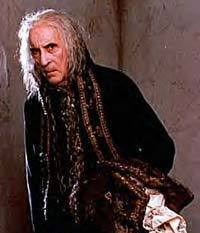
The first is Flay, Lord Sepulchrave’s (the 76th earl) first servant. He begins the story a close-mouthed, ill-tempered man but becomes one of Titus’s fiercest protectors and close friend.

Fuchsia, Titus’s older sister, begins the books a spoiled, utterly self-centered brat but she also grows and matures into a woman

And then there’s Steerpike, the adolescent kitchen slavey who rises to become the de facto master of Gormenghast. In Titus Groan, the reader can feel a certain sympathy with the youth but in Gormenghast, he assumes an evil of Miltonesque stature:
Titus Alone: Part 3 of 3
Titus Alone is admittedly the weakest of the three novels. The glass city, the Black House, Cheeta and all the other characters who populate its pages are pale indeed to their counterparts from Titus Groan and Gormenghast. No one has the same presence or reality that even so minor a character as the Poet achieves. And it doesn’t help that – even in the first books – I have no real interest in Titus.
The strongest part of the final volume is the end, when Titus, after much wandering, finds himself standing before a recognizable landmark, knowing that over the ridge he’ll find Gormenghast, and realizes he doesn’t need to go home to find home:
In an ideal world (among the myriad things that would be better), Frank Herbert would have stopped with Dune, Spock would have remained dead at the end of “The Wrath of Khan,” the universe would not have had to endure Robin Curtiss as Saavik, and Mervyn Peake would have ended the Gormenghast novels with Titus riding off into an unknown world. So I would recommend the first two books strongly. The third is interesting and, in parts, as richly imagined as anything found in Titus Groan or Gormenghast but there’s an overall lack of intensity or engagement which makes it a more cautious recommendation.
Peake’s writing in this first Gormenghast novel reminds me of E.R. Eddison’s in The Worm Ouroboros, both for its fecundity and for the manifest enjoyment in the English language its author feels. Twenty years ago – even as few as 10 – I wouldn’t have appreciated this book and would have stopped reading it rather quickly but today I can’t help but thrill to opening passages like:
This tower, patched unevenly with black ivy, arose like a mutilated finger from among the fists of knuckled masonry and pointed blasphemously at heaven. At night the owls made of it an echoing throat; by day it stood voiceless and cast its long shadow. (p. 9)
Or to the vivid descriptions that pepper the narrative:
It was a long head.
It was a wedge, a sliver, a grotesque slice in which it seemed the features had been forced to stake their claims, and it appeared that they had done so in a great hurry and with no attempt to form any kind of symmetrical pattern for their mutual advantage. The nose had evidently been the first upon the scene and had spread itself down the entire length of the wedge, beginning among the grey stubble of the hair and ending among the grey stubble of the beard, and spreading on both sides with a ruthless disregard for the eyes and mouth which found precarious purchase. The mouth was forced by the lie of the terrain left to it, to slant at an angle which gave to its right-hand side an expression of grim amusement and to its left, which dipped downward across the chin, a remorseless twist. It was forced by not only the unfriendly monopoly of the nose, but also by the tapering character of the head to be a short mouth; but it was obvious by its very nature that, under normal conditions, it would have covered twice the area. The eyes in whose expression might be read the unending grudge they bore against the nose were as small as marbles and peered out between the grey grass of the hair. (p. 107)
Based on the first book, we’re swimming in three- to four-star territory.
Gormenghast: Part 2 of 3
There is a scene early in Gormenghast where Titus is immured in the Lichen Fort for playing the truant and he is visited on his last day by Professor Bellgrove and Dr. Prunesquallor, and all three wind up playing marbles:
For the next hour, the old prison warder, peering through a keyhole the size of a table-spoon, in the inner door, was astounded to see the three figures crawling to and fro across the floor of the prison fort, to hear the high trill of the Doctor develop and strengthen into the cry of a hyena, the deep and wavering voice of the Professor bell forth like an old and happy hound, as his inhibitions waned, and the shrill cries of the child reverberate about the room, splintering like glass on the stone walls while the marbles crashed against one another, spun in their tracks, lodged shuddering in their squares, or skimmed the prison floor like shooting stars. (p. 522)
I wish I could reprint the entire episode as it’s brilliant and magical and is an example of Peake’s ability to meticulously set up a scene for maximum effect. And there are many more I could bring up. In Titus Groan, Flay learns something from his exile and his witness to (pp. 345-50). Peake lovingly lingers for 30 pages building up to Steerpike and Titus’s lethal confrontation (pp. 768-799). In an absurd vein, there’s the scene where the castle’s coterie of tutors turn their dining tables upside down and sit on them like rowers in a boat, all according to a ritual whose purpose has been lost (pp. 498-9). Equally absurd is Irma Prunesquallor’s matchmaking party (pp. 564ff); or nearly as intense as Steerpike’s fate is the young earl’s first and last meeting with The Thing (pp. 730-7).
I like Peake’s attention to detail and patience in creating a picture and setting a mood; considerations not often addressed in many fictions. I can see why some find this book tedious but it’s the rare novel where I can so vividly see what I’m reading.
And our author is as masterful in painting word images as in the first novel. Here’s his description of Professor Bellflower:
He was a fine-looking man in his way. Big of head, his brow and the bridge of his nose descended in a single line of undeniable nobility. His jaw was as long as his brow and nose together and lay exactly parallel in profile to those features. With his leonine shock of snow-white hair there was something of the major prophet about him. But his eyes were disappointing. They made no effort to bear out the promise of the other features, which would have formed the ideal setting for the kind of eye that flashes with visionary fire. Mr Bellgrove’s eyes didn’t flash at all. They were rather small, a dreary grey-green in colour, and were quite expressionless. Having seen them it was difficult not to bear a grudge against his splendid profile as something fraudulent. His teeth were both carious and uneven and were his worst feature. (p. 437)
Or, a favorite, his description of the odious Barquentine:
Barquentine in his room, sat with his withered leg drawn up to his chin. His hair, dirty as a flyblown web, hung about his face, dry and lifeless. His skin, equally filthy, with its silted fissures, its cheese-like cracks and discolorations, was dry also – an arid terrain, dead it seemed, and waterless as the moon, and yet at its centre those malignant lakes, his vile and brimming eyes. (p. 608)
Three characters stand out as my favorites:
The first is Flay, Lord Sepulchrave’s (the 76th earl) first servant. He begins the story a close-mouthed, ill-tempered man but becomes one of Titus’s fiercest protectors and close friend.
Fuchsia, Titus’s older sister, begins the books a spoiled, utterly self-centered brat but she also grows and matures into a woman
And then there’s Steerpike, the adolescent kitchen slavey who rises to become the de facto master of Gormenghast. In Titus Groan, the reader can feel a certain sympathy with the youth but in Gormenghast, he assumes an evil of Miltonesque stature:
But Steerpike hardly heard him. His future was ruptured. His years of self-advancement and intricate planning were as though they had never been. A red cloud filled his head. His body shuddered with a kind of lust. It was the lust for an unbridled evil. It was the glory of knowing himself to be pitted, openly, against the big battalions. Alone, loveless, vital, diabolic – a creature for whom compromise was no longer necessary, and intrigue was a dead letter. If it was no longer possible for him to wear, one day, the legitimate crown of Gormenghast, there was still the dark and terrible domain – the subterranean labyrinth – the lairs and warrens where, monarch of darkness like Satan himself, he could wear undisputed a crown no less imperial. (p. 705)
Titus Alone: Part 3 of 3
Titus Alone is admittedly the weakest of the three novels. The glass city, the Black House, Cheeta and all the other characters who populate its pages are pale indeed to their counterparts from Titus Groan and Gormenghast. No one has the same presence or reality that even so minor a character as the Poet achieves. And it doesn’t help that – even in the first books – I have no real interest in Titus.
The strongest part of the final volume is the end, when Titus, after much wandering, finds himself standing before a recognizable landmark, knowing that over the ridge he’ll find Gormenghast, and realizes he doesn’t need to go home to find home:
In an ideal world (among the myriad things that would be better), Frank Herbert would have stopped with Dune, Spock would have remained dead at the end of “The Wrath of Khan,” the universe would not have had to endure Robin Curtiss as Saavik, and Mervyn Peake would have ended the Gormenghast novels with Titus riding off into an unknown world. So I would recommend the first two books strongly. The third is interesting and, in parts, as richly imagined as anything found in Titus Groan or Gormenghast but there’s an overall lack of intensity or engagement which makes it a more cautious recommendation.
January 28, 2017
There is much to say, and Peake used an awful lot of words himself.
The writing is sometimes of Shakespearean quality at other times you will think of Dickens and Poe. Sometimes punches are delivered with overwhelming power, other times a scene is build up so elaborately and slowly it makes you wonder if time has indeed stopped.
At well over 1000 pages, excluding all the extras, you are starting a long journey. I made a few pit stops on my way, relaxing with some less demanding books, and I advise you to come well prepared.
In addition, this edition boasts from 12 critical essays plus an introduction by Anthony Burgess, and clearly I´ll be outwitted in no time by scholars following all possible directions of interpretations and analyses.
Some compare the book(s) to Lord of the Rings, where heroic deeds save the known world from evil.
But, there is nothing definite good or evil in this world, and there is little to be saved in the world of Titus Groan. There is only the journey towards an unknow destination for a young boy with hereditary obligations, obligations too hard to bear.
To treat The Gormenghast Novels as a classical coming off age novel makes no sense at all, even it in a “pure” reading is so.
Our protagonist does not travel from A to B with a lot of hindrances on his way, coming out the wiser and more mature man. Neither does he live happily ever after, and as far as we know most of the persons we met were just there for the occasion and were literally short lived.
The secluded Gormenghast world into which Titus Groan, the 77th Earl has been born is like nothing else you have ever seen.
Combining the Castle of Kafka with the most grotesque of the Gothic genre, we meet a family and a household so emotionally estranged from each other, that only endless rites of traditions keep them together.
That is while “The Dwellers” outside the castle walls live and die in a relatively normal way, well, except they age particularly fast from the age of 19 and bear resemblance to Neanderthals.
While some have weak personalities or have withdrawn into themselves and others are outright dimwitted, there are only a few of the characters that stand a chance of surviving.
As I mentioned before, most of the characters are only part of the scenery set for Titus Groan, even they at their specific moment bear significance and push the storyline forward.
It takes the plotting of a traitor and a flood of Biblical dimension to shake the picture of a world that would otherwise never move as it is built on solid rock.
Though Titus Groan from an early age felt he was different, the hunt for the traitor is what sparks his evolvement and initially sets him roaming as a stranger in a strange land.
It is obvious to interpret the works as the human battle against the estrangement from yourself and from the surrounding world. Knowing you are sane, but still doubting your abilities when confronted with situations so utterly different from the ones you know.
The battle of a tortured mind, locked up in a city of the hardest flint knowing your prospects are either conformity or rebellion and knowing both will lead to your end.
There are so many themes that calls more for the expertise of a psychologist than a literary analyst, but they all point to the inevitable end.
To that end, you can wonder why Peake are putting much effort in some of the characters, only to totally scrap them later. They were either just tools at the time they were needed or they were meant to be relived at a later point had his untimely dead not prevented it.
Was it an enjoyable read? Was it interesting?
50/50 I would say, a wonderfully crafted novel with interesting underlying themes, some obvious and some more subtle. Riveting, keeping you on an edge? Not really if you are going for a quick fix of heavy literature, you should go somewhere else.
I am offering 4 cautious stars, I cannot consider it a real masterpiece, but really, really well done.
The writing is sometimes of Shakespearean quality at other times you will think of Dickens and Poe. Sometimes punches are delivered with overwhelming power, other times a scene is build up so elaborately and slowly it makes you wonder if time has indeed stopped.
At well over 1000 pages, excluding all the extras, you are starting a long journey. I made a few pit stops on my way, relaxing with some less demanding books, and I advise you to come well prepared.
In addition, this edition boasts from 12 critical essays plus an introduction by Anthony Burgess, and clearly I´ll be outwitted in no time by scholars following all possible directions of interpretations and analyses.
Some compare the book(s) to Lord of the Rings, where heroic deeds save the known world from evil.
But, there is nothing definite good or evil in this world, and there is little to be saved in the world of Titus Groan. There is only the journey towards an unknow destination for a young boy with hereditary obligations, obligations too hard to bear.
To treat The Gormenghast Novels as a classical coming off age novel makes no sense at all, even it in a “pure” reading is so.
Our protagonist does not travel from A to B with a lot of hindrances on his way, coming out the wiser and more mature man. Neither does he live happily ever after, and as far as we know most of the persons we met were just there for the occasion and were literally short lived.
The secluded Gormenghast world into which Titus Groan, the 77th Earl has been born is like nothing else you have ever seen.
Combining the Castle of Kafka with the most grotesque of the Gothic genre, we meet a family and a household so emotionally estranged from each other, that only endless rites of traditions keep them together.
That is while “The Dwellers” outside the castle walls live and die in a relatively normal way, well, except they age particularly fast from the age of 19 and bear resemblance to Neanderthals.
While some have weak personalities or have withdrawn into themselves and others are outright dimwitted, there are only a few of the characters that stand a chance of surviving.
As I mentioned before, most of the characters are only part of the scenery set for Titus Groan, even they at their specific moment bear significance and push the storyline forward.
It takes the plotting of a traitor and a flood of Biblical dimension to shake the picture of a world that would otherwise never move as it is built on solid rock.
Though Titus Groan from an early age felt he was different, the hunt for the traitor is what sparks his evolvement and initially sets him roaming as a stranger in a strange land.
It is obvious to interpret the works as the human battle against the estrangement from yourself and from the surrounding world. Knowing you are sane, but still doubting your abilities when confronted with situations so utterly different from the ones you know.
The battle of a tortured mind, locked up in a city of the hardest flint knowing your prospects are either conformity or rebellion and knowing both will lead to your end.
There are so many themes that calls more for the expertise of a psychologist than a literary analyst, but they all point to the inevitable end.
To that end, you can wonder why Peake are putting much effort in some of the characters, only to totally scrap them later. They were either just tools at the time they were needed or they were meant to be relived at a later point had his untimely dead not prevented it.
Was it an enjoyable read? Was it interesting?
50/50 I would say, a wonderfully crafted novel with interesting underlying themes, some obvious and some more subtle. Riveting, keeping you on an edge? Not really if you are going for a quick fix of heavy literature, you should go somewhere else.
I am offering 4 cautious stars, I cannot consider it a real masterpiece, but really, really well done.
March 20, 2015
My 14-year-old self adored these books. Reading them required frequent dipping into my dictionary, but I loved the painterly language, the weird, knotty characters, and the sustained crepuscular (hello!) mood. I read out the opening paragraph to my English class, and they were all WTF?, but screw them! I've re-read the series several times. And Maeve Peake's unofficial sequel.
October 16, 2011
THE GORMENGHAST NOVELS by Mervyn Peake
The castle of Gormenghast is an immense rambling structure, made up of meandering corridors, countless courtyards, towers, libraries, attics, and underground passages — there are, as well, vast regions the author leaves unexplored, and it is more than likely the inhabitants have forgotten they even exist. If this were not enough, there is another tremendous landscape across the rooftops. Within this remarkable building the Groan family and its servitors enact meaningless rituals. Perhaps the rituals have been subtly altered over the centuries, over the millennia, until almost nothing of the originals remains and whatever sense was in them at the beginning was lost, long years back, yet everyone continues to enact these elaborate and often puerile rites simply because they know no other life.
But all this is only the background to a tale of grand passions and ferocious obsessions. The characters, with the exception of Titus and his sister Fuchsia, are grotesques. It is a terrifying book, not only because some of the characters are so dangerous, but because those who are not dangerous at all (Nanny Slagg is one example) are so frighteningly vulnerable. Even they have their compulsions which bind them to the castle.
The prose is dense, vivid, evocative, weirdly atmospheric, and darkly humorous. It is to be read slowly and savored, else it would kill the appetite. The first two books, at least, are works of genius, but not of a man who sees the world with clarity. Rather, they are like an extended nightmare — though if we are to have nightmares we should all have such nightmares as this, for though it is dark and disorienting it has more of delight than the brighter visions of practically any other writer I can think of.
The story begins with the momentous birth of Titus, son and heir to Gertrude, Countess of Groan, and Sepulchrave the seventy-sixth earl. In the excitement following Titus’s birth, the youth Steerpike escapes from his menial position in the castle kitchens, which are ruled by the horrifying Swelter. We are introduced to a number of characters: the monumental Gertrude, somehow magnificent in her very indolence and her single-minded devotion to her white cats; the melancholy and doomed Sepulchrave; Fuchsia, the earl’s neglected daughter, eager, clumsy, and hungry for affection; the fanatically loyal Flay; the inane twins, Clarice and Cora; and a huge cast of others.
The ostensible protagonist is Titus, for whom the first and last books of the trilogy are named. Yet he is an infant for the entire first book. In the meantime, the rôle is more or less filled by Steerpike, the ambitious kitchen-boy intent on raising his station in the world. Steerpike’s rise is fascinating indeed, but he is an uneasy fit as protagonist, somewhere between anti-hero and outright villain. He is an excellent example of how an author might manage the perceptions of his readers and lead them to accept what would otherwise be unacceptable. When we first meet Steerpike, he is so utterly down-trodden that, even repulsive and slippery as he is, sympathy is established early and takes a long time to erode. For some readers, it never does completely disappear, and right up to the end they still accept his facile excuses, his unctuous and self-flattering explanations as to why his cause (assuming he really has one besides vigilant self-interest) is noble and just and everyone else is at fault. The fact that so many of the other characters are monstrous does, to a certain extent, prevent his most vile acts from standing out as they would in another story.
While Titus reaches the venerable age of one, in Titus Groan, plots swirl around him. In the second book, Gormenghast, as he moves toward adulthood, there are more plots, murders, and disasters all around him. Titus grows dissatisfied with the restrictions and the expectations of his position, and then grows desperate. Fuchsia is her brother’s confidante, and Steerpike’s pawn ... when she allows him a place in her conflicted heart.
Although the castle is roughly the size of a city — we never learn the true extent of it — there is something claustrophobic about it all, as though the weight of tradition might crush (and in fact does crush) some of the inhabitants. It is this sense of compression, perhaps, that warps even those instincts that would otherwise be true and wholesome out of proportion, either shrinking them down so that those who possess them become weak and bewildered, or allowing them to grow into eccentric (at best) or cruelly distorted (at worst) shapes.
The trilogy is generally classified as fantasy, although there is no magic, no supernatural elements, no encounters with the numinous, yet there are good reasons why many who love speculative fiction have embraced the story.
1) It describes a culture, a way of life, that is so far beyond the bounds of probability that it holds only the most tenuous connection to reality, and could only exist in a fantasy novel.
2) Though there is nothing of the supernatural, there is very little of the truly natural, either. Personalities are either very much larger than life, very much smaller, or vague to the point of almost vanishing before they do, in fact, permanently disappear from the scene entirely.
3) There is no other classification into which it could comfortably fit.
The castle itself is perhaps the most vivid character in the story, which is one explanation why the story loses cohesion in the third book, after a teenage Titus leaves home. The other reason is that Peake did not complete the book before he died and it only exists in a rough draft form. There are moments, here and there, where his genius is evident, but for the most part it is all pretty thin, and the prose disappointing. While there are those who greatly admire Titus Alone, many who love the first two books of the trilogy find it difficult to finish the last third. Others find their minds wandering and realize, every now and again, that in spite of themselves they are skimming. (I find myself inevitably falling into this latter category.)
When Titus strikes out for parts unknown, heedless of Gertrude’s warning, “There is nowhere else. You will only tread a circle ... For everything comes to Gormenghast,” the world he encounters, if more extensive and less claustrophobic, less rich in detail, is every bit as bizarre. It would have been fascinating to see what Peake might have made of the book in its completed form.
As it is, we only have the rough draft, and its two magnificent prequels.
The castle of Gormenghast is an immense rambling structure, made up of meandering corridors, countless courtyards, towers, libraries, attics, and underground passages — there are, as well, vast regions the author leaves unexplored, and it is more than likely the inhabitants have forgotten they even exist. If this were not enough, there is another tremendous landscape across the rooftops. Within this remarkable building the Groan family and its servitors enact meaningless rituals. Perhaps the rituals have been subtly altered over the centuries, over the millennia, until almost nothing of the originals remains and whatever sense was in them at the beginning was lost, long years back, yet everyone continues to enact these elaborate and often puerile rites simply because they know no other life.
But all this is only the background to a tale of grand passions and ferocious obsessions. The characters, with the exception of Titus and his sister Fuchsia, are grotesques. It is a terrifying book, not only because some of the characters are so dangerous, but because those who are not dangerous at all (Nanny Slagg is one example) are so frighteningly vulnerable. Even they have their compulsions which bind them to the castle.
The prose is dense, vivid, evocative, weirdly atmospheric, and darkly humorous. It is to be read slowly and savored, else it would kill the appetite. The first two books, at least, are works of genius, but not of a man who sees the world with clarity. Rather, they are like an extended nightmare — though if we are to have nightmares we should all have such nightmares as this, for though it is dark and disorienting it has more of delight than the brighter visions of practically any other writer I can think of.
The story begins with the momentous birth of Titus, son and heir to Gertrude, Countess of Groan, and Sepulchrave the seventy-sixth earl. In the excitement following Titus’s birth, the youth Steerpike escapes from his menial position in the castle kitchens, which are ruled by the horrifying Swelter. We are introduced to a number of characters: the monumental Gertrude, somehow magnificent in her very indolence and her single-minded devotion to her white cats; the melancholy and doomed Sepulchrave; Fuchsia, the earl’s neglected daughter, eager, clumsy, and hungry for affection; the fanatically loyal Flay; the inane twins, Clarice and Cora; and a huge cast of others.
The ostensible protagonist is Titus, for whom the first and last books of the trilogy are named. Yet he is an infant for the entire first book. In the meantime, the rôle is more or less filled by Steerpike, the ambitious kitchen-boy intent on raising his station in the world. Steerpike’s rise is fascinating indeed, but he is an uneasy fit as protagonist, somewhere between anti-hero and outright villain. He is an excellent example of how an author might manage the perceptions of his readers and lead them to accept what would otherwise be unacceptable. When we first meet Steerpike, he is so utterly down-trodden that, even repulsive and slippery as he is, sympathy is established early and takes a long time to erode. For some readers, it never does completely disappear, and right up to the end they still accept his facile excuses, his unctuous and self-flattering explanations as to why his cause (assuming he really has one besides vigilant self-interest) is noble and just and everyone else is at fault. The fact that so many of the other characters are monstrous does, to a certain extent, prevent his most vile acts from standing out as they would in another story.
While Titus reaches the venerable age of one, in Titus Groan, plots swirl around him. In the second book, Gormenghast, as he moves toward adulthood, there are more plots, murders, and disasters all around him. Titus grows dissatisfied with the restrictions and the expectations of his position, and then grows desperate. Fuchsia is her brother’s confidante, and Steerpike’s pawn ... when she allows him a place in her conflicted heart.
Although the castle is roughly the size of a city — we never learn the true extent of it — there is something claustrophobic about it all, as though the weight of tradition might crush (and in fact does crush) some of the inhabitants. It is this sense of compression, perhaps, that warps even those instincts that would otherwise be true and wholesome out of proportion, either shrinking them down so that those who possess them become weak and bewildered, or allowing them to grow into eccentric (at best) or cruelly distorted (at worst) shapes.
The trilogy is generally classified as fantasy, although there is no magic, no supernatural elements, no encounters with the numinous, yet there are good reasons why many who love speculative fiction have embraced the story.
1) It describes a culture, a way of life, that is so far beyond the bounds of probability that it holds only the most tenuous connection to reality, and could only exist in a fantasy novel.
2) Though there is nothing of the supernatural, there is very little of the truly natural, either. Personalities are either very much larger than life, very much smaller, or vague to the point of almost vanishing before they do, in fact, permanently disappear from the scene entirely.
3) There is no other classification into which it could comfortably fit.
The castle itself is perhaps the most vivid character in the story, which is one explanation why the story loses cohesion in the third book, after a teenage Titus leaves home. The other reason is that Peake did not complete the book before he died and it only exists in a rough draft form. There are moments, here and there, where his genius is evident, but for the most part it is all pretty thin, and the prose disappointing. While there are those who greatly admire Titus Alone, many who love the first two books of the trilogy find it difficult to finish the last third. Others find their minds wandering and realize, every now and again, that in spite of themselves they are skimming. (I find myself inevitably falling into this latter category.)
When Titus strikes out for parts unknown, heedless of Gertrude’s warning, “There is nowhere else. You will only tread a circle ... For everything comes to Gormenghast,” the world he encounters, if more extensive and less claustrophobic, less rich in detail, is every bit as bizarre. It would have been fascinating to see what Peake might have made of the book in its completed form.
As it is, we only have the rough draft, and its two magnificent prequels.

February 26, 2009
Got, oh, maybe 150 pages into this and couldn't get excited about it, so I gave up.
I have repeatedly been told of the mastery of this book. Perhaps I just wasn't in the right mood. In general, I do go for dark and intricate and elaborate. But I just couldn't make myself care about this world or its people. I couldn't get into the right "suspension of disbelief" mindset -- kept having intrusive thoughts like, "Wait, where do the inhabitants of this castle get food from?" or, "Wait, I've seen truly vast palaces and castles in Europe, and none of them are close to this size. Do you know what kind of effort would be required to build a thing like that?" All of which is quite aside from the point, of course, but illustrates just how not excited I was by it.
Probably the fact that he spent 100+ pages introducing absurdist characters, for whom I had no sympathy, without actually introducing anything resembling, say, a plot, contributed to my ennui.
But, then, I guess ennui itself is quite in keeping with this universe...
I have repeatedly been told of the mastery of this book. Perhaps I just wasn't in the right mood. In general, I do go for dark and intricate and elaborate. But I just couldn't make myself care about this world or its people. I couldn't get into the right "suspension of disbelief" mindset -- kept having intrusive thoughts like, "Wait, where do the inhabitants of this castle get food from?" or, "Wait, I've seen truly vast palaces and castles in Europe, and none of them are close to this size. Do you know what kind of effort would be required to build a thing like that?" All of which is quite aside from the point, of course, but illustrates just how not excited I was by it.
Probably the fact that he spent 100+ pages introducing absurdist characters, for whom I had no sympathy, without actually introducing anything resembling, say, a plot, contributed to my ennui.
But, then, I guess ennui itself is quite in keeping with this universe...
Displaying 1 - 30 of 782 reviews