Jump to ratings and reviews
Rate this book

Fugly

Rate this book
A wrenchingly honest, thought-provoking exploration of a girl judged and dismissed by society who must break the cycle of shaming that traps her in her real life and comforts her in her online one.

In real life, eighteen-year-old Beth is overweight, shy, and geeky. She's been bullied all her life, and her only refuge is food. Online, though, she's a vicious troll who targets the beautiful, vain, oversharing It Girls of the internet. When she meets Tori, a fellow troll, she becomes her online girlfriend-slash-partner-in-crime.
But then Tori picks a target who's a little too close to home for Beth. Unsettled, Beth decides to quit their online bullying partnership. The only problem is, Tori is not willing to let her go.

Unknown Binding

First published November 5, 2019

69 people are currently reading
332 people want to read

About the author

Claire Waller

1 book9 followers

Ratings & Reviews

What do you think?
Rate this book

Friends & Following

Create a free account to discover what your friends think of this book!

Community Reviews

5 stars
76 (16%)
4 stars
142 (31%)
3 stars
140 (30%)
2 stars
63 (13%)
1 star
35 (7%)
Displaying 1 - 30 of 83 reviews
Profile Image for J.A. Ironside.
Author 60 books360 followers
October 8, 2019
ARC provided by NetGalley in exchange for an honest review.


Fugly is going to be a super polarising book, there's no two ways about it.

If you are a reader who needs to like an MC in order to engage with a book, then this is not the book for you.

Similarly, if you are not willing to engage with the topics this book discusses - fat-shaming, body image issues, bullying, sexual harassment amongst others - from the grim and grimy negative origins rather than a place of looking back positively, then this may also not be the book for you.

There's a lot of hand holding in YA lately depicting plus sized characters positively (A very GOOD THING) and immediately calling out any fat shaming (also a very GOOD THING) but this book is not a hand holder. It's an important conversation about learning to value yourself in order to value other people. Therefore, if you find an MC making fatphobic and negative comments about herself and other people triggering, you may wish to think hard about whether to read it.

Fugly is an incredibly honest, no-holds-barred look at what happens when the oppressed turn vicious. Beth Soames spent almost all of her school life alternately bullied and ignored. She doesn't fit the perceived norm for what society considers attractive. She's shy and suffers from anxiety, and she has a very unhealthy relationship with food. As in, she uses it to fill the emptiness caused by her own emotional isolation. Her parents are recently divorced, pitching her mother into a depressive state complete with idiopathic pain, and her fourteen-year-old brother is playing truant from school and becoming emotionally abusive. Full of poisonous anger and self loathing, Beth strikes back at the world which she perceives as constantly rejecting her, by donning her internet persona and trolling the Beautiful People. Those pretty, popular girls who post pictures of themselves for the approval of the adoring masses. The ones who need to be taken down a peg or two.

Beth starts off as a thoroughly unlikeable character. The things she says and does are often not merely mean but actively malicious and hateful. From the moment you first meet her, she shuts the reader out of her confidence - rejecting you before you have a chance to reject her. But gradually, as the reader follows her story, she opens up and reveals more and more. I'm not sure this increased intimacy - a brilliant ploy by Waller to play with our sympathies and establish character btw - ever really makes her likeable. There's a strong impulse in the reader to despise her for her actions - both for the hateful things she does online and for not valuing or standing up for herself irl. However it does make her more understandable. Her narrative is compulsively readable and she starts to show flashes of far better personality traits once she starts to make friends.

And that's the crux, I think. Very few of us are designed to be completely alone and most people start to go more than slightly peculiar when forced to endure alienation and isolation. Beth's case is extreme. She has internalised all the hateful and casually cruel things ever said to her, as well as all the societal disapproval constantly broadcast to people of her shape and size, and instead of analysing and rejecting it, she repeats it. I think this is where Fugly might be jarring for some people. Beth genuinely believes to start with, that she is all the things that have been said of her. How many of us at 18 were good at listening for the meaning rather than just the words? Or at separating out tasteless and non-intentionally hurtful comments from genuine malice? (A lesson we could all do with a bit more of tbh considering the current trend of being eager to be offended in some quarters.) We all internalise both approval and disapproval, whether it's implied or explicit and it's only with experience that we learn to use a filter and reject harmful rubbish. It's very hard to value yourself when through no particular fault of your own, you have never fit a narrow set of parameters for societal approval.

That being said, there is no excuse for what Beth does. She knows that unconsciously at the start and very consciously later. The examples of trolling we see are genuinely horrific. Beth's actions are uncomfortably understandable even to someone who has never succumbed to the temptation to attain some power by taking it from someone else in some form. This is not a gratuitous look through the eyes of a loveable anti hero. This is a deconstruction of internalised hatred. The introduction of Tori - another troll - ups the stakes. I really don't want to say too much there for fear of venturing into spoiler territory, so let's just say that there is a clear comparison between a friend who brings out all your worst impulses and a friend who shows you that you can be a better person.

Ultimately, Waller shows us that it's our choices that define us. Beth's choices are initially very bad but over the course of the book she learns that pushing her anger and frustration out onto the net is not merely harmful to other people, but diminishing to who she is and who she could be as a person. I was reminded of Anne Fine's The Tulip Touch which has very little in common with this book at all, save for a charismatic 'friend' leading the MC into worse and worse acts of destruction. In that book, Fine makes the point of saying that in order to show kindness, we need to have experienced at least a little kindness directed at ourselves. Amy, a new friend from uni, should be one of the Beautiful People but she's also sweet and kind, and genuinely wants to befriend Beth. Beth's self-realisation is a slow one and is triggered largely because she is forced to consider that her preconceptions about how someone looks might be wrong. Which in turn forces her to consider that other people's preconceptions about her, and her acceptance of those opinions, might also be wrong.

A final word about Beth's home life - I don't think it's unreasonable for a young person who has been shoved into the role of responsible adult in a household to feel resentment about it. I doubt many people, children or otherwise, never have a single moment of feeling aggrieved at being forced to be the carer. Beth had a right to expect her mother to be a parent - to her younger brother if not to her - and instead she got no support at all. That's not to say she couldn't have handled it better but there was also no reason why she should have to.

I found Fugly compelling, shocking, horrifying and utterly addictive. The voice is amazing and honestly quite uncomfortable. The plot is fast paced and often tense. I finished it in two sittings. This is a taut, honest and challenging account about personal value, self knowledge and emotional understanding. Highly recommended.

TW: self harm, fatphobia/ fatshaming, negative and hateful comments, bullying, sexual harassment/ abuse, depression and anxiety depiction.
Profile Image for Anomaly.
523 reviews
September 18, 2021
DNF at 15%
Free pre-publication copy provided by NetGalley. I did not finish, but I'm providing my opinions on what I did read voluntarily.

How is this being praised as "honest"?! It's not. Unless "girls who wear revealing clothes deserve mistreatment," "heroin addiction is easier to overcome than food addiction," "people who post images online deserve to be bullied," "it's okay to threaten your little brother that you'll tell his idolized father he's watching porn unless he does the dishes," and "overweight people are hideous" are what you consider honesty. I don't, not one bit.

But let's back up and explore what I did experience of this book. I wanted to take a clue-by-four to the main character, Beth, after roughly three paragraphs and the urge only grew stronger as time went on, until I gave up dealing with this book entirely. She's a horrific person who hates anyone prettier or thinner than herself - along with children and her sick/disabled mom, for good measure. That's right, she even uses ableist garbage phrases like "this pain she is supposed to be in" when lamenting how oh-so-tiresome it is dealing with her ill mother while living with her into adulthood rent-free. What a whiny, intolerable, annoying brat! (Yet she thinks her brother's the brat, ha!)

I hated Beth from the start... and I think that's the point. This book aims to show us how someone can end up that low - not to make everything perfect and happy and body positive from the start. It's not proposing to be empowering or politically correct or easy to read. I understand that, to a degree, but the way the narrative handles body image goes above and beyond "honest" or "realistic" to land firmly in "grotesquely hateful" territory.

Not only does Beth hate everyone who's thinner, she also hates herself. That's realistic. She drones on and on about double chins and being "fugly" and being overweight and all these things which paint her in a very unflattering light. That's excessive, but not entirely unbelievable. She complains every time she's in public about how society and media have taught her that fugly people like her don't have a place in the world. That's hyperbolic, unrealistic nonsense. Sure, someone may think that when reflecting or writing a blog or vlogging... but not every time they go outside over the course of normal, daily life.

This is not a good book for someone who struggles with weight-related self image issues; my self-hatred flared several times, triggered by the way Beth spoke of her own body. Therein lies where I'm super conflicted, though. I wouldn't have been bothered if not for how horribly realistic the self-hatred element is. I related too much, and then I was disgusted at myself both for existing in all my fugly glory and for relating to such a hateful character.

No, not just hateful. DESPICABLE. Imagine having to read a first-person narrative for a story about hate crime, from the attacker's perspective, and that's about how this book feels. Dirty. Gross. Unsettling. An exercise in remembering that drop kicking the device you're reading on won't actually kick this fictional person no matter how much you wish it were possible.

Beth's a horrible bully, even to her little brother, but pretends she's a good person in real life (she is not) for simple things like cooking when her sick mom can't find the energy to make dinner. And maybe she has enough of a heel turn in the change of heart the book synopsis promises to make her less loathsome, but I personally will not be getting far enough to know. I can't do it. I tried, I honestly did, but I just can't handle being exposed to this. I don't want to be in the head of such a toxic character, reading things that make me feel so uncomfortable in my own skin and so disgusted.

I hated everything about the experience of reading what I did of this book, especially the molestation on public transportation which was basically just an attempt to make Beth a #metoo girl (literally the name of the following chapter) and garner sympathy for her while she complains that she can't say anything because she's so fugly nobody would believe she got groped. Oh, and in that "#metoo" chapter she says that girls who wear skimpy clothes are asking for it and she should have worn baggy jeans instead of leggings so the guy would molest a different girl. (Yes, really!)

While I was still reeling from that, I landed on the part where Beth callously says heroin addicts can "just stop doing heroin" and therefore her food addiction is worse because people die without food. That's where I stopped. It's bad enough she's a disgusting human being but that combined with the nonsense surrounding the molestation was too much for me. (For the record: food addiction is indeed comparable to any other addiction, but it is not harder to conquer and you won't die without junk food or without emotionally binging.)

I'm disappointed in myself for reading past the first couple chapters and actually expecting it would get better. It never did. It just kept getting worse and worse like a snowball of frozen sewage water rolling down a hill toward a pack of innocent, unsuspecting orphans with puppies. I had to look away.
Profile Image for Schizanthus Nerd.
1,320 reviews312 followers
October 19, 2019
You know the feeling you get when you’re approaching a car accident? The traffic has slowed down, emergency services are already on the scene and you don’t want to look. You know if you were involved in that accident you wouldn’t want a whole pile of strangers gawking at you as they passed, yet you can’t help it. You look, even as you’re wishing you hadn’t.

That was how I felt the entire time I was reading this book. I wanted to look away and move on to something lighter, happier, less vindictive, but I kept reading. Why? Because, despite how uncomfortable I was, I still wanted to know. It was compulsive.

I’ve never understood why victims choose to become offenders. Surely if you’ve experienced something painful enough that you could be labelled a victim as a result, you know how bad that feels and wouldn’t want to inflict that pain on anyone else, right? Apparently not.

Beth was bullied at school and now she targets “Beautiful People” online. If she’d simply had some imaginative revenge fantasies featuring some of the worst offenders in her life I probably would have cheered her on but that’s not her game.

Instead she revels in trolling people she wants to be, people who have never done anything to her and who she knows nothing about outside of their likely Photoshopped online presence. It’s a victory for Beth if her victims shut down their social media accounts, and the hatred she receives from her victims’ supporters? Bring it on! It’s like a drug to her.
Here I’m not a loser. Here, I reign supreme. It doesn’t matter what side of the fence you fall down on: lover, hater, you’re still focused on me, talking about me, making me the topic of conversation.
While I never liked Beth I did find some of her commentary about being overweight authentic, from not wanting to eat in public to the shame of standing in a retail store that doesn’t stock clothes in your size. Had she not also been a troll I probably would have found her character fairly relatable. Well, except for the fact that she bought into some infuriating myths surrounding , and her propensity to blame pretty much anyone other than herself. Okay, so maybe there’s not as much relatability happening here as I thought. I did want her to make an appointment with a psychologist rather than study psychology though.

I initially liked Amy, adorable, quirky Amy. She was a bit too sweet to feel realistic but the contrast between her and Beth, who mostly only approximated sweet when she was eating chocolate, felt necessary. (While I’m thinking about sugar, I have to say that I absolutely loved the phrase “chain-eat chocolate” and expect I will probably both do this and use it in a sentence within a week.)

I wanted to hold onto the time I had with sweet Amy and bask in the warmth of the sunlight that appeared to be originating from her pure heart. While I understood her confusion, pain and anger when she , whenever she yo-yoed between anger and forgiveness her personality seemed to change, almost as if there were three distinct Amy’s.

There were a couple of reveals that I’d figured out early on and unfortunately the blurb gave too much away. While the ending felt too neat overall, I liked that there were some questions that remained unanswered. It would have been nice to know but not knowing was even better.

If you have a problem with swearing, this is probably not the book for you. Because I’m me I got curious. Give or take a couple because my maths isn’t perfect, I counted 77 times and 231 times!
description
P.S. I wasn’t offended by the swearing. It just made me think of this scene from Supernatural. 😊
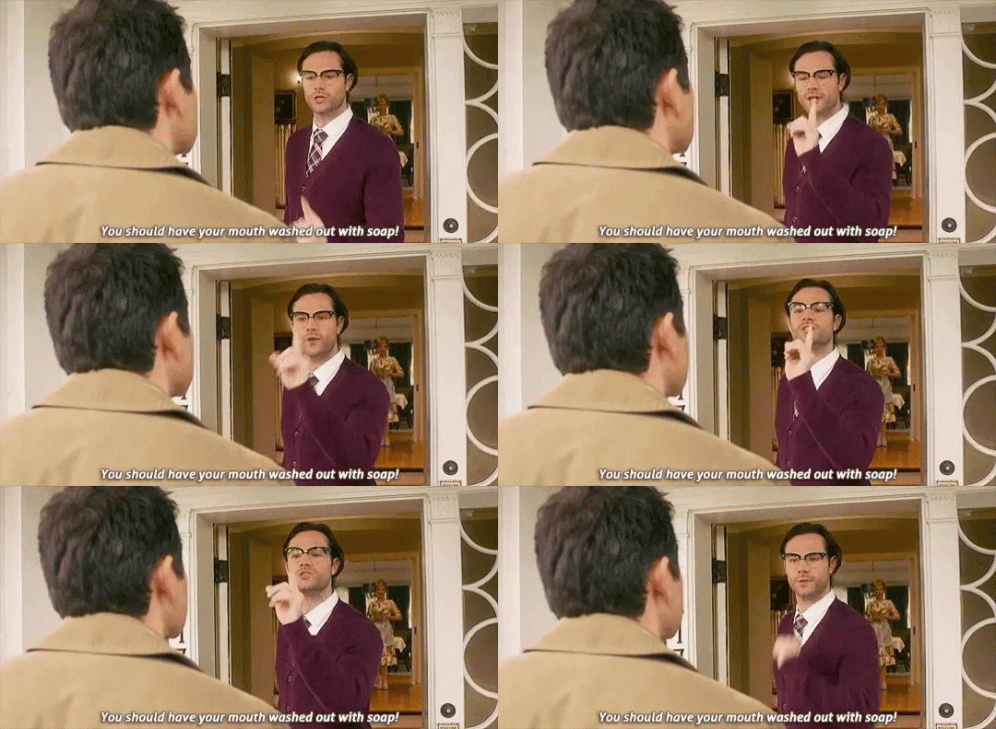
Content warnings include .

Thank you to NetGalley and Carolrhoda Lab, an imprint of Lerner Publishing Group, for the opportunity to read this book. I’m rounding up from 3.5 stars.
Profile Image for Megan ♡.
1,524 reviews
August 25, 2019
I'm struggling to see how this book has any positives to it. Sure, we get to see life in the eyes of a troll but she doesn't really learn - she continues to blame other people for her choice to become a troll and be hateful to people. This book is filled with hate. Fatphobia, girl-on-girl hate, just plain unnecessary rudeness, bullying (and not just the main character being bullied - she constantly bullies her little brother and threatens him). I just don't get why it needed to be written. To warn against being a troll? To show that trolling is bad? To say that just because people are horrible to you, doesn't mean you should be horrible to others? The main character doesn't learn any of these things and I don't know about you, but I would say they're pretty damn obvious things. They don't need a whole book to say them.

I received an e-arc from Netgalley
Profile Image for Rachel.
1,455 reviews155 followers
August 25, 2019
*thank you to Netgalley, Claire Waller and Lerner Publishing Group for an ARC of this book in exchange for an honest review*


4 Stars.

TW: self harm, sexual assault, bullying, negative self talk.

Ohh my goodness what an amazing read this turned out to be! It was so interesting having the main character be a troll on the internet and reading about her this way, finding out why she does it. It was such a great idea for a story. I'd never really given it much thought before. Why does a person Troll? So this was a real eye opener and so interesting to read about from a Trolls point of view. I zoomed through it so fast because I wanted to know more and more.

The main character Beth is a troll. Not in real life as she calls it, but on the internet she gets out all of her pent up anger and frustrations. She throws to others what she is feeling inside. All that anger over the years and this is how she deals with it because she doesn't have a clue how else to. Plus she believes that they, the beautiful people, truly deserve it. While doing this she meets another like minded person, Tori. They quickly become friends and eventually it grows to more. But while trolling the internet together, they target a particular person and things soon get out of control and lines are crossed. Having things gone too far, Beth gets a wake up call and that's where the story takes a turn.

There is so much going on with this story. So many layers. The characters are great. The way the story develops keeps the reader engaged, wanting more and wanting to find out how this ends.

Truly a great story and what I think what makes it such a great read is because this is a real thing. This is so easily a story that could be based on a real story that it makes it so captivating with a touch of horror and creepiness to it. The internet these days is such a huge place but it comes with so many real problems. Such as Catfishing, trolling and much more. You really need to be careful while online and using social media and this book highlights the reasons for that in a really dark way.

Beth is one of those characters that people can relate to in different ways. Maybe it's her weight issues. The way she treats herself and talks to herself. Her family life issues. Her anger/self hatered. Or what it is she so desperately wants and needs but isn't getting in the right ways. Or maybe even her trolling.

The story is gripping and has a little twist near the end that I didn't see coming, but there were hints of it throughout the book which I like. It was a nice touch and an added bonus. I highly recommend this book if it sounds like one you would enjoy.

Thank you again to the author for an ARC of this.
Profile Image for Paula  Phillips.
5,742 reviews348 followers
March 29, 2020
This book had captured my attention through the title "Fugly". The book starts with Beth Soames who is at the library reading a psychology book when she meets a beautiful girl who reminds her of a fairy Amy. The pair chat and you can tell that Amy is a genuinely nice person, but Beth, as we are about to discover, is a bit messed up. Beth has always been a big girl and loves to make fun of beautiful people and troll them as a way to make herself feel better. Online, she can be anybody she wants whereas IRL is a shy girl who is so insecure that I have to admit she started to annoy me. It's like come on Beth, get over freaking yourself - not everyone is out to get you. While she is online trolling, she meets online Tori who loves trolling too. When Beth is with Tori, the pair start to take things to the next level as Tori is a pro in hacking. Throughout the novel, Tori and Beth get closer to IM and start to fall in love with each other - this is a bit of a pseudo lesbian relationship but not. During the novel, Beth starts to sit next to Amy in college and hang out with Amy's crowd. What happens though when her internet life and her real-life end up crashing as one of Amy's friend tries to kill herself over social media bullying. Afterward, Beth tries to distance herself from Tori, but her double life will start unraveling and soon Beth finds herself friendless and trolled herself online. Is this moment, a chance for Beth to reinvent her life and realize that she should live in the moment and that life isn't as bad as she thought. Reading this, I did wonder right through the novel too if Beth suffered from Mental Health issues as she seemed like she had Bipolar / Split personality disorder.
Fugly is a great read to the dark underbelly of the internet from Hacking, Trolling and Catfishing.
Profile Image for Baileys Book Babble.
115 reviews11 followers
December 13, 2019
I received a copy of this via Netgalley for an honest review.
Being a plus sized girl I thought this book would be right up my alley until the first chapter. I literally couldn't get past that first chapter it was absolutely so incredible triggering. I understand that this is how people think inside their heads and that truely makes me so sad. But I have worked hard to get those thoughts out of my own and it is just not a place I could allow myself to go back to.
I appreciate the copy and hope that later in the book the main character can grow to love herself.
Profile Image for Sarah Dressler.
903 reviews38 followers
November 3, 2019
As we follow Beth, a societal outcast in all the typical ways, through life as an 18 year old, she struggles to rise above and make stronger "I'm an adult" choices. Instead she falls into the typical "let me bully people online with my new-found friend who's dragging me even lower".

It was difficult to read this novel, as an educator, because for basically the entirety of the novel you knew what was going to happen, and it is all of the choices parents and teachers work hard to help instill in youth.

The writing was appropriate for young adult literature, but the plot and character decisions were difficult to get connected with as a reader.
Profile Image for Jj Burch.
354 reviews
February 23, 2024
Bullies bully and
this one questions her actions
when she makes a friend.
27 reviews6 followers
October 18, 2019
I received this book as an e-ARC from NetGalley in exchange for my honest review.

I rarely dislike a book so much I consider not finishing it. But this was that book. I did finish it, mostly because I wanted to see if it had any redeeming qualities.

The answer? Not really, and certainly not enough to account for its shortcomings. It might be the right book for some people, but I can’t get past the triggering content in this book that had no warnings.

Some people like anti-hero protagonists. But Beth goes beyond an anti-hero into just being a villain. I don't mind reading about villainous characters, when they're written well, or have a redeeming factor, or have some interesting aspects. Beth was none of those things. Beth is not someone I wanted to root for, and she's also not written very well.

The book, in general, is a mess. The ending is sloppy and unrealistic. It's something out of a soap opera. I don't want to spoil it entirely, but it's an attempt at a redemption arc, but it's not truly earned, so it doesn't make sense.

The book needed trigger warnings. I'm an advocate for trigger warnings, which I know is controversial, some people think books don't need them. This book is marketed to young adults. It had descriptions of self-harm, eating disorders, sexual assault, fatphobia... need I go on? It needed trigger warnings. It did not have any.

Let's talk about the fatphobia. The author addresses it a bit with "discussion questions" at the very end. But that doesn't make up for the intense fatphobia throughout. The main character is fat, so on some level, her encountering a bit of fatphobia from the outside world, or some internalized fatphobia, that could be expected. Not fine, but expected. But this level was horrible. It wasn't necessary to the plot, and removing it would have, in my opinion, really strengthened the book.

It was clear that Beth had major issues, and she was at points delusional about how the outside world saw her, and used that as an excuse to enact revenge for feeling unseen.

One final note--making the two not-straight characters (it's unclear what sexuality they are, but they're not heterosexual) the villains is a homophobic trope that needs to die.
Profile Image for Ines.
257 reviews
November 10, 2019
*ARC provided by the publisher via NetGalley in exchange for an honest review.*

DNF. And I wonder why I read as far as I had.

This book is fugly. You dont expect a nice maincharacter. Or a happy-rainbow-unicorn-kinda topic. BUT. There was no trace of remorse for her actions in the character. She was going on and on about how she hated being bullied for being fugly but then she turned around and bullied on the internet all the same. Made mean comments about her mother and her brother. Or basically anyone she came across.

I did not like what I read. Maybe there would have been a turning point for the maincharacter further into the story. But I didnt feel like punishing myself until I got there.
Profile Image for Maris Mckinstry.
83 reviews4 followers
November 9, 2019
This book didn't work out for me. At the beginning of the book, I found myself very annoyed with the character Beth who gets bullied herself so instead of keeping her head up high she trolls on social media doing the same thing that people do to her.
I had a very hard time finishing the story and didn't like the writing or how Beth was so negative.
Profile Image for TJL.
658 reviews46 followers
January 9, 2020
There are two major problems with this book.

First: This book does the exact same thing that the media at large does: It conflates the term "troll" with "jerk on the internet that says mean things to people." And that's a misrepresentation.

Trolls specifically say and do things that they know will provoke a strong response from someone. They COULD act like a total jerk and say awful things; or, they could be like younger siblings playing the "I'm-Not-Touching-You" game. The troll's objective is to provoke a strong response in the target, to get a reaction (usually because they find it funny).

Hence the internet adage "Do Not Feed the Trolls".

This is the fundamental difference between a troll and an internet harasser: A troll will go away when you stop acknowledging them; a harasser will not.

Beth is not a troll. She is an asshole on the internet who says mean shit anonymously because she wants to hurt people. She's not looking for the people she goes after to freakout or give her attention- she's looking to hurt them emotionally. She wants them to delete their accounts, she wants them to feel badly about themselves, primarily because she's an insecure little bitch that has to make everyone as miserable as she is. Except she doesn't have the balls to do it to real people, so she does it online.

"Tori" isn't a troll either- she's an internet stalker, hacker, and harasser. Hard to tell exactly what her motives are, but this isn't trolling: It's sheer abuse.

Problem Two: The author apparently thinks I'm a goddamn moron.

See, here's what they've done: They've set up Beth as this super-edgy "Aw yeah, look at this flawed character doing BAD STUFF because she's hurting inside, isn't she so nuanced and hard to love?" I'm pretty sure that's what they're going for.

Except that's not how it is.

Do me a favor: Look back through the book. Notice anything... Funny about Beth's "trolling"? Anything?

You know, like the fact that we're told what she does, but we're never shown it?

I mean, the whole book is about Beth being a "vicious troll" (verbatim, from the summary). And yet, how often do we actually SEE anything that she ACTUALLY says to her victims? The author never actually seems to go into detail about anything Beth has said to them. Beth describes peoples' reactions to her, but never actually quotes anything that Beth has said that was so "acidic" and awful and mean.

Interesting, huh? It's almost as though the author either A) Doesn't want us to know exactly what Beth is saying, because that might make her unforgivably unsympathetic, or B) Beth really HASN'T said anything that bad while "trolling" people, but that doesn't fit in with the "vicious troll" character that the author is trying to play her as.

Isn't also just so interesting that Beth being a "troll" is the most controversial thing about her? She's actually quite politically correct, if you pay attention:

She says that "fugly" men are "protected by the patriarchy" (so they never get as much shit as "fugly" women); she catches her brother watching porn, and is immediately starts wondering if the women in the video was "forced" into it (because all porn is rape if there's a woman involved); she's blatantly uncomfortable and pissed off when that cab driver starts complaining about "foreigners"; and she feels bad about thinking bad things about the mother she babysits for because "it's a man's world" and women should stick together. She also repeats a lot of typical Fat Acceptance rhetoric.

I'm gonna be blunt: This is a YA book, and a lot of the author's target audience is going to be nodding along and agreeing with all that shit. At no point does Beth say anything that really crosses the line in a really profound way.

Add to this the fact that her father has left, her mother is depressed, she's got an eating disorder (basically) and suffers from serious self-esteem issues, I can't help but feel like the author thinks I'm some sort of idiot.

Because I am more than capable of telling when an author doesn't have the balls to write a controversial character. I can fucking tell that the author is using the "my character is a VICIOUS TROLL!" shtick as a selling point, and then slanting the story so that Beth isn't really that bad- because the whole point is that you're supposed to be forced to sympathize with her, because she's harassing people to cope.

If you really wanted to convince me of what "vicious troll" Beth is, Author, you would have had her say something controversial. You would have SHOWN her saying reprehensible shit to her victims instead of just vaguely alluding to it. You would have NOT had her parroting all the right SJW talking points to reassure the audience that Beth has all the Correct feelings on certain topics and is therefore okay to be empathized with.

(Of course if you did that, you'd probably start getting- uh- really seriously "trolled" by your target-audience, who would be accusing you of being the most problematic person on the planet for trying to make us sympathize with a troll.)

I am not stupid. This book is a cop-out: It tells you you're reading from the perspective of a troll, when really it's just a pissy SJW harassing people on the internet because she's insecure about her body and therefore has the right to harass anyone who she thinks looks better than she does.
Profile Image for ananya ˚ ༘♡ ⋆。˚.
119 reviews
February 20, 2022
the premise of this book seemed okay, and i guess i understood the purpose behind writing this book, but there were so many parts of this book that just felt so wrong and sickening to read.

tw: mental illness, rape, fat shaming, body shaming, suicide, self-harm, trauma, etc.

{ some spoilers ahead }


so to summarize the entire book, beth is a self-claimed "fugly" girl because she's fat. she spends her life having to deal with her insecurities and the reactions society gives her for looking the way she does, and in return, she has a sick mother and a delinquent little brother, and she eats to comfort herself and hates on skinny girls. she's also a very skilled troll online who preys on the skinny, model girls and harasses them to the point where they close accounts. beth goes to a university (later it is revealed that she isn't even a student- she failed the entrance exam but still goes just to study), and she meets one of those "pretty girls", amy. however, amy is a genuine and kind soul, and she takes it upon herself to become beth's friend, and beth appreciates having a real friend. while trolling one day, she meets a girl named tori online, and together they take down a bunch of the "pretty girls"; tori eventually becomes her girlfriend. amy introduces beth to her group from her dorm, and there is a girl who goes by the name "dizzy". beth immediately trolls her online with tori, except tori takes it a bit too far. the next day, dizzy is admitted in the hospital and it is then revealed that she was bullied a lot before university, and she self-harmed. from then, beth slowly starts to realize how shitty it is to troll, and the rest of the book follows her journey from coming out of trolling and ending her toxic relationship with tori.

this book made me quite sick.
- the part when beth says girls wearing leggings/yoga pants were asking to bet sexually harassed/raped. this was just absolutely not okay, and it didn't matter to me that the book was trying to make it from the pov of a troll- that part made me sick. no one asks to be ruined like that, holy shit.
- beth constantly whining about having to take care of her sick mom-we're sorry that your mother is sick, but maybe instead of being such an intolerable brat about it, try to realize that she wouldn't make you do so much if she could herself.
- beth herself. i understand people who are insecure hate on themselves, but after reading about how beth calls herself ugly and describes in detail about everything that is ugly about her, and not only that but her calling skinny girls who pose in short clothes "whores" and saying that "they have nothing to be sad or depressed about" made me start to hate myself- this book just has an extremely negative mindset and it isn't healthy for anyone who is trying to get better. and besides, all she does is whine all throughout the book, which really got on my nerves.
- her dad. they never did really try to give us the full details- all i picked up is that he left her mom for a "younger model" (why is she talking about women like they're cars??)
- that ending. it was so bizarre and even a bit creepy- honestly, the ending just seemed like something out of a low-budget thriller movie.
- amy. while i liked how she wanted to be beth's friend, there were some parts that genuinely made me want to punch her. like when beth showed her evidence that could've possibly avoided the ending but she decides to yell at beth because "stop trying to make it all about you"- girl, she is trying to save you from becoming a victim to catfishing. please shut up and listen.

so yeah, i pretty much didn't like anything about this book. don't get me wrong, i know that this book is supposed to anger readers because it's written from the pov of a troll, however this book just had so many topics that weren't handled well, horrid characters, and just sickening opinions. it would have been way much better if the author actually tried to focus more on the plot instead of making the characters all whiny and immature, and cutting out some of the very controversial opinions about rape and other serious situations maybe would've helped. giving 1 star is way too generous, so honestly, 0 stars.
This entire review has been hidden because of spoilers.
Profile Image for Kenzi Surkin.
171 reviews18 followers
October 23, 2019
I could not finish this. I made it through almost half of the book before stopping. I love books that tackle hard topics because I find them to be extremely important in today's world. I find it incredibly important to be able to find content that people from all walks of life can relate to in all types of media. This book tried really hard but failed. I probably should have realized this from the title alone. "Fugly" is an insult, but from that and the description, I assumed it'd be a book about a girl overcoming her negative self-image and self-talk and bullying. Instead, all I got was HORRIBLE fat-shaming (from the overweight character mostly, which was confusing), victim shaming, and flat out bullying from MOST characters involved. It all made me sick to my stomach.

The writing was hard to follow as well, as it seemed to go off on random tangents that had nothing to do with the plot and left me confused as to where we were in the story. The story was mostly told through Beth's thought process, with very little dialogue, which did not help.

There are ways to tackle tough subjects. There are always ways to make a reader dislike the main character, but have it further the plot. This book fell VERY short of that. If you have any past history of sexual assault, weight-related health issues, eating disorders, or bullying, I HIGHLY suggest skipping this book.
Profile Image for Lily.
82 reviews
February 16, 2020
Oh gosh, I’m not really sure what to think of this book. I definitely agree with a lot of the other reviews on here, it’s really hard to like this book, and specifically it’s really hard to like Beth. I understand what the author is trying to get at, showing that everyone deserves redemption, and that there’s sides even to those who are considered the villains of the story, but there were points where I just wanted to throw this book against a wall and scream at it. It’s like when you go to see a horror movie and people in the theater are yelling out advice to the main characters. I was up at the middle of the night yelling at the walls of my room “DON’T DO IT BETH! WHY WOULD YOU DO THAT???”

In the end, I gave it three stars because the writing was actually pretty good, and at least I was able to stick to it and finish the whole thing. There were a few characters I actually liked (Amy and Patrick), but other than that there’s really not much else this book has going for it.
Profile Image for Matilda T.
7 reviews
January 16, 2026
I chose this book because fugly is one of my personal favorite words. Before reading I had no clue what this book might be about because I did not look into it at all, just started reading. The contents of this book shocked me, and I was hooked from the first page. I thought Beth was such an interesting and complex character. Obviously, I hated her. You have to, at the beginning. She is so insufferable and rude and blatantly wrong about everything. It was a good thing she was so desperate for connection, because without Amy she never would have stood a chance in life. Beth's turnaround in behavior was a little bit sudden for me, but I was ready for her to stop being so whiny so I didn't really mind much.
Profile Image for bookachu.
30 reviews
May 19, 2023
Fugly is a book made for a very specific type of reader, and the protagonist will be a make-or-break for most readers. If you were a young person who grew up introverted, bullied, insecure (especially about weight issues) have a messed up family, and have immersed yourself heavily in online culture, you’ll find that Beth is someone you could relate to and understand pretty well- to a certain extent. Beth is a very polarizing character, and while there were many quotes and thoughts from her that I could never agree with (such as her channeling her frustrations with her life into lashing out at others) there were just as many that put my feelings about my insecurities into words, almost like I was reading from my very own diary.

If you don’t relate to any of the traits I listed above, you may find Beth to be absolutely insufferable and I can completely see where people could feel that way, without being in any of her shoes, I don’t think there’s any way for someone to enjoy reading her thoughts and actions. Beth is arguably a terrible person and completely flawed, but in many ways could be the most relatable protagonist for anyone who used the internet as a coping mechanism, when it comes to fandom or codependent relationships with online friends. While “trolling” is a huge part of Beth and arguably the worst thing about her, there are other parts of Beth that can deeply resonate with a specific audience.

I was one of those readers that could understand Beth outside of her toxic trolling, while I could never picture myself doing what she did, I could certainly understand how someone could be driven to it. People hurt others online for much less than what Beth goes through, it’s not a justification- rather an exploration of how someone who feels deeply depressed with anxiety and severe trauma can choose to handle their issues in the most hateful way possible. It’s in my opinion, the best part of the book. The deep dive into how Beth overthinks about something simple such as walking in front of people, being embarrassed to say excuse me, and fretting over eating in front of others, is a feeling I related very well to as a young adult/teen.

Where things start to get rocky is how we handle the other characters in this story. I was left feeling confused about how we were supposed to handle or react to certain characters, I'm being shown through the narrator's perspective that a character by the name of Dizzy is meant to be a cruel mean girl, who arguably fits everything that Beth fears, a stranger who judged her by her weight and is cruel to not only her- but others around her such as Beth’s new friend Amy. However, a few chapters later, I'm told that Dizzy herself was bullied and has anxiety, and our main character shares the same sentiment I did while reading, on how that didn’t make sense given her behavior and treatment of others.

You could blame this on Beth being a severely unreliable narrator projecting her insecurities and feelings onto these characters, however, it’s hard to accept that Dizzy was misunderstood when we clearly see her in situations and scenes that are cut-and-dry examples of her being a mean girl to not only Beth, but to her roommates as well. While Dizzy still didn’t deserve the harassment sent her way even at her absolute worst, it felt like the book couldn’t make up its mind on whether Dizzy was purposely mean or a victim of our narrator’s judgemental assumptions.

Amy was also another character I couldn’t figure out, she was as flawed as the rest of her roommates, and yet didn’t seem to receive the wrath of Beth as others did, even though there were scenes that had me shocked by how out of touch she was, an example being her view on University being about the experience- rather than about studying or grades. To someone like Beth who didn’t get accepted and couldn’t afford to go due to her family’s poor financial situation, I was shocked to read that Beth had virtually no criticisms. Beth seemed to get more angry about Amy eating pizza than her blatantly admitting she was burning her parent's money for fun. For someone like Beth who was counting out coins to pay for a meal, it was very confusing to see why she put a brutally flawed Amy on such a pedestal. "Amy was a perfect person!" but didn’t respect boundaries and ditched her friend late at night for a boy without even letting her know where she was. AFTER forcing her to come out, and buying her a ticket without asking. I would have taken any of her roommates over her, Patrick seemed like a sweetheart if not oblivious.

Tori was one of the best-written characters in this book. I fully believe that the author has known a Tori, or is close with someone who has been through a Tori. As someone who grew up immersed in internet communities, I could tell a mile away that Tori was deceitful, and yet I was still riding with Beth and understanding her feelings completely, how exciting it is to finally have a friend that accepts you within your safe zone, the dopamine you get from hearing a message notification to becoming borderline obsessive over the other.

It’s a perfect example of a character who never experienced love or affection before, and latching onto the first person who would give her a fraction of attention. I get it that this protagonist isn’t everyone’s cup of tea, but I’ve never read a book that perfectly portrayed all the magic of online relationships and feelings and captured how devastating it is when it all falls apart. Beth was wrong in everything she did, but I had empathy for her as she waited by her computer, just hoping that Tori would reach back out to her, wishing she could turn back time just so things could go back to the way they used to be. It wasn’t love, it was a toxic codependency that many young adults go through if they allow themselves to give too much of their time online, trying to fill a void with the safety of screens instead of real-life connections. However to someone like Beth who doesn't know any different, it’s just as devastating, and the writer captured the entire journey with Tori perfectly.

What ruined the book for me was around the third point of the book, everything started going to shit- and it felt like the writer didn’t really know how to fix everything. As a reader, I was wondering how on earth there was going to be a resolution because once the truth came out about Beth’s actions with Dizzy’s harassment, I can’t imagine anyone would forgive her. Well once everything inevitably did start falling apart, and our character receives the consequences and of her actions (including a plot twist that I didn’t expect) we’re left in an awkward place where the character has nothing left, and arguably shouldn’t be forgiven by her friends. However, that’s where the main problem I have with this storytelling comes in, and why my rating dropped so low. There was arguably no redeeming the main character to get back in good graces with her group of friends, even after saving Amy- I still don’t think that would be enough for Amy or everyone else to suddenly act like everything is alright, and Dizzy’s suicide attempt was water under the bridge. Beth’s role in what she did to their friend is unforgivable, and it felt like the weird plot at the end with Tori catfishing Amy and arranging for her to be assaulted was a last-ditch attempt to make Beth redeemable and tie up any loose ends.

That entire final plot just felt rushed and strange to me. It seemed like something the author was forced to put in there just to somehow force the story to work, and it just didn’t. Beth having an extremely short conclusion about remaining friends with Amy and working at a grocery store was random, and unfulfilling.

Not to mention the details of this final plot being absolutely outrageous, the idea of Tori trying to hurt Beth by harming Amy is a good idea and believable. However it struck me as extremely strange that Amy was lecturing Beth about online safety, and then absolutely refused to listen to any evidence from Beth about how she was being catfished.
It didn’t feel like the Amy we’ve grown to know in the story, and it felt very farfetched to think she spent so much time on online forums to develop a relationship with someone. Amy was a representation of Beth’s life of developing relationships offline, while only using social media as a means to post about everything she was doing.

Not only were her sudden internet habits strange, but it also seemed absolutely insane to read that she would blatantly ignore his pictures being fake and not care about his profile being relatively new. She put so much emphasis on Beth lying to her, but didn’t care about her online boyfriend lying about his photos and the clear catfish red flags? The ending of the book was a complete disappointment, which is a real shame considering how invested I was in this very polarizing story.

At the end of it all, Beth was the clear villain of this story. While she was a victim in many ways, she used her anger to become the abuser. Her role in playing a part of pushing Dizzy to a suicide attempt is unforgivable, I couldn’t imagine how the dynamics would return to normal after everyone knows the truth, especially when Dizzy came back into the picture. Yet there were no consequences in this very rushed and strange ending and very little meat in the resolution. Similar to how I feel when I’m burnt out writing a paper, and just throw whatever I can in the final paragraphs just to meet the requirements and word count, and provide nothing more.

Ultimately the book had many flaws, and while the protagonist felt more human compared to most books, the conflicting direction of the book ultimately ruined how I felt about this story. The author kept changing their mind about the characters as they wrote. The book wanted me to believe Amy and her roommates were good people while showing everything to make me believe otherwise. The only one I genuinely believed was a good person misunderstood was Patrick- who gives Beth the nickname “big bird”. That’s how low the book paints the other characters, while actively vouching for how they’re complex and sweet people, and yet we see none of it. We don’t see Dizzy’s anxiety, and we don’t see anything about Indigo being a nice person besides a few lines to Beth and a friend request.

I would have much rather the book focus more on how nobody deserves harassment, no matter how terrible of a person they are, and touching more on Beth’s internal issues about why she cares so much about comparing others to herself and yet refuses to do anything to help her own situation, mentally or physically. Beth’s true resolution should have been living with the consequences of her actions, and finally having to have a “fresh start” as she stated many times in the book being what she wanted. Beth being a good person shouldn't constitute whether she had Amy as a friend or not and remaining in her new comfort zone. A better conclusion to her story would show that she is willing to work on herself despite everything would show true character growth, acceptance of her actions and consequences, and work to truly be better for herself and find other outlets to deal with her self-esteem rather than attacking others online.

Instead, we had Beth spear a man wrestling style and everything turned out happily ever after.
This entire review has been hidden because of spoilers.
Profile Image for Kenzi Surkin.
171 reviews18 followers
Did Not Finish
January 6, 2021
I could not finish this. I made it through almost half of the book before stopping. I love books that tackle hard topics because I find them to be extremely important in today's world. I find it incredibly important to be able to find content that people from all walks of life can relate to in all types of media. This book tried really hard but failed. I probably should have realized this from the title alone. "Fugly" is an insult, but from that and the description, I assumed it'd be a book about a girl overcoming her negative self-image and self-talk and bullying. Instead, all I got was HORRIBLE fat-shaming (from the overweight character mostly, which was confusing), victim shaming, and flat out bullying from MOST characters involved. It all made me sick to my stomach.

The writing was hard to follow as well, as it seemed to go off on random tangents that had nothing to do with the plot and left me confused as to where we were in the story. The story was mostly told through Beth's thought process, with very little dialogue, which did not help.

There are ways to tackle tough subjects. There are always ways to make a reader dislike the main character, but have it further the plot. This book fell VERY short of that. If you have any past history of sexual assault, weight-related health issues, eating disorders, or bullying, I HIGHLY suggest skipping this book.
Profile Image for Louise Emerson.
49 reviews
August 11, 2019
18 year old Beth is a big girl. She always thinks the worst because people are always calling her fat and she has been bullied in the past. So bad that if you can'beat them join them.

That's right Beth is an internet troll, she picks on beautiful people and feeds into their insecurities.
Beth gets a kick out of this along with her passion for food.

However when an online partner in crime takes things a little too far. Beth witnesses first-hand the destruction that can be caused by bullying.

The story is told from Beth perspective, here we find out all about her life and what drove her to the horrible, vicious online troll. Beth does not realise just how much harm she is causing.
Profile Image for Amanda.
1,260 reviews11 followers
August 4, 2019
Definitely one you need to read. It covers all of the problems most of us face in life just put in a very well told story form.
Profile Image for Karen Patrick.
607 reviews9 followers
February 25, 2022
Not an enjoyable read and I would advise you against reading this if you have weight issues. The MC is very mean to herself and calls other people the most spiteful names. Trigger warnings: misogyny, self harm,suicidal ableism,fatphobia, trolling.
The main character was unlikeable throughout. Beth is a self-proclaimed troll who hates herself for being fugly aka fat and ugly. Then she discovers a manic pixie dream girl named Amy who becomes her friend and warms her cold dead heart, making her see the error of her ways. I am not quite sure how I managed to even finish the book. Beth does get her comeuppance at the end but at the same time, it felt like a hollow victory. She never did apologize to her mother and her brother was an absolute dick to her even when her account was hacked. I couldn't enjoy the story much because of the unlikeable characters. Even Amy who was supposed to be the cheerful antithesis ball of positivity felt illogical to me. And I felt a bit confused. What is the aim of the story? Are we supposed to feel empathy seeing the world through the eyes of a troll? I know it is trying to get us to sympathize with Beth but I feel detached from her character because she is very unlikable. quite unrealistic too to imagine a troll giving up everything that defines them online simply because they met a friend offline but meh. Borrowed it from the library and glad to return it after that. The character development was okay but not as impactful as I expected.
Profile Image for Henriette.
938 reviews15 followers
November 15, 2019
Beth is a fugly... fat & ugly and a troll. She gets a kick out of trolling those she thinks are perfect, until the day she meets a like minded and their trolling has consequences.

I didn't like Beth all that much and predicted some of what was going on, but managed to stick with the story long enough to finish the book, but I would not recommend it to my friends and family.
Profile Image for Ash Luna .
700 reviews10 followers
September 1, 2020
Fugly the cover is questioning that is for sure, but I definitely live by the rule don't judge a book by its cover.
I went into this book and was expecting something totally different than what it was. Being a plus size girl is something not to mess with and I felt this book played on it a bit and not something that I enjoyed reading about. I feel a younger audience should not read this as it would make them feel un comfortable. I finished the book because I wanted to know what would happen, but was so disappointed with the outcome.
Profile Image for J.C. Reilly.
Author 2 books3 followers
May 15, 2021
This was a hard book to read. Actually, I was at the point of giving up about 100 pages in so I looked at reviews here on Goodreads and read one that really addressed the things I didn't like about the book (and there are many) but I decided to stick with it. The second half of the book, where Beth renounces herself of the first half, actually redeems the story. Though the very end is a bit over the top. And I do really wish we found out who Tori was and what her motivation was for being so evil.
Profile Image for Phoebe Chin.
42 reviews
October 2, 2022
This feels like a book I would've liked to have written, about how I used to be this person and how I grew out of it. Beth was me, like ten or more years ago. Her thoughts, behaviours, everything, was something that I could relate to.

I found this story absorbing, and I do recommend it, however, I can also see some people finding Beth a bit whingey. I also found the use of social media sites representative of a time gone by, but perhaps that's just me.
Profile Image for Meg Eden.
Author 20 books91 followers
August 1, 2020
DNF

I could not get into this book. I was really excited by the premise, of seeing the perspective of a troll, but instead the book tells us about her trolling. Being told is far less powerful than seeing her troll, and seeing why she trolls. In the bit I read, it felt like it was glorifying trolling. I'm sure this changes by the time the book ends, but I couldn't stick around to find out..
Displaying 1 - 30 of 83 reviews