

What do you think?

Prospero and Roger Bacon #1
The Face in the Frost
The Face in the Frost is a fantasy classic, defying categorization with its richly imaginative story of two separate kingdoms of wizards, stymied by a power that is beyond their control. A tall, skinny misfit of a wizard named Prospero lives in the Southern Kingdom - a patchwork of feuding duchies and small manors, all loosely loyal to one figurehead king. Both he and an improbable adventurer named Roger Bacon look in mirrors to see different times and places, which greatly affects their personalities and mannerisms and leads them into a myriad of situations that are sometimes frightening and often hilarious. Hailed by critics as an extraordinary work, combining the thrills of a horror novel with the inventiveness of fantasy, The Face in the Frost is the debut novel that launched John Bellairs' reputation as one of the most individual voices in young adult fiction.
174 pages, Mass Market Paperback
First published January 1, 1969
About the author
John Bellairs
46 books580 followersJohn Bellairs (1938–1991) was an American novelist. He is best known for the children's classic The House with a Clock in Its Walls (1973) and the fantasy novel The Face in the Frost (1969). Bellairs held a bachelor's degree from Notre Dame University and a master's in English from the University of Chicago. He later lived and wrote in Massachusetts.
Ratings & Reviews
Friends & Following
Create a free account to discover what your friends think of this book!
Community Reviews
Displaying 1 - 30 of 337 reviews

April 28, 2012
This short fantasy--scarcely longer than a novella--is modest in scope, unremarkable in plot; it boasts no epic battles, no wizard wars that topple mountains or cleave continents. Still, in its own delicate way, it displays wizardry at its most uncanny, disarming the reader with humor while it goes about its business, subtly creating an atmosphere of menace. Magic, in the world of Bellairs, is something that is first seen--particularly by the adept who knows what to look for--in a slight alteration of the landscape, or at least in the perception of that landscape: the way a particular light falls on a copse of trees, or the uncharacteristic shimmer of a stone on the periphery of vision, or the way a mysterious face may form on a window during a frost.
The passage below is not only a good example of Bellairs' technique but also a commentary on it:
There were several travelers there from the North, and they were convinced that witches were at work in their towns. What worried me was the kind of story they told. Not the usual thing of wells poisoned, toads found in bed, ghosts rapping at windows. They talked about signboards creaking in the wind, trees casting odd shadows, dark cellar-ways that used to scare only children. And cloaks fluttering, and moths brushing faces in dark rooms.

March 11, 2023
It’s a weird little book, odd in that I can’t easily categorize it. It’s fantasy that goes from being Pratchett-like at times to eerie almost horror-like elements and back. Some is funny, some is unsettling, and overall it makes for an interesting experience.
It’s set in the undetermined time and place, with generic Fantasyland elements that sometimes are serious and sometimes are gently mocked, but then it has connections with the world that’s definitely ours, and intentional anachronisms, and in the end the worldbuilding is really not the point. There’s a journey, and some battles, and a McGuffin, and a plot that meanders despite the short length of the story, and a delightful pair of old cantankerous wizards — and for some reason it all added up to a quite entertaining result. And despite short length it felt packed with stuff, with nothing really wasted.
Pretty early on it takes on the atmosphere of a weird dream, where things follow their own odd logic, with unexpected things feeling eerie and creepy, but not overwhelmingly so, and great descriptions that are better than plot itself. And it ends like my weird dreams do, not quite satisfyingly but with its own internal logic and lingering sensation of residual unsettleness mixed with “that was it?” sensation.
3.5 stars. It will likely appeal to a very specific mindset rather than a wide appeal, and overall worked for me.
——————
Also posted on my blog.
Prospero suddenly knew what was going on. “Oh, good heavens! Great elephantine, cloudy, adamant heavens full of thunder stones! Roger! You can’t be serious. Are you?”
Roger was looking around and drumming his forefinger against his teeth. “If I were serious, I would never have become a wizard, would I?”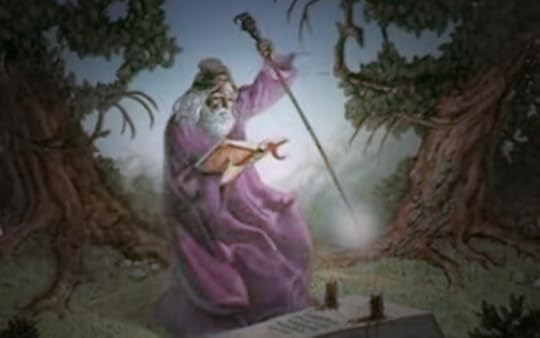
It’s set in the undetermined time and place, with generic Fantasyland elements that sometimes are serious and sometimes are gently mocked, but then it has connections with the world that’s definitely ours, and intentional anachronisms, and in the end the worldbuilding is really not the point. There’s a journey, and some battles, and a McGuffin, and a plot that meanders despite the short length of the story, and a delightful pair of old cantankerous wizards — and for some reason it all added up to a quite entertaining result. And despite short length it felt packed with stuff, with nothing really wasted.
“What worried me was the kind of story they told. Not the usual thing of wells poisoned, toads found in bed, ghosts rapping at windows. They talked about signboards creaking in the wind, trees casting odd shadows, dark cellar-ways that used to scare only children. And cloaks fluttering, and moths brushing faces in dark rooms.”
Pretty early on it takes on the atmosphere of a weird dream, where things follow their own odd logic, with unexpected things feeling eerie and creepy, but not overwhelmingly so, and great descriptions that are better than plot itself. And it ends like my weird dreams do, not quite satisfyingly but with its own internal logic and lingering sensation of residual unsettleness mixed with “that was it?” sensation.
3.5 stars. It will likely appeal to a very specific mindset rather than a wide appeal, and overall worked for me.
——————
Also posted on my blog.
June 2, 2014
Most intransigent Reader, two wanderers, whose years hang about them like millstones, though their wisdom rattles beads in the nursery of the mind, seek humble access to your cloud-bedizened person.
Prospero and Roger Bacon are two elderly wizards in a fantasy realm of small principalities and feuding warlords. When a series of ominous supernatural manifestations begin to haunt the mansion of Prospero, the two friends set out on a quest to discover the source of the evil occurences. Their travels are hampered by ghosts, wild beasts, chimaeras, inclement weather, nightmares of all sizes and shapes yet the wizards fight back with magic staff and chanted spell and bloody minded perseverence. The best weapons in their arsenal are their sense of humour, their refusal to admit defeat and give in to fear and despair.
- Oh, good heavens! Great elephantine, cloudy, adamant heaven full of thunder stones! Roger! You can’t be serious. Are you?
- If I were serious, I would never have become a wizard, would I?
Inspired by the autor discovering the prose of J R R Tolkien on a trip to England, The Face in The Frost is written as a homage to the grandmaster of fantasy, in flowery prose and with heroic scope, half in jest, half as thrilling horror story that unveils all the phobias Bellairs experienced in childhood: the dark and damp recesses of a cellar, monsters waiting in the shadows of the garden, strange noises rattling the windows, acrophobia, snakes and spiders and thunderstorms.
All of Prospero’s fear of dry insect shells, crackling, peeling, dusty things with skeletal limbs, choked him and made him thrash around in the chair until we woke up.
I enjoyed the story from start to finish, equally appreciating the sarcastic jokes and cantankerous personalities of the wizards and the mood pieces that sent chills down my spine in lonely cemeteries or haunted houses. He are a few more examples of what I’m talking about:
On a shelf over the experiment table was the inevitable skull, which the wizard put there to remind him of death, though it usually reminded him that he needed to go to the dentist.
---
They saw a haggard moon, with pinch brows and grieving mouth, rising into a blackness distant and calling. Like children lying on grass and looking into a cloud-vaulted day-time sky, they felt that they were going to fall upwards. Hollow ocean depths hung overhead, so that looking up was like standing on the edge of a cliff.
Elements from fairytales can be spotted here and there: transport solutions inspired by Cinderella, a ‘... competent, but somewhat sarcastic mirror in a heavy gilt frame. When the magician was not trying to get something out of it, it was given to tuneless humming and crabby remarks’. Like asking its patron if he ‘discovered a cure for mangy eyebrows’ . Powerful spells are delivered in doggerel verse like the following :
Higgeldy-piggeldy
John Cantacuzene
Swaddled in Byzantine
Pearl – seeded robes
Put out the eyes of his
Iconophanical
Prelate for piercing his
Priestly earlobes.
The only reason I did not rate the story five star for its inventive and beautiful prose is the lack of meaningful character development and the simplicity of the plot. It’s a case of the succes of style over substance, a divertimento that enchants but leaves little behind. Yet I would not hesitate to put the name of Bellairs next to Jack Vance who wrote in the Dying Earth cycle about wizards and their quests in an alternative humorous and melancholic manner. I might add Fritz Leiber, Gordon R Dickson and Gene Wolfe to the list of similar writers. I believe also that the more recent favorite by Sussana Clarke “Jonathan Strange and Mr. Norrell” was partially inspired by the characters of Prospero and Roger Bacon here.
Let me say goodbye for now with another extract written in the alliterative style of Beowulf:
My crest is cropped by croaking cranes! I go to drown in doleful dumps, deadrunk with drearyhead.

November 21, 2009
read during my Social Work Years
I Remember: a tale of wizards fighting wizards... featuring Prospero & Roger Bacon, but not that Prospero or Roger Bacon... brief, not a word out of place... humorous, but with some anachronistic funny business involved that didn't really enthuse me (which was also my only complaint about The Once and Future King)... i love that one wizard's crazy house... some beautifully written little bits... some very atmospheric little bits as well, some quite eerie, even chilling... not sure exactly why this is considered such a classic, but still... a charming charmer that charms... very charming indeed!
I Remember: a tale of wizards fighting wizards... featuring Prospero & Roger Bacon, but not that Prospero or Roger Bacon... brief, not a word out of place... humorous, but with some anachronistic funny business involved that didn't really enthuse me (which was also my only complaint about The Once and Future King)... i love that one wizard's crazy house... some beautifully written little bits... some very atmospheric little bits as well, some quite eerie, even chilling... not sure exactly why this is considered such a classic, but still... a charming charmer that charms... very charming indeed!

August 15, 2018
This book has lived up to my expectations so well. The language is a wonderful mix of what one might expect from wizards well educated in the ways of many worlds. The humor sneaks by the fright to balance the nearly constant sense of dread. Bellairs was expert at creating the unknown “reality”, the half-described terror that is more awful than anything fully seen. He uses the natural world so well to signal good or evil.
In one of my favorite sections from the book, everyday life becomes sinister.
In the roadside towns, the wizards picked up stories and
rumors. One man told how frost formed on the windows at
night, though it was only the middle of September. There were
no scrolls or intricate fern leaves, no branching overlaid star
clusters; instead people saw seasick wavy lines, disturbing
maps that melted into each other and always seemed on the
verge of some recognizable but fearful shape. At dawn, the
frost melted, always in the same way. At first, two black eyeholes
formed, and then a long steam-lipped mouth that spread and
and ate up the wandering white picture. In some towns, people
talked of clouds that formed long opening mouths... Doors
opened at night inside some houses, and still shadows that
could not be cast by firelight fell across beds and floors.
(pp 125-126)
I recommend this book to anyone who has ever read and enjoyed a fantasy tale during their reading life. While this is a YA book, as you can see from the excerpt above, it’s perfectly fine for adult readers who want to experience a different world for a while.
In one of my favorite sections from the book, everyday life becomes sinister.
In the roadside towns, the wizards picked up stories and
rumors. One man told how frost formed on the windows at
night, though it was only the middle of September. There were
no scrolls or intricate fern leaves, no branching overlaid star
clusters; instead people saw seasick wavy lines, disturbing
maps that melted into each other and always seemed on the
verge of some recognizable but fearful shape. At dawn, the
frost melted, always in the same way. At first, two black eyeholes
formed, and then a long steam-lipped mouth that spread and
and ate up the wandering white picture. In some towns, people
talked of clouds that formed long opening mouths... Doors
opened at night inside some houses, and still shadows that
could not be cast by firelight fell across beds and floors.
(pp 125-126)
I recommend this book to anyone who has ever read and enjoyed a fantasy tale during their reading life. While this is a YA book, as you can see from the excerpt above, it’s perfectly fine for adult readers who want to experience a different world for a while.

December 28, 2008
Bellairs's writing defies simple analysis. There's a dose of fairy-tale wit in the language and some of the styling (at times the narrator speaks directly to the reader, as though you are being read to). This would be pleasant in itself, to read of the entertainingly quirky house of a middling-powerful wizard, but then the story takes off with powerful and effective use of a sort of nightmare dream logic where reality becomes malleable. Bellairs avoids gore, vulgarity, and violence and with these limitations builds scenes of real horror: they draw from the kinds of bad dreams that everyone has had.
It reminds me somewhat of Jonathan Carroll, but more concentrated.
It reminds me somewhat of Jonathan Carroll, but more concentrated.

October 27, 2009
Mark Monday's review brought this book to my attention. His review is perfect!
All I can add: WTF? Did I miss something? Was this an allegory? Was this a deeper novel than I was able to understand? Evil wizard. Good wizard. Battle(s). Scary house...or estate...or...? All I can say is that I finished the book and eagerly looked to my shelves for another read.
All I can add: WTF? Did I miss something? Was this an allegory? Was this a deeper novel than I was able to understand? Evil wizard. Good wizard. Battle(s). Scary house...or estate...or...? All I can say is that I finished the book and eagerly looked to my shelves for another read.

August 10, 2014
Another entry on the "Why the hell didn't I read this years ago?!?" list (along with The Last Unicorn, amongst others).
Two wizards, Prospero (no, not that one) and his old friend Roger Bacon, find themselves in conflict with a truly ghastly opponent. In broad strokes the story isn't all that different from others we've seen before; the delight is in the details -- Bellairs' use of language, the occasional touches of whimsy (at one point, they try to make a carriage out of a tomato; those in the know realize that gourds are more appropriate), and the glimpses of true, deep magic or of shadowy menace as they seek their foe.
Two wizards, Prospero (no, not that one) and his old friend Roger Bacon, find themselves in conflict with a truly ghastly opponent. In broad strokes the story isn't all that different from others we've seen before; the delight is in the details -- Bellairs' use of language, the occasional touches of whimsy (at one point, they try to make a carriage out of a tomato; those in the know realize that gourds are more appropriate), and the glimpses of true, deep magic or of shadowy menace as they seek their foe.

March 24, 2011
So, I guess this book is often considered a classic, but I honestly don't get it.
The principle characters are Prospero and Roger, two elderly wizards who are likable enough, but never really developed. Some strange happenings occur in Prospero's house and the two, through no followable logic, assume that it is the doing of another nasty wizard named Melichus.
The story meanders it's way through the rest of the book, never truly making its goal or direction clear to the reader. While there are some nicely written passages, they are floating in a soup of mediocre storytelling. I found myself constantly re-reading pages because my mind would begin to wander midway through.
There really wasn't anything to grab the reader, and no real reason for the reader to want to be grabbed, actually. The ending is lackluster and vague.
I was really disappointed in this book.
Don't even bother with it.
The principle characters are Prospero and Roger, two elderly wizards who are likable enough, but never really developed. Some strange happenings occur in Prospero's house and the two, through no followable logic, assume that it is the doing of another nasty wizard named Melichus.
The story meanders it's way through the rest of the book, never truly making its goal or direction clear to the reader. While there are some nicely written passages, they are floating in a soup of mediocre storytelling. I found myself constantly re-reading pages because my mind would begin to wander midway through.
There really wasn't anything to grab the reader, and no real reason for the reader to want to be grabbed, actually. The ending is lackluster and vague.
I was really disappointed in this book.
Don't even bother with it.

July 23, 2009
What an unusual book. Although this book is only 174 pages, it took me a long time to read it. So much going on. There is no real way to say what time period this book is set in. It seems to be that generic medieval-esque period of historical fantasy, yet the narrative is overflowing with anachronisms. This is a story that it is helpful to read while a web browser is open to Wikipedia.org.
At times a little dry and in other times really unsettling, and quite humorous in parts, this fantasy is about a smackdown between master wizards. And what a meandering journey it takes to get to the final confrontation, which really doesn't last that long. I don't know if this was ever made into a movie, but I think it would make a very cool movie, live action, or animated. The urge would be to make it a kid's movie, but this is too dark for the average child. Maybe a young teen or preteen.
On the cover of my edition (which appears to be from 1969 since this book has a cover price of $1.75), a quote from Ursula K. LeGuin says this book is "Aunthentic fantasy by a writer who knows what wizardry is all about." I'd have to agree with that quote. This is a book for fans of wizards and magic. Although it was a chore to read (likely the small print, dense narrative, and crazy and hard to follow plot), I don't regret reading this one. I'm glad I did.
At times a little dry and in other times really unsettling, and quite humorous in parts, this fantasy is about a smackdown between master wizards. And what a meandering journey it takes to get to the final confrontation, which really doesn't last that long. I don't know if this was ever made into a movie, but I think it would make a very cool movie, live action, or animated. The urge would be to make it a kid's movie, but this is too dark for the average child. Maybe a young teen or preteen.
On the cover of my edition (which appears to be from 1969 since this book has a cover price of $1.75), a quote from Ursula K. LeGuin says this book is "Aunthentic fantasy by a writer who knows what wizardry is all about." I'd have to agree with that quote. This is a book for fans of wizards and magic. Although it was a chore to read (likely the small print, dense narrative, and crazy and hard to follow plot), I don't regret reading this one. I'm glad I did.

January 4, 2011
Have you ever woken up from a deep sleep in the middle of the night and found that, for just a moment, your nightmares have bled into real life? For a fleeting moment, things are just not right. Maybe it's just a feeling, or maybe hues and colors seem just a bit off, or maybe the shadows seem to be a little livelier than usual. Have you ever felt that?
I think that's the reason I love this book so much. John Bellairs has managed to capture perfectly the ominous disorientation that I sometimes experience when I just wake up. I first encountered Bellairs as a very young reader. He wrote many books for children. They were fun enough, usually about a young child that manages to stumble into black magic somehow. I quite enjoyed them, but when I got older, I didn't feel the need to revisit them. Then my mom, who has a hobby of scouring used bookstores and thrift shops, brought me The Face in the Frost in a pile of her latest acquisitions. Nostalgia led me to pick it up. I never expected it to become one of my favorite books.
It's a pretty simple book, really: good wizards must confront evil wizard intent on mastering evil powers (I hope that's not a spoiler). But Bellairs' descriptions -- oh, his descriptions! -- are so deliciously creepy. (Note: Do not read late at night!) And there's just a hint of wry humor and eccentricity to keep things lively. I can't say I'd recommend this book to everyone; based on my observations, I'm pretty sure most people don't share my odd taste in books, but to me, at least, this book is a masterpiece.
12/26/2014 : Just reread this again! I still love it.
I think that's the reason I love this book so much. John Bellairs has managed to capture perfectly the ominous disorientation that I sometimes experience when I just wake up. I first encountered Bellairs as a very young reader. He wrote many books for children. They were fun enough, usually about a young child that manages to stumble into black magic somehow. I quite enjoyed them, but when I got older, I didn't feel the need to revisit them. Then my mom, who has a hobby of scouring used bookstores and thrift shops, brought me The Face in the Frost in a pile of her latest acquisitions. Nostalgia led me to pick it up. I never expected it to become one of my favorite books.
It's a pretty simple book, really: good wizards must confront evil wizard intent on mastering evil powers (I hope that's not a spoiler). But Bellairs' descriptions -- oh, his descriptions! -- are so deliciously creepy. (Note: Do not read late at night!) And there's just a hint of wry humor and eccentricity to keep things lively. I can't say I'd recommend this book to everyone; based on my observations, I'm pretty sure most people don't share my odd taste in books, but to me, at least, this book is a masterpiece.
12/26/2014 : Just reread this again! I still love it.

December 4, 2009
The Face in the Frost is the only adult novel by John Bellairs, best known for his wonderful children's books (the best known of those being probably The House with the Clock in Its Walls), and it's good enough to make me wish very much that he'd written more. This is no epic fantasy, but a deeply atmospheric and magical tale of the wizard Prospero and his friend Roger, who are attacked by a mysterious evil power. It's charmingly written, the dialogue particularly full of witty allusions; yet much of it is spine-chillingly creepy, to the extent that I wished I were reading it during the day (which is much the same way I used to feel about The House with the Clock in Its Walls and its sequels). Although it's widely considered a fantasy classic, The Face in the Frost is sadly out of print; if you run across a copy, snap it up and consider yourself lucky.

December 8, 2019
I don’t write reviews.
Words that come to mind: Delightful. Charming. Whimsical. Magical. Adorable. Fantastic.
Words that come to mind: Delightful. Charming. Whimsical. Magical. Adorable. Fantastic.

January 30, 2010
I just reread this old and faithful friend. Oh! the magic mirror! Oh, the tomato coach! I LOVE the way this guy's mind works. In his books, no fairy tale plot device is sacred. He spoofs them all and makes the reader love it. Seriously, this author knows how to twist a tale so engagingly that only a surly sobersides wouldn't grin and giggle. I can't begin to describe his plots, which is good because that way the joy of discovery is yours. This is the premier fairy tale for grown-ups, especially for those who love wordplay. (This author also writes terrific YA and children's books. I have given them to my never-ending supply of nieces and have actually received thank-you notes.) However, you don't have to take my word for it. Just read it yourself and you'll see what I mean. So go! Get on with you!

September 25, 2021
Part funny and part scary, I can't believe it took me 52 years to read such a well respected fantasy. I was obsessed with fantasy after reading LOTR in the early 70's but this novel alluded me. I finally sought it out this summer after reading about it in Gygax's recommended reading list in an early edition of D&D. Truly glad I found it, it's basically a quest to find a great evil and overcome it by two wizards. One of my favorite parts is
December 4, 2022
Great atmosphere of wonder, some nice use of magic, good prose... I'd rate this one higher if it weren't for the long paragraphs and sentencing that cause important details to fade into the background. It's surprisingly hard to read and keep track of things - I had to double back several times.

July 28, 2014
Bellairs' riff on wizardry isn't full of flash and bang. It is more a tone poem invoking a mood of (as Yoda might say) "a disturbance in the Force." Prospero and Roger Bacon are two friends in wizardry. One from the North Kingdom and one from the South Kingdom. They get together from time to time to share companionship and knowledge.
However, when they meet near the beginning of this story, they find that someone or something is changing the world around them. The story (a novella) concerns their explorations of the Kingdoms, the manifestations of evil, and their narrow escapes.
Bellairs doesn't do much to flesh out these Kingdoms, and for this story, he confuses the reader with references to other places (such as Wales and Scotland) and other times (of greater and lesser technology) that don't add to the plot. On the other hand, he brings out an appreciation of detail in nature and some lively characters to enhance the journey. There is enough tension to carry the story along and slide over the finish line with 3 stars.
However, when they meet near the beginning of this story, they find that someone or something is changing the world around them. The story (a novella) concerns their explorations of the Kingdoms, the manifestations of evil, and their narrow escapes.
Bellairs doesn't do much to flesh out these Kingdoms, and for this story, he confuses the reader with references to other places (such as Wales and Scotland) and other times (of greater and lesser technology) that don't add to the plot. On the other hand, he brings out an appreciation of detail in nature and some lively characters to enhance the journey. There is enough tension to carry the story along and slide over the finish line with 3 stars.

December 5, 2016
A fantasy tale centering on two wizard's, Prospero (not that Prospero) and Roger Bacon. Weird and creepy things start happening and they set off to discover what is going on and ultimately how to stop it. This was John Bellairs only adult novel, most of his work was aimed at a younger audience.
There is some nicely creepy horror in this book and some fun humor. One of the more unique tales I have read in a while.
There is some nicely creepy horror in this book and some fun humor. One of the more unique tales I have read in a while.

February 20, 2019
So....where to start? I suppose at the beginning. Two wizards (neither of whom seems particularly wizard-y) meet up to confront a third wizard who is doing something bad for reasons unknown. As they seek to find said bad wizard, they encounter a menagerie of half-baked characters who provide minimal or no help, all while our two protagonists appear to be moving toward an undefined danger. In the end, a fourth mysterious wizard appears, helps out our two protagonists, and the bad wizard is vanquished through some unknown means that is referred to but not actually shown or described.
I wanted to like this book, and maybe if I was in junior high I would have, but as a mature adult there was nothing in here to put any stake in. Good guys and bad guy (only one) were poorly drawn, entirely foreign (on no level could I relate to them at all), and the plot never provided urgency. Supposedly the bad guy was causing all sorts of bad things to happen, but the only effects we see are people locking their doors at night and a couple abandoned villages. There isn't even any wizarding going on to make the reader feel like this is a battle of wizards fighting for control of anything. There was also so much detail about things that meant absolutely nothing (such as describing the roof of a house) that it made me wonder if the author was just looking for a opportunity to show off the knowledge he had acquired over time that no one in his friendship circle cared about.
There was, without doubt, potential for this book and story, but it fell short for me. Very short. Apparently I am in the minority in feeling this way, but maybe I'm just older than the average reviewer. Regardless, for me, and for anyone who desires depth to their books, this is one you can skip over.
I wanted to like this book, and maybe if I was in junior high I would have, but as a mature adult there was nothing in here to put any stake in. Good guys and bad guy (only one) were poorly drawn, entirely foreign (on no level could I relate to them at all), and the plot never provided urgency. Supposedly the bad guy was causing all sorts of bad things to happen, but the only effects we see are people locking their doors at night and a couple abandoned villages. There isn't even any wizarding going on to make the reader feel like this is a battle of wizards fighting for control of anything. There was also so much detail about things that meant absolutely nothing (such as describing the roof of a house) that it made me wonder if the author was just looking for a opportunity to show off the knowledge he had acquired over time that no one in his friendship circle cared about.
There was, without doubt, potential for this book and story, but it fell short for me. Very short. Apparently I am in the minority in feeling this way, but maybe I'm just older than the average reviewer. Regardless, for me, and for anyone who desires depth to their books, this is one you can skip over.

May 17, 2016
A classic of Appendix N fantasy!
I picked up this book because it was listed in Gary Gygax's famous "Appendix N" (fantasy works that had inspired the creation of Dungeons & Dragons). The book concerns wizards living in a fantasy realm that is supposed to be closely linked to our world in a late medieval/early Renaissance setting (mention is made of England and other countries of our world, yet the action takes place around two fantasy realms, the Northern Kingdom and the Southern Kingdom). There is some really gorgeous prose, and wonderful conceptions of how wizardry works. I found the overall plot a little muddy, but that hardly seemed to matter - it was just fun to read!
I picked up this book because it was listed in Gary Gygax's famous "Appendix N" (fantasy works that had inspired the creation of Dungeons & Dragons). The book concerns wizards living in a fantasy realm that is supposed to be closely linked to our world in a late medieval/early Renaissance setting (mention is made of England and other countries of our world, yet the action takes place around two fantasy realms, the Northern Kingdom and the Southern Kingdom). There is some really gorgeous prose, and wonderful conceptions of how wizardry works. I found the overall plot a little muddy, but that hardly seemed to matter - it was just fun to read!

March 16, 2019
Bellairs is best known for his children's books, with an added boost recently from The House With a Clock in Its Walls being released as a movie.
This isn't a kids' book. Not that it contains any inappropriate content, and there are undoubtedly kids who would enjoy it.
This book, though, is aimed at adults who will enjoy the wordplay, the humor that rests on familiarity with things kids the age of Bellairs' usual readers haven't read yet, being aware of who the "other" Prospero is and recognizing the name of Roger Bacon, and...but no. Wait. Kids would enjoy the transition from the comic beginnings to the terrifying opponent.
The basic story isn't remarkable. Two good wizards discover evidence of an evil wizard at work with dark intentions, and set out to stop him. What is remarkable is graceful, elegant, and extremely funny use of language and familiar literary imagery to create a delightfully original and absorbing story for adult readers.
I have a deep and abiding love for this story, and its author, and, weirdly, for the discovery that the women's Catholic college he taught English at for a year, and was deeply unhappy at, was in fact my own alma mater--and that he was fondly remembered there as a good, likable, interesting guy--not by the English department, but by the history department. And specifically, the chair of the history department, who was my adviser.
It's the sort of whimsy that's entirely appropriate for John Bellairs. Who, yes, really was a good, likable, interesting guy.
This story is highly recommended and a lot of fun.
I bought this audiobook.
This isn't a kids' book. Not that it contains any inappropriate content, and there are undoubtedly kids who would enjoy it.
This book, though, is aimed at adults who will enjoy the wordplay, the humor that rests on familiarity with things kids the age of Bellairs' usual readers haven't read yet, being aware of who the "other" Prospero is and recognizing the name of Roger Bacon, and...but no. Wait. Kids would enjoy the transition from the comic beginnings to the terrifying opponent.
The basic story isn't remarkable. Two good wizards discover evidence of an evil wizard at work with dark intentions, and set out to stop him. What is remarkable is graceful, elegant, and extremely funny use of language and familiar literary imagery to create a delightfully original and absorbing story for adult readers.
I have a deep and abiding love for this story, and its author, and, weirdly, for the discovery that the women's Catholic college he taught English at for a year, and was deeply unhappy at, was in fact my own alma mater--and that he was fondly remembered there as a good, likable, interesting guy--not by the English department, but by the history department. And specifically, the chair of the history department, who was my adviser.
It's the sort of whimsy that's entirely appropriate for John Bellairs. Who, yes, really was a good, likable, interesting guy.
This story is highly recommended and a lot of fun.
I bought this audiobook.

June 5, 2018
Yes, YES! This is what I hope for while reading of wizards, anything can happen and often does. Compares to, "The Dying Earth," where magic is considered in most areas of world building.
My mind was blown twice by this book, I could only mutter, "Wow," and probably not in the spots you might guess. This book uses my favorite mythic trope so what the characters do really matters.
The warmth of the wizard's friendship is a huge bonus.This book features one of the greatest character reunions, ever. With so much emphasis put on conflict in modern tales, I often wonder if the sidekicks even like the main character. Do the Star Wars droids like Luke or tolerate him? Are they loyal to him or just loyal in general?
This story takes place in a medieval realm, but magic allows some crossover from later eras. That puts some readers off, but I rolled with it. This is one of the few stories comparable to Alice in Wonderland, where the MC—and consequently the reader, is constantly off-balance, but loving every bit of it.
There were about three authorial intrusions I would have edited out, but the depth of architectural detail, and menacing atmosphere made them easy to overlook. While this book doesn't dwell on fay, it has that threatening quality, that older, Pre-60's, faerie tale feel, where you've stumbled into a dark borderland between the world you thought you knew, into what might be a cautionary tale—that isn't designed to spare your feelings, so much as inform them. This book lapses into the truly horrific at times. Which is not to imply the book makes any political or moral statement, but to point out that fantasy used to seem more dangerous, now it's all rainbows and unicorn farts.
The only way I can tolerate mysteries is when I'm given a story goal I can follow, so this worked for me. Interesting structure:
I'm confident that there is enough fruit left on this husk, I'll thoroughly enjoy a reread, a few years from now.
If I were serious I would never have become a wizard, would I?
My mind was blown twice by this book, I could only mutter, "Wow," and probably not in the spots you might guess. This book uses my favorite mythic trope so what the characters do really matters.
The warmth of the wizard's friendship is a huge bonus.This book features one of the greatest character reunions, ever. With so much emphasis put on conflict in modern tales, I often wonder if the sidekicks even like the main character. Do the Star Wars droids like Luke or tolerate him? Are they loyal to him or just loyal in general?
This story takes place in a medieval realm, but magic allows some crossover from later eras. That puts some readers off, but I rolled with it. This is one of the few stories comparable to Alice in Wonderland, where the MC—and consequently the reader, is constantly off-balance, but loving every bit of it.
There were about three authorial intrusions I would have edited out, but the depth of architectural detail, and menacing atmosphere made them easy to overlook. While this book doesn't dwell on fay, it has that threatening quality, that older, Pre-60's, faerie tale feel, where you've stumbled into a dark borderland between the world you thought you knew, into what might be a cautionary tale—that isn't designed to spare your feelings, so much as inform them. This book lapses into the truly horrific at times. Which is not to imply the book makes any political or moral statement, but to point out that fantasy used to seem more dangerous, now it's all rainbows and unicorn farts.
The only way I can tolerate mysteries is when I'm given a story goal I can follow, so this worked for me. Interesting structure:
I'm confident that there is enough fruit left on this husk, I'll thoroughly enjoy a reread, a few years from now.
If I were serious I would never have become a wizard, would I?

March 18, 2023
i read this for class and really enjoyed it! the narrative tone was so fun and the magic was very spunky

April 18, 2017
A very odd offering. For myself, I'd actually give it two stars. But given that I can see its influence in D&D, Discworld, Harry Potter and many other things, I'll give it an extra star for historical significance. Ultimately I know it's an important bit of fantasy history and it's not that it's bad, it's just very much not my cup of tea.
I both liked and disliked it. It's very inventive, and some of the imagery is lovely. Some of the scenes designed to build a sense of creeping dread are very nicely done. It tries very hard to be quirky and charming overall, and it very often succeeds at that. The characters were likeable. The register and sense of humor were things I found appealing. I certainly got a few nice chuckles out of it. 10 out of 10 for creativity in the details - I can see how the description of Prospero's house served J.K. Rowling when she wrote about The Burrow.
That said, there is little in the way of structure, there is for some reason a detailed description of some politics that don't really matter at any point during the course of the tale and for me, the lack of explanation of the magic system and simplistic plot steals away any real sense of tension. At times it was a quick read and at others it was the longest goddamn novella I have ever read.
I'd sum it up like this (spoilers ahead):
Two wizards, Prospero and Roger, set out on an adventure with the goal of stopping a bad wizard. A weird magical thing happens to them. They fix it with some magic, because they can do that. Another thing happens to them. This, too, they fix with magic. The magic has no specific rules to it that are ever really explained to us, so whatever happens you can be pretty sure that they have just the spell to fix it. Because they have spells, you see. Why did the thing happen? Why were they able to fix it?
1. Magic.
2. Bad Wizard.
3. Who the fuck knows?
4. Why the fuck not?
Pick one or all of the above, because it's the only answer you're getting.
One of the wizards is given a key by a random bloke they meet, because for generations his family has known they're supposed to give it to a guy with a name that starts with P, and Prospero will do, I guess. Why not. They meet a character, and by "character", I mean "deus ex machina". The key is useful in defeating the bad wizard, because of course it is. Everything's fine, hooray.
I both liked and disliked it. It's very inventive, and some of the imagery is lovely. Some of the scenes designed to build a sense of creeping dread are very nicely done. It tries very hard to be quirky and charming overall, and it very often succeeds at that. The characters were likeable. The register and sense of humor were things I found appealing. I certainly got a few nice chuckles out of it. 10 out of 10 for creativity in the details - I can see how the description of Prospero's house served J.K. Rowling when she wrote about The Burrow.
That said, there is little in the way of structure, there is for some reason a detailed description of some politics that don't really matter at any point during the course of the tale and for me, the lack of explanation of the magic system and simplistic plot steals away any real sense of tension. At times it was a quick read and at others it was the longest goddamn novella I have ever read.
I'd sum it up like this (spoilers ahead):
Two wizards, Prospero and Roger, set out on an adventure with the goal of stopping a bad wizard. A weird magical thing happens to them. They fix it with some magic, because they can do that. Another thing happens to them. This, too, they fix with magic. The magic has no specific rules to it that are ever really explained to us, so whatever happens you can be pretty sure that they have just the spell to fix it. Because they have spells, you see. Why did the thing happen? Why were they able to fix it?
1. Magic.
2. Bad Wizard.
3. Who the fuck knows?
4. Why the fuck not?
Pick one or all of the above, because it's the only answer you're getting.
One of the wizards is given a key by a random bloke they meet, because for generations his family has known they're supposed to give it to a guy with a name that starts with P, and Prospero will do, I guess. Why not. They meet a character, and by "character", I mean "deus ex machina". The key is useful in defeating the bad wizard, because of course it is. Everything's fine, hooray.

May 8, 2012
I really wanted to like this, since it comes recommended by one of my current favourite authors (and my boyfriend!). But alas, it was not meant to be :(
The first half of the book is meandering and the characters themselves seemed really under developed; I couldn't find much reason to care about them or their quest.
I really liked the author's descriptiveness at first (and it was so good that it rendered the weird ink illustrations kind of pointless), but it soon wore thin when I realised that all the tiny details were distracting me from the (confusing) plot.
He also fails at world-building in my opinion - I couldn't get my bearings at all. The author referred to fictional people, places and countries as well as real ones, and I could never quite grasp whether they were all existing in the same reality or not.
On the plus side, the guy really seems to understand wizards and magic, and some scenes were incredibly creepy and vivid.
By the time the plot actually made any sense, the ending was a let-down - I couldn't figure out the motivations behind the bad guy's actions, or what exactly happened to fix it all.
So in the end, it all just felt like a confused mess to me.
The first half of the book is meandering and the characters themselves seemed really under developed; I couldn't find much reason to care about them or their quest.
I really liked the author's descriptiveness at first (and it was so good that it rendered the weird ink illustrations kind of pointless), but it soon wore thin when I realised that all the tiny details were distracting me from the (confusing) plot.
He also fails at world-building in my opinion - I couldn't get my bearings at all. The author referred to fictional people, places and countries as well as real ones, and I could never quite grasp whether they were all existing in the same reality or not.
On the plus side, the guy really seems to understand wizards and magic, and some scenes were incredibly creepy and vivid.
By the time the plot actually made any sense, the ending was a let-down - I couldn't figure out the motivations behind the bad guy's actions, or what exactly happened to fix it all.
So in the end, it all just felt like a confused mess to me.

September 25, 2019
Found this little gem hiding on a dark book shelf in Dede's Bookrack in Trussville. I've known about this book for awhile, but not from the same sources as most. Up until a couple of years ago I had no idea what Appendix N even was. Sacrilege, I know. Sure I knew who Gary Gygax was, but I have never played D&D and had never encountered Appendix N. How many people read this because it was included in Gygax's Appendix N?
This is a quick read. Most of the book is a sort of waking nightmare for Prospero. Interesting set up and adventure; it kept me engaged. Even though a lot of the whys and wherefores were lost on me. I didn't love it, but I think I'll hang on to my copy.
The cover art by Carl Lundgren is very nice and actually illustrates a crucial scene from the book. Imagine that. This edition also boasts illustrations by Marilyn Fitschen.
This is a quick read. Most of the book is a sort of waking nightmare for Prospero. Interesting set up and adventure; it kept me engaged. Even though a lot of the whys and wherefores were lost on me. I didn't love it, but I think I'll hang on to my copy.
The cover art by Carl Lundgren is very nice and actually illustrates a crucial scene from the book. Imagine that. This edition also boasts illustrations by Marilyn Fitschen.

July 5, 2008
I've long been a fan of Bellairs' wonderfully creepy novels for children, so when I discovered that early in his career he'd written a fantasy novel (ostensibly for adults), I was eager to check it out.
This feels like a first novel, or an early one, and all of the great elements don't always come together into a solid whole. On the other hand, it's marvelously funny, and the wizards herein might remind some readers of Jonathan Strange and Mr. Norrell. It also has some genuinely creepy moments, and I think had I read it when I was younger, it would have spooked me a bit. Definitely worth reading, especially if you enjoyed The House With a Clock in Its Walls and other classic Bellairs.
This feels like a first novel, or an early one, and all of the great elements don't always come together into a solid whole. On the other hand, it's marvelously funny, and the wizards herein might remind some readers of Jonathan Strange and Mr. Norrell. It also has some genuinely creepy moments, and I think had I read it when I was younger, it would have spooked me a bit. Definitely worth reading, especially if you enjoyed The House With a Clock in Its Walls and other classic Bellairs.

May 21, 2008
Not much of a plot in this book. Really, it's just two wizards bumbling along together and witnessing various magical and creepy events, but the language...ah, the language! It's lovely sort of cross between Tolkien and Rowling, hilarious and breathtakingly lovely by turns. I was going to trade this one in to my book-swapping club when I finished reading it, but I was so captured by the descriptions of the wizard's house and his interactions with his magic mirror (first chapter) that now I'm keeping this book forever for myself.

July 30, 2015
This book pulls off a really unique combination: it manages to be a lighthearted, sweet story about friendship that also can be super spooky with fantastic evocative imagery. I really liked it.

October 17, 2024
This is a short fantasy book from Appendix N. The story centers around 2 wizards trying to stop another who seems to be destroying parts of their strange world. A very choppy and quirky read. The book generally receives high praise, but it’s middling to me.
Displaying 1 - 30 of 337 reviews