Over four decades ago, Yoshihiro Tatsumi expanded the horizons of comics storytelling by using the visual language of manga to tell gritty, literary short stories about the private lives of everyday people. He has been called "the grandfather of Japanese alternative comics" and has influenced generations of cartoonists, but, until now, the majority of his work has remained unavailable outside of Japan. Good-Bye is an unblinking examination of the aftershocks of war, and, fittingly, among the most searing, outrageous, and humane work from this modern master.
Yoshihiro Tatsumi (辰巳 ヨシヒロ Tatsumi Yoshihiro, June 10, 1935 in Tennōji-ku, Osaka) was a Japanese manga artist who was widely credited with starting the gekiga style of alternative comics in Japan, having allegedly coined the term in 1957.
His work has been translated into many languages, and Canadian publisher Drawn and Quarterly have embarked on a project to publish an annual compendium of his works focusing each on the highlights of one year of his work (beginning with 1969), edited by American cartoonist Adrian Tomine. This is one event in a seemingly coincidental rise to worldwide popularity that Tomine relates to in his introduction to the first volume of the aforementioned series. Tatsumi received the Japan Cartoonists Association Award in 1972. In 2009, he was awarded the Tezuka Osamu Cultural Prize for his autobiography, A Drifting Life. The same work garnered him multiple Eisner awards (Best Reality-Based Work and Best U.S. Edition of International Material–Asia) in 2010 and the regards sur le monde award in Angoulême International Comics Festival in 2012.
A full-length animated feature on the life and short stories of Yoshihiro Tatsumi was released in 2011. The film, Tatsumi, is directed by Eric Khoo.
Не съм сигурен, че комиксите на г-н Йошихиро са класическа манга. Но аз не съм специалист и може би греша?
Муцунките на част от неговите герои изглежда силно са повлияли създателите на сериала "Семейство Симпсън", не мога по друг начин да си обясня приликата.
Историите и стилът му са изчистени, издържани в стил "ноар" и разказват за пропилени съществувания, липса на любов и цел в живота, отношения между млади, стари и прочие, все ежедневни и почти тривиални случки, картини от живота в Япония.
Авторът предпочита самотниците и аутсайдерите, част от развитите проблематични ситуации са си типично по японски извънземни и неясни.
Хареса ми, очаквам още два сборника с негови графични отклонения/откровения.
The characters in Yoshihiro Tatsumi's comics are sad. They are sad in the something is missing way. There are good reasons to be sad, if you need reasons. Getting old. Getting cold. Political reasons of being sad. The whole place getting old and cold along with them. The faces are identical expressions of sad. Almost inhuman. I squinted my eyes and the drawings could have been of primates. Stuck in a zoo some place. Labeled No Longer Erectus (yeah, some of these guys can't get it up anymore on top of everything else). They could have felt a moving feeling traveling from one person to another like an infection you wouldn't want to share. I don't know. I wasn't feeling a mood as much as species... Feelings too permanent... I don't know. I don't think you can catch that so much as get mounted on the wall next to it.
There was a part missing. The part missing from the self that's hidden. It's the voice in your own head that you don't know what it is going to say next. It's the ability to be surprised. (I try not too think too hard so I can get this more often. It's the part that gets me into trouble when I don't think before I talk. Oops.) You could call it hope, I guess. I call it a part of yourself that keeps you from being utterly alone. These stories almost lacked that part completely. There was no life. The plaque was mounted. The museum has opening hours of 11 a.m. until 4 p.m. It shouldn't have been that way (the first story was about a photographer who took a photo of what seemed to be a moving glimpse of enduring family life before the black rain of Hiroshima. A man and a country scramble to profit on the signs of their own victimhood and tears. Make it a holiday. That's not a photograph! That's today). Sometimes.... I liked the story 'Sky Burial' the best. A man doesn't move with his neighbors. He stays alone in the building with the dead body, unwilling to move himself. He looks into the sky to see vultures all over his building. They know dead things when they see it. I liked the old man who chooses to live alone in the wilderness in his middle age after a life handed over to office work. His mental energies are exhausted on a rash. He's still working too hard. All of the old men want a young and pretty woman. The women give themselves away to them when they are tossed aside by a younger man. Is that their only direction? These guys (and women) all have vultures... It's that there is no other direction. The end story is Good-bye. A prostitute (for soldiers. She's not too well liked by her fellow Japanese, obviously) forces her father to have sex with her (hey, just like the dream sequence in Norma Jean & Marilyn) so that he'll be "just another man" to her. "Good-bye." I don't know. Is that good bye? It's burial, isn't it? That's what giving up is.
I'd want to scream. There's a part missing. Good-bye is an interesting book about being buried alive, I guess. Maybe I should read it as that and move along in the mausoleum of corpses... It's closing time. Should I have been living their lives more than they were? Maybe I didn't really LIKE this...
Are you sad if you are always sad?
P.s. Okay, so I didn't agree with Tatsumi's version of events either. When a young man dresses up in his sister's clothes he is spied on by someone he knows (it was a haunting image of the house burned down and the mirror he is seeing looking into cracked. Either from the fire or from self disgust. I liked that it wasn't stated). The mate thinks he dressed up as a girl because his many sisters and mother pressured him to be more of a man. I thought he was kissing the girl him in the mirror because he was lonely. The make up was to look like someone else. Someone else to love. Almost...
And if you are going to get into the whole politics (which others have said about this book that it was politics and maybe it was. But the thing about politics, since it isn't the '70s anymore...If it connects to now...)... It still matters about the missing part.
With 'Eisneresque' precision Yoshihiro Tatsumi looks at the various traps we set for ourselves...and how we take others down with us when we fall. There is a very strong 'dharma undercurrent' in these tales (one is reminded of some of the shorter works by Samuel Beckett) that seems to imply that there is no escape - provocatively haunting.
A classic collection from an original manga master.
Did you know Japan used to have stores that rented comics? In the 1950s and 60s many artists honed their talents (and earned their livings) pumping out rental comics to feed the demand.
This anthology achieves a synergy between image and story lines, without fussiness or pretence. Wonderful.
Yoshihiro Tatsumi is one of the most innovative and compelling comic book artists of all time, up there with Crumb, Tezuka and Moebius. His work is simply unique, painting candid portraits of human cruelty and perversion in a simple and clean style. He's not interested in shock for shock's sake, or to fetishize suffering, his stories are like little revelations, glimpses into something secret, a peek at the void inside all of us. Also, I'm always amazed at how many interesting stories and situations he could come up in just a couple of years. This book's only flaw is the occidental style they adapted from the original manga pages, everything else is good, and there's nothing else like it.
The third and unfortunately final volume of classic Tatsumi short stories published by D+Q. 1971-1972. The stories are getting longer and more ambitious than in the first two volumes.
-Hell -Just a Man -Sky Burial -Rash -Woman in the Mirror -Night Falls Again -Life is So Sad -Click Click Click -Good-Bye
Man... one of my biggest wants in comic publishing is more volumes of Tatsumi short stories and comics.
Each story is engrossing, but problematic. Apologies for that awful, awful grad school euphemism. What I mean is that this man has problems: he writes and draws a good story, but he hates women. His story about a boy who turns to cross dressing because his mother places too much pressure on him to support the family as the "man of the house" stinks of the pre 1972 psych drivel still desperately being touted by the "ex-gay" movement. The first story about Hiroshima, however, was worth the whole collection.
I often watch japanese films and am always taken aback because of the cultural differences shown. Yet, for the japanese comics I have read there is rarely that feel. Then again the few manga's I have read are of more universal theme's of plain fighting stories (i.e Battle Royale). So for me to start reading Tatsumi, I realized that while his output in Japan may have been enormous he was still relatively unknown. His subject matter is always somewhat depressing and topical and definitely not fantastical (which seems to have been the norm), in fact his stories of alienation and abuse and war (which is 40 years old) is more current to our times that it seems that it was written only just yesterday. His style is so normal and fluid that aside from the kenji characters and the Japanese iconography, I don't find it particularly Japanese. Meaning that he shouldn't be lumped in as a Japanese master but lauded as a wonderful storyteller. In fact it makes me wonder why he isn't hailed as a master like Will Eisner has been recently touted as. I can only applaud the efforts of Tomine and hope that there will be more and more volumes put out to keep me entertained in the future.
One of the most interesting collections of short stories I've ever read. Each of these selections is a little window into someone's falling-apart life. Much like the films of Todd Solondz, Tatsumi's work is challenging and uncomfortable, but that's what makes it even better.
Being one lonely person surrounded by 130 million contemporaries serves not only to isolate, but to besot with striking similarity amongst each of the persons in question. To be neglected and disenfranchised is what it means to be one of many nameless protagonists in a Yoshihiro Tatsumi story.
The Raymond Carver of manga, Tatsumi presents his subjects with unflinching reality (an acceptable form of cruelty). This is not because he hates his characters, but because - in a deeper sense - he communes with them. The surface levels of basic humanity are prised away, and the underlying pain, anguish, and devilish driving forces become what makes each individual somewhat apart from the millions of others.
The tedium of loveless relationships, disarray of modern living, and compunction of survival from moment to moment (like a recovering addict, only with mere existence in place of some controlled substance) are not as seclusionist as they seem to those undergoing the psychological struggles at the time.
In Japan alone, Tatsumi presents a defining litany of dozens who live the same life. The basic variables may not match point-for-point, but the alienation and subsequent humiliation, dejection, and defeat are all too identical.
Welcome to the world of adulthood.
Good-Bye presents Tatsumi's work from 1971 through 1972, and the stories themselves have a focus on the working class Japanese, and the struggles to get through a post-World War II devastation and regrouping. During this era, Japan had not presented the world with its frenzied pop-culture artifacts or superior technological advances.
One year earlier, in 1970, John Lennon lyricized the phrase "a working class hero is something to be." Tatsumi's collection of stories presents a zeitgeist of this facetious modern-day (and iconic) adage. Whether the characters struggle with adapting to their harrowing situations, or whether they've abandoned their old ways for a life of simplicity, these tales do not stretch the realm of credibility - but expand upon what we would otherwise perceive as the mundane or meaningless or uneventful.
Each human life, no matter how small or battered it has become over time, has a deliberate potency as presented in Good-Bye.
Why is it that every subsequent book I read by Tatsumi seems more mature and layered than the last? I'm amazed that many of the collected short story comics in this book were published in the 70s. They are just so stark and critical of Japanese society post Hiroshima. They are just absolutely amazing. And still so real today in depicting the life of a salary man as something of waste in the end as it only drives one's desires in dark directions. I was intrigued by the visual effect of characters having very similar faces across different stories, making them seem more like a complex whole than separate stories. Creepy and highly recommended.
Good-Bye is my favorite of the three volume collections of Yoshihiro Tatsumi's short comics published by Drawn & Quarterly. Tatsumi's work is bleak and dreary, but it serves as a brutally candid reflection of the ills and vices of humanity. The stories here are even more cynical that those found in Abandon the Old in Tokyo, but Tatsumi's approach is more about understanding where suffering comes from. In stories like "Just a Man" and "Click Click Click" we see Tatsumi return to the recurring theme of his protagonists suffering from insecurities or some form of impotency (often sexual), which serves to provide an examination of the roots of their more nefarious actions. The stories of Good-Bye is comprised of many unsympathetic and unsavory characters, but in the end we always understand why they are the way they are.
One of my favorites in this collection is the opening story, "Hell", which is about a photojournalist who gains recognition for his famous photo of a scorched silhouette of a son and his mother in the aftermath of the atomic bombing of Hiroshima, similar to the real life Human Shadow Etched in Stone exhibit. Decades later, the journalist learns the horrifying truth about his photo and now has to decide whether his reputation or the truth matters more. Tatsumi uses this story to deliver some truly disturbing images of the bombing aftermath in a style rivaling that of the excellent yet harrowing account from Keiji Nakazawa's I Saw It. But "Hell" is not really about the bomb itself, but more about how its sordid legacy shaped Japanese society in the decades to follow.
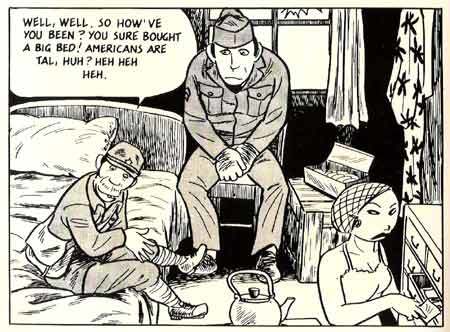
The titular story, "Good-Bye", is also a fantastic examination of the downtrodden perspective of Japanese society in the post-war years. Growing income inequality coupled with the American occupation lead to some pretty disastrous outcomes for many of Japan's citizens, and here we get a tale of the decayed relationship between a daughter and her father due to poverty and the impotence felt in the face of the more brazen American G.I.s who freely slept around with the locals. It's harrowing and saddening, and Tatsumi does little to sugarcoat the reality of the situation.
Good-Bye is haunting and affecting, with Tatsumi's simple yet effective cartooning capturing the needed expressiveness to convey the ideas within a short few pages. The stories here are undoubtedly bleak though undeniably a profound portrait of the human condition.
Yoshihro Tatsumi, Good-Bye (Drawn and Quarterly, 2008)
With every collection of Yoshihiro Tatsumi stories that Drawn and Quarterly releases, I find myself becoming more and more enamored of the man's work. I wasn't really sure that was possible; after all, D&Q's first Tatsumi collection, The Push Man and Other Stories, made my beat-reads-of-the-year list back a couple of years ago. But, yes, they just keep getting better. Good-Bye, which collects pieces Tatsumi wrote in the early- to mid-seventies, does something I'm not sure I thought was possible where manga is concerned: it shows that it's possible for an artist to come up with overtly political stories in the genre that actually still work as stories. Difficult to do in any artistic medium, and thus all the more impressive when they actually work. (Don't try this at home, kiddies; Tatsumi is a professional's professional, and he makes it look easy, rather like Bukowski does with poetry. He gets a lot of bad imitators, too.) If you're familiar with Tatsumi, you've got some idea of what to expect; the characters here are on the fringes and in the lower classes of society, for the most part, and are being acted on by forces over which they have little, if any, control; there are few positive resolutions in a book written by Tatsumi. Depressing stuff, to be sure, but brilliant in the same way that Mishima's stories are brilliant. The destination is not somewhere you want to be, but the journey is exquisite. Drawn and Quarterly's next Tatsumi project is a nine-hundred-page autobiographical comic; I, for one, can't wait. **** ½
There is a line that runs through our lives. It is where we would like our lives to go. We straddle it as best we can. Some gifts of birth make it easier, some make it virtually impossible. Then life intervenes. Somewhere along the way most of us fall off that line to the one side or the other--by events we couldn't foresee or the myriad choices we are forced to make. Some stray so far from that line that they forget it may have ever existed. That describes many of the characters in Yoshihiro Tatsumi's GOOD-BYE. A ground-breaking writer/artist who re-imagined what comic books could be in Japan the way western writers did by differentiating Graphic Novels from Comic Books. The writing is sparse, the images seem simple but as they flow one to the next the stifling frustration and angst, desperate grasping for hope beyond their reach....seeps into the reader. It is sad but beautiful in it's honesty. A fine collection of stories...my favorite being the first entitled HELL set right after the atomic bombing of Japan but they all are marvelous. There is hope here....but it costs...and it's worth it.
Another great Manga collection by Yoshihiro Tatsumi. His sparse little narratives captures the odd and the strange in post-war Japan. Poetic to a great degree, yet on a high genius level as well. Tezuka is on one side of the coin, and Tatsumi is on the other. Grim, sad, sexual, and very moving all at the same time. But not a downer for some reason. I think because the way he draws and tells the tale is quite magnificent. Even those who are not into Manga, should at the very least dip their toes into the pool of Tatsumi's odd but genius work.
it took me a month to read this book because the cover disgusted me so much. id look at the book and then put it down. why did they choose such a cover? finally i read it and enjoyed it (i enjoyed the shortness of the stories and the often abrupt endings)...except for the awful portrayal of women, especially in the last story. i mean, dude, the character's own daughter? gross. yet, he was portrayed as the "victim". gimme a break.
Short stories as manga. By the time I finished this third book by Tatsumi I had already become a fan. If there ever was an artist who explored the desperation, the ennui, the bitterness, the pervertion of city life in this medium it had to be him. I have encountered no one who is better so far. Not even Osamu Tesuka.
There is a Japanese sensibility at work here, the same spirit that haunts a piece by Tanikazi or a dreamscape by Murakami. The artwork in black and white is gorgeous.
I've had this book for several years, and I've finally gotten around to reading it. What prompted me was a recent manga episode of the podcast, http://comicsalternative.com/manga-re..., where we discussed Tatsumi's A Drifting Life. I wanted to read this to have more of a context. He is a master of the short-story form! I particularly appreciate the way his narratives end. One of the standout pieces here is the title story.
Straight from the seedy underbelly of Japan. It's dark and gritty and dirty and sometimes kinda disturbing. The character in these stories are often struggling, with themselves, loneliness, disappointment and all the stuff that makes it so oddly fascinating to follow. Life ain't pretty and there's never much of a happy ending either. So all in all, a wonderful read.
some sex is included, so be warned. I'm sure as a non-Japanese reader, I did not appreciate all the symbolism in the drawings. I did enjoy the stories raw feelings. Honest assessment of some lives in post war Japan.
This is my introduction to the works of giant of gekiga manga Yoshihiro Tatsumi. Unrelentingly bleak but always with a point. This is a short story collection mostly dealing with the collective psychology of Japan, particularly men’s, in the aftermath of WWII. When you go from the subject of a failed empire to a laborer in a US client state in the span of a lifetime, how do you make yourself — or anything else — matter?
The men of these stories drift through an existence where old narratives have been stripped of meaning. They grapple with a sense of national emasculation and defeat. The profound alienation of this new world is the context around these morally challenging stories.
A man struggles to find a satisfactory way to cheat on a wife he hates. He passes the time by gambling away the savings meant for his kids. When his impotence ruins even his dream of spiteful infidelity, he pisses on a decommissioned cannon — another useless phallus — and cries. It’s funny, but loaded with an elegiac poignance.
Not all stories are centered around men, though that is where it bends. One story for example concerns a trans woman in a small town that I thought was handled with surprising sensitivity given the time period. Another concerns a faithful woman working in a brothel to support her brutish convict husband; she liberates herself by finally cheating.
There’s not a clear way out of this world for most of these characters, and the stories bookending the collection express this idea of people living in hell. Tatsumi has a “whatever gets you through the night”attitude to morality. In “Click Click Click,” during the day a man is a good samaritan, giving free haircuts to kids in foster care. It all feels like an act to him. At night he’s consumed by his foot fetish, keeps a box of women’s shoes under his bed, pays prostitutes to step on him, fantasizes about getting trampled to death under a stampede of women’s footsteps. It’s his perverse obsession that keeps him separate from society that’s also his sole (ha) source of happiness.
Anguish is not ennobling — I’m thinking about “Sky Burial” where the proto-hikikomori character, living in a dump, so self-centered in his depression, is completely unaware his neighbor has been dead and rotting for three months just one room over. When taken in for questioning he says “I’m so preoccupied with getting my life back together… I can’t afford to think about others.” I’ve felt that depression-related narcissism before. He’s one with his overgrown, abandoned, pre-war building, vultures circling overhead. The cartoony figures of Tatsumi’s Japan inhabit ghettos and slums more filthy and honest than what readers’ were used to seeing at the time. That surprise, as the introduction to Good-Bye points out, is the shock of recognition.
I don’t think these elements come from a kind of misanthropy, not entirely at least. There is no promise of salvation for these characters; no deliverance from the separate personal hells they endure. There are only these spaces, some 40-odd pages in length each, where that loneliness and anguish is, for a moment, recognized.
I had thought I had read this in a grad class for comics (we had a $600 reading list in that class. Luckily I had half of the books already) but I was wrong. The manga I read that looked like this featured a story about a sex slave in a small box and one man murdered another to get the box I think.
This collection had some weird stories, but nothing quite like that.
This story had incest, a foot fetishist, and a lot of distraught men who seemed to have no purpose in life. So they came up with some minor consolation on or near their death beds, and then all was well.
That’s how most of the stories went, anyway. Sometimes the men even failed at their terribly small dreams.
But I love that kind of shit. It’s my jam.
And I really enjoyed this collection.
It is manga, and as such it is a relatively quick read.
The fact that these were written in the 70s was pretty cool. Very ahead of its time in terms of the depiction of sexual “deviance.” It was very honest about sex too, with a story about impotence, and stories about people losing interest in sex, but it being a part of habit more than passion. It is all here from the kinky to the mundane.
Dark, disturbing and all too relevant. The short stories found in this collection speak of a near universal sense of melancholy. Men and women alike wander in their lives trying to find meaning and human connections only to find neither. The characters in these stories are what old people refer to when they say -so and so is a 'lost soul'-. That being said, the situations found in this collection are ultimately haunting in a good way. They remind the reader that the even in the 1970s the world, be it Japan, Europe or the Americas, was a divided place. Given the current political situation, this collection is oddly calming in that it shows us that there is always a need for honest storytelling as honest storytelling ages better. Truth is universal. I am definitely checking out more from this author and I'm glad I stumbled upon the work.
Trzecia część cyklu to z jednej strony nadal historie o samotności w społeczeństwie, które dźwiga powojenne traumy, a z drugiej silniejszy nacisk na konkretne wydarzenia polityczne (ataki nuklearne, stancjonowanie żołnierzy amerykańskich w Japonii). W tym wszystkim autor widzi bardzo duży wpływ na seksualność Japończyków, która bywa formą ucieczki i zatracenia, dającą niestety jedynie chwilowe wytchnienie. Mocne, sugstywne i pomysłowe opowiadania o nieszczęśliwych ludziach.
I have been meaning to try a graphic novel for some time. Tatsumi is rated a ‘genius’ of the genre. I just don’t get it I’m afraid. The format just doesn’t work for me.