

What do you think?

Monsters of the Sea
In Monsters of the Sea , Richard Ellis casts his net wide in search of the most unusual aquatic creatures, from mermaids to manatees to the Loch Ness Monster and the mythical sea serpent for whom the giant squid has frequently been mistaken. Ellis examines the literary sources of sea-monster lore, from The Odyssey to Jules Verne to Peter Benchley. Highly entertaining, packed with curiosities, and backed by the author’s impeccable scientific credentials.
429 pages, Paperback
First published January 1, 1994
About the author
Richard Ellis
29 books58 followersRichard Ellis is a celebrated authority on marine biology and America’s foremost marine life artist whose work has been exhibited worldwide. His nine books include The Search for the Giant Squid (a Publishers Weekly 1998 Best Book of the Year), Great White Shark, Encyclopedia of the Sea, Men and Whales, Monsters of the Sea, Deep Atlantic The Book of Whales, and Imagining Atlantis.
Ratings & Reviews
Friends & Following
Create a free account to discover what your friends think of this book!
Community Reviews
Displaying 1 - 30 of 36 reviews

December 19, 2021
Myth, literature, film, and old drawings are full of oceanic monsters bigger than the Empire State Building, rising from the sea to overcome humankind. And it is easy to see why the myth of these sea serpents, et al began as we continue to discover actual animals that live in the deep oceans of our water planet and continue to amaze.
The author gives us a history, with drawings, of the mythology of sea serpents and how it gained traction from sailor's sightings of creatures unknown at the time. We know that much was exaggeration but it was believed and became part of history.
The book is divided into chapters which deal with each type of animal which contributed to the myth with special attention to squid, octopus,and sharks. His modern photographs of some of the giants mentioned are extremely interesting and he posits (correctly I think) that there are many more creatures in the deepest oceans that we may never see.
I enjoyed this book, although it was a bit slow in a few places. And, yes, he does cover the still active belief in the Loch Ness Monster!!
The author gives us a history, with drawings, of the mythology of sea serpents and how it gained traction from sailor's sightings of creatures unknown at the time. We know that much was exaggeration but it was believed and became part of history.
The book is divided into chapters which deal with each type of animal which contributed to the myth with special attention to squid, octopus,and sharks. His modern photographs of some of the giants mentioned are extremely interesting and he posits (correctly I think) that there are many more creatures in the deepest oceans that we may never see.
I enjoyed this book, although it was a bit slow in a few places. And, yes, he does cover the still active belief in the Loch Ness Monster!!

April 10, 2012
"Monsters of the Sea" is for those with a great curiosity about the mysterious creatures that lurk beneath the surface of the sea that humans have sometimes been granted glimpses of.
For as long as we've been curious, our access to the oceans' mysteries have and still remain so limited that sea monster legends have endured to this day.
Sea monsters are often considered some of the earliest cryptids to inspire countless popular myths and recent discoveries of giant squids, such as the massive 25 foot-long cephalopod photographed nearly 3,000 feet beneath the North Pacific Ocean off Japan's Ogasawara Islands in September 2004, have lent a basis of fact to some of those legends.
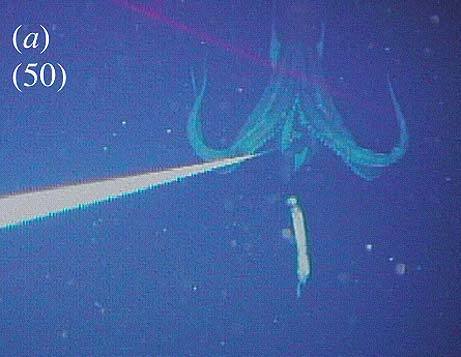
Holy Squid! First Glimpse of Live Deep-Sea Giant (National Geographic News September 27, 2005)
In a revealing, well-composed and enthralling assemblage, marine biologist Richard Ellis charts the origins of an assortment of legendary "sea monsters" including sea "serpents", giant squids (kraken), sharks and the "leviathan" or whale that frightened mariners of centuries past and brings the natural history and science of the real animals behind the myths.
All the Kraken stories and rumors about sea monsters going back centuries are outlined and then using scientific exploration and (sometimes speculative) scientific evidence, the world's deep sea monsters are explained leading the reader into the vast world of marine biology.
I particularly enjoyed the alternating between the mythological accounts about sea monsters and the reviewing of the ocean animals for what they actually are based on available facts, including 150 fascinating illustrations showing how a certain known marine animal was reasonably mistaken for a "monstrous" sea creature.
Another favourite I had was the chapter about globsters (organic masses that wash up on the shoreline distinguished from normal beached carcasses by being hard to identify) and how he theorises that Octopus giganteus could account for some of these phenomena.
If you don't want to have your sense of wonder debunked, you may want to stay away from having the sea monster myths and realities separated by Ellis, since that is the primary structure of this book, however he does leave some room for speculation and because he is also a Great white shark expert, it is mind-boggling that he has concluded that the monster shark Megalodon has only become extinct as close as 10,000 years ago in another of his books, Great White Shark.
This is a great voyage of discovery for those interested in fantastic accounts of myths, legends, and unexplained sea monster sightings and learning more of the story behind them.
Monsters of the Sea provides a comprehensive overview of sea monsters, so there is a lot to cover and can be a little heavy at times, but well worth the read.
If you're interested in obscure accounts of historical legends, early naturalists, cryptozoology or marine biology you will probably have a lot of fun with this very well researched resource.
One thing is for certain, if one of America's leading marine biologists thinks that the St. Augustine monster that washed ashore a century ago was actually a 200 foot octopus, then we still have much to learn about the legendary and mysterious Monsters of the Sea!

March 28, 2009
The research that goes into this book is incredible. Myths and rumors about sea monsters that go back centuries are explored in great detail and shown how over time, they were debunked. The author even includes drawings showing very believable reasoning for why a certain known animal was mistaken for some kind of sea monster. Up until the chapter on sharks, the book is a great resource on aquatic legend.
It's during the shark chapter, though, that it goes downhill. For one, there are no great myths about sharks except that they are man-eaters. Nobody ever thought they were a serpent or weird creature at the time uncatalogued in the annals of science. It's the one myth about their human dietary leanings that the author focuses on, and spends far too much time discussing conservation efforts. The rest of the book is very objective when discussing even animals such as whales, but for some reason the shark section is a sore spot for the author and he goes to great pains to convince the reader of their majesty. Oh, and he throws in a little bit about Megalodon, the ancient shark behemoth of which we only have teeth to measure its possible size. The conclusion, as well, is too out of sync with the rest of the book, and so while I would say it's wonderful to read, just stop before the last two sections and you will have a better appreciation for it.
It's during the shark chapter, though, that it goes downhill. For one, there are no great myths about sharks except that they are man-eaters. Nobody ever thought they were a serpent or weird creature at the time uncatalogued in the annals of science. It's the one myth about their human dietary leanings that the author focuses on, and spends far too much time discussing conservation efforts. The rest of the book is very objective when discussing even animals such as whales, but for some reason the shark section is a sore spot for the author and he goes to great pains to convince the reader of their majesty. Oh, and he throws in a little bit about Megalodon, the ancient shark behemoth of which we only have teeth to measure its possible size. The conclusion, as well, is too out of sync with the rest of the book, and so while I would say it's wonderful to read, just stop before the last two sections and you will have a better appreciation for it.

December 26, 2011
Very informative. It was kind of dry in sections, and there wasn't much in the way of psychological exploration like I thought there would be.... But it was still enjoyable. It could stand an update, since it's almost twenty years old now. Nothing earth-shattering, but a good way to entertain yourself when you've nothing else to read.

September 24, 2007
Ellis is a master archivist and his knack for finding early and obscure sources shows brilliantly in this book, as he traces the origins of sea monster legends and brings them up to the present with the actually biology of the animals in the myths.

July 27, 2008
Dense! I wanted cool pictures of giant squid; this book is more like the extremely detailed history of everything weird that ever lived in the ocean. But I'm kind of smarter because of it. Maybe.

April 9, 2013
This book was much different from any book of this genre I have ever read before. I didn't know what I would find when I opened it, would it be just another boring book about uninteresting fish? I was very much wrong, this book contains some of the most interesting material that I have absorbed in years. It takes you deep into the waters of Iceland to find the Kraken in all its mystery, to the shallow waters of the Bahamas to find the horrific and obscure Bermuda Blob.
Richard Ellis has spent his life in search of the true monsters of myth, diving deep into the archives of the middle ages and beyond. He explores many monsters revealing them such as the sea serpent, now known to be a mistaken oafish, as well as discovering their reality like the Bermuda Blob. On this journey of his, Ellis also uncovers the true theme behind the legend exposing the people behind it for what they were. To describe this journey through history itself is hard to explain in one setting so I leave you with this.
His writing style makes this book very unique as well. Its not how he writes sentences but its how he sorts his information in it. At the bottom of every paragraph or thought he has a big bibliography with all sources sorted by name. This helps to make all the information easy to trace if you wanted to learn more which to me seems like a very convenient thing to have.
Over all, this book provides a look at the strange creatures of the ocean and how the monsters of myth were made through history.
Richard Ellis has spent his life in search of the true monsters of myth, diving deep into the archives of the middle ages and beyond. He explores many monsters revealing them such as the sea serpent, now known to be a mistaken oafish, as well as discovering their reality like the Bermuda Blob. On this journey of his, Ellis also uncovers the true theme behind the legend exposing the people behind it for what they were. To describe this journey through history itself is hard to explain in one setting so I leave you with this.
His writing style makes this book very unique as well. Its not how he writes sentences but its how he sorts his information in it. At the bottom of every paragraph or thought he has a big bibliography with all sources sorted by name. This helps to make all the information easy to trace if you wanted to learn more which to me seems like a very convenient thing to have.
Over all, this book provides a look at the strange creatures of the ocean and how the monsters of myth were made through history.

August 20, 2013
This was a super fun read! It covered everything from the mythology of the Loch Ness Monster, mermaids and sea serpents to the origins of giant squid, whales, sharks, etc.
The research that went into this book must have been exhausting. The author references countless books or articles on each subject, as well as including paintings, drawings and more showing these animals as they have been depicted through the years.
This was a slow read for me because each page was packed with so much information that it was impossible to read too much in one sitting. I really enjoyed it, though!
A huge chunk of this book talks about the giant squid, which was considered a myth until dead ones started washing ashore. At the time this book was published (1994), no one had ever seen a live one. That has changed now, so I really wish this had been published later so I could read more about that!
The research that went into this book must have been exhausting. The author references countless books or articles on each subject, as well as including paintings, drawings and more showing these animals as they have been depicted through the years.
This was a slow read for me because each page was packed with so much information that it was impossible to read too much in one sitting. I really enjoyed it, though!
A huge chunk of this book talks about the giant squid, which was considered a myth until dead ones started washing ashore. At the time this book was published (1994), no one had ever seen a live one. That has changed now, so I really wish this had been published later so I could read more about that!
March 20, 2012
A thoroughly enjoyable book. An exhaustive guide on the subject, this book provides a comprehensive overview of sea monsters, myths, legends, and unexplained sightings. The author writes in an informative, yet entertaining style. While explaining many of the "monsters", he does leave room for some open minded speculation. If you like offbeat historical subjects, cryptozoology, or just a great read on the mysteries of the deep, this book will not disappoint.

December 14, 2013
Octopus seem to be everywhere these days as people are discovering how amazingly awesome they are. This is the first book I read about 15 years ago that showed me how amazing cephalopods are. The Soul of an Octopus was disappointing and sad and overwrought...this book includes many other creatures other than octopus, but worth reading for the fascinating look at cephalopods it provides.

August 5, 2009
Ellis does a fantastic job of blending fact and folklore, bringing to life the monsters that have gripped the imaginations of men for centuries. Ellis' research is fairly exhaustive making this a dense read, but well worth it.
March 4, 2014
I put it simply like this, you read the title and the inside flap of the cover slip, and just skim through some of the fascinating pictures and you'll be hooked! Oh and the writing is not too shabby either. :)

January 16, 2016
I love nautical mysteries. This book has a varied, interesting selection of many different sea monsters. It detailed the legends and stories about them, as welll as historical facts and tidbits related to each monster.
Read
June 19, 2008A good reference to sea monsters.

August 29, 2010
Great book detailing the world's monsters, separating myths and realities. A little plodding at times but very well researched.

October 14, 2012
One of the best books on "monsters" I have ever read. Excellent resource for the skeptic and the believer.

October 28, 2012
Wow, what a great book. An enormous amount of research went into it. Interesting subject matter.
June 17, 2015
A very fun and informative read. Richard Ellis is a fantastic author.
August 2, 2011
I had high hopes for this book but was sorely disappointed. It was all I could do to finish it. It was a lot of repetition. I am not sure how many times I was told sea serpents were basking shark remnants or basking sharks swimming at the surface (exposed dorsal and upper caudal fins). I thought this book would be more about the animals that inspired these tales and when the "monsters" meant to the people who saw them. I was hoping from a lot more from this book but didn't get it.
Want to Read
October 25, 2012As heard in the Science Times podcast.

June 5, 2022
Monsters of the Sea is written by proclaimed marine biologist Richard Ellis, in which, he writes of exploration of the creatures behind such significant sea legends. These mythic monsters are the likes of the kraken, mermaids, sirens, sea serpents, etc. all the greatest dangers of ancient man laid beneath the ocean surface. But in detailing of what these monsters are, and their recorded histories, Ellis attempts to rationalize and debunk the myths behind them and suggests each of these legends has a real marine organism behind the mask. Such examples could be giant squids (kraken & sea serpents), manatees (mermaids & sirens), whales (fish that devoured Jonah; maybe the Loch Ness Monster?). He provides numerous references that supports these theories, and to be honest, they seem plausible given that prior to the late 1800s, most of our information on giant sea creatures were virtually less than minimal for the public.
Of course while debunking such cryptids, Ellis also delves into details behind the mystery of globsters, organic debris that usually washes onshore and are usually considered decomposed whales, and the reputations of recognized sea animals: whales, sharks & octopus. These organisms are still, to this day, hinder in our imaginations that creates their own mythos of them. Of course, their larger than life reputations are due to the numerous films, books, and other sorts of media that fill our entertainment. Funny enough, the author also pinpoints these same reasoning as to why misinformation about these specific sea creatures are also still around, as they are not just merely still our secret fear of the great unknown beneath the waves. Surprisingly, while he critiques the inaccuracies and falsified writings of authors such as Jules Verne, they are what still seep into our minds about ocean monsters.
Ellis definitely has a lot to say about why we should not be too fearful of any of these organisms, as most of them are too out of our range or rarely big of a threat to us enough to be an ocean hazard. He does, by the end of the book, emphasize that while we created new legends of the oceans in the modern context, we also signified our fragility of existence behind the ill hunting of them. Our near extermination of these important sea organisms are what we doing to make our own possible downfall, hence why he underlines why we need to continue to learn more about them and how to manage our dominions over the waters.
Overall, this was a very insightful book on sea mysteries and unmasking folkloric legends, which is quite intriguing in my mind. Ellis clearly has a lot of heart in making this book, while a bibliography page that has too many references (old & new) to truly comprehend how far we have gotten in ocean exploration since humans have first started to sail across the waters. I admire how much context he gives to each mythos and individual organisms that it come off as an overload of information, almost. But because of the huge amount of details and evidence he provides, some of the stuff can come off as repetitive, more so with the ideas behind the sea serpent and kraken are believed to be one and the same. Though there are some speculative theories behind the monsters of Loch Ness, Gloucester and St. Augustine, Ellis doesn't provide a definitive answer to their identities due to missing key information and because of the major time passage between some of these sightings that makes it harder to find proof of. Despite those issues, I enjoyed the long read about finding truth behind deep sea myths as mysteries with a good ending is always a fun adventure, and for the name of science!
Of course while debunking such cryptids, Ellis also delves into details behind the mystery of globsters, organic debris that usually washes onshore and are usually considered decomposed whales, and the reputations of recognized sea animals: whales, sharks & octopus. These organisms are still, to this day, hinder in our imaginations that creates their own mythos of them. Of course, their larger than life reputations are due to the numerous films, books, and other sorts of media that fill our entertainment. Funny enough, the author also pinpoints these same reasoning as to why misinformation about these specific sea creatures are also still around, as they are not just merely still our secret fear of the great unknown beneath the waves. Surprisingly, while he critiques the inaccuracies and falsified writings of authors such as Jules Verne, they are what still seep into our minds about ocean monsters.
Ellis definitely has a lot to say about why we should not be too fearful of any of these organisms, as most of them are too out of our range or rarely big of a threat to us enough to be an ocean hazard. He does, by the end of the book, emphasize that while we created new legends of the oceans in the modern context, we also signified our fragility of existence behind the ill hunting of them. Our near extermination of these important sea organisms are what we doing to make our own possible downfall, hence why he underlines why we need to continue to learn more about them and how to manage our dominions over the waters.
Overall, this was a very insightful book on sea mysteries and unmasking folkloric legends, which is quite intriguing in my mind. Ellis clearly has a lot of heart in making this book, while a bibliography page that has too many references (old & new) to truly comprehend how far we have gotten in ocean exploration since humans have first started to sail across the waters. I admire how much context he gives to each mythos and individual organisms that it come off as an overload of information, almost. But because of the huge amount of details and evidence he provides, some of the stuff can come off as repetitive, more so with the ideas behind the sea serpent and kraken are believed to be one and the same. Though there are some speculative theories behind the monsters of Loch Ness, Gloucester and St. Augustine, Ellis doesn't provide a definitive answer to their identities due to missing key information and because of the major time passage between some of these sightings that makes it harder to find proof of. Despite those issues, I enjoyed the long read about finding truth behind deep sea myths as mysteries with a good ending is always a fun adventure, and for the name of science!

January 26, 2026
I did a whole presentation on this book for marine bio so this review is going to be short. (I just finished writing this, and hahaha no that is not true. I had more thoughts than I thought I did.)
It was a pretty interesting book. There were some chapters that I thought were really cool, like the chapter about mermaids, and others that were not so engaging, like the chapter that was basically just a list of every time anyone has ever seen a sea serpent. The chapters on squid and octopus biology read like a textbook, which could go either way, depending on your opinion. The first photos of living, healthy giant squid were taken in 2004, and this book was published in 1995, so a good portion of the giant squid chapters is not so relevant anymore, but it's still really interesting to see how scientists tried to research the giant squid. Cryptozoology and marine biology were pretty much the same thing, and it was cool. I thought that the very short chapter "Leviathan versus Kraken" wasn't really necessary: whales eat squid so people draw them fighting. That's it.
The book started a little rough (I found the Loch Ness Monster and sea serpent chapters to be very boring) but it picked up quickly. The writing is sometimes dense and dry, but there were multiple times that a snarky jab came out of nowhere and made me laugh out loud. (Example from page 204: "The early whalers saw their quarry as dangerous not only because the whales were huge creatures but also because they tended to react badly to having a lance plunged into them. And if you are in a small boat and you anger an animal that weighs as much as sixty tons, the results might prove harmful to you and your boat.") Ellis also really hates Jules Verne for his mistakes with the marine biology in his books.
A huge amount of research went into this book. It's incredibly comprehensive, from ancient times to when it was published, and it includes about 100 pages of appendices that I did not have time to read (seems like Ellis has been taking notes from Tolkien). It is a little dated in some parts. For example, Ellis thought that Beast by Peter Benchley (author of Jaws) defined the giant squid as a terrifying monster, but I've never heard of that book and the monstrous idea of a giant squid doesn't seem that widespread, so I think it ended up being less influential than Ellis thought it would. He also seems to think that everyone really hates octopuses, but I don't think that's the case at all today.
In summary: good book, learned a lot of interesting science, history, and folklore-ish stories. I don't regret buying it, and I might come back and read the appendices one day. I'd recommend only reading the chapters you're interested in, unless you really want to read the whole book.
It was a pretty interesting book. There were some chapters that I thought were really cool, like the chapter about mermaids, and others that were not so engaging, like the chapter that was basically just a list of every time anyone has ever seen a sea serpent. The chapters on squid and octopus biology read like a textbook, which could go either way, depending on your opinion. The first photos of living, healthy giant squid were taken in 2004, and this book was published in 1995, so a good portion of the giant squid chapters is not so relevant anymore, but it's still really interesting to see how scientists tried to research the giant squid. Cryptozoology and marine biology were pretty much the same thing, and it was cool. I thought that the very short chapter "Leviathan versus Kraken" wasn't really necessary: whales eat squid so people draw them fighting. That's it.
The book started a little rough (I found the Loch Ness Monster and sea serpent chapters to be very boring) but it picked up quickly. The writing is sometimes dense and dry, but there were multiple times that a snarky jab came out of nowhere and made me laugh out loud. (Example from page 204: "The early whalers saw their quarry as dangerous not only because the whales were huge creatures but also because they tended to react badly to having a lance plunged into them. And if you are in a small boat and you anger an animal that weighs as much as sixty tons, the results might prove harmful to you and your boat.") Ellis also really hates Jules Verne for his mistakes with the marine biology in his books.
A huge amount of research went into this book. It's incredibly comprehensive, from ancient times to when it was published, and it includes about 100 pages of appendices that I did not have time to read (seems like Ellis has been taking notes from Tolkien). It is a little dated in some parts. For example, Ellis thought that Beast by Peter Benchley (author of Jaws) defined the giant squid as a terrifying monster, but I've never heard of that book and the monstrous idea of a giant squid doesn't seem that widespread, so I think it ended up being less influential than Ellis thought it would. He also seems to think that everyone really hates octopuses, but I don't think that's the case at all today.
In summary: good book, learned a lot of interesting science, history, and folklore-ish stories. I don't regret buying it, and I might come back and read the appendices one day. I'd recommend only reading the chapters you're interested in, unless you really want to read the whole book.
Read
March 20, 2022A very interesting and amusing book of merciful mid-90s nonfiction, where Ellis does not go galivanting around the globe talking with world-renowned experts on marine biology or doing journalistic quests to find Nessie himself.
The authorial voice is very present, and I relished that. His contempt for Jules Verne's understanding of the anatomy of marine creatures he depicts in his book; his skepticism many supremely-fishy "sightings" of sea monsters recorded almost always by priests on long sea voyages, etc.
But most of all I liked his willingness to gainsay modern marine biologists who he believes have been too quick to dismiss certain well-documented encounters that have so far gone unexplained, especially concerning a couple of multi-ton hunks of collagen that have washed up on the shore in the South Pacific and seem to be very slow to decompose. Biologists are quick to attribute these multi-ton masses to the remains of whales, despite several inexplicable morphological differences.
And although certain recent "globsters" have been DNA-identified to be sperm whale remains, I think it's a fair point of view to state that the accepted explanation at the time of writing failed to explain many of the salient questions about these phenomena. I like that Ellis is sure enough to state his opinion instead of, as a modern writer would do, interviewing two experts of different opinions and one kook and leaving it at that.
All in all, a fun way to pass the time and a great way to learn a little bit about marine biology and ecology and history.
The authorial voice is very present, and I relished that. His contempt for Jules Verne's understanding of the anatomy of marine creatures he depicts in his book; his skepticism many supremely-fishy "sightings" of sea monsters recorded almost always by priests on long sea voyages, etc.
But most of all I liked his willingness to gainsay modern marine biologists who he believes have been too quick to dismiss certain well-documented encounters that have so far gone unexplained, especially concerning a couple of multi-ton hunks of collagen that have washed up on the shore in the South Pacific and seem to be very slow to decompose. Biologists are quick to attribute these multi-ton masses to the remains of whales, despite several inexplicable morphological differences.
And although certain recent "globsters" have been DNA-identified to be sperm whale remains, I think it's a fair point of view to state that the accepted explanation at the time of writing failed to explain many of the salient questions about these phenomena. I like that Ellis is sure enough to state his opinion instead of, as a modern writer would do, interviewing two experts of different opinions and one kook and leaving it at that.
All in all, a fun way to pass the time and a great way to learn a little bit about marine biology and ecology and history.

July 6, 2019
A very good book. I did find it a bit slow at times (admittedly in the sections dealing with monsters I cared less about), but overall the information included is highly informative and I found Ellis' sense of humor amusing.
I don't think I've ever seen a source on cryptozoology that does as good a job as this book at compiling the historical sources of evidence for a monster, assessing those sources, and comparing them to what is actually known about the likely creature in question. I thought Ellis had just the right amount of skepticism, along with a willingness to be convinced if the evidence is good. I particularly admired his willingness to believe that people saw what they reported they saw, and his efforts to find the most likely interpretation for the sightings. Given the evidence provided, along with what I know from other sources, I found his conclusions compelling (and in at least one case, I changed my mind on the likely explanation for sightings based on his evidence and conclusions).
I'd love to see a revised edition updated with new evidence and scientific knowledge, although given how much of this book is based on historical accounts, I'm not sure how much would change.
I don't think I've ever seen a source on cryptozoology that does as good a job as this book at compiling the historical sources of evidence for a monster, assessing those sources, and comparing them to what is actually known about the likely creature in question. I thought Ellis had just the right amount of skepticism, along with a willingness to be convinced if the evidence is good. I particularly admired his willingness to believe that people saw what they reported they saw, and his efforts to find the most likely interpretation for the sightings. Given the evidence provided, along with what I know from other sources, I found his conclusions compelling (and in at least one case, I changed my mind on the likely explanation for sightings based on his evidence and conclusions).
I'd love to see a revised edition updated with new evidence and scientific knowledge, although given how much of this book is based on historical accounts, I'm not sure how much would change.

January 12, 2021
An interesting examination of the mythical creatures of the sea which seeks to explain what those strange and ominous beasts which adorned the corners of early sea charts might have actually represented.
The book is divided into chapters representing in each a different monster. The perspective remains on what surfaces, or appears washed up on beaches. Modern exploration of the depths is not within this book.
There is some very interesting natural history along the way, as well as a focus on how modern popular media has amplified the mythical legend of many of the ocean's largest and most mysterious creatures.
While each chapter begins with brief references to the early history of these mythical creatures, I couldn't help but wonder more about the incredible leap of faith these early navigators took. I found myself wishing for a historical- psychological exploration because as the author alludes, these creatures exist almost equally in our historical imagination as in the sea, which remains the final Frontier on earth.
The book is divided into chapters representing in each a different monster. The perspective remains on what surfaces, or appears washed up on beaches. Modern exploration of the depths is not within this book.
There is some very interesting natural history along the way, as well as a focus on how modern popular media has amplified the mythical legend of many of the ocean's largest and most mysterious creatures.
While each chapter begins with brief references to the early history of these mythical creatures, I couldn't help but wonder more about the incredible leap of faith these early navigators took. I found myself wishing for a historical- psychological exploration because as the author alludes, these creatures exist almost equally in our historical imagination as in the sea, which remains the final Frontier on earth.

September 7, 2024
Fascinating subject for me, interesting book. It got bogged down/was too long in terms of little nitpicky mentions of about a bazillion different "sightings" of things. I think there could have been less of the specific data tied to a sighting. There is a huge list of giant squid sightings in the back of the book and it felt like the author mentioned every single one.
It's very odd to read this book now, when there has been film captured of giant squid during ROV explorations. As of the date this book was published, nobody had ever seen one alive. I distinctly remember how amazing it was when the ROV footage started coming out. Felt like the moon landing in terms of "did THAT just really happen??" 😁
The book covers dugongs, manatees, sharks (albeit not at length), whales, and various cephalopods. The portion dedicated to cephalopods is by far the majority of the book and the reason I liked it so much.
Interesting if a bit stodgy/lengthy. Recommended.
It's very odd to read this book now, when there has been film captured of giant squid during ROV explorations. As of the date this book was published, nobody had ever seen one alive. I distinctly remember how amazing it was when the ROV footage started coming out. Felt like the moon landing in terms of "did THAT just really happen??" 😁
The book covers dugongs, manatees, sharks (albeit not at length), whales, and various cephalopods. The portion dedicated to cephalopods is by far the majority of the book and the reason I liked it so much.
Interesting if a bit stodgy/lengthy. Recommended.

June 6, 2019
The science was a bit outdated in places (in the subsequent years since this book's publication, more advanced protein analyses and DNA tests have revealed that 'globsters' are just the carcasses of whales or large sharks, decayed beyond recognition), but it was still a fun, factual marriage of biology, mythology, and cryptozoology (which is pretty much a type of modern mythology). I even learned a thing or two! For example, I already knew that octopuses can open jars, but I had no idea that they are attracted to jars the same way cats are attracted to boxes! That's your cute trivia for the day.

January 15, 2022
Plenty of research here, and plenty of opinion too. While I appreciate the scientific attitude toward de-mystifying the Deep, the condescension does get a bit heavy at times. And really, we don't need example after example of the same creature sightings to make the point - it gets tedious. The book could have been half as long and I would have learned the same amount of information. That all said, and I know it's pretty critical, I have to tip my hat to the author's perseverance in uncovering the truth (or at least more facts and examples). Ellis knows how to write, and his thoroughness engenders trust to the reader.

March 31, 2020
My inner science nerd absolutely loved this book!
I've always been fascinated by all things related to the sea, and this book explores all the cryptozoology of the oceans. The illustrations added so much to the stories too.
Richard Ellis is a master of writing about the sea and all its astonishing creatures in a way that makes even nonscience people find it enjoyable.
I've always been fascinated by all things related to the sea, and this book explores all the cryptozoology of the oceans. The illustrations added so much to the stories too.
Richard Ellis is a master of writing about the sea and all its astonishing creatures in a way that makes even nonscience people find it enjoyable.

September 21, 2018
Ooooh spooky! There's a little bit of the cryptozoologist in all of us. Who wouldn't want to believe that there's a monster in the water?
Displaying 1 - 30 of 36 reviews