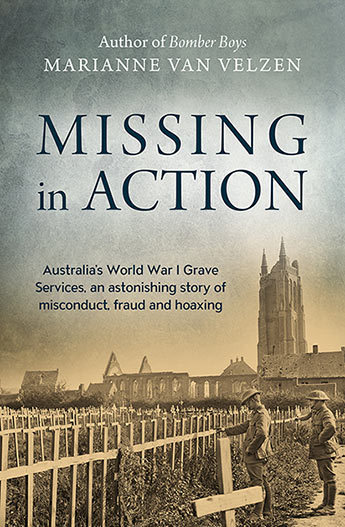
By the end of WWI, 45,000 Australians had died on the Western Front. Some bodies had been hastily buried mid-battle in massed graves; others were mutilated beyond recognition. Often men were simply listed as 'MIA' because nobody knew for sure.Lieutenant Robert Burns was one of the missing, and now that the guns had fallen silent his father wanted to know what had become of his son. He wasn't the only one looking for answers. A loud clamour arose from Australia for information and the need for the dead to be buried respectfully.Many of the Australians charged with the grisly task of finding and reburying the dead were deeply flawed. Each had his own reasons for preferring to remain in France instead of returning home.In the end there was a great scandal, with allegations of 'body hoaxing' and gross misappropriation of money and army possessions leading to two highly secretive inquiries.The Imperial War Graves Commission was created to honour the empire’s dead, it was headed by Sir Fabian Ware and Sir Fredrick Kenyon, the Director of the British Museum.Britain’s leading architects, particularly Sir Edwin Lutyens, Sir Herbert Baker and Sir Reginald Blomfield, designed the memorials and the cemeteries.The cemeteries reflected Ware’s belief in an egalitarianism brought by death.In 1919, the Australian government formed the Australian Graves Detachment and Service.Both units, working under the IWGC, were responsible for identifying Australia’s war dead and moving them for burial to the cemeteries being created by the IWGC.Whilst the public may have believed (or hoped) that the AGS was doing its best to locate, and identify, Australia’s dead, the reality was very different.The AGS was a dysfunctional unit, troubled by a poorly defined chain of command and dominated by personal animus amongst the officers in France and Belgium.Technically, the AGS was a civilian unit, reporting directly to Australia House in London.However, it was manned mainly by 1st AIF men awaiting repatriation.Despite the wrongdoings, the majority of the men in the AGS undertook their jobs with an awareness of the importance of their task and with compassion.