The wayward son of a revered Civil War general, Roland Molineux enjoyed good looks, status, and fortune--hardly the qualities of a prime suspect in a series of shocking, merciless cyanide killings. Molineux's subsequent indictment for murder led to two explosive trials and a sex-infused scandal that shocked the nation. Bringing to life Manhattan's Gilded Age, Schechter captures all the colors of the tumultuous legal proceedings, gathering his own evidence and tackling subjects no one dared address at the time--all in hopes of answering a tantalizing question: What powerfully dark motives could drive the wealthy scion of an eminent New York family to murder?
Aka Jon A. Harrald (joint pseudonym with Jonna Gormley Semeiks)
Harold Schechter is a true crime writer who specializes in serial killers. He attended the State University of New York in Buffalo, where he obtained a Ph.D. A resident of New York City, Schechter is professor of American literature and popular culture at Queens College of the City University of New York.
Among his nonfiction works are the historical true-crime classics Fatal, Fiend, Deviant, Deranged, and Depraved. He also authors a critically acclaimed mystery series featuring Edgar Allan Poe, which includes The Hum Bug and Nevermore and The Mask of Red Death.
Schechter is married to poet Kimiko Hahn. He has two daughters from a previous marriage: the writer Lauren Oliver and professor of philosophy Elizabeth Schechter.
Having just finished another historical true crime book, Death at the Priory, The Devil's Gentleman suffers in comparison. Death at the Priory is focused and succinct; whereas, The Devil's Gentleman is broad and discursive. I wouldn't normally mind going off in other directions to give the reader a taste of the age, but the only time I was truly interested in this diversion was when the author made a connection from a lawyer in the case to President McKinley's assassination.
Other than the extreme verbosity of the author, I enjoyed this glimpse into a turn of the century crime in New York in which a playboy scion of a rich, famous Civil War General commits not one, but two murders.
1. I was really not amused by the constant nudge-nudge suggestions that Roland Molineux might have been (stage whisper) gay. For one thing, there's no proof, and for another, who cares? Unless of course the writer is insinuating that Roland committed the crime BECAUSE he was (maybe, possibly, if you turn your head and squint) queer, which I'm sure Schecter would never do. Because that's terrible.
2. I also wasn't amused by the constant heavy-handed slaps at Blanche for being "frivolous" and "a golddigger" and not loving her husband. Blanche's only crime here was dating more than one guy and wanting to be rich and famous- which is not really a crime at all, especially compared with the actual crime of murdering two people and trying to murder a third.
3. Where exactly does Schecter get off hand-wringing about how awful tabloids and true crime books are given that he's basically made a career of WRITING true crime books with titles like "DERANGED: THE SHOCKING TRUE STORY OF AMERICA'S MOST FIENDISH KILLER!" Glass houses, dude.
A true crime book by Harold Schechter about cold blooded cyanide poisoning murders back in the 1890's, committed by the handsome and privileged black sheep son of a revered Civil War general, one Roland Burnham Molineux. A major scandal at the time, and a big media sensation fanned using yellow journalism, as it was full of sex, sin, jealousy and revenge.
It is sometimes interesting to read two similar books at one time. I’ve been doing that for a week or so, although the other book is my lunchtime reading so I’m making far slower progress on it. Both are true-crime books about murders that took place in the last few years of the 19th century. This one is about Roland Molineux, who lent his name to an often-cited legal statute familiar to viewers of Law & Order (it has to do with the inadmissability of prior bad acts that aren’t part of the indictment before the court) and was tried in 1899 for several poisonings. The other is The Killer of Little Shepherds, which is about the notorious French serial killer Vacher, who was killing at almost the exact same time in the French countryside. That book is about the birth of modern forensic science, but this one is more about society’s reaction to sensationalized criminality. In essence, it’s about the birth of tabloid journalism and the genesis of what we now accept as the standard conflation of news, information and entertainment. Schechter asserts that this was the real beginning of the twentieth century, and after reading the book, I find myself agreeing.
Schecter is a well-known writer to aficionados of true crime, and he’s taken his game up a peg with this well-researched and well-written history. He has a knack of giving a great deal of interest to the biographical details of the key players, building up the crime itself, and setting the stage of the events of the time. He doesn’t lapse into New Journalism Capote-esque fictionalization, nor does he do much editorializing. In fact Molineux’s guilt or innocence is never clearly established, and Schechter doesn’t take a position. The book was very interesting, especially to watch the interplay between the press, the popular opinion, and the actual investigators. Molineux’s father was a venerated Civil War hero. His wife was an ambitious socialite. The world of journalism was changing with both Pulitzer and Hearst’s papers trying to out-yellow each other with sensationalist reporting. The whole thing was hopelessly partial and ridiculously biased. Say what you will about our legal system, at least it’s no longer acceptable to use blanket insinuations about men who are possibly gay killing in a “women’s fashion” like poison to bolster one’s defense strategy.
A very accessible and interesting book and a good start for newbies of true crime who don’t want to delve right into the most gruesome books about serial killers. And the book is just as much of interest to those interested in journalism history or legal history.
I stumbled across this volume in a used book store, and, intrigued by the title, picked it up. (See? Sometimes you CAN judge a book by its cover, or at least by its title!) From the second I cracked the front cover, I was in love, and I plowed through it every chance I got. The only time I paused was to think "How have I never read about this before?", which, given how this set precedent for law, procedure, and the "trial of the century" escapades we've been subjected to ever since, is a valid question. I guess it just got lost in the shuffle of all the other sensationalism out there.
Although I particularly enjoyed the legal insight in the later chapters, nodding in appreciation or shaking my head in disbelief, I think that any history or true crime reader would enjoy the book--legal background not necessary. I kept comparing it to the profiling books I've read before, trying to outwit the officers on the case...although that usually wasn't too hard to do. The book was intense but not overly graphic, although the description of the digestion issue caused by small amounts of poison was...more than I really needed. (I will never look at rope the same way again.)
I was surprised at the end, where the author put at the beginning of the footnotes that this is considered an ambiguous, unsolved "whodunnit?". The author went with "He dunnit," and I don't know how you could reach any other conclusion. Someone else who read the book and reached a "not guilty" verdict is free to disagree.
Also, and this is not a spoiler because you can get as much from the book jacket, I really don't see Blanche as a woman worth killing over. Worth killing, maybe, but not killing over.
Interesting enough, i guess, but much of this book droned on. Odd to find a scandalous murder trial boring in places. At times the author relies so heavily on Blanche Chesebrough's unpublished memoir that i found myself thinking, why didn't he just annotate the memoir and publish THAT? The book felt somewhat phoned-in on the whole, and suffered perhaps more than it otherwise might by the fact that i'd just finished reading Paul Collins' Murder of the Century, which was a far superior book on a very similar topic (same time, different case)
I found this true story of the first New York trial of the 20th century fascinating. I especially liked all the footnotes Schecter used to give further detail of a fact that he used in the story. I look forward to reading his other true crime stories.
Did not like this book as much as I did his other true crime books but still a good read nonetheless.
Did not realize that those yellow papers as they call it came from that time period and also did not know there was so much crime even back then.
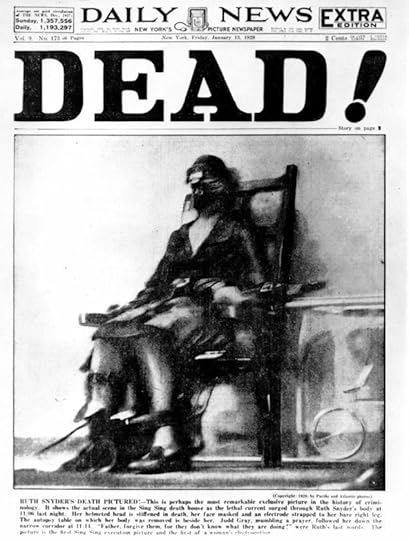
There were so many interesting tidbits about crimes committed back in the days like the murderess Ruth Snyder and the famous photo of her in the electric chair.
The photo apparently was for 30 years the most infamous picture in the history of tabloid journalism.
A very interesting story about a man Roland Molineux and about his trial. Some of the things that were decided during this trial (or in the appeal) are still being used today.
i'm very glad i did not succumb to my usual bad habits and google this case before finishing the book.
this book was quite entertaining. or as entertaining as a murder story could be. perhaps engaging would be a more suitable term--specially if you do not know what happens at the end with the main suspect.
disclosure, it did feel a bit heavy-handed with all the details. i keep thinking it could have been shorter yet i can't pinpoint where exactly i would have edited out some information. even more so, the mere sight of 89 chapters might scare some people. it certainly felt daunting for me at the beginning. however, the chapters are quite brief and there is such a large cast of people involved in this story that something was constantly happening.
there is a reason why harold schechter is considered a significant voice in the true-crime world. i will be picking up another of his books in the future.
I read this book on the plane from New York to London and I've never had such an enjoyable flight; I don't read a lot of nonfiction books but I think I'll start since I enjoyed this one so immensely. The book is about Roland Molineux, a young New York aristocrat, who was charged with murder via poisoning at the turn of the century. Think of the media circus involving O.J. Simpson but rewind to 1901 and add a good dash of yellow journalism courtesy of Pullitzer and Hearst. The author stays right on topic and never once gets bogged down or goes off on unrelated tangents. I highly recommend it to anyone with an interest in history and who likes their characters to be just a little "off".
This is more of a 3.5 out of 5. I really enjoyed the case and the parallels to today’s media circus. It gave a great overview of yellow journalism and enough forensics to keep me well entertained. Plus, it was interesting to see how much the public's fear of poisoning hasn't changed. I can see my parents warnings about strange candy in this book. "You don't know where that's been." still rings true.
Not only a very interesting story, but told in a quite engaging way. Despite the fact that this is a pretty long book, it was a page-turner for me! I will definitely seek out this author again because the pacing, storytelling and writing were so appealing.
I have to say, I've read more thrilling "murder of the century" novels. And by the other reviews I've read, I think the author is the only one who found this story that fascinating. I have to say I don't think they showed enough evidence to convince the reader that the main suspect was gay. The fact that he used poison and had a huge ego and flamboyant personality proves nothing. I think he should have leaned more into Blanche as a character study, her life after the murder, how she used the circumstances and her involvement to build a slight celebrity for herself.
Terrific historical saga of a privileged and petulant ne'er-do-well who resorts to murder. Includes information on the yellow journalism of the day, which was also explored in MURDER OF THE CENTURY by Paul Collins.
I'd like the author's books so much better if he didn't bring in all the additional information. The story stands on its own and everything else was not necessary. Review to come.
This book just rambles too much for me. I think the story would have been more poignant if more condensed and focused. Not a terrible read by any means, just not anything very wonderful either.
I am slowly making my way through Schechter's books, this being the third one I've read, and it may just be my favorite. I do dock it a point for sheer length, as the coverage of the trial itself is so long and drawn out, but then, so was the trial in real life. Schechter does an excellent job of fleshing out the facts of the case by delving into the journals and memoirs of the main characters, and even his asides on various occurrences that were taking place at the same time (like President McKinley's assassination) do a great job of bringing this era to life. It's interesting to note that while we think of the 1920s as this free wheeling, immoral time of partying and drinking, apparently the generation before had its own free spirits.
It is also interesting to see how much affect the yellow press of New York City had on the trial, to the extent that reporters were acting as detectives. I was surprised that some reporters were able to get their hands on evidence without turning it over to the police. That sort of thing would not be stood for nowadays.
It's clear that Molineux's trial set the stage for later media circuses, and had it taken place in the modern day, instead of the last years of the 1890s, every cable channel would have been devoted to coverage of this shocking trial, in which a woman died from taking poison intended for another victim, who was also taken seriously ill. Even still, the papers were obsessed with this trial, and it was marked by large spectator crowds, including scores of women inexplicably drawn to the defendant. As it's been said before, I suppose there really isn't anything new under the sun.
A fascinating look at a fin de siecle poisoning in New York City that turned into a media circus thanks to Joseph Pulitzer and William Randolph Hearst, and was chronicled by Nathaniel Hawthorne's son Julian. The victims? Henry Barnet, for one, though his death was at first blamed on diphtheria. Then Harry Cornish, who barely survived, while his cousin Katherine Adams did not. The weapon? Bromo-seltzer doctored with cyanide and sent to Barnet and Cornish through the mail. The suspect? Roland Molineux, accomplished athlete and professional chemist, and the second son of revered Civil War General Edward Leslie Molineux. Schechter delves deeply into the mores of the Gilded Age and the possible motives for these nefarious murders by mail, examining everything from jealousy to killer groupies enamored of the suspect to opium dens to the chemistry of paint to the newborn 'science' of handwriting analysis, and from New York's elite athletic clubs to theories about the killer's sexual orientation and precisely why a man might use a woman's weapon. Two trials, both sensationalized to the max by yellow journalism and histrionic lawyers, may well bring O.J. Simpson's to mind. And in the end? If the author is right, the villain of the piece may well have been a microbe. Highly recommended.
Very well done book, on a story I had not heard of before. I think the best attribute of this work, is that it keeps you in suspense through a handful of trials, appeals, hearings etc. There is so much information poured at the reader throughout, I found it impressive that no hints/spoilers were dropped regarding what would be the final outcome. Fun read, and I think it would pair well with another book I recently read regarding turn-of-the-previous-century crime in NYC,... Incendiary.
Трукрайм по делу, заявленному автором как изменившему американскую судебную процедуру (и действительно установившему несколько важных правил для судебных процессов), хитро рассмотрено им под другим контекстным углом: влияние прессы на ход суда, не только превратившее тривиальное отравление быка-спортсмена унылым куколдом ради внимания алчной бабёнки (в общем-то коэновские персонажи) в "процесс века", но и рисующее нарратив наиболее удобный своей целевой аудитории. Прямо как сейчас.
I wouldn't put this among my favorite nonfiction crime books, probably because I thought the author was trying to do too much, but it was an interesting piece of social history that many readers will enjoy. Certainly most of this is forgotten, even by historians of the period, though much of course is well known, such as the yellow press battles.
This was strangely riveting, thought it dragged a bit during the trial narrative. The author's research was impressively thorough and the book reads well for the most part, though I could have done with fewer direct citations of source material, as they left me feel a little like I was reading someone's college research paper.
So far I like it more than I thought I would. I'm generally not a big fan of turn-of-the-century true crime, perhaps their depravity is not up to my standards. But this one takes place in NYC which is kind of a neat facet for me.
The practices of yesteryear, compared of those of today, are startling. In today`s day and age, if one was to receive unsolicited medicine in the mail, addressed specifically to them, chances are it would be thrown away, certainly not consumed. We live in a day and age where concerns regarding product tampering reside; not so much at the turn of the 19th and 20th Century, where it seemed individuals had a more lackadaisical attitude about such things. Henry Barnet, a resident of New York City did, when one morning in 1898 he consumed such medicine in an effort to settle his stomach. The good news was eventually it settled his stomach, the bad news was, it did so as it was poisoned and resulted in his death.
Now, we could argue that Henry Barnet was a careless and reckless person, but he wasn`t the only one who received medicine, or in this case bromo-seltzer in the mail and consumed it. Harry Cornish director of the Knickerbocker Athletic Club (amateur sports clubs were all the rage at the turn of the century), sort of did the same in that he received the medicine, took it home, and shared it with a relative of his, also his landlady, whom died. Cornish, who consumed a bit of the bromo-seltzer, laced with cyanide of mercury, survived the ordeal.
With the death of Harry Cornish`s landlady, New York, with the help of its sensationalistic, `yellow` journalists and newspapers, owned by Joseph Pulitzer and William Randolph Hearst, inserted themselves into the police investigation and helped create a hysteria around the art of poisoning. These sensational headlines and stories, designed purely to sell newspapers, gained even more ground when eventually the police turned their attention to a suspect, namely Roland Burnham Molineux, the well-to-do son of a much respected and revered Civil War hero, General Edward Leslie Molineux.
In The Devil`s Gentleman, author Harold Schechter, one of today`s best historical crime writers, examines this precedent-setting case, from Roland`s relationship with both Henry Barnet and Harry Cornish, to his eventual incarceration and trail for the murder of Harry Cornish`s landlady. What we`re treated to is a story of ego`s, love, sex, jealousy, and petty revenge. At the turn of the century, the concept of political correctness did not exist, and the crime of poisoning was considered effeminate, and the culprit a degenerate, slang at the time for homosexual. This fact, along with Roland`s standing in New York society, based on his own successful career and his Father`s notoriety kept this case in the headlines for well over a year, and saw a trial that exceeded the length of any other capital crime trial in New York City.
Harold Schechter`s ability to bring these long forgotten individuals back to life is impressive, along with providing some context of the times as he does so. It is fascinating to see what was acceptable back in the day, like journalists taking the lead on a criminal investigation, beating the police to clues and reporting them. Today, this kind of interference would probably result in a great deal of obstruction of justice charges. Not only was this allowed to happen, but Hearst and Pulitzer would take such opportunities to ridicule the police and authorities for their incompetence in not uncovering clues first. It is an eye-opener, but somehow might have become relevant again in today`s day and age, where `fake news` is in the news, and Internet headlines are sometimes designed to be sensationalistic as a means of becoming `click-bait` and driving revenues to websites. Today we`re driving traffic, but back then they were selling newspapers – one in the same.
I don`t want to say too much about the case, as part of the joy of reading The Devil`s Gentleman is allowing the story to unfold as the author seems fit to present it. All I can say, is if you have an interest in crime, especially historical crimes, The Devil`s Gentleman is a book you will want to read; and if you`re interested in true crime writing in general, author Harold Schechter is one author whose books you should consider exploring. I decided to read The Devil`s Gentleman after reading Schechter`s Killer Colt: Murder, Disgrace and the Making of an American Legend, about another historical crime. Having done so, I`d say it is safe to say, I`ll be on the lookout for more of his work.
Every jurisdiction, I’d wager, regulates admissibility of a criminal defendant’s uncharged acts as proof of the offense being tried. The idea is that you don’t want juries convicting someone just because they think he has a propensity to commit crimes. Typically, though, other-crimes evidence is admissible for a supposedly limited, carefully circumscribed purpose, e.g. FRE 404(b)(2): “This evidence may be admissible for another purpose, such as proving motive, opportunity, intent, preparation, plan, knowledge, identity, absence of mistake, or lack of accident.” (https://www.law.cornell.edu/rules/fre...). Codified now, this rule arose from caselaw developments. Wisconsin owes its origin of sec. 904.04(2)(a) to a fellow named Whitty, who apparently liked to ask little girls to help him find a black-and-white rabbit, then assault them when they ingenuously obliged. (https://scholar.google.com/scholar_ca...). His conduct was distinctive enough that a prior such act was properly used to show his identity as the perpetrator of the same-m.o. on trial.* "Help me find a black-and-white rabbit" was distinctive enough to be deemed Whitty’s own, unique “signature.” Which brings us to Roland Burnham Molineux.
Molineux was, in a manner of speaking, the Whitty of New York. Not that he was a child molester (he did take up with an underage girl, but maintained a relationship of sorts with her for years; makes him closer to Woody Allen than Whitty). No, it's because he gave his name to New York’s rule on admissibility of uncharged misconduct, via a 1901 appellate decision reviewing his murder conviction. (http://www.courts.state.ny.us/REPORTE...). Molineux was tried for one cyanide poisoning death, with the state being allowed to show that he had poisoned someone else with cyanide. In both instances, the cyanide was sent by mail, and without getting into the fine details, certain aspects (such as distinctive wrapping and handwriting) arguably linked one to the other. But: the one was supposedly actuated by need to eliminate a romantic rival, the other by nothing more really than personality conflict. Harold Schechter tells Molineux’s story, and like the several other Schechter works I’ve read, this one is well-researched and illuminating. Highly recommended. Don’t take my word for it; the NYT ran two very favorable reviews, though be advised they contain spoilers: http://www.nytimes.com/2007/12/02/boo...http://www.nytimes.com/2007/10/24/boo....**
So then, did the uncharged poisoning prove the charged poisoning in any meaningful way, or did it just illicitly show Molineux’s predisposition for deadly acts (assuming either or both could be attributed to him)? That was the issue decided by the New York Court of Appeals, and one that decided Molineux’s fate. I won’t spoil the outcome. What I will say is that the result was perilously close (the court splitting 4-3 on that decisive question). That, and a completely unprovable assertion that were the same facts to arise today, the prior acts would be deemed admissible. In Wisconsin anyway. For whatever that’s worth.
* Today, we’d regard Mr. Whitty as indeed evincing a propensity for serious misconduct, and we’d confine him under a “sexually violent person” (or “predator”) commitment, until “cured” either by “treatment” or death. That’s after and on top of release from his prison sentence.
** Paul Collins’ “Murder of the Century” covers a different case, albeit occurring at almost the same time, and as the title suggests, about as lurid. (https://www.kirkusreviews.com/book-re...). Curiously, neither book references the other crime, even though there’s significant overlap in actors (Arthur Casey, homicide investigator, for one). Collins, like Schechter, is an American lit professor and his portrait of fin-de-siecle New York is just as vivid as the latter’s. More: both offer nice takes on the rise of yellow journalism. Both books should be read together.