

What do you think?
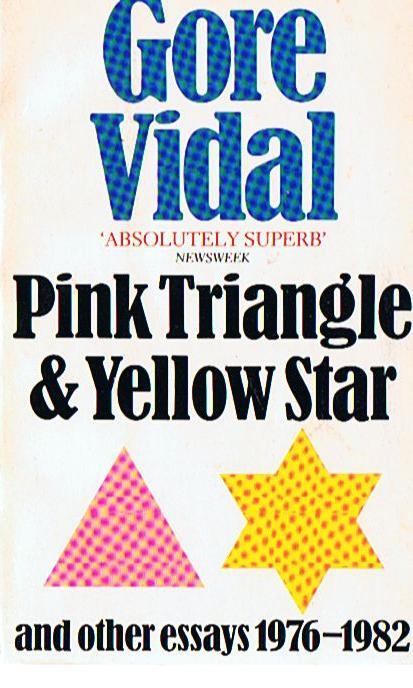
Pink Triangle and Yellow Star and Other Essays
Mass Market Paperback
- GenresNonfictionEssays
Paperback
First published August 25, 1983
About the author
Gore Vidal
416 books1,926 followersWorks of American writer Eugene Luther Gore Vidal, noted for his cynical humor and his numerous accounts of society in decline, include the play
The Best Man
(1960) and the novel
Myra Breckinridge
(1968) .
People know his essays, screenplays, and Broadway.
They also knew his patrician manner, transatlantic accent, and witty aphorisms. Vidal came from a distinguished political lineage; his grandfather was the senator Thomas Gore, and he later became a relation (through marriage) to Jacqueline Kennedy.
Vidal, a longtime political critic, ran twice for political office. He was a lifelong isolationist Democrat. The Nation, The New Yorker, Vanity Fair, The New York Review of Books, and Esquire published his essays.
Essays and media appearances long criticized foreign policy. In addition, he from the 1980s onwards characterized the United States as a decaying empire. Additionally, he was known for his well publicized spats with such figures as Norman Mailer, William F. Buckley, Jr., and Truman Capote.
They fell into distinct social and historical camps. Alongside his social, his best known historical include Julian, Burr, and Lincoln. His third novel, The City and the Pillar (1948), outraged conservative critics as the first major feature of unambiguous homosexuality.
At the time of his death he was the last of a generation of American writers who had served during World War II, including J.D. Salinger, Kurt Vonnegut, Norman Mailer and Joseph Heller. Perhaps best remembered for his caustic wit, he referred to himself as a "gentleman bitch" and has been described as the 20th century's answer to Oscar Wilde
Also used the pseudonym Edgar Box.
+++++++++++++++++++++++
Gore Vidal é um dos nomes centrais na história da literatura americana pós-Segunda Guerra Mundial.
Nascido em 1925, em Nova Iorque, estudou na Academia de Phillips Exeter (Estado de New Hampshire). O seu primeiro romance, Williwaw (1946), era uma história da guerra claramente influenciada pelo estilo de Hemingway. Embora grande parte da sua obra tenha a ver com o século XX americano, Vidal debruçou-se várias vezes sobre épocas recuadas, como, por exemplo, em A Search for the King (1950), Juliano (1964) e Creation (1981).
Entre os seus temas de eleição está o mundo do cinema e, mais concretamente, os bastidores de Hollywood, que ele desmonta de forma satírica e implacável em títulos como Myra Breckinridge (1968), Myron (1975) e Duluth (1983).
Senhor de um estilo exuberante, multifacetado e sempre surpreendente, publicou, em 1995, a autobiografia Palimpsest: A Memoir. As obras 'O Instituto Smithsonian' e 'A Idade do Ouro' encontram-se traduzidas em português.
Neto do senador Thomas Gore, enteado do padrasto de Jacqueline Kennedy Onassis, primo distante de Al Gore, Gore Vidal sempre se revelou um espelho crítico das grandezas e misérias dos EUA.
Faleceu a 31 de julho de 2012, aos 86 anos, na sua casa em Hollywood, vítima de pneumonia.
People know his essays, screenplays, and Broadway.
They also knew his patrician manner, transatlantic accent, and witty aphorisms. Vidal came from a distinguished political lineage; his grandfather was the senator Thomas Gore, and he later became a relation (through marriage) to Jacqueline Kennedy.
Vidal, a longtime political critic, ran twice for political office. He was a lifelong isolationist Democrat. The Nation, The New Yorker, Vanity Fair, The New York Review of Books, and Esquire published his essays.
Essays and media appearances long criticized foreign policy. In addition, he from the 1980s onwards characterized the United States as a decaying empire. Additionally, he was known for his well publicized spats with such figures as Norman Mailer, William F. Buckley, Jr., and Truman Capote.
They fell into distinct social and historical camps. Alongside his social, his best known historical include Julian, Burr, and Lincoln. His third novel, The City and the Pillar (1948), outraged conservative critics as the first major feature of unambiguous homosexuality.
At the time of his death he was the last of a generation of American writers who had served during World War II, including J.D. Salinger, Kurt Vonnegut, Norman Mailer and Joseph Heller. Perhaps best remembered for his caustic wit, he referred to himself as a "gentleman bitch" and has been described as the 20th century's answer to Oscar Wilde
Also used the pseudonym Edgar Box.
+++++++++++++++++++++++
Gore Vidal é um dos nomes centrais na história da literatura americana pós-Segunda Guerra Mundial.
Nascido em 1925, em Nova Iorque, estudou na Academia de Phillips Exeter (Estado de New Hampshire). O seu primeiro romance, Williwaw (1946), era uma história da guerra claramente influenciada pelo estilo de Hemingway. Embora grande parte da sua obra tenha a ver com o século XX americano, Vidal debruçou-se várias vezes sobre épocas recuadas, como, por exemplo, em A Search for the King (1950), Juliano (1964) e Creation (1981).
Entre os seus temas de eleição está o mundo do cinema e, mais concretamente, os bastidores de Hollywood, que ele desmonta de forma satírica e implacável em títulos como Myra Breckinridge (1968), Myron (1975) e Duluth (1983).
Senhor de um estilo exuberante, multifacetado e sempre surpreendente, publicou, em 1995, a autobiografia Palimpsest: A Memoir. As obras 'O Instituto Smithsonian' e 'A Idade do Ouro' encontram-se traduzidas em português.
Neto do senador Thomas Gore, enteado do padrasto de Jacqueline Kennedy Onassis, primo distante de Al Gore, Gore Vidal sempre se revelou um espelho crítico das grandezas e misérias dos EUA.
Faleceu a 31 de julho de 2012, aos 86 anos, na sua casa em Hollywood, vítima de pneumonia.
Ratings & Reviews
Friends & Following
Create a free account to discover what your friends think of this book!
Community Reviews
Displaying 1 - 6 of 6 reviews

July 31, 2019
Opening with 1980's 'F. Scott Fitzgerald's Case' (written for the New York Times Review of Books forty years after the author's death) Vidal savages Fitzgerald as a "failed writer... barely literate... with little wit and less humour." He sniffily dismisses Fitzgerald's posthumously published notebooks and correspondence for lacking literary references, for their self-pity and "astonishing misspellings." Vidal also gossips and speculates about Fitzgerald's sexuality before tearing into academia's very interest in the man: "are the academic mills now so huge and mindless that any writer of moderate talent and notoriety is grist?" Ending his essay in Hollywood with a discussion of the various drafts and revisions to the script for Three Comrades (released in 1938, written by Fitzgerald and greatly revised before release), Vidal turns, while barely seeming to realise it, into the very "scholar-squirrel" he sneers at - the sort of person who wastes his time examining Fitzgerald's life and work.
Moving onto another 1980 piece, Vidal looks at the legendary drinking habits and the posthumously published 1930s notebooks of Fitzgerald's sometime-boozing companion and literary critic Edmund Wilson. Far more admiring of Wilson than he is of F. Scott, this almost manages to be an affectionate, admiring essay.
Next up is a rambling piece about writer and gay rights activist Christopher Isherwood's memoirs that feels much longer than its fifteen pages. Vidal finds time to sneer at modern American literature and films ("that flattest and easiest and laziest of art forms") and betray a laughable ignorance of basic maths. According to Gore, it was "miraculous" that Isherwood's German lover Heinz survived the Second World War. Given how many combat veterans lived to see 1945 and beyond, that makes a LOT miracles, doesn't it?
One of the most throwaway, inconsequential things I've read in some time, his look at Sir Cecil Beaton's diaries in a 1978 piece for the New Statesman is memorable only for his description of Beaton's stage acting. "Like an elegant lizard just fed twenty milligrams of Valium, Beaton moved slowly about the stage. The tongue flicked; the lips moved; no word was audible."
Just when you think Vidal hates absolutely everything, his thirty-five page essay on Frank L. Baum's Oz books (originally published in two parts in 1977) makes you realise he was once a child, too. And his stirring defence of the Oz canon, even while taking the expected, and probably justified swipes at the failings of style, tone and overall quality, is simply a brilliant essay. Vidal ends with some exceptionally high, and well-earned praise: "those who read the Oz books are often made what they are not - imaginative, tolerant, alert to wonders, life."
In his short piece on Doris Lessing's science fiction, Vidal dwells on her Old Testament and "woolly" Sufi influences that have "got her into something of a philosophical muddle." He also announces that her 1979 novel 'Shikasta' "has not managed to create a character of the slightest interest." He compares her work, unfavourably, to Ursula Le Guin's and even L. Ron Hubbard's, the latter of whom he suggests she emulates. Well, she'd have been richer at least.
Another long-winded, free-ranging piece, his 1979 essay 'Sciascia's Italy' from the New York Review of Books starts wisely with "since World War II, Italy has managed, with characteristic artistry, to create a society that combines a number of the least appealing aspects of socialism with practically all the vices of capitalism." After that, things go south. To Sicily. And the upbringing and ideals of Italian novelist-turned-politician, Leonardo Sciascia who Vidal admires so much he compares him to Virgil and Voltaire (steady on, Gore). From there, Vidal quotes heavily from existing Sciascia interviews Gore has himself translated and, in reviewing Sciascia's 1977 novel 'Candido' manages to spoil the entire narrative of the book entirely.
An eight page letter of admiration for the man Vidal considers the only worthwhile literary critic of the day - V.S. Pritchett - is simply the set up for a snobbish paragraph about 'second rate' academics and *SHOCK! HORROR!* an increase in the number of American universities. Worth skipping, this one. From there, Vidal's look at nineteenth century satirist Thomas Love Peacock gives him (or he uses it to take) plenty of opportunities to sneer at the modern, 'serious' novel, after first making sure to slag off anything vaguely written in any sort of genre.
Far more interesting is his 1976 essay 'Who Makes the Movies?' where he argues that directors are essentially irrelevant and the entire enterprise of film-making is driven by screenwriters. And, if you didn't know, you'd be shocked to learn Vidal spent some time as... a screenwriter. Vidal writes approvingly of Tom Dardis' book 'Some Time in the Sun' detailing the screenwriting careers of F. Scott Fitzgerald, Aldous Huxley, William Faulkner, Nathaniel West and James Agee but also makes sure to highlight all the times when his personal experience shows up Dardis' sometimes faulty research. The result is the most Gore Vidal-ish writing imaginable - criticising someone while boasting about himself. If Vidal's not entirely convincing with his central argument, he does at least provide some fascinating comments on MGM's 1959 classic 'Ben-Hur' which he spent a couple of months polishing up in Rome during the film's production. "The plot of Ben-Hur is, basically absurd and any attempt to make sense of it would destroy the story's awful integrity" since it bases a lifelong enmity on a single political quarrel forming "the sole motor that must propel a very long story until Jesus Christ suddenly and pointlessly drifts onto the scene..." Gore's solution? Easy! He inserts a gay subtext to Ben-Hur and Messala's past but is warned by the director 'don't ever tell Chuck [Charlton Heston] what it's all about, or he'll fall apart.'”
1979's 'Sex is Politics' opens with Gore on television, discussing his views on the publication of pornography and wondering why so many men who work in the medium sport such obvious wigs. A brilliant, energetic, fearless waltz through his thoughts on sexual politics and faith, Vidal calls Judaism "an unusually ugly religion" due to its demand for the subordination of women and explores why and how American society tames and enslaves men through marriage. He has a good laugh at "the Christers" who take Leviticus seriously and ends with some savagely polite comments about the sort of swivel-eyed, right wing, supposedly pro-family conservative voices, journalists, pundits, crackpots, fundraisers, wannabe kingmakers and all around arseholes who, in reading this forty years on, seem to have infested American politics all over again.
The titular essay, 'Pink Triangle and Yellow Star' (published in The Nation in late 1981) is a sometimes meandering, sometimes piercing look at the common prejudices and parallel dangers faced by Jews and gays in which he gleefully and convincingly savages an article on homosexuality by Midge Decter (Norman Podhoretz' wife) published by her husband's magazine Commentary. Restrained as ever, he not only compares Decter's absolute gibberish to the Protocols of the Elders of Zion, he accuses of her of going further - “she is indeed a virtuoso of hate, and thus do progroms begin.”
'How to Find God and Make Money' is notable as much for it's ability to cram as much caustic commentary on the religious publishing scene as is humanly possibly in fifteen pages. In 'Rich Kids' (for the New York Review of Books), Vidal looks at the fifth volume of Dr Robert Coles' 'Children of Crisis' series of studies, based on interviews with America's children from various backgrounds, this time, the children of the rich and privileged. Coles' work sounds interesting and Vidal does sporadically praise it but, as a Harvard-based child psychologist, Coles is the perfect target for Vidal, a man who seems most at ease tearing into academics. He starts off gently, if dismissively, noting that he likes Coles, and is interested in his work but never finishes anything he has written because there's “nothing he has to say will ever surprise me.” Vidal pokes fun at Coles' inserting himself into his books, into his methodology, into his idealism (while also admiring it) and, variously, for being too direct and too woolly. Vidal is also unhappy that Coles' work seems to belong to a sort of moralising soft science and that, on listening to these children lay bare their prejudices against less fortunate Americans, he doesn't demand a Socialist revolution. You can't please everyone all of the time and, even if you please Vidal, you can't really please him.
'Theodore Roosevelt: An American Sissy' gives Gore a chance to lay into Teddy and, by extension, his cousin FDR who, Vidal insists without really going into any detail “brought an end to my grandfather's career in the Senate.” Thomas Gore, Senator for Oklahoma (1907 to 1920 and from 1930 until he lost a Democratic primary to Joshua B. Lee) had been an ally, then an enemy of FDR. Presumably, FDR had some role in Lee's win over Gore but that isn't the focus of this gossipy, witty, score-settling piece. “It is hard today for Americans to realise what a power the Roosevelts exerted not only in our politics but in the public's imagination” Vidal writes, comparing the Kennedys to the Roosevelts as being like comparing TV oil soap opera Dallas to Shakespeare. Perhaps Gore prefers Dallas to Shakespeare, since he makes sure to quote college classmates of Teddy as being, variously, 'a joke', 'feeble' and rather shallow', calls Roosevelt “a prig” and sets about in some way slighting everything Roosevelt ever did. “Give a sissy a gun and he will kill everything in sight. TR's slaughter of the animals in the Badlands outdoes in spades the butcheries of that sissy of a later era, Ernest Hemingway.” As character assassinations (thinly) disguised as essays on prominent political families go, this one is an excellent read. Classic Gore Vidal, really.
Vidal is (usually) at his most interesting and imaginative when writing about politics and in August 1980's Esquire piece, 'the State of the Union Revisited' (an updating of a similar essay in 1975, which he quotes liberally from) Vidal begins by railing against a succession of American presidents as mere frontmen for the banking industry before tearing into (to give a partial list) “gentle liberal voices” for their timidity, a failing educational system, a bloated defence budget and the dimwittedness of American politicians. His recommendations, breaking the US into Swiss-style cantons and adopting a parliamentary system don't always hold water but he makes one excellent suggestion, at least:
“The time has come to tax the income of the churches. After all, they are essentially money-making corporations that ought to pay tax at the same rate secular corporations do. When some of the Founders proposed that church property be tax-exempt, they meant the little white church house at the corner of Elm and Main – not the $25 billion portfolio of the Roman Catholic Church, nor the even weirder money-producing shenanigans of L. Ron Hubbard, a science fiction writer who is now the head of a wealthy 'religion' called Scientology...”
He also argues for personal freedom, genuine personal freedom, and the state (and its Police) staying out of people's private business – what they eat, drink, smoke, who they have sex with, and whether or not they gamble. Even more radically, he calls for the legalisation of all drugs, an end to American military meddling that has made America hated and despised abroad and the disbanding of the CIA on the grounds it gobbles up billions of dollars and is fundamentally illegal in both its actions and its secret, unconstitutional finances.
A brief October 1980 LA Times piece 'the Real Two-Party System' is a clever but unhelpfully empty exhortation for people to abandon voting. Much, much better is the collection's penultimate piece, 'the Second American Revolution' (February '81, New York Review of Books), in which Vidal argues that the current system is useless, explains why and comes up with some Constitutional fixes for it. He also rattles through the history of Presidents railroading Congress and the Supreme Court over-ruling the legislature. It's fascinating stuff but, reading it in 2019, the following passage really stands out:
“The president is a dictator who can only be replaced either in the quadrennial election by a clone or through his own incompetency, like Richard Nixon whose neurosis it was to shoot himself publicly and repeatedly in, as they say, the foot. Had Nixon not been helicoptered out of the White House, men in white coats would have taken him away.”
Finally, this idea-stuffed, fearlessly Vidal-ish collection ends with a 1981 LA Times 'Note on Abraham Lincoln'. An excellent piece, puncturing some popular myths about Lincoln's religious views, attitude to sex and approach to politics – seemingly three of Gore's four main interests. The fourth (brilliant literary savagery) is covered in the opening paragraph, in which he describes Carl Sandburg's four-volume biography Abraham Lincoln: the War Years...
“In the course of several million clumsily arranged words, Sandburg managed to reduce one of the most interesting and subtle men in world history to a cornball Disneyland waxwork rather like... yes, Carl Sandburg himself.”
Moving onto another 1980 piece, Vidal looks at the legendary drinking habits and the posthumously published 1930s notebooks of Fitzgerald's sometime-boozing companion and literary critic Edmund Wilson. Far more admiring of Wilson than he is of F. Scott, this almost manages to be an affectionate, admiring essay.
Next up is a rambling piece about writer and gay rights activist Christopher Isherwood's memoirs that feels much longer than its fifteen pages. Vidal finds time to sneer at modern American literature and films ("that flattest and easiest and laziest of art forms") and betray a laughable ignorance of basic maths. According to Gore, it was "miraculous" that Isherwood's German lover Heinz survived the Second World War. Given how many combat veterans lived to see 1945 and beyond, that makes a LOT miracles, doesn't it?
One of the most throwaway, inconsequential things I've read in some time, his look at Sir Cecil Beaton's diaries in a 1978 piece for the New Statesman is memorable only for his description of Beaton's stage acting. "Like an elegant lizard just fed twenty milligrams of Valium, Beaton moved slowly about the stage. The tongue flicked; the lips moved; no word was audible."
Just when you think Vidal hates absolutely everything, his thirty-five page essay on Frank L. Baum's Oz books (originally published in two parts in 1977) makes you realise he was once a child, too. And his stirring defence of the Oz canon, even while taking the expected, and probably justified swipes at the failings of style, tone and overall quality, is simply a brilliant essay. Vidal ends with some exceptionally high, and well-earned praise: "those who read the Oz books are often made what they are not - imaginative, tolerant, alert to wonders, life."
In his short piece on Doris Lessing's science fiction, Vidal dwells on her Old Testament and "woolly" Sufi influences that have "got her into something of a philosophical muddle." He also announces that her 1979 novel 'Shikasta' "has not managed to create a character of the slightest interest." He compares her work, unfavourably, to Ursula Le Guin's and even L. Ron Hubbard's, the latter of whom he suggests she emulates. Well, she'd have been richer at least.
Another long-winded, free-ranging piece, his 1979 essay 'Sciascia's Italy' from the New York Review of Books starts wisely with "since World War II, Italy has managed, with characteristic artistry, to create a society that combines a number of the least appealing aspects of socialism with practically all the vices of capitalism." After that, things go south. To Sicily. And the upbringing and ideals of Italian novelist-turned-politician, Leonardo Sciascia who Vidal admires so much he compares him to Virgil and Voltaire (steady on, Gore). From there, Vidal quotes heavily from existing Sciascia interviews Gore has himself translated and, in reviewing Sciascia's 1977 novel 'Candido' manages to spoil the entire narrative of the book entirely.
An eight page letter of admiration for the man Vidal considers the only worthwhile literary critic of the day - V.S. Pritchett - is simply the set up for a snobbish paragraph about 'second rate' academics and *SHOCK! HORROR!* an increase in the number of American universities. Worth skipping, this one. From there, Vidal's look at nineteenth century satirist Thomas Love Peacock gives him (or he uses it to take) plenty of opportunities to sneer at the modern, 'serious' novel, after first making sure to slag off anything vaguely written in any sort of genre.
Far more interesting is his 1976 essay 'Who Makes the Movies?' where he argues that directors are essentially irrelevant and the entire enterprise of film-making is driven by screenwriters. And, if you didn't know, you'd be shocked to learn Vidal spent some time as... a screenwriter. Vidal writes approvingly of Tom Dardis' book 'Some Time in the Sun' detailing the screenwriting careers of F. Scott Fitzgerald, Aldous Huxley, William Faulkner, Nathaniel West and James Agee but also makes sure to highlight all the times when his personal experience shows up Dardis' sometimes faulty research. The result is the most Gore Vidal-ish writing imaginable - criticising someone while boasting about himself. If Vidal's not entirely convincing with his central argument, he does at least provide some fascinating comments on MGM's 1959 classic 'Ben-Hur' which he spent a couple of months polishing up in Rome during the film's production. "The plot of Ben-Hur is, basically absurd and any attempt to make sense of it would destroy the story's awful integrity" since it bases a lifelong enmity on a single political quarrel forming "the sole motor that must propel a very long story until Jesus Christ suddenly and pointlessly drifts onto the scene..." Gore's solution? Easy! He inserts a gay subtext to Ben-Hur and Messala's past but is warned by the director 'don't ever tell Chuck [Charlton Heston] what it's all about, or he'll fall apart.'”
1979's 'Sex is Politics' opens with Gore on television, discussing his views on the publication of pornography and wondering why so many men who work in the medium sport such obvious wigs. A brilliant, energetic, fearless waltz through his thoughts on sexual politics and faith, Vidal calls Judaism "an unusually ugly religion" due to its demand for the subordination of women and explores why and how American society tames and enslaves men through marriage. He has a good laugh at "the Christers" who take Leviticus seriously and ends with some savagely polite comments about the sort of swivel-eyed, right wing, supposedly pro-family conservative voices, journalists, pundits, crackpots, fundraisers, wannabe kingmakers and all around arseholes who, in reading this forty years on, seem to have infested American politics all over again.
The titular essay, 'Pink Triangle and Yellow Star' (published in The Nation in late 1981) is a sometimes meandering, sometimes piercing look at the common prejudices and parallel dangers faced by Jews and gays in which he gleefully and convincingly savages an article on homosexuality by Midge Decter (Norman Podhoretz' wife) published by her husband's magazine Commentary. Restrained as ever, he not only compares Decter's absolute gibberish to the Protocols of the Elders of Zion, he accuses of her of going further - “she is indeed a virtuoso of hate, and thus do progroms begin.”
'How to Find God and Make Money' is notable as much for it's ability to cram as much caustic commentary on the religious publishing scene as is humanly possibly in fifteen pages. In 'Rich Kids' (for the New York Review of Books), Vidal looks at the fifth volume of Dr Robert Coles' 'Children of Crisis' series of studies, based on interviews with America's children from various backgrounds, this time, the children of the rich and privileged. Coles' work sounds interesting and Vidal does sporadically praise it but, as a Harvard-based child psychologist, Coles is the perfect target for Vidal, a man who seems most at ease tearing into academics. He starts off gently, if dismissively, noting that he likes Coles, and is interested in his work but never finishes anything he has written because there's “nothing he has to say will ever surprise me.” Vidal pokes fun at Coles' inserting himself into his books, into his methodology, into his idealism (while also admiring it) and, variously, for being too direct and too woolly. Vidal is also unhappy that Coles' work seems to belong to a sort of moralising soft science and that, on listening to these children lay bare their prejudices against less fortunate Americans, he doesn't demand a Socialist revolution. You can't please everyone all of the time and, even if you please Vidal, you can't really please him.
'Theodore Roosevelt: An American Sissy' gives Gore a chance to lay into Teddy and, by extension, his cousin FDR who, Vidal insists without really going into any detail “brought an end to my grandfather's career in the Senate.” Thomas Gore, Senator for Oklahoma (1907 to 1920 and from 1930 until he lost a Democratic primary to Joshua B. Lee) had been an ally, then an enemy of FDR. Presumably, FDR had some role in Lee's win over Gore but that isn't the focus of this gossipy, witty, score-settling piece. “It is hard today for Americans to realise what a power the Roosevelts exerted not only in our politics but in the public's imagination” Vidal writes, comparing the Kennedys to the Roosevelts as being like comparing TV oil soap opera Dallas to Shakespeare. Perhaps Gore prefers Dallas to Shakespeare, since he makes sure to quote college classmates of Teddy as being, variously, 'a joke', 'feeble' and rather shallow', calls Roosevelt “a prig” and sets about in some way slighting everything Roosevelt ever did. “Give a sissy a gun and he will kill everything in sight. TR's slaughter of the animals in the Badlands outdoes in spades the butcheries of that sissy of a later era, Ernest Hemingway.” As character assassinations (thinly) disguised as essays on prominent political families go, this one is an excellent read. Classic Gore Vidal, really.
Vidal is (usually) at his most interesting and imaginative when writing about politics and in August 1980's Esquire piece, 'the State of the Union Revisited' (an updating of a similar essay in 1975, which he quotes liberally from) Vidal begins by railing against a succession of American presidents as mere frontmen for the banking industry before tearing into (to give a partial list) “gentle liberal voices” for their timidity, a failing educational system, a bloated defence budget and the dimwittedness of American politicians. His recommendations, breaking the US into Swiss-style cantons and adopting a parliamentary system don't always hold water but he makes one excellent suggestion, at least:
“The time has come to tax the income of the churches. After all, they are essentially money-making corporations that ought to pay tax at the same rate secular corporations do. When some of the Founders proposed that church property be tax-exempt, they meant the little white church house at the corner of Elm and Main – not the $25 billion portfolio of the Roman Catholic Church, nor the even weirder money-producing shenanigans of L. Ron Hubbard, a science fiction writer who is now the head of a wealthy 'religion' called Scientology...”
He also argues for personal freedom, genuine personal freedom, and the state (and its Police) staying out of people's private business – what they eat, drink, smoke, who they have sex with, and whether or not they gamble. Even more radically, he calls for the legalisation of all drugs, an end to American military meddling that has made America hated and despised abroad and the disbanding of the CIA on the grounds it gobbles up billions of dollars and is fundamentally illegal in both its actions and its secret, unconstitutional finances.
A brief October 1980 LA Times piece 'the Real Two-Party System' is a clever but unhelpfully empty exhortation for people to abandon voting. Much, much better is the collection's penultimate piece, 'the Second American Revolution' (February '81, New York Review of Books), in which Vidal argues that the current system is useless, explains why and comes up with some Constitutional fixes for it. He also rattles through the history of Presidents railroading Congress and the Supreme Court over-ruling the legislature. It's fascinating stuff but, reading it in 2019, the following passage really stands out:
“The president is a dictator who can only be replaced either in the quadrennial election by a clone or through his own incompetency, like Richard Nixon whose neurosis it was to shoot himself publicly and repeatedly in, as they say, the foot. Had Nixon not been helicoptered out of the White House, men in white coats would have taken him away.”
Finally, this idea-stuffed, fearlessly Vidal-ish collection ends with a 1981 LA Times 'Note on Abraham Lincoln'. An excellent piece, puncturing some popular myths about Lincoln's religious views, attitude to sex and approach to politics – seemingly three of Gore's four main interests. The fourth (brilliant literary savagery) is covered in the opening paragraph, in which he describes Carl Sandburg's four-volume biography Abraham Lincoln: the War Years...
“In the course of several million clumsily arranged words, Sandburg managed to reduce one of the most interesting and subtle men in world history to a cornball Disneyland waxwork rather like... yes, Carl Sandburg himself.”

December 27, 2016
A lot of what Gore Vidal had to say here has changed with time: I'm sure he would be quite happy about that. After all, the Jewish community -- at least in my experience -- has been the religious group that has been the most supportive of the homosexual community. This piece was written in a time period where specific influential members in journalism and literary criticism (let's be honest... just a bunch of book critics) happened to be Jewish and were not giving gay lit a fair shot in American newspapers. This was always a huge pet peeve of Vidal's who had a personal vendetta against The New York Times -- which he brings up incessantly -- after they gave an awful review to his City and the Pillar -- and then refused to even offer reviews of his next books (gay or not).
There are four central things going on here.
One: Vidal's criticism of minority groups in the United States for repeatedly turning against one another rather than realizing that they need to band together as they have shared interests and are being equally oppressed -- despite the dominant American voice telling each group that their oppression is for separate reasons and the fault of other minority groups who are "stealing their spot." This is certainly an idea that's as relevant today as it was in 1981 when Vidal wrote this piece.
About this topic, he has countless excellent quotes such as: "Today, American evangelical Christians are busy trying to impose on the population at large their superstitions about sex and the sexes and the creation of the world. Given enough turbulence in the land, these natural fascists can be counted on to assist some sort of authoritarian political movement." Yeah... I would say so.
His message is that the danger to America is not the minorities but the so-called "Christian" so-called "majority." "Since our own Christian majority looks to be getting read for great adventures at home and abroad, I would suggest that the three despised minorities [racial, religious, orientation] join forces in order not to be destroyed. This seems an obvious thing to do."
Second: Vidal takes on Midge Decter, writer for Commentary magazine and good friend of Donald Rumsfeld -- with whom she helped form a number of lovely neo-con groups. Decter had recently published "The Boys on the Beach" which, in so many words, asked why gays couldn't just be satisfied with their little spot in the Fire Island Pines and the various artistic fields they already dominated. What was it these gays wanted anyway? Certainly not the same thing that "good" up and coming classes like Jewish Americans wanted.
Vidal wonders what the point of Decter's pitting Jewish Americans against Gay Americans is. In fact, he would never use the word gay. He would say "same sex sexers" or something of that nature as he did not believe in orientation, he believed in preferred activities and that no one should be categorized. It's in this portion that Vidal has most of his fun pointing out various conundrums for Ms. Decter -- such as the fact that there are Jewish Gay people -- and vice versa. He also points out how she absurdly dislikes the smooth bodies of some of the homosexuals she's seen at the Fire Island Pines, preferring the hairy bodies of real men -- particularly real Jewish men.
Vidal - who was not remotely religious, let alone Christian (despite his upbringing) - fires off the following quote which I found hilarious -- showing the extent to which he thinks Decter should be taken seriously: "Because the Jews killed our Lord, they are forever marked with hair on their shoulders - something no gentile man has on his shoulders except for John Travolta and a handful of Italian-Americans from Englewood, New Jersey."
This leads into the THIRD aspect of Vidal's take down essay... which is the notion that has always fascinated me most... the Western World's warped sense of masculinity, sexuality, and power -- three categories where they continue to tell themselves lies and continue to be entirely incorrect. As Decter and a number of other fools continue to go on and on -- drawing from Freud to back them up -- about what a sad group of self-destructive, suicidal sissies the gays are, Vidal fires back with facts -- something he always had at the ready, despite the fact that the conservatives he fought against seem to put so little stock in accuracy.
"Of the first twelve Roman emperors, only one was exclusively heterosexual. Since these twelve men were pretty tough cookies, rigorously trained as warriors, perhaps our sexual categories and stereotypes are - can it really be? - false."
He rails against the people who have taken the time to write articles insisting the LGBTQ community (though that title would not emerge until long after this piece) stick to its own "soft, marginal" world. He even points out the false accusations conservative writers made about the gay community's elitism -- and the Hilterian call to "take back" some of the territory "they" (I suppose I should say "we") have locked down. Decter writes, "They themselves have engaged in a good deal of discriminatory practices against others. There are businesses and professions in which it is less than easy for a straight, unless he makes the requisite gestures of propitiation to the homosexual in power to get ahead." Gore simply asks "which fields" pointing out how Decter, of course, has "no data" and that "this, of course, was Hilter's original line about the Jews."
Finally, Vidal gets around the FOURTH aspect of this article -- which was its declared original intent: to review the book TRICKS by French author Rene Camus. This proves an even more delightfully hilarious portion of the piece as Tricks is the tale of the author having twenty-five sexual encounters in six months. Vidal goes on to wonder whether Camus had since "past the 500 mark" and was now consequently "obliterated as a human being." Landing right back on his feet in Vidal fashion by saying, "If he is, he still writes very well indeed."
This is a great piece that I understand could be highly controversial out of its time pocket -- and with quotes pulled out of context. However, it is brilliantly written, stands up for sexual choice, stands up for the fact that therapy cannot change one's sexual proclivities, stands up for the fact that there are people of all desires in all walks of life, and lands some lovely groin kicks to the militant heterosexualists who fear those that don't conform and worship what Vidal calls "their God: traditional family."
There are four central things going on here.
One: Vidal's criticism of minority groups in the United States for repeatedly turning against one another rather than realizing that they need to band together as they have shared interests and are being equally oppressed -- despite the dominant American voice telling each group that their oppression is for separate reasons and the fault of other minority groups who are "stealing their spot." This is certainly an idea that's as relevant today as it was in 1981 when Vidal wrote this piece.
About this topic, he has countless excellent quotes such as: "Today, American evangelical Christians are busy trying to impose on the population at large their superstitions about sex and the sexes and the creation of the world. Given enough turbulence in the land, these natural fascists can be counted on to assist some sort of authoritarian political movement." Yeah... I would say so.
His message is that the danger to America is not the minorities but the so-called "Christian" so-called "majority." "Since our own Christian majority looks to be getting read for great adventures at home and abroad, I would suggest that the three despised minorities [racial, religious, orientation] join forces in order not to be destroyed. This seems an obvious thing to do."
Second: Vidal takes on Midge Decter, writer for Commentary magazine and good friend of Donald Rumsfeld -- with whom she helped form a number of lovely neo-con groups. Decter had recently published "The Boys on the Beach" which, in so many words, asked why gays couldn't just be satisfied with their little spot in the Fire Island Pines and the various artistic fields they already dominated. What was it these gays wanted anyway? Certainly not the same thing that "good" up and coming classes like Jewish Americans wanted.
Vidal wonders what the point of Decter's pitting Jewish Americans against Gay Americans is. In fact, he would never use the word gay. He would say "same sex sexers" or something of that nature as he did not believe in orientation, he believed in preferred activities and that no one should be categorized. It's in this portion that Vidal has most of his fun pointing out various conundrums for Ms. Decter -- such as the fact that there are Jewish Gay people -- and vice versa. He also points out how she absurdly dislikes the smooth bodies of some of the homosexuals she's seen at the Fire Island Pines, preferring the hairy bodies of real men -- particularly real Jewish men.
Vidal - who was not remotely religious, let alone Christian (despite his upbringing) - fires off the following quote which I found hilarious -- showing the extent to which he thinks Decter should be taken seriously: "Because the Jews killed our Lord, they are forever marked with hair on their shoulders - something no gentile man has on his shoulders except for John Travolta and a handful of Italian-Americans from Englewood, New Jersey."
This leads into the THIRD aspect of Vidal's take down essay... which is the notion that has always fascinated me most... the Western World's warped sense of masculinity, sexuality, and power -- three categories where they continue to tell themselves lies and continue to be entirely incorrect. As Decter and a number of other fools continue to go on and on -- drawing from Freud to back them up -- about what a sad group of self-destructive, suicidal sissies the gays are, Vidal fires back with facts -- something he always had at the ready, despite the fact that the conservatives he fought against seem to put so little stock in accuracy.
"Of the first twelve Roman emperors, only one was exclusively heterosexual. Since these twelve men were pretty tough cookies, rigorously trained as warriors, perhaps our sexual categories and stereotypes are - can it really be? - false."
He rails against the people who have taken the time to write articles insisting the LGBTQ community (though that title would not emerge until long after this piece) stick to its own "soft, marginal" world. He even points out the false accusations conservative writers made about the gay community's elitism -- and the Hilterian call to "take back" some of the territory "they" (I suppose I should say "we") have locked down. Decter writes, "They themselves have engaged in a good deal of discriminatory practices against others. There are businesses and professions in which it is less than easy for a straight, unless he makes the requisite gestures of propitiation to the homosexual in power to get ahead." Gore simply asks "which fields" pointing out how Decter, of course, has "no data" and that "this, of course, was Hilter's original line about the Jews."
Finally, Vidal gets around the FOURTH aspect of this article -- which was its declared original intent: to review the book TRICKS by French author Rene Camus. This proves an even more delightfully hilarious portion of the piece as Tricks is the tale of the author having twenty-five sexual encounters in six months. Vidal goes on to wonder whether Camus had since "past the 500 mark" and was now consequently "obliterated as a human being." Landing right back on his feet in Vidal fashion by saying, "If he is, he still writes very well indeed."
This is a great piece that I understand could be highly controversial out of its time pocket -- and with quotes pulled out of context. However, it is brilliantly written, stands up for sexual choice, stands up for the fact that therapy cannot change one's sexual proclivities, stands up for the fact that there are people of all desires in all walks of life, and lands some lovely groin kicks to the militant heterosexualists who fear those that don't conform and worship what Vidal calls "their God: traditional family."

October 27, 2020
There are many interesting essays in this collection. They include essays on: writers, literature, politics, religion, sexuality, movie production etc... some are better than others, but the writing is fluent and masterful. I envy Gore Vidal’s intellect and ability to infuse his writing with his own opinions so professionally that his caustic wit appears infallible. Although some of the commentary may be dated, his point of view is remarkable because of his unabashed will to say whatever he wants (likes?) - no, needs - to say. He’s been criticised as a seer and a scourge and I find him to be increasingly one of my favourite 20th century literary figures. He is a fine essayist and I revere his work with both envy and gratitude. Bravo, Vidal.

April 3, 2025
This was a very good collection. I particularly enjoyed the piece on Doris Lessing’s SF - something I’ve always been desperate to find someone talking at least semi-cogently about. The essays on LF Baum and Scott Fitzgerald were long, meandering, and basically said nothing of interest, but I liked them for Vidal’s way of raising his own personal beefs with things. The one on Christopher Isherwood, and the one on screenwriting vs directing in films, were both excellent. Good book😎

September 10, 2012
"Pink Triangle & Yellow Star" is a collection of essays and book reviews written by Vidal for the New York Review of Books between 1976 and 1982.
These essays are Vidal at his very best, brilliantly incisive and caustically humorous. If you are a litterateur who has read the books he reviewed, all the better. If not, his reviews will prompt you to read them, so that you can be in on all the fun.
The essay titled "Pink Triangle & Yellow Star," which gave the book its title, is the centrepiece of the book. In it Vidal upbraids the Jewish columnist, Midge Dechter, for anti-homosexual bigotry - an unseemly attitude coming from a Jew - in which she displays the same sort of horrifying mentality that lead to the Holocaust.
Vidal covers a wide range of literary, political and social topics, so there is something for almost anyone seeking an antidote to the toxic insanity that has gripped "Idiot America."
These essays are Vidal at his very best, brilliantly incisive and caustically humorous. If you are a litterateur who has read the books he reviewed, all the better. If not, his reviews will prompt you to read them, so that you can be in on all the fun.
The essay titled "Pink Triangle & Yellow Star," which gave the book its title, is the centrepiece of the book. In it Vidal upbraids the Jewish columnist, Midge Dechter, for anti-homosexual bigotry - an unseemly attitude coming from a Jew - in which she displays the same sort of horrifying mentality that lead to the Holocaust.
Vidal covers a wide range of literary, political and social topics, so there is something for almost anyone seeking an antidote to the toxic insanity that has gripped "Idiot America."

November 3, 2015
Entertaining. Depressingly up to date after more than thirty years.
Displaying 1 - 6 of 6 reviews