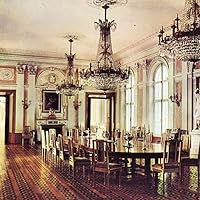
The court of Louis XIV was unequalled for splendour in Europe's history, a hotbed of intrigue and political skullduggery. The Duc de Saint-Simon was a man of political skill and influence at the heart of the royal court, and this is the first volume in his skilfully written memoirs of the time.
French diplomat Louis de Rouvroy with title of duc de Saint-Simon wrote memoirs, a valuable historical source, of the court of Louis XIV.
This grandee served as a soldier. A mother bore him at the Hôtel Selvois, 6 Rue Taranne, demolished in 1876 to make way for the Boulevard Saint-Germain.
His enormous classic of literature give the fullest and most lively account at Versailles of the Régence at the start of reign.
This book, with all the tragic silliness of the court life, the cabals, the backstabbing, the quarreling over pompoms on carriages, tabourets, long and short cloaks and visits to Marly, has been carrying me over a difficult time in my life and I’m immensely grateful for it. But I’m sure that even if I were reading it in different circumstances, it would still be a fascinating experience. This magnum opus is completely engulfing and absorbing in both good and bad sense of the word – but please note that the “bad” is only due to the sheer number of people in it, and places, and connections; and it is sometimes difficult to remember that Madame and Madame la Duchesse are not the same person, but there is only one of each in the whole of France.
The portraits and anecdotes are vivid, brutal, and sometimes quite NSFW. The contempt which Saint-Simon feels for so many people for not knowing their place is absolutely hilarious at times – and it can be endearing to see him rant, since most of these people were much more powerful than him. But what I found truly remarkable about this book was the general lack of misogyny (vide the portrait of princesse des Ursins and other influential women), and the love and respect with which he always speaks of his wife who was his best friend and confidante and from whom he hid nothing (and never regretted it).
By the way, did you know that the ladies at Versailles had their own separate language (that men didn't use) ?
Duc de Saint-Simon, a wicked old man, and I say it with affection, picked up a pen and some paper, then hung the entire court of Louis XIV out to dry. He spares nobody, except his immediate family. You can find out who sat in the King’s lap, and who was considered a beauty, despite having no teeth.
The Duke is meticulous, particular and often rather vicious. I found most of his descriptions very enjoyable. An interesting world emerges from his writing – a bubble of wealthy, influential men and women, with oddly contemporary ideas and sentiments. They do politics with a hint of backstabbing. They get mortally offended at one another, then travel together to Marly anyway. They know perfectly well who’s gay, and don’t give a toss, really. I would not call this world “civilized” – no society, which imprisons a man for political reasons, deserves the name – but it seems close.
I grew very fond of the Duke during the two volumes of his journals, and I’m glad he enjoyed a relatively comfortable life, which ended in old age, well before the French Revolution.
I realize, it’s customary, during any social upheaval, to prove your point by decapitating a selection of aristocrats, but the crowds really went for it on Robespierre’s French picnic. In all fairness – and following the usual course of such events – the terror soon spread from murdering people born to a certain class, to murdering anyone who disagrees with you. So, égalité after all, it seems.
The comparisons to Proust are exceedingly apt, for he appears to have adopted Saint-Simon's philosophical perspective of a literary critical outsider who has ties to both the reactionary and progressive sides of his political world. Perhaps we, in our era of free-flowing power relations, are all princes, jacks, kings and queens -- or at least ministers of State -- in the contemporary world of Free American Democracy ?
A true masterpiece! If you are looking for a deep (or rather very deep !) insight into life at court of Louis XIV, including interesting anecdotes, intrigues, skilfully mastered descriptions of the characters of the courtiers, as well as the battles, politics and solid history - this book is for you (all three toms!).
Duke Saint Simon also possesses true skills of a professional writer, and his diaries are written in a way, that one can’t stop reading !
How odd. I read this book over a year ago and wrote a review for it which seems to have disapeared. I cannot create that now, but I loved this book - it took a little while to get into, but both is an enjoyable read and gave a fabulous insight into the French court