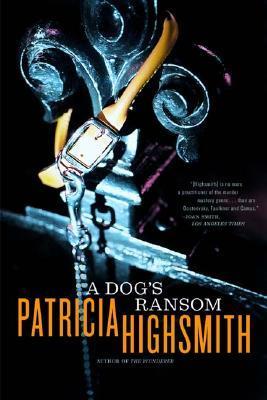
"Dear sir: I have your dog, Lisa. She is well and happy. . . I gather she is important to you? We'll see."
The lowest-rated Patricia Highsmith novel on Goodreads. At a glance, some people detest this book; many find all of the characters reprehensible and I’d agree, but I also know that Graham Greene wrote to her and said it might be her best novel, the best constructed, the best paced. I don’t agree with him, exactly, that this is her best book, but I had very low expectations for reading it--A Dog’s Ransom??! What a ridiculous premise for a book! Who cares/--and it went beyond my expectations, for sure. I’ll say 3.75 stars. I think it is sort of a deliciously low view of every cultural aspect of late sixties society.
Highsmith was a known misanthrope, a lesbian who likied men only slightly better than the women of her generation, so, that everyone is unlikable seems to fit her sardonic worldview. It seems like a mundane plot, but with each disastrous step that the main character makes, the dread and gloom seems to proliferate. It’s almost like a shaggy dog kinda story, where each step leads to more and more chaos--Got a hole in my bucket, and it just gets worse and worse, and th4y all deserve it and each other; it’s almost comedic to describe the plot, but the pacing of it is indeed very carefully planned and executed. The book was published in 1972, and it captures the zeitgeist of an older generation of fifties world Manhattan clashing with the anti-establishment flower-child generation, and Highsmith has something bad to say about each and every one of them.
It all begins with a well-off upper west side (Manhattan) couple, publishing executive Ed Reynolds (who publishes boring books!) and Greta Reynolds (who isn’t as bad as some others, but neither is she important to the plot) and their little dog Lisa.The Reynolds--who seem “nice” but terminally boring (no, Highsmith has no sympathy for them except maybe, since she is an animal -lover, well. . . but I doubt it), begin to receive disturbing notes from a clearly unbalanced man who hates their smug middle-class life and their little poodle, symbolic of their unforgivably dull lifestyle. The guy kidnaps their dog, asks for $1,000 in ransom money, which they gladly put up to get the dog back, but oops, no dog, and they (of course!) do not involve the police! The kidnapper warned them not to!
So they finally do, after losing the money, call the cops, whom Ed perceives as not surprisingly distracted from a kidnapped dog case by more serious crime, but an idealistic young cop, Clarence Reynolds, takes the case on and actually finds the guy. . . who insists on another $1K. Our young “hero” cop actually leaves to approach the Reynolds about how to approach things, and the guy escapes, of course, a ridiculous mistake, and the Reynolds ignore the cops and give the schelp/schlub yet another $1K. No dog, right! When the cops find the guy again, he is taken into psychiatric custody, but is released. You see how this all goes downhill fast?
Clarence Duhamel, Cornell University graduate is a new cop, eager to help people. He sets himself off from some of the tougher, rougher cops:
“Clarence had always known pay-offs existed in the force, and he wasn’t trying to reform anyone or to inform on anyone, but it became known that he didn’t take kickbacks and so the cops who did – the majority – tended to avoid Clarence. He wasn’t fraternity material.”
DuHamel is called Dummle by his fellow cops, or dum-hole, and while we don’t like the corrupt cops, as was the case with many New Yorkers in the early seventies--pigs! out for themselves, racists--and we don’t like the dognapper--a shallow critic of “the system” and in need of mental hralth care--we also come to despise the doofus Clarence DuHamel, who is naive and stupid. His fellow cops don’t like him, and mock him when he foolishly lets the dognapper go. And when the guy accuses DuHamel of taking a 5oo bribe to let him go (ouch, ironic) they seem to sort of side with the loser, in a way.
Then two people start to harass DuHamel’s hippie girlfriend Marylyn Coomes (no, Highsmith despises hippies and their facile social critique almost as much as the dognapper--1) a sleazy cop who hates the middle class college grad DuHamel and wants to get rid of him for doing what this guy has done all alone--steal and cheat, and 2) the dognapper. An unlikely alliance? Maybe, but they conspire to make his life an unholy Hell. Marilyn wants out of the relationship--she hates cops--though she and the Reynolds seem for awhile to agree to side with DuHamel, but things continue to spiral out of control.
I don’t love the actual ending, it’s almost anticlimactic and predictable, but I like the way it captures different kinds of class and cultural conflicts in the late sixties and early seventies. No one is admirable, but the tightening of the noose around poor dumb-bell will make you feel anxious. I was surprised how much I admired a book with such a suspect title/premise. Highsmith can surely write!