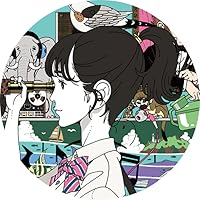
There is an urban legend that children tell one another about a shinigami that can release people from the pain they may be suffering. This "Angel of Death" has a name--Boogiepop. And the legends are true. Boogiepop is real. Told in a non-linear fashion that asks the reader to piece together the sequence of events to solve the mysteries alongside the characters, Kouhei Kadono's first Boogiepop novel took First Place in Media Works' Dengeki Game Novel Contest in 1997 and ignited the Japanese "light novel" trend. Today, there are over 2 million Boogiepop novels in print, a feature film and manga adaptation based on the first book, an original manga entitled Boogiepop Dual , and the unforgettable original anime series Boogiepop Phantom .
Kōhei Kadono (上遠野浩平 or Kouhei Kadono) is a Japanese author, best known for the Boogiepop series, which has also been adapted as a live action movie, manga and anime.
I really love this series and all the characters. I love how people you thought weren't relevant anymore reappear again and everyone is somehow connected. The stakes were amped up in this one and things started to get out of control.
But the payoff I was waiting for never really came. The Imaginator was never explained, yet again Boogiepop barely bothered to make an appearance, and the Spooky E / Asakai Jin storylines weren't ever really dived into. I still feel like its leading towards the bigger picture but I'm three books in and still no closer to understanding than I was in book one. The Imaginator duology is almost entirely self-contained plot-wise and it looks like it wasn't resolved and isn't going to be.
But I do have a love for this series. The narrative tone is really distinctive and the structure of weaving together everyone's stories is fantastic. I will read on to see where it goes even though I know I can't ever complete the series without learning Japanese!
Part 2 of this saga leaves the reader with some answers: just who is Asukai Jin? Does Boogiepop actually exist or are they also a phantom used as an excuse for violence?
This volume went by really quickly, as all the pieces and dream crumbs established in the previous entry come together. What I find interesting is how all these entities have different plans for humanity, but different manifestations. Where Manticore, who came a year later, is all about subjugation, Imaginator seems to be about setting them free…in a very narrow definition of that freedom that excludes the entire concept of free will. The way technology and contemporary drugs factor into the story make it a great vehicle for such exploration, in addition to the unsettlement that comes with no one being who they seem.
These themes also are something the characters grapple with. Orihata Aya wants to be in a relationship with Taniguchi Masaki, while he also wants to please her by pretending to be Boogiepop. It’s complex and the solutions aren’t neat.
I’m not sure I’ll be reading the remaining volumes this spooky season, but I’m absolutely going to keep on reading. Boogiepop as strange and fascinating as it is scary.
As a whole, "VS Imaginator" is a great story. It's definitely a different beast from "and Others." What keeps me from giving it a five is my own personal interpretation of the ending. Otherwise, a well crafted story.
Boogiepop vs The Imaginator part 2 is a hard book to review. It does some things very well, but then on the next page lets you down a little bit, resulting in a final product that seems a little rushed. In some cases, this can be attributed to the story, whereas in other occasions it is down to the writing. Now, with this being a translated novel, it is hard for me to assign blame, the pitfalls could be down to the writer himself, it could be down to the translator. Who can really say.
Alongside the occasional writing faux pas, I did feel a little incomplete when reaching the ending. This is not to say the ending was bad, it was just a little more subdued than I had hoped. I really wanted a grand ending, but this one just sort of fizzled out.
On the more positive note, this book does offer some really amazing scenes, particularly in allowing popular characters to cross paths with each other in a way that we have been dreaming of for so long. It was also a massive joy to see the proper return of fan-favourite Nagi Kirima.
Despite this review mostly concentrating on the negatives, this was actually a really enjoyable read and a good addition to the Boogiepop franchise. So don't let my words deter you, this was a good story that was well worth reading.
Idk, maybe it's because I read this more slowly than the other two volume of the omnibus 1-3 book, but this was kind of...meh. TBH, I couldn't really understand the role of the Imaginator.
In volume 1, the villain was obvious; but in volumes 2-3, despite double the 'screen time,' the villain seemed like a background character. Heck, Spooky E was more of a villain, and his name wasn't even in the freakin' title. IDK, maybe I missed the point completely, but this volume wasn't it.
This entire review has been hidden because of spoilers.
On re-read, I think this volume and the last should have been trimmed down a bit and combined into one longer volume much like King of Distortion. The first part is fine but all the set up ends up making you just wanting the volume to wrap up so you can get on to part 2.