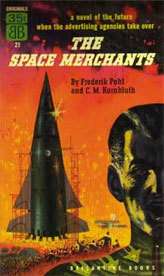
It is the 22nd Century, an advertisement-drenched world in which the big ad agencies dominate governments and everything else. Now Schoken Associates, one of the big players, has a new challenge for star copywriter Mitch Courtenay. Volunteers are needed to colonise Venus. It's a hellhole, and nobody who knew anything about it would dream of signing up. But by the time Mitch has finished, they will be queuing to get on board the spaceships.
Biographical Notes
Pohl and Kornbluth started writing together as early as 1940, although both authors produced a wide variety of stories separately, under their own names and pseudonyms.
Each wrote sections, starting where the other left off, and through long experience they developed an almost telepathic awareness of each other's intentions.
Frederik George Pohl, Jr. was an American science fiction writer, editor and fan, with a career spanning over seventy years. From about 1959 until 1969, Pohl edited Galaxy magazine and its sister magazine IF winning the Hugo for IF three years in a row. His writing also won him three Hugos and multiple Nebula Awards. He became a Nebula Grand Master in 1993.
Are you one of those people who miss Madmen desperately? Do you also have a taste for classic science fiction? If so, here is a book that could have been created just for you. Published in 1953, The Space Merchants tells the story of the USA some centuries hence, a land still stuck in the morals and mores of the Madmen era, with sexist men who take their privilege as a given and take their sexy (and intelligent, and capable) women for granted.
But things are much worse in the future than they were in the 50's. Population is soaring, nature polluted, wildlife decimated, fossil fuels exhausted. The quality of peoples' lives, the wealthy not excepted, is poor: even luxury apartments are tiny, food is synthetic and tasteless, and the bicycle rickshaw has replaced the limousine. It's a good thing they have addictive snacks and drinks—like “Coffiest"—to drug everybody into thinking they are happy.
Now who would you put in charge of a world like this, a world where the most important thing is to make people who have every reason to be miserable think they aren't miserable after all? Why, advertising agencies, of course!
Enter our hero, Mitch Courtenay, an advertising executive, who—like most great salesmen—is an expert at fooling himself. He has been put in charge of his agency's efforts to win as a “client” the colonization of Venus (the total package, including promotion, exploration, logistics, and construction), but mysterious forces have begun to interfere. Are these the machinations of his firm's powerful rival? Or of the dreaded Consies (ecological terrorists)? Or could it be somebody else entirely? Then Courtenay is kidnapped, his identity wiped from the records, and soon he finds himself a virtual prisoner, condemned to slave labor. It is then that he learns, to his dismay, about the rank human misery his civilization creates to fuel its survival.
You could do a lot worse than to give this book a try. It is outdated, but that is part of its charm. Its prose is straightforward and muscular, and what it lacks in elegance it makes up for in clarity and the briskness of its pace. Besides, it gives you the opportunity to meet “Chicken Little.” (Who--or what--is “Chicken Little”? Don't ask. There are some horrors, o reader, you must discover for yourself.)
I like Frederik Pohl more the more of his books I read.
Space Merchants, first published in 1952 is a science fiction gem. Telling the tale of a capitalistic-anarchic society from the perspective of an advertising executive, Pohl describes a world where ancient maxims have been turned upside down – such as “Power enables, and absolute power enables absolutely.”
Our hero is living the dream amidst a world of over-population and contract labor consumerism. Then corporate espionage and the nefarious Consies – Conservationists – this world’s boogeymen – step in to make things very interesting.
Somewhat dated, this is told with humor and intelligence and was no doubt wildly influential on the genre. That's true of much of Pohl's work, he was an underrated master.
We hear a lot about “fake news” today, but it’s been around for awhile. The protagonist here, Mitch Courtenay, a top-notch copywriter for a futuristic ad agency, sole job is to convince "consumers" that they need things exactly opposite of what they actually need, and he’s very good at it. This future world is run by several large corporations, primarily ad agencies, and based entirely on the idea of consumerism.
The novel is of course satire, an exaggerated satire that almost reaches the level of comedy. It was published first in 1952 and it contains the typical male misogyny/female subservient attitudes seen in that era. Also, casual public smoking was still around which is an irony in itself because of the success that tobacco advertising had on that generation.
They had trouble finding a publisher originally until Ballantine agreed to do it. The rest is history. It has now sold over 10 million copies in 25 languages and is considered a science fiction classic.
The groundbreaking initialization of the dystopic, satirical big bad government military industrial complex sci-fi subgenre, inspiring cyberpunk and modern sci-fi writers such as Richard Morgan and Daniel Suarez
Corporatism aka Corporatocracy All humans are consumers and their status, possibilities, wealth, health, etc are solely defined by the power of their corporation and their status in the hierarchy. Sounds familiar? Well yes, because this is more and more becoming the freaking reality, Pohl kind of described the reality as it really is, because mega conglomerates are dictatorships that freed themselves from governmental influences thanks to decades of lobbying and are now free to do whatever they wish with whatever environment or population they deem worthy as consumers or victims of exploitation.
Are all corporations evil? Nope, just under the current, dominating, neoliberal, Friedman Hayek endless exponential growth fringe economic dogma. That´s what´s destroying everything. Regulated, really not just greenwashed, but truly sustainable, fair (sharing, transparent companies in strong, eco social, Keynesian, kind of post scarcity states such as in the Netherlands, with the Nordic model) ones aren´t, because there is a balance of power between government, corporations, and the general population.
Did the protagonist learn something? It´s interesting how he evolves from a completely brainwashed to a, well, bigoted less brainwashed self and finds himself in an ending that can´t really be described as happy or optimistic.
What to take away from it. This is a prime example of why dark, sarcastic sci- fi is so important, because it is and always was, from its beginnings with Twain https://www.goodreads.com/book/show/1... and Capek https://www.goodreads.com/book/show/8... a mirror of all the atrocities, madnesses, injustices, etc., endless list, that are inherent to close to all human systems.
This book freaked me out in the same way that Brave New World did years ago. This one left me a little more paranoid? Anyway, the two books would pair really interestingly well together.
The story itself is okay. The main character is generally unlikable but fascinating in how he uses his one skill to constantly manipulate his way through the world, for good and bad.
The strength of the book is the real biting focus on the total power of advertising and the treatment of people as mere consumers.
I was blown away. I mean, it's not actually that deep, but it sure feels like it at times. It definitely gets at something.
Another classic that deserves to be so. I listened to it on audiobook, and the advertising terms really hit hard.
“I was becoming the kind of consumer we used to love. Think about smoking, think about Starrs, light a Starr. Light a Starr, think about Popsie, get a squirt. Get a squirt, think about Crunchies, buy a box. Buy a box, think about smoking, light a Starr. And at every step roll out the words of praise that had been dinned into you through your eyes and ears and pores.”
The Space Merchants is a different spin on the dystopia subgenre, it posits a near future where society is ruled by mega-corporations and governments play a supporting role. Earth is severely overpopulated, polluted and short on resources, including clean water. Real meat is a rarity and the most common type of meat comes from genetically engineered creatures called “Chicken Little”, which are basically gigantic living meat with no brain or limbs. “Coffiest”, made from yeast, have taken the place of coffee, which appears to be extinct. There are two main social classes, the executives, and the consumers. You can imagine which one is lording over the other.
The narrative is told in the first person by Mitchell Courtenay, one of the top advertising executives of Fowler Schocken Associates, an advertising agency and one of the ruling giant corporations. Courtenay is put in charge of a new project to induce the public to emigrate to Venus as colonists. Unfortunately, Venus is an inhospitable planet with very high temperature and uncomfortable climate. Courtenay’s job is to make Venus sound attractive to the masses with promises of a better life, more space to live in, and good career opportunities. Rivalry within the company caused Courtenay to be abducted, his identity stolen and sent to work as a laborer for the United Slime-Mold Protein Workers of Panamerica in Costa Rica. Here he learns how the consumers live, and comes into contact with the notorious underground organization, the World Conservationist Association, generally referred to as “the Consies”. As an executive Courtenay despises the Consies and everything they stand for, but in his predicament, he sees them as a ticket out of the lowly consumer class, back to the executive life.
The Space Merchants was first published in 1954. It is something of a minor sci-fi classic, though some of the concepts, science or even characterization may seem a little dated today; but a great story will always stand the test of time. This is a heavily satirical book, often funny but the underlying theme of consumerism gone mad is always near the surface. Unscrupulous advertising agencies manipulating gullible, unsuspecting consumers still exist to this day. Besides the social satire the novel is also a competent espionage thriller, with a few exciting moments. My only complaint is that the book seems to lose steam a little toward the end and the pacing slackens more than it should. The writing is very good, with some sharp irony and satirical bite; the characterization is also done well; the romantic relationship between Courtenay and his fiancé Kathy is quite complex and interesting. The ending is quite satisfying, though not entirely unpredictable.
Definitely recommended to readers who want to be well versed in sci-fi history. For basic leisure reading it passes the time nicely, though only seems like a page turner in the middle section (the Costa Rica part). Certainly, I am glad to have read it.
______________________________ Quotes: "Increase of population was always good news to us. More people, more sales. Decrease of IQ was always good news to us. Less brains, more sales."
The gap between executive and consumer could not be bridged by anything as abstract and unreal as "friendship."
“Reckless exploitation of natural resources has created needless poverty and needless human misery. It believes that continued exploitation will mean the end of human life on Earth.”
“It was an appeal to reason, and they're always dangerous. You can't trust reason. We threw it out of the ad profession long ago and have never missed it.”
"I swear, the whole damned Government must be infiltrated with Consies! You know what they've done. They outlawed compulsive subsonics in our aural advertising—but we've bounced back with a list of semantic cue words that tie in with every basic trauma and neurosis in American life today. They listened to the safety cranks and stopped us from projecting our messages on aircar windows—but we bouncedback. Lab tells me," he nodded to our Director of Research across the table, "that soon we'll be testing a system that projects directly on the retina of the eye.
"Soyaburgers and regenerated steak"—there wasn't a man around the table who didn't shudder at the thought of soyaburgers and regenerated steak—"are packed in containers the same shade of green as the Universal products. But the candy, ice cream, and Kiddiebutt cigarette ration are wrapped in colorful Starrzelius red. When those kids grow up . . ."he lifted his eyes exultantly from his notes. "According to our extrapolation, fifteen years from now Universal products will be broke, bankrupt, and off the market entirely!"
Classic science fiction from the 50s, by one of the great writing teams of SF, Fred Pohl (1919-2013) and Cyril M. Kornbluth (1923-1958). And a great example of social satire in the tradition of Jonathan Swift, author of "Gulliver's Travels." It's set in the world of the 22nd Century, when Earth is a polluted and overcrowded world dominated by the giant corporations. Our hero is Mitch Courtney working his way up the corporate ladder of an advertising agency. His company is one of the most successful ones, selling "Coffiest," the addicting chemical drink that has captured the American consumer. Mitch is given the big job of selling Venus to Americans, to persuade them to colonize a planet which is a hellhole...But the cutthroat competition in the ad game just might kill him. I give this a full *****, as an amazing satire, but, also because I do enjoy the "old school" SF of the 40s and 50s- for the stories, and this is one of the better stories. I certainly do not care for the sexism. You have to understand the sexism in these stories represents the thinking of the mainstream at the time, that women exist to take care of the home and support the bread-winning husband--and, of course, to bear children. It's still jarring to read it and I can understand it would turn off younger readers, but I think it is a good thing to be reminded that there has been some progress since the 50s. Fortunately, we now have a number of stories with female heroes--and stories actually featuring people of color as real human beings as well.
I first read this book for my German oral exam back in 1976, ah the English Summer of 76, what weather, what an idyllic Summer school holiday that was. Maybe that’s why I remembered the book with such fondness. That said it certainly stood the test of time and will be one of my favourites of the year. Great story telling, great characters and settings and just an all round excellent novel. Whether one enjoys sci-fi or not this novel is a classic and one that everyone should try. 5 stars indeed
I was blown away by this satirical and cynical novel. I couldn't believe how fresh it felt, even sixty years after it was originally published, it's still so pertinent, so topical. I would not have been surprised to find out it was written twenty years after it was.
Reading up about the origins of this novel, I was amazed to discover that Pohl actually decided to get a job in advertising just so he could know the industry better and write about it with more authority. And yes, one certainly feels that he knows what he's talking about when reading this.
This is a dystopian, consumerist future in which it is considered un-patriotic not to like advertisements and to be a fully participating consumer in a society of stark wealth inequality and acute shortages of basic things such as fuels, non-synthetic food and fresh water. It is the consumer's duty to consume, not for his own benefit, but for the benefit of production machine, and the "star class" executives at the top.
We are introduced to this world through the eyes of one of these star class executives, Mitchell Courtenay, a masterful copywriter who is appointed to run the next big project but things start falling apart as he is caught up in a deadly game of industrial espionage with one of their rivals and the seemingly deluded ideologues; the "Consies" (conservationists).
I notice that Pohl and Kornbluth collaborated on several other novels and I will definitely be interested in reading them.
Brilliantly written in the 1950s, THE SPACE MERCHANTS is a deeply cynical and darkly prescient dystopian novel in which advertising, conspicuous consumption and capitalism have run rampant in a world beset with overpopulation and environmental degradation.
Mitch Courtenay is an executive copywriter with Fowler Schocken, an advertising agency that has been given the task of selling the notion of colonizing Venus, an environmental hell-hole, to an over-populated and environmentally stressed earth. Courtenay, born with a proverbial silver spoon in his mouth and unaccustomed to anything but a pampered lifestyle is attacked by a deadly corporate conspiracy, robbed of his identity and imprisoned in an impoverished third world environment, the very existence of which came as a complete shock to him.
At the end of the day, whether you believe Courtenay to be an incorrigible villain or a reformed conservationist, THE SPACE MERCHANTS is a soft sci-fi classic well ahead of its time that explores thought-provoking themes and disturbing political issues that will be with us for many years to come. A gripping novel that well deserves it place in classic sci-fi libraries.
Κατηγορία βιβλίου «καταλαβαίνω γιατί θεωρείται κλασικό, αλλά δεν ξετρελάθηκα». Σίγουρα για της εποχή του (δεκαετία του ‘50) αυτό το βιβλίο, όπως και άλλα της SF λογοτεχνίας, θα ήταν πρωτοποριακό και έχει στοιχεία που το κάνουν κλασικό. Όμως, εν έτει 2018 είναι λίγο παρωχημένο. Μιλάει για ένα μέλλον που η διαφήμιση παίζει τον κυρίαρχο ρόλο, πουλώντας προϊόντα που η ίδια εφευρίσκει, και η Αφροδίτη προβάλλεται ως η νέα αποικία (“the place to be”, κοινώς). Κάτι το οποίο,βέβαια,συμβαίνει στην εποχή μας.Η διαφήμιση είναι όντως ο κυρίαρχος του παιχνιδιού,ενώ οι επιστήμονες ψάχνουν στοιχεία ζωής σε νέους πλανήτες˙ ίσως όχι τόσο για την μετοίκηση σε άλλους πλανήτες,καθώς είμαστε ήδη πολλοί και ο παγκόσμιος πληθυσμός αυξάνεται,όσο για την αναζήτηση καυσίμων,μιας και αναμένεται η εξάντληση των ορυκτών καυσίμων του πλανήτη μας σε λίγα χρόνια. Δεδομένου ότι αυτά που περιγράφονται στο βιβλίο συμβαίνουν ήδη, τότε,ναι,μιλάμε για ένα κλασικό βιβλίο.Όμως,ακριβώς γι’αυτό το λόγο,δεν προσφέρει κάτι φρέσκο σήμερα. Βέβαια,δεν μπορώ να μην σταθώ στον γρήγορο ρυθμό του βιβλίου, καθώς και στο χιούμορ και τον κυνισμό του.Στοιχεία,δηλαδή,που το κάνουν ένα ενδιαφέρον ανάγνωσμα.Στα συν,και το ωραίο εξώφυλλο. Έχοντας διαβάσει (μόνο) δύο βιβλία από τις εκδόσεις «Μέδουσα»,απ’ τις οποίες κυκλοφορεί το βιβλίο στα ελληνικά,μπορώ να πω ότι προσφέρουν στο κοινό ενδιαφέροντα αναγνώσματα. Συνολικά,δεν μπορώ να πω ότι έχασα τον χρόνο μου διαβάζοντάς το.Μπορεί να μην ήταν κάτι που με ταρακούνησε,αλλά νομίζω ότι υπάρχουν πολλοί που θα το απολαύσουν *περισσότερο*.
A satire of the future where commercialism is king, the raison d'etre. Unfortunately, the 1950s vibe set several centuries in the future & heavy-handed treatment made it too slapstick for me most of the time. Also, the main character (certainly no hero) was just too conveniently clueless & brilliant too often. It was well narrated, so I stuck through it & had a few laughs that I'm not sure the author intended. For instance, the blatant sexism is leavened by the obvious superiority of one of the female leads.
This is supposed to be one of the classics of SF, but it wouldn't make a top 10 or even 25 list of mine. I think the original title, "Gravy Planet", of the serialized version fit better. This edition was published prior to Pohl's update in 2011 which I'm not sure I'd want to read, but am curious about. If you've read both, I'd love to know what you think.
Never have I read such a marvelously plausible work of Science Fiction. There are many prophetic works, and plenty of works of farther distant futures that I can see being possible, but The Space Merchants is mostly here right now, and everything else (if you exchange Mars for Venus) is merely moments away. And that is a scary fucking proposition.
Pohl & Kornbluth's world is an overpopulated mess, where food and water are at a serious premium and the super-rich dominate the use of goods and services. And that world is ruled by the all-powerful ad agencies, who just happen to have overtaken every industry. There is a President who is no more than a useless figurehead. There is martial law that everyone happily accepts. There are Orwellian levels of thought control without any need for thought police because advertising and media do the job quite nicely. And there is the usual group of revolutionaries working clandestinely for the "good of all."
The Space Merchants has been on one of my must read lists for twenty years, and I've only now gotten around to it because I tracked down a two part radio play of it on Relic Radio's Sci-Fi podcast. I'll be giving it a listen tonight, but I am not sure how close to the book a sixties CBS radio play can be, especially considering the damning criticism of America's consumer culture, and its ambiguously depressing ending. I imagine it is going to end about halfway through Mitchell Courtenay's journey, when his capitalist dreams are complete. I'm kind of stoked, regardless.
One last thing, if you are looking for a classic work of Sci-Fi to turn into a mini-series SyFy, this is the the work for you. Mitchell Courtenay could easily be the Don Draper of Sci-Fi pop culture. And there's even a part for Peter Dinklage (and a damn good one).
Charles, you had it absolutely right. I am so glad I got around to this.
En un futuro cercano, surge el Proyecto Venus, que tiene como misión colonizar dicho planeta. La Tierra está superpoblada y sobreexplotada y está dominada por grandes corporaciones publicitarias. El mundo se divide en Consumidores, Productores y Ejecutivos. Es entonces cuando surge la gran oportunidad para las empresas de publicidad: dirigir la campaña para potenciar la colonización de Venus. Dicho contrato al final ha caído en manos de la Sociedad Fowler Schocken, a la que pertenece el protagonista y narrador de la novela, Mitchell Courtenay, alto ejecutivo al que se le asigna el Proyecto Venus.
‘Mercaderes del espacio’ (The Space Merchants, 1954), escrita por Frederik Pohl y C.M. Kornbluth, es una visión satírica de una sociedad mercantilista y consumista hasta el exceso. Quizá haya personajes y situaciones que hayan envejecido mal, pero sigue siendo una gran novela de ciencia ficción, escrita con gran ritmo, inteligencia e imaginación: estrategias, conspiraciones, política, terroristas, conservacionistas, etc. La historia contiene pasajes que dejan huella, como el de La Gallina. El final, algo precipitado, deja con ganas de más.
Everyone said it before and I am saying it too... This is Mad men thrown into a pulp SF blender with glorious results. Frankly for it's writing I would give this book only 3 stars, but I was in the mood for some light SF cheese and anti corporate messaging and this book delivered.
I was greatly surprised to find the anti corporate and nature preservationist sentiments in a book from the 50s. "When we look back we also look down" (I can't remember whose quote this is so please tell me in the comments so I can add it). I always have to remind myself of this quote to remember that we are not dealing with all of this just now, it is a long fight, and not all of the people in the 50s were just repeating propaganda and ads instead of speaking. I mean People had to be aware of these issues back in the 50s in other to fight for them in the 60s. We have to commend Frederik Pohl for being in the forefront of these issues and viciously mocking both the "executives" and "consumers" all the while creating this particular type of dystopia in the 50s long before anyone could dream of Cyberpunk Hellscapes.
And to think he first started work on his novel during WWII set in New York featuring men working in advertising. Coming home he realized what he had written was quite bad and that he knew nothing about advertising, so he made sure to get a job in an advertising agency and he worked for 3 years for research purposes while writing SF on the side... What a Man!
Advertising is the art of convincing people to spend money they don't have for something they don't need. - Will Rogers
Originally published in 1953, this dystopian tale critiques wild consumerism, savage capitalism, the influence of advertising in societies, and the bovine acceptance of what passes for benefits by the people. It is a classic example of satirical dystopian science fiction that critiques the path Eastern societies were already taking in the 50s
Society is entirely driven, cattle-like, to consumption, manipulated into buying unnecessary products through relentless advertising supported by the absence of any kind of regulation. The ultimate capitalist wet dream. Corporations hold immense power, effectively replacing governments and controlling every aspect of life, from marriage contracts (Increase of population was always good news to us. More people, more sales...), educational system (Decrease of IQ was always good news to us. Less brains, more sales...) to resource allocation. As a consequence, the planet is severely overpopulated and polluted due to unchecked industrial expansion to answer the ever-increasingly artificial consumer demands. If this isn't some prescience in foreseeing many aspects of today's societies, even if exaggerated for satirical effect, it remains a chilling and thought-provoking read.
Money makes the world go round, and few know the truth of that more than the advertising agencies. For them, it isn't just a cliché; it's the fundamental principle that underpins their entire existence and operation (Advertising is a valuable economic factor because it is the cheapest way of selling goods, particularly if the goods are worthless...). They are constantly working to optimize the flow of money from clients to consumers (in a ratio of 95% to 5%, obviously) and back again, with their services acting as the crucial intermediary.
I don’t believe capitalism is the worst thing to happen to humanity. It has its problems, but so do all social systems. Whenever there is an economy, some people will try to take advantage of others for profit or personal gain. The criticism of advertising, and thus of corporate domination, is biting and hits home today, with its abusive work environment built in a closed circuit rigged to benefit the company and enslave the employee. Let me explain without spoilers: The company's blue-collar job includes, in the "normal" contract, the supplied health system, communications, union labour protection, entertaining addictions, food, and housing, but at a total cost that exceeds the employee income, in a system set up so that it's impossible to avoid falling into debt. When the work contract theoretically expires, since the worker is in debt from the very beginning, the contract is automatically extended until the debt is erased, which is impossible... Many of the companies depicted in the book are reflected in very familiar ways today. Let me give you a real example: About 20 years ago, while living and working in Portugal as an average middle-class white-collar worker, for two years I got used to finding in my mailbox letters from the bank where I had my accounts, with pre-approved loans. All I had to do was sign the papers and return them to the bank, and 24 hours later, the money would be in my account. I never asked for a loan from any bank, ever. I wasn't an entrepreneur, investor, or speculator. So why the pre-approved loans? According to my "personal" bank account manager, usually known as a "Loan Shark" (Give a man a gun and he will rob a bank. Give a man a bank and he will rob everyone.) I was selected because I was a "safe" client, clarified internally to be the target of those magnanimous offers, which I translated as -You are the perfect sucker to milk. I never accepted any of those proposals, and my "love affair" with my bank ended with me going to France and them going bankrupt. No tears were shed by any party. They were smooth and convincing, and I wonder if "Space Merchants" wasn't one of their training manuals. The tactic was very simple: praise the customer (known as the "idiot") and convince him/her how special they are to them and show how delighted they are to make all this wonderful money available to him/her, at no extra cost, just to keep the production and consumption machine running smoothly. And they never forgot to remind them that the curves of the profit graphs must always be ascending; otherwise, Armageddon would be just around the corner. Does this resonate? Come on... a little bit, no?
I believe that one of the most difficult things in science fiction literature is to predict the future, particularly the near future. Jumping ahead, thousands of years away, into a world dramatically or diametrically opposite from the one we know, is in some ways simpler because of the freedom of the absence of cognitive references than imagining what changes might be real as a logical sequence of technological development. In the 50s, when Pohl and Kornbluth were writing The Space Merchants, scientists were toying with Malthus' theory. An ever-increasing population on Earth would begin to outstrip food production; resources would soon be exhausted, and pollution would cause ecological collapse. In parallel, despite warnings, Eastern societies were engaging in an orgy of consumerism without any consideration for consequences; that is a continuing problem today. This alone is already bringing the planet to its knees. Now add the very real possibilities of the deployment of nuclear weapons, given the political tensions and the existing climate change already in progress, and Earth’s future looks very bleak and short. It's a real possibility that by the end of the twenty-first century, humanity will have engineered its own demise.
Phol and Kornbluth predicted that more and more billionaires would start infiltrating and evolving in political parties and governments. Democracy is a farce and has been replaced by the dominance of corporations holding the government hostage - for instance, U.S. senators advocate for corporations rather than their constituents. (Our representative government now is perhaps more representative than it has ever been before in history. It is not necessarily representative per capita, but it most surely is ad valorem. If you like philosophical problems. Here is one for you: should each human being's vote register alike, as the lawbooks pretend and as some say the founders of our nation desired? Or should a vote be weighted according to the wisdom, the power, and the influence—that is, the money—of the voter?) Given what we witness today, I wonder how wide of the mark they were. I believe they just got their dates wrong; while exaggerated for satirical impact, everything they depicted is already happening. The only glimmer of hope is the promise of building a new Utopia elsewhere, and that works (only) in the book because it's a fantasy, like a mirage in the desert that lets you wonder if the "oasis" you see in the far distance is real and is going to save your life or is an illusion attracting you to your death. As is expected, in a self-euthanising society in a dying world, the so-called "elite" do not suffer much, but the common people teeter on the edge of scarcity while being kept pressed ever harder to consume and produce.
We are still far from the madness of a world where cafeterias hand out to kids branded products that include "Kiddiebutt" cigarettes and coffee with addictive alkaloids. Actually, we are on a crusade against tobacco (It was an appeal to reason, and they're always dangerous. You can't trust reason. We threw it out of the ad profession long ago and have never missed it.) and certain types of food advertising, and slowly, billboards are being regulated and even restricted. On the other hand, whole new possibilities have opened up for advertising in smartphones, the Internet, and AI, tools that provide marketers access to more sophisticated types of consumer research and tracking far beyond the wildest imagination. Do a little research about "Palantir" and its CEO; it's chilling.
Satire remains an important and effective form of storytelling and always will. To me, "The Space Merchants" served as one of many warnings our civilisation needs to try to start to plot a different course in our future that doesn't lead to total annihilation.
And I swear this is an absolute dystopian, science fiction classic. I haven’t been let down by a Pohl story yet and I’m still exploring Kornbluth, this book only leaving me wanting more.
The Space Merchants is about humans: one human and humanity. Their enemy and oppressor? The corporatist military-industrial complex. People are raised in a class system, the lower your social security number, the higher your class. There’s not really many ways for the vast majority to climb the ladder. For your see, people are consumers, literally. They work under harsh contracts, owned by a company, who charges them to even use a toilet. Every payday, the workers find themselves deeper in debt to the company. The unions work to harvest more money which basically offsets the corporate taxes. The worst crime is CB: contract breech. The anti-establishment? Those who want to just live and tend the Earth naturally.
Humans are being fed genetically engineered meat, again, super literally. A giant “chicken” is grown from a mutated original heart, a huge, pulsating meat bag, which is sliced off of everyday by the owned workers, to feed an overpopulated world (the only thing the writers didn’t accurately predict). Workers also cultivate nutritional material (a type of algae) to feed the meat. Water is rationed and most people use salt water for everything, but drinking. Flowers are a premium and are sold at Cartier. Wood is the new gold.
Oh, and companies rule everything. Art is advertising and museums are corporate. Your “coffee” and snacks are full of “harmless,” yet highly addictive alkaloids, to keep you coming back for more. Ingesting one, sets off withdrawals for the other, fueling an unending usage, consumer cycle. Hyponotic television is available in 30 minute units, for a cost.
Is it too far off from our world? Sure, the brothels of Yoshiwara were a long time ago, right? Read up on how the women there were indebted and made into slaves. Our clothes and phones are made by, basically, prisoners. We don’t know what’s in our food and the elitists want to feed us fake meat and (real) bugs. They want to put computers in our bodies. People already wear them and allow programs to report every intimate detail back to the companies that sell us, back to us. Carbon tax? Newsflash, we ARE carbon-based life forms. I mean, we can’t even access fresh water for free. That’s bizarre, when you stop to think about it. I guess I’m asking everyone to think; is this the world you want for you and your children?
“I hated the twisted minds who had done such a thing to a fine consumer like Gus. It was something like murder. He could have played his part in the world, buying and using and making work and profits for his brothers all around the globe, ever increasing his wants and needs, ever increasing everybody’s work and profits in the circle of consumption, raising children to be consumers in turn. It hurt to see him perverted into a sterile zealot.”
Note, Sept. 13, 2019: I edited this review just now to correct a typo.
As a young man, Pohl worked for an advertising agency, and the experience left him with both an insider's understanding of, and a profound distaste for, psychological manipulation for profit, hucksterism, and the whole mentality of material consumption for its own sake. That understanding and distaste provide the theme for a lot of his short fiction; and they're very evident in this novel (which is probably the best and most perceptive dystopian vision from its generation), which conjures a future world in which all of the above trends have been extrapolated to their unpalatable logical conclusions. (The authors don't specify the setting in time here, but I would infer that it's at least well into the 21st century, not the 20th.) Rachel Carson's Silent Spring is usually credited with sparking the modern environmental movement; but I think this book, with its warning that our present path of orgiastic consumption may not be environmentally sustainable (let alone desirable), might have helped plant some of the movement's seeds.
Pohl's rapier wit is a great strength of the book, which brims with deadpan humor and unexpected lines that blindside the reader with revelations of just how bad the world being depicted is. (The satiric irony here is worthy of Jonathan Swift.) The narrative sustains interest without violence or sexual content, and I don't recall any major bad language. A feature that dates the book is the fact that Mitch and his wife are partnered in a "trial marriage" (that idea was a favorite of secular "reformers" in the 50s and 60s, until the realization sank in that, with the instituting of "no- fault" divorce, every marriage is now in effect a "trial marriage").
Briefly, I will tell you about my happy rereading of this science fiction classic. I read it about thirty years ago and I can say that my fond memories are justified.
We are closer to this future of the 22nd century that the authors describe in this novel (written in 1952): we are temporally closer, of course, but we are even closer because of our consumer society and the degraded environment that it describes.
Curiously, the book is written in a comedy style, even with some hilarious moments. Even in the audiobook this tone is accentuated by the narrator's good work. But this should not overlook the severe criticism of the capitalist economic system that it represents, in what can be interpreted as an obvious dystopia.
This is a SF novel, originally published in 1952, which contains several surprisingly modern ideas.
The title, The Space Merchants, led me to assume it will be a kind of space opera about interstellar trade. Actually, it is about a copysmith (advertisement specialist), who should sell the idea of Venus colonization to public. Unlike, say, The Man Who Sold the Moon, the protagonist is not the ephemeral ideal of the author’s views on how things should be done but the opposite. This future USA is a plutocracy (“Our representative government now is perhaps more representative than it has ever been before in history. It is not necessarily representative per capita, but it most surely is ad valorem.”) and advertisement is the king (the protagonist’s desire is to put it on “its rightful place with the clergy, medicine, and the bar in our way of life.”) At the same time it is an entrenched plutocracy, where persons on the top see themselves as a new nobility, which would duel anyone, who they thought slighted their honor. Their only opposition are the Consies (short for Conservationists), who fight spurious consumption that plunders the planet.
A nice short read.
"You're on the inside now," I said simply. "That's the way we work. That's the way we worked on you." "What are you talking about?" "You're wearing Starrzelius Verily clothes and shoes, Jack. It means we got you. Taunton and Universal worked on you, Starrzelius and Schocken worked on you—and you chose Starrzelius. We reached you. Smoothly, without your ever being aware that it was happening, you became persuaded that there was something rather nice about Starrzelius clothes and shoes and that there was something rather not-nice about Universal clothes and shoes." "I never read the ads," he said defiantly. I grinned. "Our ultimate triumph is wrapped up in that statement," I said. "I solemnly promise," O'Shea said, "that as soon as I get back to my hotel room I'll send my clothes right down the incinerator chute—" "Luggage too?" I asked. "Starrzelius luggage?" He looked startled for a moment and then regained his calm. "Starrzelius luggage too," he said. "And then I'll pick up the phone and order a complete set of Universal luggage and apparel. And you can't stop me." "I wouldn't dream of stopping you, Jack! It means more business for Starrzelius. Tell you what you're going to do: you'll get your complete set of Universal luggage and apparel. You'll use the luggage and wear the apparel for a while with a vague, submerged discontent. It's going to work on your libido, because our ads for Starrzelius—even though you say you don't read them—have convinced you that it isn't quite virile to trade with any other firm. Your self-esteem will suffer; deep down you'll know that you're not wearing the best. Your subconscious won't stand up under much of that. You'll find yourself 'losing' bits of Universal apparel. You'll find yourself 'accidentally' putting your foot through the cuff of your Universal pants. You'll find yourself overpacking the Universal luggage and damning it for not being roomier. You'll walk into stores and in a fit of momentary amnesia regarding this conversation you'll buy Starrzelius, bless you."
*** Of all the self-contradictory gibberish—but it had a certain appeal. The ad was crafted—unconsciously, I was sure—the way we'd do a pharmaceutical-house booklet for doctors only. Calm, learned, we're all men of sound judgment and deep scholarship here; we can talk frankly about bedrock issues. Does your patient suffer from hyperspasm, Doctor? It was an appeal to reason, and they're always dangerous. You can't trust reason. We threw it out of the ad profession long ago and have never missed it
Awesome book! Hard to believe this was written like 50+ years ago, because it is so incredibly relevant to our modern times. For example: it takes a look at the dangers of imperialistic corporations & greed, the plight of workers and the ungodly conditions under which some of them have to work, the clear and unmistakeable division of class in society, the total lack of concern for the environment and the treatment of those who care about it and want change. Good grief! To say that it was way ahead of its time is an understatement; this man was nearly prophetic! I love when I find something like this. It's rare, but it happens.
here's just a little synopsis: Mitch Courtenay is an incredibly savvy and successful ad man in a New York of the future. He and others like him have perfected the art of advertising so that you can't go anywhere or do anything without ads blaring at you or getting to you in some subliminal fashion, making you want to buy things. The "Consies" (conservationists) are a radical group of people who are all about saving the environment -- they are an illegal group who are somewhat along the lines of greenpeace: protesting regularly, trying to disrupt the work of corporations, and have members everywhere. Mitch's company has decided that they are going to make a fortune by convincing the public that they really want to go live on Venus, never mind that it's virtually uninhabitable. The boss puts Mitch in charge of the campaign, and this is where all of his problems begin.
I wont' say more, but I think this is probably a book worth reading -- very very relevant. Very well written.
What was considered farce in the 1950s is now not only accepted reality, but we’re quickly passing out of late stage capitalism and into early techno feudalism. Soon we’ll all pine for the good old days of a free market economy where actual people tried to sell us shit we didn’t need, but could afford because they had competition from other companies.
This was a fun book, kinda like if Philip k. Dick wrote mad men.
A top advertising executive in a dystopian world on the edge of ecological collapse finds himself suddenly on the bottom rung of society. He stops at nothing to unravel the mystery of what happened to him and how he can get back to his former life. Along the way there’s a plethora of crazy concepts like corporate powers openly controlling the government, deliberately getting its customers addicted to it’s products, manipulating its workers into an untenable cycle of debt that they can never escape and even legally killing corporate rivals.
I’m not sure you could write a book like this today. You can’t write an absurdist look into the future from now because no matter how bad or silly you go with it, it could never be crazy or horrific enough. If you could go back in time and show Pohl and Kornbluth how the future wound up, they’d shit their dicks off.
Esta obra figura en todas las listas de clásicos imprescindibles de la CF, de los que hay que leer sí o sí. Publicada en 1952, en muchos aspectos sigue siendo relevante hoy en día, ya que se centra en el poder de las grandes corporaciones, el mundo de la publicidad y la economía basada en el crecimiento insostenible y el consumo compulsivo.
Es una de las obras pioneras de lo que se ha denominado CF blanda, por oposición a la CF más centrada en la tecnología y la ciencia, que sería CF dura. En este caso, la economía y la política son fundamentales en una sátira que abarca todos los aspectos de la vida humana y contempla un planeta arruinado que busca la salida en la colonización de Venus.
En apenas 200 páginas, ciertamente nos da mucho que pensar y el paralelismo con muchas situaciones actuales es impactante. Aunque se lee bien y es entretenida, también se ha de decir que tiene carencias en el diseño de personajes y que la trama puede llegar a ser muy enrevesada, pero creo que es fundamental para conocer la historia de la CF.
Quote from the book: "The ad was ... an appeal to reason and they're always dangerous. You can't trust reason. We threw it out of the ad profession long ago and have never missed it."
There's a lot of stuff like this, and the whole critique of advertising/consumerism is brilliant especially coming from 1952. The author anticipated things that only came out much later about how corporations have deliberately made everyday products addictive, etc. So the concept of the novel is good, and I expect a lack of character development in hard sf of the era, but for me it was a little too drawn out with cliff-hanger plot-twists.
Originally written in the fifties, this version was updated in 2010.
In comparing the two versions together it is impressive to see how little was actually changed, mainly just trading out old company names with newer, more familiar brands.
Like the original Blade Runner film, I find that the book's predictions of corporate domination and relentless advertising are moving ever closer to reality, even if many of the specific companies referenced did not survive the journey.
Which shows, it would seem, that it is easier to recognize overall social and market trends then to predict who will survive them.
I enjoyed this novella. It is a joint effort between Frederick Pohl and C. M. Kornbluth. Both authors are members of the Sci Fi pantheon of luminaries. This book was first published in 1953. I would describe it as Sci Fi pulp fiction. It portrays an Earth run by advertising agents and megacorporations. The book includes "mad men", eco-terrorists, murder and Machiavellian plot twists with settings in the US, Costa Rica, Antarctica and the Moon. When you think you understand it, get ready to be turned upside down.
This book is not written like modern sci fi book. It is from the Golden Age of science fiction. If you don't like the old style of character development and scene writing you may not care for it. If you can read it with a wry smile, you will probably enjoy the book a lot.
Audiobook during road trip. I have limited audiobook experience; is it just me, or just this book or this narrator, or do they tend toward goofiness with their silly voices and accents for the different characters? I didn't know the details of this book when I picked it; it has a decidedly 1950's feel to it, unsurprising since it turns out that's when it was written. It does a good job at predicting the future scope of immersive advertising and commercialization; kind of like Mad Men: 2040. The protagonist is a typical 1950s tough-guy-good-guy executive, and his dismissive POV does a good job of revealing the harsh realities of this semi-dystopian universe. Women are, for the most part, sterotypical secretary types and/or love interests. Overall it's wonderfully prescient but doesn't transcend its decade of publication.
4.0 stars. One of the better collaborations between Frederik Pohl and C. M. Kornbluth. Excellent world-building and an intelligent, satirical plot make this one of the better books from this period.
Una novela muy entretenida, con su buena dosis de humor (casi es parodia, pero fina) y de crítica al consumismo, a la creación de necesidades a través de la publicidad, a las desigualdades sociales propias de la economía de mercado y a la explotación irracional de los recursos naturales. Un clásico muy recomendable que toca temas que siguen vigentes hoy en día.
Una historia trepidante, ágil, que atrapa al lector, pero, lo más impactante, es el grado de vigencia y relevancia que adquiere en los tiempos actuales. Muy recomendable para los amantes del género.