

What do you think?

Mervyn Peake: My Eyes Mint Gold - A Life
Malcolm Yorke brings us the first objective biography of this brilliant figure, written with the Peake family's full cooperation. With access to letters, photographs, and drawings never previously published, Yorke charts a life often shadowed by mental turmoil and worry yet always, until its tragic end, relieved by Peake's quirky humor and ceaseless creativity. Mervyn Peake was born in 1911 in revolutionary China, where his parents were missionaries. He later drew on his exotic childhood and its often savage images in his adult creations. Throughout his life, he was a as a student and then, later, in an artists' colony on the island of Sark, a place to which he often returned when city life became too stressful or expensive. Teaching in London, he fell in love with one of his students, Maeve Gilmore, and the two married despite her family's opposition. It turned out to be a close and lasting relationship, lived among a circle of friends that included Graham Greene, Augustus John, Dylan Thomas, and Walter de la Mare. Peake proved to be a miserable and incompetent soldier during World War II, and it was during this unhappy period that he began to write Titus Groan, the first book of the Gormenghast trilogy. In 1945 he was sent by a magazine to Germany, where he visited the Bergen Belsen concentration camp immediately after its liberation-an experience that would profoundly affect his subsequent work.
- GenresBiographyNonfiction
368 pages, Hardcover
First published January 1, 2000
Ratings & Reviews
Friends & Following
Create a free account to discover what your friends think of this book!
Community Reviews
Displaying 1 - 7 of 7 reviews

April 9, 2017
“The wondrous socks... make me feel very sprightly and spring-like, and I am leaping about most frolicsome-like and giving little whimsical crys [sic] of delight which do not suit my inner aspect, but which satisfy my feeling.”
How could one not delight in a man who thanks his mother-in-law like that? She kept him in socks for the rest of her life.

A book and a tree – what more could one want? (Though this looks a little precarious.)
Mervyn Peake is best known for the Titus Groan/Gormenghast books, but his works are far more diverse than that.
This is the fifth biography I’ve read: two by two of his three children, one by his widow, and one by a Peake expert, along with collections of his works that include biographical detail (see links at the bottom). Consequently, there was little information that was new totally me, yet I still enjoyed Yorke’s approach. I’ve put the few extra snippets into my review of Winnington’s biography, Vast Alchemies, HERE and not doubled up in this review.
This book is filled with Peake’s own illustrations, spread throughout the book, rather than being lumped in a few groups, and there are plenty of quotes from Peake’s written works. It is a delight to hold and read. The index and bibliography are also comprehensive, and it quotes extensively from contemporary reviews. This is wonderful for fans, especially those who know of his writings but not his art, or vice versa.
Peake’s life is told in 20 chronological chapters, each titled by just one or two words summarising that time, although many of the labels applied for longer periods. The list alone hints at the varied fields he worked in:
Boy, Youth, Student, Bachelor, Husband, Soldier, Illustrator, Reporter, Novelist, Family Man, Householder, Poet, Amorist, Traveller, Playwright, Patient, Prophet, Invalid, Cult Figure, Revival.
Painter, Illustrator, Writer
Peake was firstly a painter (he went to art school, and taught for many years), but wrote a great deal as well – not just his Titus novels, but children’s books, poetry, and plays for stage, radio, and TV. When writing, the margins were filled with sketches, the words and pictures working together.
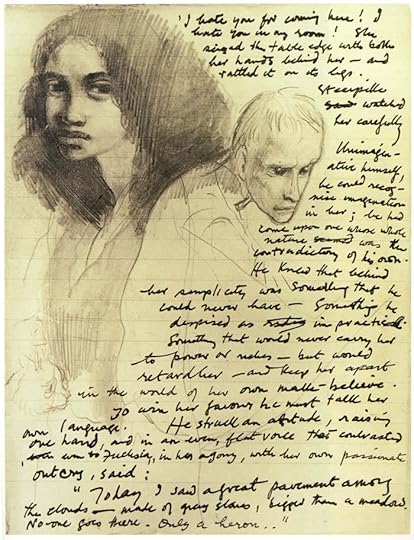
Illustration: Fuchsia and Steerpike on a page of Gormenghast
This poem, with its playful near-rhymes and nod to childhood tales, covers many of his facets:
Instinctive Iconoclast
His formative years in China (birth till being sent to school in England aged 11) left many marks on the man and his work. I've enumerated many of them in my review of Winnington’s Vast Alchemies HERE
Peake’s art was neither classical nor abstract. Critics often said he needed to pick a style, and one noted the “seeming contradiction between message and medium… Grace and grossness are hopelessly mixed up”. And the Titus/Gormenghast books are often described as being in a category of their own. It’s easier to list the many labels that don’t quite fit: fantasy, gothic, YA, humour, dystopian, even sci-fi (though Titus Alone, which I reviewed HERE, won a Nebula award).
When it came to illustrating the books of others, there was more of a reason for the variety of style. Every book has a unique “smell” and so the illustrator “must have the chameleon’s power to take on the colour of the leaf he dwells on”.
There were books Peake loved, but he was not a big reader and had little interest in literary criticism or art theory.
“It was sufficient for him to feel and experience directly, and then to express these experiences in painting or in poetry.”
“An instinctual rather than an intellectual man.”
Peake himself was always something of an outsider, similarly hard to pin down. As an English child in China, and then as someone from China in England. He worked with pen, paint, and words, and his style in all those fields was always just out of synch for fashion of the time, a situation perhaps exacerbated by his lack of interest in artistic or literary theory, discourse, or criticism, let alone politics. That was fertile soil for his unique genius, but meant his bank balance was always dangerously low.
Perhaps it’s no coincidence that subjects of his portraits invariably have their eyes averted.
He was also an outsider in time, always producing things that were no longer in fashion (if they ever had been). When, after many years, he finally got his play, The Wit to Woo staged, the reviews were mostly disastrous. Experimental theatre with a message was by then in vogue, not country house comedy. Peake’s poor physical and mental health took a sharp, instant, and permanent turn for the worse.
Peake’s Philosophy
If he had one, he rarely stated it, but Yorke finds a few examples:
• “Art is really sex in another guise."
• “Art is more than history - it is a living, breathing, self-contained and permanent state of beauty.”
• Artists see art in everything, “I am too rich already, for my eyes mint gold”.
• “Is one to risk failing at big things, or be sure of success in small things? If the word ‘artist’ has any meaning at all it means the former.”
Health - and Loss of
Peake was invalided out of the army aged 31, after a nervous breakdown shortly after his second child, Fabian, was born. He was then traumatised by visiting Belsen (as a war artist) shortly after liberation. Years later, he had a decade of heartbreaking physical and mental decline, variously diagnosed as "premature senility", Parkinson's disease and depression. ECT and surgery caused problems of their own. At least he was spared seeing the covers of the reissued US edition of Titus Alone, which Meave described as "Hieronymus Disney".
Maeve
Peake’s wife, Maeve Gilmore is the heroine here: somewhat in the shadows for much of the time, a painter (originally one of his students) sacrificing her own talent to some extent to nurture his. After his death, she became an even more vocal, passionate, and ultimately successful advocate for her late husband’s genius.
None of the biographies question their mutual passion, but most more than hint that he was not naturally monogamous. Shortly before they were married, when asked if he could be faithful, he said “I can’t imagine life without her.”
All My Peake Reviews
All my Peake/Gormenghast reviews (including biographies/memoirs and books about his art) are on a shelf,
HERE.
In particular, for more details of the Chinese influences on his work, and of Peake’s life, work, prolonged ill-health, and slow path to death, see my revised review of Winnington’s Vast Alchemies HERE .
How could one not delight in a man who thanks his mother-in-law like that? She kept him in socks for the rest of her life.
A book and a tree – what more could one want? (Though this looks a little precarious.)
Mervyn Peake is best known for the Titus Groan/Gormenghast books, but his works are far more diverse than that.
This is the fifth biography I’ve read: two by two of his three children, one by his widow, and one by a Peake expert, along with collections of his works that include biographical detail (see links at the bottom). Consequently, there was little information that was new totally me, yet I still enjoyed Yorke’s approach. I’ve put the few extra snippets into my review of Winnington’s biography, Vast Alchemies, HERE and not doubled up in this review.
This book is filled with Peake’s own illustrations, spread throughout the book, rather than being lumped in a few groups, and there are plenty of quotes from Peake’s written works. It is a delight to hold and read. The index and bibliography are also comprehensive, and it quotes extensively from contemporary reviews. This is wonderful for fans, especially those who know of his writings but not his art, or vice versa.
Peake’s life is told in 20 chronological chapters, each titled by just one or two words summarising that time, although many of the labels applied for longer periods. The list alone hints at the varied fields he worked in:
Boy, Youth, Student, Bachelor, Husband, Soldier, Illustrator, Reporter, Novelist, Family Man, Householder, Poet, Amorist, Traveller, Playwright, Patient, Prophet, Invalid, Cult Figure, Revival.
Painter, Illustrator, Writer
Peake was firstly a painter (he went to art school, and taught for many years), but wrote a great deal as well – not just his Titus novels, but children’s books, poetry, and plays for stage, radio, and TV. When writing, the margins were filled with sketches, the words and pictures working together.
Illustration: Fuchsia and Steerpike on a page of Gormenghast
This poem, with its playful near-rhymes and nod to childhood tales, covers many of his facets:
“The paper is breathless
Under the hand
And the pencil is poised
Like a warlock's wand.
But the white page darkens
And is blown on the wind
And the voice of a pencil
Who can find?”
Instinctive Iconoclast
His formative years in China (birth till being sent to school in England aged 11) left many marks on the man and his work. I've enumerated many of them in my review of Winnington’s Vast Alchemies HERE
Peake’s art was neither classical nor abstract. Critics often said he needed to pick a style, and one noted the “seeming contradiction between message and medium… Grace and grossness are hopelessly mixed up”. And the Titus/Gormenghast books are often described as being in a category of their own. It’s easier to list the many labels that don’t quite fit: fantasy, gothic, YA, humour, dystopian, even sci-fi (though Titus Alone, which I reviewed HERE, won a Nebula award).
When it came to illustrating the books of others, there was more of a reason for the variety of style. Every book has a unique “smell” and so the illustrator “must have the chameleon’s power to take on the colour of the leaf he dwells on”.
There were books Peake loved, but he was not a big reader and had little interest in literary criticism or art theory.
“It was sufficient for him to feel and experience directly, and then to express these experiences in painting or in poetry.”
“An instinctual rather than an intellectual man.”
Peake himself was always something of an outsider, similarly hard to pin down. As an English child in China, and then as someone from China in England. He worked with pen, paint, and words, and his style in all those fields was always just out of synch for fashion of the time, a situation perhaps exacerbated by his lack of interest in artistic or literary theory, discourse, or criticism, let alone politics. That was fertile soil for his unique genius, but meant his bank balance was always dangerously low.
Perhaps it’s no coincidence that subjects of his portraits invariably have their eyes averted.
He was also an outsider in time, always producing things that were no longer in fashion (if they ever had been). When, after many years, he finally got his play, The Wit to Woo staged, the reviews were mostly disastrous. Experimental theatre with a message was by then in vogue, not country house comedy. Peake’s poor physical and mental health took a sharp, instant, and permanent turn for the worse.
Peake’s Philosophy
If he had one, he rarely stated it, but Yorke finds a few examples:
• “Art is really sex in another guise."
• “Art is more than history - it is a living, breathing, self-contained and permanent state of beauty.”
• Artists see art in everything, “I am too rich already, for my eyes mint gold”.
• “Is one to risk failing at big things, or be sure of success in small things? If the word ‘artist’ has any meaning at all it means the former.”
Health - and Loss of
Peake was invalided out of the army aged 31, after a nervous breakdown shortly after his second child, Fabian, was born. He was then traumatised by visiting Belsen (as a war artist) shortly after liberation. Years later, he had a decade of heartbreaking physical and mental decline, variously diagnosed as "premature senility", Parkinson's disease and depression. ECT and surgery caused problems of their own. At least he was spared seeing the covers of the reissued US edition of Titus Alone, which Meave described as "Hieronymus Disney".
Maeve
Peake’s wife, Maeve Gilmore is the heroine here: somewhat in the shadows for much of the time, a painter (originally one of his students) sacrificing her own talent to some extent to nurture his. After his death, she became an even more vocal, passionate, and ultimately successful advocate for her late husband’s genius.
None of the biographies question their mutual passion, but most more than hint that he was not naturally monogamous. Shortly before they were married, when asked if he could be faithful, he said “I can’t imagine life without her.”
All My Peake Reviews
All my Peake/Gormenghast reviews (including biographies/memoirs and books about his art) are on a shelf,
HERE.
In particular, for more details of the Chinese influences on his work, and of Peake’s life, work, prolonged ill-health, and slow path to death, see my revised review of Winnington’s Vast Alchemies HERE .

June 1, 2017
Beyond all expectation, I just stumbled upon a copy of this in a second-hand book shop. Will be reading very soon.
====
I consider myself neither qualified nor sufficiently knowledgeable on the subjects of art or poetry to have any sensible opinions on this portion of Peake's rather prolific output, and my admiration for his prose is already on record in my reviews of Titus Groan and Gormenghast. So I'll limit myself to saying that I really rather enjoyed this and found it struck a nice balance betweeen detail and intimacy, especially in the chapters focusing on the end of Peake's life, to leave one tinged with grieving a special talent extinguished most cruelly and prematurely, mourning for the works that might have been.
====
I consider myself neither qualified nor sufficiently knowledgeable on the subjects of art or poetry to have any sensible opinions on this portion of Peake's rather prolific output, and my admiration for his prose is already on record in my reviews of Titus Groan and Gormenghast. So I'll limit myself to saying that I really rather enjoyed this and found it struck a nice balance betweeen detail and intimacy, especially in the chapters focusing on the end of Peake's life, to leave one tinged with grieving a special talent extinguished most cruelly and prematurely, mourning for the works that might have been.

June 17, 2008
A biography of the artist/illustrato/author Mervyn Peake.
Mervyn Peake was the author of the "Gormenghast" trilogy. The books are very dark, bleak, almost hopeless. To be honest, I found the first one so despairing, I couldn't finish it. Then I watched the BBC film of the books and found it amazing.
I expected to find Peake a damaged, traumatized person. Far from it. He seemed to have had a loving, fantastical childhood and grew to be a pretty eccentric, wonderful man. The quirky trek he took through life was so interesting, so far from what most people know, I found it hard to put the book down.
SPOILER SPOILER SPOILER
In middle age, Peake developed Parkinsons. Little was known about it in those days and his demise is just heart-breaking. His wife and sons have devoted their lives to bringing Peakes art and books to the public. Their love of MP is truly touching.
Mervyn Peake was the author of the "Gormenghast" trilogy. The books are very dark, bleak, almost hopeless. To be honest, I found the first one so despairing, I couldn't finish it. Then I watched the BBC film of the books and found it amazing.
I expected to find Peake a damaged, traumatized person. Far from it. He seemed to have had a loving, fantastical childhood and grew to be a pretty eccentric, wonderful man. The quirky trek he took through life was so interesting, so far from what most people know, I found it hard to put the book down.
SPOILER SPOILER SPOILER
In middle age, Peake developed Parkinsons. Little was known about it in those days and his demise is just heart-breaking. His wife and sons have devoted their lives to bringing Peakes art and books to the public. Their love of MP is truly touching.
October 24, 2014
A great biography, clearly written and without intrusion by the author, it is by turns funny, infuriating, and, ultimately, heart-breaking. That such a genius could die so young, and such an appalling death, without having ever really been appreciated. But ever was the world when it comes to great artists... This book is really worth reading whether you are a fan of Peake or not.

November 25, 2014
The author has a strange bias against his subject's wife, and prefers name-dropping other famous figures to actually composing a picture of a life.
Read
March 27, 2026I still cannot recover from the somewhat baffling conclusion (stated by this author as a fact) that Steerpike was (1) meant to represent the deceptively left-wing ideologies of the Labour Party (2) depicted as a “meritocrat” in the tv series but still dressed up in “Nazi black”. Words together that make overall as much sense as the random pic of a severed head (taken, I presume, without permission of any party involved, by a missionary British man in China) in the biography of a (British) writer and artist. If you want a good biography on Peake I’d say rather read Winnington’s Vast Alchemies or Gilmore’s A World Away (a pity though. the edition is very pretty)

May 20, 2013
A sympathetic and interesting story of Peake's life and legend. Well told.
Displaying 1 - 7 of 7 reviews