When the younger players in India’s cricket team learn that mid-level advertising executive Zoya Singh Solanki was born at the exact moment that India clinched the World Cup, back in ’83, they are intrigued; when eating breakfast with her is followed by victories on the field, they are impressed; and when not eating with her results in defeat, they are convinced she’s their lucky charm.
Between them and the eccentric IBCC president they coax Zoya to accompany the Indian team to Australia for the tenth ICC World Cup on an all-expenses-paid holiday, on the condition that she breakfast with them before every match. Worshipped by her fans, and vilified by the other competing teams, Zoya struggles valiantly to do her bit for Indian cricket. Now if only Nikhil Khoda, the erratically brilliant captain, would stop clashing with her and telling her that he doesn’t need luck to win the World Cup…
Anuja Chauhan is an Indian author and advertiser. She worked in the advertising agency, JWT India, for over 17 years. She has written 3 novels, The Zoya Factor (2008), Battle For Bittora (October 2010) and Those Pricey Thakur Girls (January 2013). All three books are romances.
I would've given this book three and a half stars, but it isn't one that would be ubiquitously entertaining. Much like chaat in the dingy gullies of India, this book was tailor-made for Indians - others may like parts of it, but unfortunately, the only people who can truly appreciate this book are Indians. Which is kind of sad because it's not bad at all.
Cricket is a big deal in India. Cricket is India's biggest religion, and this is very important to know. My grandfather is a mechanical engineer, and he is famous for his lecture on "Fluid Mechanics in Sports". He starts off his lecture with a photo of Sachin Tendulkar, because as an atheist, he only believes in the god of cricket.
I've had a love-hate relationship with cricket for over 15 years. My own personal love affair with cricket started at the age of 6. I watched bits and pieces of various matches till 2002. The 2002 Natwest Final against England, perhaps one of the greatest matches India has ever played, was the first full match I ever saw. I watched it with my whole extended family, and the match went on till quite late at night. We kids were just happy that we got to stay up so late, but I will never forget the celebrations that transpired in my uncle's house, where at least thirty of us were huddled in front of a small television, watching an absolutely riveting match. The alcohol came out and it was honestly one of the happiest days of my life.
Little less than a year later, during the 2003 World Cup, my grandfather actually taught me to play cricket. India used to play Pakistan on the giant BPL television set at home, and my brother and I would play our grandfather. We followed the '03 World Cup obsessively, as did literally everyone I knew. We discussed statistics and other things that didn't really make sense to us, but that is cricket fever in India. For the next nine or so years, till the 2011 World Cup ended, I was obsessed with cricket. I knew everything. My life was one big cricket reference; I had this tendency to speak really fast, so I was called Ricky Ponting by my family.
This was, in my opinion, India's best time in cricket. We had the greatest cricket team in the history of great cricket teams, and they were absolutely fantastic. 2005 saw the entry of Dhoni, and he led India to all kinds of victories after he became a captain in 2007-08. We won the first 2007 ICC T-20 World Cup, as well as the 2011 World Cup under his captaincy. Something happened to me after the 2011 World Cup. I continued to watch cricket after that, but somehow I began hating it. I almost completely stopped watching in 2012-2013, but started zealously watching again with the 2014 ICC T-20 World Cup. Cricket is a huge deal for me as well. Even during my I-hate-cricket phase, I am ashamed to admit that I have looked down upon people for not understanding cricket.
It probably makes no sense to most people, but I was brought up on cricket. I've seen a lot of it. Some of the cricket greats were some of my first crushes. And there's a solidarity that we develop when we watch, or even talk about cricket. If you seriously want to stop a fight between two Indians, just show them cricket, and they'll become the best of pals. It's addictive, the way we see this sport. I agree that it can turn toxic, but cricket has been a major part of every Indian's life for a very long time. We know everything about cricket, and if any Indian tells you they haven't played gully cricket, they're lying. My (government-funded) University gave the day off for a very crucial India-Pakistan match during the 2015 World Cup. The match happened on March 19th, okay, I even remember the date. I mean, I recently spent last Sunday moping around because I'd been out with my friends and missed a great game by Dinesh Karthik. Cricket is ingrained in our souls. This very long and passionate essay about cricket is important to this book, because around 70% of the book is cricket.
The protagonist, Zoya Solanki was born on 25th March 1983, at the very moment that India won the Cricket World Cup. I can't really explain it, but this is a huge deal in India. I mean, I only know how my parents would've reacted in the same situation. Anyway, being born at this propitious hour, Zoya was very nearly named Kaplia Devi Solanki, after the then Captain Kapil Dev. Zoya is an advertising executive who has to get shots of the Indian Cricket team for a soda shoot. When she is unable to do so, for whatever reason, she jokingly comments about how her auspicious moment of birth could prove lucky for the otherwise badly faring Indian team. Zoya is persuaded to stay back, and well, as luck would have it, they win their next match. This annoys Indian cricket captain Nikhil Khoda, who believes in hard-work and strategy, and not in luck. However, to pacify the rest of the team and the Cricket Board and India's one billion, Zoya agrees to accompany the team for the course of the '11 World Cup. She is considered India's good luck charm, touted a goddess, and that, ladies and gentlemen, is the eponymous Zoya Factor.
As it should be, love blooms between the "Boost-brown" eyed Khoda and the big-haired Zoya. There's a few laughs, a few tears, some fights, some steamy sessions, and of course, a happy ending. It's definitely not the best book I've read. But I've never read anything more Indian. There was the nostalgia of Boost and aloo tikki and desi Pizza and gully cricket. There is absolutely no way I could've not liked this book after that.
I'm a little disappointed that this book doesn't cater to non-Indians, because somehow, I haven't actually seen a book that depicts the good and bad of India as well as this in years. On the one hand, we have the intellectuals talking about social issues (which is very good, and I love those books); on the other, we have the pulp fiction writers who somehow cannot capture the true essence of India. Somehow, in this rather trashy chick lit, Chauhan captures true Indian sentiments. She comfortably, and without exaggeration portrays India's greatest pride and joy. Cricket.
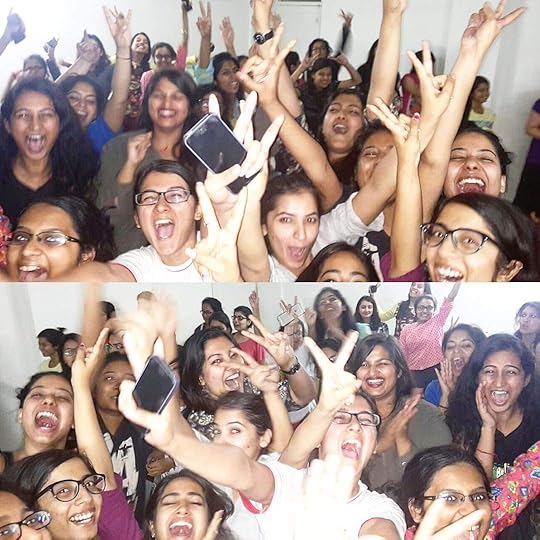
As a bonus, here's a photo of me and my friends cheering after an India-Pak match. India won, naturally.
Zoya Solanki is a mid-level marketing executive at an advertising firm, a typical zer-chill ‘Karol-Bagh’ type (in her own words) with masses of curling black hair and full-cheeks which are the bane of her existence. Her idea of a perfect assignment: Working with SRK and getting a glimpse of his toffee-coloured torso.
So how does ordinary Zoya Solanki become ‘Zoya Devi’, the Indian Goddess.....the good luck charm on which the hopes of India are riding? Simple. Zoya happened to be born at the very moment when India clinched the World Cup in 1983. In fact, when the last wicket fell, Zoya popped out into the world.
As she works on an assignment with the current Indian Cricket Team, the superstitious bunch discover that having breakfast with Zoya leads to victory. And not eating with her...crushing defeat. Consequently, Zoya is instantly escalated to the status of “Lucky Charm”.
With the tenth ICC World Cup just around the corner, Zoya is begged, bullied and emotionally blackmailed to accompany the Indian team as their official good luck mascot. Driven by a misguided sense of loyalty to India and the hope of bringing back the elusive world cup.....Zoya is soon off to Australia on a fully-paid holiday.
But being a lucky charm is not all it’s cracked up to be. Zoya is soon crossing swords with the handsome captain of the Indian team, Nikhil Khoda. Khoda doesn’t believe in lucky charms. He works hard and wants the team’s win to be attributed to the effort put in by the boys. The fact that there’s a definite attraction between the two only adds to the simmering tension between the lead pair.
Pursued by pista-munching agents, harangued by saffron-clad babas, manipulated by IBCC chiefs and wooed by cola firms……Zoya is soon sinking into the mad-crazy world of Indian Cricket. In a country where cricket is almost a religion, Zoya is elevated to goddess-status. Staying true to herself is becoming more and more difficult and the hype threatens to over-power the sassy Zoya.
Anuja Chauhan brings a chatty, engaging vibe to Indian chick lit. Generously peppered with lashings of Hinglish, ribald humor, an endearing heroine and a rather yummy hero, THE ZOYA FACTOR is a satirical yet funny take on the Indian cricket mania.
This is light ‘chick lit’ which I had heard pretty good things about especially from a friend who’s always referring to the characters. I was planning to read it but had somehow never got to it, but when I found this on sale on kindle, I picked it up. This is the story of Zoya Singh Solanki, a twenty-seven-year old who works in an advertising firm. She is assigned to work on a campaign with the Indian Cricket Team, who is on tour in Bangladesh, and it comes out that her presence is lucky for the game for she was born on the exact date and time as India won its first cricket world cup. Of course, the team wins its match after breakfasting with Zoya, and a few other ‘tests’ (including at IPL games) turn out to prove her a true lucky charm. It turns out her family too had taken her along for luck when they were at games though she was unaware of it at the time. The captain of the team Nikhil Khoda claims not to believe in luck but since his teammates and the Cricket Board have become firm believers, he agrees to her presence. It also helps that he’s beginning to get interested in her, as she is in him. There are the inevitable disagreements and misunderstandings of course, to which his position as the Indian team captain, and hers as pretty much a ‘Devi’ (or goddess) add. They head off for the cricket world cup at Melbourne, where she must deal with her feelings as well as all the attention and press that she’s getting―good and bad―as the good luck charm.
This was a really fun read which I enjoyed thoroughly. The whole atmosphere, language, and writing is very contemporary and fun without being too cheesy or too over the top (but it definitely made me want to keep far far away from the advertising and cricket worlds (of course, I have for long been disillusioned about the latter)). I thought the author got the Delhi or rather ‘Dilli’ feel of the book just right (probably something Delhities will really enjoy)―sometimes this tends to be exaggerated in books and film). The characters again were good fun, Zoya herself, her family (slightly nutty but very real), and friends―even the team members. I also enjoyed much (though not all) of the humour. The end or rather just a little bit before the end for me, however, was a bit over the top, though that too added some fun touches to the book closer to the end, and some of the ‘fights’ that Zoya picked with Nikhil (not all) felt unnecessary (plus may be it could have been a little bit shorter). But other than that, this was a light, fun, refreshing read, and I’m looking forward to reading more by Chauhan.
Zoya Solanki, Servicing girl to Zoya Devi, The Goddess! How you may ask? Well she got lucky, LITERALLY! The indian cricket team realizes that whenever she has breakfast with them they win and when she doesn't they even lose to a country that doesn't even exist (by this I mean minor cricket playing nations). This book is a roller coaster of her journey as a lucky charm to the team. Will she still be her sensible self and not go really deep into this "Goddess" status or will she start believing that she is the reason for the team to play well and lose her chance at love?
Wow was that a breath of fresh air!! I absolutely loved it! This was a book written by an Indian author and this had me super hesitant to dig right in. Don't get me wrong, I do love my country and stuff but after having Near death experiences with a few Indian Lit. Books I decided that maybe I should seriously take a break from them (Especially after Accidentally in Love where I put the lives of my family members at risk since I went through this brief period of the "I-am-going-to-stab-the next-person-I-see" syndrome!) BUT GOD THIS BOOK!
It was Indian without being boring and cheesy! It was so well written with humor and angst (well I felt it, Cricket makes me angsty,okay?). Honestly I think it's one of the best books I have read recently! The characters were relatable, flawed and made stupid mistakes and I just loved it. It truly draws upon the Indian way of life, the actual essence of being Indian! This was such a fun book and would definitely recommend it when you want to take a break from hard core novels! The narration is funny and laid back and just perfect for you to just sit back and enjoy (kind of like F.R.I.E.N.D.S).
In my defense, i picked up this book for two reasons, namely- 1) I was intrigued by the fact that 'sometime back' a noted production house wanted to make a feature film out of this and 2) The synopsis seemed interesting. What i should have also taken a moment to read were the reviews. Especially the one- and there is only one- at the back which mentions the word- 'chic-lit'!! Big Mistake!
And since i hate leaving a book midway- especially when it is not an anthology- i had to curse, moan and grunt my way through 509 pages.
I remember reading a similar book a while back, but that one was written by an author in her early 20's and was her first foray into any kind of writing. However, Anuja Chohan here has had a very long and successful stint in the creative arena. Although that stint has been in the capacity of a senior copywriter in an Ad Agency, it still seems only fair to expect a bit more than such timid and candy-assed writing from her.
I am tempted to point of the flaws but then again I am neither 16 nor a chic so in all probability this book was not meant for me.
I only wish they would have printed it in bold on the cover like a statuary warning-
"READ THIS BOOK ONLY IF YOU ARE A 'CHIC' AND IN YOUR 'TEENS'"
It's not literary elitism; it's just Anuja Chauhan being a bit over-the-top with her nonetheless fantastic metaphors. The Dilli feel to this book was what I loved the most.
SCRATCH THAT NIKHIL KHODA IS LIKE THE BEST BOOK BOYFRIEND EVEREVEREVER BECAUSE
1. he's not all mushy mushy 2. he's hot in the cannot-be-tamed way 3. strong and confident 4. he's nikhil khoda
I refuse to accept he's fictional. Oh god i love him so much even though i harbour no love for cricket gah
The best thing about Zoya is that it is not just 'an english book by an indian' if you know what I mean. There is so much more story and people and India than in the 'I'm Indian, I live abroad, I'm confused' kind of book there has been so much of in the recent past.
Zoya is peopled with characters that are as believable as they are likable. Zoravar, Eppa, Rinku Chachi, Vishal, Monita even Sanks are people you would have or at least easily could have met somewhere.
It is laugh out loud funny in many places. I especially liked the crickindya website comments section. Anuja Chauhan certainly has an ear for dialogue!
Other pluses: Nikhil's a dish and the mushy stuff doesn't make you cringe (well mostly). The romantic is nicely tempered by the ridiculous. Big bonus - people from Delhi especially of Karol Bagh origin will LOVE how VERY Delhi this book is!
Only grouse... it is way too long! Better editing would have made such a difference. With no literary pretensions whatsoever, Zoya is light weekend reading at its best.
this is the kind of book i hv always dreamed of writing! funny, saucy yet endearing!
One of my fav ppl on Goodreads had recommended me this book when we met the 1st time,saying it was chick-lit but good. now i am not a big fan of the genre, and tho i had the book for the last 10 days or so. Yday eve had a tiff with dear wifey, and thought will browse this for half hour or so, give her time to cool down, and then make the obligatory apologetic sounds to bring around the rapprochement!
not a good move i tell u... bcs for the next 2 hours i was just chortling away every page or 2! not the best way to look apologetic i tell u... :P
If u r an Indian and/or u love cricket, u r going to simply love this like nothing else... the story is of an advertising executive named Zoya, who is supposed to be especially lucky when it comes to matters cricket - she just needs to eat with a team and peck a player or two, and the heavens conspire to make the team win! Soon the Indian cricket team is depending upon her to win the world cup, along with the rest of the billion or so indians! add a love angle to this, and u have a perfect pot boiler ready!
Dont waste any more time reading this review - go read the book!
Twenty seven year old Zoya Singh Solanki lives in a sprawling bungalow in Karol Bagh with her clan. She works in client servicing for India’s biggest ad agency, AWB. She’s been dumped twice. She hates cricket. And, because she happened to be born at exactly the moment India won the World Cup in 1983—although she narrowly missed being named Kapila Devi Solanki—Zoya is now lucky for anybody playing cricket. Even being taken along for a match and having a sip of something thanda with one team—since she was a little kid—has proven lucky for the team in question. Zoya’s uncles, various colleagues of her retired father’s, as well as Zoya’s brother, Zorawar, can attest to it.
Zoya’s luckiness for cricketers suddenly zooms up when, at a commercial shoot for Zing! cola with the Indian cricket team, it becomes obvious that all Zoya has to do is have breakfast with the team, and they’re bound to win. Soon, Zoya has formally become part of the team as it goes to the World Cup. She is falling in love with the hunky captain Nikhil Khoda, but there is politics in the air—religious politics, cricket politics, big business commercial politics. Sexual politics.
I’ll say this for The Zoya Factor: it was entertaining. Anuja Chauhan’s language is a blend of Delhi Hindi and hip urban English (and yes, a good bit of it reminded me of the sort of English I came across when I worked in advertising—I could almost recognize several people, several situations). The Karol Bagh ambience comes through vividly, and there’s a good bit of humour (the reference to ‘Zoya Devi ka Chamatkaari Balla’ really cracked me up). Plus, she uses the Indian obsession with cricket and religion in an interesting and spookily easy-to-relate-to way.
What did I not like? If I were to nitpick, I’d say lid instead of the much more apt dhakkan. Or ‘honeysuckle’ instead of ‘Rangoon creeper’ when referring to madhumalati. Or Zoya’s friend Mon’s thoroughly irritating and precocious child, Armaan.
Those, though, are minor. What I really didn’t like was the somewhat clichéd romance of Zoya and Nikhil: it follows all the tropes faithfully, including Zoya kissing another hunk just to make Nikhil jealous; Zoya simmering over the many gorgeous women Nikhil hangs about with; the constant see-sawing between fighting and drooling over each other. The sad part was that Zoya’s self-confessed lust for Nikhil segued into love at a point I never really caught, and Nikhil’s love for her, while steamy at times and cute at others, never really struck me as love. The love story was a little too filmi and unconvincing.
But, all said and done, a pleasant enough book. Better editing and a tightening up of the middle chapters (where it tends to sag a wee bit) would’ve helped.
I wanted to post it on Anuja Chauhan FB page but that option is not there. So i am pasting it heare. Hope she reads it.
I just finished your “The Zoya Factor”. I liked it immensely. In goodreads I saw some of reviewers has categorized it chic lit but I will prefer to call it BINDASS LIT. Your English is good but unpretentious unlike Vikram Seth and Arundhati Roy. And Hindi and hinglish in between makes it very Indian and you doesn’t look like a Nora Roberts, Patricia Cornwell wannabe. It is surely an original product. But I felt that you are very soft on Nikhil and very hard on Zoya. It would not have hurt if she is shown somewhat more intelligent mentally and emotionally. But contrast is good in romance. The subtle (or not so subtle) satire on Indian cricket management, establishment, commentators etc. is honest. It also gave a slight peek to the working of great Indian advertising industry (you should write a whole book on this theme as who better than you to write on this with authority). Fickle mentality of Indian public is depicted truly. Some SPIRITUALLY EVOLVED READERS (pun intended) might find use of cuss words like MC, BC, CH**** etc offensive but I had a blast (maybe because I am also from Meerut and can easily identify with these gaalis as they are used as punctuations in daily lingo of Meerut). Call it Meerut bias but I find you better than Amish Tripathi, Ashwin Sanghi, Chetan Bhagat (especially Chetan), Vikram Seth and Arundhati Roy. Keep it up. God bless you. My only regret is that I read it so late and can’t wait to read your other works. As I am very lazy this is only my second review of any book. First was “Seven Habits of Highly Effective People” by Steven Covey that to as a part of some management training. So you can understand how much I Liked it. P.S.: Will also check out Delhi wali Thakur girls on & TV.
If anybody has her contact details(email etc) plz give me. I want to mail this to her.
I recently picked up this book on a friend’s recommendation. I honestly did not expect this book to be good when I started reading it. The style of writing seemed to be very juvenile and contained mostly ‘Hinglish’ dialogues. However, the plot was so quirky and unique that it kept me engrossed and made me like it a lot!
What’s fun about “The Zoya Factor” is that it brilliantly blends the intensity of cricket with romance of the protagonists. The author has written the cricket parts in a captivating manner that keeps you engrossed even if you aren’t a fan. The author doesn’t focus importance of one over the other. This is a welcome change from reading your usual melodrama soapy stories. Hence, this book is not just a ‘romance’ novel, but has something for everyone to enjoy.
The author’s strengths lies in her plot, character development and the snarky repertoire of the dialogue. She has a talent for keeping the readers glued to the book and had me laughing out loud during the funny moments, to nearly throwing the book during the annoying moments. She has done a wonderful job for a debut novel, as there is never a boring moment in any page. While the book ended the way I thought it would, I admit there were times where I kept guessing what Zoya would do next.
Even though I found most of the characters to be likable, my only problem with the book was Zoya’s personality. During the latter part, Zoya comes off as an emotionally, confused gullible clown with low self-esteem. She reacts to situations before even thinking it through. She makes really dumb decisions and falls into ridiculous situations based on her mood-swings. We can sum up the second half as “I love Nikhil”, “I hate Nikhil”, “I love Nikhil”, every other page. Perhaps this was done for more sub plots, but I kept rolling my eyes on the situations she got into.
Most of the Indian authors pen their stories in the hopes of turning it into a Bollywood movie someday. “The Zoya Factor” is no different and has all the ingredients to turn it into a perfect Bollywood film. The main characters meet through quirky circumstances and fall in love during the first half, and go through various turmoil in the second half testing their romance. The added advantage over such clichéd movies is the gripping sports aspect that gives it a nice touch. Overall, this was a fun, breezy read and I am interested on how the movie adaptation turns out.
The Zoya Factor has its high and lows for me. Still for someone reading Anuja Chauhan for the first time, I wager this book too would be an extremely entertaining experience. Chauhan's style, which was refreshing when I encountered it, has worn off its charm on me three books later. She still made me laugh out loud at certain moments, but otherwise it felt like reading the same formulae applied in a different setting. The characters as well, Dabbu, Bonita and Zoya seem to be made from the same mould with varying degrees of sass, wit and insecurity. Anuja Chauhan still is the most decent commercial writer in India I have come across, but I don’t think I will be reading Battle of Bittora anytime soon since I am pretty sure how that plot will shape itself too.
My fault (once) again. I read the 'chick-lit' tag far too late, namely, after 15 yawn-inducing pages. Juvenile and utterly predictable. (I flipped to last page to confirm the predictability factor) The end.
[This is a very rant-y review; I just had a lot to say.]
"Don't you want to be famous for something worthwhile? Instead of just being famous for being lucky?"
I read a review of this book once (right here on Goodreads) that ended with saying, "Read this book only if you are a 'chic' or a 'teen'." I had half a mind to go and ask the reviewer to explain himself. What did he mean by this book being one only that a "chic" will enjoy? I even prepared what I would write to him. I would begin my message by saying, "First of all, it's not chic-lit, it's chick-lit and if you had any idea what a chick-lit novel means, you'd refrain from using that term so derogatorily." This is to not say that chick-lit isn't a derogatory term in itself. It is. I hate that a complete genre displaying how strong modern women are and how they socialize and move on with life (yes, it's a sub-genre of women's fiction) is called chick-literature, of all things. But until we come up with a better name, I'm going to have to continue describing it this way; not because I want to, but because I am no critic and I can't think of a better name (yet). Why are women called chicks? Do you see us hatching eggs every now and then? Do you see yourself eating the eggs we hatch? Are we frickin' birds to you?
But that's a rant for another time. In this review, I want to talk about that one review I read and ask that person if he also happened to read the words "romance" in the reviews since he said that he regretted not having read the word "chick-lit" in the reviews previously. Because if it's a "chick-lit" then it more often than not also is a romance. I wonder if that was not derogatory to the reviewer. Besides, that person also wrote in his review that it's an anthology, something I wanted to laugh about. It's not an anthology. It's a whole frickin' novel, and it's brilliant. You wanna know why? Because it's a satire.
Yes, I said it. And I mean every word I am saying. More than a chick-lit or a romance book, this novel is a satire. It's a social story about the Indian society. It's a story about what it means to be superstitious in India. It's a story about how cricket is a whole other religion in India, probably much more important than Hinduism, Islam, Christianity, Sikhism--honestly, this list can keep going on and on; there's so many religions in India. It's a story of a woman finding her voice. It's not a feminist piece of work, by any chance, and I get that.
But then, it's not meant to be. It's meant to be about the society. It's meant to portray the dual-minded and corrupt people there live here, and it's meant to not be sorry about doing that.
And no, I'm not talking just about India in the above bolded and italicized message. And I can say all of that because I have read the novel and I have read the "About the Author" that they give in every book everywhere. Anuja Chauhan has worked in the advertising industry. I am pretty sure when she started writing this book, it was about something trivial. (I just went and read the acknowledgments once again. The idea was of a human lucky charm. So yes, something trivial.) But she used that trivial thing to turn into a parody of the society and you still call it just a part of chick-literature?
I haven't read the other reviews of this book. I was too disturbed by the first one that I read. Needless to say, that person gave it a one-star rating. I won't. Although I wasn't in love with it, and although there were times when I was annoyed at the way the "romance" developed between the two major characters, I still got in terms with it. Yes, the romantic story-line was a huge no-no for me. It disturbed me, especially when the romantic interest in this case was not even really romantic, or if I'm being honest, very likable. I mean, he was portrayed as this rude man since the start and although I am all up for bad boys, he was particularly unappealing, even if he had a nice body. As a result, the first half was particularly unappealing. It wasn't until the whole superstition story-line began developing that I got actually hooked.
I'm not saying that I am in love with this book. Yes, it has its faults. Yes, the author could have done a better job at it, especially if she was already writing such a huge novel. She could have thus, also improved the romance a bit, downplayed Zoya's immaturity, improved upon her familiar relationships and more than anything else, added a little more depth to some of these characters. And of course, yes, Zoya seemed immature. But that was just her being human. What will you do: you, a person who doesn't have the entire nation suddenly loving you and writing articles about you and God knows what not; what will you do when you, someone who is still naïve of the media industry are thrown at the centre of it, with every person wanting to either be you or have you as their own? So of course, Zoya seemed immature. That is how humans are. And yes, the language could have been given special attention (one of my friends said the Hinglish was particularly bad here. I, on the other hand, believe it's one of the first "popular" novels that has had such an easy-flowing Hinglish). So yes, it is, by no means, a perfect novel. But I also think that it is still an essentially important read. I don't know much about cricket. Similar to many Indian houses, I too live in one where the entire family is crazy about it, and no, I am not. I just know the basic rules and that's it; but here's the thing: by writing this story, Chauhan has tried (or at least, I hope that's what she tried) to show the reader that no, cricket isn't everything and no, just because India won the match that one day you peed in your pants (a completely random example, I swear!), it doesn't mean it will win every single time that you do. It's all about the team, alright? Trust your team, trust your stars!
And lastly, don't ever, ever, ever, ever degrade a social novel by saying it's only for the "chic"s. Perhaps, if you are so manly, then you might stop doing all the things that you, while sitting inside your house as the team plays live somewhere else, usually do, to ensure Indian team wins the next world cup. And perhaps then, people like Chauhan won't have to write social novels about antiques of people like you anymore!
Thank you for reading my rant-y review. I hope I changed someone's opinion today. And if I didn't, then I hope this quote from the book, which is meant to show the hypocrisy of the society, helps:
It was written as part of an article which was a part of the whole "lucky charm" debate: "But Zoya Devi is no longer Anybody's Creature. She's tasted power and loves it. Zoya Devi is on a rampage. The Gods are running for extra cover. I sit here, laugh a deep, guttural belly-laugh and raise an admiring toast to the Goddess. Zoya Mata ki Jai!
i did like some parts of this book. some lines that made me laugh. and the idea was a good one too. written quite well. but i did not like the fact that the book was too long for the story. about 200 pages seemed unnecessary! dragging the story along. and i think i do not like portrayal of zoya as a girl who swoons seeing the skipper. i prefer the women in books to be strong characters who do swoon at times but that is not the only thing they do!
The Zoya Factor is the debut novel of India’s most wittiest and sassy novelist Anuja Chauhan. This book was published in 2008 by Harper Collins. The Zoya Factor is a book written based on Cricket and how crazy Indians can be about this game. This book gives a five dimensional view on Cricket and the advertising industry in the country. And it is very satisfying and informative.
The Zoya Factor is the story of a young woman called Zoya Singh Solanki who was born on the exact date and time as India won its first world cup in the year 1983. She works in an advertising agency as advertising executive for a meager salary but she absolutely loves what she does. If there is one thing she doesn’t love in the world, that would be Cricket but as fate would have it, she is forced to work with the Men in Blue for an ad film. That’s when the young boys of Team India finds she is lucky for cricket and decides to have her tagged along with them for all the matches. But whereas the super hot and talented captain of Indian Cricket Team, Nikhil Khoda does’t approve of it. Though he is an incredible player and wonderful captain, he is continuously criticized by the media and people for the poor performance of his team. Nikhil Khoda is a man who believes in his hard work and ability, and he is totally against luck. This actually brings about a turf between The Skipper and our Lucky Charm. Despite having a remarkable chemistry, they both are always on the opposite sides of each other because they both have one hell of an ego clash going on between them.
Can Zoya’s luck actually make India lift the world cup after 28 years in 2011 ? That’s the story of this book!!
Anuja Chauhan’s writing style is her strength and her narrative style is beyond anything the Indian readers would have witnessed. The dialogue delivery and monologues of the protagonist will completely bundle up reader’s attention and one can never get out of the magical spell casted on them by Anuja Chauhan’s words. Anuja Chauhan is indisputably the most wittiest, humorous author India has ever seen. The way she pen down her thoughts are mind blowing and extremely funny. And nobody can write witty one-liners like her. Her writing style is very unique and it has lots of layers and depths to it. If you are reading her book, she will make sure you are absorbing everything about that particular scene in detail. For example, you will know who are the people present in the backdrop of the scene and what they are doing and why they doing it precisely. How does the protagonist feels about it, how is the weather like and what not ? But these information will only enhance the beauty of the scene and it will never be too much or unnecessary or unwanted.
Since the book is based on Cricket and also about Advertising industry, one could get to know about every tiny winy nuances of these industries. And in the end you will almost feel like you are a pro in these respective fields because that is how informed the author is about the industries she was writing about. Since, the author herself was from advertising background, you can understand the authenticity of the information she provided over in the book. All these information was written in a very engaging and remarkable manner.
Anuja Chauhan’s romance and sense of humor is unbelievably adorable. The way she has characterized both Zoya and Nikhil Khoda was very interesting and lovable. Readers just cannot help themselves from falling in love with the lead characters of this book. Nikhil Khoda’s character, his ideology, his physic, his appearance and everything about him was drool worthy. Well, who can resist the charm of the Indian Skipper ? He is one worthy hot book boyfriend anybody could ask for.
Zoya is a kind of character who will make the readers fall in love with, in no time. One of the best things about Anuja Chauhan is, she focuses on all the flaws the protagonist find in themselves which can either be of physical appearance or a characteristic. And this makes Anuja Chauhan’s protagonist more relatable and lovable. Well, with Zoya, the readers can have lots of moments where they will love her from the bottom of their hearts and at the same time they can go ‘Why the hell did she do that? Is she mad or what ?’ in a fraction of seconds. And of course that’s what makes Zoya, Zoya!!
The book was very realistic because throughout the book Zoya was very conscious about ‘what her father might think ? What will her father do when he comes to know what she did?’ And that was super wonderful. We would have read a lot of books where the protagonist go to some other place to be more independent and does all crazy wild things without a single ounce of their body caring about the orthodox family back there who thinks their child is super sanskari. This book constantly pointed out about the mentality of normal Indian parents and their concerns which made this book more relatable.
There was a lot of cricket in this book and every single match in this book was extremely nail-bidding and will put you on the edge of your seats. These match sequences has been written down so brilliantly that you will be satisfied by the way it has been written that you don’t even crave to watch it in real with your eyes because it has been written down that greatly.
There were lots of supportive characters in the book which made the reading journey much more enjoyable. There is this character called Eppa who is Zoya’s house maid and caretaker, the way she converse and talk is super exciting. Zoya’s three chaperones are the best, Monita and her son Armaan and Rinku Chachi, they are super fun to be around. With them around, there was not a single dull moment. Zahid’s presence in the book was so breezy and chill. The relationship shared between Zoya and her brother Zorovar was extremely adorable and wonderful to read. There was this antagonist called Robin Rawal who also played a significant part.
Zoya’s house in Karol Bagh aka Tera Numbar, her father, her big family will give a good understanding and peep into Zoya’s life and background. This made the book a little more rich and cozy in a very ethereal way.
The plot of the book was extraordinary and how the story marched forward was really amazing. The book was pretty big but that feels like it is damn necessary to get the kind of understanding the readers have now about the plot and the characters.
This is one hell of book which every single person out there should at least once to enjoy this journey of Zoya and Nikhil Khoda with cricket and twice, to immerse in the author’s writing skills, layered narration and so on. Anuja Chauhan is just a brilliant writer whom everyone should read without fail.
MY VIEWS
I just love The Zoya Factor, Nikhil Khoda and Anuja Chauhan the most!! Like, the most in the world!!!!
I’m basically a die hard cricket fan who is crazy about books. And this book is like the icing on top of the cake. I have been wanting to read this book for since so many year but I only read it in 2019. At the time I loved the book so much, I was mentally dating Nikhil Khoda ever since but I had mild mixed feelings about this book because I felt like the book was kind of too big and some parts could have been cut shorted and chucked out. But now, in 2021, I decided to do Anuja Chauhan reading marathon with a friend of mine and we started to buddy read all her books. Though I have already read The Zoya Factor, I still wanted to re-read it again because of cricket and Nikhil Khoda and Zoya herself. But while reading it for the second time, it was completely different experience. It was now, I looked in between the lines and understood what a great writer Anuja Chauhan is and completely fell in love with her, her writings and her books. Now I do not want to change a thing about this book. I want each and every single word of this book to be there forever because it adds so much color to the book.
I just loved the way Nikhil stood his stand throughout the book and how the book ended. There was a lot of interesting one-liners which I couldn’t stop myself from highlighting. And, oh my god! How does Anuja Chauhan comes up with names like Robin-shoe-steeler-Rawal ; Jogpal-lump-of-shit-Lohia ; Lingnath-long-turd-baba. These names themselves will make us laugh hysterically. Then terms like cute-butt ; biteable-chest just makes us go crazy. Her words are blush worthy, drool worthy and it simple elates my soul.
In between, there was a lot of newspaper articles present in the book, which talks about cricket matches, players performances and few gossip and rumor filled articles which was very interesting to read. And these had a totally different voice and tone to it from the other parts of the book and that is simply damn good. It is very intelligent of the author to come up with this kind of an idea and distinct and authentic writing style of tabloid articles.
I love this book so much! To be very frank the movie was quite disappointing and that was solely because of the great Sonam Kapoor. She is definitely not my Zoya from the book because Zoya Solanki in the book was witty, humorous, strong and bold and she had chubby cheeks which she hides consciously with the curls of her hair and Sonam Kapoor was none of that. She acted like a crackpot, typical bollywood stupid heroine. Oh please!! My zoya moya is so much more better than that. The thing that I loved the most about this movie was Dulquer Salmaan!! Damn man!! The casting was just beyond perfection and he charmed his way right into our hearts through his acting skills and everything about him. While I was reading some movie review of this movie somewhere, I found something like “Though the movie was called The Zoya Factor, it was the Dulquer factor that worked out tremendously on screen” I cannot agree more with this statement. Maybe Mithila Palkar or Nithya Menon would have been a perfect choice for Zoya.
If you haven’t watched the movie, please do read this book and watch the movie later for Dulquer Salman, you will not be disappointed. If have already watched the film, please forget the film altogether and read the book to simply understand how great and wonderful this book is!!
I loved this book very much, I cannot stop myself from saying this regularly. I would like to recommend this book to every single cricket freak like me out there. I just absolutely love the cricket in this book. If you are into rom-coms and keep on reading foreign authors like Sophie Kinsella, Marian keyes and Lauren Weisberger. Then take a breather and check out this wonderful author from India who is raising her yardstick with every single book of hers!! Check this book and the author to know how great an author this country has got!!
When I read it for the first time, I only rated this book 3.8 stars but this time I just want to simply jump over and give a 4.9 out of 5 stars without a second thought. Is this even normal to change your views and rating about a book after few years ? Please let me know, this is normal.
I bought this book long ago and forgot its existence in my book shelf till recently . I regret it . I seriously do , DAMN , How did I miss this book all this while ? This is too good to skip
Synopsis :
Zoya from AWB , an advertising company which hires celebrities and manage to shoot a few endorsements on various products . She is chubby , short , lively who loves firecrackers . Ohh yes , she is born on the same day as India won world cup . Personally she doesnt believe in luck , lucky charm or such things . But then she is considered to be the lucky charm by the Indian cricket team , and for the India by almost all Indians except a few ofcourse , Nikhil Khoda , Indian Captain Coldheart .
Now Zoya is officially tagged as the "Zoya Devi" The goddess of Cricket , she accompanies Indian team for the world cup ( Zoya is least interested in cricket , apparently she claims she only finds for sports column page in newspaper to clean the potty of her dog , lol ) .
Captain coldheart believes in no-Luck , he is a self made man and he wants his boys to believe in themselves rather than some goddess , Though Zoya wants the same, For some yet-to-be-known-reason-by-Zoya-herself she fights Nikhil . But soon loathing turns into liking and then love .
Will Zoya help India in winning the world cup ? Will India be able to win without her ? Why is Captain cold heart interested in Zoya when he claims he doesnt believe in luck ? Well , Read and find out ;) THIS IS A MUST READ IF YOU LOVE DDLG N CRICKET . I am nt a big fan of DDLG or Cricket either but I LOVED THIS BOOK. Also there is a special appearance , guess who ? Our very own Shah Rukh Khan .. OMG Yes !
What I Liked :
After reading some super ridiculous books by Indian authors , this book comes as a shock . Like , OMG Indian authors can give us some good stuff too . Am I exaggerating ? I hope not . This book is truly awesome . I am way too tooo impressed . Book has some happening stuff , I loved the gossip columns lol . Zoya's monologues and the way she has things running in her mind ( Eg : yehh tohhh badaaa toyingggg haiiii ....LOL ) What the hell is toyinggg tho ? Some rly good stupid stuff , I burst of out laughing when I read those two poems by Armaan Joy to the world . teacher is dead. GOSH , I LOVED IT.
Very rarely , you wish the fictional characters were real , And I wish I was Zoya , Not because she is treated as some bullshit goddess but yess BC of Nikhil . They gave me HP , Mills n Boons feelings . And the English was so good , Only the hinglish part convinced me that I was really reading some Indian author . Ahhh I am in love with a fictional character yet again < Gives mother India Pose> Now Every time I watch Men in blue endorse for some stupid products in TV , I cnt help but blush a little remembering Nikhil . This guy is magic ...
Reading this book is going to be an existential question for the rest of my life. Why did I choose to continue reading a book which went on interminably - about 500 pages - based itself on a superstitious premise - a girl can be lucky for the Indian cricket team and should accompany them on the World Cup tour - to realise only in the end that the Zoya Factor did not even count since the team won the finals without her. Dud!!
Zoya is a lowly advertising executive who makes a total ass of herself believing that she's the lucky charm for a country and getting involved with the captain. Megalomania at its best. The writing is sloppy and I had to literally flip through 50 pages pages at a time towards the end to get to the end. (Hence questioning my sanity is continuing reading)
I can't find the Anuja Chauhan that wrote Those Pricey Thakur Sisters. I hear that Sonam is in the movie version of the book and I think she's a perfect fit to play someone imbecile and immature - since she proved she can do that so well in Khoobsurat.
The first 100 or so pages were witty and lively. Written in a language that resembles English, it is the tongue of the Delhi teenager of the feminine kind. But it has intelligence. It reminded me of my niece. I quite enjoyed it.
After the novelty wore off, and romance reared its head, the novel nose-dived. The remaining 400 pages or so were ... well, I's rather not say anything about it, as I am not the target audience. Don't want to run down a book of a sub-genre that I don't like. That would be unfair. Once the Zoya-Khoda thing started, and the fooling around with Zahid happened, the character of the book changed, and Zoya became annoying (to me).
My rating this therefore for the first 100-odd pages.
This Anuja Chauhan's book contains all the ingredients for a masala Bollywood movie- unique plot, comedy, romance. It is a rollercoaster of cricket and love!
The dialogues and one liners are just hilarious ,the hinglish language used is like cherry on the cake. Each character is funny and different...Monita, sanks, hairy, and *zoyaji's alleged boyfriend Zahid but my favourite is Eppa :D It also provides you an insight to the cricket (including its politics), advertising world. The fairytale romance between Zoya and the Indian skipper is a delight! Indian skipper Nikhil reminded me of Mr Darcy of pride and prejudice.
The continuous breakup and patch is a bit of a turn off and also that Zoya's character is so much messed up in the second half. After finishing the book, every girl has to remind herself that its just another fiction novel. Guys like Nikhil don't exist is reality ! :D
Ignoring it's minor flaws, in all I thoroughly enjoyed reading it.
Anuja Chauhan's brilliantly hilarious debut had me in tears. There are pages and lines I kept going back to just for the sheer joy of the inane way in which she writes.
I have been on a streak this year to read more "meaningful" books. Having said that, nothing could prepare me for the simple pleasure of reading something as mundane as a filmy love story full of puppy-like romantic gestures and a constant eruption of giggly, swooning teenage crushes.
All the characters in this book are lovable and cute - even the slightly negative ones (the villians in this love story). The protagonist Zoya's eccentric joint family, her brother Zoravar, her spunky friend Monita along with the agency nut Neelo. The Men in Blue (each I feel personally inspired from the real boys on the field) are a wonderful parade of cute butts, washboard chests, dimply smiles and copper curls.
Zoya Solanki and skipper Nikhil Khoda might just be some of the most memorable characters I have read. She is oblivious, stubborn and awkward. He is dark, brooding and cocky. A classic fantasy of boy and girl can't figure each other out, boy and girl are each other's throats, boy and girl are passionately in love. It is a heady and combustible duo - what fun! You just want to be Zoya (or most likely you were that girl at some time) and Nikhil - someone should just serve him on a platter already.
But enough about my rekindled romantic escapades, the book runs on an ordinary plot with predictable twists and turns and a much-deserved happy ending. Apart from the sporadic grammar typos that editing missed, the language used is simple and colloquial. I personally got into this story expecting it to be a one of those "Indian author who tries too hard" kind of books. However, it is clear that Anuja Chauhan has written for the Indian masses, for that segment in particular that is cool enough to bar hop while watching saas-bahu serials for guilty pleasures. Her metaphors have an evocative quality that ensures the story happens in a more real way to you. I'd go so far to say that anybody born in a middle class Indian household in the early 80's would feel it was written about them.
Nikhil's character however, is portrayed as a suave, contextually witty, smooth-talking 30 something guy compared to the other "sports quota" bumpkins on the team. My question: did the writer write perfect (and clever) English lines only for this guy so that Zoya could see him as desirable? So much so, that their romantic exchanges almost had a Mills&Boon ring to them.
In the end the typos and triteness of plot don't matter though - it's just pure delight to be swept off in a whirlwind romance and be in denial about your real, very plain life. They don't make them like that any more. Sigh!
RATING : 4.5 When the younger players in India's cricket team find out that advertising executive Zoya Singh Solanki was born at the very moment India won the World Cup back in 1983, they are intrigued. When having breakfast with her is followed by victories on the field, they are impressed. And when not eating with her results in defeat, they decide she's a lucky charm.
The nation goes a step further.
Amazed at the ragtag team's sudden spurt of victories, it declares her a Goddess.
So when the eccentric IBCC president and his mesmeric, always-exquisitely-attired Swamiji invite Zoya to accompany the team to the tenth ICC World Cup, she has no choice but to agree.
Pursued by international cricket boards on the one hand, wooed by Cola majors on the other, Zoya struggles to stay grounded in the thick of the world cup action. And it doesn't help that she keeps clashing with the erratically brilliant new skipper who tells her flatly that he doesn't believe in luck…
This is one of my favorite books of all time. I ca read it again and again and never get bored. The writing is funny, witty and at times I laughed so loudly that everyone gave me this whats-wrong-with-you look. The author's descriptive power is commendable, even the smallest of this have been described in the funniest and awesomest manner possible. All the characters are uh-mah-"Zing" .
Zoya is like your everyday girl, and wants to become a Truly Spiritually Evolved Person. She loves SRK, worries about how chubby her cheeks are and eants to be 'cool' at all times. The best thing about ber was that she never lost her self-esteem. Her family is funny , embarrassing and awesome. From Meeku to Anita chachi-the hag, her irritating brother Zoravar( Nice googles, can hardly see your face gaalu) to even Rinku Chachi who believes that everyone is gay. Eppa was awesomee, so was 'Kattu', Zoya's father was like your everyday father- sweet and protective.
At the office.....Monita was so cool, her son Armann was a total amazingg with his wierd songs. Neelo was a total pervert and Sanks was the totally rude boss. Vishalll.....quite surprising.
In the TEAM... Zahid Pathan- HOT. Nikhil Khoda- Idealistic, yummy(biteable chest) , one of the best male characters I have read about. Hairy and Lakhi and the rest of the team (Rawal the creep) fall perfectly into place. Lignath Baba And Jogpal Lohia (JoLo) are amazingly funny and cunning. Lokey and Ritu Raina- funny and cunning.
Even Jay and Beeru were very well described.
An amazing read but a bit slow in some parts. Highly recommended to everyone.
I was looking for some light reading after failing to get through a description ridden Arthur Hailey medical thriller. This book tells the story of Zoya, a chubby-cheeked client service rep in advertising, who turns out to be a lucky charm for the Indian cricket team.
The plot was like a fairy tale; absolutely absurd, extremely predictable and rather dragged out. An ordinary girl (who was incidentally born at the very moment India won the World Cup in 1983) is shooting with SRK. However, her sports covering colleague is in the I.C.U so now she has to fly to Dhaka to shoot with the Indian cricket team. Then ordinary girl meets extraordinary boy - captain of the cricket team, tall, dark and handsome. But of course, handsome skipper doesn't believe in a love or luck, only in hard work. Somehow a painfully prolonged romance springs up, which mainly revolves around ordinary girl wondering why extraordinary boy loves her.
Not to take away from the writing though, it is witty, tongue in cheek and the lingo and satirical descriptions are pure genius. Zoya's character was really appealing and identifiable. Her human insecurites and lovable blundering border on self-depracating but can be endearing at some points. In fact all the characters are really colourful. Zoya's best friend Mon and her naughty son Armaan, Zahid, Hairy, the eccentric president of the cricket board and of course Zoya's traditional family living in Karol Bagh are all so believable.
I also loved the way it mocks the internal politics of the game, and brilliantly portrays the struggle to stay balanced in the high flying world of cricket while being wooed by advertising companies. All in all, a frivolous but fairly entertaining read.
If I were to describe this book in one word, it would be 'dumb'. This book was recommended to me by two of my colleagues who generally have a good taste in books. Alas, they both were wrong this time. I think I lost few of grey matter while reading this book. The facts looks like thoroughly googled and put together. Nothing wrong in that but looks obvious. The dialogues are loosely put, the narration horribly written. The hinglish did not have that kind of charm. In fact, I usually like a good mix of hindi and english in writing but this one looked super imposed. The book is not at all funny, nethier is it crazy. There was only one dialogue which really cracked me up. That too because I think I have heard it from someone before. It is a typical advertising agency thing I guess. I have read better chick-lits, by Indian writers too. I am not a big fan of Cricket, neither do I have much knowledge about the sport but this book is thouroughly disrespectful. The writer has no idea what so ever she is talking about Cricket. She seems to have a very different opinion about the game itself. I generally don't ask people to NOT read something. There is always a first time for everything. Do not pick this one up. And it seems it has won awards. For a country that makes Chennai Express a 200 crore film, anything is possible.
The Zoya Factor is a funny, refreshing read. It rises above scores of books by confused writers who desperately try but fail to portray the changing Indian society. Well, this book makes no pretences. It is an account of the cricketing world in India through the eyes of Zoya Solanki, an advertising executive who becomes a lucky charm for the Indian Cricket Team. The book follows her to Australia for the ICC World Cup where she must breakfast with the Team before every match. However, everyone on the team, particularly skipper Nikhil Khoda, does not believe in lucky charms. He believes that Zoya takes away credit due to his 'boys'. They are instantly found crossing swords and the increasing attraction between them adds to the intensity. The Zoya Factor is written in a remarkable manner combining two languages beautifully. The characters are people one meets in everyday life. Anuja Chauhan has used her experience to add thinly veiled irony in her writings that accounts for much of the humour in the book. It is young and contemporary. This book is not a chick-lit with a damsel in distress. I found it simply un-put-downable and therefore strongly recommend you buy it!!
This is the story of Zoya who was born the moment India won the cricket world cup in '83. She is so lucky that a cricket team supported by her never loses. She discovers this fact about herself and ends up becoming a lucky charm for the badly struggling Indian cricket team. Now we follow along and enjoy Zoya's antics and dive into the whole crazy circus-y world of Indian cricket. There is the dishy Indian captain of course.
This is a romantic comedy. A rom-com that is very well written. The characters are real and well-etched. You can very well see and smell the Karolbagh family. The dialogues are crackling, hilarious and absolutely real. The world of advertisement and the world of cricket come alive wickedly well. I have been out of touch with the cricket madness for some time now but the book brought a nostalgic indulgent smile on my face and often I was laughing out loud.
Highly recommended as a light read. Also you can have some fun trying to match real life cricket incidents and characters with the ones in the book. I am going to go through the rest of Anuja Chauhan's books soon.
One of the best contemporary Indian books. Wickedly humorous, couldn't stop laughing, though a bit raunchy at places. On the whole I thoroughly enjoyed this light comedy involving a middle grade advertisement executive, a young cute female with chubby cheeks, who is forced to spent her time eating breakfast with the Indian cricket team as she was born at the auspicious moment in 1983 when India stuck the last wicket and gained the cup. She falls for the dishy captain and suffers many ups and downs in their so called romance. This book is meant as a light read, it wont teach you life's lessons, but will make you laugh a lot.
Dude...if anyone asks me to describe this book...baap hai Rey!! Read it..if u Indian and cricket is your diet...then must read... And if u not a cricket lover...I suggest u still read this..INSANE!!!! One of my best books off all time..Love ZOYAJI to the core...god knows why redchillies his taking sooo long to make the movie...Hopefully the cast parineeti as Zoya..that would be epic!!! But all in all..Anuja chauhan is a genius...and this is a masterpiece!!!
I loved Sakshama Puri Dhariwal’s books. I was high on them, So I picked this and boy, was I wrong? It was the cringiest and most racist thing I read in years (Can Indians be racist about Indians?) It was bad on so many level. I was just about to die with second-hand embarrassment, if not by cringe. Literally all of the stereotypes are bundled together to produce this mess. Many a times I was irritated and enraged instead of amused. The way this book depicts toxic relationship between protagonist is quiet irritating. At one point, I was convinced that both of them deserve each other, they can be toxic together. The goddess thing was so annoying. So many times i thought , what is wrong with this Zoya girl? I don’t think I can read any other books from this author.
I seriously need to detox after it. Any suggestions?