

What do you think?

Of Orcas and Men
The orca - otherwise known as the killer whale is one of earth's most intelligent animals. Remarkably sophisticated, orcas have languages and cultures and even long-term memories, and their capacity for echolocation is nothing short of a sixth sense. They are also benign and gentle, which makes the story of the captive-orca industry and the endangerment of their population in Puget Sound that much more damning. In Of Orcas and Men, a marvellously compelling mix of cultural history, environmental reporting, and scientific research, David Neiwert explores an extraordinary species and its occasionally fraught relationship with human beings. In the tradition of Barry Lopez's classic Of Wolves and Men, David Neiwert's book is a triumph of reporting, observation, and research, and a powerful tribute to one of the animal kingdom's most remarkable members.
368 pages, Hardcover
First published June 16, 2015
Ratings & Reviews
Friends & Following
Create a free account to discover what your friends think of this book!
Community Reviews
Displaying 1 - 30 of 163 reviews

July 15, 2023
Of Orcas and Men is a lovely book about the ocean's most intelligent and successful predator. Orcas have the most gyrified brain on the planet (the more wrinkled the brain, the more information it can handle). It is often said that orcas are our oceanic counterparts. These magnificent mammals live in close family units. Each pod has its own unique dialect, and each ecotype feeds on different prey. They are capable of a remarkable amount of empathy and grief. If you want evidence of emotion in animals, look no further than J35 Tahlequah. This grief-stricken Southern Resident made worldwide headlines when she was spotted carrying her dead calf for 17 days.
The orcas were well known to the Native Americans who occupied the Northwest Coast. They shared these waters and the fish that swam in them. Harming orcas was universally taboo for these people. While many of these tribes avidly hunted humpback and fin whales, it was considered bad medicine to injure or kill a “blackfish,” who at the least was a harbinger of plentiful fish and often much more. It was widely believed that if one killed an orca, its family would wreak vengeance on you and your kinsmen the next time you took to the water. Orcas were not mere beasts, but the people who lived under the sea.
Most of these tribesmen believed in a realm parallel to ours occupied by spirits, many of whom were people who lived in spirit villages rather resembling the natives’ own large cedar dwellings. Foremost among these spirits were the killer whale people, whose powers were immense and far-reaching. This was why so many tribes claimed the killer whales as their spiritual totem and carved the creature’s likeness into their totem poles and family crests. According to the myths of the Kwakwaka’wakw tribes of northern Vancouver Island, the first men were killer whales who came to shore, transformed into land creatures, and then forgot to go back. Some of their tribal elders claimed direct descent from killer whale tribes. Their word for killer whale, Max’inuxw, means “the ones who hunt.” In this mythology, the killer whale is the lord of the underwater realm. His house can be reached by four days’ journey out to the open sea, and his village is at the head of a long narrow inlet.
“Our people have a great respect for the whales, because our belief is that they are our ancestors. They come and visit us, usually, at the beginning of a potlatch, if the family is descended from the whales, the Max’inuxw, the killer whale. Also, it’s a dance in the potlatch. Living on the island, they don’t show up every day, but when they do show up, we’re like tourists, too. We’re excited to see the ancestors. And when you see the dorsal fins, when the big dorsal fin comes out, and we know how old they are? It is just exciting to see, because it’s so massive. And there’s usually a pod—there’s usually not just one whale. So you see a whole family of whales, and it just makes you all excited.”
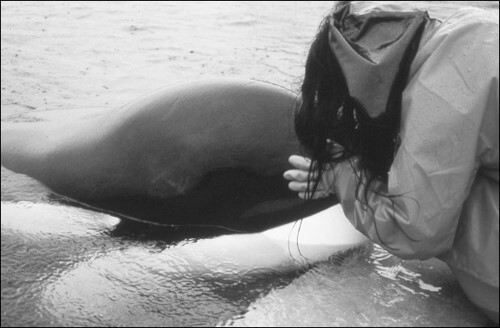
Keiko with his trainer
Of Orcas and Men is one of the most interesting non-fiction books on the market. I think the author did a satisfactory job with the book. I'll touch upon some of the things he missed.
Like humans, orcas possess a high amount of ruthlessness. They like to slap seals and stingrays for no other reason than because they can. A badass pair of orcas in South Africa has been killing great white sharks and eating their livers like it's going out of fashion. It's no wonder these aquatic assassins are known as Orcinus Orca, which comes from the Latin word 'Orcinus' meaning 'kingdom of the dead.'
Orcas live in matriarchal societies. Females go through menopause. Yes, you read it correctly. That's how I justify the species' questionable behavior. THE ORCA DIDN'T MEAN TO BITCH SLAP THAT STINGRAY; SHE WAS JUST MENOPAUSAL.
Different ecotypes never socialize, nor do they interbreed. Southern Residents, the best-studied orca ecotype in the world, share their home waters with the Transients. They inhabit the waters of Washington, Oregon, Northern California, and British Columbia.
The two groups are the oceanic equivalent of the Montagues and Capulets. The fish-eating fun-loving Southern Residents can't stand the stealthy, hardcore mammal-eating Transients. Would you still talk to your neighbors if you witnessed them chowing down on a baby seal or humpback calf?
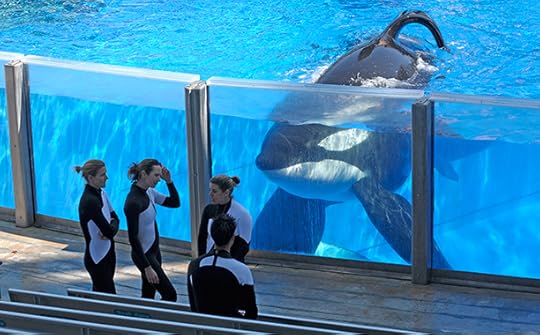
Tilikum at Seaworld Orlando
Keiko, the friendly Icelandic star of Free Willy, captured the hearts of millions of viewers across the world.
Tilikum, the tragic subject of the Blackfish documentary, killed two trainers and a trespasser. (I've written about him in my review for Death at SeaWorld: Shamu and the Dark Side of Killer Whales in Captivity)
Shamu was a member of the J Pod. Her mother was harpooned and killed in front of her. Shamu's name was immortalized in 1965 when she arrived at Seaworld San Diego. The young Southern Resident died in 1971, but her name lives.
J2 Granny was the most legendary orca of the Pacific Northwest. She was the ultimate matriarch and the unofficial queen of the entire Southern Resident community. The iconic matriarch died in 2016. Scientists estimate Granny was between 80 and 105 years old. Granny's surviving family includes great-granddaughters Hy'Shqa and Suttles, great-grandson Se-Yi'-Chn, great-great-grandson T'ilem I'nges, and great-great-granddaughter Sxwyeqólh.
J35 Tahlequah, daughter of J17 Princess Angeline and member of the J pod of the Southern Resident orcas, made worldwide headlines when she was spotted carrying her dead calf for 17 days. The female calf died a few hours after delivery. The grieving mother refused to let go of her baby.
Corky, Seaworld's oldest orca, will never be reunited with her wild Northern Resident relatives - younger sister Ripple, younger brother Fife, niece Midsummer, great-niece Eliot, and great-nephews Fern and Ne'nakw. The A5 pod A23 matriline swims in the deep, cold waters of British Columbia, unaware of Corky's existence. Sweet-tempered Corky, Seaworld's only full-blooded Canadian orca, is often abused by her Icelandic tank mates. She has raised many orphans, including Orkid, Seaworld's smartest orca and the daughter of her nemesis. (I can't get into details, this review is already too long. If you're interested in Corky's story, read my review for Listening to Whales: What the Orcas Have Taught Us)
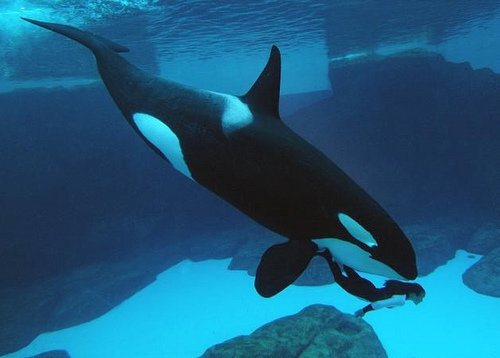
Corky and her trainer at Seaworld San Diego
Luna was born in 1999 in Puget Sound, Washington. He was born into the L pod (Lolita's pod). For reasons unknown, Luna got separated from his pod. He appeared in Nootka Sound, British Columbia, in 2001 when he was only two years old. The lonely young orca actively sought out human companionship. He was often seen playing with people and dogs. The more accustomed Luna became to people, the smaller his chances were of ever reuniting with his family. Researchers wanted to bring him back to his pod. Mowachaht/Muchalaht First Nations saw him as the reincarnation of their former chief. They were against any kind of intervention. Sadly, his life was cut short when he was accidentally struck by a boat propeller. He was six years old. (There's a documentary about Luna called The Whale, made in 2011, produced and narrated by Ryan Reynolds)
Lolita, the lonely, sweet-natured Southern Resident, still elicits strong emotions 53 years after her violent capture in the waters of Penn Cove; near Puget Sound, Washington State. Lolita, also known as Tokitae and Sk'aliCh'elh-tenaut, has spent over half a century in the smallest orca tank in the world. She will never be reunited with her 95-year-old mother, L25 Ocean Sun. Despite protests by activists, experts, and the Lummi Tribe calling for Lolita's release, she remains imprisoned. Lolita's wild older sister Tsunami died in 1982. Pacific Northwest's favorite celebrities – the J, L, and K pods, return to Puget Sound each summer and fall. Ocean Sun, Tahlequah, Shachi, Eclipse, Hy'Shqa, Onyx, and others socialize, play, and feed on Chinook salmon. It's a joyous and emotional occasion for scientists, students, locals, and whale watchers alike. We went from fearing them, shooting at them, capturing their babies, to worshipping them. Humans are truly bizarre creatures. What do the whales think of us?
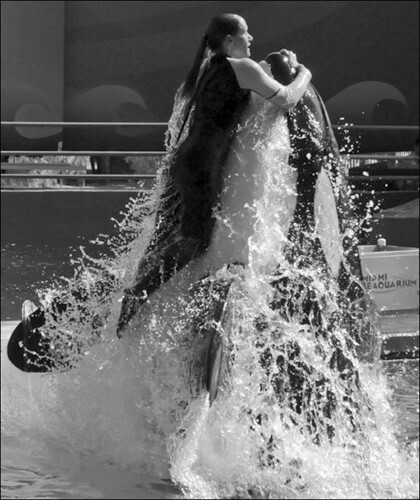
Lolita with one of her trainers
On our second visit to Sea World, we bought tickets for Fiona and her mom to go to the exclusive “Dine With Shamu” luncheon, where trainers bring whales up close to the tables where you’re noshing and give you a good look. The whale Fiona got to see up close was none other than Corky. I asked her afterward if she was excited to meet Corky up that close. She seemed noncommittal. Her mom told me that she seemed more taken aback than anything. “There was something disturbing about it,” she said.
Later that summer, we had our close encounter with orcas in the wild. That evening in camp, I asked Fiona if she had thought about those orcas at Sea World after seeing these in the wild. She said she had. I asked what her thoughts were. She paused for only a moment.
“They should let them go,” she said. Even a three-year-old could see it.
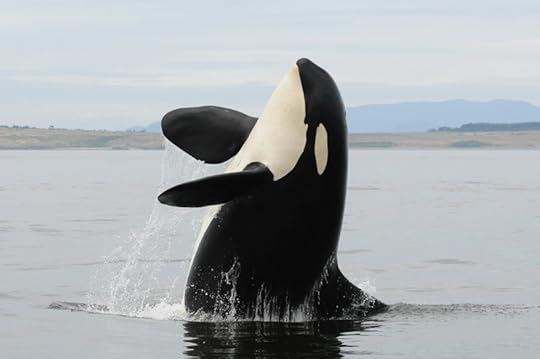
Lolita's mom, L25 Ocean Sun, oldest Southern Resident orca
I have to give a shout-out to my girl, Springer. A73 Springer is the only orca to be successfully rehabilitated back into the wild. However, she was under human care for only a short period. Springer was first spotted as a calf in January 2002 in Washington's Puget Sound, miles and miles from her home waters. She was riddled with disease and emaciated. Scientists identified her by examining her vocal calls and eye patch. They discovered she was the daughter of A45 Sutlej. Sutlej was a Northern Resident and member of one of the most famous killer whale families in British Columbia. Sutlej was the daughter of A24 Kelsey and A6 Strider and the granddaughter of A30 Tsitika (on her father's side).
It is believed Sutlej died, thus leaving her little daughter orphaned and alone. Springer wandered around Puget Sound, often coming dangerously close to boats. After much debate, it was decided she was to be captured, rehabilitated, and relocated back home to British Columbia. She was carefully captured and moved to a sea pen in Manchester, Washington. There, she began her month-long rehabilitation process. The staff was careful to keep their presence to a bare minimum. Live salmon was injected with medication and released into her pen through a slide. They devised creative ways to keep her entertained, which would not include human interaction. Once she regained her health, they transported her to Johnstone Strait, British Columbia.
Her release was carefully timed with the arrival of her mother's pod. When her extended family approached her pen, Springer began making loud vocalizations. When she was released, she took off with a live fish in her mouth, presumably to share with her relatives. At first, she was timid, trailing behind the pod. Not long after, she was accepted into the pod. A few years ago, Springer formed her own pod, which consists of her and her two children, Spirit and Storm. This year marked the 21st anniversary of her successful release.
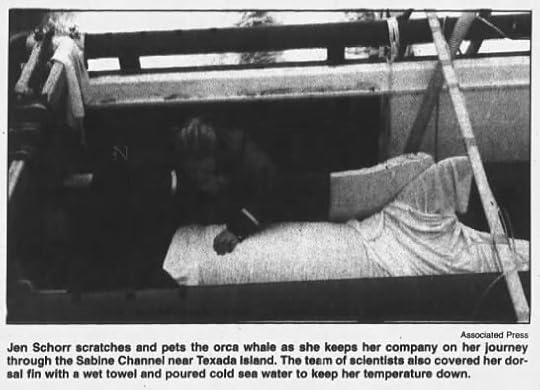
A73 Springer's rescue
At Miami Seaquarium, they’re self-assured that they are doing the right thing for Lolita. Certainly, they deserve credit for having maintained her health well for all these years, although the whale herself also deserves much of the credit for that, too. Nearly everyone who comes in contact with her comes away impressed with her immense internal strength and patience. I was deeply moved by the mutual affection she clearly shared with her trainers.
Still, it’s unlikely a child will watch a Lolita show, a glitzy affair with leaping dolphins and Lolita’s playful stunts, and come away knowing much relevant about the animal beyond basic physiology. Even the Seaquarium’s public-relations director admits the show won’t tell kids where Lolita comes from, what life for orcas is like in the wild, what threats face her native L pod. Nothing they will have gleaned from the show would contribute to understanding the conservation issues orcas represent. But then, these are the kinds of facts that prompt children to ask uncomfortable questions like, “Why isn’t Lolita with her family, Mommy?”
P.S. The new owners of the Miami Seaquarium are willing to release Lolita! If all goes well, Lolita will be relocated to a sea sanctuary in her home waters of Washington's Puget Sound. The project is still in its infancy. Lolita's tank mate Hugo died from a brain aneurysm in 1980 after repeatedly slamming his head against the wall of their tank. There's still hope for Lolita.
The orcas were well known to the Native Americans who occupied the Northwest Coast. They shared these waters and the fish that swam in them. Harming orcas was universally taboo for these people. While many of these tribes avidly hunted humpback and fin whales, it was considered bad medicine to injure or kill a “blackfish,” who at the least was a harbinger of plentiful fish and often much more. It was widely believed that if one killed an orca, its family would wreak vengeance on you and your kinsmen the next time you took to the water. Orcas were not mere beasts, but the people who lived under the sea.
Most of these tribesmen believed in a realm parallel to ours occupied by spirits, many of whom were people who lived in spirit villages rather resembling the natives’ own large cedar dwellings. Foremost among these spirits were the killer whale people, whose powers were immense and far-reaching. This was why so many tribes claimed the killer whales as their spiritual totem and carved the creature’s likeness into their totem poles and family crests. According to the myths of the Kwakwaka’wakw tribes of northern Vancouver Island, the first men were killer whales who came to shore, transformed into land creatures, and then forgot to go back. Some of their tribal elders claimed direct descent from killer whale tribes. Their word for killer whale, Max’inuxw, means “the ones who hunt.” In this mythology, the killer whale is the lord of the underwater realm. His house can be reached by four days’ journey out to the open sea, and his village is at the head of a long narrow inlet.
“Our people have a great respect for the whales, because our belief is that they are our ancestors. They come and visit us, usually, at the beginning of a potlatch, if the family is descended from the whales, the Max’inuxw, the killer whale. Also, it’s a dance in the potlatch. Living on the island, they don’t show up every day, but when they do show up, we’re like tourists, too. We’re excited to see the ancestors. And when you see the dorsal fins, when the big dorsal fin comes out, and we know how old they are? It is just exciting to see, because it’s so massive. And there’s usually a pod—there’s usually not just one whale. So you see a whole family of whales, and it just makes you all excited.”
Keiko with his trainer
Of Orcas and Men is one of the most interesting non-fiction books on the market. I think the author did a satisfactory job with the book. I'll touch upon some of the things he missed.
Like humans, orcas possess a high amount of ruthlessness. They like to slap seals and stingrays for no other reason than because they can. A badass pair of orcas in South Africa has been killing great white sharks and eating their livers like it's going out of fashion. It's no wonder these aquatic assassins are known as Orcinus Orca, which comes from the Latin word 'Orcinus' meaning 'kingdom of the dead.'
Orcas live in matriarchal societies. Females go through menopause. Yes, you read it correctly. That's how I justify the species' questionable behavior. THE ORCA DIDN'T MEAN TO BITCH SLAP THAT STINGRAY; SHE WAS JUST MENOPAUSAL.
Different ecotypes never socialize, nor do they interbreed. Southern Residents, the best-studied orca ecotype in the world, share their home waters with the Transients. They inhabit the waters of Washington, Oregon, Northern California, and British Columbia.
The two groups are the oceanic equivalent of the Montagues and Capulets. The fish-eating fun-loving Southern Residents can't stand the stealthy, hardcore mammal-eating Transients. Would you still talk to your neighbors if you witnessed them chowing down on a baby seal or humpback calf?
Tilikum at Seaworld Orlando
Keiko, the friendly Icelandic star of Free Willy, captured the hearts of millions of viewers across the world.
Tilikum, the tragic subject of the Blackfish documentary, killed two trainers and a trespasser. (I've written about him in my review for Death at SeaWorld: Shamu and the Dark Side of Killer Whales in Captivity)
Shamu was a member of the J Pod. Her mother was harpooned and killed in front of her. Shamu's name was immortalized in 1965 when she arrived at Seaworld San Diego. The young Southern Resident died in 1971, but her name lives.
J2 Granny was the most legendary orca of the Pacific Northwest. She was the ultimate matriarch and the unofficial queen of the entire Southern Resident community. The iconic matriarch died in 2016. Scientists estimate Granny was between 80 and 105 years old. Granny's surviving family includes great-granddaughters Hy'Shqa and Suttles, great-grandson Se-Yi'-Chn, great-great-grandson T'ilem I'nges, and great-great-granddaughter Sxwyeqólh.
J35 Tahlequah, daughter of J17 Princess Angeline and member of the J pod of the Southern Resident orcas, made worldwide headlines when she was spotted carrying her dead calf for 17 days. The female calf died a few hours after delivery. The grieving mother refused to let go of her baby.
Corky, Seaworld's oldest orca, will never be reunited with her wild Northern Resident relatives - younger sister Ripple, younger brother Fife, niece Midsummer, great-niece Eliot, and great-nephews Fern and Ne'nakw. The A5 pod A23 matriline swims in the deep, cold waters of British Columbia, unaware of Corky's existence. Sweet-tempered Corky, Seaworld's only full-blooded Canadian orca, is often abused by her Icelandic tank mates. She has raised many orphans, including Orkid, Seaworld's smartest orca and the daughter of her nemesis. (I can't get into details, this review is already too long. If you're interested in Corky's story, read my review for Listening to Whales: What the Orcas Have Taught Us)
Corky and her trainer at Seaworld San Diego
Luna was born in 1999 in Puget Sound, Washington. He was born into the L pod (Lolita's pod). For reasons unknown, Luna got separated from his pod. He appeared in Nootka Sound, British Columbia, in 2001 when he was only two years old. The lonely young orca actively sought out human companionship. He was often seen playing with people and dogs. The more accustomed Luna became to people, the smaller his chances were of ever reuniting with his family. Researchers wanted to bring him back to his pod. Mowachaht/Muchalaht First Nations saw him as the reincarnation of their former chief. They were against any kind of intervention. Sadly, his life was cut short when he was accidentally struck by a boat propeller. He was six years old. (There's a documentary about Luna called The Whale, made in 2011, produced and narrated by Ryan Reynolds)
Lolita, the lonely, sweet-natured Southern Resident, still elicits strong emotions 53 years after her violent capture in the waters of Penn Cove; near Puget Sound, Washington State. Lolita, also known as Tokitae and Sk'aliCh'elh-tenaut, has spent over half a century in the smallest orca tank in the world. She will never be reunited with her 95-year-old mother, L25 Ocean Sun. Despite protests by activists, experts, and the Lummi Tribe calling for Lolita's release, she remains imprisoned. Lolita's wild older sister Tsunami died in 1982. Pacific Northwest's favorite celebrities – the J, L, and K pods, return to Puget Sound each summer and fall. Ocean Sun, Tahlequah, Shachi, Eclipse, Hy'Shqa, Onyx, and others socialize, play, and feed on Chinook salmon. It's a joyous and emotional occasion for scientists, students, locals, and whale watchers alike. We went from fearing them, shooting at them, capturing their babies, to worshipping them. Humans are truly bizarre creatures. What do the whales think of us?
Lolita with one of her trainers
On our second visit to Sea World, we bought tickets for Fiona and her mom to go to the exclusive “Dine With Shamu” luncheon, where trainers bring whales up close to the tables where you’re noshing and give you a good look. The whale Fiona got to see up close was none other than Corky. I asked her afterward if she was excited to meet Corky up that close. She seemed noncommittal. Her mom told me that she seemed more taken aback than anything. “There was something disturbing about it,” she said.
Later that summer, we had our close encounter with orcas in the wild. That evening in camp, I asked Fiona if she had thought about those orcas at Sea World after seeing these in the wild. She said she had. I asked what her thoughts were. She paused for only a moment.
“They should let them go,” she said. Even a three-year-old could see it.
Lolita's mom, L25 Ocean Sun, oldest Southern Resident orca
I have to give a shout-out to my girl, Springer. A73 Springer is the only orca to be successfully rehabilitated back into the wild. However, she was under human care for only a short period. Springer was first spotted as a calf in January 2002 in Washington's Puget Sound, miles and miles from her home waters. She was riddled with disease and emaciated. Scientists identified her by examining her vocal calls and eye patch. They discovered she was the daughter of A45 Sutlej. Sutlej was a Northern Resident and member of one of the most famous killer whale families in British Columbia. Sutlej was the daughter of A24 Kelsey and A6 Strider and the granddaughter of A30 Tsitika (on her father's side).
It is believed Sutlej died, thus leaving her little daughter orphaned and alone. Springer wandered around Puget Sound, often coming dangerously close to boats. After much debate, it was decided she was to be captured, rehabilitated, and relocated back home to British Columbia. She was carefully captured and moved to a sea pen in Manchester, Washington. There, she began her month-long rehabilitation process. The staff was careful to keep their presence to a bare minimum. Live salmon was injected with medication and released into her pen through a slide. They devised creative ways to keep her entertained, which would not include human interaction. Once she regained her health, they transported her to Johnstone Strait, British Columbia.
Her release was carefully timed with the arrival of her mother's pod. When her extended family approached her pen, Springer began making loud vocalizations. When she was released, she took off with a live fish in her mouth, presumably to share with her relatives. At first, she was timid, trailing behind the pod. Not long after, she was accepted into the pod. A few years ago, Springer formed her own pod, which consists of her and her two children, Spirit and Storm. This year marked the 21st anniversary of her successful release.
A73 Springer's rescue
At Miami Seaquarium, they’re self-assured that they are doing the right thing for Lolita. Certainly, they deserve credit for having maintained her health well for all these years, although the whale herself also deserves much of the credit for that, too. Nearly everyone who comes in contact with her comes away impressed with her immense internal strength and patience. I was deeply moved by the mutual affection she clearly shared with her trainers.
Still, it’s unlikely a child will watch a Lolita show, a glitzy affair with leaping dolphins and Lolita’s playful stunts, and come away knowing much relevant about the animal beyond basic physiology. Even the Seaquarium’s public-relations director admits the show won’t tell kids where Lolita comes from, what life for orcas is like in the wild, what threats face her native L pod. Nothing they will have gleaned from the show would contribute to understanding the conservation issues orcas represent. But then, these are the kinds of facts that prompt children to ask uncomfortable questions like, “Why isn’t Lolita with her family, Mommy?”
P.S. The new owners of the Miami Seaquarium are willing to release Lolita! If all goes well, Lolita will be relocated to a sea sanctuary in her home waters of Washington's Puget Sound. The project is still in its infancy. Lolita's tank mate Hugo died from a brain aneurysm in 1980 after repeatedly slamming his head against the wall of their tank. There's still hope for Lolita.
March 12, 2021
A well-written overview of human-orca relations. I think it's still worth a read even if someone has already read other books about orcas. It could use better editing though (the author repeats and contradicts himself a lot, and that was my only problem with the book and the reason I gave it 4 stars).
As my recommendations go, I still find Orca: The Whale Called Killer (2019 edition) to be the #1 book about orcas - not only is it beautifully written but also the most up-to-date and comprehensive one. Into Great Silence, Listening to Whales, The Lost Whale, and The Killer Whale Who Changed the World are also excellent.
As my recommendations go, I still find Orca: The Whale Called Killer (2019 edition) to be the #1 book about orcas - not only is it beautifully written but also the most up-to-date and comprehensive one. Into Great Silence, Listening to Whales, The Lost Whale, and The Killer Whale Who Changed the World are also excellent.

August 10, 2015
This is the best nonfiction book I have read this year, and one of the best I have read in quite some time.
The author obviously has a great appreciation and love for orcas, and his personal anecdotes of various encounters he has had with them add a great deal to his book. There are also fascinating chapters about orca evolution and retellings of Native myths about the animals. Killer whale intelligence and possible sapience is discussed, along with their incredibly close social structure and the fact that they really do have another sense (echolocation) that humans cannot comprehend.
Unfortunately, a great deal of this book is terribly depressing. Neiwert makes a convincing case that these majestic animals should not be in captivity at all, and the way various marine parks (cough *SeaWorld* cough) treat them is tantamount to the deliberate torture of an intelligent species. (For instance, the calves are routinely separated from their mothers when they are a year old, when in the wild calves stay with their mothers and their pod their entire lives.) Orcas in captivity also do not live as long as those in the wild, despite SeaWorld's blatantly false assertions to the contrary. (Yes, I have seen the movie Blackfish, and my heart goes out to the whale profiled in the film, Tilikum. In my opinion, his captivity has left him psychotic, and that's why he killed three people, including his trainer Dawn Brancheau.) In the wild, killer whales swim up to a hundred miles a day; confining them to tanks, even million-gallon ones, is equivalent to confining a human to a bathtub. For life. Orcas never attack people outside of captivity, or each other; their highly social, cooperative natures forbid it.
There are also chapters on the people who have devoted their lives to studying these animals, and attempting to preserve their numbers, in particular the declining Southern Resident population. The possibility of returning some captive orcas to the wild is discussed, focusing on the story of Keiko, the whale featured in the movie Free Willy. All of it is very well done--the book reads like a novel--and all of it, at least to me, is fascinating. Be prepared to be pissed, though, especially at SeaWorld. I for one will never darken their doors again.
The author obviously has a great appreciation and love for orcas, and his personal anecdotes of various encounters he has had with them add a great deal to his book. There are also fascinating chapters about orca evolution and retellings of Native myths about the animals. Killer whale intelligence and possible sapience is discussed, along with their incredibly close social structure and the fact that they really do have another sense (echolocation) that humans cannot comprehend.
Unfortunately, a great deal of this book is terribly depressing. Neiwert makes a convincing case that these majestic animals should not be in captivity at all, and the way various marine parks (cough *SeaWorld* cough) treat them is tantamount to the deliberate torture of an intelligent species. (For instance, the calves are routinely separated from their mothers when they are a year old, when in the wild calves stay with their mothers and their pod their entire lives.) Orcas in captivity also do not live as long as those in the wild, despite SeaWorld's blatantly false assertions to the contrary. (Yes, I have seen the movie Blackfish, and my heart goes out to the whale profiled in the film, Tilikum. In my opinion, his captivity has left him psychotic, and that's why he killed three people, including his trainer Dawn Brancheau.) In the wild, killer whales swim up to a hundred miles a day; confining them to tanks, even million-gallon ones, is equivalent to confining a human to a bathtub. For life. Orcas never attack people outside of captivity, or each other; their highly social, cooperative natures forbid it.
There are also chapters on the people who have devoted their lives to studying these animals, and attempting to preserve their numbers, in particular the declining Southern Resident population. The possibility of returning some captive orcas to the wild is discussed, focusing on the story of Keiko, the whale featured in the movie Free Willy. All of it is very well done--the book reads like a novel--and all of it, at least to me, is fascinating. Be prepared to be pissed, though, especially at SeaWorld. I for one will never darken their doors again.
April 23, 2015
Of Orcas and Men: What Killer Whales Can Teach Us by David Neiwert grabbed my attention on the first page and held it throughout the book. Although the author works as an investigative journalist in Seattle, he has had 25 years experience observing orcas in the wild. His interest in and respect for the whales is evident throughout his writing.
This is a nonfiction book but at times almost has the feel of fiction. The author sprinkles in many interesting personal anecdotes describing his encounters with orcas in the wild. They add a certain richness to the text. Also included are stories passed down from generation to generation from the native tribes living in the northwest section of the US and parts of Canada who live near the water where many of the orcas he has studied tend to visit.
I found the section on orca communication particularly interesting. The scientists who are studying these animals (both in captivity and in the wild) are learning more and more about the way orcas communicate and are finding evidence of a more sophisticated language than they had previously thought. In several different areas of study, David Neiwert was able to interview and consult with experts in the field and get the latest scientific information for his book. Many new intriguing developments about the way orcas brains work, their strong social capabilities, and the possibilities of freeing some captive whales (or at least moving them to more humane sea pens) were all elaborated on in the book.
Having recently read John Hargrove's Beneath the Surface: Killer Whales, SeaWorld, and the Truth Beyond Blackfish, I feel that the two work well as companion books. John Hargrove's book addresses many of the untold stories of captive orcas, and David Neiwert's book tells the story of orcas in the wild - the history of their relationship with humans, the science to help you understand the whales better, and the dangers they now face due to pollution, etc. and what people can do to help.
I definitely recommend this book.
I received this book for free through Goodreads First Reads in exchange for an honest review.
This is a nonfiction book but at times almost has the feel of fiction. The author sprinkles in many interesting personal anecdotes describing his encounters with orcas in the wild. They add a certain richness to the text. Also included are stories passed down from generation to generation from the native tribes living in the northwest section of the US and parts of Canada who live near the water where many of the orcas he has studied tend to visit.
I found the section on orca communication particularly interesting. The scientists who are studying these animals (both in captivity and in the wild) are learning more and more about the way orcas communicate and are finding evidence of a more sophisticated language than they had previously thought. In several different areas of study, David Neiwert was able to interview and consult with experts in the field and get the latest scientific information for his book. Many new intriguing developments about the way orcas brains work, their strong social capabilities, and the possibilities of freeing some captive whales (or at least moving them to more humane sea pens) were all elaborated on in the book.
Having recently read John Hargrove's Beneath the Surface: Killer Whales, SeaWorld, and the Truth Beyond Blackfish, I feel that the two work well as companion books. John Hargrove's book addresses many of the untold stories of captive orcas, and David Neiwert's book tells the story of orcas in the wild - the history of their relationship with humans, the science to help you understand the whales better, and the dangers they now face due to pollution, etc. and what people can do to help.
I definitely recommend this book.
I received this book for free through Goodreads First Reads in exchange for an honest review.

November 3, 2017
Intelligence is not a trait solely linked to humans, it is present across the whole animal kingdom. Some of the mammals with the highest intellect are the cetaceans, in particular dolphins and Killer Whales. Better known as the Orca, these beautiful creatures have been tormented and persecuted by us for a long time, but things are changing as we learn more about their amazing abilities. It was known that they travel around in small family pods, but it has only recently been discovered that there are several sub-species of orca. Each of these sub-species has developed their own language and culture, have astonishing echolocation and form lifelong bonds.
In the wild they are ruthless hunters, they have developed sophisticated hunting techniques for a particular prey. For example orca in one part of the world will eat fish, they have a penchant for salmon and in other parts of the wild, they hunt seals, seabirds and even moose. Yet they are gentle and kind with there being almost no known incidents of people being killed in the wild. There have been a few deaths, but these have happened in places where they have been held captive. There is a large chapter on those orcas that have been taken from the wild and held in captivity; holding a creature as magnificent as this in a concrete tank is equally cruel and unnecessary.
This is a fascinating book on these awesome creatures. Neiwert clearly explains the latest research and explores the myths and legends associated with them, as well as information on the perilous state that they are in because of our scant concern for the environment. There are some heart-stopping and wondrous moments he has experienced with them whilst bobbing around in his kayak in the ocean near his home. It is a thoroughly enjoyable book on these stunning whales.
In the wild they are ruthless hunters, they have developed sophisticated hunting techniques for a particular prey. For example orca in one part of the world will eat fish, they have a penchant for salmon and in other parts of the wild, they hunt seals, seabirds and even moose. Yet they are gentle and kind with there being almost no known incidents of people being killed in the wild. There have been a few deaths, but these have happened in places where they have been held captive. There is a large chapter on those orcas that have been taken from the wild and held in captivity; holding a creature as magnificent as this in a concrete tank is equally cruel and unnecessary.
This is a fascinating book on these awesome creatures. Neiwert clearly explains the latest research and explores the myths and legends associated with them, as well as information on the perilous state that they are in because of our scant concern for the environment. There are some heart-stopping and wondrous moments he has experienced with them whilst bobbing around in his kayak in the ocean near his home. It is a thoroughly enjoyable book on these stunning whales.

June 3, 2017
Your rating of this book probably varies pretty significantly based on what you're expecting from it. I guess that's true of every book, but what I mean is, looking at the reviews here, some people seem pretty content just to have some orca content, others really connected to the more activist portions, and others seemed a little bored by the bigger discussions of the ecosystem/salmon/environmental factors.
I'm not sure what I wanted from the book at the start, but I think it only intermittently delivered. The 1st two chapters focus a lot on the social lives and behaviors of orcas, and I found a lot of that pretty fascinating. Most of the second half of the book is a sharp critique of Sea World and other marine parks that keep whales in captivity, and while a lot of this is important well done, it does get very repetitive. Actually, the book in general has a tendency toward repetitiveness (i.e., every time Bigg's Whales are mentioned, the author spends a paragraph reminding you how they got that name and how Bigg was and so on).
Anyway. Orcas are cool, and this book is well-researched and reported.
I'm not sure what I wanted from the book at the start, but I think it only intermittently delivered. The 1st two chapters focus a lot on the social lives and behaviors of orcas, and I found a lot of that pretty fascinating. Most of the second half of the book is a sharp critique of Sea World and other marine parks that keep whales in captivity, and while a lot of this is important well done, it does get very repetitive. Actually, the book in general has a tendency toward repetitiveness (i.e., every time Bigg's Whales are mentioned, the author spends a paragraph reminding you how they got that name and how Bigg was and so on).
Anyway. Orcas are cool, and this book is well-researched and reported.

February 5, 2016
Neiwert provides a clear, well researched overview of these beautiful creatures we call orcas. His book examines the changing societal views towards these creatures, and presents the traditional and sacred place the orcas hold in many Aboriginal cultures. This book also tackles the issue of captivity and the terrible injustices suffered by these sentient beings. Neiwert tackles the three main obstacles which the endangered SRP faces and provokes the reader to contemplate "How can I make this world better, not only for these creatures, but for all creatures?". I learned a great deal from this book and highly recommend it to anyone who is even the least bit interested in orcas.

December 27, 2015
This is a must read for denizens of the Pacific Northwest! The Southern Residents most likely depend on Columbia River Chinook salmon runs, so these are also Oregon's whales along with Washington and BC.
"Then, one of the few universal behaviors that they have is that they do not harm humans. They are unique among apex predators that way. So it's clear that even though they are capable of extreme forms of aggression-just ask their prey-the prevailing ethos of their culture keeps them from harming each other and from harming other life forms they choose not to eat. It's actually a remarkable display of discipline and intelligence. And to note that humans could learn from that is probably an understatement."
"Then, one of the few universal behaviors that they have is that they do not harm humans. They are unique among apex predators that way. So it's clear that even though they are capable of extreme forms of aggression-just ask their prey-the prevailing ethos of their culture keeps them from harming each other and from harming other life forms they choose not to eat. It's actually a remarkable display of discipline and intelligence. And to note that humans could learn from that is probably an understatement."

September 12, 2015
GUYS. BUT LIKE ORCAS.

June 25, 2015
This is ultimately a very sad book. It is filled with information about the magnificent Orcas or "killer whales" but it also contains many tales of tragedy for the animal when there is an encounter with humans. Orcas have a highly developed social structure. They are intelligent. They communicate with members of their families, or pods, in a mysterious cetacean language that we are yet unable to decode. Although they look magnificently invulnerable they are threatened by the sharp decrease in salmon which sustains them, pollution of their home waters and ship engines that emit loud noises that interfere with hunting. The population of orcas that inhabits the area encompassing Puget Sound has yet to recover thirty years after Sea World last captured them in the wild. They may never recover. Don't patronize "Sea World" or any organization that keeps captive orcas to perform for the public. It is cruel and unusual punishment for these wonderful creatures.

Read
June 3, 2017DNF page 67.
Wasn't a bad book but was not what I was looking for
Wasn't a bad book but was not what I was looking for

June 27, 2019
Another 3-3.5*.
RTC!
RTC!

March 20, 2026
Growing up just off the Hood Canal, I used to see orcas swimming by all the time. It didn't occur to me until I was much older how much of a gift that was. Now living more on the Puget Sound, I have been blessed with seeing Orcas a few more times (one time I was on the ferry coming home from Seattle and it was absolutely magical).
This book opened my eyes to the true history of Killer whales in the PNW. I am lucky that the elementary school I went to really emphasized the fact that we lived and learned on native land. Native American culture is very prominent across the community. That being said, I never really grasped how sacred killer whales really are to Native PNW history. I really appreciated Neiwert throughout the book reminding me, as the reader, how these beautiful creatures are connected to the people of this area.
Not to harp on the fact that I live in the PNW but it is hard to grow up here without learning of the brutal captures of killer whales in the 1960s and 70s. Specifically the Penn Cove captures of 1970. This book continues to mention this brutality which I think was necessary when speaking on Orcas and subsequently orcas in captivity. This book was published in 2013 which lends to some out of date information (I will get to Tokitae later). However, it's important (and amazing) to share that after 50 years, in 2024, the L-Pod returned to Penn Cove. This was an area that has not been visited by the southern residents since the captures and deaths in 1970.
Back to the actual book review: Like I said, it's impossible to talk about Orcas without touching on Orcas in captivity. The first half of the book really dives into the history of orcas and their connection to the native people. As well as the areas of the PNW they most frequent. The second half of the book feels as though it spirals into a tell all about Sea World. I am not saying this is a bad thing, but the narrative started to feel repetitive. It felt less informative and more so a call to action. Again, not necessarily a bad thing, I just wasn't expecting it. This did make it harder for me to get through the back end of this book.
As I promised, I wanted to give some into on Tokitae (Lolita). Lolita was the last orca in captivity from the PNW captures. She was only 4 years old and taken from the L-Pod (the pod that finally returned to Penn Cove in 2024). She spent her life in the Miami Seaquarium performing in an uninhabitable tank. She was retired in 2022 and after much work from activists and non profits, it was decided in March of 2023 that we would be released from captivity back to her home waters in Washington state within 24 months. However, in August of 2023 she passed away from illnesses common in captured whales. Lolita lived to be 57. For reference, the oldest living killer whale from the same Penn Cove captures is L25 (Ocean Sun) at 98 years old. She is the last surviving Southern Resident who escaped from the Penn Cove atrocities.
This book lead me to dive deeper into the lives and wellbeing of Killer Whales in the PNW. While I don't think this book would be the best place to gain all knowledge of these animals, I think it is a great place to start.
This book opened my eyes to the true history of Killer whales in the PNW. I am lucky that the elementary school I went to really emphasized the fact that we lived and learned on native land. Native American culture is very prominent across the community. That being said, I never really grasped how sacred killer whales really are to Native PNW history. I really appreciated Neiwert throughout the book reminding me, as the reader, how these beautiful creatures are connected to the people of this area.
Not to harp on the fact that I live in the PNW but it is hard to grow up here without learning of the brutal captures of killer whales in the 1960s and 70s. Specifically the Penn Cove captures of 1970. This book continues to mention this brutality which I think was necessary when speaking on Orcas and subsequently orcas in captivity. This book was published in 2013 which lends to some out of date information (I will get to Tokitae later). However, it's important (and amazing) to share that after 50 years, in 2024, the L-Pod returned to Penn Cove. This was an area that has not been visited by the southern residents since the captures and deaths in 1970.
Back to the actual book review: Like I said, it's impossible to talk about Orcas without touching on Orcas in captivity. The first half of the book really dives into the history of orcas and their connection to the native people. As well as the areas of the PNW they most frequent. The second half of the book feels as though it spirals into a tell all about Sea World. I am not saying this is a bad thing, but the narrative started to feel repetitive. It felt less informative and more so a call to action. Again, not necessarily a bad thing, I just wasn't expecting it. This did make it harder for me to get through the back end of this book.
As I promised, I wanted to give some into on Tokitae (Lolita). Lolita was the last orca in captivity from the PNW captures. She was only 4 years old and taken from the L-Pod (the pod that finally returned to Penn Cove in 2024). She spent her life in the Miami Seaquarium performing in an uninhabitable tank. She was retired in 2022 and after much work from activists and non profits, it was decided in March of 2023 that we would be released from captivity back to her home waters in Washington state within 24 months. However, in August of 2023 she passed away from illnesses common in captured whales. Lolita lived to be 57. For reference, the oldest living killer whale from the same Penn Cove captures is L25 (Ocean Sun) at 98 years old. She is the last surviving Southern Resident who escaped from the Penn Cove atrocities.
This book lead me to dive deeper into the lives and wellbeing of Killer Whales in the PNW. While I don't think this book would be the best place to gain all knowledge of these animals, I think it is a great place to start.

February 6, 2025
This was a LONG audiobook and some chapters I wouldn’t have been able to get through without my long commute! But then some chapters were so beautiful like the native legends about orcas, their intelligence, culture and subspecies was sooooo freakin cool as was the content related to captivity & attempts to return to wild. Orcas truly might be my favorite animal & this book only added to that but it was DENSE & some chapters about salmon I was like okay, I got it, but overall, very interesting and really cool thoughts!

December 19, 2018
This book definitely emerged on the coattails of the Blackfish documentary a few years ago- which is so damn good and which made an orca media frenzy. But just because it emerges as a result of that frenzy doesn’t mean it’s not worth reading. There’s a LOT of material here and a lot of it I haven’t encountered before. It’s well-researched and well put together. And I was pleased to see a mention of Steven Wise, a/k/a THE KING. No book which touches on the potential legal personhood of animals is complete with the wisdom of Wise.
Some of my favourite facts:
>> Some people consider orcas to be, intelligence-wise, just bigger versions of dolphins. But dolphin sounds, while they probably have some meaning, aren’t necessarily full-on conversations. They often chatter willy-nilly with little regard to one another. Meanwhile, orcas are “generally more polite.” They wait for other orcas to stop speaking before making their own sounds—possibly suggesting it’s a real conversation.
>> Sonar language might show more than we’re capable of seeing or conceptualizing. It might, for example, allow other orcas to see and feel what the sonar-speaking orca is seeing and feeling. The lines of identity for orca might be blurred between individual pod. In other words, a pod might be “one individual” in a sense, which would explain the fact that they have such ridiculously developed empathic centers in their brain (more than humans). Maybe they aren’t just sympathizing with pod-members; maybe they really do feel as they do in a way humans can't comprehend.
>> We might call orcas inferior—after all, even the smartest orca only understands about 50 English words. . . . But of course, no human knows how to speak even one word of orca, so what does that say about us?
Basically, if we’re going to define “intelligence” as “being like a human,” then obviously the human will come out on top. But if we define intelligence as, say, extreme empathy and the ability to use sonar language to interact with your environment and communicate with other beings, humans start to look pretty stupid compared to orcas.
>> Each pod has a different call. Often when they meet other pods, orcas will mimick the other pod’s call. Not only that, but at other times, when they’re nowhere near these other pods, the orcas might still imitate the other pod’s call. It could mean that the orcas are referring to, or “talking about” these other pods.
>> “Resident orcas used an entirely different set of calls from transients when communicating and used them in entirely different fashions. It was a biologically unusual situation for two populations of the same species to occupy the same waters and to observe completely different behaviors, including diet and communications. The only word for this is culture, and there is only one other species that has exhibited it: human beings.”
>> “These are lifelong bonds and, indeed, appear to be essential to each killer whale’s self-identity. Home, for these whales, is not a place. Their home is each other. This profoundly affects the behavior of the killer whales, because the pod’s well-being is essential to their own.”
>> A whale named Namu (his captive companion would later be named Shamu, of SeaWorld fame— her name is a portmanteau of “she” and “Namu”) had a trainer named Ted Griffin, and the two of them would squeak back and forth at each other. A marine mammal scientist observed this and realized that “You’re not talking like the whale. The whale has entirely changed his vocalization to sound like you.” Griffin said, “I was just thunderstruck . . . one of the biggest shocks that I ever had was that this whale was trying to reach me in this way.”
>> On Keiko, the orca star of the movie Free Willy (with a rather depressing story): “When the crowds left and he was alone at night, he would watch movies on a television his trainers set up for him at one of the windows. Mostly he liked videos of other orcas. His favorite movie—the only one he would watch from beginning to end—was Monty Python and the Holy Grail. He was utterly uninterested in Free Willy.”
Some of my favourite facts:
>> Some people consider orcas to be, intelligence-wise, just bigger versions of dolphins. But dolphin sounds, while they probably have some meaning, aren’t necessarily full-on conversations. They often chatter willy-nilly with little regard to one another. Meanwhile, orcas are “generally more polite.” They wait for other orcas to stop speaking before making their own sounds—possibly suggesting it’s a real conversation.
>> Sonar language might show more than we’re capable of seeing or conceptualizing. It might, for example, allow other orcas to see and feel what the sonar-speaking orca is seeing and feeling. The lines of identity for orca might be blurred between individual pod. In other words, a pod might be “one individual” in a sense, which would explain the fact that they have such ridiculously developed empathic centers in their brain (more than humans). Maybe they aren’t just sympathizing with pod-members; maybe they really do feel as they do in a way humans can't comprehend.
>> We might call orcas inferior—after all, even the smartest orca only understands about 50 English words. . . . But of course, no human knows how to speak even one word of orca, so what does that say about us?
Basically, if we’re going to define “intelligence” as “being like a human,” then obviously the human will come out on top. But if we define intelligence as, say, extreme empathy and the ability to use sonar language to interact with your environment and communicate with other beings, humans start to look pretty stupid compared to orcas.
>> Each pod has a different call. Often when they meet other pods, orcas will mimick the other pod’s call. Not only that, but at other times, when they’re nowhere near these other pods, the orcas might still imitate the other pod’s call. It could mean that the orcas are referring to, or “talking about” these other pods.
>> “Resident orcas used an entirely different set of calls from transients when communicating and used them in entirely different fashions. It was a biologically unusual situation for two populations of the same species to occupy the same waters and to observe completely different behaviors, including diet and communications. The only word for this is culture, and there is only one other species that has exhibited it: human beings.”
>> “These are lifelong bonds and, indeed, appear to be essential to each killer whale’s self-identity. Home, for these whales, is not a place. Their home is each other. This profoundly affects the behavior of the killer whales, because the pod’s well-being is essential to their own.”
>> A whale named Namu (his captive companion would later be named Shamu, of SeaWorld fame— her name is a portmanteau of “she” and “Namu”) had a trainer named Ted Griffin, and the two of them would squeak back and forth at each other. A marine mammal scientist observed this and realized that “You’re not talking like the whale. The whale has entirely changed his vocalization to sound like you.” Griffin said, “I was just thunderstruck . . . one of the biggest shocks that I ever had was that this whale was trying to reach me in this way.”
>> On Keiko, the orca star of the movie Free Willy (with a rather depressing story): “When the crowds left and he was alone at night, he would watch movies on a television his trainers set up for him at one of the windows. Mostly he liked videos of other orcas. His favorite movie—the only one he would watch from beginning to end—was Monty Python and the Holy Grail. He was utterly uninterested in Free Willy.”

June 23, 2015
I remember reading about Namu when I was a child. Namu was the first documented killer whale (orca) captured and displayed for the public. During his short lifespan, Namu helped change public opinion of orcas from that of “the most vicious and intelligent killer in the sea” to “cuddly intelligent beast that only kills when needed to live”. However, neither view truly captures the complexity of this amazing animal, nor was Namu’s tale the beginning of the story of interactions between mankind and orca, nor was it to be the ending …
In his book “Of Orcas and Men: What Killer Whales Can Teach Us”, David Neiwert covers the historical and cultural gamut of encounters between humans and orcas (although heavily weighted towards those in and from Washington and British Columbia). These go back to look at the historic record of the native peoples of those areas, through to the local residents and tourists today – as well as the companies who own aquatic-based theme parks displaying orcas and the employees who work at and tourists who visit those attractions. He also looks at individuals – humans who research the whales, humans who captured and displayed them, and even individual orcas in captivity and in the wild.
The author succeeds in writing a non-fiction narrative that does not have the dry feel of a textbook, drawing the reader in with narratives and anecdotes while also referencing studies and findings based both on wild whales and those in captivity.
Mr. Neiwert strives to write a balanced report, although he makes no effort to disguise his preference that orcas should not be held in captivity, whether captured in the wild or captive-bred. As such, he occasionally falls into the trap of quoting statistics and studies that back his personal opinion as gospel, while pooh-poohing those that disagree with his view. However, unlike some authors, Mr. Neiwert DOES at least make note of these conflicting accounts, rather than ignoring them altogether.
While not perfect, this is a highly recommended read.
RATING: 4.5 stars, rounded down to 4 stars for those sites that cannot handle fractions of a star.
DISCLOSURE: I received this book free of charge from the publisher without obligation, although a fair and unbiased review would be appreciated.
In his book “Of Orcas and Men: What Killer Whales Can Teach Us”, David Neiwert covers the historical and cultural gamut of encounters between humans and orcas (although heavily weighted towards those in and from Washington and British Columbia). These go back to look at the historic record of the native peoples of those areas, through to the local residents and tourists today – as well as the companies who own aquatic-based theme parks displaying orcas and the employees who work at and tourists who visit those attractions. He also looks at individuals – humans who research the whales, humans who captured and displayed them, and even individual orcas in captivity and in the wild.
The author succeeds in writing a non-fiction narrative that does not have the dry feel of a textbook, drawing the reader in with narratives and anecdotes while also referencing studies and findings based both on wild whales and those in captivity.
Mr. Neiwert strives to write a balanced report, although he makes no effort to disguise his preference that orcas should not be held in captivity, whether captured in the wild or captive-bred. As such, he occasionally falls into the trap of quoting statistics and studies that back his personal opinion as gospel, while pooh-poohing those that disagree with his view. However, unlike some authors, Mr. Neiwert DOES at least make note of these conflicting accounts, rather than ignoring them altogether.
While not perfect, this is a highly recommended read.
RATING: 4.5 stars, rounded down to 4 stars for those sites that cannot handle fractions of a star.
DISCLOSURE: I received this book free of charge from the publisher without obligation, although a fair and unbiased review would be appreciated.

March 30, 2016
This book engendered a series of events ultimately leading to a life's peak experience. I was fascinated by the story of Orcas: their double brains, sociability, family ties, habits, limited numbers, abuse at the hand of man to the extent that I wanted to see them in the wild, no sea park. So I started planning a trip to the northwest in the hope of a view of one of the "resident" Orcas, until a month ago when standing in the street talking to a neighbor in Moss Beach, he said "well their are Orcas in Monterey Bay right now!" Quickly turning to the internet I found Monterey Whale Watch, run by a biologist boat captain who has been studying Orcas for 30 years. I joined her all day whale watch journey on Monterey bay a few days later, when we were able to follow a pod of 11 Orcas for 5 hours as they crisscrossed the bay hunting for sea lions and gray whale calves. Go to MWW website to see the result. Extraordinary experience.

August 14, 2015
Inspired by personal sightings near his home in Seattle, Neiwert set out to learn everything he could about orcas. The result is a thorough study of whales’ behavior and interactions with humanity from native mythology through modern-day aquarium shows. Some specialist interest would probably be helpful to those attempting this book, although there are plenty of black-and-white photographs to keep even casual readers interested. “Recovering our humanity may be the real gift of the orcas, what they can teach us. It’s our choice whether to listen.”
See my full review at The Bookbag.
See my full review at The Bookbag.

July 23, 2021
Awesome information passionately shared. a little too much for casual non-marine biologist readers, seems like it didn’t really know which side of that particular fence to be on.

July 4, 2024
I question writing this review as I don’t want to offend anyone, this is just my own opinion .
Our task must be to free ourselves from this prison by widening our circle of compassion to embrace all living creatures. —ALBERT EINSTEIN
Wow this book has left me completely speechless; I love orcas i have always been in awe of their beauty and intelligence. In 2013 I saw the documentary “ Blackfish” and I had a visceral response ; it completely changed my view on zoos, marine parks and aquariums. IMHO it is absolutely cruel to all of these beautiful creatures that are on this earth to be stuck in concrete tanks and cages; I believe they deserve to be free and not used for our entertainment. In saying that I love animal research when it’s done outside of captivity. However I also respect other individuals opinions as well as I don’t want to offend anyone . If this subject triggers you in anyway I would not read this book. It talks about how orcas flourish in the wild , they are gentle , social and intelligent creatures with individual personalities and come from different eco types . It discusses in depth the problems with captivity, the stories of specific whales like Luna, Keiko, Corky and Lolita . It discusses the impact of “ Free Willy” and a couple of success stories of releasing these orcas into the wild. And lastly the most heartbreaking part of this book is the story of Tilikum and the tragic deaths that have occurred . This book is so important it’s done with respect and care towards the orcas as well as the victims . This is a beautiful and very depressing book so read at your own risk. As the author David Neiwert said at the end of the novel “ Recovering our humanity may be the real gift of the orcas, what they can teach us. It’s our choice whether to listen.”
“Orcas, with their big brains, complex social structures, mysterious communications, and mind-boggling sixth sense, by their very existence, challenge the longstanding belief that human beings are the planet’s only intelligent occupants.
Social life for killer whales, as we have seen, is deeper and more omnipresent than it is for humans; their identities are defined by their families and tribal connections; and their empathy is powerful enough to extend to other species.” Pg. 304
“The only times that humans have ever been injured or killed by orcas have occurred in captivity.” Pg. 285
“Not only are they prevented from swimming the vast distances to which they are accustomed, their pools are invariably featureless concrete tanks, the likes of which, for creatures used to perceiving the world through sound, is essentially the same as imprisoning humans in small white featureless rooms. All of these stresses add up to shortened lifespans, unhealthy animals, and most of all unhappy animals, capable of acts of aggression that are unseen among wild killer whales, especially toward their human handlers. Tilikum is far from the only psychologically unstable orca among the ranks of the captives, nor the only one who has acted aggressively against trainers”. Pg. 312
“ In the flesh, orcas are so much more impressive than even the best wildlife film. Their mere physical presence, a combination of mass and
grace, surprises even jaundiced adults, and if you make eye contact, those deep, black, wise-looking orbs can feel like they’re probing your soul. It’s downright unnerving. “Pg. 279
“Orcas, too, have a limited number of senses. Their ability to see is about equal that of humans. Their sense of touch is exquisite and may be more important than we know. They have no sense of smell at all, but they do have a well-developed sense of taste roughly equal to ours.
they are also capable of making sounds that reflect back to them and that, thanks to huge brains capable of translating all this information, enable them to not only see the shape and nature and inhabitants of their world, but to see inside them. That is a kind of intelligence that is simply beyond our ability to fully comprehend, let alone measure.
killer whales are definitively, and undeniably, more intelligent than human beings, because their echolocation sense provides both greater breadth and superior depth” . Pg. 42-43.
“What’s really impressive about orcas is all the stuff they do in their natural environment—their social life, the way they hunt, the way they travel, the way they partition resources, their cultures—all that stuff, you get no sense of that in captivity. You just get basically the very superficial kind of big giant strong animal splashing in the water.” - Marino Pg. 309
Our task must be to free ourselves from this prison by widening our circle of compassion to embrace all living creatures. —ALBERT EINSTEIN
Wow this book has left me completely speechless; I love orcas i have always been in awe of their beauty and intelligence. In 2013 I saw the documentary “ Blackfish” and I had a visceral response ; it completely changed my view on zoos, marine parks and aquariums. IMHO it is absolutely cruel to all of these beautiful creatures that are on this earth to be stuck in concrete tanks and cages; I believe they deserve to be free and not used for our entertainment. In saying that I love animal research when it’s done outside of captivity. However I also respect other individuals opinions as well as I don’t want to offend anyone . If this subject triggers you in anyway I would not read this book. It talks about how orcas flourish in the wild , they are gentle , social and intelligent creatures with individual personalities and come from different eco types . It discusses in depth the problems with captivity, the stories of specific whales like Luna, Keiko, Corky and Lolita . It discusses the impact of “ Free Willy” and a couple of success stories of releasing these orcas into the wild. And lastly the most heartbreaking part of this book is the story of Tilikum and the tragic deaths that have occurred . This book is so important it’s done with respect and care towards the orcas as well as the victims . This is a beautiful and very depressing book so read at your own risk. As the author David Neiwert said at the end of the novel “ Recovering our humanity may be the real gift of the orcas, what they can teach us. It’s our choice whether to listen.”
“Orcas, with their big brains, complex social structures, mysterious communications, and mind-boggling sixth sense, by their very existence, challenge the longstanding belief that human beings are the planet’s only intelligent occupants.
Social life for killer whales, as we have seen, is deeper and more omnipresent than it is for humans; their identities are defined by their families and tribal connections; and their empathy is powerful enough to extend to other species.” Pg. 304
“The only times that humans have ever been injured or killed by orcas have occurred in captivity.” Pg. 285
“Not only are they prevented from swimming the vast distances to which they are accustomed, their pools are invariably featureless concrete tanks, the likes of which, for creatures used to perceiving the world through sound, is essentially the same as imprisoning humans in small white featureless rooms. All of these stresses add up to shortened lifespans, unhealthy animals, and most of all unhappy animals, capable of acts of aggression that are unseen among wild killer whales, especially toward their human handlers. Tilikum is far from the only psychologically unstable orca among the ranks of the captives, nor the only one who has acted aggressively against trainers”. Pg. 312
“ In the flesh, orcas are so much more impressive than even the best wildlife film. Their mere physical presence, a combination of mass and
grace, surprises even jaundiced adults, and if you make eye contact, those deep, black, wise-looking orbs can feel like they’re probing your soul. It’s downright unnerving. “Pg. 279
“Orcas, too, have a limited number of senses. Their ability to see is about equal that of humans. Their sense of touch is exquisite and may be more important than we know. They have no sense of smell at all, but they do have a well-developed sense of taste roughly equal to ours.
they are also capable of making sounds that reflect back to them and that, thanks to huge brains capable of translating all this information, enable them to not only see the shape and nature and inhabitants of their world, but to see inside them. That is a kind of intelligence that is simply beyond our ability to fully comprehend, let alone measure.
killer whales are definitively, and undeniably, more intelligent than human beings, because their echolocation sense provides both greater breadth and superior depth” . Pg. 42-43.
“What’s really impressive about orcas is all the stuff they do in their natural environment—their social life, the way they hunt, the way they travel, the way they partition resources, their cultures—all that stuff, you get no sense of that in captivity. You just get basically the very superficial kind of big giant strong animal splashing in the water.” - Marino Pg. 309

July 11, 2023
At the time this book was written, there had been no to almost no recorded attacks by wild orcas on humans (captive orcas are a different matter). As of 2023, the subtitle takes on a rather different tone.
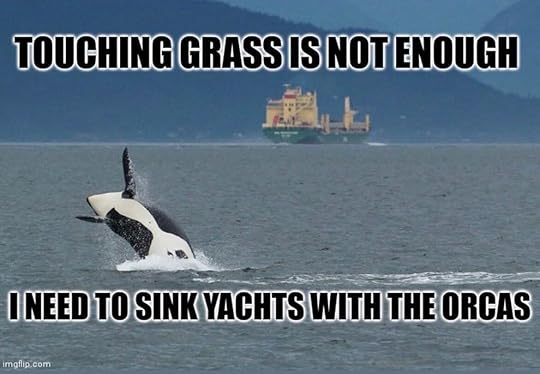
Touching grass is not enough. I need to sink yachts with the orcas
Neiwart is Pacific Northwest journalist, and this account focuses on the highly studied Southern Resident orcas of the Salish Sea between Vancouver and Washington. Orcas are of course the exemplars of charismatic megafauna, apex predators with their dramatic coloring, physical prowess, and agility. People around the world have venerated and feared orcas. The native people of the Pacific Northwest regarded orcas as fellow-people, and their stories are full of meetings between ordinary humans and orcas who can take human form to bestow blessings, curses, and take human wives. Europeans feared and dreaded the giant porpoise, naming it after a Roman underworld god.
The story follows loops through themes. Orcas push the scientific boundaries of what counts as a person. They're definitely intelligent, with social structures based around matriarchal lines, complex group hunting behavior, and a set of calls which have language-like structures. Orcas have culture. The Salish Sea features three populations: residents, transients, and off-shore orcas, each with different hunting styles and calls, and while being genetically compatible, have not interbred for hundreds of thousands of years. And yet, orcas and humans have not figured out how to talk, and orcas themselves behave in extremely conservative ways that indicate potential limits to their cognitive flexibility.
While there are perhaps 100,000 orcas worldwide, most of those inhabit the oceans around Antarctica. The Salish Sea residents are down to about 100 members, dangerous low numbers. Orcas face many threats: marine pollution, collisions with ships, collapse of the salmon fishery, and above all else, captivity. Orcas were fantastic attractions for marine parks, worth millions of dollars in revenue, and 'orca cowboys' in the 70s captured and killed many of the Southern Residents. Orcas fare poorly in captivity, tending to survive for a few years before succumbing to psychological and physical stress, whereas they can live for up to a century in the wild. Commercial orca pens are the equivalent of human solitary confinement, and it's no wonder that captive orcas go crazy.
Of Orcas and Men is a solid introduction to modern cetology, and a call for better fieldwork on these fascinating and unique animals.
Touching grass is not enough. I need to sink yachts with the orcas
Neiwart is Pacific Northwest journalist, and this account focuses on the highly studied Southern Resident orcas of the Salish Sea between Vancouver and Washington. Orcas are of course the exemplars of charismatic megafauna, apex predators with their dramatic coloring, physical prowess, and agility. People around the world have venerated and feared orcas. The native people of the Pacific Northwest regarded orcas as fellow-people, and their stories are full of meetings between ordinary humans and orcas who can take human form to bestow blessings, curses, and take human wives. Europeans feared and dreaded the giant porpoise, naming it after a Roman underworld god.
The story follows loops through themes. Orcas push the scientific boundaries of what counts as a person. They're definitely intelligent, with social structures based around matriarchal lines, complex group hunting behavior, and a set of calls which have language-like structures. Orcas have culture. The Salish Sea features three populations: residents, transients, and off-shore orcas, each with different hunting styles and calls, and while being genetically compatible, have not interbred for hundreds of thousands of years. And yet, orcas and humans have not figured out how to talk, and orcas themselves behave in extremely conservative ways that indicate potential limits to their cognitive flexibility.
While there are perhaps 100,000 orcas worldwide, most of those inhabit the oceans around Antarctica. The Salish Sea residents are down to about 100 members, dangerous low numbers. Orcas face many threats: marine pollution, collisions with ships, collapse of the salmon fishery, and above all else, captivity. Orcas were fantastic attractions for marine parks, worth millions of dollars in revenue, and 'orca cowboys' in the 70s captured and killed many of the Southern Residents. Orcas fare poorly in captivity, tending to survive for a few years before succumbing to psychological and physical stress, whereas they can live for up to a century in the wild. Commercial orca pens are the equivalent of human solitary confinement, and it's no wonder that captive orcas go crazy.
Of Orcas and Men is a solid introduction to modern cetology, and a call for better fieldwork on these fascinating and unique animals.

September 10, 2022
Orcas are so cool, so killer cool, and Of Orcas and Men gave me more reasons to love them. I had already known about certain things, like their social behavior and ability to communicate at a complex level, but this book widened and deepened my knowledge.
It was repetitive, though, and I think that, as usual, comes down to editing. But the segments on orca captivity could have been cut in half and the sections on orca social lives and biology lengthened, making for a more interesting book to me. If you have seen Blackfish, and this book references the documentary quite often, you know most of what this book discusses with regard to sea parks. The extra detail Neiwert gives adds to the outrage already felt. And we should feel outraged, but I would have definitely preferred fewer humans and more orcas, in this book and in general.
It was repetitive, though, and I think that, as usual, comes down to editing. But the segments on orca captivity could have been cut in half and the sections on orca social lives and biology lengthened, making for a more interesting book to me. If you have seen Blackfish, and this book references the documentary quite often, you know most of what this book discusses with regard to sea parks. The extra detail Neiwert gives adds to the outrage already felt. And we should feel outraged, but I would have definitely preferred fewer humans and more orcas, in this book and in general.

August 28, 2026
Good non fiction read, really found the captivity discussion interesting and how noise pollution can affect the waters. Did feel like some sections were repetitive though

March 24, 2026
Amazing, learned so much. Basically a love letter to Seattle. It’s pretty outdated at this point, which actually made it more compelling (since we now know the endings to the oil spill fears and Lolita’s stories).

January 11, 2017
I found this book extremely frustrating. As much as I love the subject matter and found some of the discussion engaging, the author simply prioritizes human emotions over science and conservation, and cannot decide on the tone of the book. Scientific facts are consistently swept aside by personal anecdotes and emotional responses to whale behaviour. There are many beautiful stories about orcas and their complicated relationship with humans, but this book could not decide on a tone and swung wildly between trying to be scientifically and logically compelling, and being an emotional personal response to a species. Sometimes those two styles can be married, but in this book it was not successful. As someone with a background in biology and a strong interest in the orca populations discussed in the book, it was irritating to find little errors scattered throughout the text that could have easily been fact-checked (the wrong mother was listed for one wild whale; captive infant whales are rarely hand-fed - inconsequential perhaps but little things like this kept happening and made me question the veracity of any of the book's claims). The citations were also lacking for many of the wilder statements. I realize this is not a textbook, but if you're going to make drastic generalized claims, it's natural for people to want to know the source. The writing was often repetitive and stories were repeated in multiple chapters, which seems silly considering how many rich stories there are that can be told about this species. There were some fascinating discussions (the various perspectives on whale-watching tours was a highlight) but overall it wasn't enough to make up for the book's overall unevenness. There are many great books written on orcas, books that deal with the amazing scientific discoveries of this species, books that deal with the emotional response people have to them, books that deal with the conservation challenges facing them, and even a few that manage to hit all three and be successful. This one does not manage that feat. I would recommend finding another book on this amazing species.

July 12, 2018
interesting, but quite repetitive at times and does not take a clear enough stand against the abuse and usage of living beings.
April 25, 2021
Badly structured, repetitive ideas that are somewhat outdated now. A bit wishywashy

February 3, 2026
Un libro absolutamente precioso con el que he aprendido muchísimo. Un viaje increíble a través de los océanos que habitan estos animales sobrenaturales. Sobre su evolución, ecotipos, mitología e inteligencia. Un alegato muy bello sobre lo generosos, inteligentes y empáticos que han demostrado ser, en realidad, todos los animales de este planeta con nosotros, mientras que nuestra historia, la humana, ha demostrado todo lo contrario. Habla de la cautividad, que tal como la conocemos hoy en día, aunque no es la que fue antaño, se alimenta de las capturas ilegales que un día hicieron grandes empresas. Creo que en la actualidad sí que hay interés por la investigación y el cuidado de los animales en algunos zoos, y creo necesaria la adaptación progresiva para proporcionar entornos seguros y libres a los animales que los habitan, pero no me parecen realistas ni seguras algunas de las propuestas de liberaciones que propone. Por supuesto que santuarios en semilibertad es lo que todos deseamos, pero seamos conscientes de que se necesitan los fondos y recursos necesarios para poder ofrecerles la solución que merecen, y por desgracia muchos de ellos no cuentan con los requisitos mínimos para garantizar el bienestar de los animales. Todos los recursos y dinero que poseen los zoológicos tienen que ir destinados a buscar opciones cada vez mejores para los animales. Y ya no me enrollo mucho más. No quiero dejar de leer nunca más sobre orcas, lo dejo escrito para que no se me olvide.

April 12, 2026
A lot of interesting information about orcas in here but ultimately there was too much repetition.
The book was heavily focused on the resident whales of the Pacific Northwest and a lot of the information about their life (and that of other orca groupings) was super interesting, especially the discussion around varying definitions of intelligence and the idea that intelligence is often defined as how human-like an animal's thoughts are rather than considering what it might mean to be an intelligent orca. The array of information that must come from sonar was an especially fascinating part of the book and really made me think.
But, overall, information is repeated over and over again. The last chapter or two goes on and on about captive orcas. The story about releasing Keiko was definitely interesting but that part of the book goes on and on about the state of captivity for orcas. Similarly, when it's making a point about how humans can learn from orcas because apparently they don't have in group conflict or talking about the threat of oil tankers the book restates its point over and over again.
So, it was overall really interesting information but it repeats itself a lot.
The book was heavily focused on the resident whales of the Pacific Northwest and a lot of the information about their life (and that of other orca groupings) was super interesting, especially the discussion around varying definitions of intelligence and the idea that intelligence is often defined as how human-like an animal's thoughts are rather than considering what it might mean to be an intelligent orca. The array of information that must come from sonar was an especially fascinating part of the book and really made me think.
But, overall, information is repeated over and over again. The last chapter or two goes on and on about captive orcas. The story about releasing Keiko was definitely interesting but that part of the book goes on and on about the state of captivity for orcas. Similarly, when it's making a point about how humans can learn from orcas because apparently they don't have in group conflict or talking about the threat of oil tankers the book restates its point over and over again.
So, it was overall really interesting information but it repeats itself a lot.

February 9, 2024
An engaging read, that captures the latest scientific knowledge of orcas and blends it with an exploration of their cultural significance to native societies as well as Westernized ones. I loved hearing the collection of stories both mythological and real, however it doesn't really offer anything new that the film Blackfish didn't cover. But perhaps it doesn't have to?
The only issue I had with it was structure, the chapters didn't have any clear topics and themes, and arguments he brought forth in the first chapter were developed finally in the last, which didn't make in an unpleasant read, but a little of a confusing one.
Overall, I think its a good book for anyone who is interested on orcas (which everyone should be).
The only issue I had with it was structure, the chapters didn't have any clear topics and themes, and arguments he brought forth in the first chapter were developed finally in the last, which didn't make in an unpleasant read, but a little of a confusing one.
Overall, I think its a good book for anyone who is interested on orcas (which everyone should be).
Displaying 1 - 30 of 163 reviews