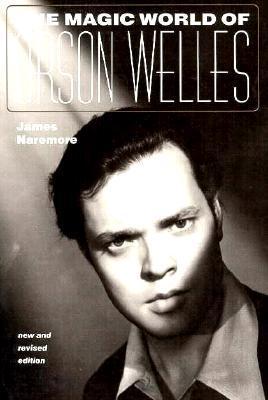
Paper edition of the 1978 original, with a new introduction and final chapter, and expanded and updated filmography and bibliography. Discusses the historical context and the political, psychological, and autobiographical aspects of specific films, and traces overall characteristics of his film career. Annotation copyright Book News, Inc. Portland, Or.
Un libro che spazia in modo dettagliato la filmografia e e le vicissitudini di Orson Welles. Un’opera che va letta con calma per assaporare tutte le sfaccettature di questo personaggio immenso, forse troppo fuori dagli schemi per essere compreso a fondo dai suoi contemporanei. L’analisi dei film è molto dettagliata e minuziosa, si sofferma su punti e scene in maniera esaustiva. Adatto a chi ha visionato i film in precedenza.
Naremore was always great to listen to on the Welles Criterion movies. The book contains a lot of the information he shares in his commentaries but is nevertheless worth a read, especially fresh off a watching of the Welles film in question.
Citizen Kane, Magnificent Ambersons, Touch of Evil, The Trial, Chimes at Midnight are all covered in detail. Some of his other less prominent or unfinished works are also included in between the major works.
An acclaimed study that's great (if brief) on the director's technical innovation, and incisively considers Welles' essential duality, but undermines the validity of its often valuable psychological and thematic analysis through an overly Freudian approach that sees sexual repression everywhere, rather than just in The Trial.
Ho letto e studiato questo libro per scopi accademici, tuttavia l'ho davvero apprezzato perché espone la figura emblematica di Orson Welles con semplicità ma dovizia di particolari e precisazioni tecniche, nonché con spunti di critica,
Certainly a must for any studious Orson Welles fan, Naremore's sympathies in this book lie pretty close to my own, so I can highly recommend it. He focususes almost entirely on Welles' work, not his life, and within that still-wide area concentrates specifically on five films (Citizen Kane, The Magnificent Ambersons, Touch of Evil, The Trial, and Chimes at Midnight) which are arguably the master's most important contributions to cinema. I disagree to a large extent with his views on 'The Trial' but he's probably seen the film many more times than I have, and under better conditions -- certainly he makes me eager to get back and watch those Welles films that I've not seen so many times again and again. My favorite sections are probably those on 'Ambersons', a film I probably overrate but that Naremore offers some convincing arguments both for and against, and 'Chimes at Midnight'. Shorter discussions on Welles' other films, though curiously nothing at all on 'Filming Othello' which may have at the time of this 2nd edition of the book (1985) not been listed as having been directed by Welles. Very little here on Welles' work as an actor (except in the film he also directed); some discussion on his radio work and incomplete films.
More analysis than a discussion of technique, I found Naremore's arguments convincing and valuable. A lot of film theory is based on, well, theory; this book looks to the material at hand for its evidence.
After a brief review of his roots on stage and in radio, Naremore walks the reader through an in depth critical analysis of all of Welles's films. Excellent film criticism on one of the essential directors.