Jump to ratings and reviews
Rate this book

Yesterday Will Make You Cry

Rate this book
“There could not be a fitter time or place for the publication of this great prison novel than today’s United States.” ―H. Bruce Franklin, The Nation A classic restored-the complete and unexpurgated text of a great African-American writer's brutal and lyrical novel of prison life. First published in reduced and bowdlerized form in 1952 as Cast the First Stone, Yesterday Will Make You Cry was Chester Himes's first, most powerful, and autobiographical novel. This Old School Books edition presents it for the first time precisely as Himes wrote it, a sardonic masterpiece of debasement and transfiguration in an American penitentiary and one of his most enduring literary achievements.

363 pages, Paperback

First published January 1, 1952

32 people are currently reading
878 people want to read

About the author

Chester Himes

122 books484 followers
Chester Bomar Himes began writing in the early 1930s while serving a prison sentence for armed robbery. From there, he produced short stories for periodicals such as Esquire and Abbott's Monthly. When released, he focussed on semi-autobiographical protest novels.

In 1953, Himes emigrated to France, where he was approached by Marcel Duhamel of Gallimard to write a detective series for Série Noire, which had published works from the likes of Raymond Chandler, Dashiell Hammett and Jim Thompson. Himes would be the first black author included in the series. The resulting Harlem Cycle gained him celebrity when he won France's Grand Prix de Littérature Policière for La Reine des Pommes (now known in English as A Rage in Harlem) in 1958. Three of these novels have been adapted into movies: Cotton Comes to Harlem, directed by Ossie Davis in 1970; Come Back, Charleston Blue (based on The Heat's On) in 1972; and A Rage in Harlem, starring Gregory Hines and Danny Glover in 1991.

In 1968, Himes moved to Spain where he made his home until his death.

Ratings & Reviews

What do you think?
Rate this book

Friends & Following

Create a free account to discover what your friends think of this book!

Community Reviews

5 stars
99 (29%)
4 stars
124 (37%)
3 stars
74 (22%)
2 stars
28 (8%)
1 star
7 (2%)
Displaying 1 - 30 of 40 reviews
Profile Image for None Ofyourbusiness Loves Israel.
883 reviews182 followers
May 11, 2025
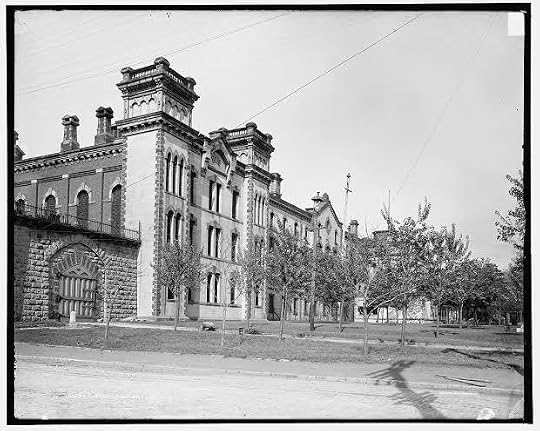
Incarceration becomes both crucible and canvas in Chester Himes' raw autobiographical work, where Jimmy Monroe's fourteen-year sentence at Ohio State Penitentiary transforms from punishment into painful enlightenment.

Written in 1937 yet published uncensored only posthumously in 1998, this examination of prison life chronicles Monroe's evolution from terrified nineteen-year-old arsonist to contemplative man who discovers, "Prison doesn't just break your heart. It hollows your soul until you either find something worth holding onto or collapse into the void."

Monroe's journey includes hellish prison fires where men burn alive, forbidden love affairs with fellow inmates, brutal guard beatings, desperate escape attempts foiled by fate, and an interior liberation more meaningful than physical freedom could provide.

Himes' writing reveals prison's dehumanizing ecosystem while illuminating humanity that survives within these confines. When Monroe witnesses a guard attack an elderly prisoner and thinks, "The difference between animal and man is that animals kill from necessity—men create pleasure from it," we glimpse Himes' own prison experiences that shaped his literary voice.

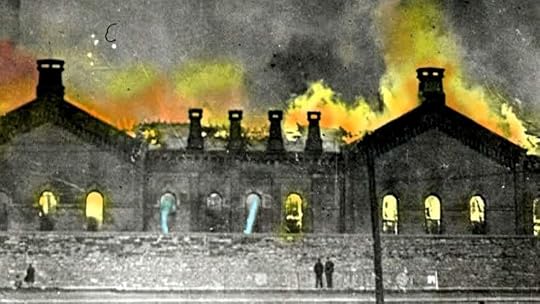
Key moments anchor this psychological self-examination: Monroe's initial processing that leaves him "naked in body and spirit," his nearly fatal tuberculosis where "death seemed like another cell transfer," the Christmas celebration where contraband hooch flows until violence erupts, his passionate relationship with Prince Rico that blooms despite institutional homophobia, the workshop accident severing his fingers, a devastating race riot forcing choices between tribal loyalties and friendships, his awakening through prison library books, his mentor's suicide, saving a guard during the infamous 1930 Ohio Penitentiary fire that killed 320 inmates, and his realization that external freedom cannot guarantee internal liberation.

Himes—who served seven years for armed robbery before becoming an acclaimed novelist—created a work expanding beyond prison literature into an existential question about freedom's nature.

The text's psychological depth makes Camus' The Stranger seem shallow, while its institutional critique equals Solzhenitsyn's Gulag Archipelago in exposing how confinement reveals society's contradictions.

Monroe's observation that "every man in here built his own prison long before the state built this one" connects across cultures—from Dostoyevsky's House of the Dead to Genet's Miracle of the Rose.

This work represents Himes' personal triumph, a literary achievement that, like its central character, overcomes circumstances to approach wisdom. As Monroe concludes in a moment of clarity: "Yesterday will make you cry, but tomorrow depends on what you do with those tears today."
Profile Image for Mariel.
667 reviews1,212 followers
November 22, 2013
After that no one said anything. Jimmy sat on his bunk. The darkness closed in and the silence became tangible. His shoulders drooped forward, his head bowed as if from the weight of the silence. His mind would not penetrate the darkness and his thoughts turned into themselves. He wished some one would start talking again because all he could hear was his own heart beating like a trip-hammer, and his thoughts became broken and scattered. He tried to say something himself, but when he opened his mouth to speak his voice would not come out.
It is never quiet in prison. Jimmy is heralded into his twenty year sentence on golden showers and rugs of body hair under slow no motion. Cat calls and caterwauling. Jimmy is not a real person. Time stoppingly handsome (he always blushes in pleasure. Wasn't it old by the billionth time?) in places the hands are the judge, jury and executioner. A college graduate (beauty before brains. This is touted plenty too, only not quite as nauseatingly often), an object in a bidding war. A bird behind bars without a song to sing. Sound escapes, hard of nothing and no flight.

Jimmy felt so very tender for the Rico whom he knew and was scared for him and wanted to protect him and change him all over from that Rico whom he did not know, the Rico who repulsed him so and whom he found so repellent on occasions. It must have been that on those times he was afraid that Rico would turn back and become the other Rico, and that he, Jimmy, would be again a goddamned, solid fool.

Have you ever looked on inmates who are headed to the big house? Some probably going for a long time. Long enough that it is forever. They are shackled to each other and the bars in mouths glow in the dark. The happy looks on their faces feels like falling. If it feels that way just to see them. If you could pull off their faces it is the corpses of the weight of dreaded centuries behind them. My stomach is pitted thinking about it. I wonder sometimes if this kind of knot inside you could turn into a self destruct capsule if you can't find a way to not think about it anymore. Yesterday Will Make You Cry is the best in the beginning when Jimmy first gets there and it is the too quiet. When it is the shift between I can't believe this is happening. He can't believe there's a poker game going on. People are laughing. It is best that Himes creates in that he sounds absolutely fake as shit in his pleasure in this. It isn't real. He's in the prison is real ball and it also isn't happening chains. They are stolen. Himes kinda fucked up making Jimmy a repeat offender, though. I can't believe that he is this naive about everything when he'd been locked up before. Jimmy becomes a-whatever-point-I-want-to-make-whim in his thoughts and beliefs. Don't believe him when he worries Rico won't love him. It won't be Rico's back walking away. I wish he had made a choice one way or the other to make Jimmy his see-through plastic bag on the face of prison, or the ducts. Jimmy doesn't know he's doing it until it is time for the shark to take a bite. I'm not empty. Fill up time. I felt so eyes in a dark room with objects to knock into (I know that's a dresser because it's always there) with him (and huge parts of the book are cringe worthy. Episodic cliches of prison life you could pick up anywhere else. If he were writing fake letters to home from camp he would sound more present). When he doesn't exist there any more they fill up whatever shape he has to take next. Maybe all of the sweat from all of the sex he has will rain down like tears on the faces of the many men who want his body so hard. Jimmy can get you anything you want. What is your poison? Newspapers, shoes, shower caps. Hey, handsome.

(This is probably trivial but I couldn't help noting the fashion. Himes was released in 1937. Men are described sporting the pants dropping drawers look. Come on, isn't it time for a new look already? I always found it interesting that so much of men's fashion is styled by the prison population. Maybe it is because so much of the population is in prison. That's depressing.)

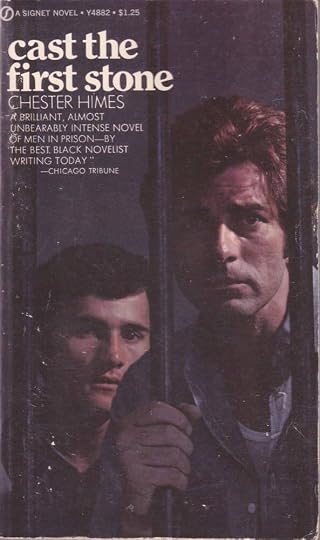
So Chester Himes probably had this friend. Once upon a time the fat cats must've wink wink nudged nudged. "Oh, okay. Your friend. We get you." Yesterday Will Make You Cry was messed around with like fresh meat in the prison shark pool (I think it was four "retoolings"!) and called "Cast the First Stone". Yeah, we know Jimmy is written as a white man but wink wink. Decades later it is "restored" and to the original title and material. But, the cover is of a line-up of negro inmates. His "friend" Jimmy could not have been a white man, no matter it is Himes' damned book and not theirs? What gives? Famous author book blurbers such as Ishmael Reed bespeak of its "trenchant commentary about blacks living in a society that is hostile to them". I wonder if any one of the blurbers read any of the novel (or just flipped to the author photo in the back flap, probably). It is prison for everyone in there. To separate them based on color of their skin is missing it. Every moment, under the skin.

I don't get Jimmy. Okay, a lot of inmates will break your mama's back on she was so stupid she got lost on the way to Popeye's jokes. It is never quiet and a voice in the dark could be crying, or anything at all. But Jimmy doesn't hear it. He talks about wanting to hear it and THAT is the voice he and (unfortunately) myself hears. That girl I screwed when I was young was the love of my life. Blah, blah, blah shit eating grin of bravado. The abyss' abyss happens to the negro inmates, it makes a bitch out of every asshole and everyone has one of those. He turns on the fairy lights when some inmates die in a fire. I could have died! I'm going to make out with my "best friend" because what the hey, something has to happen (the kind of best friend you have with the kid who is the only kid your age living on your street).

'Yesterday' broke me during the long, long chapters of Jimmy's back story. (No one knows the troubles I've seen.) Taking him out of the prison context was another big fuck up, especially since it didn't tell me anything I didn't already know, breathe any other kind of life to make this case about how prison stops meaning that cannot pretend inside it. Walter becomes Lively and his laughter turns into Rico's half trusting face cuddling to the backs of knowing inmates. We have nothing but time. He was a socket of getting into trouble to break the time to get there in the first place (he was already on parole when he got sent up again for armed robbery). Don't forget ridiculously good looking, Mars! Jimmy may go back or he'll see some pretty face and what the hey. I wish Himes had shown the black behind his tombstone smile for others, if Jimmy was going to be so important. Maybe someone hoped for a different voice in the dark when they enacted love on his "handsome" face. Maybe their love felt like Jimmy when he had to forget what his mother looked like until he could forget what prison looked like.
Profile Image for Michael.
77 reviews4 followers
September 22, 2021
Once again, as always, a book that exceeded all expectations I had. It’s such a shame “Yesterday Will Make You Cry” is relatively unknown today. NYRB…..where are you?!

I’ve read some other reviews and agree that the first portion of the novel is fragmented and jumps around a lot but to me it totally works and I thought it a really compelling way of showing Jimmy’s mindset as he settles into prison life. He can’t think straight, he can’t focus or feel much of anything, he’s still kind of stunned and every day is the same as all the others. A monotonous existence. The only things that stand out to him, the only things worth noting are the incidents - the killings, flirtations, fights, beatings, odd conversations and one stalker-type situation which is so unexpectedly unsettling I got chills. I’d give the book 5 stars for the first 100 pages alone, but then there’s the prison fire, a literal hellscape - disturbing and lurid and riveting.

I love the way Himes writes and the way he gets you inside Jimmy’s head and pulls you down with him, the way you start feeling like you’re going crazy because he’s trapped, so you’re trapped, not only in a prison but in his mind and body and way of thinking. He’s not the most likable character, but there’s a lot of history Himes goes into about his childhood, his family, growing up, that explains why Jimmy is the way he is, which made me feel for him a lot more. Not that I agree with everything he does, but Himes made me understand.

A standout scene for me is Jimmy’s first experience being sent to the hole, waiting in nothing but complete darkness with nothing to do but think and sleep and listen to other convicts speak from elsewhere in the room, and they read like voices inside his head.

The the last section of the novel presents a new character, Rico, who brings out a side of Jimmy we haven’t seen up until that point, and this final chapter was the most touching and interesting for me. The tone changes a bit, but after all the horror before it’s a nice change of pace. The life and death of a short lived relationship. The happy parts of their relationship where they get drunk and laugh at everything, forgetting anyone else exists were some of my favorite moments of the book. My ONLY slight complaint was how often Rico called Jimmy “Puggy Wuggy”. But everyone has their faults…

It was shocking how openly Himes spoke about gay relationships and characters considering this was written in the 1950’s. I was not expecting that to be a main focus of the story at all, but I’m glad it was.

Anyway, this review really isn’t doing justice to the book but it’s definitely one of my favorite reads of 2021 and I highly recommend!
Profile Image for Cody.
997 reviews304 followers
July 2, 2025
Admission: I have always felt affinity with anything that takes place in prison. Or with gladiators. Greco-Roman wrestling. Turkish baths. Ho-hum.

That this was HEAVILY edited for its original release (1952 as Cast the First Stone) in the wake of the Good War—when all good heterosexuals should have been (and were) busily fucking Young Americans into existence—should surprise absolutely no one. Except that rascal Mamie Eisenhower (fox that she was; stone freak kinkstress). Here is a novel about the transformative experiences of sexual and gender liquidity in an environment not exactly conducive to adding to the Boom’s bean counter. Although our protag is called otherwise, he’s a barely fictionalized rendering of Himes. Yep—before cutting his teeth in the lit world and bailing for a life under Parisian skies, Chester did a good stretch of time in the clink. It was in lock-up that he discovered his inimitable ability as an author, his gift to a world that would pay it back by summarily forgetting he ever existed. How lovely we all are.

Oh—of course the stand-in for Himes is white in this; you didn’t think a large publisher was going to print up the man-on-man fuckplay of BROWN people, did you? No way Jesus or NATO would’ve stood for that shit (although Mamie sure would have gotten down with it). Call this novel MY alignment pact, as I walk away saluting absolutely nothing.
Profile Image for Ed.
Author 68 books2,711 followers
August 4, 2010
Late in his career and life, Chester Himes authored a famous PI series while living in France. This book is his first novel republished the way he originally wrote it in 1998. Much of the story takes place in an Ohio prison during the 1930s when Mr. Himes was also incarerated for seven years. The protagonist Jimmy Monroe is a white kid from Mississippi. The gritty tedium of jail is spelled by card games (with gambling) and softball leagues. Mr. Himes deals with the gay issues in probably frank ways for the time. He uses some literary flourishes that more than once reminded me of John Dos Passos' writing. Bottom line: a solid read for a prison novel without the extra violence and bitterness.
Profile Image for Richard Jespers.
Author 2 books22 followers
January 11, 2015
African-American writing in 1930s, published 1953 (abridged). Reissued this time, in 1999, as it was originally written. Main characters are white persons (straight) who fall in love in prison. Interesting. Helped me to focus on the importance of “place” in my own writing.
8 reviews
February 12, 2018
Read it for University. Was a good book. Can see the merits but without a proper narrative it wouldn't be the sort I would read all the time.
Profile Image for Aaron Thomas.
Author 6 books57 followers
May 19, 2024
This novel is mind-blowing. It's a prison novel from the mid-1950s in the United States that tells the story of an incarcerated man named Jimmy and his relationship (this takes up most of the last third of the book) with another man called Prince Rico. This is a humane, generous study of men behind bars, and it's a really extraordinary character study.

Here's one example of the wisdom of this novel:
"It seemed so illogical to punish some poor criminal for doing something that civilization taught him how to do so he could have something that civilization taught him how to want. It seemed to him as wrong as if they had hung the gun that shot the man."

The novel is filled with brilliant, terrible insights like this, as Jimmy struggles with how he got to where he got, plagued by regret, and not fully understanding himself or his own motivations. I didn't know it was possible for a book like this to exist in the early 1950s. I guess the only book that comes close is Giovanni's Room... which was written a few years after this Chester Himes novel, though Yesterday Will Make You Cry was never published as written until after Himes' death. In any case this is a masterpiece.
Profile Image for Martin.
539 reviews32 followers
December 31, 2013
The first hundred pages, I didn't know how I was gonna get through it. Names come and go. Things that would be disturbing in the outside world happen on the periphery and "That happened." was often the only commentary. Then there was the prison fire, a magnificent piece of writing taking up a huge chunk of the novel and of our protagonist's psyche. The digression into Jimmy's early life was a welcome break from the endless card games and innuendo, although the prose was standard and predictable. But the novel started to have a cumulative effect. I couldn't put it down. I became acutely aware of the prisoners' humanity, and "that there was nothing in a drug store that would kill them quite as dead as standing inside of a prison, looking out." Or the endless standing and waiting for nothing greater than a plate of beans or a haircut. Or how a phrase in a song can bring up emotions that cannot be repressed.
I appreciated how, as a writer, Jimmy could happen into a song or a scene in a movie and it would unleash a wave of memories, creativity and anguish that he had to ride until it subsided or the story was finished. And how he could feel touched by all of the laughter, skyscrapers, or normal people he would never know. I've worked with the juvenile probation population and with mentally ill men who have spent much of their lives in prison, and this novel made me question how well I could ever have understood them. Going forward, reading this novel will make me a better person and clinician.
This is probably a four star book but for me, the same-sex romance in the final half pushes it over the top, considering when it was written and how well it still plays. I'm not calling the relationship 'gay' because neither one of the men may actually be gay as we've come to know it. Certainly not our protagonist. The relationship between Jimmy and Rico reminded me, unfortunately, of an important but ill-fated relationship I had in the 90s with someone who was older and carried much more gay shame than I did.
My criteria for a five star novel are thus: have I learned something about myself, such that I have a different perspective on my past or my relationships? Have I gained a deeper understanding of people who are different from me? Will I approach situations differently, with more maturity and reasoning? Was the novel written in a manner that when I think back on it, it will seem like I am recalling my own memories? Did the novel manage to work its way into my dreams while I was reading it? Would the novel be worth reading again? Did I manage to get more out of the novel than I put into it? Was my only duty to sit down and read the damn thing, and in return I received innumerable riches? And did the form justify the content, and vice versa? Yes to all.
1 review
December 13, 2013
The author Chester Himes of the book Yesterday will make you cry, takes you to a dark setting which is a prison. "He had celled with the other newcomers up on 5th-K, the top range of the I&K cell block, a very old block with small, grimy, and very cold cells" I like how he goes into detail when describing the setting because you can really picture it and you feel like you are part of the setting. This story shows the struggle of one man's journey through prison.

The main characters in the story were Jimmy and Rico. For me Rico was likeable but not so much Jimmy. "Where there had been hurts; now there were only shocks. Before, each moment had been all past, hurting with a deep ache of remorse; or all future, hideous with the thought of twenty years." These were Jimmy's thoughts and to me I thought he was dwelling on the past too much and being sad all the time when he was the one who got himself into the trouble. On the other hand, I liked Rico because he was very reckless and careless about everything and he always stood up for himself even when that put him in dangerous positions at times. "His eyes became wild and feverish, his face became flushed, and his whole mouth twisted into a sneer. Where I come from, when you win, you put your money in, turn your hand over and take the pot." This shows that Rico likes to prove everyone wrong because all the convicts were trying to leave him with no money while they were playing cards.

Although the book had great description and setting, it was not what I had expected. I rated this three stars because through the book I found myself getting bored really fast especially in the beginning when Jimmy was reflecting on what he did. Based on the illustration on the front cover and the title, I thought it would be more about discrimination between African Americans and whites in prison but it was the complete opposite which was a disappointment for me. I feel like there are more interesting books out there to read.

The ending of the book get more interesting which is the only thing that keeps the reader engaged. A lot of things happen between Rico and Jimmy that weren't expected and that are very shocking.
Profile Image for Robert Lashley.
Author 6 books54 followers
December 13, 2016
Himes wrote "literary novels" that were garish extensions of Richard Wrights social protest/white women killer fiction; and detective novels that read too much like a middle-aged expat trying to be down in Harlem. It took me forever to come up to the re-release of the original version of "Yesterday" ( although all my hip Black lit nerd friends were telling me to read it for years)

But when I did... A book about a group of men trying to come to terms with themselves, their surroundings, and their sexuality while doing bids in prison; "Yesterday" is a novel that would be explosive right now. In showing relationships between blacks and whites, fractured origin stories, and the damage the prisoners do and do to themselves, the novel is both heartbreaking and darkly beautiful. It is a revelation to see Himes Style(always his strongest suit) unfettered, free from the performative slogans, statements, and checklisted actions that dictated the "Wright Protest Genre" The novel stands up with any AA novel in the 20th century and should last and be read in the 21st

Yesterday was also a Novel that-in it's original form-didn't stand a chance in hell of getting published in 1937. In that context, the book is heartbreaking to read in that it present's a case of Himes' regression as a writer; showing the apex of his talent before he put back inside all his examined tensions and contradictions and cultivated an ugly( and at times murderous) drag persona.
Profile Image for J.
259 reviews7 followers
Want to read
August 14, 2013
(FROM JACKET)In 1937 Chester Himes, newly released from a seven-year stretch in the Ohio State Penitentiary for grand larceny, began his first novel, "Yesterday Will Make You Cry". By turns brutal and lyrical and never less than totally honest, it tells the autobiographical story of young Jimmy Monroe's passage through the prison system, which tests the limits of his sanity, his capacity for suffering, and his definition of love. Stunningly candid about racism, homosexuality, and prison corruption, the book would take sixteen years and four subsequent revisions before being published in a much-altered form as "Cast the First Stone" in 1953. Even bowlderized, it was recognized as a sardonic masterpiece of debasement and transfiguration.

This edition, the first hardcover publication in Norton's Old School Books series, presents for the first time the book precisely as Himes intended it to be read, with its raw honesty and startingly compassion entirely intact. It now stands definitively as one of the great novels of prison life and one of Himes's most enduring literary achievements.
Profile Image for Adam Dunn.
670 reviews23 followers
August 27, 2014
Unreadable.
The book mentions in the introduction that this was shopped around and rejected quite a lot before finally being published in a highly censored and reworked version. The book implies that racism and homophobia led to the revision, but I question that. I think they're using that to sell this version of the book. The book needs revision and narrative structure.
The introduction also says that the book hasn't been republished since it's initial printed in 1953, which is also untrue. It was published as a gay pulp in 1972 by Signet Books. What would lead the author to ignore this gay re-printing of this work? Homophobia?
The book itself has no narrative structure. It's difficult to read, there's slang from the period. The author is black but writes from the perspective of a white man because he thought it would help sell books. Da black folks de all be talkin like dis. The book is a series of vignettes rather than a story, impossible to follow the characters from one scene to the next when there is no description or character development.
I got to page 100 and this book started to make me cry.
Profile Image for Caroline Rose.
71 reviews13 followers
February 15, 2022
Sometimes when I rate a book, the rating represents how I felt when I was reading the book, or how much I liked reading it. For this rating, it rather reflects the quality of the work. I didn’t quite enjoy reading this story at all times, as it droned on without a strong plot. The writing somewhat resembled the conditions of prison, in which convicts live their lives without a plot. So, the organization of the story was appropriate. I didn’t understand a lot of the jokes that the characters made, or why certain comments made them angry, or what those comments even meant. This makes sense because the story is based in 1930s prison. It did make it difficult to enjoy the story.

Anyway, very well written but not especially enjoyable to read.
Profile Image for Ronald Wilcox.
866 reviews18 followers
January 2, 2015
This is the version of "Cast the First Stone" with the text and title as written by the author before it was significantly changed by editors. In the late 1920's, Jimmy Munroe is sentenced to twenty years in prison in Arkansas after robbing a couple. In prison, he becomes even more corrupted by his association with other prisoners and eventually begins to find himself attracted to other men. He falls in lust with two men before he meets Prince Rico with whom he falls in love. Himes is a good writer and this supposedly was semi-autobiographical but the language he uses for the characters seems very unrealistic to me. Still was a very good read overall.
6 reviews
October 30, 2022
A prison novel, in part based on the author's personal experiences. Offers a brutal depiction of prisons in the 1930s and a frank portrayal of homosexual relations within them. Was bowdlerized by censors in the 50s, when it was published, but can now be read in it's original form. Surprisingly the topic of race does not come up often in the novel, despite the author being a Black expatriate. Is somewhat similar to the works of Eddie Bunker or Iceberg Slim. Would recommend to anyone interested in criminal/penal literature.
Profile Image for Alana.
165 reviews5 followers
October 2, 2012
Honestly, I was expecting more interaction and controversy between black and white inmates as this book is classified under African American Studies. T'was not the case. Though autobiographical in part, this is a story of brutal self-discovery of one (white) man's twenty-year stint in the penitentiary. Difficult to read at times due to graphic scenes of violence. Worth it for the insight gained.
Profile Image for Khelani.
18 reviews
May 24, 2008
Remained one of my favorite books for a very long time. This is a REAL prison novel from someone who spent time there. Originally it was supposed to depict a black inmate, but publishers made him change his protagonist to a white boy...typical. If you read it in either voice its equally compelling, albeit a completely different novel.
Profile Image for Hugo.
511 reviews14 followers
February 23, 2019
Novela negra, autobiográfica.

Narra la historia de Jimmy Monroe, un joven, a mi parecer, sociópata, indiferente ante otros seres humanos, que vive sólo el presente, sin los recuerdos del pasado y la esperanzas del futuro.

Sus dos más importantes relaciones en la cárcel, con Liberly y Rico, y el episodio del incendio, lo cambian un poco.
Profile Image for Renae.
196 reviews1 follower
March 10, 2019
While an interesting (and apparently first-hand) portrayal of prison life in the 30s, Himes' story of a self-sabotaging two-bit criminal gets a bit long-winded in parts. As a result, the bizarre nature of imprisonment becomes mundane and nearly boring. Himes is a beautiful writer, I just wish this novel had been about 100 pages tighter.
Profile Image for João Coelho.
25 reviews
November 25, 2019
Esse livro é até de certa forma raro e pode ser visto de duas formas: Se você quer porradaria e ação na prisão, você vai se frustar; Se você quer ver como funciona a cadeia nos anos 30(Digo, aliás, que é focado intensamente nos sentimentos e ações dos presos) você vai gostar e ver o quanto o livro é de certa forma bem escrito. Mais uma coisa: É um livro bem forte.
Profile Image for Joseph Hirsch.
Author 50 books132 followers
September 24, 2025
Chester Himes remains one of the most overlooked American writers of the 20th century. This could be partly because he never quite fit easily into any category, at least until late in his career. He wrote about the black experience in America before and after World War II mostly, but his novels weren’t really “protest novels.” He didn’t seem to trust humanity—white or black—enough to write in a prescriptive or diagnostic way, and when he tried, the results were clunky. He was more like Kafka, seeing an irreconcilable absurdity at the heart of the human condition, something no WPA program or political dialectic was ever going to address.
He also made even the white liberals of his time uncomfortable by at least considering the salvific power of violence. Had the violence he flirted with been political, the intelligentsia could not have only condoned it, but encouraged it. But his kind was more personal, more that of a lapsed Catholic who remembered the blood in the Bible but forget the reason for all the shedding of the same.

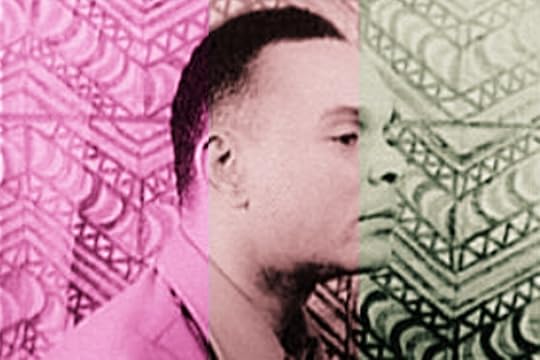
“Yesterday Will Make You Cry” is one of his most troubling, troubled, and frankly ballsy books. He wrote it from the perspective of a white con doing twenty years in an Ohio prison for an armed robbery. Publishers sabotaged the book from the first, however, refusing to accept an anti-essentialist argument, that a black person could write from the perspective of a white man. Such a thing—horror of horrors—might suggest a black man being capable of sympathy for a white man, instead of displaying the de rigeur outrage, which, in a weird way satisfied some sadomasochistic urge in the left-leaning soul. Himes’ good friend and photographer Carl Van Vechten noted this strange tendency in the phenomenon of “racial cabarets,” in which bourgeois whites showed up in theaters to be berated by black performers on stage. We still have not just vestiges of this, but highly profitable rackets based entirely on this dynamic, the only difference being that now white people like Robin DiAngelo get to cash in, too.
Himes, in “Yesterday Will Make You Cry,” is not interested in larger racial discourse. Instead he is interested in the intimate dynamic that develops between heterosexual men when long confinement pushes them toward situational homosexuality, which then occasionally and accidentally becomes love. He focuses on the travails of protagonist Jimmy Monroe as he struggles to adapt to doing a long bid in prison, fighting authority and making war against himself in incomprehensible and sudden outbursts of inexplicable rage. He has affairs with men—dealing with this forthrightly required a lot of taboo-breaking on Himes’ part—but they prove generally unsatisfactory.
At least, that is, until Jimmy meets Rico. This is by far the best part of the novel, being not just compelling but sometimes transcendent, as powerful and real a romance as any I’ve ever encountered in print. It reminded me quite a bit of Genet, when he was at the peak of his powers. The problem, though, is that this relationship is only introduced well into the third act of the book. And while the initial publishers may have botched the job and underestimated Himes by changing his protag’s race, they did good work in their general edit. Here most of the stuff that’s been reintegrated into the body of the text slows things down. Granted, the pace of life in prison is glacially slow—especially for those doing long bids—but part of the challenge of writing about prison is to convey the boringness of it without actually being boring oneself. “Cast the First Stone” (the original version) did that. This “improved and unexpurgated version,” alas, does not.
Maybe Himes would have liked it more, but a writer is hardly ever the best judge of their work.
Besides which, the restoration is all for naught, since it’s gainsaid by the cover, which features a perp walk of several black men. What’s the point of restoring the race of the protagonist in the book if your art department is just going to muddle the issue by featuring black rather than white (or least mixed race) suspects in a lineup?
The answer is probably crass commercialism, something better suited to Holloway House than Old School books. “Hey,” some guy with a cigar wagging in his mouth might have said, “Himes is black, so let’s put some black guys on the cover. Maybe it will even sneak its way onto the ‘urban’ shelf with the K’wan bestsellers.”
The best thing about this book, in fact, is probably the intro by legendary filmmaker Melvin Van Peebles. That, and the stretch of the novel that takes place after Rico enters the picture. That part makes it almost worth it for the casual reader, and definitely worth it for the Himes aficionado. I won’t soon forget it, and that’s gotta be worth something. Lastly, it’s a rare realistic look at life in prison before that B.C. / A.D schism that prison writer Edward Bunker talked about. In other words, MLK had not yet been assassinated, and white and black convicts could not only exist together in (relative) peace, but hard segregation was not a daily fact, or explicit race riots an inevitable given, as they are now, especially in California prisons where it’s not a question of “if,” but “when” the dormant volcano blows again.


Profile Image for Katie.
76 reviews
August 28, 2007
Prison lit...kind of a downer. But a great book!
Profile Image for Matt.
24 reviews1 follower
October 24, 2017
Really need the half star on this to make it 3.5.

Profile Image for David Absalom.
82 reviews
January 28, 2020
I don't know what to think. I think it needed revising but on the other hand, the author knows what his material is and must stand upon it.
Profile Image for Jeffrey Powanda.
Author 1 book19 followers
October 16, 2023
A poignant, brutal, lyrical, and frank treatment of depression-era prison life, written by Himes in the Thirties while he was serving seven years in Ohio Penitentiary for armed robbery. After his release, Himes tried for many years to find a publisher, but the publishing industry wasn't ready to tackle a candid, soul-searching book about gay life in prison. The book was finally published in a highly censored version called Cast the First Stone in 1953. Fortunately, Norton released this unabridged version in 1998, which restores the book to its original form. Sure, it's uneven and crude, but it's also powerful, naturalistic, and gripping, and there are many shocking scenes, especially the catastrophic prison fire, which is based on a true event. It's one of the finest prison novels ever.

It surprised me that protagonist Jimmy Monroe, his two gay lovers Lively and Rico, and most of the other characters featured in the book are white. Yes, a black man can write a novel about mostly white men in prison, but it seems like an unnecessary attempt by Himes to broaden the appeal of the story. The cover photo, which features four men in a police lineup, three of whom are black, only adds to the confusion. Given Himes's decades-long attempt to publish his original novel (it was published more than a decade after his death), it’s unfortunate that he chose to whitewash his story. But a writer’s gotta eat.
Displaying 1 - 30 of 40 reviews

Can't find what you're looking for?

Get help and learn more about the design.