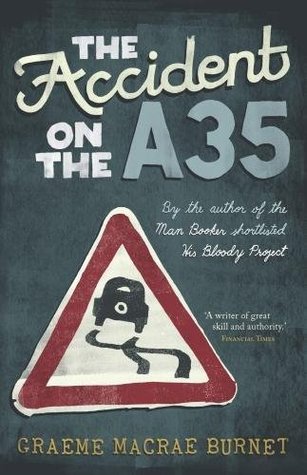
The Accident on the A35 returns to the scene of Burnet’s accomplished first novel, The Disappearance of Adèle Bedeau - the small French town of Saint-Louis.
Detective Gorski is called away from his night of solitary drinking to the site of a car accident that left Bertrand Barthelme, a respected solicitor, dead. When the deceased's rather attractive wife suggests that the crash may not have been an accident, Gorski looks closer into Barthelme's circumspect movements on the night of his death. His investigation leads him to various bars, hotels, and brothels in the nearby city of Strasbourg. At the same time, Barthelme's rebellious son, drunk on Jean Paul Sartre novels, is conducting an investigation of his own. Their independent, dual inquiries lead the reader down a twisted road marked by seedy back rooms, bar brawls, a moment of accidental incest, and, as we have come to expect from Burnet, copious amounts of wine.
The Accident on the A35 is a darkly humorous, subtle, and sophisticated novel that burrows into the psyches of its characters and explores the dark corners of life in a sleepy town.
Graeme Macrae Burnet was born in Kilmarnock in 1967. He studied English Literature at Glasgow University before spending some years teaching in France, the Czech Republic and Portugal. He then took an M.Litt in International Security Studies at St Andrews University and fell into a series of jobs in television. These days he lives in Glasgow.
He has been writing since he was a teenager. His first book, The Disappearance of Adèle Bedeau (2014), is a literary crime novel set in a small town in France. His second novel, His Bloody Project (2015), revolves around the murder of a village birleyman in nineteenth century Wester Ross. He likes Georges Simenon, the films of Michael Haneke and black pudding.
Macrae Burnet writes a literary mystery, paying homage to Sartre and Georges Simenon in this distinctly French style novel, set primarily in the non descript and insipid small town of Saint-Louis. An author commits suicide, paving the path to the publication of a novel deemed to be autobiographical, although how much is truth or false is up for debate, but it does feel real. George Gorski, Chief of Police in the town is, by his own estimation, a provincial plodder, separated from his wife, Celine, and missing his daughter. He wanders around the town's bars, cafes and restaurants, drinking whilst trying to avoid being perceived as a drinker. A fatal car accident on the A35 kills respectable lawyer, Bernard Barthelme, a man not much mourned by those close to him or those who knew him. Lucette, the widow, asks him to look into the death because her husband by all rights should not have been on that road. Feeling drawn to Lucette, and with nothing better to do, Gorski begins to look into the mystery. This is a slow building character driven story, not a plot driven crime story with tension and suspense.
17 year old Raymond Barthelme feels an overwhelming sense of a burden lifted with the death of his father, much like his mother. Bernard had instituted a rigid and austere set of routines that inhibited mother and son, a house of silence where putting the heating on was heavily frowned upon. Slowly these rituals are challenged under the disapproving eye of the housekeeper, Therese. Raymond embarks on a fit of rebellion and out of character behaviour, and upon finding a scrap of paper with an address in a nearby small town in his father's desk, he is intrigued. His curiosity leads him to spend substantial amounts of time there, attracted to a waitress, going to a club called Johnny's, looking into the inhabitants at that address and observing them. Gorski contacts Strasbourg police over the slim possibility of a connection with the accident and a murder investigation.
Macrae paints a masterly picture of small town life, the disappointments, bar brawls, angst, humiliations, teenage sexual forays, social class, disintegrating marriages, secrets and petty behaviours that typify the everyday in Saint Louis for the main characters. This novel is for those who enjoy character driven psychological studies and interested in small town French society and its workings. The central mystery of why Bernard Barthelme was on the road packs its own punch but it is not the central focus of the story. A book I thoroughly enjoyed reading and recommend highly. Many thanks to Skyhorse Publishing for an ARC.
I was introduced to Scottish author, Graeme Macrae Burnet, with His Blood Project, shortlisted for the Booker prize in 2016. A brilliant novel and one worth every 5 stars I gave it. Given the opportunity to read his Accident on the A35, I jumped at it.
Accident on the A35 is a literary mystery. Not like other crime mysteries that are plot-driven with many twists and turns. It’s important to step into this novel realizing you are about to read an easy flowing mystery that is character-driven.
The setting of this novel is in small town Saint-Louis, France. This backwater town plays an important role in the book. The plodding Chief of Police, Inspector Georges Gorski, looks into the fatal car accident of solicitor Bertrand Barthelme only at the behest of his pretty widow. The book is more focused on the lives of the characters rather than the solving of a crime. Marital discord, teenage struggles with conformity, cafe life, and class are delved into with such an excellent quality of writing that the novel is best read slowly. Such brilliant character development. Most enjoyably read is the angst of Bertrand’s 17 year old son, Raymond.
This is a subtle book about a man living a hidden life and what transpires after his death. The reader must not mind that a crime isn’t solved or is it that there was no crime at all?
Accident on the A35 is the 2nd in a series, but can definitely be read as a stand-alone. I haven’t read The Disappearance of Adèle Bedeau yet and look forward to doing so.
4 out of 5 stars
Thanks to #SkyhorsePublishing, NetGalley, and the terrific Graeme Macrae Burnet for the opportunity to read the ARC.
Originally published in October, 2017. To be republished on October 16, 2018 by #SkyhorsePublishing
applause. serious applause. If my reading year continues to maintain this quality, I'll be a very happy reader person.
Reading The Disappearance of Adèle Bedeau convinced me that Burnet was channeling Simenon; while carrying on in that vein in The Accident on the A35, he now brings in some of the existentialist flavor of Sartre with a side of Camus. The alienation, the desire for freedom, the internal darkness is all there, running throughout the entire novel. Burnet has really done an especially great job with the character of Raymond, who exemplifies the existential angst of doing and feeling what he wants to as opposed to conforming to social expectations; the same is true in the case of the elder Gorski, with the added problems of a failing home life and career which is anything but satisfying. Add into the mix that these dramas play out within the confines of the claustrophobic French town of Saint-Louis, and what may have started as a detective story turns into much more of an examination deep into the realm of the human psyche. And it's not pretty, trust me.
One more thing: the metafictional nods in the introduction and epilogue work very nicely this time; I was less keen on them with the previous novel but this time they add an entirely new dimension to the reading of this book. I can't and won't say why, but all becomes very clear.
Don't expect your average, run-of-the-mill detective/mystery story here -- this book is something that transcends the mundane and the ordinary. It's so refreshing these days to find an author who rises well out of the mainstream and moves his work into literary territory, and that is precisely why I'm so drawn to his work. It's also why I'll keep buying and reading Burnet's books as long as he continues to write them. If you want an average crime drama, well, this is definitely not that.
The reviews for this book make fascinating reading. It is actually a very short little book but it supplies endless amounts of commentary both for and against it. As often happens I am firmly in the middle. I think it must have something to do with being Libra. I can always see both sides and I love those scales to be balanced.
The Accident on the A35 is a literary mystery so expect the mystery to be of less importance than the characters and do not assume that it will be solved. Instead expect a well written, occasionally tongue in cheek, tale of the lives of some rather sad, confused individuals.
I thought the book was clever, well written and interesting. However it never really 'grabbed' me or made itself particularly memorable.
A word of warning – don’t expect a thriller with a few curve balls or twists with this book, it’s more of a leisurely paced character-driven journey in which the setting also plays a prominent part. Also, if you’re the sort of person that likes a crime or mystery solved and don’t like things left open-ended then this book may not be for you. Set in Saint-Louis, France, very close to the Tripoint, where France, Germany and Switzerland meet, the main characters are the Chief of Police Georges Gorski, and the Barthelme family – husband and wife Bertrand and Lucette and their 17yo son Raymond. Bertrand has died in a car accident and Lucette suspects foul play. Gorski fancies Lucette and feels a connection with her as they both know what it’s like living in a marriage devoid of love and affection and he agrees to look into the accident even though there are no outward signs that anything devious has happened. Meanwhile Raymond starts snooping around in his Dad’s office, somewhere he was always forbidden to enter, and finds a piece of paper with an address from a nearby town written on it and he starts playing detective himself to see if he can discover the hidden life that his father appears to have been living.
I think Graeme Macrae Burnet has done a really skilful job of depicting the characters and the places and to me this is the book’s strength. You can really immerse yourself in the atmosphere of the bars and cafes and the ordinary lives of the Saint-Louis inhabitants. I felt like I was right there with them, enjoying a smoke and a drink and pontificating on the latest goings-on and gossip and who’s who in the town. When I read an author for the first time one obvious question I always ask myself is “Would I read another of his/her books?” An unequivocal yes for Graeme Macrae Burnet. I might try His Bloody Project: Documents Relating to the Case of Roderick Macrae next.
Graeme Macrae Burnet has written a book purported to be a translation of a manuscript (one of two) sent to a publisher by fictional writer, Raymond Burnet after he committed suicide. The novel is a literary mystery in the classic French style of Georges Simenon, creator of fictional French detective Jules Maigret. Although, I haven't read any of Simenon's books I have seen the TV series Maigret based on the books and can see that the this novel captures the shadowy detective and the dark, smoky scenes in cafes and nightclubs of Maigret's world.
The mystery at the centre of the book is fairly straightforward. A lawyer, Bertrand Barthelme, in a small French town is killed in what looks an accident late at night but on a road he shouldn't be on if he was where he told his wife. When Chief Inspector Georges Gorski informs the man's young and attractive wife of his death, she asks him to find out where her husband had been that night. Bertrand's 17 year old son, Raymond decides to carry out his own investigation into his father's movements that night.
Although this is a police procedural and there are mysteries and a crime to be solved, they are not gripping by any means, and the novel is more focused on the lives and motives of the characters - the bored, French detective whose wife has left him, the teenager full of angst and Satre, the lonely, beautiful widow and the characters who populate the bars and cafes of small rural French towns. With hints of a second manuscript sent to the publisher by Raymond Burnet, there is sure to be another book so I'll be interested to see if there is still more to this story to come.
I don’t get it. It’s like I was reading two different authors. This sucked goose eggs. I really liked ‘The Disappearance of Adele Bedeau’ (5 stars) and ‘His Bloody Project’ (4 stars). This was extremely boring….all everybody did in the book was drink…and some sentences were so sophomoric.
I only completed this because I am trying to refrain from doing DNFs. 😑
Not sure I will read this dude again (well I might read reviews, and if some GR friends like the book, then I might try it 😉).
There were two pages of blurbs at the front extolling the praises of the book. I don’t get it.
What bugs me is I can’t find his two other books in my library. That bugs me when 1) I can’t remember if I gave books away (and as best my feeble brain can recall I did not), and 2) if I did not give them away where in the hell are they? 😟
I’m afraid I struggled with The Accident on the A35 by Graeme Macrae Burnet. It could well have to do with the translation, but as well as being unable to get close to the characters, I couldn’t raise any enthusiasm for the plot.
Chief Inspector Georges Gorski contacted the wife of the lawyer killed in the accident, to give her the awful news. She asked him to find out why her husband was on the A35 when to her knowledge he had been out to dinner with colleagues, which meant he’d be nowhere near the A35 when driving home. So, Gorski decided to pursue it for the sake of the wife.
Raymond, son of the lawyer killed in the accident decided to do some investigating of his own after finding a strange address in his father’s office. What would be the consequences of such a search? What would be the outcome?
There are varied ratings for this one – perhaps it’s me! For those who enjoy this type of mystery, I recommend you give it a go!
With thanks to Text Publishing for my copy to read and review.
When your legs and intellectual capabilities have been obliterated by a summer stomach bug, there's nothing more suitable than this kind of fast-paced, playful, atmospheric policier. The characters are ones you can invest in, the post-modern framing device is suitable unobtrusive, the whole package was one that kept me occupied for hours while I lay on the sofa with the fan to provide cooling off by convection, since the body wasn't retaining fluids enough for the evaporation kind. Highly enjoyable.
“The greater part of his work as a cop was entirely mundane. It is a misconception that detectives spend their time unravelling dark mysteries. They do not. In the vast majority of cases, the perpetrator of a crime is either known from the outset, or, in the case of petty theft or burglary, unlikely ever to be apprehended. The police go through the motions of investigating crimes not primarily in the hope of finding the culprit, but simply to assure the citizens whose taxes pay their salaries that they are protected from the villains the press encourages them to believe are ready to rob, rape or murder them”
The Accident on the A35 is the second book in the Georges Gorski series by award-winning Scottish author, Graeme Macrae Burnet. It looked pretty straightforward: Bertrand Bethelme’s Mercedes had run off the A35 into a tree, sometime after 9pm on Tuesday night. He probably fell asleep at the wheel. But after confirming his identity the following morning, his widow, Lucette raised a query: where had her husband been that night? His usual Tuesday night dinner with his club would not put him anywhere near the A35.
While any follow up is unnecessary, as Chief Inspector, Gorski decides he will make some enquiries for the attractive young widow. And the inconsistencies he uncovers, coupled with a puzzling reticence displayed by the dead man’s colleagues and friends soon has Gorski intrigued, and determined to find out just what’s been going on. Meanwhile, Raymond Bethelme, the accident victim’s 17-year-old son, is conducting a sort of enquiry of his own, based on a scrap of paper found in his father’s desk drawer.
Macrae Burnet gives the reader a crime novel that is much more about the characters than about the crime being solved. The players are intimately drawn, their actions closely described, the mood of the town almost palpable and the setting thoroughly evoked, while the reader is left to reach their own conclusions on several key aspects of the story.
Thus: “In Saint-Louis, as in all provincial backwaters, the inhabitants are most comfortable with failure. Success serves only to remind the citizenry of their own shortcomings and thus is to be enthusiastically resented.” And well before Philippe Lambert says, “You know, to be honest, Georges, I had you down as a bit of a plodder”, readers will likely have come to the same conclusion about Gorski. But Georges is still more perceptive than first impressions allow.
Readers in the habit of skipping the Foreword and Afterword are strongly advised not to do so in this case, as these oft-ignored incidentals constitute an essential part of this novel. They also provide a very much tongue-in-cheek commentary on publishers, the press and book critics, as well as hinting at the possibility of a third Georges Gorksi novel, and any reader who, having read them, does not find themselves chuckling, or at least, broadly grinning has, sadly, missed the point. Literary crime at its best.
When Bertrand Barthelme runs his car off the A35 into a tree one evening and dies, Inspector Georges Gorski has no reason to think it was anything other than an unfortunate accident. But Barthelme's widow thinks there's something odd about her husband having been at that spot at that time and asks Gorski to look into it a bit more. Mme Barthelme is an attractive 40-something with more than a touch of the femme fatale in this first meeting, so Gorski finds himself agreeing. Meantime, Barthelme's 17-year-old son Raymond starts a kind of investigation of his own, in an attempt to learn more about the father with whom he had always had a rather cold, distant relationship. Both investigations will head off in unexpected directions.
This is on the face of it a crime novel, but the quality of the writing, the depth of the characterisation, the creation of place and time and the intelligence of the game the author plays with the reader all raise it so that it sits easily into the literary fiction category, in my opinion at the highest level.
There is an introduction and an afterword, and it's essential to read them both. The book is presented as a manuscript come to light years after the author's death, and translated by Burnet from the original French. This device is crucial in getting the full impact of what follows, but I'll go no further than that since the journey is best taken without a roadmap. This is actually the second book featuring Inspector Gorski. I haven't read the first one, The Disappearance of Adèle Bedeau, but didn't find that presented a problem – this one works entirely as a standalone.
The setting is the small town of Saint-Louis, in the corner of France that borders Germany and Switzerland, some time in the 1970s. A drab and dreary little town from the author's account of it, a respectable backwater. It is brilliantly drawn – I could see the streets and the little run-down cafés and bars, where people have their regular tables and drink their regular drinks each day. I could smell the Gitanes, feel the rain, visualise each person, their class and social standing indicated with subtlety and authenticity. No wonder Raymond thought the next town along the road, Mulhouse, was an exciting metropolis in comparison, with its shops and cinemas and life!
Both towns are important characters in the book but it's the human characters who make it such an absorbing story. Gorski is a middle-aged man in something of a rut, but without the ambition or desire to find his way out. He is content to be the Chief of Police in Saint-Louis – a medium-size fish in a tiny pool – even if he's not particularly liked by his subordinates nor respected by those at the top of the social heap. He's less happy with the fact that his wife has just left him – he's not altogether sure why and he's not convinced that he wants to change whatever it is about himself that's led her to go. He's a decent man, but rather passively so – neither hero nor villain. It's the skill of the writing that makes this ordinary man into an extraordinary character.
Raymond is on the cusp of adulthood and, faced with the sudden death of a father with whom his relationship has never been close, is unsure how to react. Burnet does a wonderful job of showing how hard it can be for a young person to know how to deal with these great crises that life throws at us. Raymond struggles to conform to other people's expectations of how he should behave and seems at first rather unaffected by his father's death. But as he gets sucked into trying to discover more about Bertrand's life, Burnet quietly lets us see how grief is there, deep within him, perhaps so deep he can't make himself fully aware of it - grief either for the father he has lost, or perhaps for the father that he felt he'd never really had. But at that time of life grief is rarely all-consuming – Raymond's quest leads him into new experiences and new desires, and as he discovers more about his father, so he discovers more about himself.
All the other characters we meet along the way are just as well-drawn, building up a complete picture of the two neighbouring societies at the heart of the story. Despite the relative brevity of the book, the secondary characters are allowed to develop over time, making them feel rounded and true. Short sketches of people who appear only for moments in a café or on the street all add to the understanding of the culture, which in turn adds to our understanding of how it has formed and shaped our main characters, Raymond and Gorski. Not a word is wasted – with the briefest of descriptions, Burnet can create a person who feels real, solid, entire, as if they might be a neighbour we've known all our life.
For me the place and people are what makes this book so special, but there's an excellent plot at the heart of it too. There are definite undertones of Simenon's Maigret in the writing, a debt Burnet acknowledges, and lots of references to the greats of French literature. There's also a noir feel to it, though in line with the town this noir is greyish rather than black. As Raymond and Gorski each come to the end of their separate quests, I found it fully satisfying as both a story and a brilliant display of characterisation. And then the afterword made me reassess everything I'd just read...
Not a word of criticism in this review because I can find nothing to criticise. I loved every lean and beautifully placed word of this slim book, and was wholly absorbed from beginning to end. It deserves and gets my highest recommendation – superb!
NB This book was provided for review by the publisher, Saraband.
“What’s that you’re reading,” She asked with a bemused smirk on her face.
I finished the sentence I was reading and held the book up.
She stifled a laugh.
“It’s actually really good,” I said.
“Let’s get a look,” she said, holding her hand out. I passed her the book. “Mmmm,” she murmured sarcastically, eyeing the cover. “Sounds… interesting.”
——
Ok, so the title and the cover aren’t likely to hook any readers in. Not that they are bad or anything, but as the first point of contact with the reader they are unlikely to turn any heads. However, as this is metafiction, this ends up coming full circle. The mundaneness of the title turns into something interesting. Either that, or the author is very aware of it, and turns it into something else. Either way, it becomes a talking point.
There’s something a bit Wes Anderson about Graeme Macrae Burnet. There’s a dry humour to his characters. It’s hard not to love. He skilfully portrays absurdity and contradictions of characters that have a very strong sense of self.
“His body was slim and lithe. His mother liked to tell him he looked like a girl. Sometimes in the evening when he visited her room, she would have him sit on the edge of the bed and brush his hair. Raymond did not take exception to his mother’s feminine view of him and even cultivated a certain girlishness in his mannerisms, if only to aggravate his father.”
The novel is written in a polite tone. Character’s back stories go into pivotal points in their life, which gives us a full picture of who they are and why. The story has no clickbait-y type lines designed to hook you in, but you keep reading anyway because you love the characters and their stories.
The prose is very skilfully written, and will reward slow and careful reading. The way it transitions into back stories can be confusing, and if you aren’t paying attention, as I wasn’t, it may catch you out so that you don’t realise the transition has happened. From a current scene you may be transported into a past scene within a few lines, then forward again. I feel, certainly in my case, this was more down to the person reading it, than the prose.
There are however a few aspects of the writing that served to make things a little less clear, which could have been very easily fixed, but they are minor. For example two of the characters that are distinctly different, but are often referred in the same page, are called Raymond and Roland. I found it very easy to mix these names up. It doesn’t seem unreasonable to say this could have been foreseen, and Roland could have been called something different. There didn’t appear to be any reason to call them by similar sounding names. Roland, for example, could have been ‘Piere’.
The third person narrative of the books drifts between different perspectives. This is very pleasing. It allows you an insight into the characters thoughts without too much exposition. The way the narration is handled in scenes where both of the main characters feature is masterful. The introduction of these characters is seamless.
The orientation and proximity of the locations confused me. A few short sentences explaining their geography would have been more useful than a slow reveal. If these were present, apologies, as I missed them. At one point I was unsure as to whether two different apartment blocks could be the same place or not. Did any other readers have this issue?
The reader comes away with the impression that the author is deeply knowledgeable about the topics encountered in the situations, and not that he has just shallowly researched them for the purposes of the book. This is no more apparent than when Gorski is interviewing people. Also GMB has a very good grasp on social dynamics. The way the characters interact with, and react to each other is absolutely pitch perfect. Example:
“The proprietor carefully placed a bottle on a paper doily in front of him. Then he lit a cigarette himself. Usually in such a situation, the proprietor of a bar will busy himself with some menial task- polishing glasses or wiping down surfaces - so that his customer does not feel self conscious about drinking alone. Or he will feel the need to offer some banal remarks. But the proprietor of the cafe on the corner of Rue Saint-Fiacre did neither of these things. He simply stood behind the counter, watching Gorski with a placid expression.”
The metafiction element of this book turns it into a work of art, and opens up a discussion about fiction and literature in general, and the way it may or may not be intertwined with the lives of the writers who wrote it. After reading this you may question other books, and which parts of them are real or fiction. It’s very poetic. Macrae Burnet becomes a character himself, that comments on and critiques the work, which to some extent, absolves him of the responsibility for any of it’s flaws. He says exactly what you are thinking at the end of the book. If it was overused it would be a cop-out, but it isn’t (to me at least, in fact I think it’s the first time I’ve seen this), so it feels very original. We’ll leave it at that before we spoil it for anyone. But it is a very interesting device which is beginning to characterise and define Macrae Burnet’s work.
I enjoy this book hugely. If anyone else has read it please let us know what you think.
Burnet once again. He lets us wallow in a bath perfumed a la Simenon.
Quiet Gorski, quiet Raymond, the link between Gorski and young man, this time we have Raymond instead of Manfred but I get the feeling that we might almost be talking of the same person. Burnet keeps putting different pieces of the overall arc of the Gorski trilogy onto different characters and in different parts of their timeline. This way he explores deeper, creating the sense that we are all in the same waters, swimming or drowning as per the moment. He puts a piece of bone here and then continues to gnaw away at the bone in front of him until it makes sense, it becomes 'real'. Then he picks up the bone and puts it somewhere else, takes a look around and starts gnawing again.
In this way Burnet continues to play games with us, adding and removing layers of truth or fiction or both. Who is real, Macrae? Brunet? Burnet? Who is real? Who is fiction? Can one be both real and fiction. If we are made up of the stories we create about ourselves and our lives that we are both real and story, fiction.
I loved the author's previous book His Bloody Project, so was hoping for another great story; unfortunately that was not what I got. The story was ok, and I was interested enough to keep reading but it didn't really go anywhere. Reading about Gorski, the detective in this story, I just had Columbo in my head!
Over the past year I’ve become an aficionado of Grame Macrae Burnet after becoming entranced with his Booker-nominated novel, His Bloody Project. That was followed by reading The Disappearance of Adele Bedeau, and now I’ve dipped into the well for the third time with his thoroughly absorbing The Accident on A35.
This novel – like Adele Bedeau – reintroduces the reader to Georges Gorski, the police chief of an Alsace town who has married above his station…and is now estranged from his wife. When a wealthy solicitor named Bertrand Barhelme suffers a fatal car crash, Georges Gorski must deliver the news to his youngish widow, Lucette, and their teenage son Raymond.
Readers who are looking for an explosive “whodunit” plot twist will not find it here. Rather, The Accident on A35 carefully crafts a story of a man who is living a hidden life and who may or may not have been a victim of foul play.
The novel is character-based, exploring the emotional journeys of a rebellious and troubled teen who is just beginning to discover who he really is and what he really wants (with echoes of Albert Camus’ The Stranger)…a shy and lovely widow whose marriage has been a sham for many years…a seasoned detective who has been living parallel lives with his wife…and a woman in the Alsace town of Strasbourg who may possibly hold the key to what really happened.
As in the past books, Burnet teases the reader: this time he postures as the translator of a French writer named Raymond Burnet who committed suicide years ago Years later, lawyers working in his behalf send his publisher the manuscript of this book…and another. Brunet thus sets the stage for this next novel and I will certainly be in line for it.
This, for me, was a disappointment after the excellent debut novel which was the first in this series. It wasn't a bad story, but there was too much lingering on the cop's marriage to hold my interest, and the characters were just not as intriguing as those in the first book.
Scottish writer Graeme Macrae Burnet is my top new discovery this year, and I have now read all three of his novels, including the outstanding HIS BLOODY PROJECT, which was short-listed for the 2017 Booker Prize (and I was rooting for him to win). THE ACCIDENT ON THE A 35, like THE DISAPPEARANCE OF ADELE BUDEAU, takes place in the small French town of Saint-Louis, close to the Swiss border.
As with Adele Budeau, we learn in the Forward (and more in the Afterword) that this detective story was actually one of two outstanding manuscripts by the “acclaimed” (fictional) author, Raymond Brunet, delivered to the publisher on the day of his mother’s death. Brunet had died years earlier in a suicide, which leaves the reader wondering why these manuscripts weren’t sent until this very day. Burnet is such a tease with his crafty meta-fiction!
The lugubrious Detective Gorski is back, with an accident on his hands. The 60-ish year-old driver, Bertrand Barthelme, a successful solicitor, appears to have fallen asleep at the wheel, rolled down a slope, hit a tree, and instantly died. No mystery there, until Gorski is asked by the attractive young widow, Lucette, to look further into the accident, due to an unexplained route Bertrand took on the night in question. Gorski’s vulnerability to Lucette, like every other detail in this story, has a hand in changing the course of events. When it is apparent that a murder occurred in a neighboring town on the night of Bertrand’s death, Gorski starts making connections.
The deceased’s seventeen-year-old son, Raymond (the same name as the “author’s”), appears relieved by his father’s death. “…a certain lightness; a feeling similar to that which he experienced when the school year ended for summer, or when spring arrived and it became possible to leave the house without a winter coat.”
Raymond is a loner, but has two close friends—male and female. He’s an eccentric boy that appears to lack empathy. He prefers to read, currently preoccupied by Sartre. There does seem to be a sly NO EXIT sprinkling in the story, as this novel often explores the concept of subjectivity—looking at oneself as an object and seeing oneself as the self appears to others. “How should I react?" thinks Raymond, when told by Gorski that his father has died. “He glanced on the floor to buy time. Then he sat on the bed. That was good. That was what people did in such circumstances…” This was a boy who wasn’t guilty of a crime--except perhaps the crime of unkind thoughts.
Several of the characters periodically digress into deductive reasoning concerning present actions, and there is a consciousness—or, more accurately, self-consciousness, as they ponder the reaction of others and themselves. In this way, even small gestures or inconsequential and innocent actions take on significance. A stray look from a stranger never ceases to alarm Raymond, especially as he follows-up on an address he found in his father’s desk. This leads him to another town where he subsequently begins to act out in reckless and risky behaviors.
As the narrative moves forward, the reader witnesses a solid sense of isolation between characters, and even between characters and their immediate environment. It accentuates an existential angst that is pervasive here. Regarding Raymond’s stiff-necked father, “Even in his absence…when Raymond and his mother shared a light-hearted moment, they would restrain themselves, as if their deeds might be reported to the authorities.”
Background details of the family are revealed gradually through the tale, poignant moments and random encounters that tunnel its way toward the visceral denouement. Ongoing marital problems between Gorski and his wife, as well as unanswered questions regarding his own childhood, add a layer of motif in the vessels of the main story. The plot is lightly told while the psychological tension ratchets up.
As the reader is led back and forth through the past and present, the narrative gains ground and stimulates our curiosity subtly but surely. The book’s framework consists of small stones that gather bits of moss as they roll on, page after page. “Something HAD happened. And it happened without any exertion of will on his part. One thing had simply followed from another.”
Hauntingly atmospheric, mordantly witty, and brilliantly written, Burnet’s book will leave you with many questions of your own about the characters and events. Motivations are sublime and secondary characters are written just as skillfully as the primary ones, with a tinge of undertone that makes you pause, and with the force and nuance suggestive of a Dostoevsky novel. The dissection of small-town life is reminiscent of Karin Fossum's THE INDIAN BRIDE. This is one to read again and again. I can’t wait for the "other" manuscript to surface. I will be at the front of the queue.
I did love the first Gorski and this one took some more than strange detours leaving me as an uninterested observer in the end. Sad to anticipate reading a book with such glee and then have the balloon popped. I can't envision another Gorski as he will likely be found dead of alcoholism with only his mother to care since he is minus his wife and home. Three stars though I disliked events because this author writes compelling, unpredictable and very off-center plots.
The editions of this book are a mess. I really read the hardback published by Arcade, not the ebook. I give up trying to correct the info.
God he's good. Having began his metafictional series with The Disappearance of Adele Bedeau, Burnet returns to the Alsatian town of Saint-Louis, considered a backwater by most of it inhabitants who seem unable to leave it. The Accident of the title is a one car crash, resulting in the death of a local barrister. But Inspector Gorski can't leave well enough alone and starts delving into the mysterious circumstances surrounding the direction in which the car was traveling. Meanwhile, in alternating chapters, Raymond, son of the deceased, finds himself affected by his father's death, more so than he'd ever anticipated. He begins his own investigations. Raymond's inner life is beautifully delineated, as his outer actions don't always reflect what he knows in his heart is wrong even as he is performing them. It is the confusion and anger of coming of age, done better than I've seen before.
I approached The Accident on the A35 with no expectations either way, aware that the original manuscript by French author Raymond Brunet had been delivered to his editor in Paris by his solicitors in Mulhouse following the death of the author’s mother. (Brunet had committed suicide 22 years earlier by throwing himself in front of the train at Saint-Louis). Brunet had published The Disappearance of Adèle Bedeau, made into a film by celebrated French director Claude Chabrol, and there was excitement in the literary world that the “new” manuscript had been authenticated and was to be published.
The publisher describes it as “a thinly veiled autobiography” and there is little in the way of a plot. A lawyer dies in a road accident when his family believed he was dining with his “club”. At the widow’s behest Chief inspector Gorski makes discrete enquiries into the man’s last movements in the small provincial town of Saint-Louis, near the Swiss-German border. Complications arise by the discovery of a woman found murdered in Strasbourg, within the same timeframe. Gorski makes the trip north, to find that ambitious Strasbourg detective, Lambert, is only too happy to make circumstantial evidence fit.
Gorski had no time for the idea of human nature. It was a meaningless idea people used to absolve themselves of responsibility for their own actions…
Meanwhile the deceased lawyer’s unloved teenage son, Raymond, finds a slip of paper in his father’s desk with an address in Mulhouse and sets out on his own investigation, unwittingly echoing his father’s deception.
The book switches between the methodical Chief Inspector, with his stale marriage on the rocks, and the adolescent son with his clumsy sexual encounters. There are references to Sartre and Zola, friendships and distrust, jealousies and the minutiae of the petit-bourgeoisie, highlighted when Lambert, tired of waiting on Gorski’s calls, drives to Saint-Louis.
Everything about the Strasbourg cop had the effect of accentuating the drabness of Saint-Louis. His face was too handsome, his suit too well cut, his hair too blond and well groomed. Even his confident gait contributed to the effect that he was an actor striding through a badly painted backdrop…as in all provincial backwaters, the inhabitants are most comfortable with failure.
In the “Afterword” Macrae-Burnet examines the life of Raymond Brunet, with references to family, his brief flirtation with fame from his earlier book and the unpopular image of townsfolk in the place where he spent most of his life. He notes that “What matters is not the “The Accident on the A35” is ‘true’ but whether it is any good.” For me the book started well, but quickly became transparent.
The real story here is why Macrae-Burnet chose to translate it (funded by a grant to research the book), and after reading Ian McEwan’s wicked satire “Sweet Tooth” on literary prizes I tend not to be swayed by the cover. (Spoken as a ‘true’ philistine).
On the basis of only a few books, Graeme Macrae Burnet has become a favorite. So tricky. This, the second of a trilogy featuring local inspector Gorski, takes us to Saint-Louis so well described in the Disappearance of Adèle Bedeau, translated from French writer Raymond Brunet and released by his estate after his suicide. A not-too-subtle joke in itself. Burnet cites Simenon as his inspiration, and has said in interviews that he has decided to keep his series a trilogy since it would be impossible to emulate Simenon further based on the latter's astounding body of work. Also compared to Camus, Burnet gives credence to the success of His Bloody Project, his highly original Booker short lister, for putting him on the map and bringing interest to this trilogy which although set up as a thriller, is more of a character study of Gorski and a coming of age story of Raymond, son of the victim of the titular Accident. Twists and turns, fantastic dialogue, and now onto the third installment.
I hope Graeme Macrae Burnet keeps going with this series because Georges Gorski is wonderful. Georges is the police chief in Saint-Louis, a provincial backwater in the Alsace region of France. He is defined by his insecurity and social awkwardness. Spending time with Georges is arguably better than the intriguing plots of these books. The small town milieu is, once again, beautifully observed.
The story opens when a lawyer is killed in a road accident, the titular "accident on the A35". It appears a routine accident however Georges Gorski wonders where the lawyer was prior to the accident and this query opens a can of worms which sustains the rest of the book.
Once again Graeme Macrae Burnet adds a foreword and afterword which explain how the story is a rediscovered lost manuscript by the book's actual author, Raymond Brunet (who also wrote The Disappearance of Adèle Bedeau). It all adds another layer of playfulness to a very satisfying read.
I have still yet to read His Bloody Project (2015), Graeme Macrae Burnet's other book, which many people have told me is marvellous. I'll be putting that right very soon.
“The Accident on the A35: An Inspector Gorski Investigation” by Graeme Macrae Burnet deservedly earned accolades as a Guardian Best Crime and Thriller Book for 2017, and was long-listed for the Theakston's Old Peculier Crime Novel of the Year award for 2018. This highly compelling historical thriller — one of my fave genres — is beautifully described in the Publisher’s Note, which I’ll share here while awarding it 5/5!
“The Accident on the A35 returns to the scene of Burnet’s accomplished first novel, The Disappearance of Adèle Bedeau--the small French town of Saint-Louis. Detective Gorski is called away from his night of solitary drinking to the site of a car accident that left Bertrand Barthelme, a respected solicitor, dead. When the deceased's rather attractive wife suggests that the crash may not have been an accident, Gorski looks closer into Barthelme's circumspect movements on the night of his death. His investigation leads him to various bars, hotels, and brothels in the nearby city of Strasbourg. At the same time, Barthelme's rebellious son, drunk on Jean Paul Sartre novels, is conducting an investigation of his own. Their independent, dual inquiries lead the reader down a twisted road marked by seedy back rooms, bar brawls, and--as we have come to expect from Burnet--copious amounts of wine.
“The Accident on the A35 is a darkly humorous, subtle, and sophisticated novel that burrows into the psyches of its characters and explores the dark corners of life in a sleepy town.”
Pub Date 30 Oct 2018
Thanks to Skyhorse Publishing and NetGalley for the review copy. Opinions are fully mine.
Once again, Graeme Macrae Burnet comes up with a clever conceit based around the discovery of a decades-old manuscript in the slush pile of a Parisian publishing house. The story in this book is Macrae Burnet’s ‘translation’ and is every bit as brilliant a concept as the Booker-nominated His Bloody Project. Indeed, all the better, in my view, for being a far more subtle take on subterfuge. Here, the author succeeds in authentically replicating the slightly formal, ever so slightly stilted language of a French-to-English translation. This is handled in such a convincing manner that it becomes a totally credible construct and to me it is the very finest thing about this very fine literary crime novel.
Following an apparently unremarkable car crash in which a prominent local solicitor has been killed, Inspector Gorski arrives at midnight to break the news to his attractive but unperturbed widow. There’s just one thing she wishes to know: why was her husband on the A35? Glum Gorski has recently separated from his wife and the local drinking dens have become rather too magnetic. Without any form of stimulation or distraction from his mundane case-load, Gorski finds himself seeking an answer to the widow’s question. Meanwhile, the victim’s son Raymond has found a scrap of paper with an address on it in his father’s desk. Perhaps he could find out whose it is…
The Accident on the A35 is as much about character and backdrop as it is about plot. It’s the second outing for Inspector Gorski but it’s by no means necessary to have read the first (though this is something I aim to correct pronto). Set in achingly dull Saint-Louis, the small town plays second fiddle to its neighbouring Mulhouse and a poor third to its nearest city, Strasbourg. The idea of comparative inferiority – whether personal, professional, financial or geographical – is a running theme throughout the book: “In Saint-Louis, as in all provincial backwaters, the inhabitants are most comfortable with failure. Success serves only to remind the citizenry of their own shortcomings and is thus to be enthusiastically resented.”
If you like the endings of your crime novels all tied up with a neat bow, then this may not be for you. But if you like something a little deeper and more thought-provoking, something of elusive substance, something that you may indeed want to read more than once, then you should take the A road.
This novel is situated in Saint-Louis in France. It is is structured in two parts. The first part is the plot about how the death of Bertrand Barthelme during a car crash affects the lives of the two main protagonists. The first protagonist is Georges Gorski, a senior officer in the St Louis police force who is investigating the crash. The second is Raymond Barthelme, the son of Bertrand Barthelme.
The second part of the structure of the novel is that it is not narrated by the author Graeme Macrae Burnet. This is where the mystery and confusion of the novel starts. The book's Foreword reveals that this story comes from the two manuscripts of a writer called Raymond Brunet, sent following the author's instruction by his solicitor, to the publishers Editions Gaspard-Moreau in 2014 after the death of Marie Brunet, Raymond Brunet's mother. This manuscripts were meant for the attention of the editor George Pires, but he had previously died. Brunet had died in 1992 after committing suicide underneath a train, and the manuscripts were only sent by the solicitor after the death of Marie Brunet.
Because of the death of the editor Pires, a trainee who subsequently received the manuscripts had put them to one side, not realising that they linked up with a previously published novel of Brunet called The Disappearance of Adele Bedeau. The link was recognised later by another editor at the publishers, who then published a second novel from the manuscripts as The Accident on the A35. Graeme Burnet uses this as a clever structural device to add mystery and intrigue to what otherwise would be a straightforward police mystery novel. The reader sees the novel as being a smaller thing within a larger publishing world. Nothing was mentioned as to the fate of the second manuscript.
Now the whole novel is seen as a real life description linked in to the memory of Raymond Brunet who is narrating his own experiences through the character of Raymond Barthelme. As the reader we are considering the macrocosm of Graeme Macrae Burnet, the overall author, manipulating the characters of Raymond Brunet, the sub author, and the smaller characters of George Gorski and Raymond Brunet. I find this an extremely intelligent device to add depth and emotion to the novel. Notice the spelling of the real author Burnet and the spelling of the fictitious author Brunet. When I first glanced at my copy of the book I thought that there had been a typographical error at the editing stage, until it was pointed out by my husband that there was a spelling differentiation and that the similarity was intentional. Here the reality and the fiction is blurred.
Macrae Burnet adds to the mystery in the Afterword , writing as himself and discussing Brunet as a real living author, the possibility that the characters were real people, and the publisher of Editions Gaspard-Moreau as a real existing company, evoking a situation where the history behind the novel could really exist. The parameters of fiction and reality become blurred. It becomes great intellectual fun. Macrea Burnet displays his skills as an imaginative author, inventing and skilfully manipulating the tools available to him. He used this method of retrospection with his novel His Bloody Project, short listed for the Man Booker Prize in 2016. This novel exposes the plot as a series of documents read after the events of the novel took place . This method was also used by Margaret Attwood in The Handmaid's Tale where the plot was revealed by a series of tapes where the experiences of the protagonist were recorded and listed to in retrospect. It was also used by Jack London in The Iron Heel where the events of the novel were exposed by documents read after the events of the novel took place.
At first glance it appears that the plot of The Accident on the A35 was to be a police murder mystery, but it doesn't turn out like that. It deals with the every day lives and routines of the characters. There are many references to meal times and the food eaten, the types and frequency of alcohol drunk, the bars visited and what went on in them and descriptions of the inhabitants. There is much reference to the relationships between those inhabitants, the cynicism and manipulation that takes place, the emptiness and blankness of humanity. This blankness is reflected at the end by a less than satisfactory ending that does not conclude properly the questions raised during the exposition of the plot. I was particularly struck by Macrae Burnet's use of double negatives that I noticed happening with frequency. In an ideal world I was going to retrospectively identify and count them all, but I can't be bothered. You can have the fun of looking for them yourself.
In conclusion I was impressed by Graeme Macrea Burnet's skills as a writer and reading this novel has reinforced the high opinion I formed of him when reading His Bloody Project; he has intrigued and inspired me to read The Disappearance of Adele Bedeau.
Then there is the question of the second unpublished manuscript. No doubt Macrae Burnet will be teasing us as to the outcome of this at a later date with a new novel.
Me ha gustado más la primera "La desaparición de Adèle Bedeau". Me sorprendió gratamente la primera, esta no le llega, pero tampoco es que se quede muy atrás.
Last year His Bloody Project got a pile of praise. I got a copy, read the first 30 pages or so, then set it aside never (yet) to return. Months later this book pops up in more enthusiastic reviews; I ordered it and settled down, not quite knowing what to expect. I started with the translator's Foreword and was immediately confused, then I looked a bit closer and realized that its readers were being set up for a joke.
And that's all I'll say for the story itself: it would be shame to give too much away. A couple weeks ago I wrote of Pierre Lemaitre's Three Days and a Life that it reminded me of Simenon and Highsmith, only to wonder this week at my narrow range of reference – because this book really reminded me of Simenon, almost to the point of parody. Now I suspect that was exactly the point. Faux-Maigret.
I read straight through its small-printed chapters of a defeated, mildly miserable detective and an even more defeated, miserable teenage boy; wandered through the bleak compromised labyrinth Burnet had built for them; and then… Well, there is no then. There's only a translator's afterword that is even funnier than the foreword.
This won't be everyone's cup of tea – or beer or wine (there is so much drinking in this book I felt bloated). The comedy is offbeat, unexpected, occasionally cruel. The ending, such as it was, made me laugh out loud.
I am reading Burnet's French crime series in the wrong order... the first, the Disappearance of Adele Bedeau, still awaits me. To add to the fiction in these novels in the prologue and afterword he gives credit for writing to a French alter ego, Brunet. The traces of Georges Simenon are certainly present throughout, and in the afterword he writes that he was a hero of Brunet's.
The story though is captivating and the setting, the mundane town of Saint Louis, not far outside Mulhouse, works extremely well. Solicitor Belhelme is killed when his car goes off the road one night, and Georges Gorski investigates the apparent accident. Gorski is reaching the end of a long career. His wife has left him, he has an unhealthy liftesyle, and a well developed gut from the considerable amount of alcohol he consumes. But his character is engaging, and the scenes involving his interviews, usually at restaurant tables, are amongst the best in the book. Indeed, rather than steps to solve the crime, the book concentrates on the characters around the incident and settings.
Had I the chance to ask Burnet a question, I would ask that despite his homage to Simenon, and the very appealing French village setting, why not Applecross?