In the first book of this mystery series, Judy Bolton is resigned to spending several boring weeks at her grandparents' farm near Dry Brook Hollow. Her summer suddenly becomes interesting when she overhears some men talking about the Roulsville dam. Although, Judy does not understand the conversation, the men fear that she does and threaten her. Judy also becomes reacquainted with her childhood friend, Peter Dobbs, who gives her a cat that she names Blackberry, and meets the wealthy siblings, Arthur and Lois Farringdon-Pett. As the days pass, Judy learns that the Roulsville dam is cracked and may break during the next rain. The moment of truth arrives when a torrential downpour threatens the dam and Judy must rely on her seemingly cowardly brother Horace to warn the people of Roulsville of the danger. All Judy can do is hope that the dam holds long enough for Horace to warn the townspeople in time.
Margaret Sutton was born Rachel Irene Beebe in Odin, Pennsylvania in 1903. She was the daughter of Victor Beebe, a well-known historian, and Estella Andrews Beebe. Being a spirited nonconformist, she dropped out of high school, but in 1920, graduated from the Rochester Business Institute. After graduation, she worked for several years as a secretary and in printing. During that time, she met William Sutton at a church dance in New York City. After a courtship exchanging poems and playing chess, they were married in 1924, and she began writing stories for her husband's daughter, Dorothy. Her first Judy Bolton Mystery was published in 1932 under the pen name Margaret Sutton. Ms. Sutton wove many real events and places into the Judy Bolton stories through the 35-year history of the series. She also wrote numerous stories for children and young adults. She was also active in social causes, joining the historic March on Washington in 1964. In 1965, her husband of more than 40 years died. In 1975, after traveling extensively, she married a long-time family friend, Everett Hunting. They moved to Berkeley, California and made their home there until 1993 when they moved back to Pennsylvania. Mr. Hunting died shortly after they moved. In 2001, at the age of 98, Margaret Sutton died in Lock Haven, Pennsylvania, not far from her native Potter County.
While I was happy that Judy was indeed more badass and self-sufficient than Nancy (as the person who recommended these to me said), I was really bothered by the constant insults towards Judy's brother for being a "sissy" "mama's boy" (and also by the villain being a dude who wore pink nail polish)--it seemed like this book was saying there is only one way to be brave, that embodied by Judy and all the appropriately masculine guys. Also, Judy's willingness to keep the promise that was violently extorted out of her was really ridiculous--obviously as a plot device it kept the story going, but teaching that keeping a promise (esp. one that wasn't voluntarily given) is more important than one's own safety is really unhealthy. Obvi I want way too much from a book from 1932, but I heard it was way feminist compared to other books of its time so I had expectations.
This is a cliffhanging mystery with a great heroine! Judy Bolton is such a great charector- she has spirit, a temper,red hair, and brains. She is not your classic Nancy Drew detective. She has her faults. But that makes it all the better. I also like how most of her stories involve people instead of items. You really get to know charectors as they grow and change and find out mysteries together, like Horace and Honey and Peter and Arthur and Lois and Lorraine and Irene. I also like how they get married because it is differant from other books. You feel like you really know them and are living with them. Plus Judy has her problems, like fighting with Lorraine Lee or chosing Arthur or Peter. I also love the books with Roberta she is sweet. Also every book has a completely differant plot even though some are connected. They all have a twist and are based on living event. I wish I knew what parts really happened. I like this because Judy is just a normal person. She is a little bit better than Nancy Drew because her life is not perfect and she does get into trouble. Plus you find out mysteries about the charector's life instead of just looking for missing items. This paticular book was pretty good, I really liked the way it started the series and how she ended up moving. Horace's change of charector was great, and Judy's fear was very real. It is in this book that Blackberry came to be and we meet Peter and his grandparents and Judy's grandparents also. You feel like you have known them always.Plusd you feel a connection to all the people and places in this book. It is really suspeseful and well written. I love the whole plot. This is a really fast moving story that will keep you hooked. It's no mystery that Judy Bolton is the best vintage girl detective series ever!!!
This is the very first Judy Bolton mystery. We get introduced to the characters. Judy is 15. She's smart, but she's not as self-reliant as, say, Nancy Drew. She has an older brother, Horace, who she thinks is basically a coward. Mrs. Smeed is her grandmother. Both her parents are alive.
A dam is being finished near the town and she overhears an argument among two workers. Before long she's kidnapped, ending up in a room in a swampy area. She's released upon promising to her captors that she will not say a word of what she heard them talking about.
(This is a rough area of the book, I think, in that the two guys do kidnap her, but then they are not hardened crooks since they are willing to let her go on her own word that she won't talk about what she heard them say. Basically, this all relates to the dam being built in a shoddy manner.)
There's a scene where she's riding a horse that gets spooked by a train and she's thrown.
Judy continues to think of Horace as a coward while she finds out some more about the dam. There's a major storm coming and it's likely that the dam will break and destroy the nearby town. It turns Horace shows he's not as much of a coward as she thought.
Judy is, in some ways, a bit more believable of a person than, say, Nancy Drew. Judy doesn't always know just what to do. She's not as brave as Nancy and, at least in this book, she's not really as much of a detective. Yet she seems to react in a more realistic way a young girl like her would react if thrown into the situation she finds herself in.
It's an interesting first book, and the kind that leads people to want to read more of the series.
This was my "Nancy Drew" series growing up - my sisters and I read this series instead, and I love it to this day! I love that the series follows Judy as she matures, grows up, and gets married.
I'm working on a new project at work (surveying American girls mystery series, 1930-1960), and Judy Bolton was stop #1 in my survey. I liked Judy a great deal, much more so than I remember liking Nancy Drew: she's spunky, plucky, resourceful, clever, and (to borrow one from Pinnochio) very much a real girl, flaws and all. I was somewhat surprised by the constant and very real physical danger that Judy found herself in through the first half of the book, and I was also somewhat surprised by her response - rational thought and action result in Judy saving herself rather than being saved. The last half of the book, though, revolved uncomfortably around getting Judy's brother Horace (not so affectionately known as "Sister" on account of his sissy fearfulness) to act braver and "more like a man." Judy was so well-drawn and un-stereotypical (remarkably so for 1932) that I found myself wishing that Horace's story had found a resolution that didn't hinge on his manning up.
This is an enjoyable read involving a young girl who stumbles upon a mystery that impacts her entire home town. The characters are enjoyable and even a bit old-fashioned (which adds to the appeal of the book).
One aspect that I thought was poor was the idea that one should keep a promise made under duress. However, the novel was written for a different time and Judy does come up with a way around it.
SUMMARY: Judy Bolton is spending the summer, along with her brother, at her grandparents house in Dry Brook Hollow. It's not too far from her own home in Roulsville but as her parents have gone out of town it is where the two are staying. Judy spends her days out among the beech trees, reading, and trying to avoid the neighbor girl Edna. One day she and Edna overhear two construction workers, who are building a new road, arguing about the recent dam that had been built above Roulsville, as well as mention a pit. After noticing the girls one of the men marches over angrily and demands to know what they've heard. Edna insists she's heard nothing but Judy confidently replies she had heard everything they said but does not mention that she does not understand the meaning of what they said.
Finding she's been sent tickets in the mail to an upcoming dance and spelling bee Judy goes to ask her Grandmother for some of the money her father had left for them so she can attend the dance. She is told that grandmother gave the money to her brother, Horace, for a suit and there's none left for her. Upset over her brothers special treatment Judy runs back to the beech grove and becomes startled when she sees a mysterious shadow and follows it through the bushes where it disappears. She hears her brother walking on the paved road and as she goes after him to yell about the money, she is grabbed from behind. You can read the rest of this summary on my blog post, The Vanishing Shadow
REVIEW: - The promise thing is ridiculous. I would think the fact that the men know where Judy lives would be more of a threat to ensure her silence than a promise.
- Horace being bullied by his peers by being called sissy, sister, and salmon-faced sister is really weird and outdated. He's picked on because he's not a Man™ and as much as I don't want to use the word toxic, it's very toxic. The book remarks that Horace is known as a coward by everyone but doesn't give any example of why. Through out the story he's called a coward because he fears the imminent danger of the dam breaking, washing out his entire town where he's lived his whole life, and killing his friends, family, and everyone he knows. I don't think this is cowardly at all.
THOUGHTS: This is the revised version of this story and it has been shortened quite a bit. Unfortunately this causes it to feel like you're missing something. Several times I had to stop and re-read a page because I thought I must have missed an important part. The only way I can think to describe it is as if you're watching a movie but you get up and leave the room for a minute several times. You can still keep up with the movie but you feel like you've missed some things. The only thing I noticed that completely didn't make sense is when Judy says at the end something like "so that's why Arthur had business at the mill". I don't recall Arthur talking about going to the mill at all. It answered a question the had been cut from the book so now it made no sense.
This review is for the 1932 text version.
SUMMARY: Judy Bolton is spending the summer, along with her brother, at her grandparents house in Dry Brook Hollow. It's not too far from her own home in Roulsville but as her parents have gone out of town it is where the two are staying. Judy spends her days out among the beech trees, reading, and trying to avoid the neighbor girl Edna. One day she and Edna overhear two construction workers, who are building a new road, arguing about the recent dam that had been built above Roulsville, as well as mention a pit. After noticing the girls one of the men marches over angrily and demands to know what they've heard. Edna insists she's heard nothing but Judy confidently replies she had heard everything said but does not mention that she does not understand the meaning of anything said.
Finding she's been sent tickets in the mail to an upcoming dance and spelling bee Judy goes to ask her Grandmother for some of the money her father had left for them so she can attend the dance. She is told that grandmother gave the money to her brother, Horace, for a suit and there's none left for her. Upset over her brothers special treatment Judy runs back to the beech grove to find the construction worker there waiting for her. He offers her a necklace in exchange for her silence on what she had overheard and Judy informs him she cannot be bribed. He says he'll find another way to silence her and marches off. Judy sits down in the beech grove to read and becomes startled when she sees a mysterious shadow quickly falling across her book pages. She jumps up to see this shadow has gone through the bushes so she follows it however it quickly disappears. She then hears her brother walking on the paved road and as she goes after him to yell about the money, she is grabbed from behind by thin pale white hands. She is gagged, has a hood placed over her head, and her hands tied behind her back before being thrown in the backseat of a car. As the car heads towards its unknown destination Judy can hear two people speaking up front; the workman and someone else with such a high-pitched rasping voice that Judy can not tell if it's a man or woman. The two are discussing how Judy's overhearing the workmen talking has spoiled their plans and they must get rid of her. The talk about locking her up and starving her until they can secure a promise from her not to repeat what she has heard. Once the car stops she is pulled out and marches over wet, soggy ground. She can hear the sound of rushing water and fears she may be about to be tossed into it while still bound... You can read the rest of this summary on my blog post, The Vanishing Shadow
REVIEW: - Judy's abduction is actually included in this version of the book. In the revised it says she was grabbed and went unconscious from her mouth being covered, that she regained slight consciousness while walking over wet, soggy ground, and that she went unconscious again when tossed into the dark room. I much prefer Judy being awake for the whole experience. It makes the story make more sense when Judy realizes where she was take. It also feels more realistic than continuous unconsciousness and makes Judy appear tougher than some other heroines who are prone to fainting... *cough* Nancy Drew *cough*
- In both books Judy is being held captive when she hears a dog outside. She thinks maybe this "dumb creature" could help her escape, then its immediately said that Judy is a lover of all cats and dogs. I found it amusing she calls the dog dumb followed by how much Judy loves all dogs.
- In the revised book Judy and Horace collect blackberries when they go for a picnic. They leave their picnic basket in the cave while the search for the beginning of dry brook yet they bring the pails, I thought that strange. In the original they are not collecting blackberries which makes me assume the berries are from a part of the book that was removed when it was revised and added in her for continuity (it was).
- The biggest part that was left out of this book was Judy destroying the Dry Brook dam. This leaves Judy partially responsible for the flood which, I assume, is why it was removed from the revised edition. After Christopher White has been exposed Dr. Bolton tells Judy she may have to testify in court and to be honest about setting Dry Brook free. Since Judy's act was not kept in the revision it did not make a lot of sense why Dr. Bolton would be telling Judy to be completely honest in court.
- I couldn't help but read this while picturing Katharine Hepburn as Judy, it really is the perfect fit, auburn colored hair and all.
THOUGHTS: Overall this book is good but that's not surprising since Judy Bolton is an exceptionally good series. Nothing felt missing like in the revised texts. I think the mystery is simple to understand but complicated to situate and I really admire Margaret Sutton for creating it.
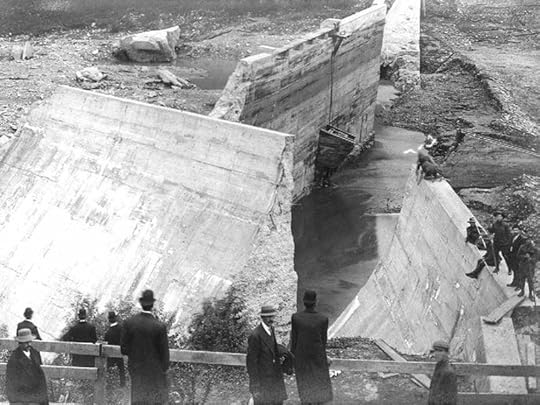
It's also worth noting that the Roulsville dam is based on the real life Austin dam. The Austin dam was also built inadequately and broke in 1911, destroying the paper mill below it, and flooding the town of Austin. The dam was rebuilt the year after this book was published and broke again in the 1940's.
Well-written for plotting and character development, this debut of teen sleuth Judy Bolton has social commentary, and more relatable realism than a Nancy Drew story, although the auburn instead of Titian, and the binding and gagging seem to be lifted from a characteristic Carolyn Keene novel. I was going to withhold comment about and comparison of the Shadow, a contemporary of Judy's for a different demographic, but his number one agent shares the name of an unseen character toward the end of the book. Convenient, or coincident?
I'm disappointed. The lesson here seems to be a poor one. Judy and Edna overhear a conversation between two workman about the new dam that has just been constructed by the lowest bidder. The workmen are afraid that the girls will tell someone about the conversation. Edna takes a bribe to keep quiet. Taking a bribe is wrong! Only a girl with no integrity would take a bribe!
But Judy has integrity. Judy doesn't take a bribe. So Judy is kidnapped and held prisoner by the workmen who give her no food or water until she promises not to tell. If the dam gives way because of faulty construction, the entire town of Roulsville will be wiped out, houses destroyed, people killed. But Judy has promised not to talk about their conversation. And, of course, keeping her promise to two criminals is more important than the lives of all the people in town. Because Judy is a girl with lots of integrity and about the same amount of common sense as a brick.
And let's not forget Judy's cowardly brother Horace. It's a poor lesson to teach children that the way to prove yourself is to do whatever the local bully tells you to do following the words "I dare you..." If Horace is a timid introvert or whatever, how in the world did he get a job as a newspaper reporter anyway? It makes no sense, particularly as it isn't relevant to the story. And no, it didn't have anything to do with Clark Kent because he hadn't been invented yet.
Based on this book, I have no idea why this series continued for so long and became so popular.
Another old-fashioned mystery series for me, but this one was published in the 1930s. I don't know much about it yet, but these were great favorites of my maternal grandmother. After she passed, my mom collected them and I have the collection now.
The only real thing I know about the series is that there are 38 (!) books in the series and, according to a print out my mom gave me of the various editions, the real pleasure is seeing Judy's large circle of acquaintances grow and mature within the series. So now I'm expecting this so it better be true! I will say, by the end of this book, I got a feeling that much like my recent 1980s-but-felt-older Inspector Thanet series, the relationships between people will be the best part.
Some 1930s shockers for this 2019 reader: they call Judy's brother Horace "sister" as an insult because he is such a "sissy woman" about things, Judy tells her brother "silence is consent" (oh man, Judy), and Judy is held hostage overnight but shockingly is not raped or harmed and, because she promises her kidnappers not to tell, they release her home again.
“Nothing exciting like this ever happens to me,” Judy Bolton thought as she turned the pages of the latest book in her favorite series.
Thus begins the first paragraph in the first book of the Judy Bolton Mystery series. That is, in the edition I have, which is the 1964 revision of the original 1932 version. The book was originally written as the first of a series called Melissa of Dry Brook Hollow, but when Grosset and Dunlap agreed to publish it, Margaret made many changes to transform it into the first of her new Judy Bolton series. As with all of her books, Margaret based at least one aspect of the plot on a real incident in her life. This one is based on a real flood that devasted the town of Austin, Pennsylvania when the dam burst. 78 died in that disaster when Margaret was 8 years old. In this novel, thanks to the heroics of Horace, Judy’s brother, only 3 men died. And those 3 men were villains whose criminal actions caused the dam to burst to begin with. So serves them right, I say.
But first, we meet Judy a 15-year-old student spending her summer in Dry Brook Hollow with her grandparents and brother Horace while her parents, Dr. And Mrs. Bolton are away on vacation and good for them. Judy is bored and lonely with only a girl named Edna to do things with. Horace is not the witty energetic courageous reporter he will become in subsequent books. He is frail and cowardly. His nickname is “Sister” or "Sissy". Judy wants little to do with him. Luckily for Judy and the reader, Judy does not remain bored for long.
First, she overhears an argument about the Roulsville dam between the workers who are building a new road between Farringdon and Roulsville where the Boltons live. The workers threaten Judy and her friend Edna and when Judy tells the truth about overhearing everything they said. They end up kidnapping our heroine and locking her in a nasty shed until she agrees to promise not to “speak” about anything she overheard. While Judy is pondering what the deal is with the dam and stressing about what to do about her promise not to tell what she knows or even that she was kidnapped, lots of not-boring things happen to formerly bored Judy. She has a big fight with Grandma Smeed who virtually stole Judy’s share of the spending money her parents left her and Horace to buy Horace a new suit. The Smeeds and Horace think Judy ran away in anger when in reality she was being held captive in the shed. She wins first place in the community Spelling Bee and is the Belle of the Ball of the party and dance afterward. She goes to pick blackberries but her too-frisky horse runs away with her and she almost collides with a moving train. She is rescued by a childhood acquaintance, Peter Dobbs, and he gives her a kitten she calls “Blackberry”. We also meet Arthur Farringdon-Pett, his sister Lois, and her friend Lorraine. These 3 will also become familiar characters in the series. I loved the way all of these characters are introduced for the first time and their future relationships foreshadowed. It is from architect Arthur, who is something of a hero in this book, that she learns that the dam is poorly constructed by a shady company and is in danger of breaking upon the next hard rain.
Although this book is not a favorite of many Judy Bolton fans, or indeed of Margaret Sutton herself, there is some excellent writing in this. There are some dodgy parts including Grandma Smeed's character, Judy not going to the authorities immediately when she learns about the dam, and Horace's over-the-top humility about his actions. But there are some genuinely terrifying and evocative descriptions, especially of Horace hearing the dam breaking, the flood, and his courage (although partially in spite of himself) in warning the citizens of Roulsville and saving thousands of lives. Judy is safe at home above the dam when she and her grandmother hear the terrible storm and rain approaching and hear the dam breaking. Her terror and guilt for Horace’s fate and her search for him is quite affecting. In the aftermath, Judy nails the criminals who are responsible for the tragedy. Horace’s reputation and indeed his character are forever changed by his heroic actions. By the end of the book, the stage is set for Judy’s new life and hopefully new friends and adventures in the neighboring city of Farringdon, since Roulsville as it was, is no more. **4 1/2 stars**
3.5🌟 Compelling and suspenseful with solid characters. This was my first Judy Bolton book and I thought it was pretty good. Because this story was loosely based on an actual event, it had more of a historical fiction feel to it.
Meeting the cast of characters in Judy Bolton's world was interesting and fun. I like Judy herself—she's such a smart cookie. I liked less the focus on her brother, Horace, and his being called a "sissy" and "coward" for a good part of the book.
The book portrays Judy as being more of a "real" person with faults, whims and misjudgement at times which, in my mind, is a good thing. I'm still very interested in continuing with this series and I'm hoping that the next book will have more of a cozy mystery style.
The Vanishing Shadow was written by Margaret Sutton and published in 1932. It is the first in the Judy Bolton mystery series. This was another one of those mystery series for younger audiences that were so popular during this time period ( I have a total soft spot for them). In this book Judy and her brother Horace go to stay at their grandparents house during the summer. While there Judy is getting bored and hankering for adventure, when she gets involved with a mystery! There’s a new dam that has been built, but there’s something fishy about it. Something that could cause irreparable harm if Judy and her friends don’t act fast to save the day.
I read a few of the Judy Bolton books as a teenager when I found some copies in a used book store ( sadly they were lost in a move at some point). I really wanted to read all of them and in order. This was my first time reading this first installment in the series. There’s something unique about the Judy Bolton books compared to other similar series at the time. Judy ends up aging as the series goes on for one. I also feel like these aren’t so ‘cookie cutter’ in their plot. It was a fun mystery, but yet the characters came to life more. There was more meat to the story. More life. Some of the things that happened in the book were actually quite serious. I have a feeling that the Judy Bolton books are going to be an all time favorite when I finish the series.
I adored the characters. Judy was so great. So plucky. Smart. A good heart, but also quite flawed. Her brother Horace had a lot of character growth. He starts out rather meek and scared of life and ends up becoming quite courageous and saving the day. The one thing I didn’t like about that however, was that everyone kept calling Horace ‘sister’ and ‘sissy’ just because he was a sensitive boy earlier in the novel. That was the one thing I didn’t like about this book. Judy’s new friends were all fun too and I wonder if they’ll show up in later books. I know a boy named Peter Dobbs ends up becoming her love interest, which I will love to see develop.
Overall this was such an enjoyable read! I highly recommend if you like mystery series for younger audiences from the golden age of mysteries such as Nancy Drew, Hardy Boys, Trixie Belden etc.
Judy Bolton is the daughter of a small town doctor. She's something of a headstrong girl, who sniffs at the dangers of riding a semi-tamed horse, and once ran off in a temper and stayed at a friend's overnight without telling her family. But she will not break a promise, no matter how it was extracted. She has a close but not unproblematic friendship with her brother, who was sickly as a child and as a result is inclined to be cowardly (earning him the name "Sister" from colleagues).
Reading a book written in the 1930s can be a hit or miss affair. Some are timeless, with characters so clearly defined and beautifully themselves that they will be loved for centuries, and some are so bound in the social expectations of another age that they jar on modern sensibilities. The description of this series tells me that to many "Judy is a feminist in the best light - smart, capable, courageous, nurturing, and always unwavering in her true beliefs - a perfect role model."
Judy Bolton drove me insane.
Fearless, yet inclined to shriek. Smart, yet a simple solution to a problem keeping her silent does not occur to her for half the book. Practical, but naive to the point of idiocy. I soon grew so impatient with Judy that I could barely keep reading.
I feel really bad giving this one single star since I have NEVER given ANY book that rating before, but this was not good at all. The writing was so poor, I just don't understand how it went on to be such a long running series. Loving Nancy Drew, I was really excited to give it a try since Judy Bolton is her rival, but truly the writing doesn't even compare. As for the characters, they're NOT lovable in the least, specifically Judy herself. She's treats her brother horribly! I was choking on some of the things she said to him. The relationship she has with her grandparents is uncomfortable, and the town feels very right wing/religious/weird. The mystery itself was decent, and perhaps Margaret Sutton's writing got stronger as the years went on, or perhaps she got herself a new editor, or perhaps I'm just being hopeful. I cant imagine sitting through another book, but there's something nagging at me to try one more since there were so many. If you're a Nancy Drew fan, I'd say give this a try just so you can say you did, but don't expect it to be as good as Nancy Drew. Also check out the Penny Parker series written by Mildred Wirt, the original writer of Nancy Drew 1-10 & 12 ( I believe).
A pretty good series opener with lots of action and drama, with a fairly obvious mystery, even for a preteen reader. To me, an interesting subplot is Judy’s brother being teased as a “sissy” — this doesn’t seem tied to traits that today might be called “gay” or then, “effeminate” or “light in his loafers.” It’s tied more to him being considered a coward and afraid of being too active. (He’s presented as having been “sickly” as a boy and thus “spoiled” by his mother.) I’m curious why this has been introduced. At this point it seems that it’s to highlight/contrast Judy’s daring and attraction to adventure. Maybe I’m reading too much into it with my 2022 brain, lol. I know from later books that this trait of her brother’s is referred to in past tense, to contrast with his current adventurous spirit, similar to his sister’s.
I will begin with the book, itself. It was published by Applewood Books, the same company that brought back the original Nancy Drew Mysteries. It seems to be of very good quality, for a paperback. The cover is glossy & the binding is solid. After one reading, there are no visible creases in the spine. The pages are made of quality paper. There are several illustrations featured throughout the book. They are a little dark but are otherwise clear & easy to make out.
This is the first Judy Bolton Mystery that I've read. The story moves along at a good pace & Judy is a likeable heroine. She is, of course, brave, adventurous, curious, & intelligent. She did not do quite as much investigating as you would find in a Nancy Drew Mystery. Perhaps that changes further into the series as she gains more experience as a detective.
This book is based on real events as are, according to the author, all of her stories. It was published in 1932 & I assume that the story is probably set during the late 1920's. I am in my mid-twenties, so I did not grow up during the time that this story is set. I did not find it or the language used to be too old-fashioned. It is true that not everyone, in the story, has a car & many still ride horses or use carriages. I did not find that to be off-putting at all. I grew up reading Nancy Drew Mysteries & I think I would have enjoyed this series, as well, when I was a child.
Judy Bolton, in my opinion, has more wit and realism than Nancy Drew. With this being said, I'm not saying I don't like Nancy Drew--because the first say twenty books of ND are very interesting. Unlike Nancy Drew, Judy Bolton matures and grows older in each book. Judy Bolton also has in continuance the same personality, due to there being just one author. Nancy Drew changes personalities to a degree, as "Carolyn Keene" is actually a pen name of several authors.
Judy Bolton has a brother named Horace, who in the first book has a timid and slightly effeminate attitude. Judy constantly teases him about this and in the end Horace grows up and does something of a heroic nature. He is no longer teased and turns into a fine man of the occupation of a newspaper reporter. Judy's dad is a Doctor and helps Judy in her cases when advice of medical affairs is in need. Mrs. Bolton, her mother, doesn't do to much, but nevertheless is very nice and compassionate. And I mustn't forget Peter, who is about five years older than Judy and is a longtime friend of her. He helps her in her cases.
The mysteries are well written, although perhaps a few are not in deserving of being named supreme. I highly recommend this series and hopefully later I will finish them all.
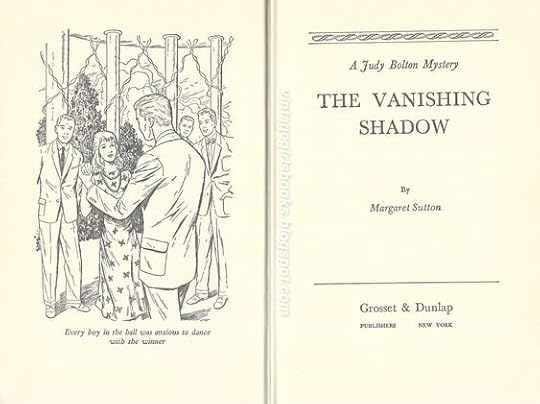
JUDY BOLTON is an olden days classic series, although this is the first time I have read it. Found it rather tiresome. The ongoing question: is Judy's younger brother a "coward" or "sissy" ? I guess it would be the end of the world if people thought your younger brother was a "sissy." I did not like the co-ed dance: "Judy was being whirled around and around. Every boy in the hall was anxious to dance with the winner." The author wrote this book based on the Austin, PA flood of 1911. In the real flood, almost 100 people died. In this book.... spoiler, I won't tell! After reading this Judy Bolton book I am reconciled to "Swallows and Amazons" which I previously criticized. Between the two I like S&A much better. There are no cowards, sissies or coed dances, and the story seems to have more of a timeless quality.
I'm currently reading Margaret Sutton's manuscript titled "Melissa of Dry Brook Hollow" which later became known as The Vanishing Shadow...book one in the Judy Bolton series. Since this is published by the author's estate, it's not a well known book and I can't find it when I search goodreads. I'm on ch 7, and although it's quite different than Vanishing Shadow, there are similarities and the author has introduced the same characters that are in the Judy Bolton books. In Melissa of Dry Brook Hollow, Melissa's family is very poor, and her dad is a farmer and not a doctor. And her brother Horace is a student and wanting to become a preacher instead of a newspaper reporter.
I was introduced to Judy Bolton in the 1950s and I have loved her ever since. When I got married and moved away, I left my books behind and they were given away. Several years ago I started buying them back. It's hard to find the ones written in the 1960s.
I love Judy's curiosity and her sixth sense about mysteries. Sutton devised plots that usually introduce Judy to a new friend while she solved ghost stories, tales of treasures in hidden trunks, family secrets, and always with her cat Blackberry by her side. Nancy Drew could never compare to Judy Bolton.
Alas that I did not read these sooner, after Nancy Drew had made me sceptic of any girls mystery series other than Trixie Belden! Unlike Nancy, who never changes, ages, marries, and is perfect at Everything she puts her hand to, Judy grows, falls in love and marries, and, (if what I'm seeing on the covers is what I think it is), has children! All while solving unique and intriguing mysterys!
The Vanishing Shadow, 1932, is the first of Margaret Sutton's Judy Bolton series. I enjoyed the escapades, the innocence and the naïveté of the young people in the novel, who seemed totally unaware of the chaos in the greater world of the late '20's and 30's. It was great to be lost in a world where crime doesn't pay and the good survive misfortune to move on to new adventures.
I'm starting a Judy Bolton reading group all of my own. Quick reads, of course, but bring me back to my childhood. I had forgotten how weak Horace was in this first book. It was nice to see how Judy met all the people who continue on in the series. These are so different from the children's books written today.
Pretty good, though the mystery itself wasn't that interesting or captivating, and it really bothered me how everyone treated Horace (including himself) for not embodying stereotypically masculine traits. I may or may not read more in the series.
The book ended up being pretty good. It was definitely a lot different than a Nancy Drew book. Not everyone is perfect. It's been a while since I finished it, though, so I'm not remembering enough to do a detailed review on it.
Haven't read my Judy Bolton collection for over 20 years, so I thought I'd re-read them. Just as good as I remember. Love all the "gees!" and "golly" and the words describing Judy like "spunky." Loved these books so much more than my Nancy Drews.