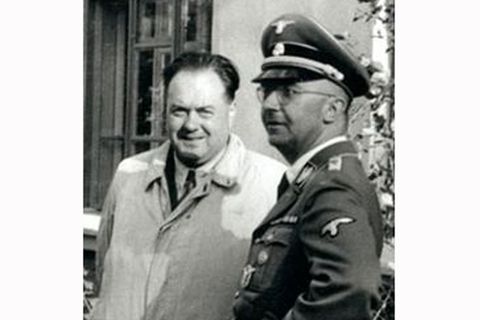
Physician to the high-demon of the Third Reich, Heinrich Himmler. Kersten could alleviate Himmler's severe stomach pains with his hands using massage and manipulation. In return, Kersten bargained with Himmler to order the release of innocent prisoners condemned to die.
Joseph Kessel was a French journalist and novelist. He was born in Villa Clara, Entre Ríos, Argentina, because of the constant journeys of his father, a Lithuanian doctor of Jewish origin. Kessel lived the first years of his childhood in Orenburg, Russia, before the family moved to France. He studied in Nice and Paris, and took part in the First World War as an aviator.
Kessel wrote several novels and books that were later represented in the cinema, notably Belle de Jour (by Luis Buñuel in 1967). He was also a member of the Académie française from 1962 to 1979. In 1943 he and his nephew Maurice Druon translated Anna Marly's song Chant des Partisans into French from its original Russian. The song became one of the anthems of the Free French Forces.
Joseph Kessel died in Avernes, Val-d'Oise. He is buried in the Cimetière de Montparnasse in Paris.
The Man with Miraculous Hands by Joseph Kessel is the story of a Russian born, Finnish citizen named Dr Felix Kerston. He used Chinese massage to alleviate pain in his patients, one of these patient’s was one of the biggest monsters of all-time. The man in charge of the SS and the Gestapo, the man responsible for Nazi Concentration Camps, responsible for the death and torture of millions and a part of Adolf Hitler’s inner circle. Heinrich Himmler.
Dr Kerston used manual manipulation to alleviate the disabling pain experienced by Himmler, this pain rendered him helplessly immobile. Himmler had tried conventional medicine to no avail, Dr Kerston was able to relieve Himmler’s pain instantly. This made Kerston indispensable to Himmler, he was essentially permanently on-call. Himmler considered him a friend – possibly his only friend. During their sessions over the years, Himmler was incredibly open and frank with Kerston. The good doctor also was able to befriend Himmler’s private secretary – Brandt – which was very useful.
Dr Kerston and Himmler
Kerston was able to use his influence and ‘friendship’ with Himmler to secure the release of many, many prisoners held in camps or prisons. He was also able to secure favourable treatment for many other victims of the Nazi crime machine. These details were extracted from Dr Kerston’s diary.
This is a fascinating inside look at the way the Nazi hierarchy viewed the world, also of how Himmler’s mind worked and his obsession with pleasing and following Hitler. There have been some reports that Kerston’s impact has been somewhat exaggerated – and I did find it interesting how his this account recorded what Himmler was thinking at times – but even if only 50% of what Dr Kerston claimed to influence was true, he saved numerous lives. I think, to be fair, his impact was significant, his efforts are well-documented and involved the cooperation of other significant parties – such as the Finnish Government of the day – and they could easily dispute his claims if untrue.
An excellent read for those interested in this shameful period of human history. This book has given me reason to spend some time watching various movies like The Pianist and Inglorious Basterds, I think I’ll keep watching more material of this period for a while (again). Also, Woody Harrelson will be starring in an upcoming movie of this story.
Many thanks to NetGalley for providing me a copy in exchange for my review.
Chcela by som učiť deti literatúru. Rozprávať sa s nimi o knihách, nepísať suché poznámky z učebníc, ale hovoriť o románoch, ktoré by sme spolu čítali a prepájali tak predmety. Keby na dejepise preberali druhú svetovú vojnu, čítali by sme Josepha Kessela a jeho knihu Muž so zázračnými rukami.
Román je o vzťahu lekára Félixa Kerstena a jeho výnimočného pacienta Heinricha Himmlera, s ktorými sa fyzioterapeut pôvodom z Estónska, dušou Švéd a srdcom Holanďan spoznal v poslednú mierovú jar v roku 1939. Odvtedy ho liečil svojimi rukami, masíroval jeho svaly, ktoré boli ochabnuté a telo spustošené chorobami. A Kersten ich stretnutia využíval na to, aby zachraňoval ľudí odsúdených na smrť pre ich pôvod.
„Ráno, čo ráno sa Kersten znova púšťal do boja za spásu ľudí, ktorí zomierali v táboroch,“ píše Kessel. Jeho román nie je preplnený informáciám, ťažisko je na osobe lekára, ktorý si za päť rokov získal dôveru a priateľstvo, aké Himmler nedoprial nikomu inému. Jeho rozprávanie je miestami neskutočné a silné. Pri kapitole o tom, ako sa vďaka Kerstenovi transport s 2700 Židmi otočí z východu do Švajčiarka som sa plakala.
Toto je kniha, ktorú by sme si mali prečítať, aby sme o druhej svetovej vojne vedeli viac ako len dátumy, názvy vojenských operácii a prehraté bitky. Toto je kniha so skutočným príbehom o človeku, ktorý si počas jedenej bezsennej noci dal sľub, že bude zachraňovať ľudí zakaždým, keď sa mu naskytne príležitosť.
„Ako v takýchto podmienkach dúfať, že sa vo vodcoch takého neľudského režimu pohne ľudskosť? Ako pomyslieť, hoci len na okamih, že z koncentračných táborov sa dajú vyslobodiť muži a ženy, ktorí sú pre Hitlera, Himmlera a ostatných nacistických veliteľov rebelmi, zradcami, svätokrádežníkmi, Židmi? Ako toľkej necitlivosti a pohŕdaniu vytrhnúť obete, ktoré dozorcovia z SS považujú za mrciny, hoci ešte dýchajú?“
I was forced to add a review of this mendacious, self serving farago of misinformation delusional grandstanding when I discovered that a new English language print edition came out in 2023 and that it was bought for the London (UK) library system. Felix Kersten was a liar who did nothing except, post war, seek to burnish his reputation with the help of various royals from the Netherlands and Scandinavia with fraudulent claims of helping rescue not simply thousands of Jews but the entire population of the Netherlands. Lies, all lies.
Please ignore the mountain of credulous writing this blowhard has attracted and read the section on Kersten in Ian Burman's 'The Collaborators, Three Stories of Deception and Survival in World War II'. It is a scandal that scarce resources are spent putting this book into libraries. It is even more scandalous that people continue to promote this odious little toady as a great humanitarian when those who did extraordinary, risky things, often at the cost of their lives (please see Martin Gilbert's 'The Righteous') are unremembered.
There are two books that I've read that have blown my mind and this is one of them. It's written so well. It's a view point I had never known about or considered. It's about the relationship between Heinrich Himmler and his personal physician Felix Kersten. It's an amazing story and everyone should know it. Dr. Kersten is an amazing human who took the most horrible job in history and turned it into a rescue mission. I would highly recommend it.
Un livre absolument hallucinant sur un destin bien trop méconnu de la seconde guerre mondiale. Le style est très documentaire, j’aurais peut-être préféré plus de romanesque encore, mais ça n’empêche pas le lecteur de vibrer autour des enjeux colossaux des décisions de Kersten. Une vraie découverte.
Nepoznala som osud a životný príbeh doktora Félixa Kerstena. Muž, ktorý dokázal nemožné len svojimi rukami... Svojimi vynikajúcimi masérskymi skúsenosťami, fyzioterapeutickými znalosťami ovplyvnil Heinricha Himmlera, ktorý trpel bolesťami brucha a popri liečbe od neho získal slobodu a milosť pre mnohých. Narodil sa v Estónsku, žil vo Fínsku, Holandsku, Nemecku a Švédsku. Vyštudoval fyzioterapiu a učil sa od čínskeho majstra tibetských liečebných masáží, neskôr viedol medzinárodnú prax. A takto sa dostal aj do Nemecka a priamo ho odporučili k šéfovi gestapa a vojenských zložiek. Získal si dôveru jedného z najvyšších veliteľov Tretej ríše a svojím umením sa stal osobným lekárom HH. Pomohol však zachrániť deportácii miliónov Holanďanov a takisto bol pri zrode dohody, ktorá zabránila zničeniu koncentračných táborov pred oslobodením spojeneckými vojskami. Nechápem, vôbec nič som o ňom nečítala... a pritom všetko je podložené reálnymi dokumentami. Odporúčam, ak si chcete rozšíriť vedomosti o 2. svetovej vojne z pohľadu osobnosti, ktorá milovala jedlo a ženy a svoju prax.
On pense avoir tout lu sur la seconde guerre mondiale, dans tous les sens et de tous les côtés, et puis on tombe sur cette pépite. Au delà de l'écriture et des sujets abordés par Kessel, toujours pertinents, ce roman (re)donne foi en l'espèce humaine au travers du docteur Kersten. A lire en ayant en tête qu'il s'agit d'une histoire réelle.
Espectacular, toda una revelación. La mezcla perfecta entre una trama increíble y una construcción impoluta. Empiezo a estar un poco cansada de los relatos sobre la segunda guerra mundial pero al leer este libro me di cuenta de cuántas cosas desconozco todavía sobre este episodio tan negro de nuestra historia reciente. Y cuántos episodios, cuántos personajes interesantísimos me quedan todavía por descubrir. Es increíble que la historia del doctor Kersten no sea mundialmente conocida. Es injusto que el mundo no sepa cuántas vidas consiguió salvar. Es cierto que, como Kessel nos advierte al principio de la novela, en ciertos pasajes el lector se ve tentado de creer que lo que se cuenta no es más que ficción. Y, sin embargo, el autor nos asegura que todo se basa en pruebas fehacientes. Un libro muy bien escrito, que no se hace en absoluto pesado a pesar de todas las notas históricas que introduce para situarnos. Los personajes están muy bien desarrollados, Kessel retrata al detalle la psicología de cada uno de ellos. Tanto, que por momentos llegamos a comprender e incluso a sentir pena o ternura por Himmler. Uno de mis nuevos libros favoritos. Sin duda.
Fascinating and often unbelievable récit of the influence Félix Kersten had on Himmler during the war. I can't believe this/he is not more widely known about, and had to independently fact check through the book. Incredible. Sobering. Absorbing.
3,5 L’histoire est complètement crazy c’est dingue que personne ne connaisse cet épisode de la 2de Guerre mondiale Mon seul soucis c’est qu’en vrai une fois que t’as capté l’idée et le mécanisme le récit perd un peu de son intérêt ça peut devenir parfois un peu répétitif mais le livre reste intéressant et puis c’est pas très long donc on s’ennuie pas non plus Je pense que limite j’aurais préféré un truc très factuel et historique plutôt que le format roman même si c’est évidemment très documenté Je reco qm
Very interesting story. Clearly not 100% accurate, but no doubting the events occurred and that he may have assisted in saving lives, but not to the extent he tries to portray. The forward said as much, and after doing some fact checking, I found it was the case.
Still a very easy read and entertaining enough if you can decipher where fact stops, and fiction begins.
L'histoire est extraordinaire, je n'en avais pas entendu parler avant que le collège ne donne ce livre à lire à ma fille. Kessel nous plonge au cœur de l'action, c'est captivant.
On m’a vivement recommandé ce bouquin et je dois admettre en être plutôt déçu. Les faits décrits dans ce livre, sur les miracles réalisés par Félix Kersten, paraissent invraisemblables, et d’après quelques recherches préliminaires, semblent l’être pour de bonnes raison.
Bien que facile à lire, cette histoire finit par être plutôt ennuyeuse et répétitive, avec un Himmler qui vacille entre délires idéologiques et tourmentes abdominales mais sans aperçus dans la psychologie de l’homme qui devrait être facile à rendre fascinant dans le mal absolu qu’il incarne.
Je suis certainement influencé par le film sur la collaboration « Les Rayons et les Ombres » que je viens de voir, mais je ne peux pas m’empêcher de penser à Jean Luchaire lorsque Kessel décrit un homme qui « sut profiter des dispositions » d’Himmler en s’octroyant une vie de gourmandise, luxe et privilège en étant le masseur d’Himmler. Je ne doute pas qu’il ait eu un véritable impact sur le secours de milliers de personnes, mais je trouve que ce portait si unidimensionnel de Kersten (mais aussi des autres protagonistes) remet l’entièreté des bonnes actions revendiquées en cause.
" Hitler l'a dit. Il y a trois catégories d'êtres : celles des hommes, celles de bêtes et celles des Juifs. Et ces derniers doivent être détruits pour que les deux autres puissent exister " C'est sur ces paroles d'Himmler que nous nous rendons compte de l'emprise des idées d'Hitler sur le peuple allemand.
J'ai adoré en savoir plus sur Kersten, un héros oublié du monde, alors qu'il a durement œuvré pour sauver des milliers d'hommes et de femmes des griffes des nazis.
Not entirely sure how accurate all the content is, but very amusing to think about an overweight doctor clapping back at Himmler. The good doctor was also not a Ribbentrop fan (shock), and was “dismayed to see such a stupid man holding such an office.”
This type of literature is peculiar ; it helps us grasp the dilemmas and realities of this period even more deeply than a straightforward, pragmatic essay could.
5/5 - un très grand roman de Joseph Kessel, où l'on découvre l'histoire incroyable - au sens littéral du terme - du docteur Kersten. C'est un livre psychologique, que l'on suit depuis les pensées du docteur, dans des scènes parfois surréalistes et merveilleusement bien décrites par Kessel. On suit un dilemme entre la fuite et l'abnégation, et on ne peut s'empêcher de se demander ce qu'on aurait fait à la place du docteur. À lire absolument !!
Histoire absolument fascinante et complètement incroyable. L’écriture de Kessel est vraiment superbe et rend le récit très prenant. Il permet de comprendre de l’intérieur comment fonctionnaient les rouages du régime nazi et la folie du cercle restreint. Un must read !
I am going to have to disclaimer the heck out of this review. Which is fair because the foreward of the book is a giant disclaimer.
First, this is a re-release of a book which was published in 1961. Second, the title character, Felix Kersten, was part of the Nazi war machine but also kind of not. He was definitely Himmler's physician. Third, Kersten definitely saved lives but also exaggerated excessively about how many he saved. Finally, he claimed to not benefit from being a Nazi and that he was forced into it.
Got all that? Ultimately, the foreward of the book does an excellent job explaining all of this and making the case the book is still important. We get a look at the Nazi inner court and Kersten may be a liar, but he also was at least partially a hero. Scholars agree he saved lives. How many is still very much up for debate.
Where does this leave the story? Joseph Kessel, the author, clearly was taken in by Kersten. He tells a fawning story which very much excuses Kersten for collaborating. Is it fair to judge a book from the 1960s with our expectations today, though? It doesn't ask tough questions about inherent benefits. It does not do good enough scholarship to catch Kessel in his lies. It does, however, give us a glimpse at the workings of one of the most vile humans to ever live in Himmler.
Ultimately, I couldn't recommend this book but I would not say it is without merit. If you want to know everything about World War II then it may be worth it.
(This book was provided as an advance copy by Netgalley and Elliott & Thompson Books.)
Amazing true story of the private doctor of Himmler, Hitler's righthand man. He becomes Himmler's confidant while treating the debilitating pain that he often has due to intestinal problems. He finds ways to talk Himmler out of plans that would have killed millions - including forcing everyone in Denmark to walk to Poland (resettling Denmark with Germans), buying up the food on the French black market to starve the French and feed Germany, blow up all of the concentration camps before the allies could find them, and many others. He also negotiates the release of tens of thousands of political prisoners and Jews, sometimes one at a time and as groups. An inside look at the madness of the Nazi regime, and someone who gained their trust in order to temper their policies - and had to survive at least one assassination attempt from zealots who didn't like the impact he was having. Makes you wonder about other crazy plans that the Nazis had that we never heard about. Could be a great movie someday. BTW this is in French, don't know if it has been translated.
"...il arrivait que je refusais d'accepter certains épisodes du récit. Cela ne pouvait pas être vrai (...). Il sortait simplement avec un demi-sourire, une lettre, un document, un témoignage, une photocopie. Et il fallait bien admettre cela, comme le reste". Ces quelques mots tirés du prologue au roman de Joseph Kessel concerne un homme bien peu connu de l'histoire, au regard des exploits qu'il aurait accompli pendant la Seconde Guerre mondiale. Cet homme, et ses Mains du miracles dont il est question, c'est Félix Kersten. Une bande dessinée en deux tomes, qui m'était un peu tombée des mains il y a quelques années (le dessin ne me plaisait pas), avait bien peu excité ma curiosité. Je laissai donc cela dans les rayons de mon vendeur favori et oubliai cette histoire, jusqu'à la découverte dans un vieux carton de cette édition ancienne. La suite ici: https://pagesdhistoires.blogspot.com/...
La vie de Kersten est peu connue et mérite de l’être tant elle est improbable et passionnante. Mais là où l’Histoire lui reconnait le sauvetage de quelques milliers de vies (ce qui est énorme), le livre en indique des millions. Là où Kersten a dû tirer des ficelles politiques ne serait-ce que pour se maintenir aux côtés d’Himmler, le livre ne décrit que des massages. Là où Kersten n’a pas pu être irréprochable, le livre présente un bonhomme enveloppé et sympathique. Bref, c’est un roman que Kessel propose ici et non une oeuvre de journaliste. En tant que grand résistant devant l’éternel, il n’a peut-être pas pu décrire un environnement gris pour ne pas détruire l’image des résistants. Pourtant la vie de Kersten a dû être faite de gris. Il est toujours dommage qu’un livre historique laisse place à l’inexactitude, qui remet en cause la véracité du reste. Pourtant le récit reste assez fascinant et se lit facilement
The Man with Miraculous Hands is an excellent historical book. We get to know the biography of the excellent doctor Felix Kersten. He was Heinrich Himmler's masseur. With his miraculous hands, he helped Himmler relieve pain. Let me tell you, he was playing with fire. Kersten's life has been in danger more than once. He had many friends, but also many enemies. He tried to rescue Jewish prisoners from the camps. How did he do it? Was his mission successful? What did Himmler say about all this? I encourage you to read this amazing book. Thanks to her, I learned new information about World War II. I am delighted with this biography.
4,5 - Vraiment fascinant. Au final, il ne se passe pas grand chose, mais j'ai tout de même été happée par le récit. C'est comme une partie d'échecs très bien écrite! C'est d'autant plus intéressant que c'est une histoire vraie.
Krásna kniha o liečiteľovi Himmlera ktorý pomohol tisíckam ludi uniknúť pred smrťou. Koncentračné tábory sa spomínajú len veľmi jemne ak by ste na tuto tematiku nemali žalúdok.. treba prečítať!